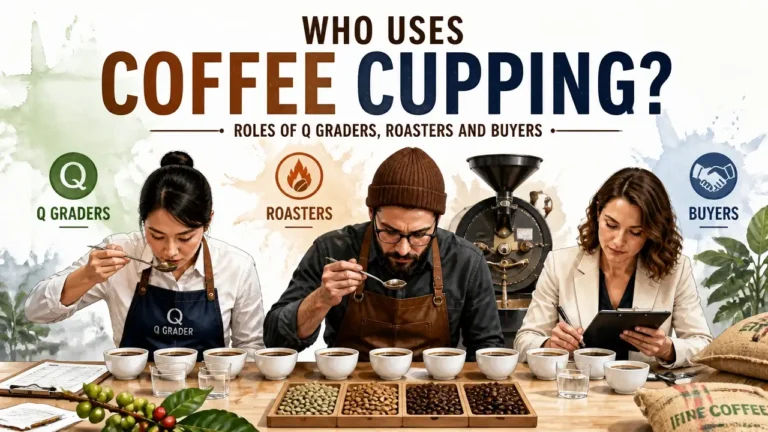

Professional coffee cupping isn’t a single job – it’s a skill that shows up in at least six distinct career tracks, from a Q Grader certifying origin lots in Colombia to an ICE grader settling futures contracts at a port warehouse in New Jersey. The Coffee Quality Institute credential that most people associate with “cupping as a career” is one entry point among many.
What unites every role is this: at some point in the supply chain, a human being has to put their nose over a bowl, slurp, and make a call that matters. The career question isn’t whether to cup. It’s which version of that moment you want to live every day.
Key Takeaways on Who Uses Coffee Cupping
- Q Grader certification from CQI validates calibrated scoring to SCA standards, but it’s a qualification, not a job – practical experience determines how far it takes you.
- Production roasters cup daily to catch roast defects and batch deviations before they reach customers, often without Q certification.
- Green buyers face the highest-stakes cupping work: 20-40 samples per session, with financial consequences attached to every decision.
- ICE graders evaluate commodity coffee for futures contract compliance – a finance-adjacent cupping career that most specialty coffee aspirants never consider.
- Published cupping parameters diverge across institutions, meaning calibration is a portable, adaptable skill rather than a fixed protocol you learn once.
- The cupping career that fits you depends more on your tolerance for daily repetition, pressure type, and lifestyle constraints than on which role sounds most impressive.
What a Q Grader Actually Is – and What It Isn’t
Q Grader certification is the highest formal credential in specialty coffee sensory evaluation, issued by the Coffee Quality Institute (CQI). It validates one specific thing: that the holder can cup and score coffee to international specialty standards using SCA protocols, consistently enough that a trading partner halfway around the world can trust the number on the form without being in the room.
The exam is not a single test. It’s a multi-day gauntlet covering sensory skills, roast defect identification, triangulation (detecting the odd-one-out in sets of matched coffees), and scoring calibration across multiple cupping flights. Candidates must demonstrate that their scores land within a defined range of the standard – not just that they can taste, but that they taste predictably.
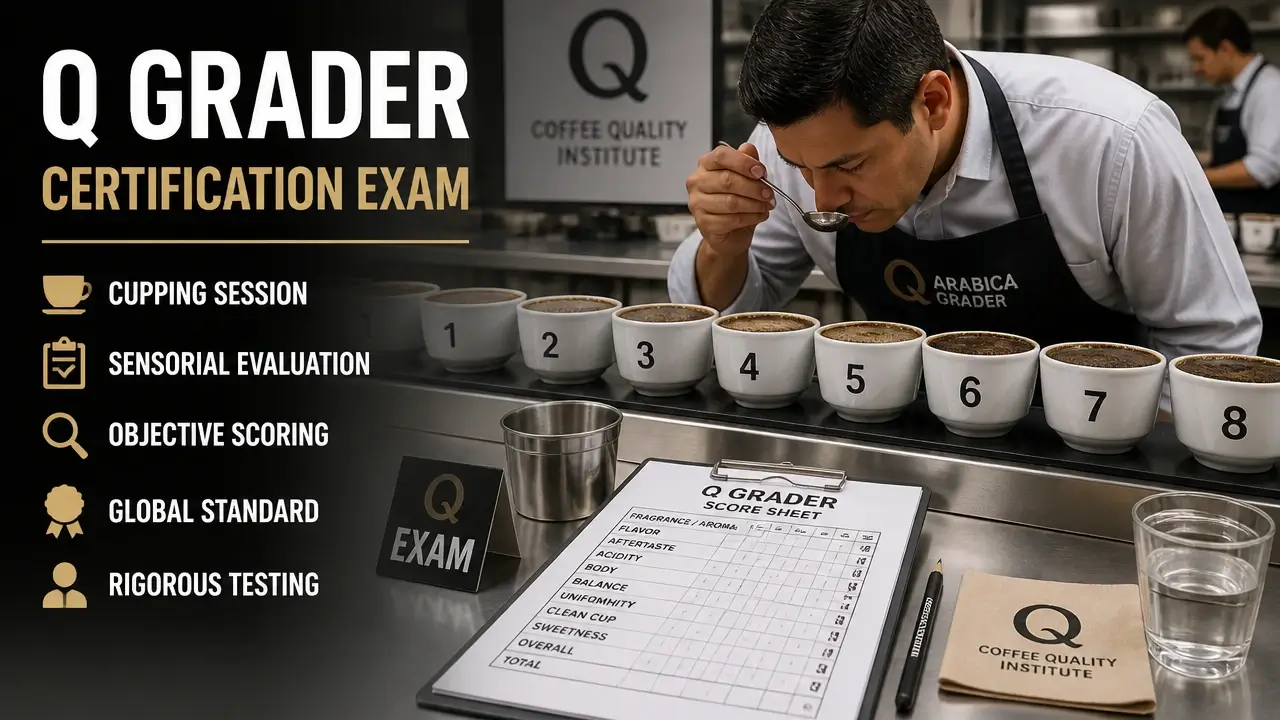
Q Graders work across every node of the supply chain. You’ll find them in quality control labs at importing companies, on the cupping tables of specialty roasters, at origin evaluating producer lots before export, and inside certification bodies that need a universally trusted scoring framework. The credential functions as a common language. When a Q Grader in Dubai and a Q Grader in São Paulo score the same coffee within a point of each other, the trading relationship between those two markets becomes more reliable.
That said, the Q credential is not a job title. It’s a qualification – one that signals calibration reliability but doesn’t replace the practical experience of reading markets, managing producer relationships, or running a roasting program. Many people cup professionally every day without it. The Q certification’s real value is that it removes a question mark for partners who can’t verify your palate firsthand.
Dulce Barrera, a Q Grader and International Coffee Cupping Champion who manages coffee quality for her organization, describes how the credential transformed her practical impact: the precision it built allowed her to trace quality problems back to their source at the farm level, giving producers specific, actionable feedback that led to measurable improvements in their coffee.
This is the detail that separates a Q Grader from someone who simply cups well. The credential doesn’t just measure your ability to score a coffee – it builds a diagnostic framework. When a lot comes back with a flaw, a calibrated Q Grader can distinguish between a processing defect and a roast defect, between a transport issue and an origin characteristic. That specificity is what makes the feedback useful to a producer rather than discouraging.
Frankie Volkema, a Q Arabica Grader, points to something most certification discussions skip: the training creates a sensory foundation that persists even through breaks in practice. Step away from regular cupping and come back months later – the calibration holds in a way that self-taught tasting rarely does.
The mechanism behind that durability is worth understanding. Calibration isn’t just about taste memory. It’s about having a structured protocol and vocabulary that anchors your perception to a shared reference system. Without that anchor, a taster’s scores drift relative to their own recent experience. With it, they drift relative to an external standard – which is a much smaller and more correctable error.
Camila Khalife, a Q Arabica Grader and co-founder of Botánica in Ecuador, frames professional cupping development as fundamentally introspective: understanding your own sensory world – what conditions, biases, and states affect your perception – is as important as the protocol itself.
And Dr. Mandappa IM, Divisional Head of Coffee Quality at the Coffee Board of India and a Q Arabica Grader, captures why the credential travels so well across institutional contexts: it’s not about personal taste preference. It’s about adopting a globally understood quality language that lets institutions across the entire value chain communicate without ambiguity.
The career reality: Q certification opens doors in specialty coffee trading and quality assurance that would otherwise require years of relationship-building to access. But it is a starting point, not a destination. The professionals who build lasting careers around it treat the credential as the floor, not the ceiling.
How Roasters Use Cupping for Roast Development and Daily QC
Roasters use coffee cupping as an operational tool, not a credentialing exercise. For a production roaster in a specialty operation, cupping yesterday’s roasts before the day’s production begins is standard practice – as routine as checking equipment calibration or reviewing batch logs.
The workflow follows a predictable structure. Sample roasting comes first: roasters pull small reference batches from green lots under evaluation, roasted to a consistent light profile so the green coffee’s character is legible. Then comes production cupping: evaluating actual roasted batches against the target profile to catch deviations before they reach customers. Blend component assessment runs alongside this – cupping individual origins separately and in combination to dial in ratios.
What roasters are specifically hunting for: roast defects like underdevelopment (grassy, cereal-like flavors from insufficient heat application), tipping (scorched bean tips from excessive initial heat), and scorching (direct contact with a drum surface that’s too hot). They’re also tracking flavor development – whether the roast brought out the green coffee’s potential or flattened it – and batch-to-batch consistency that customers can rely on.
Cupping results change decisions directly. A roast that cups flat may prompt an adjustment to the curve’s development phase – more time, slightly lower temperature – to coax more sweetness out of the same green coffee. A batch that shows tipping triggers an investigation of drum temperature at charge. A blend component that’s reading too bright relative to its partners shifts the percentage. The cup is the feedback mechanism for the entire roasting program.
For a deeper look at how cupping improves quality control across a roastery’s full operation, the mechanisms go well beyond defect detection – cupping shapes purchasing decisions, customer communication, and product development simultaneously.
Carolina Gutierrez, Q Grader and Production Development Manager for Três Marias Coffee Company in Dubai, makes the purpose of sample roasting precise: the protocol exists to expose the coffee fully to observation, ensuring that any faults or flaws surface rather than hide behind a development profile that masks them.
This is the principle that separates cupping-for-evaluation from cupping-for-enjoyment. A darker roast can make a flawed coffee taste acceptable to a casual taster. A light, standardized sample roast strips that cover away. The roaster who cups their own production at the sample roast level sees problems their customers will never notice – and catches them before those customers have to.
The expertise threshold here is worth stating clearly. Production roasters need sufficient calibration to detect subtle defect signatures and flag meaningful deviations from their target profile. Q Grader certification is valuable but not universal in roasting roles – many excellent production QC programs run on internally calibrated teams using consistent protocols rather than externally certified scores. What matters is that the internal standard is defined, defended, and applied consistently.
Here’s where the “universal standard” narrative gets complicated. Across training institutions and professional roasteries, published cupping parameters diverge in ways that produce genuinely different extractions. Water temperature varies from 92°C to 95°C. Coffee-to-water ratios range from 1:16 to 1:20. Steep times split between 3 and 4 minutes – a 25% difference that changes extraction yield measurably. No single authoritative source reconciles these variations publicly.
This means every roasting operation must define and defend its own cupping parameters rather than simply deferring to a mythical universal standard. The roaster who understands why their operation uses 4 minutes at 93°C versus 3 minutes at 95°C can troubleshoot intelligently when results conflict with a trading partner’s assessment. The roaster who follows a protocol without questioning it cannot.
The Green Coffee Buyer: Cupping When Money Is Actually on the Line
Green coffee buyers use cupping under conditions that roasters rarely face: dozens of samples in a single session, financial consequences attached to every decision, and the knowledge that a wrong call on a container can cost tens of thousands of dollars and damage a producer relationship that took years to build.
The buying context structures cupping into three distinct decision points. Pre-shipment samples arrive before a lot ships from origin – the buyer’s last chance to confirm quality before committing to the purchase. Arrival samples are drawn from the physical container after it lands, verifying that the coffee matches what was approved. Origin cuppings happen at the farm or washing station during sourcing trips, evaluating lots in the raw before any commercial terms are set. Each of these serves a different function in the purchasing timeline, and the stakes at each stage are different.
Beyond flavor, buyers evaluate processing consistency across a lot – whether the cup character is uniform or shows variation that suggests uneven fermentation, drying, or sorting. Defect presence that affects grading gets flagged. The buyer also asks whether the coffee’s cup quality justifies its price point and matches the advertised specification. A beautiful flavor profile on a sample that doesn’t represent the full lot is a trap, not an opportunity.
During peak buying season, a buyer may cup 20 to 40 samples in a single session. That volume requires physical stamina, rigorous palate calibration, and efficient note-taking systems – because the notes taken on sample 37 at 11:45 a.m. need to be as reliable as the notes taken on sample 3 at 9:00 a.m.
Q Grader certification is common among buyers, particularly those working in specialty importing or direct trade. But the credential is a foundation, not the complete skill set. The buyer’s most valuable ability is translating cup quality into commercial decisions – weighing sensory evaluation against budget constraints, volume needs, seasonal availability, and market positioning simultaneously.
A peer-reviewed study in the Journal of Food Process Engineering on coffee extraction at varying temperatures and steep times found that extraction yield increases with water temperature and proceeds in two distinct kinetic stages – a fast initial phase followed by a slower secondary phase. The total dissolved solids extracted from a given coffee change measurably depending on both variables.
This finding lands differently for a buyer than for a hobbyist. If a buyer cups at an importer’s lab using a 95°C, 3-minute protocol and then evaluates the same coffee at origin using a 93°C, 4-minute protocol, the TDS yield – and therefore the perceived flavor balance – will differ. The comparison between those two sessions is compromised before the first slurp. The buyer who doesn’t account for this will misread the discrepancy as a quality shift in the coffee when it’s actually a parameter shift in the protocol.
The buyer who thrives in this role isn’t necessarily the one with the most sensitive palate in isolation. It’s the one who has learned to calibrate mentally across different cupping environments – recognizing how parameter shifts affect perception and adjusting their evaluation accordingly. That unspoken skill separates competent buyers from exceptional ones. No certification teaches it explicitly. It comes from deliberate experience across enough different labs, enough different protocols, and enough honest post-mortem analysis of decisions that turned out to be wrong.
Thiago Cazarini, owner of Cazarini Trading Company in Brazil, describes the commercial pressure that surrounds every buying decision: volatile markets, cash flow constraints among exporters, and producers reluctant to sell create an environment where the buyer’s sensory confidence must coexist with financial uncertainty.
The implication for a buyer’s cupping practice: sensory evaluation doesn’t happen in a vacuum. It happens inside a market context where the coffee that cups brilliantly may not be available at the price the roaster can support, and the coffee that’s available at budget may cup just well enough to work. The buyer’s cupping skill has to be sharp enough to make that judgment call accurately – every day, under pressure, with real money attached.
The ICE Grader: Cupping Inside the Commodity Futures Market
ICE graders are the cupping professionals that most specialty coffee conversations never mention – and that gap in the narrative misrepresents how much of the world’s coffee actually moves.
An ICE grader evaluates commodity-grade coffee for the Intercontinental Exchange (ICE) futures market. When a coffee futures contract comes due for physical delivery, someone has to verify that the coffee being delivered against that contract actually meets exchange specifications. That someone is an ICE grader.
The work looks nothing like specialty cupping. ICE graders assess for contract compliance: bean size, defect count, moisture content, and basic cup quality thresholds that determine whether a lot qualifies for delivery against the futures contract. They are not building flavor profiles or assigning nuanced scores on a 100-point scale. They are making a binary determination – compliant or non-compliant – with contractual and financial weight behind every call.
The stakes are structurally different from anything in specialty coffee. ICE graders’ decisions can determine whether millions of dollars in futures contracts are settled or disputed. This is a finance-adjacent career with legal and contractual dimensions that roasters and buyers rarely encounter. A disagreement over a defect count isn’t a quality discussion – it’s a contractual dispute.
The career path follows a different track than Q Grader certification. ICE grading training focuses on exchange rules, defect identification at scale, and contract specifications rather than SCA flavor wheels or sensory scoring methodology. The credential is specific to exchange requirements, not transferable to specialty cupping contexts in the way a Q certification is.
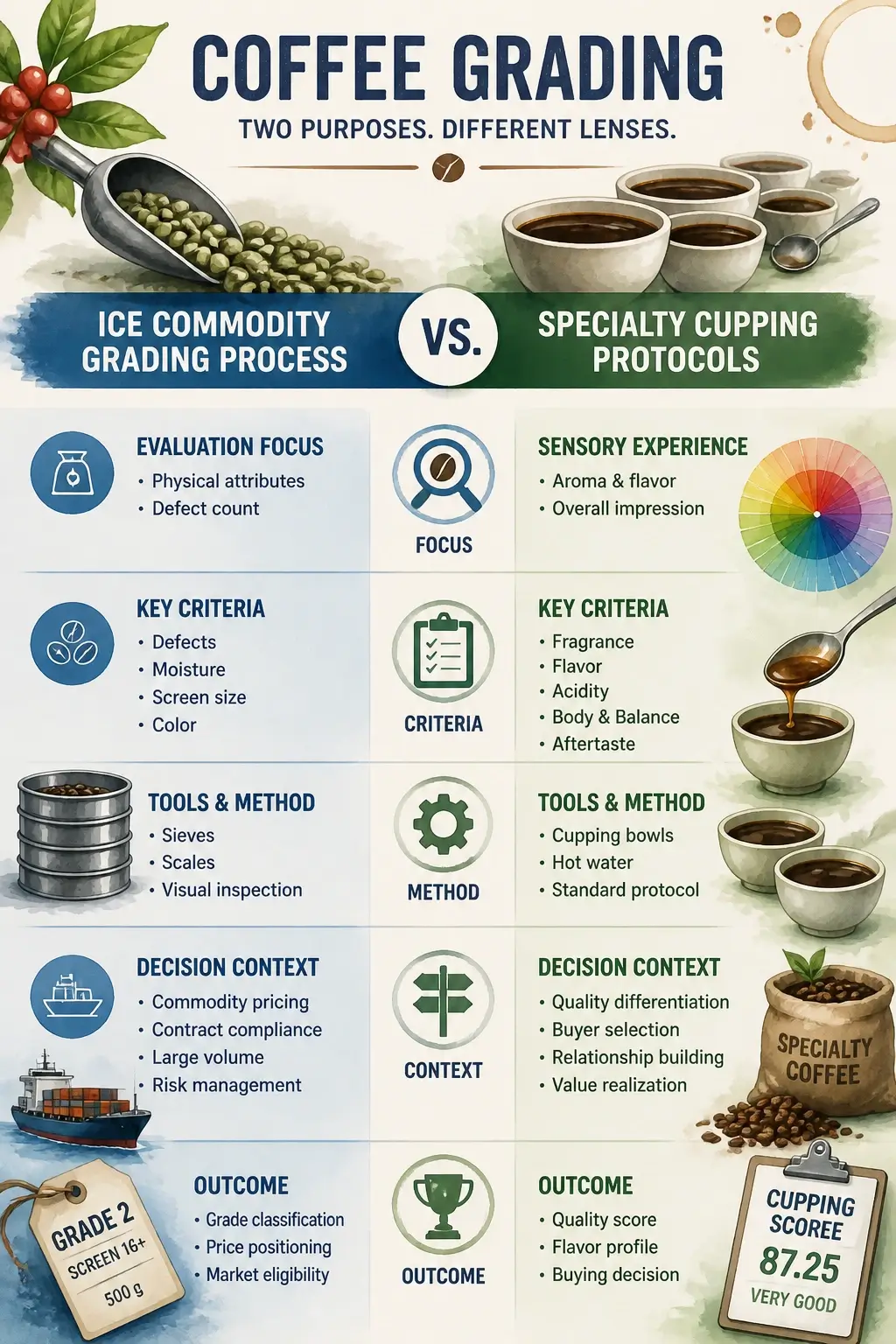
This role suits someone drawn to the intersection of sensory evaluation, commodity markets, and contract integrity – not flavor discovery. The work is precise, high-stakes, and largely invisible to the specialty coffee world. That invisibility is part of why the career path is underutilized by people with genuine cupping aptitude who simply never knew it existed.
Beyond the Core Three: Research, Competition, Education, and Emerging Roles
The Q Grader, roaster, and buyer account for most cupping careers people encounter. But the full professional landscape is wider, and for some people, the paths outside the core three are a better fit.
Research and Competition: Cupping as a Scientific and Performance Tool
Sensory scientists and researchers use cupping as an investigative instrument rather than a commercial one. Working for large coffee companies, academic institutions, or independent research organizations, they design studies to understand flavor chemistry, map consumer preference patterns, and develop or validate sensory methodology. A sensory scientist might cup hundreds of samples to establish a flavor baseline for a new origin, or to measure how a processing variable shifts consumer acceptance scores. The cupping here is rigorous, controlled, and often statistical – closer to laboratory work than to the daily QC routine of a production roaster.
Competition baristas have a different relationship with cupping entirely. World-class competitors use cupping to select their competition coffees – running multiple lots against each other to identify the one whose sensory range best supports their presentation narrative. They also use cupping to calibrate with coaches: understanding how their own perception of a coffee’s sweetness, acidity, or texture maps against their coach’s assessment, and whether their verbal description of those qualities will land accurately with judges. Cupping here serves performance. The goal isn’t a score on a form. It’s a deep enough understanding of a single coffee’s character that you can articulate it convincingly under competition pressure.
Education, Consulting, and Hybrid Roles
SCA-certified instructors and independent cupping educators teach sensory skills to professionals and enthusiasts across every level of the industry. This path requires both deep cupping competence and teaching ability – two skills that don’t always coexist in the same person. An educator cups frequently, but the primary goal isn’t evaluation. It’s calibration with students: understanding where their perception breaks down, which descriptors confuse them, and how to build their sensory vocabulary systematically.
Beyond formal instruction, a set of hybrid cupping roles has emerged that the industry hasn’t fully named yet:
- Green coffee consultants cup on behalf of clients – roasters, retailers, importers – without holding direct buying authority. They provide sensory evaluation as a service, often working across multiple accounts simultaneously.
- Café chain quality managers oversee cupping programs across multiple locations, ensuring that the sensory standard applied in one city holds in another. This role blends QC, training, and logistics.
- Sensory marketers translate cupping insights into consumer-facing language – taking the vocabulary that Q Graders use internally and converting it into the words that appear on a bag, a menu, or a campaign.
Each of these roles cups regularly, but the frequency and formality vary. A consultant may cup 15-30 samples weekly across client projects. A sensory marketer may cup infrequently but with intense focus on how flavor descriptions resonate with non-expert consumers. Formal certification helps in all of them, but practical experience and communication ability often matter more than the credential on the wall.
Here’s the paradox that anyone pursuing these non-traditional paths will encounter: every introductory cupping resource frames the practice as democratically accessible – something anyone can do at home with a kitchen scale and a kettle. The same resources then describe a protocol requiring calibrated grinders, precise temperature control, specific ratios, and a sensory vocabulary that takes weeks of consistent practice to develop. The gap between those two descriptions is real.
The aspiring sensory professional who hits this gap and treats it as useful information – a signal that professional cupping competence requires deliberate investment, not just enthusiasm – is already thinking like a professional. The one who treats it as discouragement has misread what the gap is telling them.
Training Paths, Certification Costs, and What These Careers Actually Pay
The training ecosystem for cupping careers has three distinct lanes, and choosing the right one depends on which role you’re targeting.
The Q Grader path through CQI is the most structured and most recognized in specialty coffee. Preparation typically involves a formal preparatory course followed by the multi-day exam. Q Arabica Grader certification generally costs between $1,800 and $2,500 depending on provider and location. Recertification is required every three years, adding ongoing cost to the credential’s lifetime price.
The SCA Sensory Skills pathway runs from Foundation through Intermediate to Professional, with each level building on the last. Individual modules range from roughly $200 to $1,000 depending on the provider and format. The full pathway costs less than Q Grader preparation in most markets, but it carries different recognition – more useful for education and café-level roles, less decisive for trading and importing positions where the Q credential is the expected standard.
Informal mentorship and apprenticeship inside roasteries and importing companies remains the most common path into cupping work, particularly for roasting and QC roles. The cost is lower in dollars, higher in time – and the quality of the training depends entirely on the calibration level of the people teaching you.
The cost of Q Arabica Grader certification generally ranges from $1,800 to $2,500, while quality control roles in the United States show annual salary averages between $70,438 and $125,988. – Source: Helena Coffee Vietnam
Entry-level QC roles in specialty coffee typically start between $35,000 and $50,000 annually. Senior buyers and head roasters with established track records may reach $60,000 to $90,000. ICE grading positions carry compensation structures tied to exchange or inspection company scales, which differ from specialty coffee salary norms.
The gap between certification cost and entry-level salary is real and worth naming honestly. A Q Grader course plus exam plus recertification over three years represents a meaningful financial commitment against a starting salary that won’t immediately recoup it. This is a long-game career path.
Here’s what a realistic cupping workday looks like for a production QC specialist at a mid-size specialty roaster. Arrive at 7:00 a.m. Set up the cupping table: weigh and grind samples, heat water to protocol temperature, arrange bowls in the session order. By 7:30, water goes on the first flight. Four minutes of steeping, then break the crust, skim, and begin evaluating. Two flights of six samples takes roughly 90 minutes from setup to final notes. By 9:30, the notes are compiled and the morning’s decisions are made: three batches approved, one flagged for re-roast review, one green lot deferred for a second evaluation. Then the day’s actual roasting begins.
That’s the texture of the work. Not glamorous. Precise, repetitive, and consequential.
There’s a hidden cost beyond the dollar figure: the cognitive load of learning to taste accurately within a fragmented standard. When a student learns cupping at one institution using a 3-minute steep at 95°C, then works in a lab using 4 minutes at 93°C, their calibration is disrupted. The problem isn’t their palate. It’s the invisible parameter shift between environments that no one explicitly reconciles.
The professional who understands this early can accelerate their development deliberately – cupping across different parameters, building the mental flexibility to calibrate anywhere. Calibration is a portable skill, not a fixed setting. That insight is worth more than any single certification’s cost.
Which Cupping Career Actually Fits You?
The honest answer to this question starts not with which role sounds most impressive, but with which version of a Tuesday morning you can sustain for years.
The green buyer who cups 30 samples before noon is living a structurally different life than the production roaster who cups the same six batches every morning at 7:30. Both are skilled. Both are valuable. But the daily texture is completely different – and most career decisions in coffee get made based on role identity rather than daily reality.
Start with your tolerance for repetition versus variety. Production QC roles reward consistency and routine. The value you create comes from showing up with the same calibrated attention every day, catching the deviation that most people would miss because they’ve seen the same flight a hundred times. Buying and consulting roles reward pattern recognition across constant novelty – every new origin, every new harvest, every new producer relationship is a different puzzle. Neither is superior. They suit different cognitive styles.
Then consider pressure tolerance. Buyer decisions carry immediate financial risk: a wrong call on a container is a recoverable but expensive mistake. Competition cupping carries performance pressure with a defined audience and a clock. Research and education roles carry methodological rigor – the pressure of getting the process right, not just the outcome. These are different flavors of stress, and honest self-assessment here is more useful than any career quiz.
Factor in lifestyle. Buying often requires origin travel – weeks in Ethiopia, Colombia, or Indonesia during sourcing season. Roasting is typically location-bound; you are where your roaster is. ICE grading may involve working near ports and warehouses rather than in the café and lab environments that most specialty coffee aspirants imagine when they picture their careers. The SCAA cupping form and the futures contract are both legitimate professional contexts for cupping skill – they just happen in very different physical environments.
The professionals who build lasting cupping careers share one characteristic more than any other. They recognized early that cupping standards are more aspirational than actual, that calibration is a negotiation rather than a fixed state, and that the real skill is making sound decisions despite imperfect protocols. Every role in this article asks you to apply cupping in a context where the “universal standard” breaks down under real-world conditions.
The Q Grader must score consistently with graders trained at different labs on different continents. The buyer must cup accurately across protocols that don’t match. The roaster must build an internal quality program on parameters they had to choose and defend without any authority to appeal to. Mastering the SCAA cupping form is table stakes – understanding why the form’s outputs vary depending on who fills it out, under what conditions, is the actual skill.
The career that fits you isn’t just about which role sounds right. It’s about which flavor of ambiguity you can live with daily. The professionals who stay in cupping careers find the fragmentation fascinating rather than frustrating. If you read this article and your reaction to the parameter inconsistency was curiosity rather than anxiety, that’s useful information about where you belong.
Frequently Asked Questions About Who Uses Coffee Cupping
How long does a professional cupping session typically last?
A standard cupping flight of six samples takes 60 to 90 minutes from setup through final notes. Buyers evaluating 20-40 samples in a single session may spend three to four hours at the table.
Where did the standardized cupping protocol originate?
The formalized cupping protocol used in specialty coffee today grew out of the Specialty Coffee Association of America’s work in the 1980s and 1990s to create a universal quality evaluation framework. The SCA’s published standards became the foundation for Q Grader certification when CQI launched the program in 2004.
What is a good coffee cupping score?
Under SCA protocols, coffees scoring 80 points or above qualify as specialty grade. Scores above 85 are considered high-quality specialty, and anything above 90 is exceptional. Most commercial-grade coffees don’t reach 80.
Do you need Q Grader certification to get a job as a coffee buyer?
Not universally, but it’s increasingly expected at specialty importers and direct-trade roasters. Some buyers build credibility through years of practical experience and producer relationships without the credential, but Q certification removes ambiguity for trading partners who can’t evaluate your palate directly.
Can you cup coffee professionally without formal certification?
Yes. Many production roasters and QC specialists work effectively without formal certification, particularly in roasteries that train internally. Certification matters most in roles where external partners need to trust your scores without witnessing your process.
How does an ICE grader’s training differ from a Q Grader’s?
ICE grader training focuses on exchange specifications, defect counting at scale, and contract compliance standards rather than SCA flavor methodology or specialty scoring. The two credentials don’t overlap meaningfully and aren’t interchangeable.
What’s the biggest mistake people make when pursuing a cupping career?
Choosing a role based on how it sounds to other coffee professionals rather than what its daily reality actually demands. Cupping 40 samples before lunch looks impressive on paper; living it five days a week requires a specific combination of stamina, pressure tolerance, and genuine interest in the commercial decision-making that follows.
How often do working Q Graders need to recertify?
CQI requires Q Graders to recertify every three years to maintain their credential. The recertification process ensures that calibration doesn’t drift over time as tasters’ sensory references shift.
References
- CQI Community Chat: Q Graders Frankie and Tim Volkema | coffeeinstitute.org
- How to Roast for Cupping Purposes | perfectdailygrind.com
- High Prices, Exporters Hesitant to Sell Coffee | perfectdailygrind.com
- CQI Community Chat: Q Grader Camila Khalife | coffeeinstitute.org
- CQI Community Chat: Dr. Mandappa IM | coffeeinstitute.org
- CQI Community Chat: Dulce Barrera | coffeeinstitute.org
- Modeling Study of Coffee Extraction at Different Temperature and Grind Size Conditions | Journal of Food Process Engineering (doi.org)
- What Is the Q Grader Certification? | helenacoffee.vn