
The SCA coffee cupping protocol is not a tasting ritual. It is a measurement instrument, and like any instrument, it only produces reliable data when every variable except the one being measured is locked down. Dose, water volume, water chemistry, temperature, steep time, grind: all fixed. What remains is the coffee.
Understanding why each parameter exists changes how you run the table. Q Graders, roasters, and green buyers who treat the protocol as ceremony get numbers. Those who treat it as engineering get numbers worth trusting across tables, companies, and years.
Key Takeaways on SCA Coffee Cupping Protocol
- The protocol’s operating logic is subtraction: fix every variable the brewer controls, and what remains on the palate is the coffee itself.
- Water at 125-175 ppm TDS is not a preference; it’s the range where water acts as a neutral carrier rather than a flavor variable.
- Grind size governs the washing phase of extraction, and at the fixed steep time, a grind shift alone can fabricate or amplify a defect.
- Scoring scales conflict across SCA-aligned sources; record the form revision and scale alongside every score or the number has no readable provenance.
- Table hygiene and cross-contamination prevention are the most consequential unpublished standards in the protocol; a contaminated spoon produces a wrong score, not a low one.
- Calibration is palate alignment to a population of calibrated cuppers, not abstract accuracy; a score that doesn’t transfer to another table has no commercial value.
What Standard Coffee Cupping Is, and Why the Trade Needs One Shared Method
The SCA cupping protocol is the Specialty Coffee Association’s standardized method for evaluating coffee under controlled conditions, and its operating logic is straightforward: fix every variable the brewer controls, and the only thing left to measure is the coffee. Dose, water volume, water chemistry, temperature, steep time, and grind are all specified. Strip those out and what lands on the palate is the sample itself.
That matters commercially because green buyers, importers, roasters, and Q Graders are comparing lots across companies, borders, and years. Without a shared method, “quality” is incomparable opinion. One importer’s 84 is another’s 79 if they’re using different ratios, different water, and different timing. The SCA coffee cupping protocol exists specifically so that a score generated in Addis Ababa means the same thing to a buyer in Oslo or São Paulo.
The most damaging misconception in published cupping content is that the protocol is about producing a great cup. It is not. A high score reflects the quality of a sample evaluated under controlled conditions. Drift the procedure, and the same coffee scores differently. The number is only as trustworthy as the discipline behind it. That’s the premise every other section in this guide builds on.
From San Francisco Sample Rooms to the SCA Standard: How the Cupping Ritual Was Built
Historical Codification Arc
The cupping ritual did not originate in a laboratory. It originated in 19th-century San Francisco warehouses, where green coffee merchants and brokers needed a fast, repeatable way to evaluate incoming samples before committing to a purchase. They brewed directly in the cup, smelled the grounds, broke the crust, and slurped. No brewing equipment to clean, no variables introduced by a separate vessel. The method was commercial from the start.
That practice spread through the trade long before anyone wrote it down formally. As the specialty coffee industry organized in the late 20th century, the SCA inherited this informal broker practice and codified it into governance: standards documents, protocol references, and the current Coffee Value Assessment resource hub that defines what “official” now means. The transition from warehouse habit to formal standard took roughly a century, and most of the steps on the table today trace directly back to decisions made in those San Francisco sample rooms.
Specialty Coffee Association describes its Descriptive Assessment as objectively recording sensory attributes of coffee, including aroma, flavor, texture, and aftertaste, through standardized coffee sensory analysis.
Standardized coffee cupping protocols are the point. Without it, a broker’s “bright” and a roaster’s “bright” describe different things. The codification arc is really a language standardization project with a cupping table attached.
Terroir Rationale and Volatile Release
The deeper purpose of the protocol is terroir isolation. Every variable a skilled barista or roaster would normally control, including brew ratio, water temperature, contact time, and turbulence, is removed from the equation. What’s left on the palate is the coffee’s intrinsic character: origin, variety, processing method, and any defects riding along with them.
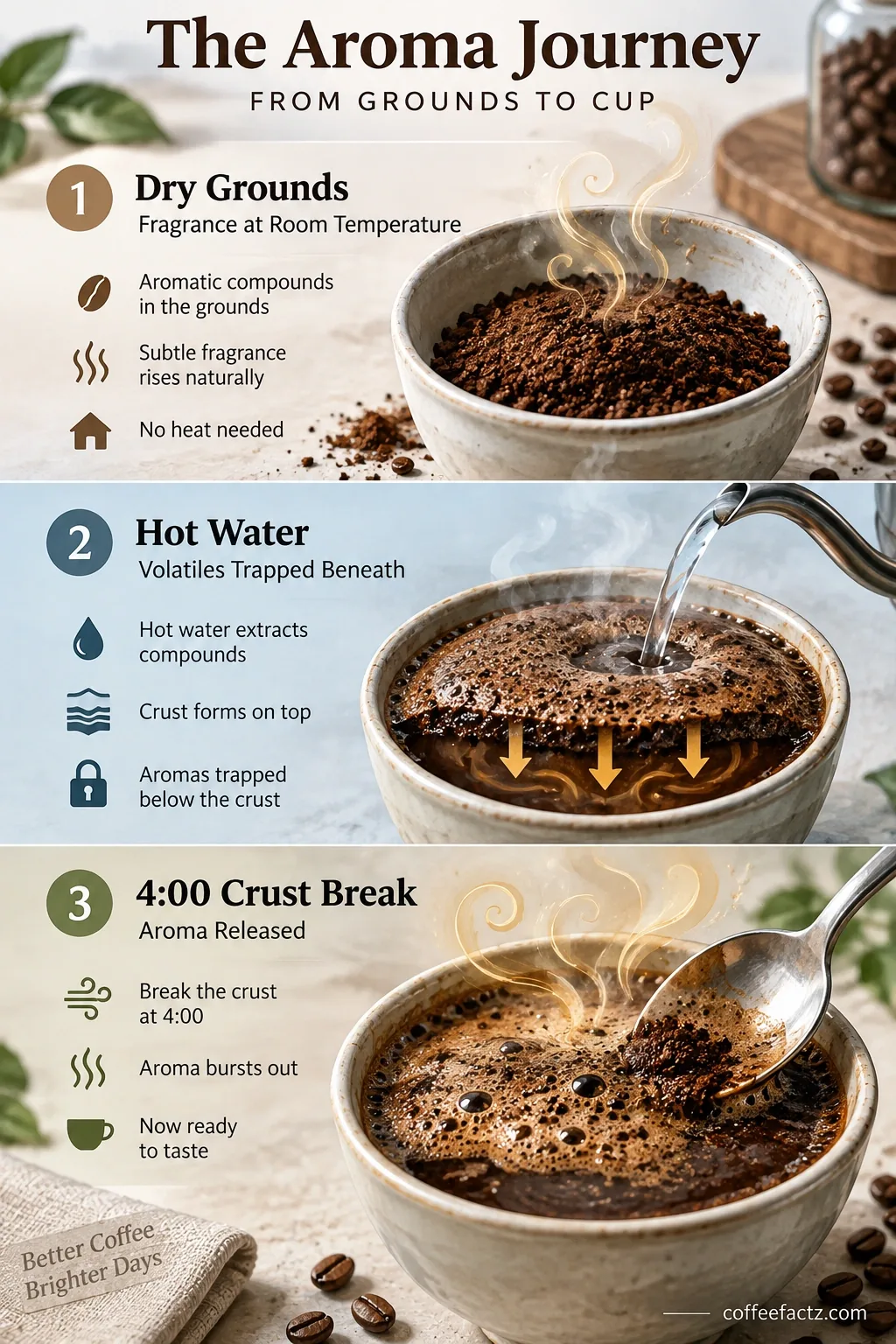
The sequence is chemically ordered, not traditional. Dry grounds at room temperature release volatile compounds into the air above the bowl. That’s what you’re evaluating during fragrance. When hot water is poured, it traps a fresh set of volatiles beneath the crust that forms as grounds absorb water and float. Breaking the crust at four minutes releases those trapped compounds upward in a concentrated burst. That’s what you’re evaluating during aroma. Fragrance and aroma are scored before the coffee is ever tasted because the volatile chemistry is most concentrated and most informative at those two specific moments, not because of tradition.
The same logic explains why the protocol has persisted. Any method that fixes dose, water chemistry, temperature, time, and grind is, by definition, removing the brewer from the equation. The trade kept the one method that does this fastest at scale.
Building the Table: Equipment, Water, Sample Roast, Ratio and Grind
Physical Kit, Liquid Chemistry, and Fixed Dose
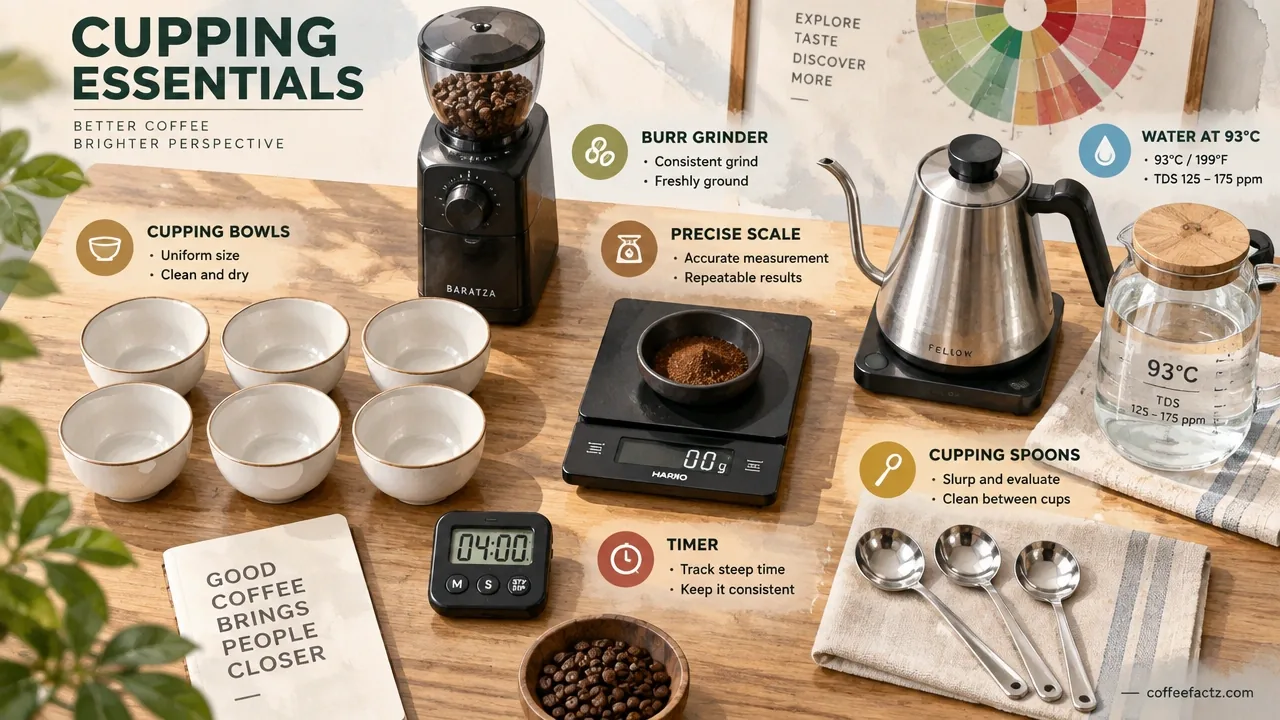
The fixed dose is 8.25 g of coffee per 150 ml of water. Weighed, not scooped. That ratio is non-negotiable not because it produces the best-tasting cup but because it produces a comparable one. Every table, in every country, running this ratio is measuring the same extraction surface under the same conditions.
The physical kit has a standard attached to each item:
- Cupping bowls: uniform capacity, typically 207-266 ml, ceramic or tempered glass
- Burr grinder: consistent particle distribution, no blade grinders
- Scale: precise to 0.1 g
- Timer: visible to all cuppers at the table
- Cupping spoons: deep-bowled, silver or stainless
- Water: 93°C, with a total dissolved solids range of 125-175 ppm
That water specification matters as much as the dose. Distilled water under-extracts because it has no mineral buffer. Heavily mineralized tap water over-extracts and introduces flavors the coffee didn’t bring. Softened water strips the mineral content that helps solubles dissolve cleanly. The 125-175 ppm TDS range is the window where water acts as a neutral carrier rather than a flavor contributor.
Separate the cupping ratio from the brew ratios that circulate in consumer content. A 1:18 pour-over ratio and a cupping table ratio are serving different purposes. The pour-over ratio is optimized for the drinking experience. The cupping ratio is optimized for comparability.
Preparation Consistency and Extraction Surface
Extraction surface is the variable that most cupping guides underspecify. Grind size controls particle surface area, and surface area controls how quickly both desirable solubles and defect compounds reach the cup. The protocol calls for a medium-coarse grind, but “medium-coarse” is only meaningful when it’s pinned to a specific grinder and a recorded setting.
A study modeling aqueous extraction from roasted coffee grounds published in the Journal of the Science of Food and Agriculture found that extraction happens in two distinct phases: a washing phase, where surface solubles dissolve and transfer by convection, and a diffusion phase, where solubles migrate out of the porous interior of the particle. The washing phase has a linear relationship with the external surface area of the grounds. In plain terms: grind finer, more surface area, faster soluble release in those first seconds of contact. At the fixed dose, volume, and steep time of the cupping protocol, a grind shift alone can make a clean coffee taste muddled and amplify a mild defect into something that looks like a scoring problem.
Practical rule: pin your grind to a single reference grinder and a recorded setting. Check it against a reference sample at the start of every session. Sample roast consistency matters too. The sample should be roasted to a light-to-medium profile, rested for a minimum of 8 hours but no more than 24, and ground immediately before the session. The five-cup-per-sample convention used in full-form assessment exists so that uniformity and clean cup checks are statistically meaningful rather than based on a single bowl.
The Session, Minute by Minute: Steep, 4:00 Crust Break, Skim and Slurp
The cupping procedure starts before the water is poured. Dose and grind directly into the bowl, then evaluate dry fragrance immediately, while the volatile compounds are still releasing at room temperature. This is a timed window: the longer you wait, the more of that fragrance escapes into the room rather than reaching your nose above the bowl.
Pour 93°C water over the grounds in a steady, even stream that saturates the bed completely. Start the timer at the first contact. The crust forms as grounds absorb water and float to the surface. Leave it intact for the full four-minute steep. Breaking early releases the trapped volatile compounds before they’ve had time to concentrate, and you lose the aroma evaluation before it happens.
At 4:00, break the crust. Three passes with the back of the spoon across the top of the crust, nose close to the bowl, evaluating wet aroma while those trapped volatiles rise. Then skim the surface foam and any floating grounds with two spoons until the liquid is clear. No grounds should remain. A bowl with floating grounds will continue extracting unevenly and introduce textural noise into the body evaluation.
Wait for the liquid to cool to tasting temperature, roughly 70°C, before the first slurp. The slurp is not affectation. Pulling liquid forcefully across a wide, flat spoon atomizes it into fine droplets that spread across the entire palate simultaneously and carry volatile compounds retronasally, up through the back of the throat to the olfactory receptors. A sip delivers flavor to the front of the mouth. A slurp delivers it everywhere.
Taste at multiple temperature points as the cup cools. Acidity is most perceptible at higher temperatures. Sweetness opens up as the cup drops toward 50°C. Body and texture become clearer below 60°C. Score in the fixed order: fragrance and aroma first, then flavor, aftertaste, acidity, body, and balance as the cup cools through the tasting window. Keep the table silent until every cupper has recorded individual scores. One dominant voice at the table anchors everyone else’s scores before the discussion is supposed to start.
The Ten Sensory Attributes and the SCA Cupping Form: Turning Palate into Numbers
Perception Categories and Total Assessment
The SCA Cupping Form organizes evaluation into ten attributes. Understanding what each one is actually measuring, rather than just what it’s named, is what separates a calibrated score from a guess.
Specialty Coffee Association Protocols & Best Practices: The Cupping Form records flavor attributes including Fragrance/Aroma, Flavor, Aftertaste, Acidity, Body, Balance, Uniformity, Clean Cup, and Sweetness as positive quality scores on a 16-point scale in quarter-point increments between 6 and 9, with Defects as negative scores and Overall as a personal holistic appraisal by the cupper.
Here’s what each attribute is actually asking the cupper to judge:
| Attribute | What You’re Evaluating |
|---|---|
| Fragrance/Aroma | Volatile compounds released from dry grounds (fragrance) and from the broken crust (aroma) |
| Flavor | The combined orthonasal and retronasal impression during the slurp |
| Aftertaste | The length and quality of flavor remaining after the liquid is swallowed |
| Acidity | Brightness and liveliness, not sourness; quality and intensity both matter |
| Body | Tactile weight and texture of the liquid on the palate |
| Balance | How well the preceding five attributes integrate without one dominating |
| Uniformity | Consistency across the five cups in the sample set |
| Clean Cup | Absence of off-flavors or interfering impressions in any of the five cups |
| Sweetness | Presence of a pleasant sweetness, checked across all five cups |
| Overall | The cupper’s holistic personal appraisal of the coffee |
Uniformity, clean cup, and sweetness are per-cup checks: each of the five cups in the sample gets 2 points, for a maximum of 10 points per attribute. The other attributes are scored once per sample on the quality scale.
The arithmetic that produces the final total adds all positive attribute scores and subtracts defect penalties. Overall is not a summary of the other nine. It is the cupper’s holistic judgment, and it’s where protocol discipline ends and calibrated opinion begins. Two cuppers can score the first nine attributes identically and diverge on overall, because that attribute is explicitly personal.
Score Sheet Completion and Revision Provenance
Mario Fernandez, SCA Technical Officer, noted that the SCA had not revised its cupping standards in approximately 20 years, and that significant developments in the industry, in sensory science, and within the SCA itself made revision necessary.
That context matters when you’re looking at a score sheet. Scoring scales and deduction rules actively conflict across SCA-aligned sources. You will encounter a 0-10 scale in 0.25 increments, a 6-10 scale, and a 16-point scale running from 6 to 9. Defect handling splits between “taints and faults” language and Category 1 / Category 2 language. These are not equivalent systems. A score of 84 on one form is not the same as 84 on another if the underlying scales differ.
The specialty-grade threshold, 80+ points with zero Category 1 defects and no more than five Category 2 defects, only holds when you know which version of the form produced the number. Category 1 defects are full defects that disqualify a sample regardless of total score. Category 2 defects are taints that reduce the score incrementally.
Operational rule: record the form revision and the scale alongside every score. A score without its scale is unreadable provenance. When comparing scores across sources or years, convert the defect language first, taints/faults versus Category 1/2, and then the numbers. Always obtain the current official form directly from the SCA rather than working from screenshots of older versions that circulate as images online. The form has changed, and an outdated sheet produces an incompatible score.
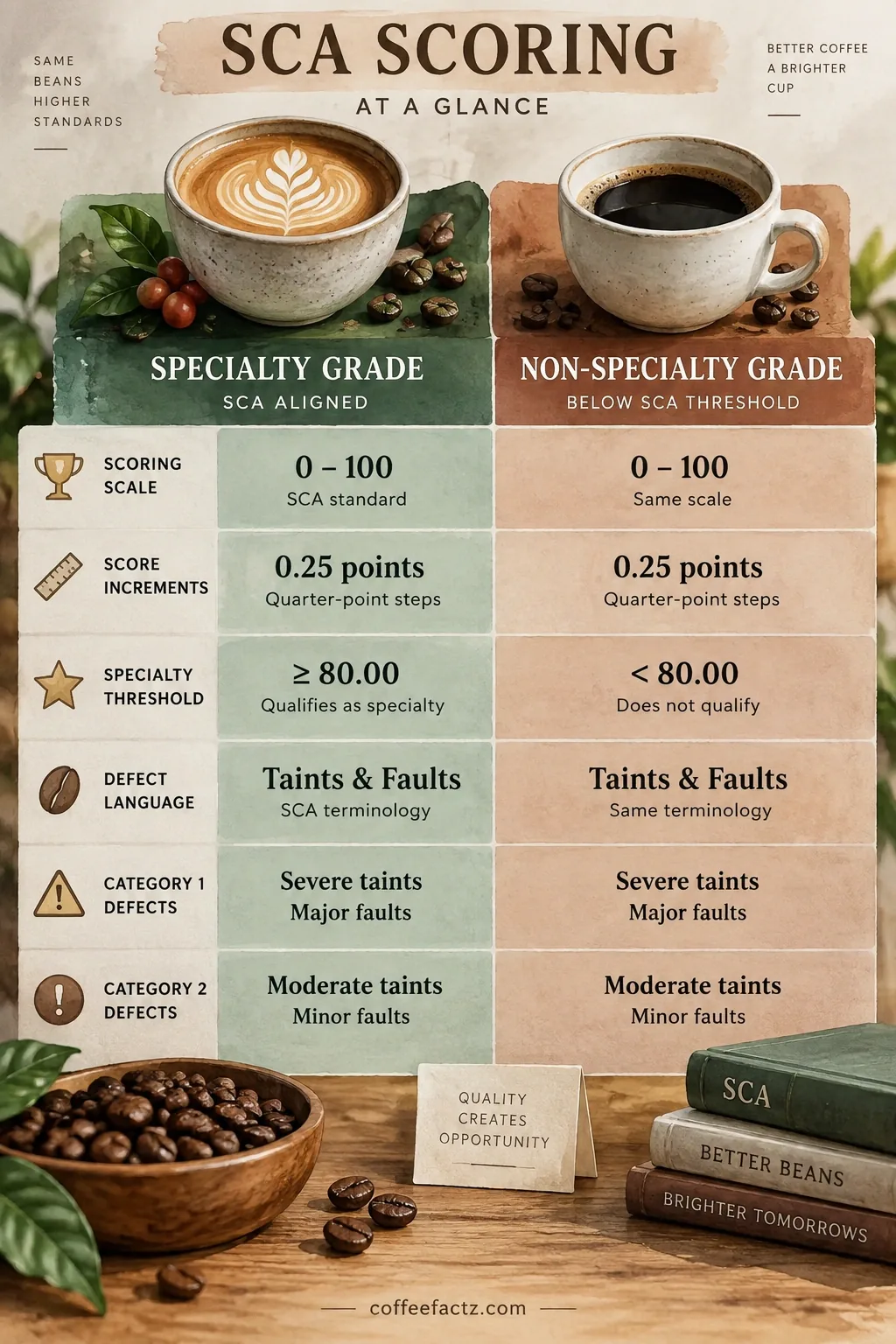
Table Hygiene and Cross-Contamination: The Blindspot That Invalidates a Session
Table hygiene is the discipline’s most consequential published gap. The SCA technical protocol specifies parameters, and practitioner guides walk through the session timeline. Almost none of them address what happens when a spoon carries residue from a defective lot into the next bowl, or when a rinse vessel has been sitting long enough to pick up its own off-notes.
Contamination never announces itself. A clean lot scored after a defect-heavy one through an unrinsed spoon produces a number that looks like a real assessment. The panel has no way to know the score is wrong.
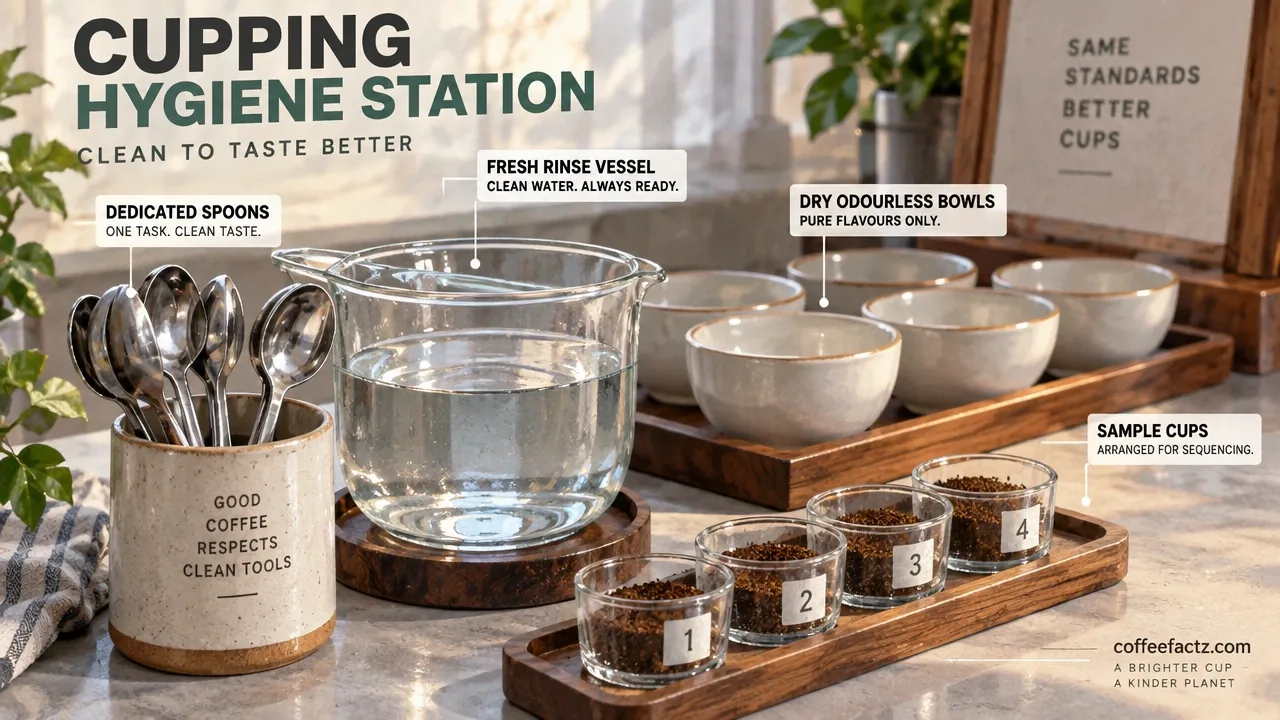
The room and kit standard is non-negotiable: scent-free environment, clean and dry bowls and glassware with no residual odor, no perfume, cologne, lotion, or scented soap on any person at the table, and no strongly flavored food in the hour before the session. The olfactory system adapts to persistent background scents and stops registering them, which means a cupper wearing fragrance is not just adding noise to their own evaluation, they’re potentially skewing the aromatic environment for everyone at the table.
Spoon and cup discipline:
- Rinse the spoon between every cup and every sample, not just between samples
- Use separate cups per sample so carry-over between bowls is physically impossible
- Never carry a spoon directly from a defective coffee to a clean lot
- Keep the rinse water fresh throughout the session; stale rinse water is a contamination source, not a cleaning tool
Stop conditions matter as much as setup. Defect-heavy or intensely processed lots should be sequenced last, or separated into a distinct session, so that high-intensity aromatics don’t suppress or mask what follows. If a cupper is ill, congested, or fatigued, postpone the session. A compromised palate doesn’t just score lower: it scores wrong, assigning attribute values that reflect the cupper’s physiological state rather than the coffee’s actual character. That number then enters the record and the comparison pool.
Write these rules as a posted SOP, not tribal knowledge passed verbally. Dedicated spoons and bowls per sample, a fresh rinse vessel, defined sample sequencing, and an explicit stop condition that suspends a session rather than producing a number nobody should trust.
Calibration: Making Your Scores Mean the Same Thing as Everyone Else’s
Palate Alignment Definition and Credential Context
Palate alignment is what calibration actually is: aligning your scoring to a reference standard and to other cuppers so that your 7 means the same thing at your table as it does at a buyer’s table. This is not about scoring “correctly” in the abstract. A score that accurately reflects your perception but doesn’t correspond to the population of calibrated cuppers is useless commercially. It’s a private opinion wearing the format of a professional evaluation.
The Q Grader licence is the SCA’s globally recognized professional credential for evaluating, describing, and scoring coffee using standardized methods. It covers nine assessments, eight practical and one written, delivered over a six-day course. The licence is valid for three years and requires continued professional development for renewal. It targets experienced professionals in sourcing, roasting, and quality control, and its scope is sensory evaluation, not brewing technique or roasting theory. Passing the Q exam means you can evaluate coffee to a calibrated standard. It doesn’t mean you can brew or roast better.
Drift Correction and Market Trust
Score drift is real, and no source that asserts you must calibrate actually explains how to correct it. Here is a concrete, repeatable drill:
- Cup with peers and record scores independently before any discussion. No anchoring.
- Compare scores on a single known reference sample at the start of each session. Track your variance from the group mean over time.
- Use known-defect sets periodically to check whether you’re detecting and scoring defect intensity consistently.
- After any gap in practice, run a calibration session against reference samples before cupping commercially meaningful lots.
The cups-per-sample convention matters here. Two cups, five cups, or multiple sets produce different statistical conditions for uniformity and clean cup detection. A table running two cups per sample will miss inconsistencies that five cups would catch. When comparing scores across sources, establish which convention the table used before treating the uniformity and clean cup scores as equivalent.
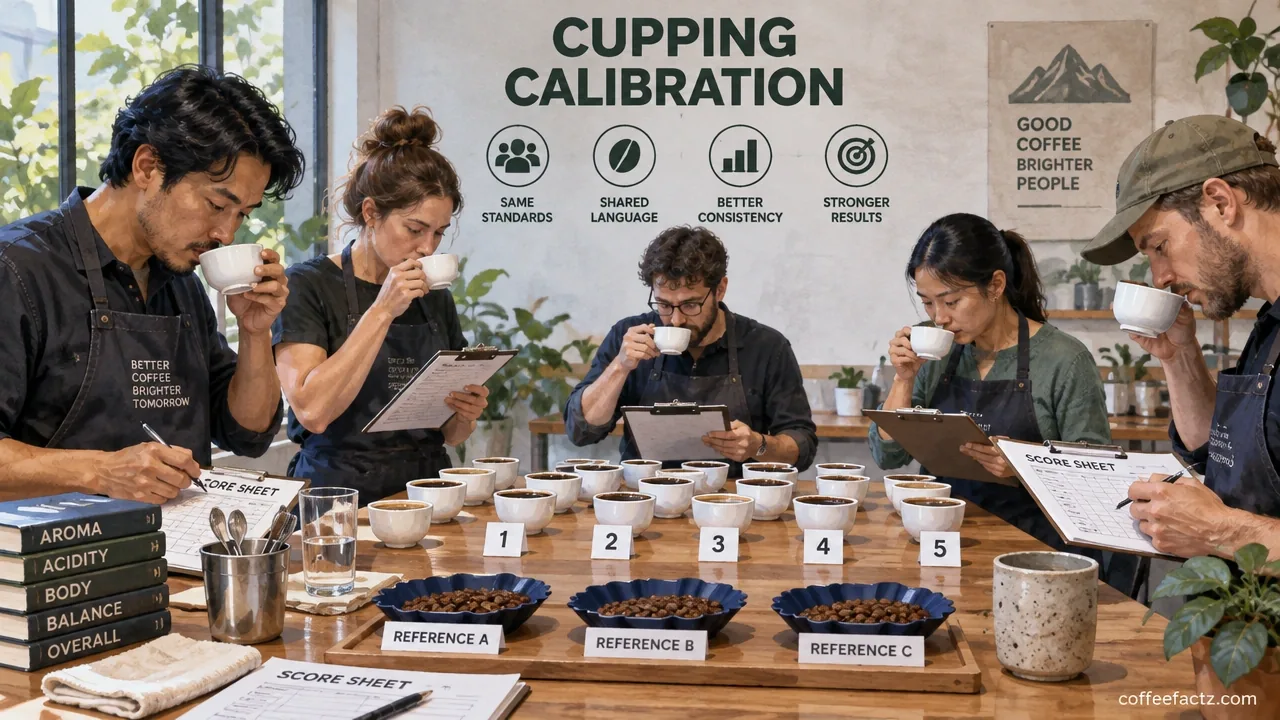
Commercially, the stakes are direct. Purchase decisions, contracts, and quality certificates rest on scores that are only meaningful relative to the population of calibrated cuppers. A score produced at an uncalibrated table by someone whose drift has never been checked is not a specialty-grade determination. It’s an unanchored number on a form that looks like one.
Beyond the Form: What the Protocol Can and Cannot Tell You
The SCA coffee cupping protocol measures sample quality under controlled conditions. That’s the boundary. It does not predict how a coffee will perform on a specific brew method, under a specific roast profile, or in a specific market. It does not measure consumer preference. A coffee that scores 87 on the cupping table may be genuinely difficult to dial on espresso, or may not suit the palate of the market the buyer is serving. The score is not a purchase recommendation. It is a quality statement about a sample, evaluated under fixed conditions, by a calibrated cupper, using a specified form revision.
The SCA has moved beyond treating a single number as a complete description of a coffee. The Coffee Value Assessment framework treats value through four complementary assessments: physical, descriptive, affective, and extrinsic. Physical assessment covers green and roasted defects. Descriptive assessment records sensory attributes in standardized language. Affective assessment captures preference and liking, which the cupping form deliberately excludes. Extrinsic assessment addresses market, supply chain, and sustainability factors. The point is explicit: no single score describes a coffee, and the trade is moving toward a framework that acknowledges that.
The durable practice loop that produces numbers worth trusting is: hygiene SOP plus locked parameters plus the current form revision plus recorded scale plus scheduled group calibration. Remove any one of those elements and the score’s comparability degrades. Remove two and the number is private data.
The knowledge base that supports this practice is split by audience, and that split is why practitioners keep relearning the same fundamentals from scratch. SCA institutional sources are the authority for what is current: form revisions, thresholds, and framework changes. Practitioner and supplier guides carry the operational step-by-step execution detail. Neither is complete alone. Treat standards documents as the authority for currency and treat practitioner sources as the authority for execution, then validate both against your own calibrated table, which is the only test that actually settles a disagreement between them.
Frequently Asked Questions About SCA Coffee Cupping Protocol
What is the recommended SCA ratio for cupping coffee?
The SCA protocol specifies 8.25 g of coffee per 150 ml of water, weighed rather than scooped. That ratio exists for comparability across tables, not to produce an ideal drinking cup.
What are the steps involved in the cupping protocol for coffee?
Grind into the bowl, evaluate dry fragrance, pour 93°C water and start the timer, break the crust at exactly four minutes while evaluating wet aroma, skim the surface, wait for the liquid to cool, then slurp and score attributes in the fixed order as the cup cools.
What is the 15-15-15 coffee rule, and does it apply to SCA cupping?
The 15-15-15 rule is a consumer brewing guideline, not an SCA protocol parameter. It has no role in standard cupping procedure, where steep time, dose, and temperature are governed by the SCA’s own fixed specifications.
What is the ideal ratio of coffee to water for cupping?
For SCA-standard cupping, 8.25 g per 150 ml is the specified ratio. Deviating from it, even slightly, breaks comparability with other tables running the standard.
Why does the crust break happen at exactly four minutes?
Four minutes is when the volatile compounds trapped beneath the crust are at their most concentrated. Breaking earlier loses aromatic intensity; breaking later allows the crust to begin degrading and the volatile window closes.
How does a Q Grader stay calibrated between recertification cycles?
By cupping regularly with peers, scoring independently before any group discussion, using reference samples with known scores, and tracking personal variance from the group mean over time. The three-year licence cycle sets the formal interval, but drift correction requires ongoing practice, not just periodic retesting.
Can a coffee score differently on the same form at different tables?
Yes, and it happens more often than the industry acknowledges. Water chemistry, grind variance, spoon hygiene, and cupper drift all shift the score independently of the coffee’s actual quality. That’s why the hygiene SOP, locked parameters, and group calibration are not optional extras; they’re what makes the number transferable.
What does the SCA Coffee Value Assessment change about how cupping scores are used?
It reframes a single cupping score as one input among four: physical assessment, descriptive assessment, affective assessment, and extrinsic assessment. A cupping score describes quality under controlled conditions; it doesn’t capture preference, brew performance, or market fit, and the CVA framework treats those as separate, legitimate data points.
References
- What Is Coffee Cupping? | sprudge.com
- SCA Protocols & Best Practices | scith.coffee
- Coffee Value Assessment | sca.coffee
- Modelling the aqueous extraction of soluble substances from ground roasted coffee | scijournals.onlinelibrary.wiley.com