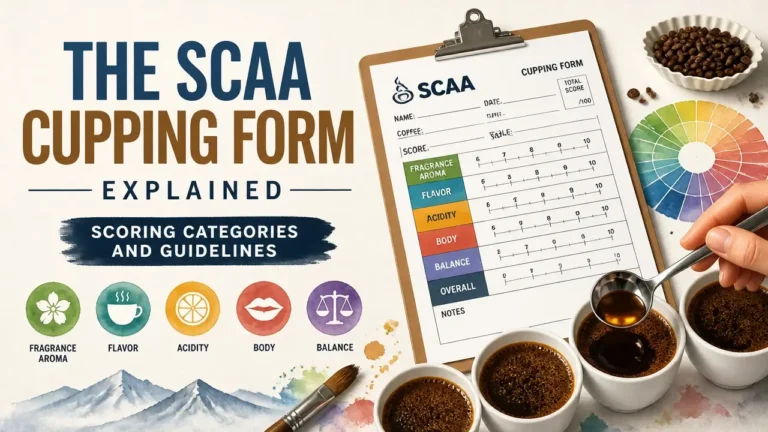

The SCAA cupping form is the specialty coffee industry’s shared language – a scoring instrument built not to confirm what you already taste, but to make your sensory findings legible to everyone else in the supply chain. Without it, an 85 is just a number a roaster in Portland assigned to a coffee a producer in Colombia grew, with nothing connecting the two.
Understanding the form at its mechanical level changes how you use it. The 100-point scale, the defect deduction system, the new Coffee Value Assessment layer – each piece exists for a reason. Once you see that reason, the form stops feeling like a bureaucratic checklist and starts working as the precision instrument it was designed to be.
Key Takeaways on SCAA Cupping Form Explained
- The SCAA cupping form is a supply-chain communication tool, not a personal scoring diary – its value is transferability, not individual accuracy.
- Scores exist in 0.25-point increments, meaning a single tick mark separates specialty-grade coffee from commodity at the 80-point threshold.
- Fragrance/Aroma, Flavor, Aftertaste, Acidity, and Body measure distinct sensory phenomena; conflating them inflates scores and undermines the form’s integrity.
- Taint deductions subtract 2 points and fault deductions subtract 4 points from the final score – missing a single defect call can misclassify a non-specialty lot.
- The CVA’s Affective Assessment preserves the 2004 form’s scoring scale and threshold; the new requirement is structured descriptive documentation, not a new scoring philosophy.
- Standardized forms do not guarantee standardized scores – inter-rater calibration through regular group cuppings is the only mechanism that produces genuine scoring consistency.
Why the Cupping Form Exists: Beyond Personal Preference
The SCAA cupping form is a supply-chain communication protocol. That distinction matters more than it sounds. The form’s purpose is not to help you identify what you’re tasting – you already have a palate for that. Its purpose is to translate what you taste into a data format that a producer in Huila and a green buyer in Portland can read and interpret identically, without a phone call, without context, without you in the room.
This is the distinction experienced cuppers sometimes miss. The ability to taste quality without a form is real. But a personal judgment, however accurate, is not transferable. The moment your score affects a purchasing contract, a producer’s payment, or a lot’s classification, it stops being your opinion and becomes a document. The form is what makes that document valid.
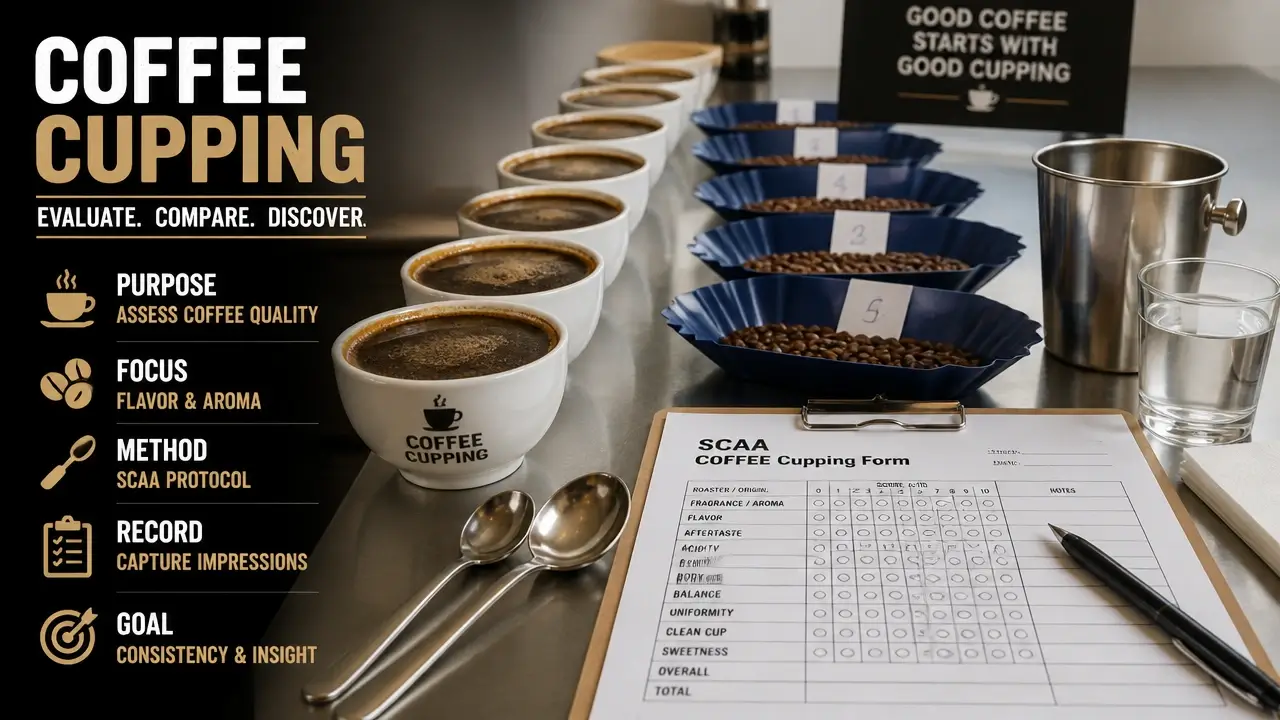
The 100-point scale was designed around a specific gatekeeping function: separating specialty coffee (80 points and above) from commodity-grade coffee. That threshold isn’t aesthetic. It’s commercial. Coffee that crosses the 80-point line enters a different supply chain, commands different pricing, and carries different expectations at every stage from farm to cup. The form is the instrument that draws that line.
The scoring increments make this more precise than most cuppers realize. Scores exist in 0.25-point steps. A coffee that earns an 84.75 does not qualify as specialty. A coffee that earns an 85.00 does. That single tick mark – one quarter of one point – can determine whether a lot sells as specialty or gets absorbed into the commodity market. The cupper holding the form is holding that decision.
The full scoring range reflects the form’s ambition. A 6.00 means “Good.” A 7 means “Very Good.” An 8 means “Excellent.” A 9 means “Outstanding.” A 10 means “Extraordinary.” Most working cuppers spend their careers in the 6.75-to-8.50 range. The upper end of the scale exists not as decoration but as an anchor point – it calibrates what “excellent” means relative to what’s possible.
To understand how the form is properly administered before going deeper into scoring mechanics, the SCAA cupping protocol establishes the procedural standards that govern everything from grind time to water temperature, and those conditions directly affect the scores the form produces.
The industry’s own experts have identified a structural vulnerability in this system worth naming directly. Ensei Neto, a coffee consultant at The Coffee Traveller, has observed that sample preparation inconsistencies in producing countries create a scoring distortion before the form is even picked up:
Neto points out that samples submitted for evaluation are sometimes prepared differently from the actual commercial lot – with defective beans selectively removed to create a cleaner cup. The score the cupper records reflects the sample, not the lot. The form is accurate; the input is not.
This is not a flaw in the form’s design. It’s a reminder that the form’s validity depends entirely on the integrity of what goes into the cup. A cupping form completed on a cherry-picked sample produces a number that is precise, documented, and wrong.
The language problem runs even deeper. Jonathan Vaz Matías, a traveling AST trainer and CEO of Acuerdo Project, has argued that the descriptive vocabulary baked into cupping systems carries significant cultural weight:
Matías contends that the industry’s sensory language was built on a cultural framework that doesn’t translate universally. A descriptor like “stone fruit” or “black tea” carries no sensory anchor for a cupper whose reference points are entirely different. The words on the form assume a shared flavor memory that doesn’t exist across every producing region.
This is the form’s deepest structural tension. It was designed as a universal communication tool, but its vocabulary was built in one cultural context and exported globally. The numbers may be universal. The words attached to them are not.
The Category Architecture: What Each Box Actually Measures
Each category on the cupping form measures a distinct sensory dimension. The form doesn’t ask for your overall impression of the coffee – it asks for independent evaluations of specific phenomena, one at a time. That structure is intentional. The categories function as sensory isolators, forcing the cupper to evaluate one dimension before moving to the next. The discipline of scoring them separately is what produces a defensible result.
Individual Sensory Attributes: Fragrance, Flavor, Aftertaste, Acidity, and Body
Fragrance/Aroma is a two-stage evaluation collapsed into one score. The first stage is dry fragrance: you evaluate the ground coffee before water is added, noting intensity and identifying specific aromatic compounds. The second stage is wet aroma: after brewing, you break the crust and evaluate what volatiles are released. Both stages contribute to the single combined score. A cupper who skips the dry stage is scoring half the category.
Flavor is the central sensory event. When the coffee reaches the mid-palate, taste and retro-nasal aroma fire simultaneously – sweet, sour, salty, bitter, and umami signals combine with aromatic compounds traveling up through the nasopharynx. Flavor is that combined experience. It is the most complex category on the form and the one most vulnerable to the halo effect, which we’ll address in the next section.
Aftertaste is what remains after you expectorate or swallow. Operationally, it is not a continuation of Flavor – it is a separate event. A coffee can have exceptional mid-palate complexity and a short, astringent finish. A coffee can have a relatively simple Flavor profile and a long, clean, satisfying Aftertaste. Scoring them identically because they “felt similar” is a scoring error.
Acidity measures sharpness and liveliness, not sourness. This distinction is one of the most important in cupping, and confusing the two produces systematically inaccurate scores. Sourness is a defect – it signals fermentation errors or processing failures. Acidity is a positive attribute when it is clean, bright, and balanced. Sub-descriptors matter here: malic acidity (apple-like, soft) scores differently from citric acidity (sharp, bright) or phosphoric acidity (complex, wine-like). The character of the acidity is as important as its intensity.
Body is tactile, not gustatory. It is the physical weight and texture of the liquid on the tongue – heavy, light, silky, buttery, gritty, thin. A coffee with thin body and exceptional flavor is not a body-forward coffee; it should be scored accordingly. Conflating body with flavor richness is a common mistake that inflates Body scores on coffees that don’t deserve them.
A structural note for cuppers transitioning to the new Coffee Value Assessment: the CVA renames “Body” to “Mouthfeel” and requires explicit differentiation between weight (heavy vs. light) and texture (silky vs. gritty) as separate sub-dimensions. On the 2004 form, collapsing both into one Body score was acceptable. On the CVA, it is not. If you’re already scoring Body with that level of granularity, the transition requires no adjustment. If you’ve been treating Body as a single impression, you’ll need to rebuild that category from the ground up.
For a practical walkthrough of how to build and apply sensory descriptors across these categories, the guide on how to describe coffee aromas and flavors provides a structured vocabulary framework that maps directly onto the form’s category architecture.
The video below walks through the cupping process in real time, showing how a trained cupper moves through each sensory category at the table:
Watch this walkthrough of a live cupping session to see how each category on the form gets evaluated in sequence, from dry fragrance through final aftertaste assessment:
Relational and Defect-Check Categories: Balance, Sweetness, Clean Cup, Uniformity, and Overall
Balance is the most misused category on the form. It does not measure overall quality. It measures the relationship between Flavor, Aftertaste, Acidity, and Body. A coffee where one attribute dominates unpleasantly – overwhelming acidity that masks everything else, or a heavy body that flattens the flavor – scores lower on Balance regardless of how high the individual attribute scores are. Balance is a relational judgment, not a summary.
Sweetness, Clean Cup, and Uniformity operate on a different mathematical logic than the other categories. These three are assessed across all five cups in the cupping set. Each cup that exhibits the quality earns 2 points, for a possible total of 10 points per category across five cups. A coffee that lacks sweetness in two cups scores 6 out of 10 for Sweetness, not 10. A coffee with an off-flavor in one cup scores 8 out of 10 for Clean Cup. These are not bonus points – they are scored ranges that can and do subtract from the final total.
The CVA’s elevation of Sweetness to a full Affective scoring category changes the stakes here. Under the old form, sweetness presence was essentially a pass/fail check. Under the CVA, sweetness quality – its intensity, character, and integration with other attributes – directly affects the score calculation. A coffee that passes the sweetness check but has thin, underdeveloped sweetness will now score differently from a coffee with rich, complex sweetness. Cuppers who haven’t recalibrated their sweetness anchor points will find their scores drifting.
Overall is the cupper’s holistic verdict. It is explicitly not an average of the other categories. It is an independent judgment: does the coffee’s total experience exceed, meet, or fall short of what its individual parts suggest? A coffee with consistent 7.5s across every category but a transcendent, unexpected complexity might earn an Overall of 8.5. A coffee with high individual scores that don’t cohere might earn an Overall of 7.0. The Overall score is where the cupper exercises judgment, not arithmetic.
The Psychology of Scoring: Avoiding the Halo Effect and Other Biases
Scoring bias is not a character flaw – it’s a mechanical feature of how human perception works. Every cupper experiences it. The question is whether you’ve built a practice that catches it before it contaminates your form.
The halo effect in cupping operates like this: you encounter exceptional acidity in the first sip. That single outstanding attribute creates a positive cognitive frame, and every subsequent category gets evaluated through that frame rather than independently. Your Body score goes up. Your Balance score goes up. Your Aftertaste score goes up – not because those attributes are exceptional, but because your brain is still processing the acidity hit. You are no longer scoring coffee; you are scoring your reaction to one attribute of the coffee.
A peer-reviewed study published in the Journal of Food Science on sensory evaluation of carbonated beverages demonstrated this mechanism with precision: adding caramel color to a beverage significantly increased perceived body and mouthcoating – despite no change in the actual liquid’s physical properties – while simultaneously decreasing ratings for carbonation and bite. A single salient attribute, in this case visual rather than gustatory, biased scores across entirely separate sensory dimensions.
The implication for cupping is direct. If a visual cue can distort mouthfeel scores in a controlled sensory study, a genuinely outstanding flavor attribute can distort every other score on your form. The mechanism is the same; the input is different.
Preference bias is subtler and more persistent. If you have a systematic dislike of fermented flavors or a strong preference for citrus-forward profiles, you will over-score coffees that match your preferences and under-score coffees that don’t – not consciously, but consistently. Over hundreds of cuppings, this produces a scoring signature that reflects you, not the coffee. The form can’t prevent this. Only self-awareness and active counter-pressure can.
The corrective technique is structural, not motivational. Score each category before looking at any other score you’ve assigned. If you score Flavor at 8.5 and then move to Acidity, the 8.5 becomes an anchor. Your brain will resist scoring Acidity below 8.0 because the cognitive dissonance of a high-flavor, low-acidity coffee feels wrong – even when it’s accurate. The sequence matters. Complete each category’s evaluation independently before your own previous marks can bias the next one.
Objective descriptors are the form’s immune system against vague impressionism. “Medium-high malic acidity with a clean, bright finish” is a defensible observation. “Tastes really vibrant” is not. The form’s value as a communication tool depends entirely on the cupper’s willingness to attach specific sensory language to each number. A score without a descriptor is an assertion without evidence. Learning how to describe coffee aromas and flavors with precision is not a stylistic nicety – it’s what makes your form usable by anyone who wasn’t in the room.
The most common Balance scoring error deserves direct attention. Balance is not a substitute for the Overall score. Cuppers who conflate the two end up scoring Balance as a general quality impression and then have nothing distinct to say in the Overall field. The result is two scores that measure the same thing and one category that measures nothing. Balance is relational – how Flavor, Aftertaste, Acidity, and Body interact with each other. Overall is holistic – whether the total experience delivers something beyond its parts. These are different questions. They require different answers.
The industry’s training discourse has a documented blindspot here. Calibration protocols are mentioned in passing in some SCA sensory evaluation contexts, but the current CVA rollout materials focus on form mechanics rather than the psychological variables that cause identical coffees to receive different scores from different cuppers. Until formal inter-rater calibration becomes widely available, the burden of objectivity falls on the individual cupper’s self-discipline. The most effective proxy is consistent participation in group cuppings where scores are compared and discrepancies are discussed immediately – while sensory memory is still intact, not the following morning.
The Defect System: Why a Great Coffee Can Still Fail
The defect scoring system is the most mathematically consequential element of the cupping form, and the least discussed. A coffee can earn strong scores across every positive category and still fail the specialty threshold because of deductions the cupper either missed or misunderstood. Understanding the arithmetic here is not optional.
The form distinguishes between two levels of defect. A taint is a minor off-flavor – noticeable, identifiable, but not overwhelming. Common taints include slight bagginess, mild ferment character, or faint phenolic notes. Each identified taint deducts 2 points from the final score. A fault is a major defect that makes the coffee unpleasant or undrinkable: hard ferment, severe phenolic contamination, mold. Each fault deducts 4 points.
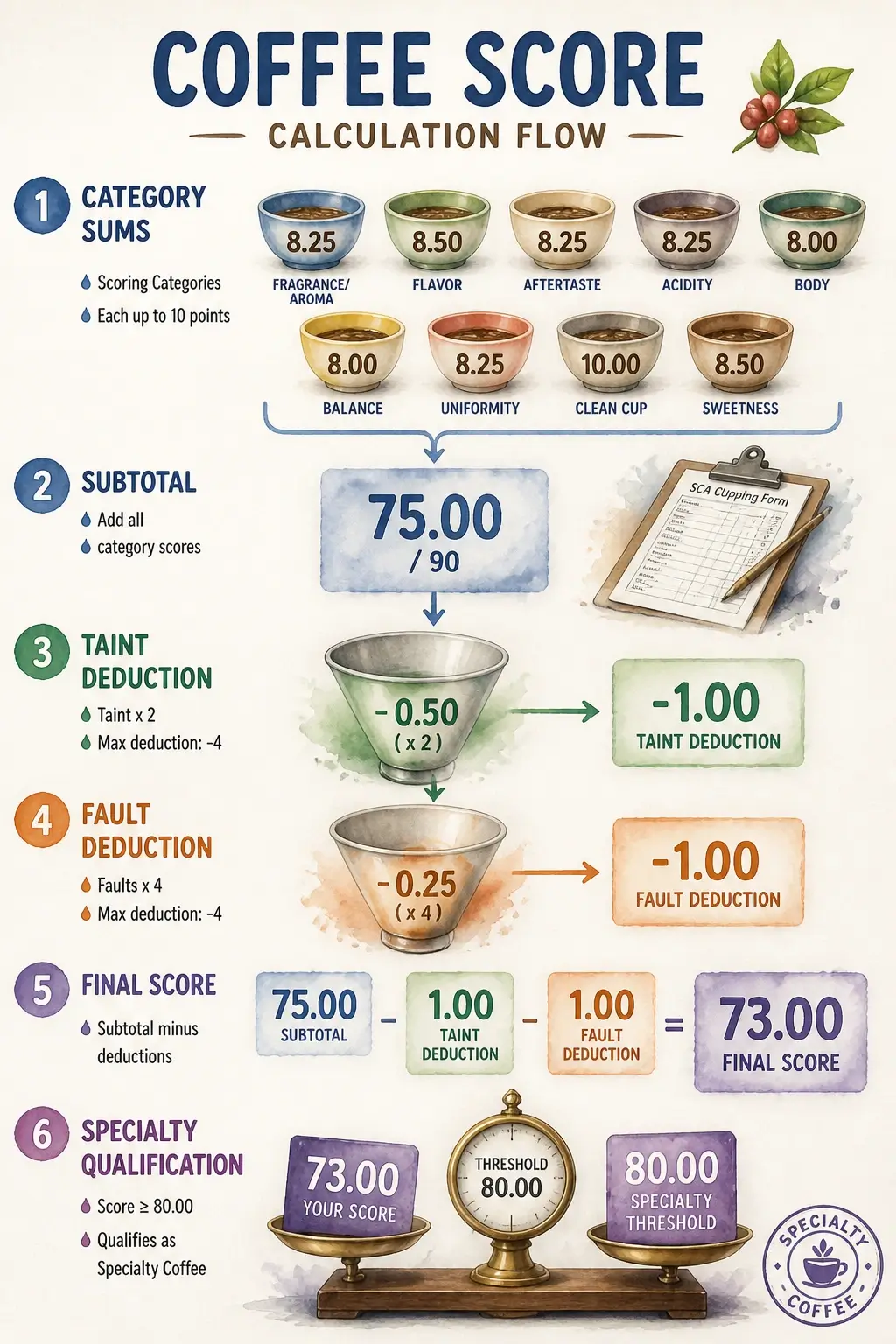
The arithmetic sequence matters. The seven positive attribute categories – Fragrance/Aroma, Flavor, Aftertaste, Acidity, Body, Balance, and Overall – are summed first. Then taint and fault deductions are subtracted from that sum. A coffee with category scores averaging 8.0 across all seven attributes produces a raw sum of approximately 56 from those categories alone, which combines with the Sweetness, Clean Cup, and Uniformity scores to reach the final total. Two identified taints subtract 4 points from that total. The difference between a score that clears 80 and one that doesn’t can be a single defect call.
The Sweetness, Clean Cup, and Uniformity categories feed into this same logic. These categories are not scored on a standard 6-10 scale – they are assessed per cup across five cups, with each clean, sweet, uniform cup contributing 2 points toward a possible 10. A coffee that shows a ferment note in two of five cups loses 4 points from Clean Cup alone. That subtraction happens before the final total is calculated, and it compounds with any taint deductions.
Defect identification requires its own training track. A cupper who cannot reliably identify and name phenolic, ferment, baggy, musty, earthy, and moldy profiles cannot produce valid defect scores – which means they cannot produce valid final scores. This is not a supplementary skill; it is a prerequisite. The positive attribute categories measure what the coffee does well. The defect system measures what it does wrong. Accurate scoring requires both.
The commercial stakes are concrete. A coffee that earns a 79.75 is not specialty coffee. If a cupper misses a single taint that should have been called, they may assign a score of 81 to a coffee that should have scored 79. The implication moves through the entire transaction: the producer gets paid a specialty premium for a non-specialty lot, the importer receives a lot that doesn’t perform as contracted, and the roaster is left explaining to their customers why the coffee doesn’t match the cupping notes.
One significant gap in the industry’s current public discourse is worth naming. Of the major sources covering the CVA transition, only the Torque guide addresses defect mechanics. Both the RoyalNY blog and Daily Coffee News omit defect scoring entirely from their CVA coverage. The new form retains defect subtraction, but the public-facing narrative focuses so heavily on the Descriptive Assessment layer that the defect mechanism has become nearly invisible. A cupper who learns about the CVA exclusively through official announcements and trade publications may assume the new form is purely additive – and systematically over-score defective coffees as a result. The form has not eliminated defects. The conversation simply stopped including them.
The CVA Transition: What’s Actually Changing and What’s Staying the Same
The Coffee Value Assessment is generating contradictory signals in the industry, and that contradiction has real operational consequences for how organizations prepare their cuppers. The clearest way to resolve it is to separate what the CVA actually changes from what it leaves intact.
Continuity in the Coffee Value Assessment (CVA): What Remains Unchanged
The Affective Assessment – the scoring portion of the CVA – preserves the 2004 form’s core architecture almost entirely. The 6.00-to-10.00 scale remains. The 0.25-point increments remain. The 80-point specialty threshold remains. A cupper who has spent years scoring on the old form will find the Affective Assessment immediately familiar.
The CVA is not a scoring overhaul. It is an addition of documentation requirements to an existing scoring methodology. Cuppers who could produce accurate, defensible scores on the old form can still produce accurate, defensible scores on the new one. The critical difference is that the new form asks them to show their work.
This is the most important thing to understand about the CVA’s scope. The RoyalNY blog states explicitly that “nothing has changed in how we determine quality.” That is accurate for the scoring mechanics. Where it becomes misleading is in implying that nothing else has changed – because the Descriptive Assessment layer represents a genuine new skill requirement, not just a form redesign.
New Documentation Requirements in the Coffee Value Assessment (CVA)
The CVA is a two-part system. The Affective Assessment handles scoring. The Descriptive Assessment handles documentation. These two components are designed to work together, and understanding the Descriptive Assessment is where most of the transition work lives.
The Descriptive Assessment captures sensory findings in structured, specific language. It includes intensity scales for key attributes – acidity, bitterness, sweetness – that require the cupper to place each attribute on a defined spectrum rather than simply assigning a numeric score. It includes CATA (check-all-that-apply) flavor descriptors organized by category, giving the cupper a structured vocabulary to document what they perceive. And it includes open-text fields for observations that fall outside the CATA options.
The practical output is different from anything the 2004 form could produce. On the old form, a score of 84 is a number. On the CVA, an 84 comes with documentation: medium-high malic acidity, medium body with silky texture, a short but clean finish, no defects detected. That documentation tells the producer exactly what their coffee did and didn’t do. It gives the importer evidence to support the score. It gives the roaster a starting point for their development profile. The number hasn’t changed. What surrounds it has.
The two structural changes to the scoring section itself are specific and limited. Sweetness is elevated from a defect-check category to a standalone Affective scoring category, meaning sweetness quality – not just sweetness presence – now directly affects the final score. And “Body” is renamed “Mouthfeel,” with explicit differentiation between weight and texture as scoring sub-dimensions. Those are the only changes to the scoring architecture.
The industry’s messaging around the CVA’s magnitude deserves scrutiny. RoyalNY frames it as an enhancement to communication. Daily Coffee News describes it as a “seismic shift.” The SCA’s own announcement positions it as a “landmark achievement.” None of these characterizations are wrong, but none of them are complete. The scoring philosophy is continuous; the documentation requirements are genuinely new; and the validation data – evidence that the CVA produces more reliable inter-rater results than the 2004 form – has not been published publicly. Cuppers who hear “nothing has changed” may skip training and discover too late that they’re expected to produce descriptive documentation they’ve never practiced. Cuppers who hear “seismic shift” may resist adoption, believing their existing skills are being invalidated. The accurate framing is narrower: your scoring skills transfer. Your documentation skills need building.
The Calibration Problem: Why Standardized Forms Don’t Guarantee Standardized Scores
Inter-rater reliability is the metric that would prove the cupping form works as advertised – and it is the metric the industry has not systematically measured. This is the form’s structural ceiling, and it applies equally to the 2004 form and the CVA.
The value proposition of any standardized scoring system is that two trained evaluators applying the same form to the same subject will produce comparable results. In cupping, that proposition has never been formally validated at scale. What we know from practice is that it often doesn’t hold:
The same coffee sample received scores ranging from approximately 65 to 88 across different trained evaluators – a 23-point spread on a form designed to produce objective, consistent results. Source: Coffee Mind
A 23-point range is not measurement error. It is a breakdown of the system’s core function. If ten trained cuppers score the same coffee and produce scores spanning from 65 to 88, the form has not produced an objective result. It has produced ten subjective results formatted to look objective.
The problem is not the form’s design. The problem is the absence of a mechanism that ensures the form is being applied consistently across different cuppers. Category definitions can be written with precision. The sensory experience of applying those definitions cannot be standardized through documentation alone. Two cuppers can read the same definition of “Acidity” and walk away with different anchor points for what a 7.0 versus an 8.0 feels like on the palate. Without a process that surfaces and resolves those differences, the form produces the illusion of objectivity rather than the substance of it.
A genuine calibration protocol requires a specific sequence. Cuppers score the same set of coffees independently, without discussing their impressions beforehand. Then scores are compared, category by category. Any discrepancy larger than 0.5 points on a single category becomes a discussion point – not to force agreement, but to identify the sensory basis for the disagreement. Is it a difference in perception? A difference in how each cupper interprets the category definition? A difference in their personal anchor points for the scale? The goal is not uniform scores. The goal is documented transparency about why scores differ.
This distinction matters practically. A score of 84 documented with “short finish due to slight astringency, medium citric acidity, clean cup across all five samples” is more useful than a score of 86 with no explanation – even if the 86 is more generous. The documented 84 tells everyone in the supply chain exactly what the cupper found. The undocumented 86 tells them nothing except that someone liked the coffee.
None of the three major industry sources covering cupping forms – Torque, RoyalNY, or Daily Coffee News – address inter-rater calibration or reliability. This is not a minor omission. The CVA’s stated purpose, according to RoyalNY, is “better communication” through shared language. But a shared language produces consistent communication only if its speakers assign consistent meanings to the same words. The absence of calibration guidance in the industry’s public-facing education means that organizations adopting the CVA must develop their own internal protocols – or accept that their “standardized” scores are only as standardized as each individual cupper’s last calibration session.
The minimum viable practice is a structured group cupping where scores are compared and discrepancies are discussed immediately, while sensory memory is intact. Not the next day. Not over email. In the room, with the cups still warm. That immediacy is what allows cuppers to connect a specific sensory disagreement to a specific cup, rather than reconstructing the experience from memory. Your scores are only as objective as your last calibration session. If you haven’t compared scores with another trained cupper recently, you are scoring in isolation – and isolation produces drift.
Frequently Asked Questions About SCAA Cupping Form Explained
How is the Overall score different from an average of the other categories?
The Overall score is an independent holistic judgment – whether the coffee’s total experience exceeds or falls short of what its parts suggest. Averaging the other categories and entering that number is a scoring error.
Can a coffee with no detected defects still score below 80?
Yes. If the positive attribute categories and the Sweetness, Clean Cup, and Uniformity scores don’t sum to 80 or above, the coffee doesn’t qualify as specialty regardless of defect status.
Why does Acidity score differently from sourness, even though both are perceived as sharp?
Acidity is a positive attribute describing brightness and liveliness – malic, citric, or phosphoric in character. Sourness is a defect signal indicating fermentation errors or processing failures. They feel similar but originate from different chemistry and score on opposite ends of the form.
How many cups are evaluated per coffee in a standard SCAA cupping, and why does that number matter?
Five cups per coffee. The Sweetness, Clean Cup, and Uniformity categories are each scored per cup, with 2 points available per cup. That structure catches lot-level inconsistency that a single-cup evaluation would miss entirely.
What’s the practical difference between a taint and a fault when you’re at the table?
A taint is identifiable but doesn’t make the cup unpleasant enough to reject – it’s a 2-point deduction. A fault is severe enough that you wouldn’t serve the cup – it’s a 4-point deduction. The call requires you to know both the sensory signature of the defect and its intensity.
If the CVA adds descriptive documentation, does that mean the cupping session takes longer?
Yes, in practice. The Descriptive Assessment’s intensity scales and CATA flavor descriptors require additional time per coffee. Organizations adopting the CVA should expect to adjust their session formats before rolling it out at scale.
Why does calibration need to happen immediately after scoring, not later?
Sensory memory decays fast. A discrepancy you discuss while the cups are still in front of you can be traced back to a specific sensory experience. The same discrepancy discussed the next morning becomes a theoretical debate with no sensory anchor – which produces agreement on paper but not in practice.
Does the CVA change how defect deductions are calculated?
No. The defect subtraction logic from the 2004 form carries over into the CVA’s Affective Assessment unchanged. The public discourse around the CVA has largely ignored this, but taints and faults still subtract 2 and 4 points respectively from the final score.
References
- Tackling Unintentional Coffee Overscoring in Producing Countries | perfectdailygrind.com
- The Evolution of the Coffee Taster’s Flavor Wheel | perfectdailygrind.com
- Color Halo/Horns and Halo-Attribute Dumping Effects within Descriptive Analysis of Carbonated Beverages | Journal of Food Science | doi.org
- The Concept of Quality Pt. 2 | coffee-mind.com