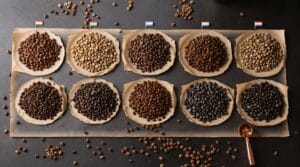
Rigorous SCA coffee cupping protocol steps don’t exist to slow you down – they exist because every uncontrolled variable between green sample and final score is a lie waiting to enter your data. Water chemistry, roast color, grind timing, and steep duration each carry enough influence to shift a borderline lot across the 80-point specialty threshold in either direction.
What follows is the full sequence: environment through calibration, built for roasters, importers, Q Grader students, and QA staff who need results that hold up under scrutiny.
Before diving into the procedural sequence, it is worth understanding the benefits and limitations of cupping to maximize the analytical value you extract from each session.
While these rigorous commercial standards govern professional laboratories, you can easily apply similar sensory evaluation techniques to coffee cupping at home using scaled-down equipment and the same methodical approach.
Key Takeaways on SCA Coffee Cupping Protocol Steps
- Water TDS outside 125–175 ppm invalidates extraction before a single score is written.
- The roast/rest/grind sequence is the hidden failure point – stale roast or pre-ground coffee corrupts the session upstream of the form.
- Undisturbed steeping for four minutes isn’t a preference; any disturbance creates extraction inconsistency that contaminates cup-to-cup comparison.
- The crust break is a diagnostic event – a weak wet aroma signals preparation failure, not a low-quality coffee.
- Three temperature passes reveal different quality layers; a coffee that collapses at cool has a ceiling the hot pass won’t show.
- Calibration against a reference sample is the highest-value step most practitioners skip, and score drift without a correction protocol produces data that can’t be defended.
Prerequisites: Environment, Equipment, and Water Standards
Your cupping environment is an instrument. Before a single gram of coffee is weighed, the room itself must be controlled – no competing aromas, no perfume or scented hand products, consistent neutral lighting that won’t distort your visual read of the liquor, and a clean, unscented work surface. These aren’t hospitality preferences; they’re the conditions under which sensory data stays uncorrupted.
Equipment specifications under the complete specialty coffee cupping standards are non-negotiable starting points:
| Equipment | Specification |
|---|---|
| Digital scale | 0.1g resolution minimum |
| Kettle | ±1°C temperature control |
| Burr grinder | Consistent particle distribution across all samples |
| Cupping bowls | Glass or ceramic, 207–266ml capacity, rim diameter 76–89mm |
| Cupping spoons | 4–5ml capacity |
| Rinse vessel | Hot water, dedicated to spoon rinsing only |
| Timer | Accurate to the second |
Water quality carries more weight than most practitioners realize. The SCA coffee cupping protocol specifies purified water with a total dissolved solids (TDS) target of approximately 150 mg/L (acceptable range: 125–175 ppm). Water that falls outside this window either under-extracts or over-extracts the grounds regardless of how precisely everything else is controlled. Brew temperature at sea level is 93°C, held to ±1°C tolerance. For every 300 meters of elevation gain, the boiling point drops by approximately 1°C – sessions run at altitude require a compensating temperature adjustment to maintain equivalent extraction energy.
The final discipline in this phase is uniformity: water temperature and volume must be identical across every cup and every sample in the session. A single cup poured at 91°C when the rest hit 93°C is not a minor variation – it’s a different extraction, and it invalidates any comparison drawn from that cup.
Here’s a look at a properly configured cupping station before the session begins:

Sample Preparation: Roast, Rest, and Grind Specifications
Sample preparation is where most cupping sessions are already broken before the kettle boils. The coffee must arrive at the brew step in a specific, reproducible state – and the roast/rest/grind sequence is the axis around which everything else rotates.
Roast Color and the Agtron Target
The sample roast should land at Agtron 55–60 on whole bean, a light-medium profile that exposes origin character and defects without layering roast character on top. A darker roast doesn’t just change flavor – it actively conceals the information you’re trying to evaluate. If the sample roast is too dark, you’re scoring the roaster’s decisions, not the coffee’s genetic and processing potential.
The Rest Window
Coffee roasted for cupping must rest a minimum of 8 hours and a maximum of 24 hours after roasting. The session itself must happen within 24 hours of the roast date; beyond that, aromatic compounds begin degrading at a rate that measurably affects fragrance and aroma scores. This window is narrow by design – the protocol is measuring peak expression, not shelf-stable character.
Grind Timing and Distribution
Grind immediately before infusion, with a maximum of 15 minutes between grinding and water contact. Aromatic loss begins almost immediately after grinding; a sample ground 30 minutes early is already a different sample. The target distribution is 70–75% of particles passing through a US #20 sieve (~850µm). Grind that skews coarser under-extracts and suppresses defects that would otherwise register clearly. Grind that skews finer over-extracts and introduces bitterness that masks the attributes you’re trying to isolate.
The SCA cupping form scoring attributes from the protocol are only meaningful when the sample arrives at the cup in this exact state. The form can’t compensate for a preparation error upstream.
The Brew Ratio
The SCA standard ratio is 8.25g of coffee per 150ml of water – approximately 1:18 by weight. All five cups per sample must be weighed and filled to this specification individually. Batch-weighing or eyeballing volume introduces the kind of cup-to-cup variance that contaminates uniformity scores before tasting begins.
The Brew Phase: Pouring, Steeping, and the Undisturbed Crust
Pouring is not passive. The brew phase has a specific sequence, and deviating from it at any point creates extraction inconsistency that will read as a quality problem in the cup – even when the coffee itself is clean.
Begin with a purge: push 5–10g of the next sample’s coffee through the grinder before grinding the actual portion. This clears residual particles from the previous sample and prevents contamination of the dose. Weigh whole beans per cup, grind, and immediately pour 93°C water in a circular motion directly over the grounds, saturating the entire bed evenly. The circular pour isn’t a ritual – it ensures no dry pockets remain at the edges of the bowl, which would create localized under-extraction.
Start your timer at the first pour. Fill all cups to the same level, moving through the sample set consistently. Once poured, the cups steep undisturbed for 4 minutes (the SCA CVA guidance allows a 3–5 minute range, with 4 minutes as the target). Do not touch, stir, agitate, or disturb the surface during the steep under any circumstances. Any disruption creates uneven extraction between cups, and uneven extraction makes cup-to-cup comparison unreliable.
The undisturbed crust forms naturally as CO₂ escapes the grounds and particles float to the surface. This isn’t incidental – the crust acts as a seal that traps volatile aromatic compounds in the liquid below, concentrating them for release at the break. The four-minute steep is the protocol building pressure. The crust break is where that pressure pays off.
Crust Break and Skimming: Wet Aroma and Surface Preparation
At four minutes, move to the first cup and break the crust immediately. Lean in close, place a cupping spoon at the edge of the crust, and use a firm stirring motion to push it through. The wet aroma that releases at this moment is the most aromatic event in the entire session – it’s also the most time-sensitive. Hesitate, and the volatile compounds disperse before you’ve registered them.
The crust break is a diagnostic checkpoint in itself: a strong, clean wet-aroma burst signals proper roast color, adequate rest, and timely grinding. A weak or flat release indicates a stale roast, a sample that over-rested, or grounds that sat too long after milling.
After breaking, skim immediately. Use the spoon to remove floating foam, oils, and ground debris from the surface, leaving a clean, clear liquid. Rinse the spoon in hot water before moving to the next cup – cross-contamination between samples is a real risk at this stage, and a single unrinsed spoon transfer enough aromatic and flavor compounds to distort what you’re about to taste. Use a dedicated clean spoon for each cup in the set if the session size allows.
Skim lightly but thoroughly. A surface left cloudy with oils and fines will coat the palate during the first tasting pass and suppress clarity in the early temperature round. After skimming, allow the liquid to settle – particles need time to sink before the first slurp. Rushing this step trades sensory clarity for clock efficiency, and that’s a trade the protocol doesn’t support.
Here’s a live cupping session demonstrating the crust break, skimming, and early tasting passes in real time:
Tasting Passes: Slurping, Temperature Rounds, and Palate Coverage
Sensory analysis in cupping isn’t a single tasting event – it’s a structured sequence of passes across a temperature gradient, each designed to reveal a different layer of the coffee’s character. Treating it as one pass produces incomplete data.
The Slurp as a Delivery Mechanism
The slurp technique exists for a specific physiological reason: a deep, forceful slurp atomizes the liquid across the entire tongue surface and upper palate simultaneously, coating all taste receptor zones and maximizing volatile compound delivery to the olfactory receptors via retronasal passage. A quiet sip delivers the coffee to the front of the mouth and tells you about sweetness and acidity. A proper slurp tells you everything. Practice until it becomes automatic – the technique is not optional.
Three Temperature Rounds
The session runs three tasting passes as the coffee cools:
- First pass (hot, ~70°C): Fragrance intensity, initial acidity structure, and early flavor character. Body begins to register. Defects that are temperature-sensitive may be suppressed here.
- Second pass (warm, ~50–55°C): The most information-dense round. Acidity, sweetness, balance, and flavor complexity are most clearly differentiated at this stage. Most attribute scoring happens here.
- Final pass (cool, ~35–40°C): Aftertaste persistence, finish cleanliness, and any defects that only emerge as the coffee cools. A coffee that collapses at this stage – losing balance or developing off-notes – has a quality ceiling that the hot pass may have hidden.
Taste all cups within a sample in parallel during each pass: cup A of sample 1, then cup A of sample 2, maintaining the same order across the full set. This parallel structure controls for temperature drift across samples and ensures that comparison happens between equivalent states.
Flavor clarity and balance sharpen at lower temperatures. If a defect only surfaces in the final pass, the cup isn’t automatically disqualified – but it must be noted, and the sample should be re-evaluated with that finding in context. A coffee that shows clean sweetness and balance through the warm pass and develops a mild astringency at cool is a different quality story than one that shows the same astringency at first slurp.
William Ristenpart, Professor of Chemical Engineering and Director of the UC Davis Coffee Center, explains the framework behind temperature’s role in sensory evaluation:
In research conducted through the UC Davis Coffee Center, Ristenpart’s team treated brew temperature as an independent variable – holding extraction yield and brew strength constant by adjusting grind size and brew time – specifically to isolate temperature’s direct effect on sensory attributes like sourness, bitterness, and citrus character. The finding: temperature doesn’t just affect extraction efficiency; it independently shapes which flavor compounds register and at what intensity.
This has a direct implication for cupping practice. The three-pass structure isn’t just about letting the coffee cool – it’s about systematically sampling the same extraction at different sensory windows. A defect that appears at one temperature but not another isn’t a fluke; it’s a data point about which compounds are temperature-sensitive in that particular coffee.
Scoring on the SCA Form: Attributes, Uniformity, and the 80-Point Threshold
Scoring converts sensory experience into a number that can travel – to a buyer, a contract, a sourcing database, a roast adjustment decision. The form’s architecture is what makes that number defensible.
Mastering the mechanics of the evaluation sheet is essential, and you can explore the broader context of sensory documentation in this complete coffee cupping guide.
The Scoring Scale
Each attribute is scored on a 0–10 scale in 0.25-point increments, anchored by four quality descriptors:
| Score | Quality Descriptor |
|---|---|
| 6.00 | Good |
| 7.00 | Very Good |
| 8.00 | Excellent |
| 9.00 | Outstanding |
Scores below 6.00 are possible but indicate significant quality problems. Scores above 9.00 are theoretically available but rarely assigned outside exceptional lots.
The Six Core Attributes
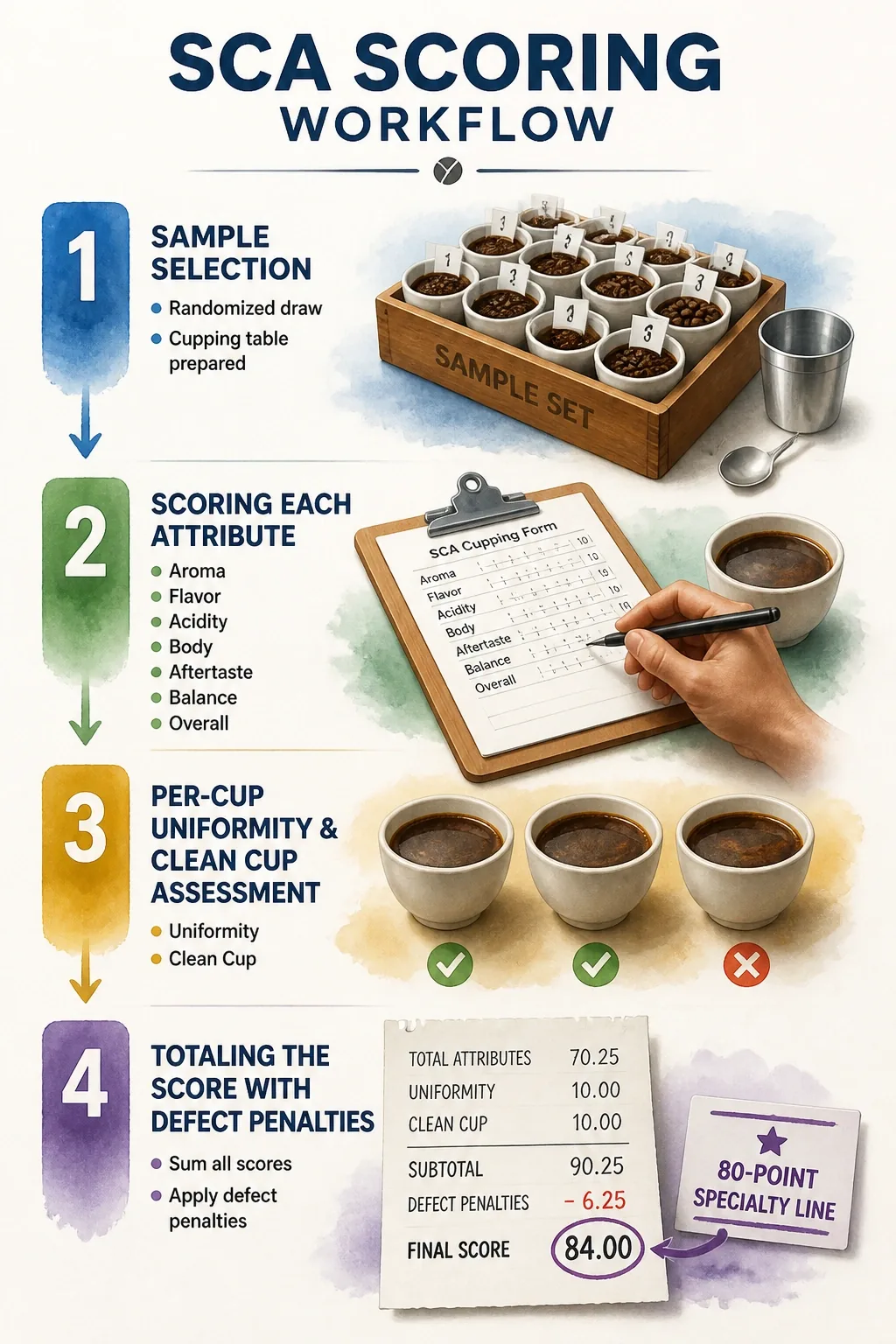
The SCA form scores six primary attributes: fragrance/aroma, flavor, aftertaste, acidity, body/balance, and uniformity. Each attribute score reflects the evaluator’s assessment of that specific quality dimension – not an overall impression. The form’s structure is deliberately granular to prevent one dominant attribute from inflating or suppressing the others.
Each of the five cups per sample is evaluated separately for uniformity, clean cup, and overall assessment. Cup-to-cup variation within a sample is itself a quality signal: a sample that scores inconsistently across its five cups is telling you something about processing or storage that aggregate scoring would obscure.
Defect Scoring
Two categories of defects apply: taints (flavor notes that are present but don’t dominate – phenolic character, mild sourness) and faults (dominant off-notes that define the cup – rubber, hard green, ferment). Taints carry a lower penalty per cup than faults. Both are subtracted from the total score, ensuring that a high attribute score can’t mask a cup that is fundamentally compromised.
The 80-point threshold is where specialty coffee begins. A total score of 80 or above, assessed across the full attribute set with defects accounted for, qualifies a lot as specialty under SCA standards. The form’s multi-attribute structure prevents the halo effect – a single outstanding fragrance score cannot carry a coffee to 80 if its balance, aftertaste, and uniformity don’t support it.
For professionals pursuing Q Grader certification applied in cupping, calibrated accuracy on this form is the core competency being tested.
The Specialty Coffee Association’s own CVA documentation reinforces why roast standardization is a prerequisite for valid scoring:
“The effect of roasting on the variability of coffee flavor shall be minimized, so that flavor variability is due to the variations among green coffees and not due to the differences in roasting conditions.” – SCA Coffee Value Assessment Standards
A score produced from an over-roasted or inconsistently roasted sample isn’t measuring the coffee – it’s measuring the roast. The form can only do its job when the sample arrives in the standardized state the protocol requires.
Roukiat Delrue, an expert coffee consultant who contributed to the development and rollout of the CVA framework, addresses the tension between objective scoring and preference that every evaluator eventually confronts:
Delrue acknowledges that preference cannot be fully removed from quality discussions – and argues that trying to eliminate it entirely creates its own distortions. The CVA’s Affective Assessment component was designed to reduce the mental gymnastics evaluators perform when attempting to suppress their preference responses in order to score “objectively.” Acknowledging the affective dimension, rather than pretending it doesn’t exist, produces more honest and ultimately more useful quality data.
This matters practically at the form level: evaluators who recognize their preference responses and account for them explicitly score more consistently across sessions than those who attempt to eliminate subjectivity entirely. Calibration, discussed in the next section, is what makes that consistency measurable.
The scoring workflow from attribute assessment through the 80-point threshold is mapped out below:
Troubleshooting and Calibration: When Scores Drift and How to Fix It
Calibration is the step that distinguishes a cupping session from a cupping exercise. Every element of the protocol up to this point controls the coffee’s state. Calibration controls the evaluator’s state – and it’s the most consistently skipped step in professional practice.
Common Failure Points
Before troubleshooting scores, identify where the session broke down physically:
- Over- or under-roasted samples produce scores that reflect roast character, not origin character. If the roast color is outside Agtron 55–60, the session data is compromised at the source.
- Stale coffee (beyond 24 hours post-roast, or ground more than 15 minutes before infusion) suppresses fragrance and aroma scores regardless of underlying quality.
- Grind distribution errors – too coarse or too fine – create extraction artifacts that register as flavor defects or mask real defects, respectively.
- Water chemistry drift – TDS outside the 125–175 ppm range, or temperature inconsistency between cups – produces extraction variance that reads as cup-to-cup inconsistency in uniformity scoring.
The Calibration Protocol
A reference sample is the anchor for every calibration session. Use a coffee with a known, documented score from a previous session or from a certified source. Cup it blind alongside the evaluation set, taste it in the same order and at the same temperature passes as the other samples, and compare your score against the reference. If your score on the reference drifts more than 0.5 points from its documented baseline, recalibrate before proceeding.
Blind cupping is the most rigorous calibration format: samples are coded, evaluators score without knowing which coffee is the reference, and scores are compared after the session. This removes anchoring bias – the tendency to score subsequent cups relative to the first one rather than against the absolute quality scale.
Cup-to-Cup Inconsistency
When the same coffee scores significantly differently across its five cups, the correct response is not to average and move on. The inconsistency is itself a finding. Identify the outlier cups, note the variance, and ask whether the inconsistency is procedural (a pour temperature error, a grind distribution problem in one cup) or inherent to the sample (a processing defect that isn’t evenly distributed). If the cause is procedural, the session can be corrected. If it’s inherent, the sample variance becomes part of the quality record.
Score Drift Across a Session
Score drift – when an evaluator’s scores gradually shift upward or downward across a session – is normal and predictable. Palate fatigue, hunger, hydration level, and sensory adaptation all contribute. The correction is straightforward: return to the reference sample, re-cup it in its coded position, and compare your current score against your opening score on that same coffee. Discuss what changed with other evaluators if the session is collaborative. Then return to the set.
The real question score drift raises isn’t “which score is correct?” It’s “what condition changed, and is that condition within the protocol’s control?” If it is – temperature drift, a grinder that ran hot mid-session, a water batch with different TDS – fix it and re-cup the affected samples. If it isn’t – evaluator fatigue after a long session – acknowledge the limitation and weight the later scores accordingly.
Frequently Asked Questions About SCA Coffee Cupping Protocol Steps
What are the steps involved in the coffee cupping procedure?
The sequence runs: environment setup, equipment and water verification, sample roasting and resting, grinding immediately before infusion, brewing with a 4-minute undisturbed steep, crust break and skimming, three tasting passes at decreasing temperatures, and scoring on the SCA form with defect subtraction.
What is the SCA standard cupping ratio for coffee?
It’s 8.25g of coffee per 150ml of water, roughly 1:18 by weight. Each of the five cups per sample is weighed and filled individually – batch-filling introduces the cup-to-cup variance that undermines uniformity scoring.
What is a good coffee cupping score?
80 points or above on the SCA scale qualifies a lot as specialty. Scores of 85+ indicate a distinguished lot, and anything above 90 is considered exceptional. Below 80, the coffee is commercial grade regardless of individual attribute highlights.
Why does grind timing matter so much in cupping?
Aromatic compounds begin volatilizing within minutes of grinding. A sample ground 30 minutes before infusion has already lost measurable fragrance intensity – which means fragrance and aroma scores reflect degradation, not the coffee’s actual potential.
Can you cup coffee roasted more than 24 hours ago?
Technically yes, but the SCA protocol specifies roasting within 24 hours of the session for a reason. Beyond that window, aromatic loss is significant enough to suppress scores in a way that misrepresents the coffee’s quality.
Why do evaluators slurp instead of sipping?
A forceful slurp atomizes the liquid across the full tongue surface and drives volatile compounds retronasally to the olfactory receptors – the same receptors responsible for most of what we call “flavor.” A quiet sip delivers coffee mostly to the front of the mouth and misses a significant portion of the sensory picture.
What’s the difference between a taint and a fault on the SCA form?
A taint is a defect that’s present but doesn’t dominate the cup – it nudges the score down. A fault is a dominant off-note that defines the cup and carries a heavier per-cup penalty. Both are subtracted from the total, but a fault in even one cup can push a sample below 80.
How often should a cupping panel recalibrate during a session?
Any time score drift exceeds roughly 0.5 points on the reference sample, or whenever a procedural variable – water temperature, grinder heat, batch TDS – has changed mid-session. For long sessions covering many samples, a mid-session recalibration pass is standard practice in serious QA environments.
References
- Just Published: Brewing Temperature and the Sensory Profile of Brewed Coffee | sca.coffee
- CVA in Action: Affective Assessment | sca.coffee
- SCA Coffee Value Assessment – CVA 102 | sca.coffee