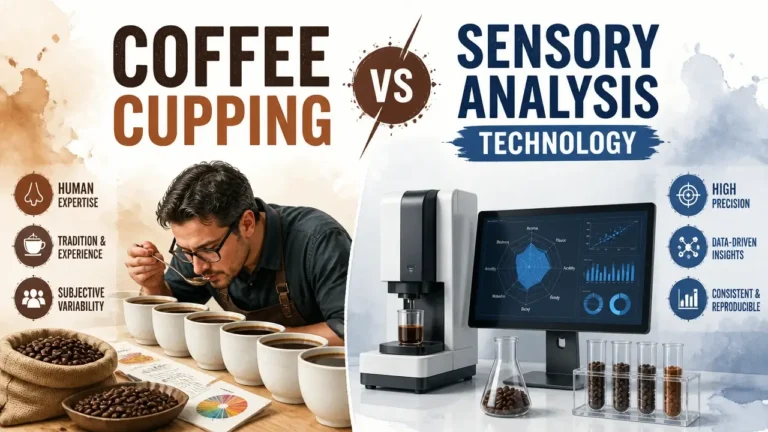

Rigorous coffee cupping vs sensory analysis technology comparisons rarely survive contact with real operational data. Most quality programs inherit their evaluation method by default – a cupping table because that’s what specialty coffee does, or a spectrometer because a vendor made a compelling pitch – without ever stress-testing either tool against the demands of the actual workflow.
The choice matters more than most operations realize. Bias, throughput limits, and defensibility gaps in your evaluation chain translate directly into buying errors, supplier disputes, and product inconsistency. The evidence from both the SCA and emerging analytical platforms like Demetria points toward the same conclusion: the question was never which method wins. It’s which method belongs where.
Key Takeaways on Coffee Cupping vs Sensory Analysis Technology
- No evaluation method is universally superior; the right tool depends on which performance dimensions – accuracy, consistency, speed, cost, objectivity, scalability – matter most for your operation.
- The SCA cupping form carries a structural dark-roast penalty that no amount of calibration removes, systematically under-scoring coffees roasted beyond light-medium.
- Instrumental methods dominate on consistency and throughput, but their accuracy ceiling is the quality and diversity of the calibration model behind them.
- QDA’s separation of intensity scoring from value assignment makes evaluation bias visible and governable – the structural advantage that allowed Cafe Imports to scale from 2,000 to 5,500 samples annually.
- Technology cannot replicate the affective, integrated sensory experience that makes a coffee memorable; creative green selection and brand narrative still require a trained human palate.
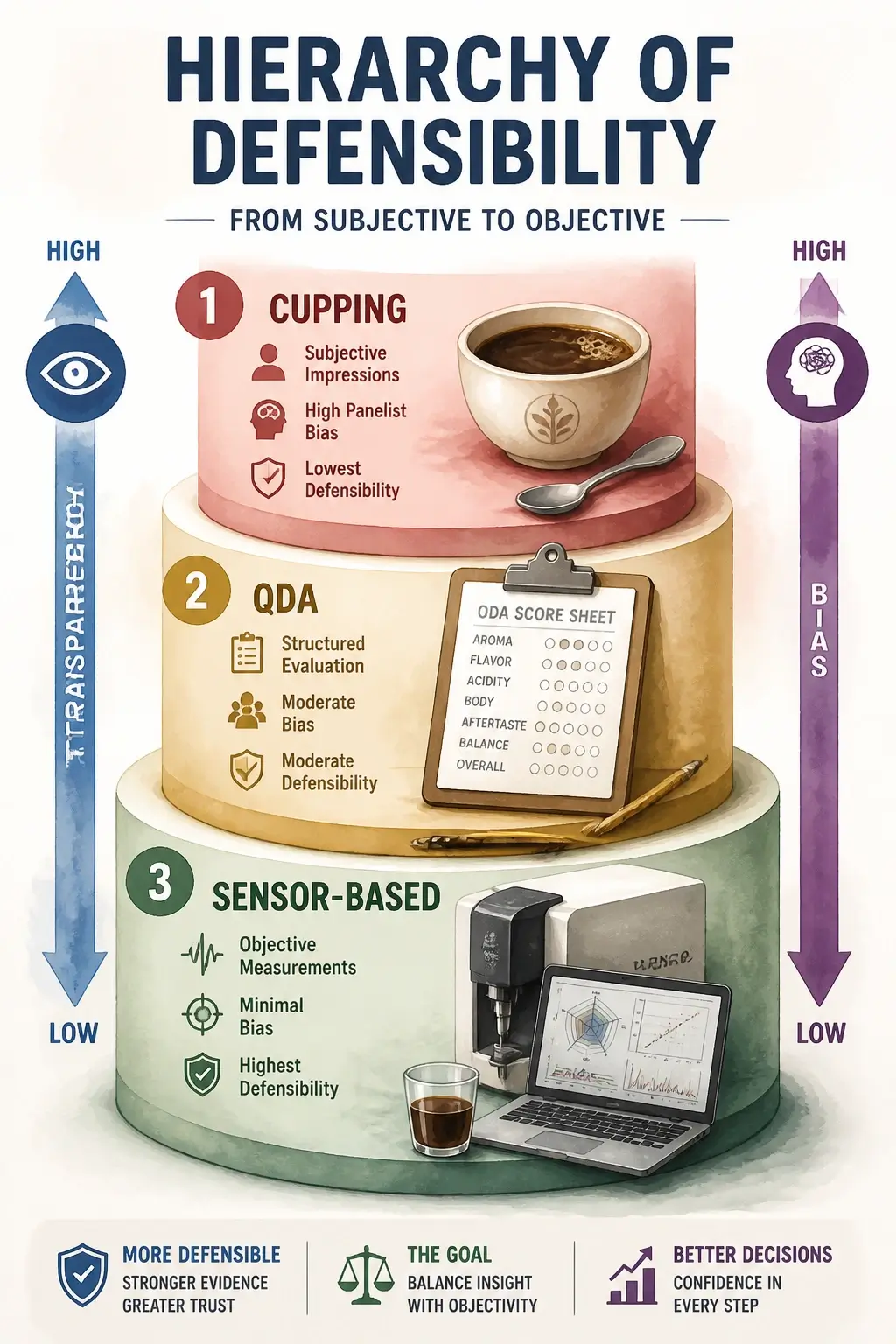
- The defensibility hierarchy runs from SCA cupping (fast, standardized, biased) through QDA (transparent, scalable) to full deconstructive methods – match your method to your actual risk exposure.
What Any Evaluation System Must Actually Prove
No single evaluation method is the universal best. That sentence is worth sitting with before any comparison begins, because the entire industry debate – cupping versus sensors, human versus machine – collapses the moment you ask: best for what? The right tool depends entirely on which performance dimensions matter most for a given operation, and most operations have never mapped those dimensions explicitly.
Here are the six that every quality system must answer for:
Accuracy asks whether the assessment matches trained consensus. Does the score your method produces align with what a calibrated expert panel would conclude on the same sample? Consistency splits into two sub-problems: inter-rater agreement (do two evaluators score the same cup the same way?) and session-to-session repeatability (does the same evaluator score the same coffee the same way on Tuesday as on Friday?). Speed measures the window from raw sample to actionable decision – relevant the moment your sample queue exceeds what a single panel can process before fatigue degrades judgment.
Total cost of ownership goes beyond the price tag on a spectrometer or the salary of a Q-grader. It includes training time, calibration maintenance, software licensing, and the hidden cost of evaluation errors that slip through. Objectivity is the most misunderstood dimension in this list. It does not mean eliminating human judgment. It means reducing the influence of personal preference on a score that is supposed to represent market quality. A cupper trying to evaluate on behalf of their target consumer is still making a subjective call – just an informed one.
Sensory completeness is the hardest to quantify: does the method capture the full sensory experience – aroma, flavor, body, aftertaste, and defect character – or does it reduce the coffee to a biochemical proxy that correlates with those attributes but never actually is them?
Then there are two dimensions the industry rarely names explicitly. Scalability – raw sample throughput per day – exposes operational ceilings that only become visible at volume. And fairness across diverse green profiles – different processing methods, roast levels, origins – reveals structural biases baked into the scoring instrument itself. A method that works perfectly for washed Ethiopians may systematically misgrade anaerobic Colombians. That hidden asymmetry is where real evaluation programs break down.
“Cupping results are affective – they do not reflect an objective property of coffee, but the cupper’s judgment about the coffee quality. Such judgment may be more or less ‘inter-subjective,’ inasmuch as the cupper tries to cup on behalf of their market’s preferences as opposed to personal liking, but it remains subjective – and there should not be right or wrong answers for affective judgments.” – From the Specialty Coffee Association
The SCA’s own framing here is precise and worth taking seriously. Affective judgment is not a flaw to engineer out of the system. It is the purpose of cupping. The problem only emerges when an affective tool gets deployed as if it were a measurement instrument – when a score that reflects a cupper’s informed impression gets treated as an objective property of the bean.
Felipe Ayerbe, CEO and co-founder of Demetria, describes his platform’s approach as training sensors the same way you train a human cupper – running the certification process, but replacing taste and smell with biochemical marker detection and AI. The result, he argues, is an accurate predictor of cupping analysis outputs, not a replacement for the judgment behind them.
That framing matters. Demetria isn’t claiming to make the affective call for you. It’s claiming to predict what a trained human panel would say. The distinction is subtle but operationally significant: the machine tells you what the cupper would score; it still can’t tell you whether that score should make you buy the lot.
Inside Sensory Analysis Technology: How the Hardware Actually Reads Coffee
Sensory analysis technology in coffee quality assessment runs on three core analytical techniques, and understanding what each one physically measures is the only way to evaluate vendor claims with any rigor.
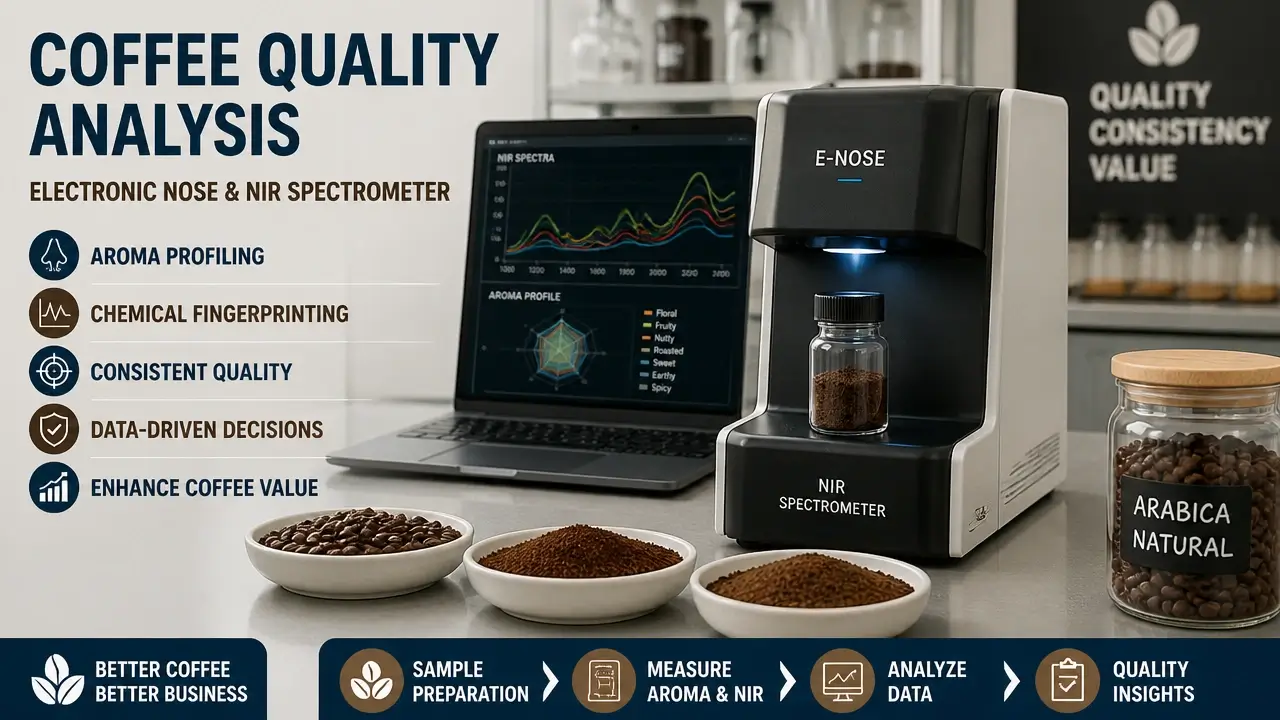
Near-infrared spectroscopy (NIR) works by bouncing specific wavelengths of light off a coffee sample – green, roasted, or ground – and measuring which wavelengths get absorbed. Different chemical compounds absorb light at different wavelengths. The resulting absorption pattern is a spectral fingerprint. NIR doesn’t directly detect flavor; it detects the chemical composition that correlates with flavor attributes. Moisture, lipid content, chlorogenic acid concentration, sucrose levels – these are the signals NIR reads, and a calibration model translates them into sensory predictions.
Electronic nose (E-nose) sensor arrays work differently. They expose a sample’s volatile headspace – the aromatic gases released by the coffee – to an array of sensors, each sensitive to different chemical classes. No single sensor identifies a specific compound; the pattern across the full array is what carries the information. That pattern gets processed through multivariate statistical analysis to produce a “volatile fingerprint” that can be matched against reference profiles for specific flavor attributes or defect signatures.
Mass spectrometry-based electronic nose (MS-EN) systems push the resolution further. Instead of a sensor array approximating compound classes, MS-EN actually measures the mass-to-charge ratios of individual aroma molecules. The output is far more granular – you’re not just getting a pattern, you’re getting a molecular inventory. The tradeoff is cost and throughput; MS-EN systems are slower and more expensive than standard E-nose arrays.
The workflow across all three technologies follows the same basic structure: sample preparation, sensor or spectrometer reading, multivariate data analysis (typically principal component analysis or partial least squares regression), and then attribute prediction – an output like “fruity intensity: 7.2” or a binary defect flag. Modern AI flavor prediction models sit on top of this pipeline, trained on human panel data to translate sensor outputs into the SCA flavor wheel language that buyers and roasters actually use.
That last point is where the ceiling lives. The model’s accuracy is bounded by the quality, diversity, and size of its training dataset. A model trained predominantly on washed Central Americans will underperform on wet-hulled Sumatrans. A model trained on light roasts will lose predictive accuracy as roast degree increases. The sensor hardware is only as useful as the human expertise that built the reference library behind it.
One widely repeated industry claim is worth pausing on: the assertion that coffee contains “over 800 aromatic compounds,” invoked to explain why human evaluation remains irreplaceable. The number appears across professional literature and vendor materials, but no source in the published analytical chemistry record – including SCA foundational texts – traces it to a single verifiable study. Depending on the publication, the count ranges from 800 to over 1,200. The figure functions as a rhetorical anchor more than a reproducible measurement. This matters because every prediction model is built on an assumption about what “complete” chemical coverage looks like. If the true volatile landscape of roasted coffee is still incompletely mapped, then every sensor system – regardless of its hardware resolution – is predicting against an unvalidated ground truth.
The practical line to draw: these tools are well-validated for routine screening – defect detection, lot-to-lot consistency checks, incoming green uniformity. The claim of fully replacing a descriptive cupping panel is a different, harder argument, and the research literature is careful to distinguish between the two use cases.
The Case for Coffee Cupping: What the Palate Catches and What It Quietly Distorts
Coffee cupping gives you something no spectrometer can generate: a lived, integrated sensory experience. Aroma, flavor, body, and aftertaste arrive simultaneously as a gestalt – not as separate data channels to be reassembled by an algorithm, but as a single impression processed by a human nervous system that evolved to care about exactly this kind of experience. A trained cupper can detect “silky mouthfeel” as a tactile sensation, identify “jasmine that resolves to stone fruit” as a temporal arc, and flag a fermentation defect as something that just feels wrong before they can name the compound responsible. No current sensor array captures temporal flavor development or mouthfeel as a continuous perceptual event.
The practical case for cupping is also the simplest one in this entire comparison: it costs almost nothing to start. A kettle, a scale, a grinder, clean cups, and a trained palate. For a small-batch roaster evaluating 200 green samples a year, the infrastructure investment is trivial. The evaluation is immediate, flexible, and directly connected to the sensory experience the end consumer will have.
Then there are the real costs that rarely appear in the pro-cupping argument. Palate fatigue sets in after roughly 40 to 60 samples, and the degradation is not dramatic – it’s subtle and invisible to the cupper experiencing it. Scores drift. Threshold sensitivity drops. The cupper doesn’t feel less accurate; they just are. Inter-cupper disagreement persists even among calibrated Q-graders on granular attribute scores, particularly on intensity ratings for acidity and specific flavor descriptors. Calibration sessions reduce random error – they bring panels into tighter alignment on shared references – but they cannot eliminate systematic bias, because systematic bias is baked into the scoring instrument, not the individual cupper.
That last point is where the cupping ritual’s fault line runs deepest.
A peer-reviewed study published in Foods examined 12 specialty coffees and commercial blends evaluated by 56 expert tasters. The penalty analysis of just-about-right ratings found that coffees described as “too dark roast” and beverages with “too dark color” carried the single largest negative impact on overall quality scores – a systematic dark-roast penalty that held across SCA Q-grading and internal company protocols, and across cupping, drip, pour-over, and espresso preparations.
This is not a training failure. It is a structural feature of the SCA scoring protocol. A coffee of identical green quality will receive a lower score simply because it was roasted beyond a light-medium level. No amount of panel calibration removes that penalty, because the penalty is embedded in the scale’s value architecture, not in the individual cupper’s judgment.
The processing-method problem compounds this. Cafe Imports’ Ian Fretheim articulated the core issue with a precise analogy: judging a stout by lager standards. The universal SCA cupping form collapses washed, natural, and wet-hulled coffees into a single scoring framework. The ferment-forward, fruit-driven characteristics that define high-quality naturals – the very attributes that make them distinctive and valuable – get penalized by a scale calibrated around the clean, bright, transparent profile of a well-processed washed coffee. The promise of cupping as a neutral evaluator breaks down exactly at the edges where specialty coffee’s most interesting work is happening.
Understanding how cupping improves quality control in a real operation requires holding both truths at once: the ritual is irreplaceable for holistic sensory judgment and creative direction, and it carries systematic biases that no calibration protocol fully corrects.
The Case for Instrumental Sensory Analysis: What Scale Reveals About Human Limits
Instrumental sensory analysis earns its place in quality programs through one argument that is genuinely hard to refute: it doesn’t get tired. The same NIR scan or E-nose reading on sample 4,800 produces output with the same precision as sample one. There is no drift, no hunger, no lingering impression from the previous lot. For operations running high sample volumes, that consistency is not a convenience – it’s an operational necessity.
The data these systems generate is also archivable in a way that human cupping notes simply are not. A spectral fingerprint or sensor array output can be stored, queried, and trended across months or years. A quality manager can pull every NIR scan from a specific origin across three harvest cycles and ask whether the lot’s moisture profile is drifting. A human cupping archive of equivalent depth would require extraordinary documentation discipline and still carry the inter-cupper variation problem through every historical data point. Longitudinal quality tracking at scale is a genuine capability advantage for instrumental methods.
The entry barrier is real and should not be minimized. Upfront capital costs for a quality NIR system or E-nose platform run into the tens of thousands of dollars before calibration model development and staff training. Interpreting multivariate output – understanding what a principal component plot actually tells you about lot-to-lot variation – requires analytical competence that most traditional Q-grading programs don’t build. The investment is recoverable at volume, but it is front-loaded and non-trivial.
The research consensus on what these tools can and cannot do is fairly settled: they predict specific sensory attributes with high accuracy for routine quality control applications, but they lack the nuance of human experience required for new product development and affective evaluation. The optimal deployment is “efficient routine control” – not panel replacement.
The throughput data from Cafe Imports illustrates where the operational inflection point actually sits. Before 2011, the company processed roughly 2,000 samples per year through traditional affective cupping. By 2016, after transitioning to a Quantitative Descriptive Analysis (QDA) model – which separated attribute intensity scoring from value judgment, and introduced processing-specific scoring standards beginning in 2013 – the same team was handling approximately 5,500 samples annually. That’s nearly a threefold increase in sample volume without sacrificing reproducibility.
The structural reason QDA achieved this matters more than the numbers. In affective cupping, the evaluator simultaneously rates an attribute’s intensity and decides whether that intensity is desirable – a value judgment made in the moment, inside the cupper’s head, never documented in a way that can be audited or reproduced. QDA decouples these tasks. The panel records intensity values on a neutral scale. The value assignment – what intensity level constitutes a “good” score for a given attribute in a given context – is made administratively, pre-decided, visible, and open for revision. A lab can decide collectively that a specific level of ferment character in a natural coffee is desirable, encode that decision once, and apply it consistently across 5,500 evaluations. The bias doesn’t disappear; it becomes governable.
This transparency also makes the system structurally fairer to non-traditional processing methods. When value assignments are explicit and revisable, a coffee’s score is no longer a mysterious outcome of one cupper’s palate on one morning. It becomes a documentable, debatable metric – which matters considerably when you’re defending a purchasing decision to a supplier or justifying a rejection to a buyer. For a deeper look at the benefits and limitations of coffee cupping as a standalone quality tool, the tradeoffs become even clearer in the context of high-volume operations.
Head-to-Head: Cupping vs. Technology Across Every Dimension That Determines Your Bottom Line
The evidence from the previous sections doesn’t point to a winner. It points to a map. Here’s what that map looks like when every performance dimension is placed side by side.
Quantitative Performance: Accuracy, Consistency, and Speed
Accuracy in both methods comes with error bands – just different kinds. Human cupping achieves strong consensus on broad quality tiers: a panel of calibrated Q-graders will reliably agree on whether a coffee scores in the low 80s versus the high 80s. Where the method diverges is on granular attribute scores – specific intensity ratings for acidity, body, or individual flavor descriptors. Inter-cupper variation on these fine-grained calls is well-documented, even among trained panels. Instrumental methods deliver repeatable values on the same sample, but their accuracy ceiling is the calibration model. A model trained on insufficient diversity produces systematically wrong predictions for profiles outside its training distribution. Both methods are accurate within their domain of validity. Neither is accurate beyond it.
Consistency is where technology wins without qualification. Inter-session and inter-instrument variation in NIR and E-nose systems is orders of magnitude lower than inter-cupper variation, even among calibrated human panels. The same sample scanned twice on the same day produces effectively identical output. The same sample evaluated by two Q-graders on the same day does not.
Speed and cost follow a crossover curve. A trained cupper can evaluate 50 to 100 samples per day before fatigue meaningfully degrades judgment. An NIR or E-nose system can screen hundreds of samples in the same window, with per-sample costs dropping well below labor costs after initial capital recovery. At low sample volumes, the human cupper wins on cost. At high volumes – the 2,000-plus-samples-per-year threshold where programs like Cafe Imports’ QDA transition start making operational sense – the math inverts.
For a direct look at how these performance tradeoffs play out in a professional training context, this video on the XORXIOS AURA system demonstrates the practical calibration workflow that bridges sensor-based screening and expert sensory judgment:
Bias, Sensory Completeness, and Why the Smartest Operations Use Both
Bias is where the comparison gets structurally interesting. Cupping’s dark-roast penalty is not a training problem – it is an instrument problem. The SCA form’s value architecture systematically depresses scores for coffees roasted beyond light-medium, regardless of green quality. Technology’s bias is a different kind: it lives in the training data. A model built on diverse roast levels, processing methods, and origins is structurally fairer to non-traditional profiles than the universal SCA form. But a model built on a narrow dataset is worse than cupping, not better, because it produces confidently wrong predictions with no visible signal of its own failure.
Sensory completeness remains the clearest advantage of the human palate. No current analytical platform captures the affective, integrated, temporally dynamic experience of tasting a coffee – the way a floral note opens and then resolves, the persistence of a clean finish, the tactile quality of body as a physical sensation. These are not secondary attributes. For creative green selection, blend development, and the brand narrative that justifies a premium price point, they are the entire point. Technology cannot make a coffee go from “technically acceptable” to “a story worth telling.” Only a human taster can do that.
The research consensus and the practitioner evidence both point to the same structural recommendation: these methods are not interchangeable, and the operations that treat them as substitutes pay for it in either creative stagnation (over-reliance on sensors) or operational fragility (over-reliance on human panels at scale). The smartest programs use technology for routine QC and reserve expert human evaluation for complex, creative, and affective decisions.
The Cafe Imports QDA transition makes this defensibility argument concrete. In the old affective model, a score was a decree – the cupper’s internal value judgment was locked inside the number, invisible and unauditable. In QDA, the administrative value assignment makes that judgment visible and revisable. When the Coffee Cuality method reported in peer-reviewed research extends this further – using just-about-right scaling, check-all-that-apply attribute mapping, and open-comment justification – the result is the most transparent and auditable evaluation model currently described in the literature. It has not yet been validated at commercial scale, but its direction is clear: the hierarchy of defensibility runs from SCA affective cupping (fast, standardized, structurally biased) through QDA (transparent, scalable, processing-fair) to full deconstructive methods (maximally auditable, not yet proven at volume).
The Verdict: Matching Your Evaluation Method to Your Operation’s Actual Demands
Cupping and sensory technology are complementary. The question every quality professional needs to answer is not which one is better – it’s which one belongs where in their specific workflow. The evidence across accuracy, bias, throughput, and defensibility points to a two-track model: technology screens the routine, humans curate the exceptional.
What that looks like in practice depends on who you are.
Small-batch specialty roaster with fewer than 500 samples per year: Cupping remains the backbone of your quality program and your creative identity. It’s how you select greens, develop products, and build the sensory story your customers pay for. A low-cost NIR spectrometer used for incoming defect screening on new lots is a reasonable supplement – it catches moisture anomalies and gross defect profiles before they reach your roaster. But the soul of your evaluation chain lives at the cupping table. Consider Q-Grader credentials not as a certification endpoint but as a calibration discipline – while carrying the clear-eyed awareness that the SCA form carries a dark-roast and processing-method bias you’ll need to consciously correct for when evaluating naturals or darker profiles. Occasional processing-specific calibration sessions with your panel will do more for evaluation fairness than any sensor.
Large-scale importer or commercial roaster handling 2,000-plus samples per year: The Cafe Imports QDA transition is the most directly applicable case study in the industry. The shift from affective SCA-style scoring to analytic QDA – with explicit, administratively assigned value thresholds and processing-specific standards – is what made a threefold increase in sample throughput possible without sacrificing reproducibility. Implement an analytic sensory program for routine lot approval and consistency tracking. Maintain a trained human panel for periodic calibration, new-origin exploration, and affective validation. The return on that infrastructure investment compounds over time as your spectral and sensor archives deepen into longitudinal quality data your competitors can’t match.
Quality control manager requiring defensible documentation: Your exposure to risk is supplier disputes, buyer rejections, and internal audit failures – situations where “the cupper said so” is not a sufficient answer. Adopt a transparent, deconstructive evaluation method – whether QDA, the Coffee Cuality framework’s JAR scaling and CATA attribute mapping, or sensor-based attribute logging – so that every score is backed by an auditable evidence chain. This doesn’t replace cupping; it makes cupping decisions justifiable. A score that can be traced to documented intensity values and explicit value assignments is a score you can defend in a negotiation. A score that lives inside a cupper’s impression cannot be.
The professionals who will build the most resilient quality programs in the next decade are the ones who master the handoff between these two tracks – who know exactly when to trust the sensor and when to trust the spoon, and can explain why.
Frequently Asked Questions About Coffee Cupping vs Sensory Analysis Technology
Can an electronic nose replace a Q-grader for green coffee purchasing?
Not for the full purchasing decision. E-nose systems can screen for defects and lot consistency with high reliability, but they can’t make the affective judgment – whether this coffee’s specific profile is worth a premium price for your market – that green buying actually requires.
How many samples per day does palate fatigue start affecting cupping scores?
Most sensory research places the meaningful degradation threshold somewhere between 40 and 60 samples. The tricky part is that the cupper rarely notices the drift; their confidence stays constant while their threshold sensitivity drops.
Why do NIR models sometimes fail on coffees from new origins?
Because NIR predictions are calibration-dependent. The model learned to associate specific spectral patterns with specific sensory attributes using a reference dataset. A new origin with a different biochemical profile – different variety, processing, altitude – may sit outside that learned distribution, producing predictions that are confidently wrong.
Is QDA the same thing as the SCA cupping protocol?
No. QDA separates the tasks of rating attribute intensity and assigning quality value, which the SCA form conflates into a single score. QDA panels record intensity on a neutral scale; the value threshold is set administratively and is revisable. The SCA form asks the cupper to do both simultaneously, hiding the value judgment inside the score.
What’s the most cost-effective entry point for instrumental screening at a small roastery?
A benchtop NIR unit for incoming green lot screening is the lowest-cost, highest-return starting point. It catches moisture and gross compositional anomalies before roasting, without requiring the full multivariate analytical infrastructure of an E-nose or MS-EN system.
Does processing method bias in cupping affect commercial grades, or only specialty?
It shows up across both, but the practical impact is sharpest in specialty. Commercial grading tends to use simpler defect-count frameworks that are less sensitive to the flavor profile biases in the SCA form. Specialty scoring’s emphasis on flavor complexity is precisely where the washed-coffee calibration of the SCA scale does the most damage to naturals and wet-hulled profiles.
How do sensor-based systems handle seasonal variation in the same origin?
Inconsistently, unless the calibration model is updated with each new harvest cycle. A model trained on last year’s harvest from a specific farm may drift in accuracy as the biochemical profile of this year’s crop shifts with weather, fermentation practice, or processing changes. Regular model recalibration is an ongoing cost that vendors don’t always emphasize upfront.
Can the Coffee Cuality method be used at commercial scale today?
The peer-reviewed evidence supports its validity as an evaluation framework, but high-throughput commercial validation hasn’t been published yet. It’s the most transparent and auditable method currently described in the literature – the right direction, but not yet proven at the sample volumes a large importer would need.
References
- How Do Cuppers Cup? Evaluating and Evolving Elements of the SCA Cupping Protocol | sca.coffee
- With AI-Powered Green Coffee Analysis, Demetria Closes $3 Million Round | dailycoffeenews.com
- Validation of the Coffee Cuality™ Method for the Expert Assessment of Coffee Sensory Quality | doi.org
- How Coffee Cupping Improves Quality Control in Specialty Coffee | coffeefactz.com
- Benefits and Limitations of Coffee Cupping: An Honest Assessment | coffeefactz.com