
The original SCAA cupping protocol defined specialty coffee evaluation for two decades. Then the Specialty Coffee Association of America merged with its European counterpart in 2017, and the standards body that owned that protocol ceased to exist. What replaced it isn’t a minor revision.
The SCA’s Coffee Value Assessment, finalized in 2024, splits evaluation into two distinct assessments grounded in modern sensory science. If you’re still printing the old PDF form for professional sessions, you’re working from a document the industry has formally retired.
Key Takeaways on SCAA Cupping Protocol
- The SCAA merged with the SCAE in 2017; the SCA now owns all official cupping standards and the SCAA brand is historical.
- The 2004 SCAA cupping protocol was formally replaced by the SCA Coffee Value Assessment in 2024; the old PDF form is obsolete for professional use.
- The CVA separates Descriptive Assessment (what the coffee tastes like, 0-15 intensity scale) from Affective Assessment (how much you like it, 0-10 scale) to eliminate halo-effect bias.
- Water quality is now formally specified: TDS 125-175 ppm, neutral pH, no off-odors; most tap water fails this requirement.
- Roast must hit Agtron Gourmet 58 whole-bean and 63 ground, rested 8-24 hours before cupping; production roasts are not acceptable.
- Calibration before every evaluative session is mandatory; five cups per sample is the statistical minimum for defensible data.
Why the SCAA Protocol Is Now the SCA Cupping Protocol
The SCAA cupping protocol you trained on is no longer the official standard, and the organization that published it no longer exists as a separate entity. In 2017, the Specialty Coffee Association of America (SCAA) merged with the Specialty Coffee Association of Europe (SCAE) to form a single global body: the Specialty Coffee Association (SCA). The SCA became the sole custodian of cupping standards from that point forward. The SCAA brand is now historical.
That merger alone didn’t change your workflow. What changed it was the SCA’s decision to replace the 2004 SCAA protocol entirely. In 2024, the SCA formally adopted the Coffee Value Assessment (CVA) as the new official standard. The old single-form, 10-attribute evaluation is now obsolete. For certification, Q-grading, and credible green-coffee trade, the CVA is what the industry requires.
The reason for the overhaul wasn’t bureaucratic housekeeping. The original protocol was built as a screening tool. It was effective for its time, but it bundled sensory description and quality judgment onto the same form, which introduced cognitive bias into professional evaluations. The CVA addresses that structural problem directly, aligning the protocol with contemporary sensory science. The Cupping Committee didn’t redesign the ritual. They redesigned the logic underneath it.
SCA Technical Officer Mario Fernández described the adoption as a landmark achievement for specialty coffee, one that reflects years of collaborative research and significant input from early adopters and domain experts across the industry.
That framing matters. This wasn’t a top-down mandate handed down by a standards committee. It was a multi-year research process with working professionals at the table. The CVA is the output of that process, and it’s the framework everyone in specialty coffee now operates under.
The SCA Coffee Value Assessment: A New Evaluation Framework
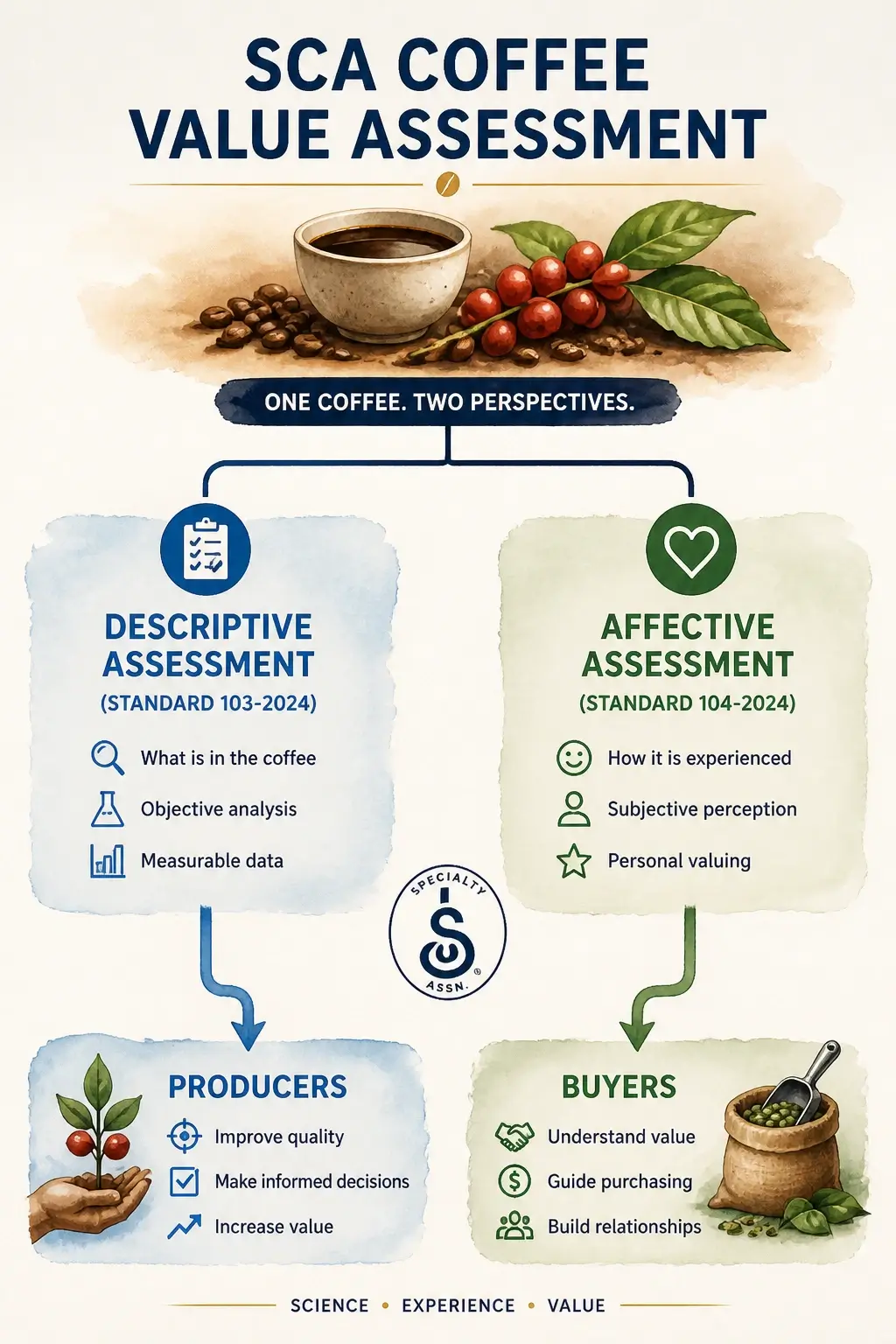
The SCA Coffee Value Assessment isn’t a new form. It’s a new architecture. The CVA is a multi-standard system built across three documents: SCA Standard 102-2024 (Sample Preparation and Tasting Mechanics), SCA Standard 103-2024 (Descriptive Assessment), and SCA Standard 104-2024 (Affective Assessment). Each standard governs a distinct phase of evaluation, and that separation is the point.
The fundamental split is between two types of questions a cupper is actually answering. Standard 103-2024 governs the Descriptive Assessment, which asks: what is in this cup, and at what intensity? It records sensory attributes without any judgment of whether those attributes are good or bad. A high-intensity acidity is noted as high-intensity acidity. Nothing more. Standard 104-2024 governs the Affective Assessment, which asks: how much do I like this? It captures the quality impression, the subjective liking score that determines commercial value.
That separation solves a real problem. On the old SCAA form, a cupper who found a coffee’s acidity thrilling tended to score its sweetness higher too, not because the sweetness was exceptional, but because the overall impression bled across every attribute. That’s the halo effect, and the legacy protocol had no structural defense against it. The CVA isolates the two types of judgment so producers get clean data on what their coffee actually tastes like, and buyers get a reliable signal on quality impression, not a composite score that conflates the two.
The full standards are accessible through the SCA member portal. This article walks through the mandatory protocol components in sequence.
Exact Sample Preparation: Ratios, Grind, Water, and Roast
SCA Standard 102-2024 governs everything that happens before a spoon touches the coffee, and none of it is negotiable. Get the physical parameters wrong and your sensory data is unreliable regardless of how skilled your cuppers are. Here’s what the standard specifies.
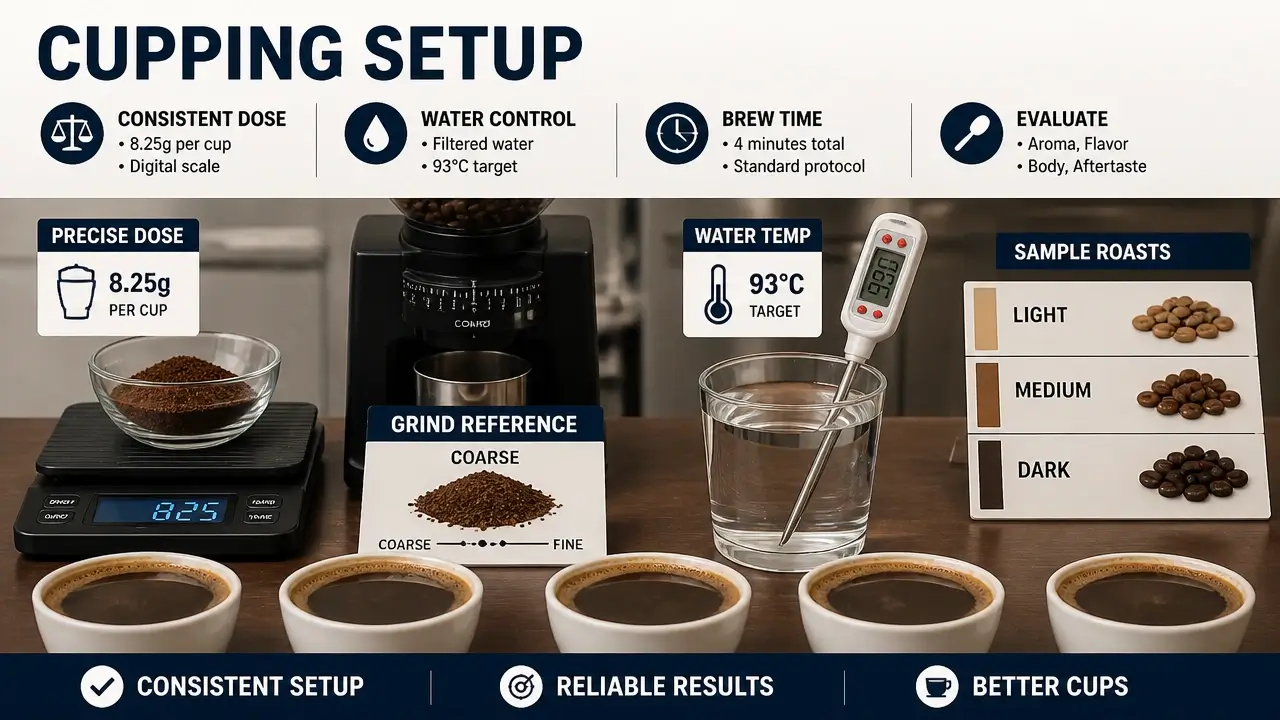
Coffee-to-water ratio: 8.25 grams of whole-bean coffee per 150 ml of water. This ratio is unchanged from the original protocol and remains the fixed foundation. Bowl size is standardized at 150 ml to match.
Grind: Coarse, resembling sea salt in particle size, with a target of 70-75% pass-through on a U.S. #20 sieve. Grind immediately before cupping. Once ground, the coffee degasses quickly and the fragrance evaluation window closes fast.
Water temperature: 200°F (93°C) ± 2°F (1°C) at the point of pour. Not at the kettle. At the bowl. A two-degree variance sounds small. Across five cups it compounds into meaningfully different extraction.
Water quality: Standard 102-2024 formalizes what the old protocol left vague. Total Dissolved Solids must fall between 125 ppm and 175 ppm, with neutral pH and no off-odors. Municipal tap water in most cities fails this specification. Use filtered water and verify TDS with a meter before every session.
Roast level: The coffee must be a sample roast, not a production roast. The target is an Agtron Gourmet color reading of 58 for whole-bean and 63 for ground. Roasting must occur 8 to 24 hours before cupping. Too fresh and the CO₂ interference distorts aroma perception. Too old and volatile compounds have already dissipated.
Number of cups: A minimum of five cups per sample. This isn’t preference. It’s the statistical minimum needed to account for bean-to-bean variation and to flag defective cups reliably.
Step-by-Step Cupping Mechanics: From Dry Aroma to Final Taste
The cupping procedure under the SCA protocol is a defined sequence, not a loose ritual. Each step captures a different volatile window. Miss the order and you lose data that can’t be recovered.
Dry Fragrance/Aroma Evaluation. Immediately after grinding, nose the dry grounds. Note intensity and character. The volatile compounds responsible for dry fragrance begin dissipating within minutes of grinding, so this step happens first, before water is anywhere near the bowls.
Pouring. Pour 200°F water directly onto the grounds, ensuring complete saturation of all grounds in the bowl. Fill to the brim. The goal is uniform extraction across the entire dose, not just the top layer.
Steeping. Start a timer immediately. The coffee steeps undisturbed for exactly 4 minutes. Don’t stir, don’t tilt the bowl, don’t hover. The crust forms naturally and that crust is part of the next step.
Breaking the Crust. At exactly 4 minutes, use a silver-plated or stainless-steel cupping spoon to break the crust with three deliberate motions, nose close to the bowl. The burst of wet aroma released at this moment is chemically distinct from both dry fragrance and the cooled cup. Capture it now.
Wet Aroma Evaluation. Note the aromas perceived during and immediately after crust breaking. This is a separate sensory event from dry fragrance. Record it as such.
Skimming. Use two spoons to remove all floating foam and grounds from the surface. A clean surface ensures that subsequent tasting isn’t contaminated by floating particulate.
Tasting at Three Temperatures. Begin tasting at approximately 160°F (71°C). Continue as the coffee cools to 140°F (60°C). Taste again at room temperature (~77°F/25°C). At each stage, slurp from the spoon to aerosolize the coffee across the full palate. Different compounds express at different temperatures. Acidity reads differently at 160°F than at room temperature. Sweetness often becomes more apparent as the cup cools. Each temperature is a distinct data point.
Move systematically across all five cups at each temperature stage. Record observations immediately after each bowl. Memory is not a reliable substitute for real-time notes, and order effects are real.
Decoding the Cupping Scores: The 0-10 Scale and the New Affective Assessment
The cupping score scale looks familiar on the surface. Dig one level deeper and the logic has changed substantially. The CVA didn’t abandon numerical scoring. It reorganized what each number is actually measuring and why.
The 0-10 Rating Scale and the Official CVA Cupping Forms
The familiar attributes from the old SCAA cupping form are still present in the CVA: fragrance/aroma, flavor, aftertaste, acidity, body, balance, uniformity, clean cup, sweetness, and overall impression. What changed is how they’re organized and what the scores represent.
The 0-10 rating scale remains, with 6.0 as the threshold for acceptable specialty coffee. The qualitative anchors are: 6 = Good, 7 = Very Good, 8 = Excellent, 9 = Outstanding, 10 = Perfect. Those anchors haven’t shifted. What has shifted is that the score you assign to acidity, for example, now means something different depending on which assessment you’re in.
The old SCAA PDF form is no longer the official document for professional use. CVA Cupping Forms and digital tools are available through the SCA member portal. If your team is still printing the legacy form for evaluations that feed into trade decisions or certification, that needs to change.
Descriptive Intensity Ratings vs. Affective Liking Scores in the CVA
Under the Descriptive Assessment (Standard 103-2024), the cupper rates the intensity of specific attributes on a 0-to-15 scale. High acidity intensity is recorded as high. Low sweetness intensity is recorded as low. There’s no judgment embedded in that number. It’s a measurement, not an opinion.
Under the Affective Assessment (Standard 104-2024), the cupper provides a holistic quality score for Overall Impression on the 0-10 scale, plus optional liking ratings for individual attributes. These scores represent preference and quality perception. The same acidity that scored an 11 on the descriptive intensity scale might score a 6 or a 9 on the affective scale depending on whether the cupper finds that intensity desirable. Both scores are valid. They answer different questions.
The old “Cupper’s Points” concept is now integrated into the affective overall score. But the final affective score isn’t a simple arithmetic sum of attribute scores. The protocol expects calibration on how cuppers apply the affective scale, and that calibration process is what keeps the numbers comparable across sessions and evaluators.
The science behind this separation is well-established. A foundational study in Chemical Senses demonstrated the halo-dumping effect directly: when panelists rated only sweetness intensity in a flavored beverage, their scores were significantly higher than when they simultaneously rated both sweetness and flavor. The cognitive load of evaluating multiple attributes on a single form causes ratings to bleed into one another. Providing separate response scales for each attribute reduced the bias. The CVA’s structural split between descriptive and affective assessments is a direct application of this principle.
Calibration, Environment, and Statistical Validity
Cupper calibration is what separates a professional cupping session from an informal tasting. Five skilled cuppers at the same table, evaluating the same coffee, can produce meaningless data if they haven’t aligned their use of the scale before the session begins. Calibration is the fix. It’s not optional under the SCA protocol.
Calibration means tasting the same reference samples together, discussing scores openly, and reaching agreement on how the scale maps to specific sensory experiences before any evaluative data is recorded. It must happen before every session where data will be used for trade, certification, or quality control. Not occasionally. Every time.
The environment matters as much as the calibration. The SCA protocol specifies a clean, well-lit, quiet room with no extraneous odors. No perfume. No residual smoke. No food smells from an adjacent kitchen. Temperature should be comfortable and constant throughout the session. These aren’t preferences. Olfactory perception is acutely sensitive to ambient interference, and a single strong odor in the room can suppress retronasal detection of compounds in the cup.
The five-cup minimum per sample exists for a statistical reason. Bean-to-bean variation within a single lot is real. One defective cup in a five-cup set can be flagged and excluded. Two or more defective cups in the same set disqualify the sample entirely. That threshold is built into the protocol because a single anomalous cup doesn’t tell you whether the sample has a problem or whether one bean in the grinder was an outlier. Five cups give you enough data to distinguish between the two.
The protocol also specifies cupping table layout, the absence of conversation during tasting, and the use of neutral-colored bowls and spoons. Conversation during evaluation introduces anchoring bias. One cupper naming a flavor attribute out loud before others have recorded their notes pulls the group toward that descriptor. Silence during tasting isn’t a formality. It’s bias control.
Digital tools now assist with consistency checks and data recording, but the sensory calibration remains human. No software replaces the agreement between cuppers on what a 7.5 means in practice.
If you want a ground-level walkthrough of the full procedure before applying the official standards, the guide on how to cup coffee step by step covers the practical mechanics in detail.
Old vs. New: Key Changes in the Official Cupping Standards and Why They Matter
The SCAA cupping standard from 2004 was a single form with 10 attributes, each scored on a 0-10 scale, summing to a 100-point total. That total became the industry’s shorthand for quality. A coffee was an 84. A coffee was a 91. The number traveled through supply chains, appeared on green-coffee invoices, and determined price premiums. The problem was that the number was doing two different jobs at once and wasn’t fully reliable at either.
The 2004 form conflated “what this coffee tastes like” with “how much I like it.” Acidity intensity and acidity preference shared the same score box. A cupper who found a coffee’s profile exciting tended to score everything higher, not because every attribute was exceptional, but because the overall impression leaked across the form. The CVA dual assessment eliminates that conflation structurally. Descriptive intensity lives on one assessment. Affective liking lives on another. The scores no longer contaminate each other.
The old protocol also left water chemistry underspecified. It mentioned water quality in general terms. The new SCA cupping standard enforces a TDS window of 125-175 ppm and specifies neutral pH and absence of off-odors. Roast targets in the legacy protocol were similarly loose. The CVA locks them to Agtron Gourmet 58/63 with a defined rest window of 8 to 24 hours. These aren’t minor refinements. Extraction chemistry is sensitive to water mineral content, and roast level directly affects which volatile compounds are present at the time of evaluation.
For producers, the shift is significant. The old form produced a single number that told them whether a buyer liked the coffee. The CVA produces descriptive data that tells them what the coffee actually tastes like at measurable intensities. That’s actionable for processing decisions, variety selection, and fermentation management in a way that an 84-point score never was.
For buyers, the affective assessment provides a cleaner quality signal because it’s no longer entangled with intensity data. A coffee with high-intensity acidity that a buyer finds unpleasant scores differently than a coffee with the same intensity that they find thrilling. The data reflects the distinction.
Professional Q-graders, competition judges, and green-coffee evaluators are expected to operate under CVA methodology. Certification programs are migrating to the new framework. If your evaluation workflow still centers on the old form, the practical implications are real: scores produced on the legacy form aren’t directly comparable to CVA scores, and the professional community is moving toward requiring CVA compliance for credible trade documentation.
For a detailed breakdown of how the legacy scoring categories were structured before the transition, the article on SCAA cupping form scoring categories provides a useful reference point for understanding exactly what changed and why.
The SCA protocol as it stands today is what this article has documented: sample preparation parameters, tasting mechanics, scoring logic, calibration standards, and the environmental requirements that make the data trustworthy. That’s the complete framework. Follow it.
Frequently Asked Questions About SCAA Cupping Protocol
Is the SCAA cupping form still valid for Q-grader certification?
No. The SCA Coffee Value Assessment replaced the 2004 SCAA form as the official standard in 2024, and certification programs are migrating to CVA methodology. Scores produced on the legacy form aren’t directly comparable to CVA scores.
What’s the difference between the 0-10 and 0-15 scales in the CVA?
The 0-10 scale is used in the Affective Assessment for quality liking scores, with 6.0 as the specialty threshold. The 0-15 scale is used in the Descriptive Assessment to rate attribute intensity without any quality judgment attached.
Why does the protocol require exactly five cups per sample?
Five cups is the minimum needed to statistically distinguish a defective bean from a sample-wide defect. One bad cup in five can be flagged and excluded; two or more bad cups disqualify the entire sample.
Can I use a paper form, or does the CVA require digital tools?
Paper forms are available through the SCA, and the protocol doesn’t mandate digital tools. Digital platforms assist with consistency checks and data aggregation, but sensory calibration and evaluation remain human tasks regardless of recording format.
How does the CVA’s Descriptive Assessment help producers specifically?
It gives producers intensity measurements for individual attributes like acidity, body, and sweetness without the quality judgment attached. That data directly informs processing decisions, fermentation protocols, and variety selection in a way a single composite score never could.
What happens if my water TDS is outside the 125-175 ppm range?
Extraction chemistry shifts outside that window. Low TDS water over-extracts certain compounds; high TDS water suppresses extraction and can introduce mineral flavors. Either scenario makes your sensory data unreliable and non-comparable to sessions run with compliant water.
How often does cupper calibration need to happen?
Before every evaluative session where data feeds into trade decisions, quality control, or certification. It’s not a one-time training event. Scale alignment drifts between sessions, and calibration is the mechanism that keeps inter-rater variability from compounding into noise.
Does the CVA change the 6.0 specialty coffee threshold?
No. The 6.0 threshold for acceptable specialty coffee on the 0-10 affective scale is unchanged. What changed is that the score now reflects pure quality liking, not a composite of intensity and preference bundled together.
References
- SCA Officially Adopts New Cupping Forms and Standards | dailycoffeenews.com
- Limiting response alternatives in time-intensity scaling: an examination of the halo-dumping effect | academic.oup.com