

Rigorous coffee cupping gives you a direct, unfiltered read on a bean’s intrinsic quality. No brew variables, no extraction noise. Just the coffee. That’s a powerful capability, and it’s why the SCA cupping protocol became the industry’s shared language across green buying, roast development, and origin evaluation.
But the same design that makes cupping precise also makes it fragile. Human palates fatigue. Bias compounds. Water chemistry goes unrecorded. Before you build a quality program around the bowl, you need a clear-eyed look at what cupping actually does well, where it breaks down, and whether your operation gives it room to work.
Key Takeaways on Benefits and Limitations of Coffee Cupping
- Cupping removes brewing variables entirely, revealing a coffee’s intrinsic sensory attributes with no extraction interference.
- The SCA protocol’s thermal architecture scores different attributes at different temperature zones, a detail most cuppers skip.
- Blind cupping removes associative bias; structured calibration with triangle tests builds actual scoring accuracy.
- Water chemistry, room odor, and time of day measurably shift cupping scores but appear on almost no standard cupping forms.
- Cupping is indispensable for green buying and roast development; it’s a bottleneck for daily production QC and commodity release.
- An integrated three-pillar system – cupping, instrumental analysis, and brew-level QC – outperforms any single method across speed, accuracy, and scalability.
Define Your Quality Control Playbook
Quality control in coffee is not one thing. Before you evaluate any tool, you need to know what you’re actually trying to control. Write it in one sentence: Are you differentiating specialty lots, eliminating defects, maintaining batch-to-batch consistency, or holding down cost? Your answer shapes everything that follows, because cupping was not designed to serve all four goals equally.
The resource constraints on your decision are just as real as the goal itself. A professional team has to weigh personnel time available per evaluation cycle, the training budget for building sensory skill, how frequently you need to evaluate, and how fast you need feedback to act on it. A green buyer sourcing micro-lots operates on a different clock than a production roaster releasing fifty bags a day.
Two distinct mindsets drive quality programs, and they pull in opposite directions. The first asks: what is this coffee capable of? The second asks: is this cup consistent for the customer? Cupping was built for the first question. It evaluates a coffee’s inherent potential by removing external variables. That’s a strength in the right context and a mismatch in the wrong one.
Keep both mindsets in mind as you read each of the realities below. Every benefit and every limitation looks different depending on which question your operation is actually trying to answer.
Krzysztof Blinkiewicz, founder of the coffee education platform Red Ink Coffee, SCA Authorised Trainer, and Q grader, describes a systemic problem he calls score inflation: when the number on a bag no longer reflects what’s in the cup, it’s usually not a single exaggeration but a structural failure. He traces it to three recurring causes: panels that never calibrate against each other, supply chains that lack transparency, and market pressure that rewards high numbers over honest ones.
This is the operating environment your quality program lives in. Cupping is the industry’s primary tool for generating those scores, which means the protocol’s strengths and weaknesses have direct financial and reputational consequences. Understanding them clearly is not optional.
Reality 1: The Unfiltered Sensory Window
Coffee cupping removes every brewing variable and leaves you alone with the bean. No grinder setting, no brew method, no water contact time controlled by a barista’s intuition. What you taste in the bowl is what lives in the coffee itself: fragrance off the dry grounds, aroma off the wet crust, and then flavor, acidity, body, aftertaste, and balance as they exist in the green and the roast, not as a recipe produces them.
This is a meaningful distinction. When you brew, extraction and recipe choices actively shape the cup. A slightly coarser grind softens acidity. A higher brew temperature opens body. Those effects are real, but they belong to the process, not the bean. Cupping strips all of that away.
The result is direct sensory access to the coffee’s intrinsic attributes. That’s why cupping is the starting point for green coffee buying and roast profiling. A buyer evaluating a Kenyan lot needs to know whether the bright, tomato-like acidity is coming from the variety and terroir or from a processing artifact. A roaster dialing in a new profile needs to separate what the green brought to the table from what the drum added. The bowl answers both questions without interference.
Here’s what that looks like in practice:
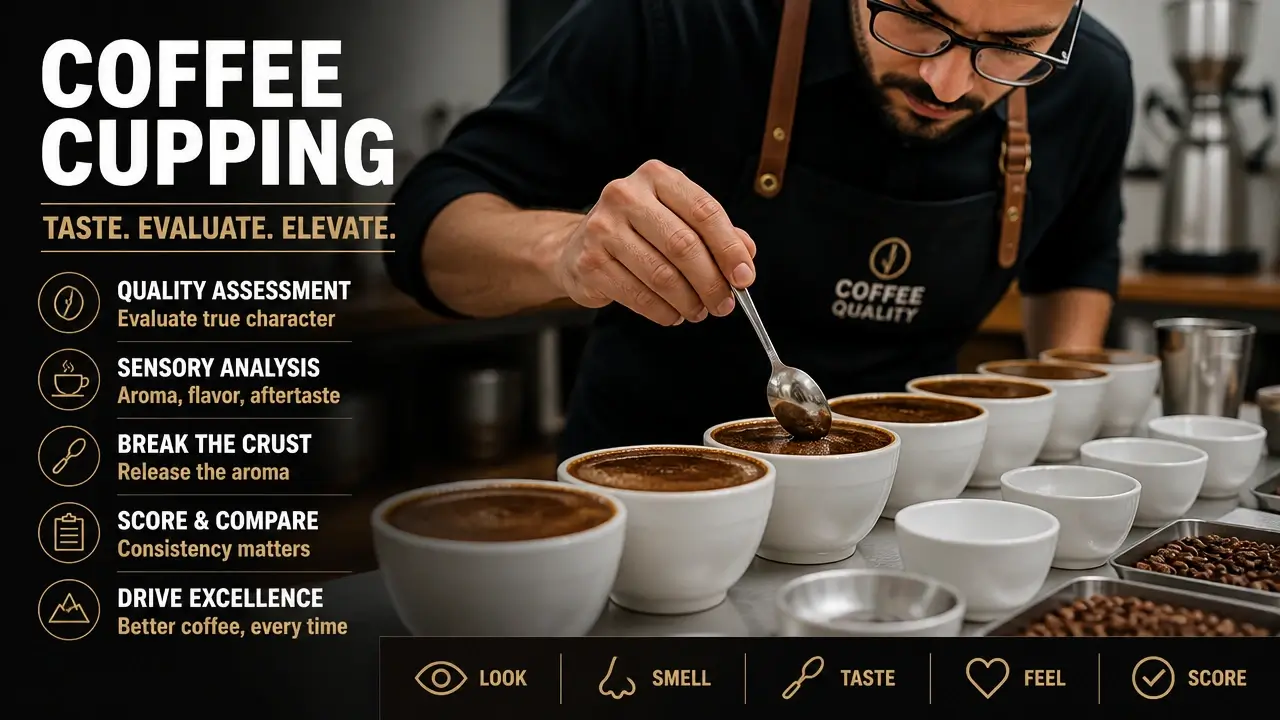
No other routine evaluation method gives you this level of isolation. Brewing-based tastings are valuable for customer-facing quality checks, but they conflate the coffee’s character with the brewer’s execution. For evaluating the coffee itself, cupping has no equal.
Reality 2: The Industry’s Common Yardstick
Comparative cupping works because every participant operates inside the same fixed protocol. The SCA cupping standard doesn’t just describe a method; it creates a shared sensory language. Farmers, importers, buyers, roasters, and baristas can all sit at the same table and discuss the same coffee without ambiguity. That interoperability is rare in any industry.
The SCA Protocol’s Fixed Variables and Repeatability
The SCA cupping protocol achieves repeatability through fixed variables: an 8.25g-per-150mL coffee-to-water ratio, a uniform coarse grind, water at 93°C poured directly over the grounds, a four-minute steep, and a minimum of five sample replicates per coffee. None of these are arbitrary. Each one eliminates a dimension of variability so that what remains is the coffee’s character, not the method’s noise.
What most cuppers miss is the thermal architecture built into that protocol. The scoring form isn’t meant to be filled out all at once. Flavor and aftertaste are sharpest around 70°C, when volatile aromatics are still active. Acidity, body, and balance reveal themselves more clearly near 60°C, as the cup cools and the structure settles. By 40°C, uniformity, cleanliness, and sweetness become legible. A single bowl, evaluated across those three temperature zones, functions as a comprehensive analytical instrument. Treat it as a snapshot and you leave data on the table.
The video below walks through the SCA cupping form in real time, showing how each attribute maps to the evaluation sequence:
Low Barrier to Entry and Cost-Efficiency of Cupping
The capital requirements are minimal. A set of cupping bowls, cupping spoons, a consistent grinder, and a kettle are all you need to run a protocol-compliant session. No proprietary equipment, no software license, no lab infrastructure.
That low barrier makes cupping the most cost-efficient sensory evaluation method available for comparative tasting. You can evaluate six to eight coffees side by side in a single session for a fraction of what any instrumental analysis would cost. For teams deciding where to invest their quality budget, that ratio matters.
Reality 3: The Human Factor – Bias, Error, and How to Fight Back
Cupper bias is not a character flaw. It’s a structural feature of any human sensory system, and ignoring it doesn’t make it go away. The question isn’t whether your panel has bias. It does. The question is which biases are active, how large they are, and whether your protocol controls for them.
For teams weighing human sensory evaluation against instrumental alternatives, the tradeoffs are laid out in detail in coffee cupping vs sensory analysis technology.
The Three Main Sources of Cupper Error and Blind Cupping Mitigation
Cupper error comes from three distinct sources, and conflating them leads to the wrong fixes.
The first is personal palate bias: preferences and cultural imprints that make certain flavor profiles feel more correct than others. A cupper raised on washed East African coffees will often score naturals lower on cleanliness, not because the coffee is dirtier but because the sensory reference point is different.
The second is psychological bias, which operates even when the cupper has no conscious preference. The halo effect is the most common version: one dominant attribute colors the entire evaluation. A powerful jasmine aroma, for example, can pull scores upward on acidity and body even when those attributes are objectively average. The cupper isn’t lying; the brain is pattern-matching. The contrast effect works in the opposite direction: a mediocre coffee evaluated immediately after an exceptional one scores lower than it would in isolation, because the previous sample reset the reference point.
The third source is simple fatigue-driven inconsistency, which compounds the first two as a session progresses.
Blind cupping is the first line of defense. When the cupper doesn’t know what’s in the bowl, associative bias loses its anchor. Origin, price, and producer reputation can’t influence a score the cupper can’t see.
Calibration Sessions and the Value of Multiple Cuppers
Blind cupping handles associative bias. Calibration sessions address the deeper problem of divergent sensory scales. In a structured calibration, the panel evaluates identical reference coffees and then discusses where their scores diverged and why. Over time, this process aligns individual scales toward a shared standard.
Multiple cuppers add a second layer of protection. Averaging independent scores from even two or three tasters measurably reduces individual noise. The data becomes more reliable not because any individual cupper improved but because the aggregation filters out their idiosyncratic errors.
Unfortunately, even well-intentioned calibration efforts often miss a structural piece. Sensory science shows that unguided practice can entrench bias rather than correct it. Most cupping training programs skip the structured feedback tools that actually produce calibration: triangle tests to measure discrimination ability, explicit reference standards tied to known flavor compounds, and inter-rater reliability checks that quantify how much individual scores diverge from the group mean. Without those mechanisms, a “calibration session” often functions as group confirmation of existing biases rather than genuine realignment.
The implication is direct: if your team cups regularly but never runs a triangle test or compares scores against a reference standard, you may be building false confidence. Regular cupping builds familiarity. Structured calibration builds accuracy. They are not the same thing.
Reality 4: The Grind – Fatigue, Time, and Hidden Variables
The operational cost of cupping is easy to underestimate on paper and hard to ignore in practice. Fatigue, time, and a set of variables most labs treat as neutral can all degrade data quality without leaving an obvious trace in your cupping logs.
Taste Fatigue and Time Investment in Cupping Sessions
Taste fatigue sets in earlier than most cuppers acknowledge. After five to seven cups, palate sensitivity begins to drop, and scoring inconsistency increases. Full cupping flights in commercial settings routinely exceed that threshold. The scores at the end of the flight are often less reliable than the scores at the start, but they sit on the same form with no flag attached.
The time investment for a proper SCA-style session is also non-trivial. Grinding, smelling dry grounds, breaking crusts, tasting across multiple heat passes, and clean-up typically consume 30 to 45 minutes per table, before accounting for setup and score reconciliation. For a team running daily evaluations, that time compounds quickly.
Hidden Variables: Training Curve, Environmental Factors, and Water Chemistry
The training curve for producing repeatable cupping scores is steeper than most job postings suggest. Scoring accuracy is not intuitive. It requires weeks of guided, structured exposure to reference coffees before a new cupper generates data that’s meaningful enough to act on. Skipping that investment and putting a novice on a buying panel introduces noise that looks like signal.
Environmental factors add another layer of instability. Room odor, ambient temperature, and even the time of day measurably shift taste perception. None of these get recorded in standard cupping logs. Two sessions conducted on the same coffee in different rooms, at different times, by the same cupper can produce divergent scores, and there’s no field on the SCA form to explain why.
The most pernicious hidden variable, though, is one that nearly every cupping lab treats as neutral: water. Total dissolved solids, mineral content, and pH all measurably alter extraction rate and flavor balance. Using different water sources for the same coffee can produce genuinely divergent scores, yet water specification appears in almost none of the cupping forms in standard use. A panel that cups with municipal tap water one week and filtered water the next is not running the same protocol, even if everything else is identical.
Compounding the problem: most cupping training programs don’t include systematic defect-identification exercises. Cuppers learn to detect that something is wrong but rarely learn to reliably trace it to a specific processing fault. A fermented note from over-ripe cherry and a sour note from under-extraction can be easy to confuse under fatigue. Cupping can flag the problem; without defect training, it can’t always diagnose it.
Reality 5: When Cupping Shines – Specialty Contexts
Specialty green buying is the environment cupping was designed for, and the fit is nearly perfect. When a buyer evaluates a new lot from an Ethiopian cooperative, the core question is about origin character, processing signature, and the presence or absence of defects. Cupping answers all three. It isolates the bean’s intrinsic attributes, strips away brewer influence, and allows direct comparison across multiple lots in a single session. No other routine method does that.
Micro-lot differentiation is where this capability becomes financially decisive. When a roaster is choosing between three small lots from the same farm, harvested from adjacent plots, the differences are subtle. Body, sweetness, and a specific fruit note in the finish. Cupping’s holistic sensory profile captures those distinctions; a refractometer reading cannot.
Cupping also functions as a roast profiling diagnostic. By tasting the naked bean before and after roast development iterations, a roaster can separate what the green brought from what the drum added. If a floral note disappears between two roast profiles, the question becomes: did the heat kill it, or was the development time too short? Cupping gives you the sensory baseline to answer that question with evidence.
In all of these scenarios, the time and personnel cost is proportionate to the stakes. Contract pricing, brand positioning, and sourcing relationships all hinge on accurate lot evaluation. The batch sizes are small. The decision impact is high. That ratio justifies the investment in a trained panel, structured calibration, and proper protocol execution.
Reality 6: When Cupping Fails – High-Volume and Daily Ops
Daily production operations are where cupping’s design starts working against you. The same sensitivity that makes it invaluable for micro-lot selection becomes a liability when you’re releasing commodity-grade blends at volume. A simple brew QC is faster, more representative of the customer’s actual experience, and far easier to execute consistently across shifts.
The customer in a café doesn’t taste the isolated green coffee. They taste the brewed cup, shaped by grind setting, water temperature, dose, and the barista’s technique. Cupping tells you nothing about brew consistency, extraction yield, or service-level quality. A coffee that scores 87 in the bowl can taste flat and hollow in a batch brewer if the recipe is off. The cupping score doesn’t catch that. A refractometer and a quick taste from the batch brewer do.
Daily production QC needs results in minutes. A cupping table takes 30 to 45 minutes to run properly. By the time the session is complete, the batch may already be on the bar. A refractometer reading and a brew-method taste check deliver actionable data in under five minutes. For daily release decisions, that speed matters more than holistic sensory depth.
There’s also a staffing reality that rarely appears in quality program proposals. Maintaining a reliable cupping panel in a high-turnover café or production facility is structurally difficult. Every time a trained cupper leaves, the calibration built over weeks of practice leaves with them. The next hire starts from zero. In these environments, a quality system that depends on trained human palates is fragile by design. Instrumental tools and standardized brew checks are more durable precisely because they don’t walk out the door.
Reality 7: Beyond the Bowl – Integrating Cupping with Modern Tools
An integrated quality system is more resilient than any single method, and cupping’s value increases sharply when it’s flanked by tools that compensate for its weaknesses.
The practical architecture has three pillars. Cupping handles deep sensory evaluation at decision gates where intrinsic coffee quality is the question. Instrumental analysis, specifically a refractometer for extraction yield and TDS, a color meter for roast consistency, and a moisture analyzer for green storage quality, provides objective physical metrics that don’t fatigue and don’t have opinions. Brew-level QC, a quick taste and refractometer read from the actual brewing equipment, covers customer-facing consistency on a daily basis.
These three pillars don’t just coexist; they check each other. If cupping detects elevated acidity but TDS and extraction yield are within normal range, the issue likely lives in the roast profile, not the green. If cupping scores are stable but customer complaints about bitterness are rising, the brew-level check catches what the bowl missed. Chemical and physical data act as a reality check on sensory scores, and sensory scores provide context that numbers alone can’t supply.
The practical sequencing is a tiered quality gate system. Use cupping at the two moments where its design matches the job: green buying decisions and roast development approvals. Use faster brew checks for daily batch release. This approach concentrates your panel’s time and attention where it generates the most value, and removes cupping from contexts where it creates bottlenecks without adding proportionate insight.
The result is a system where no single tool carries the full weight. Cupping becomes a teammate with a specific role rather than an oracle expected to answer every question. That shift also makes the system more resilient to staff changes, because the instrumental and brew-level components don’t depend on a trained sensory panel to function.
The Honest Verdict: Your Cupping Decision Checklist
Cupping adoption should be conditional on your operation’s actual context, not on the protocol’s reputation. Here’s a direct decision framework based on everything above.
Decision Tree:
| Your Primary Goal | Recommendation |
|---|---|
| Specialty differentiation or micro-lot selection | Cupping is essential. Build the panel. |
| High daily volume, homogeneous product | Prioritize brew QC and instrumental tools. Use cupping sparingly. |
| Somewhere in between | Adopt a hybrid system with tiered quality gates. |
Cupping-Only vs. Integrated Approach:
| Dimension | Cupping Only | Integrated System |
|---|---|---|
| Speed | 30–45 min per session | Minutes for daily checks |
| Cost | Low equipment, high labor | Moderate equipment, lower labor per check |
| Accuracy | High for intrinsic quality | High across intrinsic and brewed quality |
| Scalability | Low – degrades with volume and turnover | High – instrumental tools don’t fatigue |
| Brewed-cup defect detection | Weak | Strong – brew-level QC fills the gap |
For teams who want a deeper look at the mechanics of how cupping drives quality outcomes in specialty contexts, the article on how cupping improves quality control covers the causal chain in detail.
5-Step Action Checklist:
- Define your top quality goal in one sentence. Specialty differentiation and batch consistency require different tools.
- Assess your team’s training bandwidth. Cupping only produces reliable data after weeks of structured, guided practice. If you can’t commit to that, start with instrumental tools.
- Run a pilot cupping program on one product line. Don’t overhaul your entire QC process at once. Pilot on a single lot category where cupping’s strengths are most relevant.
- Add one instrumental tool within three months. A refractometer is the highest-value first addition. It takes minutes to use and immediately validates or challenges your sensory scores.
- Re-evaluate based on decision impact, not cupping scores alone. Track whether your quality evaluations are actually changing purchasing decisions, roast profiles, or customer satisfaction. If the data isn’t driving action, the method isn’t working for your context.
Cupping is a high-resolution microscope. It magnifies what’s in the bean with exceptional clarity. That’s exactly what you need for green buying and roast development, and exactly the wrong tool for daily batch release and commodity QC. Bring the right instrument to each job, and both will perform.
Frequently Asked Questions About Benefits and Limitations of Coffee Cupping
What is a good coffee cupping score?
An SCA score of 80 or above qualifies as specialty grade. Scores above 85 indicate a distinctly high-quality lot, and anything above 90 is exceptional and rare. Keep in mind that scores only mean something when the panel is calibrated; an 87 from an uncalibrated cupper carries far less weight than an 84 from a trained, referenced panel.
How long does a coffee cupping session last?
A proper SCA-style session runs 30 to 45 minutes per table, not counting setup and score reconciliation. Fatigue starts affecting palate accuracy after five to seven cups, so longer flights with more samples produce progressively less reliable data toward the end.
Why does the same coffee sometimes score differently in different labs?
Water chemistry is the most common culprit that goes unnoticed. Differences in total dissolved solids, mineral content, and pH between water sources measurably alter extraction and flavor balance. Panel calibration differences and environmental factors like room temperature and ambient odor also contribute.
What is the 15-15-15 rule in coffee cupping?
It refers to a simplified timing structure: 15 grams of coffee, 15 minutes of rest after grinding before evaluation, and 15 minutes of total tasting time. It’s a teaching shorthand, not an official SCA parameter. The SCA protocol specifies its own ratios and timing, which differ from this rule.
Can cupping replace a refractometer for production QC?
No. Cupping tells you about the coffee’s intrinsic sensory potential; a refractometer tells you whether the brew was extracted correctly. They measure different things. A coffee can cup beautifully and still produce a poorly extracted batch if the brew recipe is off.
How many cuppers do you need for reliable results?
Two or three independent cuppers averaging their scores markedly improves data reliability over a single evaluator. More isn’t always better; a larger uncalibrated panel can generate more noise, not less. Calibration quality matters more than panel size.
How does the halo effect distort cupping scores?
When one dominant attribute – a powerful floral aroma, an unusually clean finish – captures the cupper’s attention, it inflates scores on unrelated attributes like body or acidity. The cupper isn’t being dishonest; the brain is pattern-matching across the entire cup based on the strongest signal it received. Blind cupping reduces this but doesn’t eliminate it.
When should a roaster stop relying on cupping and switch to brew-based QC?
When the question shifts from “what is this coffee capable of?” to “is this batch consistent for the customer?” That transition typically happens at the production release stage. Cupping evaluates green and roast quality; brew-based QC evaluates whether the customer’s cup is correct. Both questions are legitimate, but they need different tools.
References
- Resolving Discrepancies in Coffee Cup Scores | perfectdailygrind.com
- Coffee Cupping vs Sensory Analysis Technology: Pros and Cons | coffeefactz.com
- How Coffee Cupping Improves Quality Control in Specialty Coffee | coffeefactz.com