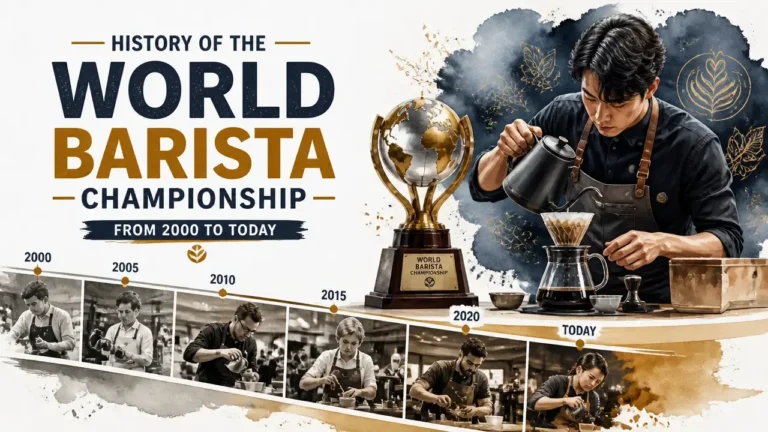

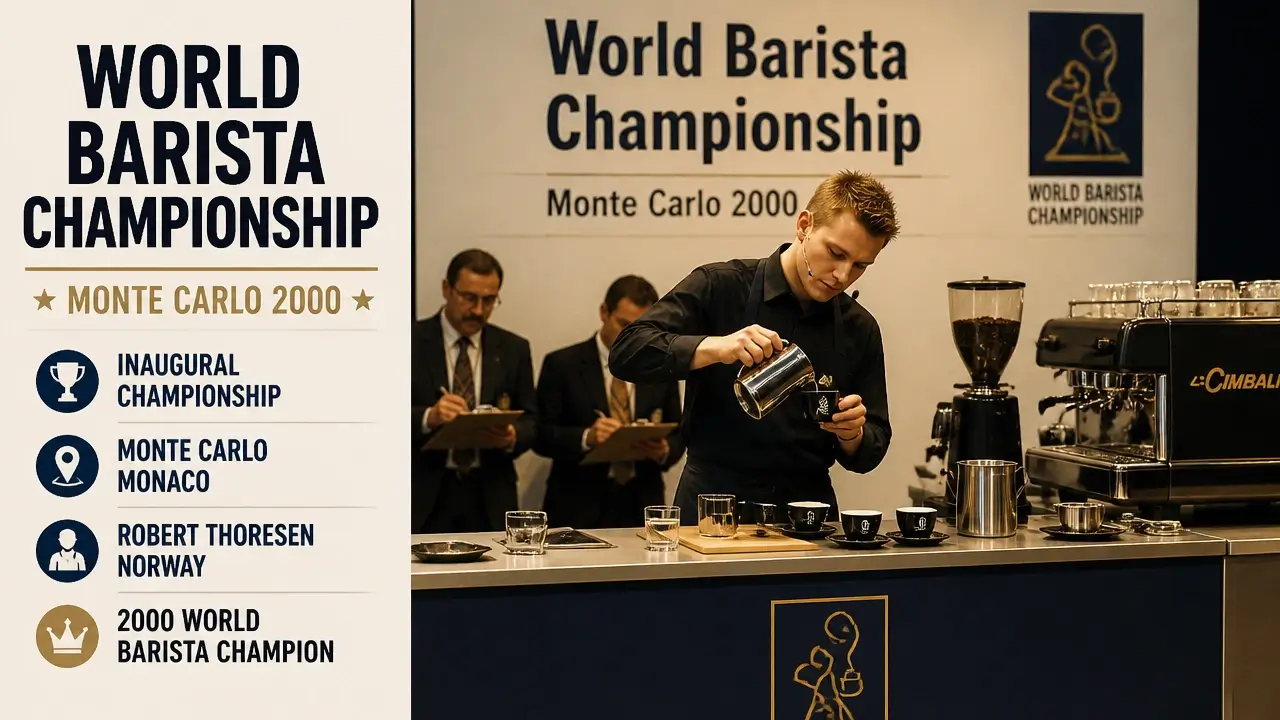
The modern World Barista Championship began with 17 competitors, a borrowed stage in Monte Carlo, and a question the coffee industry hadn’t yet learned to ask: what does a truly skilled barista actually look like? That was 2000. The Specialty Coffee Association had just formed World Coffee Events to give the craft a competitive home, and Robert Thoresen of Norway walked away with the first title.
Twenty-five years later, the WBC draws 50-plus national champions, runs on food-science technique, and has produced alumni who’ve reshaped how the world buys, brews, and talks about coffee. The competition’s history is the specialty coffee world‘s clearest mirror.
To better understand how these foundational events established the modern global circuit and competition definitions, it helps to examine the foundational standards that continue to shape professional coffee events today.
To understand the rigorous standards behind these international events, it helps to examine how coffee competitions work across different judging categories.
While celebrating this quarter-century of craftsmanship, it is equally vital to acknowledge the industry’s darker realities, as detailed in Blood Beans amp Billions The.
Key Takeaways on the History of the World Barista Championship
- The inaugural WBC in Monte Carlo (2000) had 17 competitors; it was built to professionalize the barista role, not just rank espresso-makers.
- Scandinavian countries dominated the first seven years because they had already invested in barista training as a formal discipline before the competition existed.
- James Hoffmann’s 2007 win established origin storytelling as a competitive pillar; every WBC routine since has built on that framework.
- Processing innovations like carbonic maceration and anaerobic fermentation reached café menus worldwide because champions introduced them on the WBC stage first.
- Diego Campos’ 2021 win as the first Latin American producing-country champion restructured the specialty coffee world’s authority hierarchy in a concrete way.
- The WBC’s rule evolution, from cappuccino-only to plant-based milks, tracks the specialty industry’s real values shifts in near real time.
Origins: The WBC Begins in Monte Carlo (2000)
The inaugural World Barista Championship didn’t emerge from a boardroom strategy. It grew from a simpler frustration: the barista had no professional stage. In the late 1990s, a skilled espresso maker was still largely invisible, categorized alongside fast-food counter staff rather than alongside chefs or sommeliers. Specialty coffee existed, but it was a fringe movement, not a recognized industry pillar.
According to Klaus Thomsen, World Barista Champion 2006 and co-founder of The Coffee Collective, the seed for the WBC was planted even earlier: Norwegian Alf Kramer first organized a Nordic Barista Championship in 1998, and that regional event directly inspired the global format that debuted two years later in Monte Carlo.
That regional experiment mattered because it proved the concept worked. A competition gave baristas a shared vocabulary for quality and a reason to take their craft seriously as a discipline. The Specialty Coffee Association, through its newly formed World Coffee Events division, took that template and scaled it. Monte Carlo, 2000: 17 competitors, 10 countries, one championship.
The format they chose was deliberate and has proven remarkably durable. Each competitor gets 15 minutes to prepare four espressos, four milk beverages, and four signature drinks for a panel of judges. That structure wasn’t arbitrary; it mirrored the service reality of a working barista while creating enough complexity to separate craft from habit. The skeleton has held for 25 years.
Robert Thoresen of Norway won that first title. His victory wasn’t a coincidence of geography. Scandinavia, and Norway in particular, had already built a coffee culture that valued extraction precision and sourcing transparency at a time when most of the world still treated espresso as a commodity. A Norwegian champion in 2000 was the competition’s first piece of honest signal.
The early milestones came quickly:
- 2000 – Monte Carlo: First WBC. Robert Thoresen (Norway) wins.
- 2001 – Rimini, Italy: Robert Thoresen (Norway) repeats, becoming the first back-to-back champion.
- 2002 – Oslo, Norway: Troels Overdal Poulsen (Denmark) takes the title, cementing Nordic dominance.
Agnieszka Rojewska, the 2018 World Barista Champion, captured the existential momentum behind the competition’s creation when she reflected on the pace of the specialty world: coffee evolves so fast that yesterday’s innovation becomes today’s baseline, which raises a persistent question about where the craft is actually heading.
That question is precisely what the WBC was built to answer, one championship at a time.
The Scandinavian Era: Nordic Dominance (2000–2006)
Nordic countries controlled the World Barista Championship’s first seven years in a way that wasn’t accidental. Four of the first seven titles went to Scandinavian baristas, and the two Australian wins in that stretch shared the same aesthetic DNA: clean, technically rigorous, restrained.
The full champion list from this era:
| Year | Location | Champion | Country |
|---|---|---|---|
| 2000 | Monte Carlo | Robert Thoresen | Norway |
| 2001 | Rimini | Robert Thoresen | Norway |
| 2002 | Oslo | Troels Overdal Poulsen | Denmark |
| 2003 | Boston | Paul Bassett | Australia |
| 2004 | Trieste | Tim Wendelboe | Norway |
| 2005 | Seattle | Erin McCarthy | Australia |
| 2006 | Berne | Klaus Thomsen | Denmark |
Tim Wendelboe’s 2004 win was the most consequential of this era, though it didn’t look that way at the time. His routine placed unusual weight on the origin story of his coffee, asking judges to taste the place as much as the extraction. That framing, coffee as a traceable agricultural product rather than a blended commodity, would become the philosophical backbone of every WBC routine that followed. Wendelboe would go on to build one of Oslo’s most respected roasteries and help define what light roasting actually means as a sensory discipline, not just a color on a chart.
The judging criteria of this period reinforced the Nordic aesthetic by design. Technical scores weighted heavily on workflow cleanliness, consistent dose, and even extraction. Sensory scoring existed but lacked the granular descriptor vocabulary that later score sheets would demand. If your espresso was clean and your milk was smooth, you were competitive. That framework rewarded the cultures that had invested earliest in barista training as a formal discipline, which is exactly what Norway and Denmark had done.
Signature drinks in this era were functional rather than theatrical: syrups, spices, occasionally cream. Nobody was running a rotary evaporator or sourcing cascara for custom syrups. The creativity ceiling was low, and the technical floor was everything.
Global Expansion and a New Wave of Champions (2007–2015)
James Hoffmann’s 2007 victory is the clearest line in the sand between the WBC’s first chapter and its second. The UK champion walked onto the stage and did something the competition hadn’t fully seen before: he made the coffee’s origin, its farmer, its processing method, the center of his presentation. The espresso was excellent. But the story was the architecture.
That shift wasn’t cosmetic. Hoffmann understood that a 15-minute competition slot is fundamentally a pitch. The coffee has to be extraordinary, but the judge’s experience of it is shaped by the narrative frame you build before the first cup lands. His win validated that approach at the highest level, and every champion who followed built on it. Hoffmann later co-founded Square Mile Coffee Roasters and became the most widely followed coffee educator on the internet, which tells you something about how the WBC title can function as a professional accelerant when the person holding it has the range to use it.
The geographic map of the competition expanded fast in this period. From roughly 25 competing nations in 2007, the WBC grew to over 50 by 2015. Asia, South America, and Africa sent national champions for the first time in meaningful numbers. The competition was no longer a European and Antipodean contest with international observers.
The champions who defined this era each brought a distinct discipline:
- Pete Licata (USA, 2013) arrived with water chemistry data and extraction science as explicit presentation content. He treated the judging panel like a scientific audience, not a hospitality one.
- Hidenori Izaki (Japan, 2014) built his routine around omotenashi, the Japanese philosophy of anticipating a guest’s needs before they’re expressed. His win proved that the service philosophy embedded in a routine could carry as much weight as the coffee itself.
- Sasa Sestic (Australia, 2015) popularized carbonic maceration on the WBC stage, a processing technique borrowed from winemaking. Within two years, it was appearing on café menus worldwide. That’s the WBC’s most direct mechanism of industry influence: a champion introduces a technique, the specialty world watches, and the technique migrates downstream.
For deeper profiles of these competitors and others who shaped the sport, the famous barista champions archive covers their careers and competition stories in full.
The signature drink course transformed in this period from a creative bonus into a genuine sensory experience. Baristas began using clarity agents, custom syrups made from cascara or tamarind, and flavor explanations that resembled a sommelier’s tasting notes. The presentation became as technically demanding as the espresso.
In 2011, the first formal WBC Rules & Regulations Committee convened to systematically codify scoring and technical standards. Before that, the rules had evolved through consensus and precedent. The committee’s formation marked the point where the WBC stopped being a well-organized event and became a professional institution with enforceable standards. The first permanent online broadcasts of this era compounded the effect, turning WBC routines into reference material that baristas worldwide could study, dissect, and build on.
The Innovation Era: Science, Rule Changes, and Modern Champions (2016–Present)
The 2016 milk beverage rule change sounds administrative. It wasn’t. Replacing the strict cappuccino requirement with a broader “milk beverage” category, allowing lattes, flat whites, and cortados, removed a significant constraint from the competition’s creative range. A cappuccino has a defined ratio and texture expectation. A milk beverage is a category that demands the barista justify every choice. That shift moved the competition from technical compliance toward genuine craft expression.
The rule changes kept coming, each one tracking a real movement in the wider coffee world:
| Year | Change |
|---|---|
| 2016 | “Milk beverage” replaces mandatory cappuccino |
| 2019 | Updated score sheets with more granular sensory descriptors |
| 2020 | Championship suspended (COVID-19 pandemic) |
| 2021 | Return in Milan; video replay introduced for judge consistency review |
| 2023 | Plant-based milks (oat, soy, almond) formally approved |
Modern signature drinks operate at a level that would be unrecognizable to a 2002 competitor. Baristas now use rotary evaporators to isolate aromatic compounds, cryoconcentration to intensify flavors without heat damage, lactic acid fermentation to develop specific flavor profiles in their coffee before it even reaches the grinder, and ultra-specific water chemistry calibrated to their particular coffee’s mineral interaction profile. The WBC stage has become a food science lab with a 15-minute clock.
Anthony Douglas, the 2022 World Barista Champion and Head of Research and Development at Axil Coffee Roasters, described the direction of the 2024 rule revisions as a progressive shift that pushes baristas toward more specific and complex sensory descriptions while giving greater scoring weight to the barista’s ability to dial in their coffee precisely.
That framing captures what this era is actually about: the rules are no longer just measuring cleanliness and consistency. They’re measuring the depth of a barista’s understanding of their coffee as an agricultural and chemical object.
The champions of this era reflect that depth:
- Dale Harris (UK, 2017): His data-driven approach made coffee science explicit presentation content, not background work.
- Agnieszka Rojewska (Poland, 2018): The first woman to win the WBC, whose routine combined emotional storytelling with meticulous processing knowledge.
- Jooyeon Jeon (South Korea, 2019): Drew on tea culture and fermentation traditions to build a flavor narrative that expanded the competition’s sensory vocabulary.
- Diego Campos (Colombia, 2021): Won as the first champion from a coffee-producing Latin American country, a result that restructured the conversation about who holds authority in specialty coffee.
- Anthony Douglas (Australia, 2022) and Boram Um (Brazil, 2023) continued the trend of producing-country presence at the top of the podium.
Mikael Jasin, the 2024 World Barista Champion, distilled the modern competition’s core tension cleanly: competing is ultimately a 15-minute pitch, and the product matters, but the story matters just as much.
That balance, between technical mastery and narrative clarity, is what the WBC’s rule evolution has been building toward for 25 years. If you want to understand the mechanics behind how judges evaluate these routines, the how to become a judge guide covers the requirements, score sheet structure, and certification process in detail.
How the WBC Transformed the Specialty Coffee World
The barista’s professional status changed because of the World Barista Championship in ways that are measurable, not just rhetorical. Before the WBC existed, the role sat firmly in the service category, adjacent to bartending, defined by speed and consistency rather than knowledge and craft. The competition created a public arena where technical mastery and sensory expertise were the only currencies that mattered. That arena produced a new professional archetype.
A 2021 peer-reviewed study in Signs and Society by researcher Cotter analyzed how WBC-style competitions elevated baristas from service workers to skilled artisans, educators, and supply chain authorities. The study found that barista competitions function as platforms where professionals codify sensory expertise and incorporate voices from across the production chain to build institutional authority, directly shaping the quality standards and consumer expectations that define the third-wave specialty coffee market.
The mechanism here is worth understanding precisely. The WBC doesn’t just crown a winner; it publishes a detailed score sheet that becomes the industry’s shared definition of excellence. Every café owner whose barista trains for a national qualifier adopts that score sheet’s logic, at least partially. Systematic tasting, workflow cleanliness, and origin transparency become local standards because the competition made them legible and measurable.
The trickle-down effect on café menus is concrete. Anaerobic fermentation processing appeared on the WBC stage before most specialty café customers had heard the term. Single-origin espresso was a competition novelty before it became a menu staple. The thermal shock technique, the carbonic maceration processing, the cascara syrup: all of them moved from championship stage to neighborhood café within a few years of their WBC debut. Champions are effectively the R&D department for the wider industry.
The rise of coffee-producing countries as competitive powers represents the sharpest structural shift. Before Diego Campos’ 2021 win, no champion had come from a Latin American producing nation. The historic arrangement had placed producing countries at one end of the value chain and consuming countries at the other, with expertise and prestige flowing in one direction. Campos’ win, and the subsequent presence of Brazilian and Colombian competitors at the top of the field, signals a redistribution of that authority. Producing-country baristas are now defining what great coffee tastes like, not just growing it.
The derivative competitions the WBC spawned extended its influence beyond the espresso bar. The World Brewers Cup created a parallel track for filter coffee specialists. The World Coffee Roasting Championship pulled roasters into the competitive development pipeline. Each event adopted the WBC’s core model: rigorous judging criteria, public scoring, and a championship title that functions as a career credential.
The career trajectories of champions confirm that the title is a genuine professional accelerant. James Hoffmann co-founded Square Mile Coffee Roasters and built the most-watched coffee education channel on YouTube. Tim Wendelboe built a roasting operation in Oslo that defines the light-roast standard globally. Most WBC champions now run cafés, roasteries, or consulting practices that carry direct authority from their competition history. The title isn’t ceremonial. It opens doors that don’t exist otherwise.
The WBC Today: Legacy and What Comes Next
The World Barista Championship’s current structure operates under World Coffee Events in partnership with the Specialty Coffee Association, drawing national champions from more than 50 countries and running alongside major industry expos like World of Coffee. The logistical scale alone is a long distance from 17 competitors in Monte Carlo, but the format’s core architecture, 15 minutes, three drink courses, a panel of calibrated judges, remains intact.
The conversations happening inside the WBC community right now are less about format and more about values. Scoring inclusivity is an active debate: critics argue that the current judging framework, built largely by Western specialty coffee culture, carries implicit biases about what “clean” or “complex” flavor means, and that judges from producing countries should hold more weight in the panel. The push for diversity in judging panels is a direct consequence of the producing-country champions who’ve reshaped what competitive coffee can look like.
Sustainability protocols are the other live tension. Competition generates waste: water, milk, discarded shots, single-use cups. The community is actively debating waste reduction mandates and reusable cup requirements. These aren’t peripheral concerns; they reflect the same values the WBC has always amplified, whatever the competition validates becomes the industry’s direction of travel.
As for where the 2026 championship will be held: the location will be confirmed through World Coffee Events’ official channels, but the significance of each host city is real. The WBC in an Asian city reads differently than the WBC in a European one; it signals which markets the specialty world considers central to its future.
For baristas asking how to get there: the path runs through your national barista championship. Win your country’s sanctioned qualifier, and you earn the WBC entry. The process, including judging standards and qualification requirements, is covered in full in this coffee competition guide.
Understanding the WBC’s history matters beyond nostalgia. Every major consumer trend in specialty coffee for the past two decades, traceability, processing innovation, scientific extraction, producing-country equity, appeared on a WBC stage before it appeared on a café menu. The competition has consistently been about five years ahead of the market.
As climate change reshapes growing regions and forces producers to experiment with new varieties and processing methods out of necessity rather than curiosity, the WBC will be the first public forum where the specialty world decides what those changes mean for quality. That’s the competition’s real function: not to crown a champion, but to define, year by year, what great coffee is.
Frequently Asked Questions About the History of the World Barista Championship
Who is the current world barista champion?
Mikael Jasin won the 2024 World Barista Championship. He’s described the competition as a 15-minute pitch where the product and the story carry equal weight.
Did James Hoffmann win the World Barista Championship?
Yes. James Hoffmann won in 2007 representing the UK. His routine’s emphasis on coffee origin and producer storytelling set a template that shaped every WBC presentation that followed.
Where is the World Barista Championship 2026?
The 2026 location hasn’t been officially confirmed yet. World Coffee Events announces host cities through their official channels, typically in conjunction with major specialty coffee expos.
How do you qualify for the World Barista Championship?
You must win your country’s sanctioned national barista championship. There’s no direct application process; the WBC entry is the national title itself.
Why did Scandinavian countries dominate the early WBC years?
Norway and Denmark had built structured barista training programs and a café culture centered on extraction precision before most countries had formalized the role at all. The competition’s early judging criteria rewarded exactly what those cultures had already developed.
How has the WBC influenced what’s on café menus?
Directly. Processing methods like carbonic maceration, anaerobic fermentation, and thermal shock processing all appeared at the WBC before reaching mainstream menus. Baristas who watch the competition see what’s coming in specialty coffee roughly two to five years before the general consumer does.
What was the most significant rule change in WBC history?
The 2016 shift from a mandatory cappuccino to a broader “milk beverage” category had the deepest structural impact. It moved the competition from measuring compliance with a defined format to measuring a barista’s judgment in choosing and justifying their own drink style.
Has a coffee-producing country ever won the WBC?
Yes. Diego Campos of Colombia won in 2021, the first champion from a Latin American producing nation. Boram Um of Brazil won in 2023, continuing a shift in where competitive authority in specialty coffee now sits.
References
- Nordic Roasters Driving Innovation in Specialty Coffee | perfectdailygrind.com
- Calling the Shots: 20 Years of the World Barista Championship | sca.coffee
- New Rules for the World Barista Championship 2024 | perfectdailygrind.com
- How Baristas Can Stand Out at Competitions | perfectdailygrind.com
- Signs and Society (2021) – Voicing the Supply Chain | doi.org