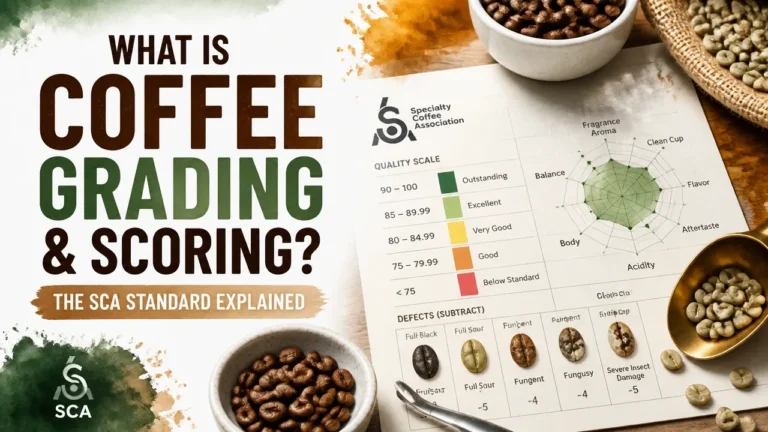

Precise coffee grading and scoring meaning is the foundation of every credible quality conversation in the specialty trade-yet the two terms are routinely treated as synonyms by buyers, roasters, and even some producers. One describes what you measure under a light on a grading table; the other describes what a trained palate detects in a cup.
Get the distinction wrong in a sourcing note, and the entire quality claim unravels. Get it right, and you have a two-gate system that the Specialty Coffee Association and the Coffee Quality Institute both recognize as the industry standard-a system built to separate genuine specialty from everything else.
To fully understand how these evaluations maintain industry-wide consistency, you need to examine the SCA specialty standard working mechanism in greater detail.
To understand how physical flaws translate into cup losses, you should review the coffee defects and grading system to see how individual imperfections impact flavor and scoring.
Key Takeaways on Coffee Grading and Scoring Meaning
- Coffee grading inspects physical green coffee properties; coffee scoring measures sensory quality through cupping-they are separate evaluations, not two names for one process.
- Specialty status requires passing both gates: 80+ on the SCA cupping scale and zero primary defects with no more than five full defects per 300 grams.
- Moisture content between 10–12% is the validated safe range; above 12.5% creates microbiological risk that degrades cup quality before roasting begins.
- Screen size measures uniformity for roasting consistency, not flavor quality-small Ethiopian screen-14 beans can outperform large-screen coffees in the cup.
- National grading systems at origin are independent of SCA cupping scores; Kenya AA, Ethiopian Grade 1, and Colombia Supremo describe different physical properties using different national scales.
- A cup score is a quality threshold indicator, not a complete sensory identity-two coffees scoring 87.25 can taste entirely different.
Grading Is Not Scoring: The Two-Gate System Behind Coffee Quality
Most people entering the specialty trade assume coffee grading and coffee scoring describe the same evaluation from different angles. They do not. The SCA and CQI model treats them as two separate quality gates that a coffee must pass independently-and confusing them in documentation creates real QA problems downstream.
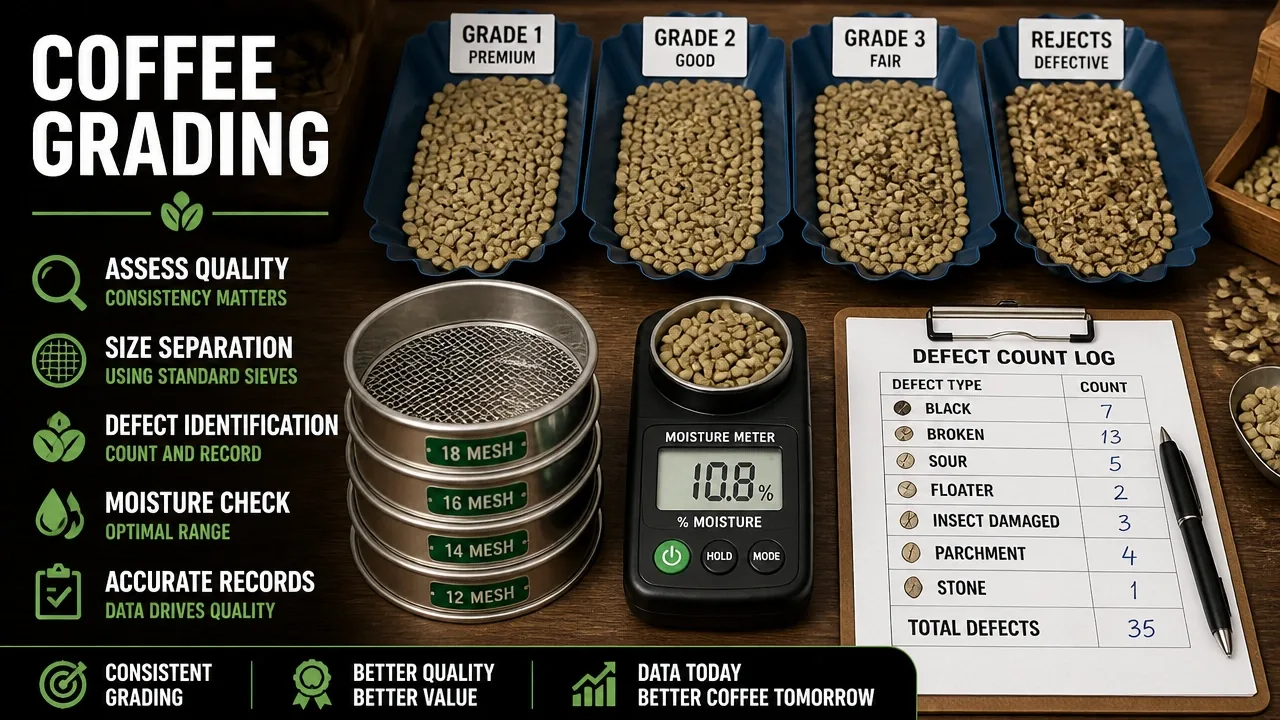
Coffee grading is a physical inspection performed on green coffee before roasting. It measures moisture content, counts defects, records screen size, and assesses bean density. The output is a quality tier-specialty grade or commercial grade-based on whether the sample meets defined physical thresholds.
Coffee scoring is a sensory evaluation performed after roasting, using the SCA cupping protocol. A trained evaluator scores the coffee across ten sensory attributes on a 100-point scale, and the resulting number-say, 87.25-is the cup score. “Grade” and “score” are not interchangeable: grade is the physical classification, score is the numeric sensory result. Treating one as a proxy for the other is where most QA communication breaks down.
For a full picture of how these two systems interact across the supply chain, the complete specialty coffee grading guide is the place to start.
To better understand how evaluators assign values across this 100-point scoring system, it is essential to examine the rigorous standards set by the Specialty Coffee Association.
Here is a visual of what a physical grading setup looks like in practice-sieves, moisture logs, and sample trays working together before a single cup is brewed.
The SCA/CQI Baseline: What “Specialty” Actually Requires
Specialty status is not a single number. The Specialty Coffee Association and the Coffee Quality Institute together provide the official quality baseline that most specialty markets operate against, and that baseline contains two conditions-not one.
A coffee earns specialty classification only when it clears a sensory threshold and a physical threshold. Fail either gate, and the coffee is not specialty, regardless of how well it performs on the other dimension. For a granular look at how each sensory attribute contributes to the final number, the SCA cupping form attribute breakdown walks through every scoring dimension in detail.
The 80-Point Cupping Threshold
The SCA cupping score threshold for specialty is 80 points or higher on the 100-point cupping scale. A Q Grader-a certified evaluator trained and credentialed by the Coffee Quality Institute-conducts the evaluation using the SCA cupping protocol. Any coffee scoring below 80 does not qualify as specialty, regardless of its physical condition.
“It’s always important to note that these scores are to define flavour quality only. The SCA and Coffee Quality Institute both define specialty in the context of green coffee as a combination of cup characteristics (sensory quality) and grade attributes (physical quality).” – Spencer Turer, Vice President, Coffee Enterprises
The 80-point cutoff is widely quoted, but Turer’s point is the one most professionals miss: the score defines flavor quality only. It says nothing about the physical condition of the green coffee that produced it. This is precisely why the SCA/CQI framework insists on a second, independent gate.
The Green Defect Gate
The physical gate is unambiguous: a specialty-grade sample must contain zero primary defects and no more than five full defects per 300-gram sample. Primary defects-full black beans, full sour beans, dried cherry, fungus-damaged beans, foreign matter, and severe insect damage-carry zero tolerance. A single primary defect disqualifies the sample.
Many industry sources describe the physical gate as “five secondary defects,” which is a standards error. Primary defects and secondary defects are evaluated separately, and the zero-tolerance rule applies only to primary defects. The five-full-defect limit applies to the secondary defect count, expressed in full defect equivalents-a counting system that weights different defect types differently rather than treating every damaged bean as one defect.
“A green coffee that is Q Certified goes through the CQI Q Grading System. Green grading and cup scoring with the common language of quality provides a transparent, verifiable report certifying that the coffee has no primary defects, a cup score of 80 points or more and a described coffee flavor profile of the sample roast.” – Coffee Quality Institute
The CQI’s framing confirms what the standards require: both gates must clear. A high cup score does not offset primary defects, and a flawless physical sample does not compensate for a score below 80.
Physical Grading: The Green-Coffee Inspection Gate
Physical grading answers a specific question: does this green coffee meet the structural requirements to be considered specialty before it ever touches a roaster? Even a sample that produces a clean, defect-free physical report cannot tell you how the coffee will taste. That is what the sensory gate is for. But without passing the physical gate first, the sensory question is irrelevant for specialty classification purposes.
Physical grading inspects four main dimensions: bean size, bean density, moisture content, and defect count. Each dimension contributes to roast consistency and, indirectly, to the conditions under which cup quality can be expressed. For a detailed comparison of how physical grade separates specialty vs commercial coffee grade, the trade-offs between physical standards and market positioning become much clearer.
Bean Size and Density Measurements
Screen size is measured in increments of 1/64 of an inch. A screen-18 bean is 18/64 of an inch in diameter. The practical reason this matters is roast uniformity: beans of significantly different sizes absorb heat at different rates, making it difficult to achieve even development across a batch. Uniform screen size is therefore primarily a roasting consistency variable, not a flavor quality marker in itself.
Bean density is a separate physical input. High-altitude coffees tend to produce denser beans because slower cellular development at elevation allows more sugars and organic compounds to accumulate within the bean structure. Denser beans often suggest higher potential for flavor complexity-but that potential still requires cupping to confirm. A small screen-14 Ethiopian coffee can be extraordinary. The operative rule in physical grading: don’t judge by size; cup and see.
Moisture and Defect Thresholds
Moisture content in green coffee targets a band of 10–12%. Below 9%, beans become brittle and prone to fracturing during roasting. Above 12.5%, microbial growth and mycotoxin formation become genuine risks.
The peer-reviewed Food Chemistry study on water content determination in green coffee identifies moisture as the most critical quality parameter in green coffee, establishing that a water content between 8.0% and 12.5% is considered adequate to prevent microbial growth and mycotoxin formation-scientifically anchoring the 10–12% industry target within a validated safe range.
Moisture rising above the 12.5% upper boundary is not merely a storage inconvenience; it is a documented microbiological risk that can degrade cup quality before the coffee reaches a roaster.
Defect classification uses a weighted counting system. Primary defects-black beans, sour beans, fungus damage-have major cup impact and carry a zero-tolerance threshold at the specialty gate. Secondary defects have less direct cup impact, but they accumulate toward the five-full-defect limit using equivalence ratios. For example, one full black bean may count as one full defect, while it can take ten slightly insect-damaged beans to equal one full defect. This is why a raw bean count and a defect count are never the same number.
Sensory Scoring: The Cupping Evaluation Gate
A physically clean green coffee can still fail specialty classification if it cannot produce an adequate cup. The sensory gate exists precisely because physical properties are necessary but not sufficient-they create the conditions for quality, they do not guarantee it.
Sensory scoring uses the SCA cupping protocol and is performed by certified Q Graders. The evaluator scores the coffee across ten standard attributes, each contributing to the final composite score on the 100-point scale:
- Fragrance/Aroma
- Flavor
- Aftertaste
- Acidity
- Body
- Balance
- Uniformity
- Clean Cup
- Sweetness
- Overall
Each attribute carries its own scoring weight, and the ten scores combine to produce the final cup score. A result of 80 or above qualifies as specialty on the sensory dimension. The mechanics of how each attribute is evaluated-and how Q Graders move through the protocol-are covered in depth in the SCA cupping form attribute breakdown.
To see the SCA cupping protocol in action, this video walks through a live cupping session with the scoring form:
When the Two Gates Disagree: How Specialty Status Fails
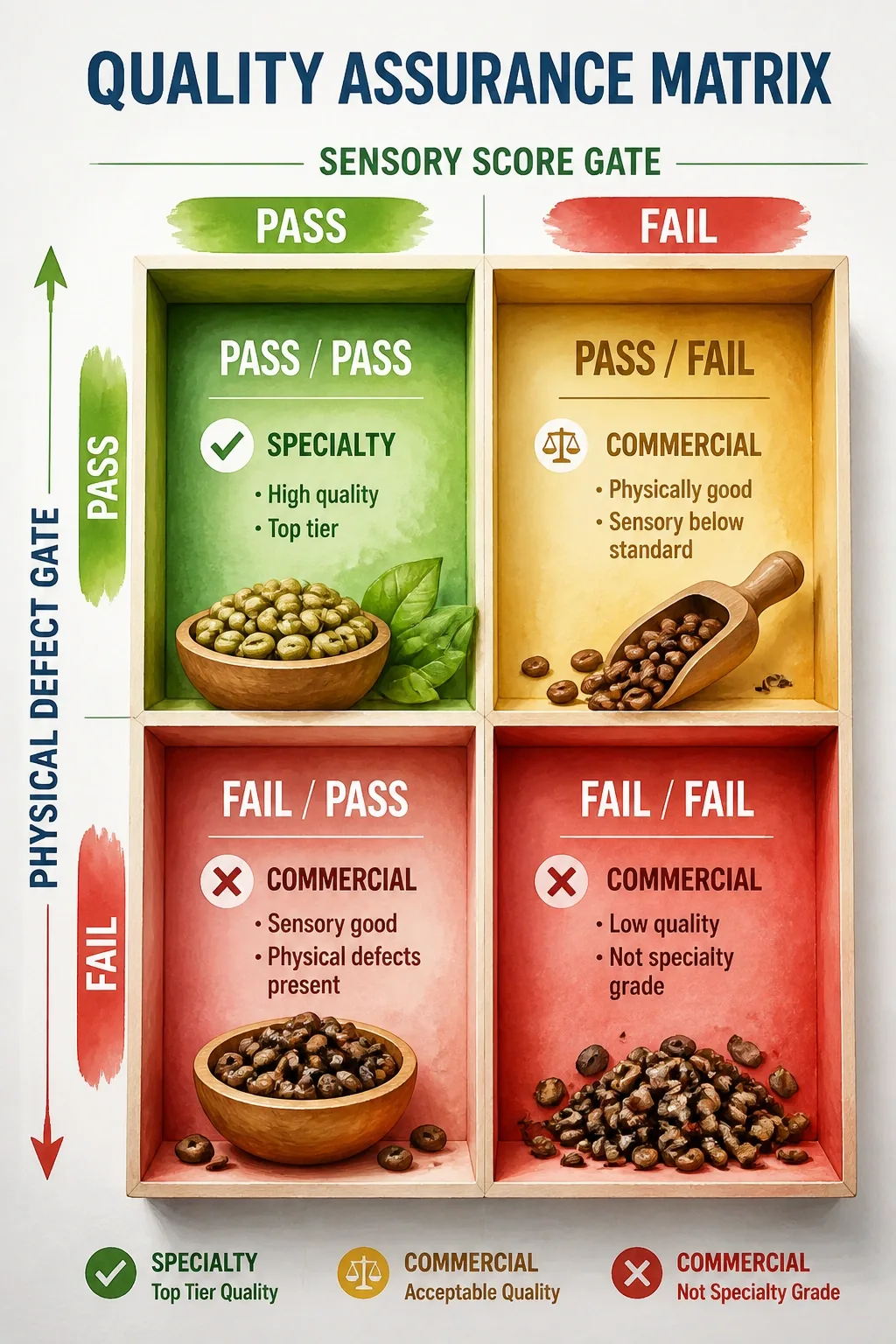
The most important thing to understand about specialty classification is that the two gates are evaluated independently. There is no averaging. A coffee that scores 86 on the cupping form but contains one full black bean is not specialty. A coffee with a flawless physical report that scores 78 in the cup is not specialty. Both conditions must hold simultaneously.
This produces a four-outcome quality matrix that most QA documentation fails to make explicit:
| Physical Gate | Sensory Gate | Outcome |
|---|---|---|
| Pass | Pass | Specialty |
| Pass | Fail (< 80) | Not specialty |
| Fail (defects) | Pass | Not specialty |
| Fail | Fail | Commercial |
The matrix matters because it prevents a common sourcing error: describing a coffee as “specialty grade” based on one gate alone. A visually clean sample with a high score still requires the defect count to be on record. A coffee with documented zero defects still requires a cup score above 80.
There is a second subtlety worth naming here: the same numeric score does not mean the same flavor profile. An 87.25 from a washed Ethiopian Yirgacheffe and an 87.25 from a natural Brazilian Cerrado describe the same quality level, not the same sensory experience. A score is a quality simplification-useful for classification, insufficient as a full sensory identity.
Why the SCA/CQI Standard Is Not a Universal Grading Passport
The SCA/CQI framework is the specialty trade’s shared quality language, but it does not govern how coffee is graded at origin. National grading systems predate the specialty movement and operate independently of SCA cupping scores.
“Current green grading guidelines are based on tradition, rather than on sensory science.” – Peter Giuliano, Head of the Coffee Science Foundation
Giuliano’s observation is the key to understanding why the SCA/CQI standard cannot function as a universal passport: the physical grading systems it sits alongside were not designed with sensory outcomes in mind. They were designed for trade standardization within national export systems.
National Systems by Origin
No universal coffee grading system exists. Every major producing country has developed its own classification framework, and those frameworks measure different things using different scales.
| Origin | System | Key Classifier |
|---|---|---|
| Ethiopia | Grade 1–5 | Defect count and cup quality |
| Kenya | Class AA–TT | Screen size (bean diameter) |
| Colombia | Supremo / Excelso | Screen size |
| Brazil | NY 2–6 / Fine Cup | Defect count and cup quality |
Ethiopian Grade 1 is the highest physical classification in that system; Kenya AA refers to bean diameter (screen 18+), not to cup quality. A Kenya AA can score below 80 in the cup. An Ethiopian Grade 3 can score above 85. These are separate national rankings, not rungs on a shared international ladder.
Kenya’s Class system is particularly important to flag: Class is a separate national grading scale independent of physical size, meaning two coffees with the same screen size can be classified differently based on cup evaluation. This is a key reason why “grade” can mean entirely different things depending on origin.
Specialty’s Sensory Language in a Fragmented Trade
The SCA/CQI scoring system has become the specialty trade’s lingua franca precisely because it provides a shared sensory metric that national physical grades cannot supply. When an importer in Hamburg buys a washed Ethiopian from an exporter in Addis Ababa, the Q score provides a common reference point that “Grade 1” alone does not.
But the score does not replace the national grade-it supplements it. A sourcing document that lists only a cup score is incomplete; one that lists only a national grade is equally incomplete. Terms like “specialty grade” and “Grade 1” contain no single universal meaning until the context-origin, grading system, and cup score-is specified.
The Coffee Value Assessment (CVA), developed as an evolution of single-score thinking, makes this fragmentation explicit. The CVA separates physical quality, descriptive sensory analysis, and affective (preference-based) scoring into distinct dimensions. A Q score compresses all of these into one number-useful as a threshold indicator, but insufficient as a complete quality verdict. Think of the score as one data point in a larger quality picture, not as the picture itself.
Putting It Together: How to Communicate Grade and Score Precisely
The practical payoff of understanding coffee grading and scoring meaning is the ability to write a sourcing note that cannot be misread. The rule is simple: use “grade” for the physical quality tier and “score” for the numeric cupping result. Never substitute one for the other.
A specialty claim is only valid when both gates pass: a sensory score of 80 or above, zero primary defects, and no more than five full defects per 300-gram sample. State all three in documentation. Stating one without the others is an incomplete quality claim.
The documentation template that QA professionals use follows a three-part structure:
| Field | What to Record | Example |
|---|---|---|
| Physical | Pass / Fail + defect count | Pass – 0 primary, 3 full defects / 300g |
| Score | Numeric cupping result | 87.25 |
| Status | Concluding classification | Specialty |
A coffee buyer calling a coffee “specialty grade” in a commercial context typically means an 80+ composite impression. A QA professional in a roastery setting can-and should-legally and operationally separate the physical grade from the cup score. These are not the same claim, and treating them as equivalent erodes the precision that the two-gate system was designed to provide.
Among 653 Cup of Excellence auction coffees, the score distribution broke down as follows: 99 coffees scored 90 or above, 147 scored between 87 and 90, 216 scored between 85 and 87, and 191 scored below 85.
This distribution matters for documentation because it illustrates that even within confirmed specialty-grade coffees, the score range is wide. A label is a conclusion, not a measurement. Treat it as grade plus score-not grade instead of score.
Frequently Asked Questions About Coffee Grading and Scoring Meaning
How does coffee scoring work?
A certified Q Grader evaluates a roasted coffee sample using the SCA cupping protocol, scoring ten sensory attributes-including acidity, body, flavor, and aftertaste-on a 100-point scale. The scores combine into a final composite number, with 80 or above qualifying as specialty.
What are the three grades of coffee?
There’s no single universal three-grade system-grading is origin-specific. In broad commercial terms, coffees are often separated into specialty (80+ cup score, clean physical grade), premium commercial, and commodity grades, but the exact criteria differ by country and trade context.
What is Grade 4 coffee?
In the Ethiopian national grading system, Grade 4 is a lower-tier classification based on defect count and cup evaluation. It falls well below the specialty threshold and is generally used for domestic consumption or lower-grade export contracts.
Can a coffee pass physical grading but still fail to be specialty?
Yes, and this happens more often than people expect. A physically clean sample with zero defects and ideal moisture still fails specialty classification if its cup score lands below 80. Both gates must pass independently.
Why do defect counts use “full defect equivalents” instead of raw bean counts?
Because different defect types cause different levels of cup damage. One full black bean equals one full defect, but it may take ten slightly insect-damaged beans to equal the same one full defect. The equivalence system weights defects by their actual impact on cup quality.
What’s the difference between a Q Score and a national grade like Kenya AA?
They measure completely different things. Kenya AA describes bean diameter-it’s a screen-size classification. A Q Score measures sensory quality through cupping. A Kenya AA can score anywhere from below 80 to above 90 in the cup; the physical classification tells you nothing about flavor.
Why doesn’t the SCA cupping score work as a universal grading passport?
Because it only addresses one dimension of quality-sensory evaluation. Physical grading at origin follows national systems built on different criteria, and those systems weren’t designed around sensory outcomes. A complete quality picture requires both the national physical grade and the SCA cup score.
What is the Coffee Value Assessment and how does it differ from a Q Score?
The CVA separates quality evaluation into distinct dimensions-physical, descriptive sensory, and preference-based scoring-rather than compressing everything into a single number. A Q Score is useful as a threshold indicator, but the CVA acknowledges that one number can’t fully represent a coffee’s quality identity.
References
- Should Specialty Coffee Start at 84 Points? Quality Challenges | perfectdailygrind.com
- Grounding Green Grading | sca.coffee
- QE Program Guidebook v8 | database.coffeeinstitute.org
- Water Content Determination in Green Coffee | sciencedirect.com
- Cup of Excellence Auction Coffee Quality Distribution | doi.org (ag.econ.9797)