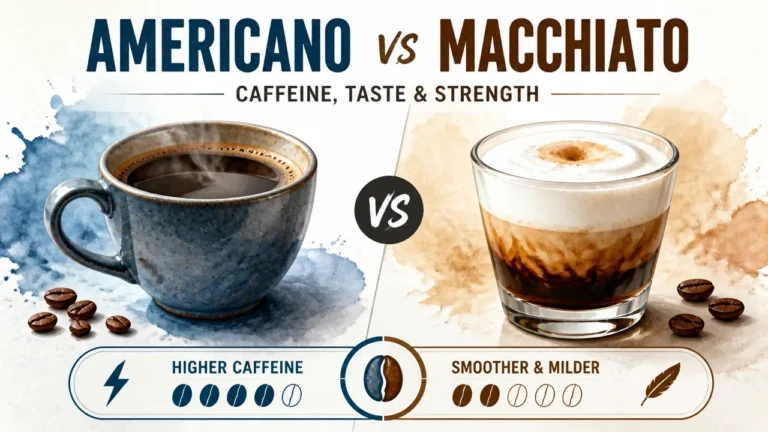

Freshly pulled espresso sits at the center of both drinks, which is exactly why the comparison trips people up. The Americano stretches that shot with hot water into a larger, cleaner cup. The macchiato marks it with a small touch of milk and stays small.
But the word “macchiato” alone can describe two completely different beverages depending on where you order it, and that changes everything about the comparison. Understanding the construction of each drink tells you more than any side-by-side taste chart ever could.
If choosing between espresso beverages feels complicated, exploring a flat white versus cappuccino reveals how milk texture can completely change your coffee experience.
Key Takeaways on Americano vs Macchiato
- Both drinks start from the same espresso shot; every difference comes from what’s added after extraction.
- An Americano adds hot water and no milk, producing a larger, smoother, black coffee experience typically in the 6-12 oz range.
- The word “macchiato” describes two incompatible drinks: a 1.3-3.5 oz espresso-forward traditional version and a larger, milk-first chain version.
- Caffeine content overlaps heavily (150-237 mg) because shot count, not drink name, controls the actual milligram load.
- A traditional macchiato tastes stronger than an Americano with identical shots because the same caffeine is concentrated in a fraction of the liquid volume.
- The Americano forgives a mediocre espresso shot; the traditional macchiato exposes it immediately.
The Espresso Foundation Both Drinks Share
Espresso is the atomic unit here, and both drinks are built entirely on it. That means before you compare anything else, you need to know what espresso actually is: concentrated coffee made by forcing hot water, not steam, through finely-ground coffee under roughly 9 bars of pressure. The result is a small, dense shot with a layer of reddish-brown crema on top.
The standard measurements are simple. A single shot is approximately 1 oz / 30 ml. A double shot is approximately 2 oz / 60 ml. Most cafes default to a double when you order any espresso-based drink, though some smaller shops still pull singles for traditional preparations.
Here’s why that matters for this comparison: the Americano and the macchiato draw their caffeine and their core flavor from the same source. Every difference you taste, every visual difference you see, and every calorie difference you track comes entirely from what happens after that shot finishes pulling. The espresso itself is identical.
Americano: What Hot Water Does to an Espresso Shot
The Americano is built on a straightforward idea: one or two shots of espresso combined with hot water, served in a larger cup. The typical range runs from 6 oz up to 24 oz, depending on the cafe and how many shots you order. Most well-made Americanos land between 6 and 12 oz.
The water does something specific to the espresso. It doesn’t just thin it out; it opens up the aromatic compounds, softens the intensity, and produces a cup that reads like brewed coffee in terms of volume and drinkability, while still carrying espresso’s distinct character. The flavor profile stays clean and coffee-forward. There’s no milk to round the edges, which means the acidity is more present than in a latte or cappuccino, but considerably gentler than drinking the shot straight.
One thing worth stating plainly: a traditional Americano contains no milk. It is a black coffee drink by default. You can add milk, but the moment you do, you’ve moved into different territory.
The practical limits of the Americano become obvious at the extremes. Pouring a single 2 oz shot into a 24 oz cup of water produces something thin and unsatisfying, both sensorially and economically. The espresso character dissolves to near-nothing, and you’re essentially paying espresso prices for flavored hot water. This is why the 6-12 oz range is where the drink actually works. The shot-to-water ratio keeps the espresso character detectable, the cup remains smooth, and the drink justifies its own existence.
Macchiato: One Word, Two Completely Different Drinks
The word macchiato comes from Italian, meaning “stained” or “spotted.” The name describes the act of marking espresso with a small amount of milk. Simple enough. The problem is that the word now refers to two drinks that are nearly incompatible with each other, and if you don’t know which one you’re getting, the comparison with an Americano becomes meaningless.
Navigating these stylistic extremes is essential when making macchiato at home with precision and historical accuracy.
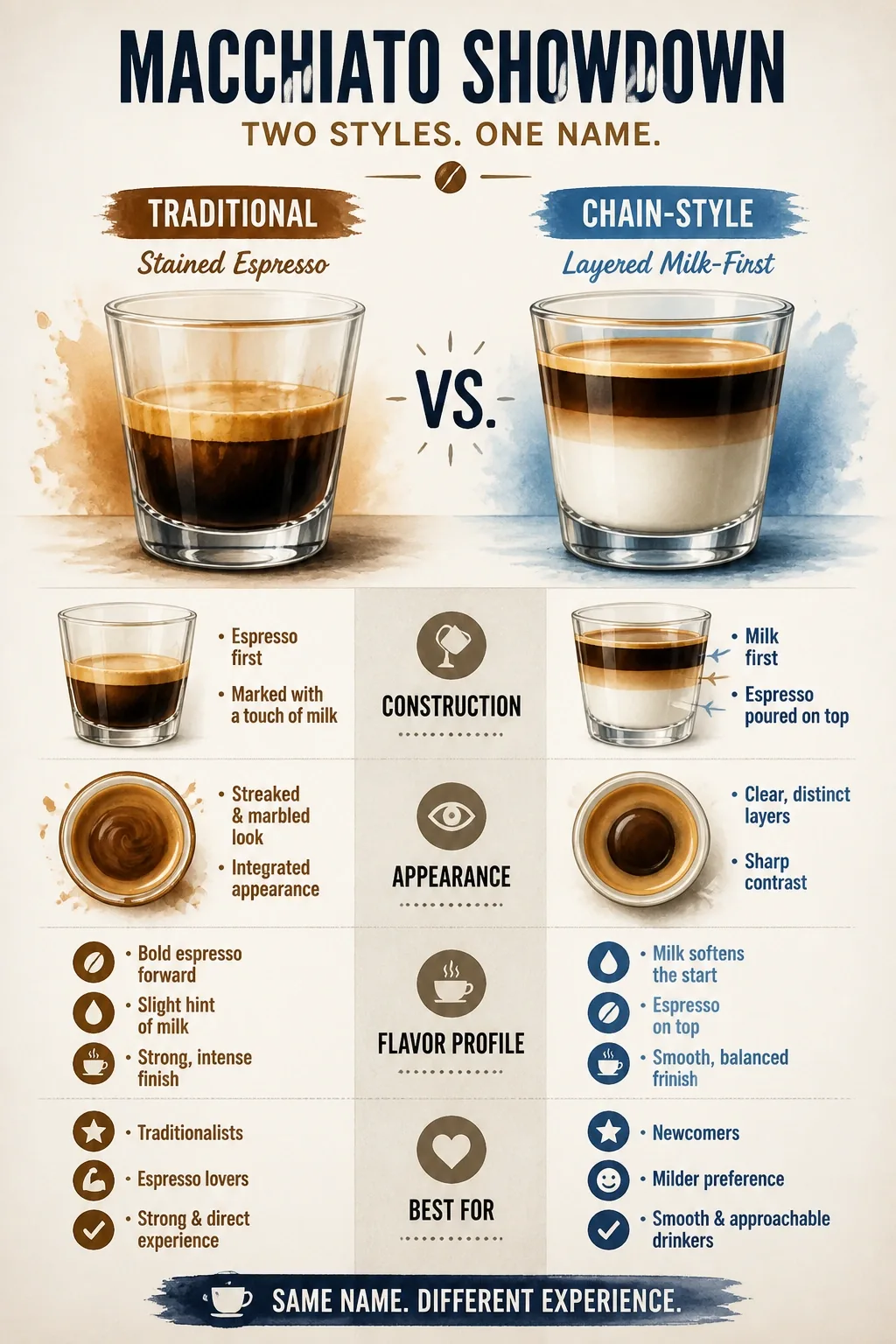
The Traditional Espresso Macchiato
The traditional macchiato is an espresso-forward drink. One or two shots of espresso, marked with a small dollop of milk foam or a splash of steamed milk. Total volume typically lands between 1.3 and 3.5 oz. The milk is present but barely. Its job is to soften the very sharpest edge of the espresso’s bitterness, not to change the character of the drink. You are still drinking espresso. The milk is a whisper, not a statement.
Achieving that pristine texture requires mastering the caffe macchiato mini foam trick to ensure the dairy harmonizes with the crema.
The Chain-Style Macchiato
The chain-style macchiato, popularized by large coffee chains, works in reverse. Steamed milk goes into the cup first, then the espresso is poured through the foam on top. The result is a layered, milk-forward beverage that is significantly larger, considerably creamier, and far more approachable than anything the traditional version produces.
“An espresso macchiato is made by extracting the espresso shot first and adding a small spoonful of foam on top. A latte macchiato flips this around, where you basically pour steamed milk in the glass first and then add espresso through the foam. The order is important because it completely changes how strong the coffee tastes and its visual appearance.” – John Beaver, Founder of Alternative Brewing
The construction order Beaver describes isn’t just a visual trick. When espresso hits a bed of cold foam first, it disperses slowly and layers visually. When foam is added to a pulled shot, the espresso stays concentrated at the bottom and the milk sits on top. The same ingredients, reversed, produce a different drinking experience from the first sip to the last.
This two-macchiato problem is not a naming quirk. It rewrites the entire comparison. A traditional macchiato is closer to a straight espresso than it is to an Americano. A chain macchiato is closer to a small latte. Knowing which one is in front of you is the prerequisite for any meaningful comparison.
Caffeine and Strength: What the Numbers Actually Show
Caffeine content in both drinks overlaps more than most people expect. A typical Americano delivers somewhere between 150 and 237 mg of caffeine. A typical macchiato lands in the 212 to 237 mg range. Those ranges share enough territory that the drink’s name alone tells you almost nothing reliable about how much caffeine you’re actually consuming.
The variable that controls caffeine is shot count, not the drink category. A double-shot Americano and a double-shot traditional macchiato deliver essentially the same caffeine load. The water in the Americano and the milk foam in the macchiato don’t add stimulants; they add volume and texture. Strip those away and you’re comparing shot-for-shot.
“Strength” is where the conversation gets genuinely complicated. A 2023 study published in the Journal of Food Science mapped sensory attributes, consumer preferences, and brew parameters across a controlled range of coffee preparations. The research operationally defined brew strength as the mass fraction of dissolved solids in the cup, what the industry calls total dissolved solids (TDS), and demonstrated that this metric moves independently from both extraction yield and caffeine concentration. Bitterness, acidity, and body don’t scale in lockstep with caffeine. They follow their own trajectories across the brewing control chart.
The Journal of Food Science study found that sensory attributes like bitterness, acidity, and viscosity peak at different coordinates on the brewing control chart, meaning a drink can register as intensely bitter or thick-bodied without necessarily containing more caffeine than a milder cup.
That finding matters here because it explains something counterintuitive: a traditional macchiato at 2 oz with two shots will taste dramatically stronger than a 16 oz Americano with the same two shots, even though both cups contain identical caffeine. The macchiato delivers that caffeine in a fraction of the liquid volume, which means every sip is more concentrated. The Americano spreads the same stimulant across eight times the water. Same milligrams. Completely different experience.
The practical rule: compare shot count first, then total volume, then talk about flavor concentration. Caffeine is the wrong starting point for this conversation.
What Each Drink Actually Tastes Like
Taste is where the two drinks diverge most clearly for the person holding the cup. The Americano presents as smooth and clean. The water dilution softens the espresso’s intensity while keeping its aromatic complexity intact. You get the brightness, the subtle acidity, and the roasted character of the espresso, but spread across a larger, more approachable volume. It reads like a sophisticated black coffee: familiar enough for daily drinking, distinct enough to be interesting.
The traditional macchiato is a different proposition entirely. The flavor is intense and espresso-forward, with a small creamy note from the milk mark. That milk softens only the sharpest edge of the bitterness; it doesn’t neutralize it. You are tasting the espresso almost in its raw form, with a thin layer of texture added on top.
The textural difference is just as significant. An Americano has a thin, water-like body. It flows easily, sits light in the stomach, and doesn’t leave much coating on the palate. A traditional macchiato, despite its tiny volume, carries a heavier mouthfeel from the milk foam. The crema and foam combine into something richer than water could produce, even in a 2 oz serving.
There’s also a forgiveness gap between these two drinks that working baristas understand immediately. The macchiato is the less forgiving order. With almost no milk buffer, a mediocre espresso shot has nowhere to hide. Every flaw in the extraction, whether it’s over-roasted beans, poor grind calibration, or a slightly stale puck, comes through clearly. The Americano, by contrast, can mask a mediocre shot behind dilution. It won’t make a bad shot taste good, but it will make it drinkable. This is a practical consideration when you’re ordering at an unfamiliar cafe.
The Verdict: Which Drink Should You Actually Order?
The decision rule is simpler than the comparison suggests. Neither drink is universally better. They serve different intentions.
Choose the Americano if you want a larger cup, prefer black coffee with no milk, and value smoothness and drinkability over intensity. It’s the practical daily driver. It’s consistent across cafes, forgiving of shot quality, and easy to scale up with an extra shot if you want more caffeine without more volume. If you’re new to espresso drinks or unsure about a cafe’s shot quality, the Americano is the cleaner entry point.
Choose the traditional macchiato if you want a small, concentrated, espresso-driven drink with a light creamy mark. It rewards high-quality shots and experienced palates. At a specialty cafe where you trust the espresso, the macchiato is the most direct way to taste what that espresso actually is. It punishes a bad shot just as effectively as it showcases a great one.
The chain-store caveat is worth stating directly: if you’re ordering at a large coffee chain and you ask for a macchiato, you will almost certainly receive the milk-forward layered version. That drink is closer to a small latte than to a traditional macchiato. Adjust your expectations accordingly, or specify “espresso macchiato” to clarify what you want.
The practical shorthand from experienced baristas holds up: Americano for clean, no-milk drinkers who want volume and reliability; traditional macchiato for espresso purists who want to taste the shot itself; chain macchiato for milk-forward drinkers who want something approachable and layered. Know which category you’re in before you order, and the choice makes itself.
Frequently Asked Questions About Americano vs Macchiato
Is a macchiato stronger than an Americano?
It depends on what “stronger” means to you. In terms of flavor concentration per sip, a traditional macchiato is far more intense because the same espresso is packed into 2-3 oz instead of 8-12. In terms of total caffeine, they’re nearly identical if they’re made with the same number of shots.
Which drink has more caffeine, an Americano or a macchiato?
Both overlap in the 150-237 mg range, so the shot count matters more than the drink name. Two shots in an Americano and two shots in a macchiato deliver essentially the same caffeine, regardless of the water or milk surrounding them.
Why would anyone order an Americano instead of just getting brewed coffee?
Espresso extraction produces a chemically different cup than drip brewing. The high pressure and short contact time pull different compounds from the grounds, giving the Americano a distinct character, body, and crema that drip coffee doesn’t produce, even at the same volume.
What’s the actual difference between an espresso macchiato and a latte macchiato?
Construction order and milk volume. An espresso macchiato adds a small foam dollop to a pulled shot. A latte macchiato pours steamed milk into the glass first, then adds espresso through the foam. The result is a much larger, creamier, milk-dominant drink in the latte macchiato.
Can I add milk to an Americano?
You can, but technically you’ve moved into a different drink category at that point. A small amount of milk in an Americano is sometimes called a “white Americano” or a “long white,” depending on the cafe. Most baristas won’t object, but it changes the taste profile noticeably.
Which drink is better for someone who doesn’t like bitter coffee?
The Americano is the safer choice. The water dilution softens bitterness and spreads the intensity across a larger volume. A traditional macchiato is essentially espresso with a whisper of foam, so bitterness stays front and center.
Does the water temperature in an Americano affect the taste?
Yes. Hot water added to espresso after extraction is different from hot water passing through the grounds. If the water is too hot, it can flatten the aromatic compounds in the shot. Most specialty baristas add the espresso to the water (not water to espresso) to preserve the crema and avoid temperature shock.
How do I order a traditional macchiato at a chain coffee shop?
Ask for an “espresso macchiato” specifically. At most chains, saying just “macchiato” will get you the larger, layered, milk-forward version. Specifying “espresso macchiato” signals that you want the small, two-to-three-ounce traditional version with just a dollop of foam.
References
- Macchiato vs. Espresso Macchiato | themanual.com
- A New Coffee Brewing Control Chart Relating Sensory Properties and Consumer Liking to Brew Strength, Extraction Yield, and Brew Ratio | Journal of Food Science | ift.onlinelibrary.wiley.com
The standard measurements are simple.