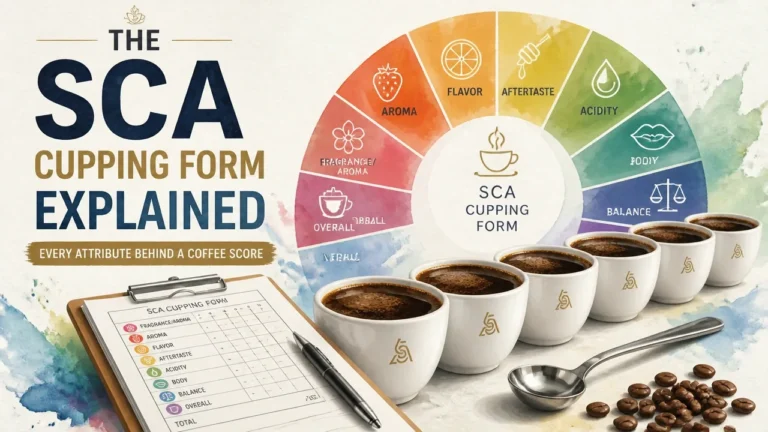

The standardized SCA cupping form is the instrument behind every specialty grade decision in professional coffee evaluation-yet the version in front of you may not match the protocol your colleagues are using. One iteration omits the Overall row. Another lists a Fault penalty that contradicts what most educators teach. The Coffee Value Assessment has since expanded the framework entirely.
Understanding what each attribute measures, how penalties stack, and where the arithmetic goes undocumented is the difference between a score that holds up in a buying conversation and one that quietly falls apart under calibration.
Understanding what each attribute measures, how penalties stack, and where the arithmetic goes undocumented is the difference between a score that holds up in a buying conversation and one that quietly falls apart under calibration, especially when exploring coffee cupping vs technology in modern quality control labs.
Before diving into professional attribute scoring and calibration, you can review the fundamentals by learning How to Perform Coffee Cupping in a home setting.
Key Takeaways on SCA Cupping Form Attributes Explained
- The 2024 SCA cupping form omits the Overall row, making the ten-attribute framework version-dependent-confirm your form edition before calibrating.
- Acidity, Body, and Sweetness score quality, not intensity or quantity; the separate Intensity and Level fields document degree independently.
- The Fault penalty discrepancy (-4 on the 2024 form vs. -6 in older protocols) can shift a borderline score by six or more points across three affected cups.
- Clean Cup and Uniformity scale per cup rather than averaging across five, making them the form’s most sensitive indicators of lot-level inconsistency.
- An 80-point score clears specialty grade but fails the internal buying bars of most quality-focused roasters, who apply 84+ or 86+ thresholds in practice.
- The final score is a calibrated judgment, not an objective measurement-form version, protocol alignment, and sample integrity are prerequisites for a defensible number.
The SCA Cupping Form: What It Is and Why Version Matters
The SCA cupping form is the standardized evaluation sheet that converts a cupper’s sensory judgments into a number on a 100-point scale-and 80 points is the threshold that separates specialty grade from everything below it. Most professionals treat it as a stable industry instrument, which it largely is. The problem is that “largely” is doing a lot of work in that sentence.
The form has changed, and version confusion is one of the most consequential accuracy traps in professional cupping. If the instrument itself varies by edition, then scores produced on different versions aren’t directly comparable-which matters enormously when calibration, green buying, or certification is on the line. Understanding the form means understanding not just what’s on it, but which version you’re holding and whether it matches the cupping protocol your team is following.
For context on how the form connects to broader grading standards, the specialty coffee score thresholds that define grade boundaries are part of a larger quality framework the SCA form feeds into-not a standalone system.
Core Form Structure and Scoring Components
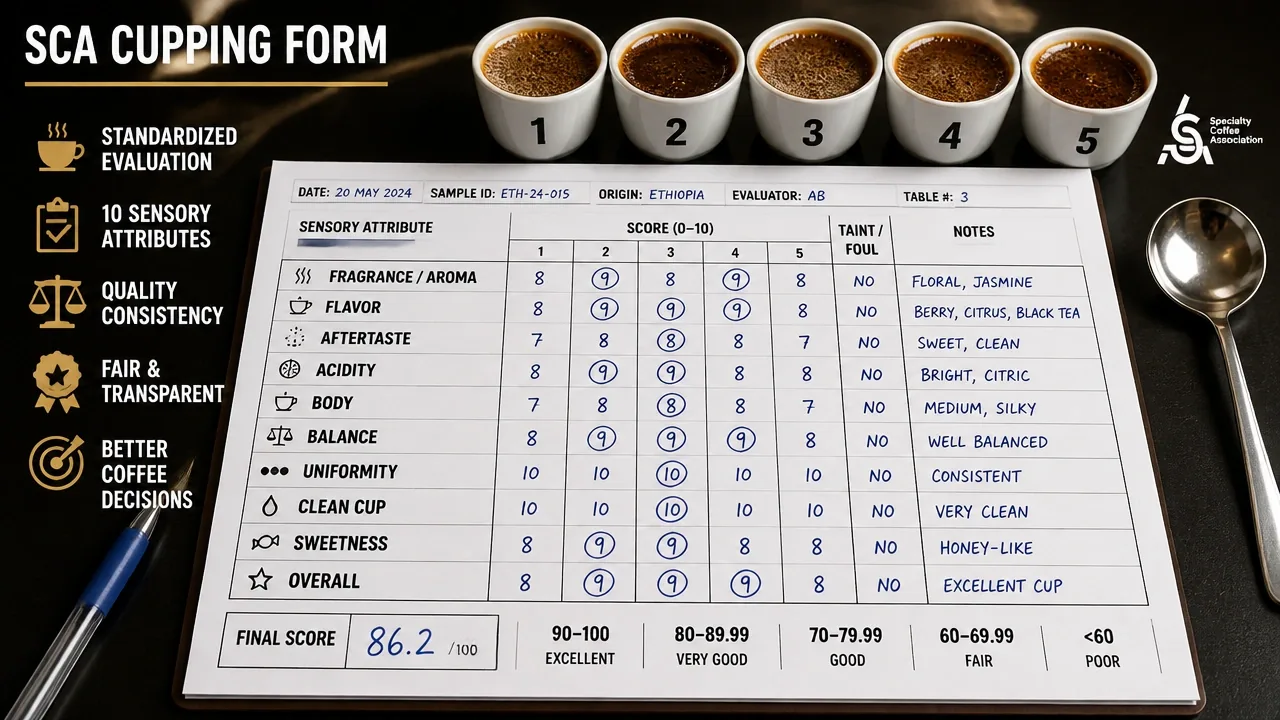
The SCA cupping form evaluates coffee across ten sensory attributes, each scored on a 0–10 scale, with the results combined into a final score that determines specialty grade status. The form also includes defect columns-Taint and Foul-and a final score field where the penalized total lands.
Each attribute row captures a distinct sensory dimension: Fragrance/Aroma, Flavor, Aftertaste, Acidity, Body, Balance, Sweetness, Clean Cup, Uniformity, and (in most versions) Overall. The defect columns operate separately from the attribute rows, applying a penalty subtracted from the total rather than reducing any individual attribute score.
Here’s where the form’s apparent stability breaks down. The official 2024 Arabica Cupping Form does not include an Overall row-the attribute list ends at Sweetness. That means the number of scored attributes is version-dependent: nine on the 2024 form, ten on earlier versions. For anyone calibrating scores across teams or training cohorts, this isn’t a minor formatting detail. It changes the maximum possible attribute total before defect deductions are applied.
Version Evolution and Protocol Alignment
The SCA cupping protocol that governed professional evaluation for two decades originated in 2004. The Specialty Coffee Association has since developed the Coffee Value Assessment (CVA)-a four-stage system that separates Physical evaluation, Extrinsic context, Affective assessment (preference-based), and Descriptive assessment (sensory characterization) into distinct modules. The CVA represents a meaningful shift in how the SCA conceptualizes quality evaluation, moving away from a single numeric verdict toward a richer, multi-layered signal.
That said, the cupping form remains the reference instrument for numeric scoring in the vast majority of commercial, educational, and certification contexts. The CVA hasn’t replaced it-it’s expanded around it. The form must be used in conjunction with the SCA cupping protocol; the sheet alone is not a scoring system. Without the protocol governing brew ratio, water temperature, grind, and timing, the scores it generates aren’t comparable across sessions.
One version-specific discrepancy worth flagging immediately: the 2024 form shows a Fault penalty of -4 points, but many educational sources and older protocols cite -6 points for a Foul defect. That’s a two-point difference per affected cup-meaningful when a coffee is sitting close to the 80-point threshold. Before any calibration session or commercial cupping, confirm the form version and the penalty source being applied.
For buyers and producers evaluating coffees where a single numeric score isn’t sufficient context, the CVA’s four-stage model offers a framework that separates objective description from subjective preference. When traceability, market-specific appeal, or origin storytelling matters more than a single number, that separation carries real practical value.
Fragrance/Aroma, Flavor, and Aftertaste: The Temporal Arc of the Cup
These three attributes form the sensory sequence of a cupping session-dry smell, wet smell, full taste, and lingering finish-and they must be scored independently of each other. The most common mistake among newer cuppers is allowing a dominant aroma to inflate the Flavor score, or letting a clean finish compensate for a weak mid-palate. The SCA cupping form scores each attribute as its own judgment, and the integrity of the final number depends on maintaining that independence throughout the session.
The Taste Experience
Fragrance is the dry coffee smell evaluated before any water contact-assessed immediately after grinding, while the grounds are still undisturbed. Aroma is the wet smell captured after the crust is broken during cupping. The form carries separate Dry quality and Break quality score fields for these two moments, and the final Fragrance/Aroma score integrates both into a single entry. A coffee that smells extraordinary dry but delivers little on the break-or vice versa-should reflect that asymmetry in how the cupper weights the two fields.
Flavor is the broadest attribute on the form. It captures the total taste impression: the combined effect of taste, aroma, and mouthfeel as they register simultaneously on the palate. Critically, Flavor is not scored for a single dominant note. It represents the whole taste experience-intensity, complexity, and character together. Cuppers who default to scoring Flavor based only on the most prominent note consistently underrepresent coffees with layered, evolving profiles.
For a practical demonstration of the full cupping sequence from dry fragrance through flavor evaluation, this walkthrough covers the process in real time:
The Finish and Scoring Independence
Aftertaste measures the taste and aroma that persists after the coffee has been expectorated or swallowed. Three dimensions drive the score: length (how long the finish lasts), quality (whether what lingers is pleasant), and cleanliness (the absence of off-flavors in the finish). A short but clean finish scores differently than a long but astringent one-both dimensions matter, and neither automatically dominates.
Each of these three attributes-Fragrance/Aroma, Flavor, and Aftertaste-is scored independently on the 0–10 scale before any cross-attribute comparison. Scoring them in sequence, without revising earlier scores based on later impressions, is the discipline the form requires. Calibration studies consistently show that retroactive score adjustment-going back to raise a Fragrance score after tasting an exceptional Flavor-is one of the primary sources of inter-cupper variance.
Acidity, Body, and Sweetness: The Structural Pillars in the Cup
Where Fragrance, Flavor, and Aftertaste capture the sensory sequence, Acidity, Body, and Sweetness describe the physical architecture of the cup-the structural properties that give coffee its character and, in commercial terms, much of its price. The confusion these attributes generate is almost always definitional: acidity is not sourness, body is not strength, and sweetness is not sugar.
Acidity Quality and Mouthfeel Weight
Acidity on the SCA cupping form refers to the lively, bright, often fruity structure that gives coffee its vibrancy-not the harsh, sharp sensation of sourness. The distinction is qualitative: positive acidity is a feature, sourness is a defect. The form includes a separate Acidity Intensity field (High/Low) that documents the level independently from the score itself. The score reflects quality-how well the acidity contributes to the cup-not simply how much of it is present. A high-intensity acidity that is sharp and unpleasant scores low; a moderate acidity that is bright and clean scores high.
Body is the tactile sensation of the liquid in the mouth-the weighted, physical presence of the coffee as it moves across the palate. The form includes a Body Level field (Heavy/Thin) that captures degree, separate from the quality score. Body is not strength: a coffee brewed at high concentration can feel thin, while a naturally processed low-grown coffee can carry a syrupy, heavy body with relatively low perceived intensity. The score should reflect the quality of the mouthfeel-how pleasing and appropriate the body is-not just its weight.
The distinction worth pressing further: heaviness and texture are separate dimensions of body. A coffee can be heavy but rough in texture, or light but silky and coating. The form’s single Body score is meant to capture the quality of the mouthfeel as a whole, which means the cupper must integrate both weight and texture into one judgment. When those two dimensions diverge, the score requires a deliberate decision about which dimension carries more weight in that cup’s overall character.
Sweetness Perception and the 0–10 Scale
Sweetness on the form measures the coffee’s inherent sugary quality-the natural sweetness present in the bean itself, not anything added to the cup. It reflects how the coffee’s sugars survived processing and roasting, and how that sweetness contributes to overall balance. A coffee with no perceptible natural sweetness scores at the low end; one with a rich, integrated sweetness that supports the other attributes scores toward the top.
The 0–10 scale applies to every scored attribute, with the following benchmarks: 6 = average, 7 = good, 8 = specialty-level quality, 9 = excellent, 10 = perfect. One practical issue: the official form prints only the 6–10 rows in the scoring section, which leads many new cuppers to treat 6 as the floor. It isn’t. The full 0–10 range exists, and scores below 6 indicate defective or non-specialty coffee. A coffee that scores 4 on Acidity has a genuine acidity problem-it’s not an abstraction. Printing only the upper half of the scale on the form is a design choice that can quietly distort how trainees understand the scoring range.
Balance, Uniformity, Clean Cup, and Overall: The Integrative Judgments
These four attributes evaluate the cup as a system rather than as a sequence of isolated sensory events. Where the earlier attributes ask “what does this taste like?”, these ask “how well does it hold together-and does it hold together the same way across every cup?” This is where the cupping protocol the form scoring depends on becomes especially critical: these attributes only make sense if the session was executed consistently from the first pour to the final score.
Harmony and Holistic Quality
Balance measures the harmony across all attributes simultaneously-how well Fragrance/Aroma, Flavor, Aftertaste, Acidity, Body, and Sweetness function together without any single dimension dominating or collapsing the whole. A coffee with extraordinary acidity that overwhelms every other attribute doesn’t score high on Balance, even if the acidity itself is excellent. Balance rewards proportion and integration, not the sum of peak individual scores.
Overall is the cupper’s independent holistic judgment of the cup’s total quality. It is not an average of the other attributes and should not be calculated from them. It’s a separate question: having experienced everything the coffee has to offer, what is the cupper’s verdict on its total quality? A coffee can score well across individual attributes but feel disjointed as an experience-and the Overall score is where that gap gets captured.
The version caveat here is significant: the official 2024 form does not include an Overall row. The attribute list ends at Sweetness, meaning the ten-attribute framework that most training programs teach is, on the current official form, actually nine attributes. When calibrating across teams or sourcing form templates from different educational providers, this discrepancy directly affects the maximum attribute total-and therefore the score ceiling before defect deductions.
Consistency and Cup-by-Cup Integrity
Clean Cup measures the absence of non-coffee off-flavors or defects in the sensory experience. It evaluates whether the cup is free from any flavor contamination that doesn’t belong to the coffee itself. Critically, this attribute scales across cups: if a defect appears in one of the five cups, the score reflects that specific cup count-it is not averaged across the set. A defect in two of five cups produces a different Clean Cup score than a defect in one.
Uniformity measures the consistency of the experience across all five cups in the cupping set. All five cups must present the same character for Uniformity to score at the top of the range. If one cup tastes noticeably different-whether due to a processing inconsistency, a defective bean, or a preparation error-that inconsistency is captured here. Like Clean Cup, Uniformity scales per cup rather than producing a single undifferentiated score.
Balance, Clean Cup, and Uniformity share a structural distinction from the other attributes: they can each vary cup-by-cup within a single session, producing scaled scores rather than a single entry for the set. The other attributes are scored once, representing the overall impression across all five cups. This scaling mechanism is what makes these three attributes particularly sensitive to lot-level inconsistency-they’re the form’s built-in quality control layer.
A practical note for calibration sessions: the absence of Overall on the official 2024 form means the ten-attribute framework some teams use and the nine-attribute framework the current form supports will produce different total scores from identical cups. Before any calibration session, confirm the form version and attribute list in use. The difference isn’t hypothetical-it’s a fixed-point discrepancy that compounds across multiple cuppers.
Taint and Foul: The Defect Penalty System
Defect penalties operate outside the attribute scoring rows and can override an otherwise strong attribute total. A coffee that scores well across every sensory dimension but carries a Foul defect in multiple cups can drop below the specialty threshold entirely-not because its flavor is poor, but because the penalty arithmetic removes enough points to push the final number under 80. Understanding how Taint and Foul stack is essential for any professional using the form in a commercial or certification context.
Defect Types and Sensory Impact
Taint is a minor off-flavor-noticeable but not overwhelming, a sensory disruption that degrades the cup without making it undrinkable. The standard penalty is -2 points per affected cup. Foul is a major off-flavor-intensive and unpleasant, the kind of defect that makes the cup actively objectionable. The standard penalty most educators and training programs cite is -6 points per affected cup.
Here is where the version discrepancy from H2-1 becomes directly consequential: the official 2024 form lists the Fault penalty as -4 points, not -6. That’s a two-point difference per affected cup. For a coffee with a Foul defect in three cups, the difference between a -4 and a -6 penalty is six points on the final score-potentially the difference between specialty grade and commercial. Before scoring any defect, confirm which form version is in use and which penalty structure applies. Citing a penalty without citing its source is an error in documentation, not just in arithmetic.
Penalty Arithmetic and Deduction Rules
The penalty arithmetic follows a straightforward multiplication rule: penalty value × number of affected cups = total deduction. Two cups with a Taint defect at the standard -2 penalty produces a 4-point deduction. Three cups with a Foul defect at the -4 penalty (2024 form) produces a 12-point deduction; at the older -6 rate, the same three cups produce an 18-point deduction.
The deduction is subtracted from the total attribute score-the sum of all attribute rows-not from any individual attribute. This means a coffee that scores 91 across its attribute rows but carries a 12-point Foul penalty finishes at 79: commercial grade, despite attribute-level quality that would otherwise clear specialty with room to spare. The defect penalty system is designed to ensure that sensory integrity failures can’t be masked by exceptional scores in other dimensions.
The Final Score Calculation: How the Number Comes Together
The final score on the SCA cupping form is not a weighted average, a normalized composite, or a proprietary algorithm. It is, in principle, a straightforward operation: sum the attribute scores, subtract the defect penalties, and the result is the final score on the 100-point scale. In practice, the arithmetic is less transparent than that description implies-and for who is qualified to use the SCA cupping form, that transparency gap matters.
Score Aggregation and Grade Determination
A concrete example clarifies how penalties interact with attribute totals. A coffee that cups at an 86 total attribute score, then receives two Taint penalties (2 × 2 = 4 points deducted), finishes at 82-still specialty grade, but only four points above the threshold. The same coffee with a single Foul defect in two cups (2 × 4 = 8 points on the 2024 form, or 2 × 6 = 12 points on older protocols) finishes at 74 or 78, depending on the form version. That’s the difference between a commercial lot and a near-specialty one-driven entirely by which penalty figure was applied.
The grade thresholds that govern commercial use are: 80+ = specialty grade, 79 and below = commercial grade, and 90+ = exceptional, elite single-origin quality. The 80-point floor is the most widely cited threshold in the industry, but it functions differently across buyer tiers.
Nordic Approach states that “a jump from 84 to 87 can meaningfully change what a lot is worth” in specialty coffee buying decisions. – Source: Nordic Approach Glossary
This reflects a commercial reality that the basic specialty/commercial binary doesn’t capture. The 80-point threshold defines the legal minimum for specialty designation, but many specialty roasters apply internal buying bars of 84+ or 86+. A coffee that scores 82 clears specialty grade on paper but won’t clear the procurement threshold of most quality-focused importers or roasters. Scores in the 84–87 range carry disproportionate commercial weight-not because the SCA defines a sub-tier there, but because the market has built one.
Arithmetic Transparency and Documentation
Each attribute is scored independently before the final sum is calculated, which means the total represents the coffee’s internal balance as an integrated whole-not a series of isolated impressions averaged together. The independence of scoring is what makes the final number defensible: each row was a separate judgment before the arithmetic combined them.
What the official protocol does not publicly document is the precise formula for converting the attribute row totals into the final 100-point score. The Acidity and Body scores are documented as discrete entries. The defect deduction is documented. But the specific aggregation arithmetic-how the Total Score field maps to the Final Score field-is not publicly available in any document the SCA has published. Most practitioners treat the relationship as simple addition followed by defect subtraction, and that assumption is almost certainly correct. The absence of a public formula, however, means the calculation cannot be independently verified from the form alone. For QC documentation and certification purposes, this is worth flagging.
What the Score Actually Means: Grade Thresholds and Commercial Reality
The SCA cupping form produces a number, but that number’s meaning is context-dependent. The same 83-point score carries different implications for a producer in Ethiopia, a green buyer in Oslo, and a Q Grader candidate in a calibration exam. What the score represents-and what it’s worth-depends on the grade threshold framework being applied, the form version used, and the commercial tier the coffee is being evaluated for.
Grade Thresholds and Market Readiness
The formal threshold structure is: below 80 = commercial grade, 80–89 = specialty grade, 90+ = exceptional. Within the specialty band, the 80–83 range is the most commercially ambiguous: these coffees meet the SCA’s definition of specialty but will fail the internal buying bars of most quality-focused specialty roasters. An 83-point coffee is technically specialty; in practical terms, it’s at the bottom of a tier where most serious buyers start at 84.
The market has effectively created sub-tiers the form doesn’t formally recognize. Nordic and similar high-end importers apply 84+ as a minimum entry point and 86+ as a threshold for premium positioning. The price jump between 84 and 87 is disproportionate to the three-point difference-it reflects a change in market tier, not just a marginal quality improvement. For producers and exporters, this means the difference between an 83 and an 87 isn’t four points of quality; it’s a different class of buyer, a different contract structure, and a materially different price.
Scores below 80 are commercial by definition, and no amount of favorable processing narrative changes that designation within a protocol-governed evaluation. The form doesn’t accommodate qualitative exceptions-the arithmetic is final.
Calibration and the Evolving Evaluation Framework
The score is not an objective measurement-it’s a calibrated judgment. The same coffee evaluated by two trained cuppers using the same form version can produce different scores, and that variance is not a flaw in the system. It’s an inherent property of sensory evaluation.
Dr. Jorge Berny and Dr. Mario Fernández-Alduenda of World Coffee Research and the Coffee Science Foundation make the point directly: cupping results are affective-they reflect the cupper’s judgment about coffee quality, not an objective property of the coffee itself. That judgment may be more or less inter-subjective depending on how well the cupper calibrates to market preferences rather than personal taste, but it remains irreducibly subjective.
This isn’t a limitation to work around-it’s the structural reality that makes calibration sessions necessary in the first place. Two cuppers on the same lot, same form, same protocol, will still produce slightly different numbers. The goal of calibration is to narrow that variance to a professionally acceptable range, not to eliminate subjectivity. For QC teams and Q Grader candidates, this means the score is only as defensible as the consistency of the people producing it.
Spencer Turer, Vice President of Coffee Enterprises, adds a precision that often gets lost in the 80-point conversation: the numeric score defines flavor quality only. Specialty grade, as both the SCA and Coffee Quality Institute define it, combines cup characteristics with physical quality attributes-the form’s score is one input into that determination, not the complete verdict.
The Coffee Value Assessment framework extends this further. The CVA uses a 9-point hedonic scale across eight categories, with a calculator that translates those ratings into a 100-point value. This means the same final number can now be derived from a more user-centered evaluation system that separates descriptive characterization from affective preference-a distinction the traditional cupping form collapses into a single score. For teams working across multiple markets with different preference profiles, the CVA’s Affective and Descriptive assessments provide signals the cupping form cannot.
Ensei Neto, a coffee consultant known as The Coffee Traveller, identifies a practical risk that sits upstream of all of this: samples presented for cupping are sometimes prepared differently from the actual lot, with defective beans removed to create a more favorable impression. The cupping form scores what’s in the cup-not what’s in the bag.
This is the practical ceiling of any evaluation instrument: it can only assess what it’s given. For procurement professionals, the implication is that form accuracy, protocol alignment, and sample integrity are prerequisites for a score that means anything. The arithmetic is the easy part. The defensibility of the number depends on everything that happened before the first spoon hit the cup.
Frequently Asked Questions About SCA Cupping Form Attributes Explained
How do you use the SCA cupping form correctly?
Score each attribute independently in sequence-don’t revise earlier scores based on later impressions. Use the form in conjunction with the official SCA cupping protocol; the sheet alone doesn’t define brew ratio, timing, or temperature, and without those controls the scores aren’t comparable across sessions.
What’s a good SCA score in practice?
80+ is the formal specialty threshold, but most quality-focused specialty buyers apply internal bars of 84+ or 86+. A score below 84 may clear the SCA’s definition of specialty while still failing to meet the procurement standards of the roasters most likely to pay specialty prices.
Why does the 0–10 scale only show 6–10 on the form?
The form prints only the upper half of the range as a practical convenience, but the full 0–10 scale exists. Scores below 6 indicate defective or non-specialty coffee-they’re not hypothetical. New cuppers who treat 6 as the floor systematically compress their scoring range.
What’s the difference between Taint and Foul defects?
Taint is a minor off-flavor-noticeable but not overwhelming, penalized at -2 per affected cup. Foul is a major, actively unpleasant defect, penalized at -4 on the 2024 form or -6 on older protocols. Always confirm which form version you’re using before applying either penalty.
Does the SCA cupping form replace the Coffee Value Assessment?
No. The CVA expands around the cupping form rather than replacing it. The form remains the reference instrument for numeric scoring in most commercial and certification contexts; the CVA adds separate Descriptive and Affective assessments that provide signals the single-score format can’t capture.
Can two Q Graders produce different scores from the same cup?
Yes, and that’s expected. Cupping scores are affective judgments, not objective measurements. The goal of calibration is to narrow inter-cupper variance to a professionally acceptable range-not to eliminate the subjectivity that’s inherent in sensory evaluation.
What’s the SCA recommended brew ratio for cupping?
The SCA protocol specifies 8.25 grams of coffee per 150 mL of water, which works out to approximately 55 grams per liter. This ratio is fixed by the protocol, not the form itself-another reason the form must be used alongside the protocol to produce comparable results.
How does sample preparation affect the score?
The form scores what’s in the cup, not what’s in the lot. Samples prepared with defective beans removed will produce higher scores than the actual commercial lot would. For procurement decisions, sample integrity is a prerequisite for a score that translates to real-world quality.
References
- How Do Cuppers Cup? Evaluating and Evolving Elements of the SCA Cupping Protocol | sca.coffee
- Should Specialty Coffee Start at 84 Points? Quality Challenges | perfectdailygrind.com
- Tackling Unintentional Coffee Overscoring in Producing Countries | perfectdailygrind.com
- SCA Score Coffee Glossary | nordicapproach.no