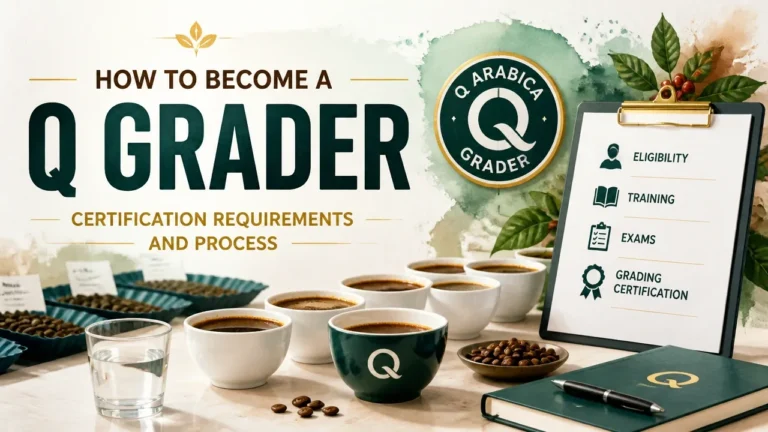

Rigorous Q Grader certification requirements exist precisely because the credential authorizes real quality decisions – lot certifications, specialty grade verifications, and supply-chain evaluations that move coffee and money. The Coffee Quality Institute and the Specialty Coffee Association built the program for professionals already inside the industry, not for curious beginners looking for a tasting badge.
What separates candidates who finish from those who don’t isn’t always sensory talent. It’s preparation architecture: knowing which track to book, which course generation is actually running, what the exam week demands, and how to keep the license alive once earned.
Beyond technical sensory evaluation, professionals must also understand the Fair Trade and Direct Trade differences to fully grasp how quality standards impact global coffee economics and producer livelihoods.
Whether you are pursuing this intensive credential or simply selecting quality certified coffee for your daily brew, understanding the standards behind the labels is essential.
Key Takeaways on Q Grader Certification Requirements
- The Q Grader license is a professional quality-evaluation credential, not an entry-level course – cupping fluency before enrollment is the real prerequisite.
- Two separate tracks exist: Q Arabica and Q Robusta carry different standards, syllabi, and exam structures; confirm your track before studying.
- The SCA Evolved Q Grader program uses the Coffee Value Assessment framework; legacy CQI-structured courses still circulate, and studying the wrong generation is a costly mistake.
- Total course fees range roughly from $1,650 to $2,647 depending on provider and location; retake terms vary significantly and must be secured in writing before enrolling.
- No published numeric pass threshold exists – train for reproducible, protocol-aligned scoring rather than chasing an invisible benchmark.
- The license is valid for three years and requires active recalibration to remain current; plan the renewal cycle from the day the credential is issued.
Prerequisites: Readiness Beyond the “All Levels” Label
Q Grader certification is a professional specialty coffee quality-evaluation license – not a barista elective or an entry-level sensory introduction. Historically administered by the Coffee Quality Institute (CQI) and now delivered through the SCA Evolved Q Grader pathway, the credential authorizes holders to certify lots, verify specialty grades, and make consequential purchasing decisions. That professional weight is built into the exam structure from day one.
Official course pages sometimes carry language like “all levels welcome,” and that framing deserves scrutiny. The course is designed for experienced coffee professionals already fluent in cupping, sensory vocabulary, and green and roasted coffee evaluation. The “all levels” label is a marketing position, not an assessment readiness standard – and conflating the two is one of the most common reasons candidates arrive underprepared.
SCA Education, the Specialty Coffee Association’s official education department, advises prospective candidates to download the CVA Forms and practice conducting Physical, Descriptive, Affective, and Extrinsic Assessments on coffees in a professional setting before attending the course – not as optional enrichment, but as the baseline preparation expectation.
That guidance signals the real entry point: you need working familiarity with the scoring forms, not just with coffee in general. Readiness looks like consistent practice with standardized cupping protocols, a developed sensory vocabulary for separating aromas and tastes under pressure, comfort with defect identification, and the ability to produce reproducible scores across multiple sessions. Understanding the full coffee grading and scoring system that underpins the license – how attributes translate to numeric quality thresholds – is part of that foundation, not something to learn during the course itself.
Candidates who treat the Q Grader as a structured introduction to cupping typically stall at the sensory calibration components. Candidates who arrive having already built reproducible scoring habits across dozens of cuppings treat those same components as confirmation rather than revelation.
Step 1: Choose Your Track and Confirm the Course Generation
Two distinct botanical tracks exist under the Q Grader umbrella: Q Arabica and Q Robusta. They are not interchangeable. Each operates under its own quality standards, syllabus expectations, and scoring frameworks – Arabica evaluated against SCA specialty criteria, Robusta against the Fine Robusta standards developed with CQI. Most vendor pages market Q Arabica almost exclusively, which means a reader assuming a single universal credential can miss the Robusta track entirely or assume it’s a minor variation rather than a separate qualification.
Selecting the right botanical track is only the first decision. The more consequential one is confirming which course generation the provider is actually running.
The marketplace currently contains two generations operating in parallel. The legacy structure – associated with the original CQI Q Grader program – described formats with 19 or 22 individual test items across multiple modules, typically framed as three days of instruction followed by three days of testing. The current pathway is the SCA Evolved Q Grader program, built on the Coffee Value Assessment (CVA), an evaluation system introduced in 2023 that expands coffee assessment beyond a single numeric score to encompass the full range of attributes that distinguish specialty coffee.
The Specialty Coffee Association has described the evolved Q Grader license as the first and only program built on the CVA – a framework that represents a fundamental shift in how coffee quality evaluation is structured and taught.
What this means practically: a candidate who studies from legacy CQI-style materials and then arrives at a venue running the SCA Evolved curriculum will encounter a different exam architecture, different scoring instruments, and different competency framing. The SCA cupping form the grader fills out during the course reflects the governing framework in use – and legacy forms differ meaningfully from CVA-aligned assessment documents. Confirm the framework, not just the course name, before building your study plan.
Step 2: Register, Budget, and Secure Retake Terms in Writing
Once the track and course generation are confirmed, the administrative layer requires the same precision as the sensory one. Q Grader course fees vary by provider, region, and whether applicable taxes apply. Published ranges run approximately $1,650 to $2,647 depending on provider and location, with SCA fees and VAT potentially added on top. Treat any single figure you encounter as directional rather than definitive – request an itemized total from the provider before committing.
Registration typically requires creating an account with the SCA or the specific course provider, paying the required fee, and completing any pre-course registration forms. These steps are procedural, but skipping or rushing them creates downstream complications with exam eligibility and credential issuance.
The more critical administrative task is securing retake policy in writing before enrolling. Retake and attempt rules are not standardized across providers, and the variation is significant enough to affect your financial exposure and timeline if you don’t pass a component on the first attempt. The SCA’s current framework states two attempts per assessment during the course, with a third attempt available for individual practical exams from 2026 onward. Individual providers add their own windows: some specify an 18-month retake period; others build two attempts per exam into the course week itself. These are materially different terms.
Ask for written confirmation of: the course date and venue, the course version and governing framework, the cancellation policy, the number of attempts permitted per assessment, the retake window after the course ends, and the renewal pathway for the resulting credential. A provider unwilling to confirm these terms in writing before enrollment is a provider worth reconsidering.
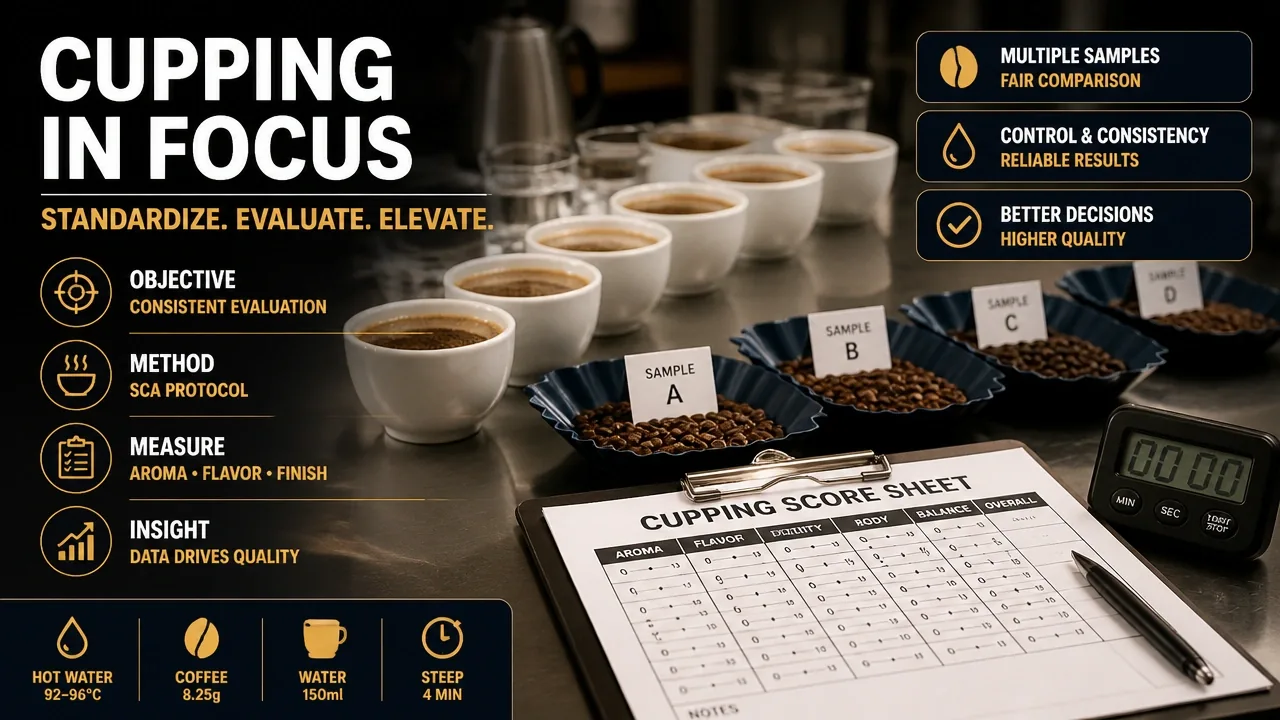
Step 3: Train the Sensory Modules Using CVA Forms and the Cupping Sheet
Cupping protocol mastery is the engine of the Q Grader exam, and the preparation period is where that engine gets built. Training should be structured around the specific modules the course will assess, using the current assessment forms – not legacy scoring sheets or informal tasting notes.
Olfactory, Gustatory, and Comparative Calibration Drills
The sensory training load covers a specific set of competency areas: olfactory recognition, aromatic recognition, taste sensitivity, acid calibration, cupping-to-standard verification, triangulation, green and roasted coffee grading, processing evaluation, and value-chain knowledge. Each of these demands a different type of sensory memory – distinguishing between similar aromatics under time pressure is a different skill from placing acid intensity on a calibrated scale, which is a different skill from identifying defects in a green coffee sample.
Standardized defect identification and flavor standards deserve dedicated drilling. Mock cuppings that incorporate defect-positive samples – not just clean specialty-grade lots – build the discrimination capacity the exam requires. The Coffee Value Assessment framework places descriptive and affective assessment alongside physical evaluation, which means training sessions should include coffees that challenge across all three dimensions, not just the ones that score well.
Scoring Reproducibility and Timed Protocol Preparation
The scoring sheet is not a passive record-keeping tool – it’s the primary instrument of calibration. Training against it under realistic time conditions is what separates candidates who understand the scoring system intellectually from those who can execute it accurately under exam pressure.
Practice the full assessment sequence in order: physical → descriptive → affective/extrinsic → triangulation/comparative. Each stage feeds the next, and breaking that sequence during preparation means breaking it during the exam. Reproducibility – the ability to arrive at the same score on the same coffee across multiple sessions – is the measurable output the course is testing. If your scores on the same sample vary by more than a few points across sessions, the preparation work isn’t done yet.
Timed practice matters because the exam week is intensive. Candidates who have only ever cupped at their own pace frequently underperform on the affective and comparative components, where the cognitive load of scoring multiple attributes simultaneously meets a clock.
Step 4: Execute the Six-Day Certification Sequence and Required Assessments
The Q Grader course exam week is where preparation converts to performance. The format is demanding by design – six consecutive days of instruction and assessment that test sensory precision, protocol adherence, and knowledge depth simultaneously.
Current Cadence vs. Legacy Course Structure
The current standard under the SCA Evolved Q Grader program runs six consecutive days and includes nine exam components plus a 55-question written test. That written test covers the knowledge layer of coffee quality evaluation – processing, green grading, value-chain mechanics, and the theoretical foundations of the assessment system – while the practical components test what the candidate can actually do at the cupping table.
The Specialty Coffee Association describes the course as including nine comprehensive exams: eight practical evaluations and one written assessment.
Legacy course descriptions in the marketplace may still reference three days of teaching followed by three days of testing, or list 19 to 22 individual test items across separate modules. These are not the same structure. If provider instructions reference either of those legacy formats without explicitly confirming the SCA Evolved framework, seek clarification before the course begins. Studying for the wrong structure is a recoverable mistake before enrollment; it is not recoverable during exam week.
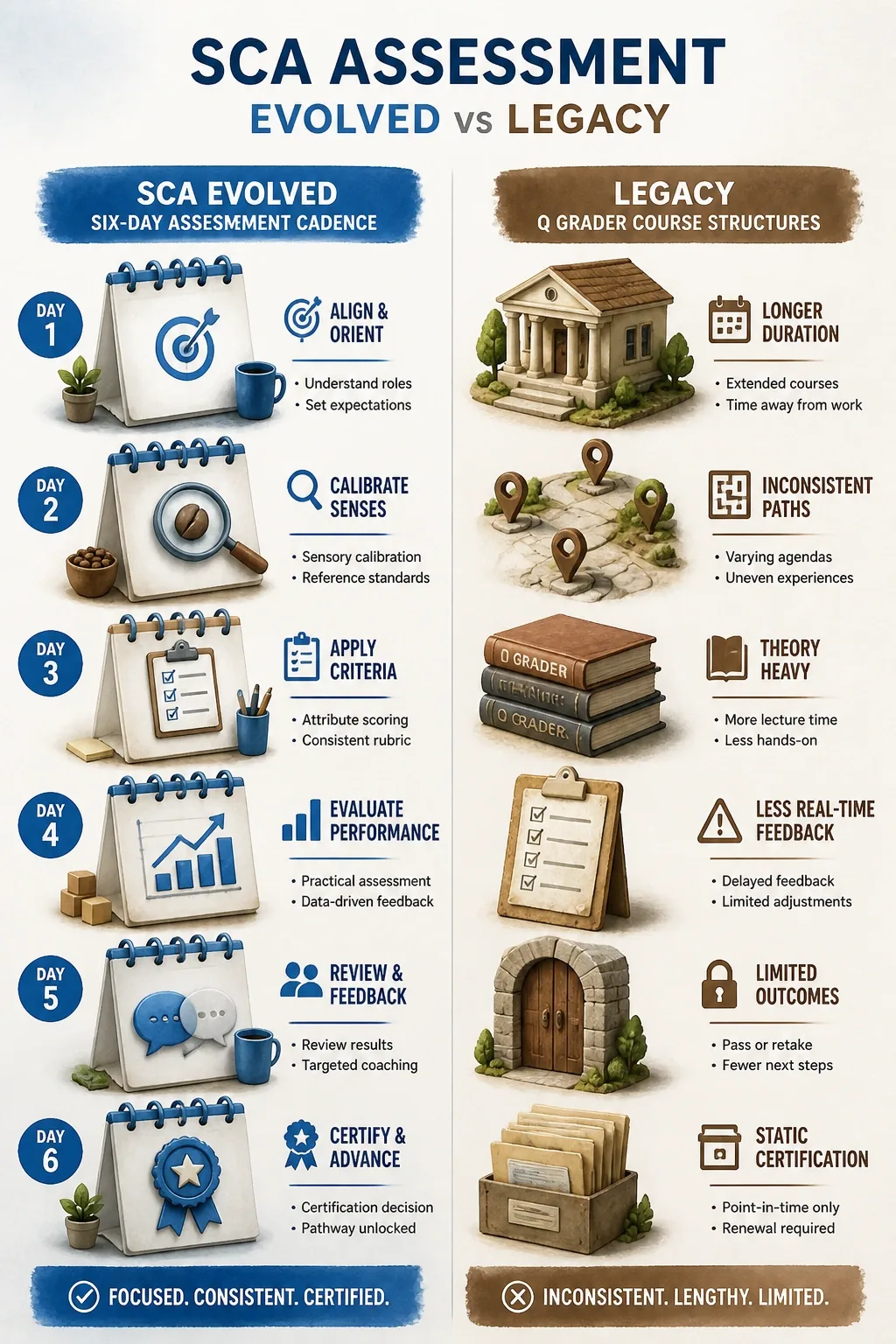
Competency Components and Gate Criteria
The sensory competency areas assessed during the week span the full professional evaluation toolkit: current assessment system application, sensory skills across olfactory and gustatory domains, green coffee evaluation, olfactory and aromatic recognition, acid calibration, cupping-to-standard verification, and reproducible scoring against the CVA framework. Sample preparation and repeated cupping actions are embedded throughout – the week is physically and cognitively demanding in a way that casual cupping sessions don’t replicate.
The gate is absolute: a candidate must pass all assessments to earn the license. Failing a single component means that component must be retaken within the terms secured in Step 2. What no published source currently provides is the specific numeric or calibration threshold that constitutes a passing score on each practical assessment. That information is not publicly available, which means candidates cannot benchmark practice scores against an actual pass mark. The practical consequence: stop optimizing for a target number during preparation and optimize instead for protocol adherence and calibration consistency. A grader who executes the correct protocol reproducibly is positioned far better than one who chases an invisible score ceiling.
Step 5: Apply the License in Specialty Coffee Quality Decision Roles
The Q Grader license converts cupping skill into institutional authority. A licensed grader can officially certify that a coffee lot meets specialty grade, verify quality claims for importers, exporters, roasters, and producers, and perform formal quality control roles that require a credentialed evaluator rather than an experienced opinion.
That authority matters in supply chain contexts where buyers and sellers need a shared, defensible quality standard. A Q Grader’s evaluation carries weight precisely because it references a globally recognized scoring framework – the same framework that the SCA cupping protocol the grader uses operationalizes in practice. The credential doesn’t just signal expertise; it signals that the holder’s scores are calibrated to an external standard, not just an internal preference.
The more honest framing is that the license is a quality-decision credential, not a salary instrument. It expands the scope of roles a professional can credibly occupy – green buying, lab analysis, origin evaluation, exporter QC programs – and improves the precision of supply chain communication by establishing a shared language between producers, traders, and roasters. Whether that translates to a specific compensation outcome depends on the employer, the market, and the role.
What the license does not do is replace the daily operational discipline it certifies. A Q Grader who stops cupping systematically, stops using the scoring form as a working tool, and stops calibrating against current standards will drift from the precision the credential implies. The license documents a demonstrated skill level at a point in time; maintaining that level is an ongoing professional commitment.
Beyond sensory evaluation and cup scoring, credentialed professionals frequently interface with broader sustainability and supply chain verifications like Rainforest Alliance certification to validate ethical sourcing claims.
Step 6: Maintain and Recalibrate Your License Over the Three-Year Cycle
The Q Grader license is valid for three years from the date of issuance. After that window closes, the credential lapses unless the holder completes the required renewal process. This is not a passive renewal – it is an active demonstration that the grader’s skills remain aligned to current quality standards.
The Coffee Quality Institute states that Q Graders must calibrate their coffee evaluation skills every three years through a Coffee Calibration process that verifies their ability to accurately evaluate coffee quality based on globally accepted standards for Fine Robusta and Specialty Arabica – framing calibration as both a skills validation and a commitment to quality.
The recalibration requirement exists because coffee quality standards are not static. The SCA’s CVA framework, cupping protocols, and scoring standards evolve, and a grader calibrated to a prior version of those standards may be producing scores that no longer map accurately to current industry benchmarks. Calibration sessions – typically run through accredited providers or SCA-authorized events – bring the grader’s sensory execution back into alignment with the current framework.
The practical implication is that the three-year cycle should be planned from the moment the license is issued, not treated as a future administrative task. Identifying accredited calibration session providers in your region, tracking the renewal pathway under the current SCA Evolved program, and building periodic recalibration cuppings into regular professional practice are all part of what it means to hold a live credential rather than a historical one.
Troubleshooting: Resolving Version, Retake, and Pass-Threshold Confusion
When the course generation process is unclear – when a provider’s website mixes legacy CQI language with SCA Evolved terminology, or lists exam counts that don’t match either known structure – the right move is direct confirmation before studying. Contact the provider and ask three specific questions: Is this course running the SCA Evolved Q Grader framework or the legacy CQI structure? Who is the governing body for credentialing? What syllabus and assessment forms does the course use? Document the answers.
If retake and renewal rules are generating confusion, provider policy confirmed in writing supersedes anything on a landing page. SCA publishes framework-level guidance; individual providers layer their own operational terms on top of that. The combination is what governs your specific enrollment. If written confirmation isn’t forthcoming, treat the gap as a risk signal.
If pass thresholds aren’t published – and currently they aren’t, at least not in the form of publicly accessible score benchmarks – stop searching for a number that doesn’t exist in the public domain. The preparation response is to train for reproducibility against the current protocol, not to reverse-engineer a target score. Candidates who execute the CVA-aligned cupping framework consistently and accurately are calibrated in the way the exam is designed to recognize.
The full action sequence resolves most of the confusion points that derail candidates:
- Confirm the track: Q Arabica or Q Robusta, not both by default.
- Verify the course generation: SCA Evolved CVA framework or legacy CQI structure – in writing.
- Secure all terms in writing: attempts, retake window, cancellation terms, renewal pathway.
- Prepare with the current forms under timed conditions, not legacy scoring sheets.
- Pass all assessments: treat it as an absolute gate, not a weighted average.
- Plan the renewal cycle from day one of licensure, not year three.
The path through Q Grader certification is navigable. The candidates who don’t finish it cleanly are usually the ones who treated one of these steps as optional.
Frequently Asked Questions About Q Grader Certification Requirements
What’s the difference between a Q Grader and an SCA-certified barista?
They’re built for different roles. An SCA barista certification covers coffee preparation and service skills; Q Grader certification qualifies you to formally evaluate and certify coffee quality at the lot level, using a standardized scoring framework recognized across the supply chain.
Can you fail one exam and still pass the Q Grader course?
No. All assessments must be passed to earn the license. Failing a single component means you’ll need to retake it within the window your provider confirmed before enrollment – which is why securing those retake terms in writing beforehand matters so much.
How much does Q grading cost overall?
Course fees run approximately $1,650 to $2,647 depending on provider and location, with SCA fees and applicable taxes potentially added on top. Budget for the full itemized cost from your specific provider, not the lowest figure you find online.
What does the SCA CVA framework change about the Q Grader exam?
The Coffee Value Assessment expands evaluation beyond a single numeric quality score to include physical, descriptive, affective, and extrinsic assessments. It changes both the scoring forms in use and the competency areas the exam tests – which is why confirming you’re studying current CVA-aligned materials matters.
How do I know if my cupping experience is strong enough to attempt the course?
If you can produce reproducible scores on the same coffee across multiple sessions, confidently identify defects in green and roasted samples, and work through a standardized cupping protocol without needing to reference instructions, you’re in the right preparation zone. Inconsistent scores or heavy reliance on tasting notes over calibrated attributes are signals to keep drilling first.
Does earning a Q Robusta credential require different preparation than Q Arabica?
Yes. Q Robusta is evaluated against Fine Robusta standards rather than SCA specialty Arabica criteria, and the flavor profiles, defect categories, and quality benchmarks differ. Treat them as separate qualifications that share a methodology but not a syllabus.
What happens if my Q Grader license lapses before recalibration?
A lapsed credential means you’re no longer a licensed Q Grader in the active sense – you can’t officially certify lots or represent yourself as currently licensed. Recalibration must happen within the three-year window to maintain uninterrupted credential status; check with your provider or the SCA on reinstatement pathways if the window has already closed.
Is the Q Grader credential recognized globally, or only in certain markets?
The Q Grader license is recognized across the specialty coffee supply chain internationally – by importers, exporters, roasters, and producers who use it as a shared quality standard. Its value in a specific market depends on how deeply specialty coffee infrastructure is developed there, but the credential itself is not region-restricted.
References
- How to Prepare for the Q Grader Course | education.sca.coffee
- Q Grader Program Overview | education.sca.coffee
- SCA and CQI Announce Historic Partnership for Evolved Q Grader | sca.coffee
- QE Program Guidebook v8 | database.coffeeinstitute.org