
Rigorously defined, specialty vs commercial coffee grade is not a marketing spectrum – it is a binary pass/fail gate enforced by the SCA/CQI cupping protocol, a defect count, and a licensed Q Grader’s signature. Everything below that threshold is commercial, regardless of what the offer sheet calls it.
The distinction matters most at the contract table, where “premium,” “traceable,” and “single-origin” can appear without consistent definition. Understanding exactly what score, what defect limits, and what documentation separate the two grades turns a buying judgment into a defensible commercial decision.
When formulating contracts for espresso programs, choosing quality espresso beans requires careful attention to these strict grading thresholds to ensure optimal extraction in the cup.
Once you have secured high-scoring green coffee that meets these strict grading standards, selecting the right roast profile becomes essential for your daily brew, starting with the best espresso beans for bold coffee.
When navigating these complex trade classifications for different brew methods, understanding the espresso versus coffee beans truth helps buyers make better purchasing decisions.
Key Takeaways on Specialty vs Commercial Coffee Grade
- The specialty threshold is a documented 80+ SCA/CQI cup score, zero primary defects, and a maximum of five secondary defects – all three conditions must be met simultaneously.
- The word “specialty” on an offer sheet carries no contractual weight without an attached signed Q Grader score sheet and defect analysis.
- Regional grades like Kenya AA or Brazil 18 measure bean size, not cup quality – always require a licensed Q Grader evaluation before paying a specialty premium.
- Pre-blending a lot before physical grade evaluation can mask defect levels and invalidates the grade; always request pre-blend lot samples.
- Commercial grade is a legitimate contract tool for high-volume, blend-uniformity, or flavored programs – the error is paying specialty pricing for commercial-grade applications.
- Roast level is a roaster’s decision, not a grade indicator; sensory comparisons between specialty and commercial lots are only valid at equivalent roast degree.
The Specialty Gate: Score, Defects, and the Contract Threshold
Specialty coffee grade begins at a single, objective number: a minimum cupping score of 80 points on the SCA/CQI 100-point scale, combined with zero primary defects and no more than five secondary defects in the evaluated sample. Any lot that fails either condition – on the cup score or the physical count – is commercial grade, regardless of origin story, farm elevation, or what the export documentation says.
To fully understand how these evaluation protocols operate, buyers should examine the foundational specialty coffee grades and standards that govern SCA scoring and physical grading.
The grade bands above that floor are equally specific. Scores from 80 to 84.99 qualify as Very Good or entry-level specialty. From 85 to 89.99 the lot is Excellent, and differentiation becomes commercially meaningful. At 90 and above, the lot is Outstanding – a category that represents a small fraction of all evaluated green coffee globally. Below the specialty threshold, 75 to 79.99 is often called “Premium” in trade shorthand, but that label does not confer specialty status; it sits in commercial territory. Buyers who see “premium” on an offer sheet without an attached Q Grader score sheet should treat that description as unverified.
The SCA/CQI standard is a voluntary industry framework, not a legal food-label regulation enforced across all markets. That distinction has a direct contractual consequence: the word “specialty” on an invoice carries no enforceable rights on its own. What creates enforceable rights is attaching a signed Q Grader score sheet, a defect analysis, and sample identification details directly to the purchase contract. Without those documents, a buyer who receives an 78-point lot after paying a specialty premium has limited recourse.
One procedural detail that creates disputes: the standard green evaluation sample size is commonly 350 grams under current SCA green protocol, but legacy contracts and some buyer briefs still reference 300 grams. The defect count per sample changes with sample weight, so a lot evaluated on 300g and one evaluated on 350g are not directly comparable without adjustment. Buyers should confirm the exact sample size written into every contract before signing. For a detailed walkthrough of how those evaluation protocols work in practice, the specialty coffee grading and scoring guide covers the SCA/CQI framework from sample preparation through final score tabulation.
The practical takeaway is structural: “specialty” is not a tier of the market defined by price or packaging. It is a condition defined by a score, a defect count, and documentation – and the only reliable comparison between two offers is a Q Grader cupping score attached to a verified physical sample.
To fully understand how these physical flaws alter your brew, review common coffee defects and flavor impact before finalizing your defect thresholds.
To navigate these parameters successfully, buyers must master the intricacies of the SCA specialty standard when evaluating contract terms.
Physical Pass/Fail: Primary Defects, Secondary Defects, and Moisture
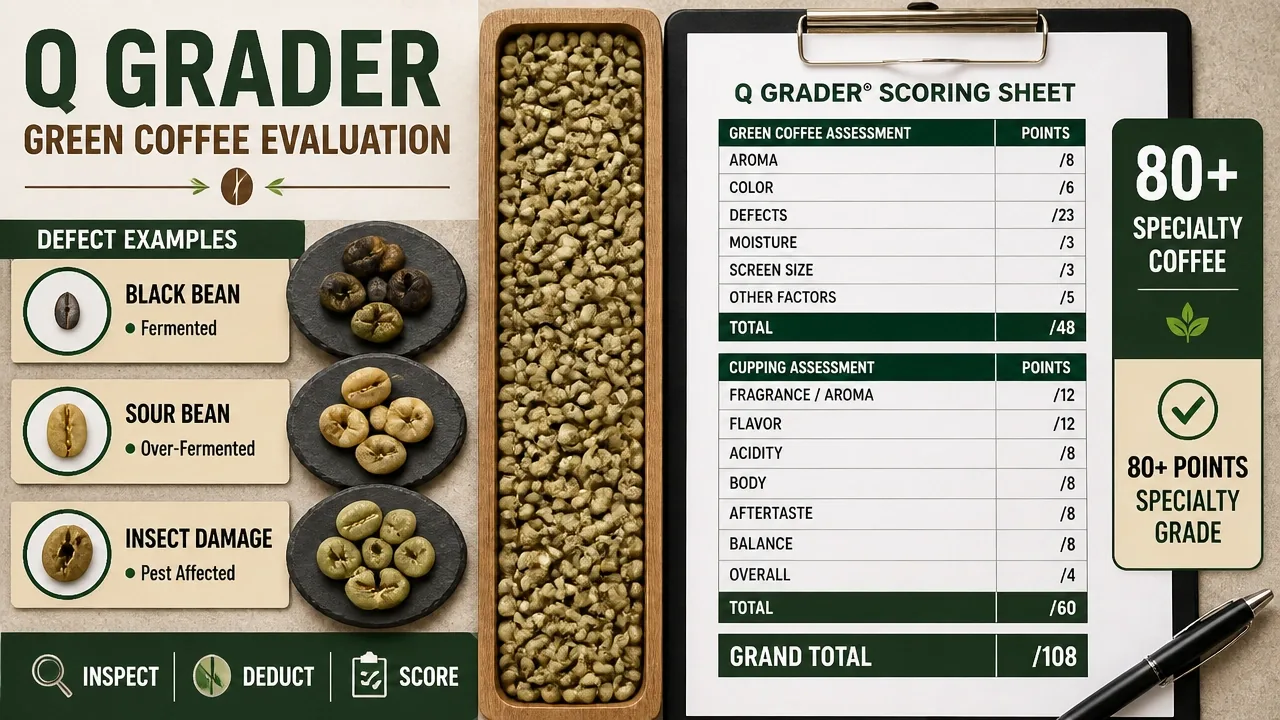
Physical defects eliminate a lot from specialty consideration before the first cup is poured. The SCA/CQI framework divides defects into two categories with different tolerance levels, and the distinction between them is not subtle.
Primary defects – full black beans, full sour beans, and major insect damage – carry zero tolerance. A single confirmed primary defect in the evaluated sample disqualifies the lot from specialty classification regardless of cup score. Secondary defects – partial black, husks, broken or cut beans, and minor insect damage – are permitted up to a maximum of five. Exceeding that count, or finding any primary defect, moves the lot into commercial grade.
Moisture sits outside the cup score entirely but belongs in every specialty contract. Inconsistent drying creates compounding risks: microbial activity, weight loss in transit, and accelerated quality degradation in storage. Research into bean storage behavior demonstrates why the moisture window matters – a peer-reviewed study published in the African Journal of Food, Agriculture, Nutrition and Development found that freshly harvested beans stored at higher moisture content (around 15%) developed significantly more storage defects than those dried to 12% or 9%, with the authors identifying controlled drying and prevention of heat buildup as the primary mechanisms for keeping storage degradation in check. That 9–12% window is the accepted safe range for green coffee, and buyers should request moisture analysis as a standard contract term, not an optional addendum.
One mechanism that creates physical-grade fraud risk is pre-blending. Defect evaluation only works on a defined, unblended green sample – mixing lots before the physical grade is taken dilutes defect concentration across the blend and can push a failing lot below the visible threshold. Buyers should require that physical grade evaluation occurs on the pre-blend sample, with documentation confirming lot identity at the time of evaluation.
Passing physicals does not make a lot specialty. A clean defect count qualifies the lot for cupping; it does not replace cupping. A lot with zero primary and three secondary defects can still cup at 74 points and be firmly commercial grade.
The most concrete example of defect masking is not dark roasting – it is Torrefacto, a commercial roasting practice common in Spain and Portugal that adds sugar during the roast cycle. The result is a shiny black coating on the bean that adds apparent weight and conceals physical defects that would otherwise be visible in green evaluation. If a European commercial offer appears unusually cheap relative to stated origin quality, buyers should request written confirmation that no sugar coating or Torrefacto process was applied – unless that style is explicitly acceptable for the intended use.
Cup Score vs. Commercial Uniformity: How Sensory Quality Pays Off
The flavor difference between specialty and commercial grade is not simply “better versus worse.” It is a difference in what the coffee is designed to do sensorially, and understanding that distinction prevents expensive mismatches between lot selection and intended use.
SCA/CQI cupping evaluates ten attributes: fragrance and aroma, flavor, aftertaste, acidity, body, balance, uniformity, clean cup, sweetness, and overall impression. Each attribute is scored individually, and the total determines where the lot lands on the grade scale. A specialty lot at 85+ typically shows origin-distinct complexity – identifiable notes such as stone fruit, citrus, florals, or dark chocolate, clean acidity with structure, and sweetness that persists through the aftertaste. A commercial lot is engineered for different virtues: consistency across large volumes, a predictable and familiar cup profile, and tolerance for variable extraction conditions. Flat or muted sensory intensity is a feature in that context, not a failure.
The 80-point floor deserves precise framing. An 80 is not average – it is the minimum entry ticket to specialty classification, and lots in the 80–84.99 range are everyday specialty: clean, traceable, and above commercial threshold, but not differentiated enough to command a significant premium over commodity pricing. The sensory gap between an 82 and an 88 is meaningful and price-justified. The gap between an 82 and a 79 is contractually decisive.
95% of specialty coffee roasters surveyed selected “Cup Quality” as one of their three most important purchasing criteria, outweighing price – selected by only 50% of respondents – as the primary driver of buying decisions. – Source: Algrano Roaster Market Report 2021
That weighting reflects a structural reality in specialty buying: cup quality is not one consideration among many – it is the primary filter, and price follows score rather than leading it. For buyers who want to understand how the SCA scoring system maps to those quality tiers before applying it to a purchasing decision, the coffee grading and scoring meaning breakdown explains how each attribute contributes to the final score and what the bands mean in practice.
One persistent misconception distorts sensory comparisons between lots: dark roast does not equal commercial grade. Roast level is a roaster’s decision applied after purchase; it is not a grade indicator. Commercial coffee frequently tastes bitter because low-quality green or physical defects are masked by heavy dark roast development – not because dark roasting itself is a commercial characteristic. A specialty lot can be roasted dark; a commercial lot can be roasted light. Sensory comparisons between specialty and commercial lots are only valid when both are evaluated at equivalent roast degree.
Price, Traceability, and Blending: Where Grade Becomes Contract Value
Differential Economics and Producer Bands
Specialty pricing operates as a differential over the commodity C market price, with the premium rising as cup scores climb. That structure is familiar to most buyers, but the producer price bands make the stakes concrete and clarify why documentation matters at each tier.
Commercial green coffee can trade around €1.30/kg at origin. Entry-level specialty in the 80–84.99 range typically sits at €2.50–3.50/kg. Lots scoring 85 and above move into €4.50–9/kg territory, and microlots at exceptional scores can reach €13–45/kg depending on variety, process, and producer relationship. A higher score does not automatically guarantee higher producer capture – supply chain structure, exporter margins, and contract terms all affect how much of that differential reaches the farm – but the scoring tier sets the ceiling for what the market will pay.
The comparison table below organizes the key contractual differences between grade tiers in one view:
| Criterion | Specialty (80+) | Commercial (Below 80) |
|---|---|---|
| Cupping Score | 80.00+ (SCA/CQI) | Below 80.00 |
| Primary Defects | Zero permitted | Permitted |
| Secondary Defects | Maximum 5 per sample | No specialty limit |
| Moisture / Traceability | Requested as contract term; lot-level documentation expected | Generally not required |
| Typical Use Case | Single-origin, filter, espresso clarity, destination claims | Blend base, flavored, high-volume, cream-and-sugar programs |
| Legal / Contract Status | Enforceable only with Q Grader score sheet + defect report attached | Standard commodity contract terms |
| Indicative Price (green) | €2.50–45/kg depending on score tier | ~€1.30/kg |
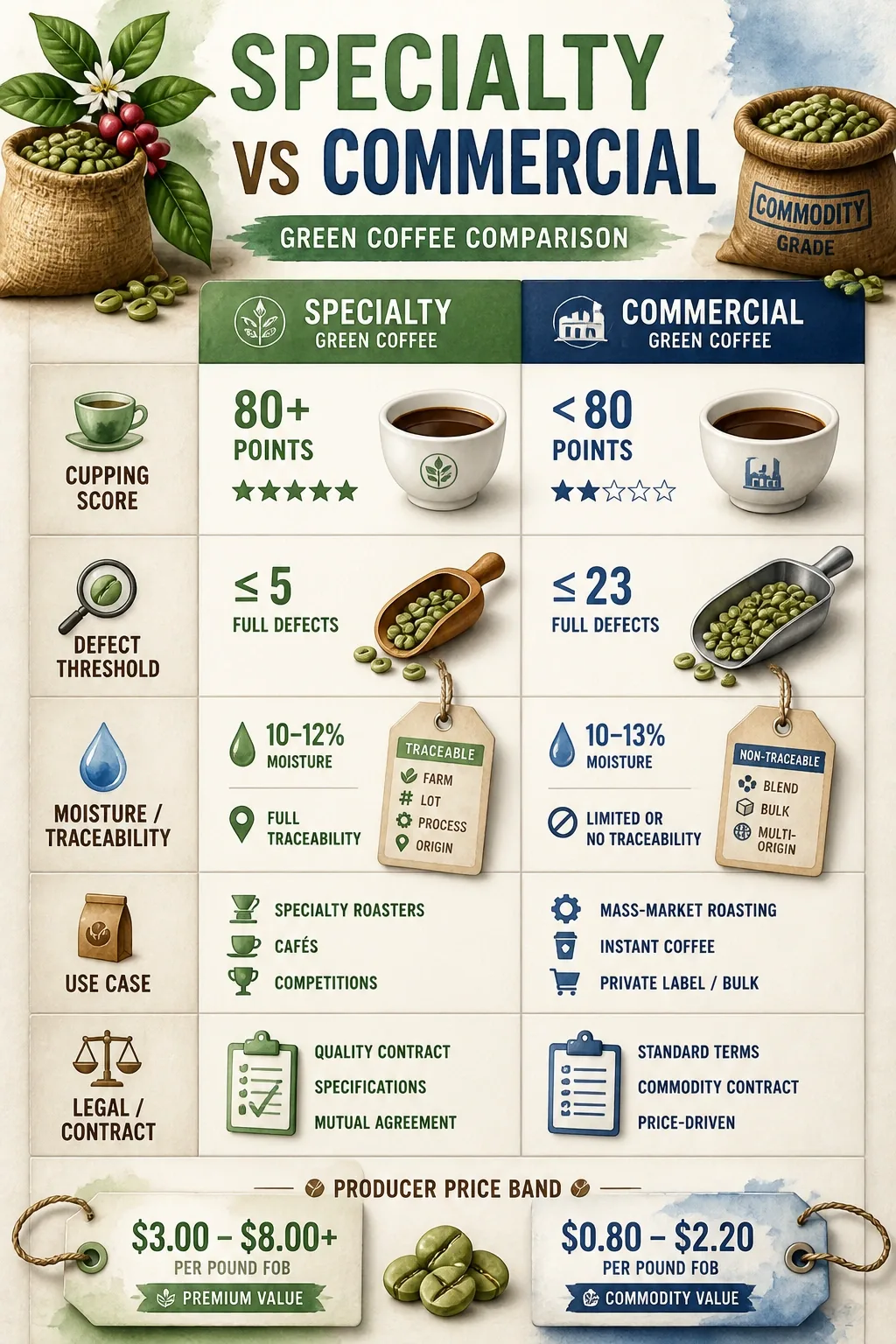
Here is a visual summary of how specialty and commercial green coffee compare across the key buying criteria:
Lot Integrity and Documentation Standards
Traceability in specialty coffee is not automatic – it is a documentation requirement that buyers must request explicitly. A lot described as “farm-traceable” or “single-origin” may or may not have farm-level, lot-level, or region-level documentation attached. The offer language does not guarantee the paper trail. Specialty buyers should require origin specificity at farm or lot level, variety and process identification, Q Grader cupping notes, and Q-sourced documentation as minimum contract terms. If those documents are absent, “traceable specialty” is a marketing claim, not a verified grade.
Commercial grade serves a legitimate function as a blend base. Volume, price stability, and supply consistency are genuine purchasing criteria for roasters running high-volume programs, and commercial lots meet those needs effectively. The problem arises when a specialty lot is blended before the offer is made. Blending destroys lot identity, cup clarity, and traceability simultaneously – the three attributes that justify a specialty premium. Buyers evaluating blended offers should request pre-blend lot samples and evaluate each component separately before accepting the blend at specialty pricing.
The documentation standard separates the two grade categories as clearly as the cup score does. Specialty buyers expect a verified defect report, a signed Q Grader score sheet, and consistent arrival quality that matches the pre-ship sample. Commercial buyers prioritize price, volume, and supply reliability. Both are legitimate purchasing frameworks – but they are not interchangeable, and a commercial-grade lot offered with specialty-grade documentation expectations is a contract dispute waiting to happen.
Regional Grades vs. SCA/CQI Scores: Why Kenya AA or Brazil 18 Is Not a Specialty Guarantee
Regional physical grades are sorting mechanisms, not quality certificates. Kenya AA describes screen size – beans retained on a size-18 screen (approximately 7.2mm). Brazil 18 does the same. Colombia’s Supremo, Ethiopia’s Grade 1, and Honduras’s HS parchment grades are each defined by their origin’s export authority using criteria specific to that country’s production system. None of them measure cup quality.
A Kenya AA can cup at 92 points or at 76 points. Both are Kenya AA by screen-size definition. The physical grade tells a buyer something useful about bean density, uniformity, and processing consistency – all of which correlate loosely with cup potential – but correlation is not verification. Only a licensed Q Grader cupping score confirms specialty status, because only that evaluation directly measures what ends up in the cup. For buyers who want to understand exactly who is qualified to score coffee and what that certification process involves, the article on who is qualified to score coffee explains the Q Grader credentialing system in full.
The SCA/CQI framework resolves the comparison problem that regional grades create. An 82-point score from a Kenyan lot is directly comparable to an 82-point score from a Colombian lot, because both were evaluated using the same ten-attribute protocol by licensed evaluators. Local grade names are not comparable across origins – a Grade 1 in one country’s system is not equivalent to a Grade 1 in another’s. The SCA score creates a single common language.
The practical instruction for buyers is straightforward: use regional grades as a first-pass logistics filter for screen size and processing consistency, then require a Q Grader cupping score and defect report before making any specialty classification or pricing decision. One without the other is incomplete due diligence.
To see the SCA cupping form in action and understand how evaluators move through the ten attributes during a live session, this walkthrough demonstrates the process from setup through scoring:
Buyer’s Verdict: When to Pay Specialty Premiums and When Commercial Grade Is the Right Tool
The right buying decision is not always specialty. Commercial grade is a legitimate contract tool for specific applications, and paying a specialty premium for a lot that will be used in a high-volume flavored blend program is a cost structure that doesn’t serve the roast program or the business.
The verdict depends on role and end use.
Roasters should pay the specialty premium when origin clarity, roast transparency, and cup quality at the retail or wholesale level justify the differential. A single-origin weekend offering, a filter program with tasting notes, or an espresso menu built around provenance claims all require a documented 80+ lot. A house blend designed for cream-and-sugar service does not – and forcing specialty-grade green into that application adds cost without adding value to the customer experience.
Importers and traders should require score, defect count, and harvest documentation before committing to specialty pricing at any tier. The premium is real and substantial; the obligation to verify it before payment is equally real. An importer who accepts “specialty” on the offer sheet without attached documentation has no contractual basis for rejection if the arriving lot cups below 80.
Blending and bulk buyers can accept commercial grade when cost, supply stability, and blend uniformity are the primary purchasing criteria. Commercial lots are engineered for those virtues. The condition is that the lot is contracted and documented as commercial – not priced as commercial while described as specialty.
The contract approval checklist that closes any specialty purchase should include:
- Approved pre-ship sample with documented cupping score matching the offered lot
- Verified defect count from the pre-ship sample at the correct sample weight
- Signed Q Grader score sheet attached to the contract, not provided separately post-signing
- Moisture content and water-activity tolerance written as a contract specification
- Harvest date and crop year confirmed in writing
- Arrival rejection rights for lots that fail to match the pre-ship sample on defect count or cup score
The central answer does not change across any of these personas: a lot is specialty when it passes 80+ on the SCA/CQI cup score, carries zero primary defects, has no more than five secondary defects, and all of that is documented. Where the score falls above 80 determines the premium tier. Everything below that threshold – regardless of label, origin name, or screen size – is commercial grade, and it should be contracted and priced accordingly.
Frequently Asked Questions About Specialty vs Commercial Coffee Grade
Can a lot score above 80 and still be rejected as specialty?
Yes – a lot must pass both the cup score and the physical defect evaluation. A single confirmed primary defect disqualifies the lot regardless of how high it cups.
What happens if the arriving lot cups lower than the pre-ship sample?
That’s why arrival rejection rights belong in the contract. Without that clause, a buyer who receives a lot cupping below the agreed score has limited formal recourse; with it, the score sheet becomes the basis for rejection or renegotiation.
How does Torrefacto affect a green coffee evaluation?
Torrefacto is applied during roasting, so the green sample itself may look clean. The issue is that the practice is used commercially to cover defects that would be visible at the roast stage – request written confirmation that no sugar coating or Torrefacto process was used if the offer seems unusually cheap.
Is there a meaningful cup difference between an 82 and an 85?
In practice, yes. An 82 is clean and traceable but not distinctly complex; an 85 begins to show origin character, defined acidity, and the kind of sensory clarity that justifies a roast program built around it. The price differential between those tiers reflects a real sensory gap.
Why do some specialty offers lack farm-level traceability?
Specialty classification requires a cup score and defect count – it doesn’t mandate a specific level of supply chain transparency. A lot can legitimately score 83 points while being traceable only to a cooperative or washing station. Buyers who need farm-level traceability must require it as a separate contract term.
What does moisture content actually tell a buyer that cup score doesn’t?
Moisture is a storage and transit risk indicator, not a quality attribute scored at cupping. A lot at 13% moisture may cup beautifully at origin and arrive degraded six months later. Moisture analysis protects the buyer against post-harvest quality loss, which the cup score at time of evaluation cannot predict.
Can commercial-grade coffee be used in a specialty roastery without misrepresentation?
Yes, provided it isn’t marketed as specialty. Commercial green is a legitimate input for house blends, flavored products, or espresso programs where consistency and price matter more than origin distinction. The ethical and contractual line is in how the finished product is described to the end customer.
If two origins both score 82, does that mean they taste the same?
No – the score reflects the intensity and cleanliness of quality attributes, not the specific flavor profile. An Ethiopian 82 and a Colombian 82 are equally “specialty” by classification but will taste entirely different. The score is a quality floor, not a flavor fingerprint.
References
- Specialty Coffee Grading and Scoring Guide | coffeefactz.com
- Coffee Grading and Scoring Meaning: The SCA Standard Explained | coffeefactz.com
- How to Become a Q Grader: Certification Requirements and Process | coffeefactz.com
- Influence of variety, growth location and storage conditions on development of hard-to-cook defect in common bean | ajol.info
- Algrano Roaster Market Report 2021 | hubspotusercontent-na1.net