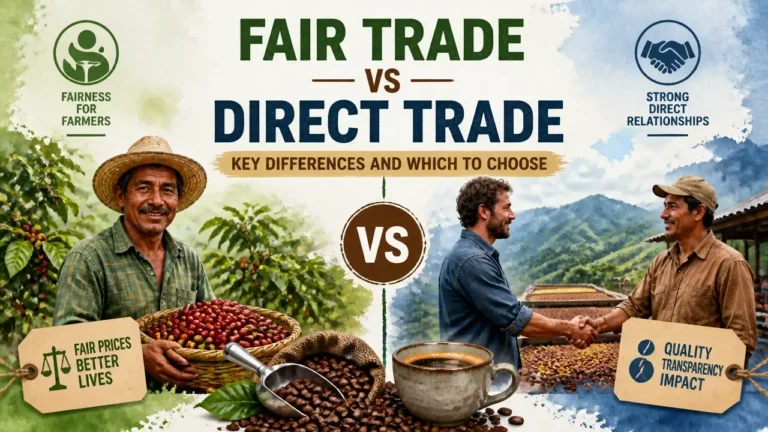

Fair trade vs direct trade coffee sits at the center of every honest conversation about where your morning cup actually comes from. Both labels signal ethical intent. But they operate on completely different mechanics, and confusing one for the other means you can’t evaluate either.
One system, built around Fair Trade certification, sets a guaranteed price floor enforced by independent auditors. The other, built on Direct Trade sourcing, bets that a roaster’s direct relationship with a farmer can outperform any standardized minimum. Neither model is a fraud. Neither is perfect. The difference is in the machinery.
While both models aim to improve livelihoods, evaluating these sourcing frameworks requires looking closely at valid criticisms of coffee certifications regarding transparency and enforcement.
For cooperatives looking to understand the requirements behind these systems, navigating the smallholder farmer certification process is an essential first step toward accessing global ethical markets.
Beyond these two approaches, other programs like Rainforest Alliance standards focus on environmental sustainability and farm management to further shape the ethical coffee market.
To fully grasp how these distinct sourcing methods fit into the broader landscape of Coffee Certifications Standards What Every coffee drinker should know, it helps to examine the foundational mechanisms of each system.
Key Takeaways on Fair Trade vs Direct Trade Coffee
- Fair Trade guarantees a minimum price and social premium through independent audits; Direct Trade sets no floor but often pays significantly more for high-scoring lots.
- Fair Trade certification says nothing about cup quality; Direct Trade is built entirely around quality as the condition for the premium.
- Direct Trade transparency depends entirely on the roaster’s willingness to publish sourcing details; no independent body verifies their claims.
- Fair Trade opens markets to certified cooperatives regardless of quality grade; Direct Trade requires exceptional production and a roaster relationship, excluding many small farmers.
- The two models are not mutually exclusive: some roasters combine Direct Trade practices with Fair Trade certification to get both the audit trail and the quality premium.
- When evaluating any ethical coffee claim, ask who set the price, how it was verified, and whether farm-level information is publicly available.
What Are Fair Trade and Direct Trade Coffee?
Fair Trade certification and Direct Trade sourcing are not two versions of the same idea. They are two structurally different answers to the same problem: coffee farmers, who do the hardest work in the supply chain, have historically received the least money from it.
Fair Trade is a formal, third-party audited certification system. It guarantees farmer cooperatives a minimum price per pound, currently set at a floor that protects against catastrophic market collapses, plus a social premium paid directly to the cooperative for community projects like schools, clinics, and infrastructure. An independent certifying body verifies compliance. The promise is standardized, auditable, and attached to a label anyone can see on a bag.
Direct Trade is something different in almost every way. It is an informal, roaster-led sourcing model built on direct relationships between a roaster and a specific farm or cooperative. There is no universal certifying body, no minimum price requirement, and no third-party audit. Instead, the model runs on negotiated transparent pricing and quality-based premiums. The roaster sets the terms. The farmer negotiates from a position of demonstrated quality, not just membership in a certified group.
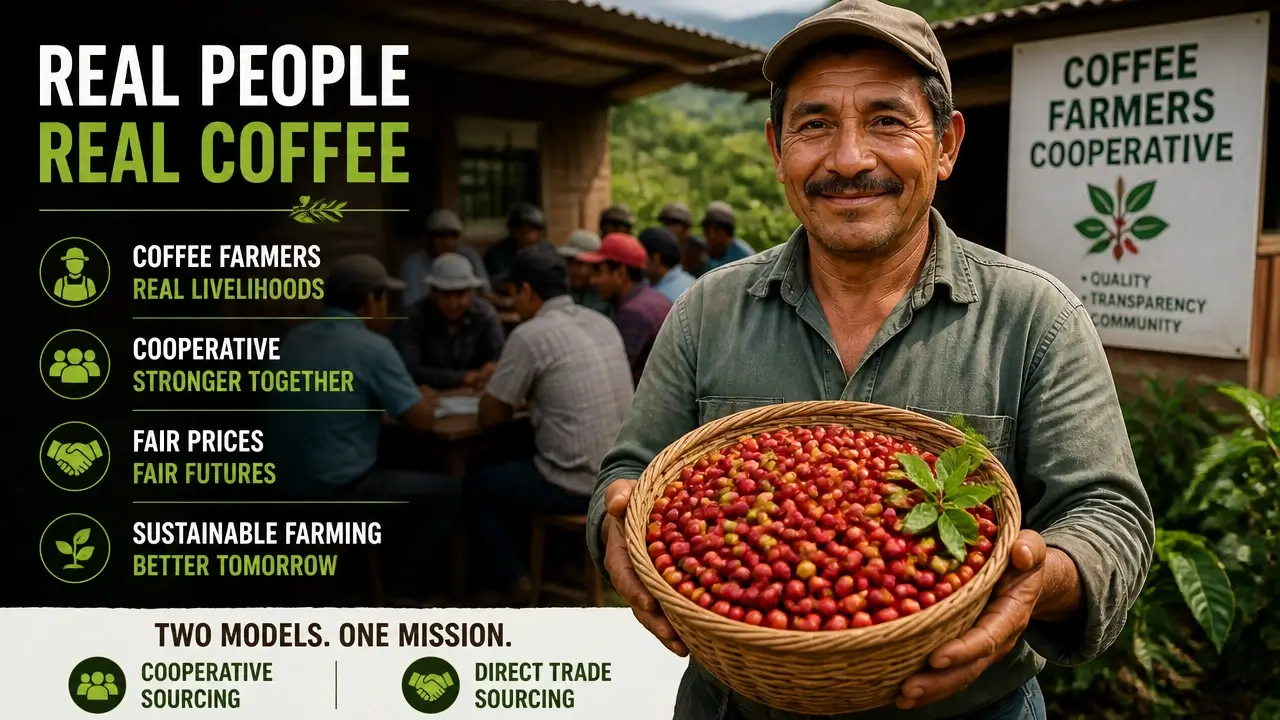
To understand how each model plays out across a real purchasing decision, five criteria matter most: price mechanism, transparency, quality focus, farmer support, and market access. These are not abstract categories. They map directly to what a farmer receives, what a roaster promises, and what ends up in your cup. The rest of this article runs both models through all five.
The core tension is this: Fair Trade is a standardized safety net. Direct Trade is a bespoke performance incentive. One protects the floor. The other raises the ceiling. Which mechanism does more good depends entirely on the farmer, the roaster, and the coffee.
For a broader look at how these two models sit inside the larger certification landscape, see our complete guide to coffee certifications and standards.
According to Dave Jameson, Coffee Programme Manager at Grumpy Mule, Fairtrade’s social premium creates a direct feedback loop between the price paid and the quality of the coffee grown. Farmers who receive the premium have a concrete incentive and the capital to invest in better cultivation practices, which means the financial structure of the certification shapes what ends up in the bag.
That feedback loop is real, but it only works when the premium actually reaches the farm and gets reinvested productively. The certification guarantees the premium exists. It does not guarantee how it gets used.
Trish Rothgeb, co-owner and roastmaster of Wrecking Ball Coffee Roasters and former director of programs at the Coffee Quality Institute, puts the Direct Trade accountability problem plainly. The model has no universal core. Some roasters, she notes, operate with rigorous sourcing principles and deep farm-level knowledge. Most others apply the term loosely, with little to distinguish their sourcing from conventional buying dressed up in better language.
This is the practical risk of Direct Trade: the label is only as honest as the roaster using it. There is no certifying body to catch a bad actor.
Paul Rice, founder of TransFair USA (now Fair Trade USA), takes a notably non-defensive position on this competition. If Direct Trade roasters can demonstrate better outcomes for farmers than Fair Trade’s certified structure, he argues, the field should make room for that. The goal is farmer welfare, not institutional preservation.
That framing matters. The two models are not at war. They are parallel experiments, and the evidence on which one works better is genuinely mixed.
Ed Canty, General Manager of Cooperative Coffees and a former Fair Trade and Organic Coffee Buyer at Green Mountain Coffee Roasters, offers a concrete data point on what Fair Trade minimums look like in practice. At Cooperative Coffees, the policy floor for Fairtrade Organic was set at $2.20/lb FOB. In the most recent fiscal year he cited, actual payments averaged $2.54/lb FOB, because local market conditions, quality expectations, and contract timing all pushed prices above the certified minimum.
That gap between the certified floor and the actual payment is important. It means Fair Trade’s minimum price functions as a guarantee, not a ceiling. When market conditions support higher prices, good buyers pay them.
Fair Trade vs Direct Trade: Comparing Price, Transparency, and Quality
Both models want farmers to earn more. Where they diverge is in how they engineer that outcome, and the differences matter at every point in the chain.
Price Mechanism
Fair Trade’s minimum price is its most visible feature and its most debated one. The floor protects farmers from market collapses, which is genuinely valuable when commodity prices crater. But the floor can also become a ceiling. When a farmer produces exceptional coffee worth $4.00/lb on the specialty market, the Fair Trade minimum of around $1.80/lb (for conventional Arabica) does not reflect that value. The social premium adds to the cooperative’s income, but it does not reach the individual farmer as a direct quality reward.
Direct Trade pricing is negotiated between the roaster and the producer, typically tied to cup quality scores and the strength of the relationship. Top Direct Trade roasters regularly pay $3.00 to $6.00/lb or more for exceptional lots. The upside is real. The downside is that there is no floor. A farmer who loses a roaster partner has no guaranteed minimum to fall back on.
The honest comparison: Fair Trade provides predictable stability; Direct Trade provides performance-based upside with no safety net beneath it.
Transparency and Verification
Fair Trade’s third-party audit creates a verifiable chain. Certifying bodies inspect cooperatives, review contracts, and confirm that premiums were paid and allocated. A consumer can look up a cooperative’s certification status. The transparency is institutional and checkable.
Direct Trade’s transparency is roaster-dependent. The best Direct Trade roasters, like Intelligentsia and Counter Culture, publish sourcing contracts, farm visit reports, and specific prices paid. That level of disclosure can be deeper than anything a certification audit captures. But it requires the consumer to trust the roaster’s self-reporting, because no independent body confirms it. The transparency can be extraordinary or entirely fabricated, and a consumer cannot easily tell the difference from a bag label alone.
This is also why the organic vs conventional coffee comparison follows a similar pattern: third-party certification gives you a checkable standard; uncertified claims give you a promise that depends entirely on who’s making it.
Quality Focus
Fair Trade certification evaluates compliance with labor and pricing standards. It does not evaluate the coffee in the cup. A cooperative can pass every audit and still produce mediocre coffee. The label tells you something meaningful about how the farmers were treated. It tells you nothing about whether the coffee is worth drinking.
Direct Trade is quality-driven by design. Roasters only build relationships with farms whose coffee scores well enough to justify the premium. Many roasters work directly with farmers on processing improvements, fermentation control, and drying methods as a condition of the ongoing relationship. The quality feedback loop is baked into the model.
The practical result: a Direct Trade bag is more likely to contain exceptional coffee. A Fair Trade bag is more likely to contain ethically sourced coffee. Those are not the same guarantee.
Farmer Support
Fair Trade’s social premium funds cooperative projects that benefit the entire community: clean water, schools, healthcare, agricultural training. These are real, documented benefits. The limitation is structural. Fair Trade is organized around cooperatives. Independent smallholders who do not belong to a certified cooperative cannot access the system.
Direct Trade can offer tailored support: long-term contracts that give farmers planning stability, production loans that let farmers invest in equipment before harvest, and technical assistance that improves quality scores over time. But this support only flows to producers the roaster has chosen. A farmer outside a roaster’s network receives nothing, regardless of their need.
Market Access
Fair Trade opens global market access to cooperatives that meet certification standards, regardless of cup quality. A cooperative producing average coffee can still sell to Fair Trade buyers worldwide. The certification itself is the market credential.
Direct Trade requires a farmer to produce exceptional coffee and then find a roaster willing to build a direct relationship. That is a much higher bar. Farmers in remote regions, or those without the infrastructure to produce consistent specialty-grade lots, may never qualify. The model rewards excellence but can leave behind the farmers who need support most.
| Criterion | Fair Trade | Direct Trade |
|---|---|---|
| Price Floor | Guaranteed minimum (~$1.80/lb Arabica) | No floor; negotiated per lot |
| Price Upside | Limited; premium is fixed | High; tied to cup quality |
| Verification | Independent third-party audit | Roaster self-reporting |
| Quality Requirement | None | High; drives the relationship |
| Farmer Support | Community-level via social premium | Individual; roaster-selected farms only |
| Market Access | Open to certified cooperatives | Requires specialty-grade production |
Which Should You Choose? A Buyer’s Guide
The choice between Fair Trade and Direct Trade comes down to what you believe should drive the price a farmer receives. That is a values question, not just a taste question. Here is how to think through it based on what you actually care about.
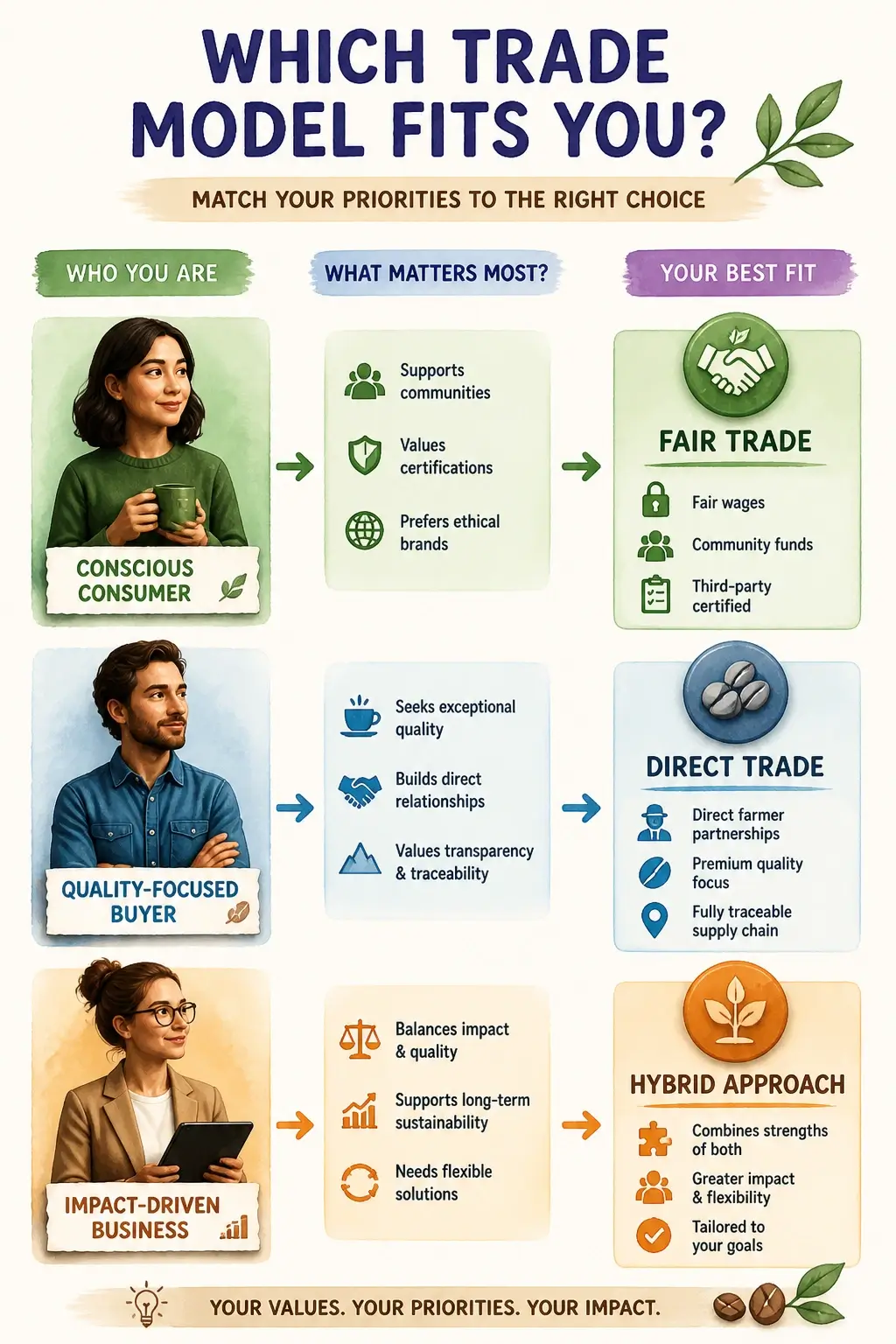
The Verifiable Ethics Seeker
You want to know, with certainty, that a minimum safety net was paid. You are not willing to take a roaster’s word for it. You want an independent body to have checked the math.
Fair Trade is your model. The certification exists precisely for this use case. The third-party audit gives you a checkable guarantee that the cooperative received the minimum price and that the social premium was allocated to community projects. The coffee may not be exceptional. But the ethical floor is real and documented.
Look for the official Fairtrade International mark, not generic “fair trade” language on a label. The mark means the certification actually happened.
The Quality-First Drinker
You care about what is in the cup, and you trust that a roaster who pays extraordinary prices for extraordinary coffee is, by definition, treating that farmer well. You are willing to do a little homework on the roaster.
Direct Trade roasters are your model, with one condition: the roaster must be transparent about it. Before you buy, check whether the roaster publishes farm visit reports, specific prices paid, or sourcing contracts. Intelligentsia’s Direct Trade program and Counter Culture’s sourcing documentation are examples of what genuine transparency looks like. If a roaster uses the term “Direct Trade” but provides no sourcing details on their website, treat the label as marketing, not evidence.
The Both-Worlds Buyer
You want the safety net of a certified floor and the quality upside of a direct relationship. This combination exists.
Some roasters operate Direct Trade sourcing practices with Fair Trade-certified cooperatives, paying above the certified minimum based on quality while maintaining the certification’s audit trail. Others detail their sourcing so thoroughly on their website or packaging that the disclosure functions as a de facto verification. Look for roasters who list the farm name, the country and region, the harvest year, the processing method, and the price paid per pound. That specificity is the signal.
Three Questions Worth Asking
Before you buy any coffee marketed as ethically sourced, three questions cut through the noise:
- “Who set the price, and how was it verified?” A certified minimum set by a third-party body is different from a number a roaster chose themselves.
- “Can I see farm-level information?” The farm name, the farmer’s name, the specific lot: these details are hard to fake and easy for honest roasters to provide.
- “Is the focus on a minimum price or on quality premiums?” The answer tells you whether the model is designed to protect the floor or raise the ceiling.
Fair Trade creates predictable, community-wide benefits that reach farmers regardless of cup quality. Direct Trade can lift individual farmers significantly higher, but only if the consumer does the work to verify the roaster’s claims. The best strategy is to learn how your preferred roaster sources and how they hold themselves accountable. A roaster who cannot answer those three questions clearly is one worth reconsidering.
The infographic below maps the decision flow if you want a quick visual reference.
Frequently Asked Questions About Fair Trade vs Direct Trade Coffee
Is Starbucks a fair trade coffee?
Starbucks is not primarily a Fair Trade brand. The company operates its own internal sourcing standard called C.A.F.E. Practices, which is verified by a third party but is not the same as Fairtrade International certification. Some Starbucks products carry the Fairtrade mark, but it’s not their default sourcing model.
Does Dunkin’ use fair trade coffee?
Dunkin’ does not prominently use Fairtrade International-certified coffee across its core menu. The brand has made commitments to ethical sourcing, but those commitments operate through supplier codes of conduct rather than third-party Fair Trade certification.
Why is fair trade coffee more expensive?
Fair Trade coffee carries a price premium because the certification requires roasters to pay above the commodity market floor, plus a social premium on top of that. The cost of the certification audit itself also flows through the supply chain. You’re paying for the guaranteed floor and the community investment, not necessarily for superior cup quality.
Which coffee brands are Fairtrade certified?
Several well-known brands carry Fairtrade International certification, including Equal Exchange, Cafédirect, and Green Mountain Coffee’s certified lines. The Fairtrade International website maintains a searchable database of certified products, which is the most reliable way to verify a specific brand’s status.
Can a coffee be both Fair Trade and Direct Trade?
Yes, and some roasters deliberately combine both. A roaster can maintain a Fair Trade-certified cooperative relationship while also negotiating quality premiums above the certified minimum and publishing detailed sourcing information. The certification provides the audit trail; the direct relationship provides the quality incentive.
Does Direct Trade actually pay farmers more than Fair Trade?
It depends on the roaster and the coffee. Top Direct Trade roasters regularly pay two to three times the Fair Trade minimum for exceptional lots. But because Direct Trade has no floor and no independent verification, the range is enormous. A rigorous Direct Trade program beats Fair Trade on price. A casual one may not.
How do I verify a roaster’s Direct Trade claims?
Look for farm names, farmer names, specific regions, harvest years, and prices paid per pound published on the roaster’s website. Farm visit documentation and relationship histories are additional signals. If a roaster uses the term “Direct Trade” but provides none of these details, the claim is unverified marketing.
What happens to Direct Trade farmers when a roaster relationship ends?
This is one of Direct Trade’s real structural risks. When a roaster moves on, the farmer loses both the premium and the market relationship, with no certified floor to fall back on. Long-term contracts mitigate this risk, but only the most rigorous Direct Trade programs include them as standard practice.
References
- Fairtrade Partnerships Success Stories | fairtrade.net
- Is Direct Trade Fair? | sprudge.com
- TransFair on Direct Trade Movement | sprudge.com
- Farm Profitability Q&A: Ed Canty | sca.coffee