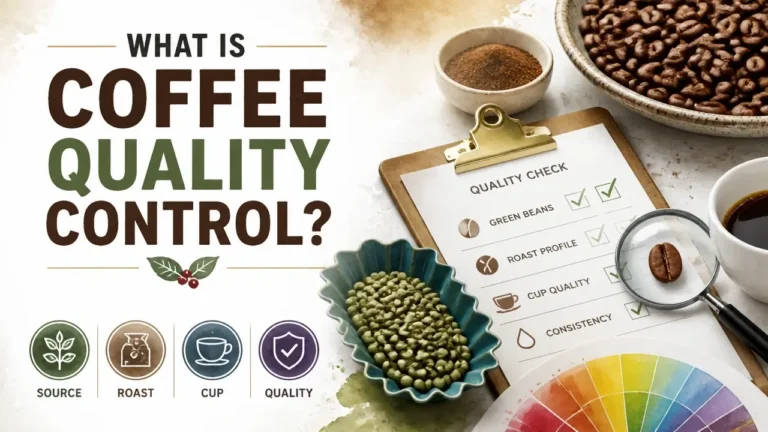

Rigorous coffee quality control in specialty coffee is not a backstage chore – it is the mechanism that separates an 84-point Ethiopian from a commodity blend, and it runs on far more than a defect sheet. The SCA Cupping Protocol, green grading, and Q Grader calibration together form a shared sensory language that makes flavor measurable, not just memorable.
Understanding this system at its core changes how you read a cupping score, evaluate a supplier, or build a sourcing program. The Coffee Quality Institute didn’t certify thousands of Q Graders so buyers could feel confident. They did it so the industry could speak the same language about the same cup.
Key Takeaways on Coffee Quality Control in Specialty Coffee
- Specialty coffee QC is a standardized measurement system that decides whether a lot meets its target sensory attributes – not just a defect-removal exercise.
- Three objectives drive QC simultaneously: flavor consistency, defect reduction, and economic value protection – and a single defect can collapse all three at once.
- QC is operational (measuring and deciding at specific points); QA is systemic (the training, calibration, and SOPs that make QC reliable). Both are required.
- The SCA’s ≤5 defects per 350g threshold and 80-point minimum Q Score are hard floors – a lot below either number exits the specialty category regardless of its story.
- QC responsibility is distributed across producers, exporters, importers, and roasters; data must flow both upstream and downstream to close the feedback loop.
- Specialty QC quantifies the presence of quality, not just the absence of faults – that distinction is what separates it from commercial-grade quality systems.
What Specialty Coffee Quality Control Actually Means
Specialty coffee quality control is the use of standardized, repeatable measurements to decide whether a coffee lot meets its target quality attributes – especially its sensory attributes – and to detect and reject defects before they degrade the cup or the contract. One sentence. That’s it. Everything else in this article builds on that anchor.
But that definition immediately raises a distinction worth planting early: QC is not the same as quality assurance (QA). QC is operational. It happens at specific inspection points – a cupping table, a moisture meter, a sorting line. QA is systemic. It’s the training programs, standard operating procedures, calibration schedules, and audit trails that make consistent QC possible in the first place. A full comparison comes later in this article, but the difference matters now because people conflate the two constantly, and the confusion leads to programs that inspect without preventing, or prevent without measuring.
In specialty coffee specifically, “quality” is not a feeling. It is a protocol-driven outcome with hard thresholds. The SCA defect limits set the floor: no more than 5 full defects per 350 grams of milled green beans to qualify as specialty grade. Below that ceiling, the lot still has to cup clean, balanced, and distinctive – scoring at least 80 points on the SCA’s 100-point scale. Miss either threshold and the lot drops out of the specialty category, regardless of how beautiful the farm story is.
The most persistent misconception about QC is that it’s simply “removing bad beans.” That framing undersells it by about nine-tenths. Removing bad beans is one task inside a much larger value-defining discipline. QC is the system that answers the question: does this coffee still deliver what was promised? Physical grading and cupping are both required to answer that question, and neither is sufficient alone.
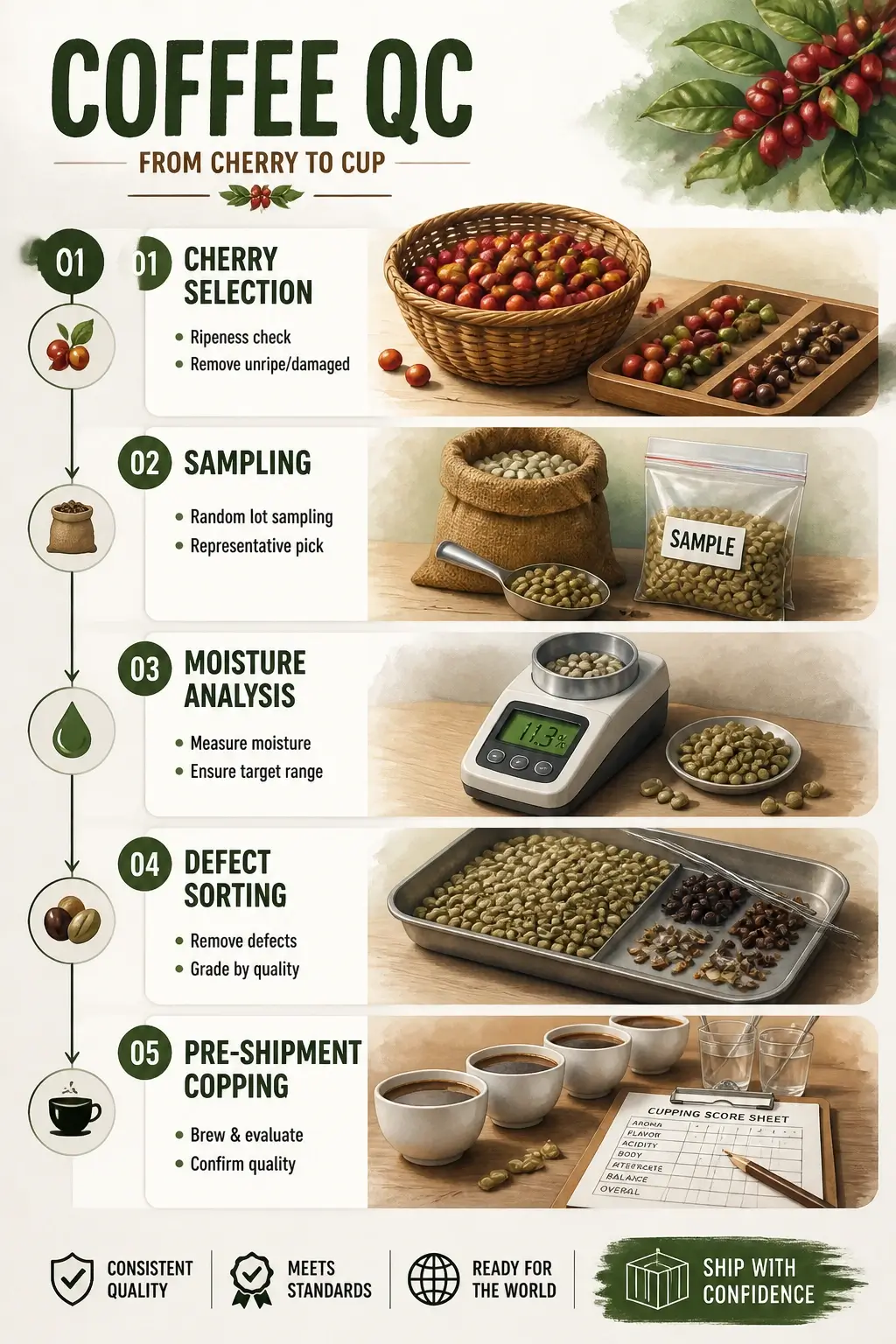
QC also does not happen once. It is a chain of checks that follows the coffee from cherry selection at the washing station through export approval at the dry mill, with additional checks at import and at the roastery. Each link in that chain asks the same question from a different vantage point.
Nicolás, a researcher at CESURCAFÉ, makes the case for a quality evaluation system grounded more in what the coffee tastes like than in a visual tally of physical defects – arguing that sensory features should carry more weight than a simple defect count.
This is exactly where specialty coffee has pushed the industry. Physical grading is necessary but not sufficient. The cup is the final verdict.
Tatiana, a quality professional at The Coffee Source, describes a minimum of three separate control steps for each lot her team handles, checking both sensory and physical characteristics at each one.
Three checkpoints per lot. That’s not paranoia – that’s the architecture of a system designed to catch what any single inspection point will miss.
Sandra, a quality control expert in coffee roastery operations, frames roasted coffee QC as two parallel tracks: how the coffee behaves inside the roaster relative to the target profile, and how it actually tastes once roasting is complete.
Both tracks run simultaneously because a roast can match its profile on paper and still produce a cup that’s off. The sensory check catches what the data log doesn’t.
Laetitia Mukandahiro, co-founder of Ikawa House and the first professional cupper in Rwanda, describes how her organization selects partner washing stations based on a combination of business practice integrity, historical consistency, and physical infrastructure – not just cup score alone.
The infrastructure point is easy to overlook. A washing station without clean water, functioning fermentation tanks, and calibrated drying beds cannot produce consistent quality regardless of how talented its operators are. QC starts with the conditions that make quality possible, not just the measurements that confirm it.
The Triple Mission: Flavor, Defects, and Economic Value
Specialty coffee QC pursues three objectives simultaneously, and they are not independent. Pull on one and the other two move.
The first objective is flavor consistency – delivering the sensory profile that the approved sample promised. A buyer who contracts a Yirgacheffe based on a pre-shipment sample with bright citrus acidity and a floral finish is purchasing that specific experience. If the shipment cups differently, QC has failed, even if zero physical defects appear in the green analysis.
The second objective is defect reduction. Physical defects like full blacks, stinkers, and heavily insect-damaged beans do not merely lower a score on a form. A single full black bean in a cup can introduce a phenolic, fermented, or medicinal flavor that overwhelms everything else the lot has to offer. Category 1 defects are not statistical nuisances; they are cup-killers.
The third objective is economic value protection. Every custody transfer in the specialty supply chain is a financial event. A lot that arrives at an importer’s warehouse with moisture above 12.5% risks mold development. A lot that cups 3 points below the contracted score may trigger a price adjustment or outright rejection. QC is what prevents those outcomes – not by luck, but by systematic verification at each handoff.
The interdependence is the part most people miss. A single visible defect – say, a full black bean – can simultaneously destroy the cup profile (objective one), push the lot over its defect tolerance (objective two), and erase the premium the producer was counting on (objective three). All three failures from one bean. That’s why QC operates as a chain rather than a single checkpoint.
The economic framing matters because QC is sometimes treated as overhead – a cost of doing business that slows throughput. The reality is the opposite. In specialty, QC is a risk-management investment. The cost of a failed pre-shipment cupping is trivial compared to the cost of a container rejection, a chargeback, or a lost buyer relationship. When executed well, QC preserves the price premium that separates a specialty contract from a commodity exchange price.
Each objective also concentrates at different nodes in the supply chain. Defect reduction does most of its work at the dry mill during physical grading and hand-sorting. Flavor consistency is primarily verified at the cupping table – during pre-shipment approval, importer arrival checks, and roaster inbound QC. Economic value protection runs everywhere, because every checkpoint is also a decision point about whether the lot advances or is downgraded.
The QC Journey: From Cherry to Export-Ready Green
The physical journey of a coffee lot is also a quality control timeline, and each stage has a specific inspection logic tied to what can go wrong at that point.
It starts at the cherry stage. At a washing station, trained pickers and sorters remove underripe, overripe, and damaged cherries by hand. Many stations use floatation tanks – dense, compromised cherries sink; healthy cherries float – as a rapid mechanical sort before processing begins. This is QC at its most upstream, and it matters because no downstream intervention can fully recover a lot built from poor-quality cherry.
During fermentation and drying, moisture monitoring becomes the primary tool. Fermentation time, water quality, and ambient temperature all affect cup quality in ways that become irreversible once the process is complete. On drying beds, workers turn and inspect parchment regularly, removing any material that shows signs of mold, over-fermentation, or pest damage. Moisture at export must typically fall between 10.5% and 12.5% – outside that range, the coffee is either too dry and brittle or too wet and vulnerable to mold.
At the dry mill, the lot undergoes hulling to remove parchment, then passes through mechanical graders that sort by screen size and density. Larger, denser beans generally indicate better development and more even roasting. After mechanical grading, trained sorters – and increasingly, optical sorting machines – remove remaining defects by visual inspection. This is where the formal SCA green grading protocol applies: a 350-gram sample is drawn and assessed for Category 1 and Category 2 defects.
Sampling discipline is a QC skill in its own right. A cupping score derived from a poorly drawn sample – one that doesn’t represent the actual lot – is noise, not data. Sampling protocols specify how many sub-samples to pull from a lot, how to combine them, and how to store and transport them to preserve integrity. Skip this step and every downstream measurement loses its validity.
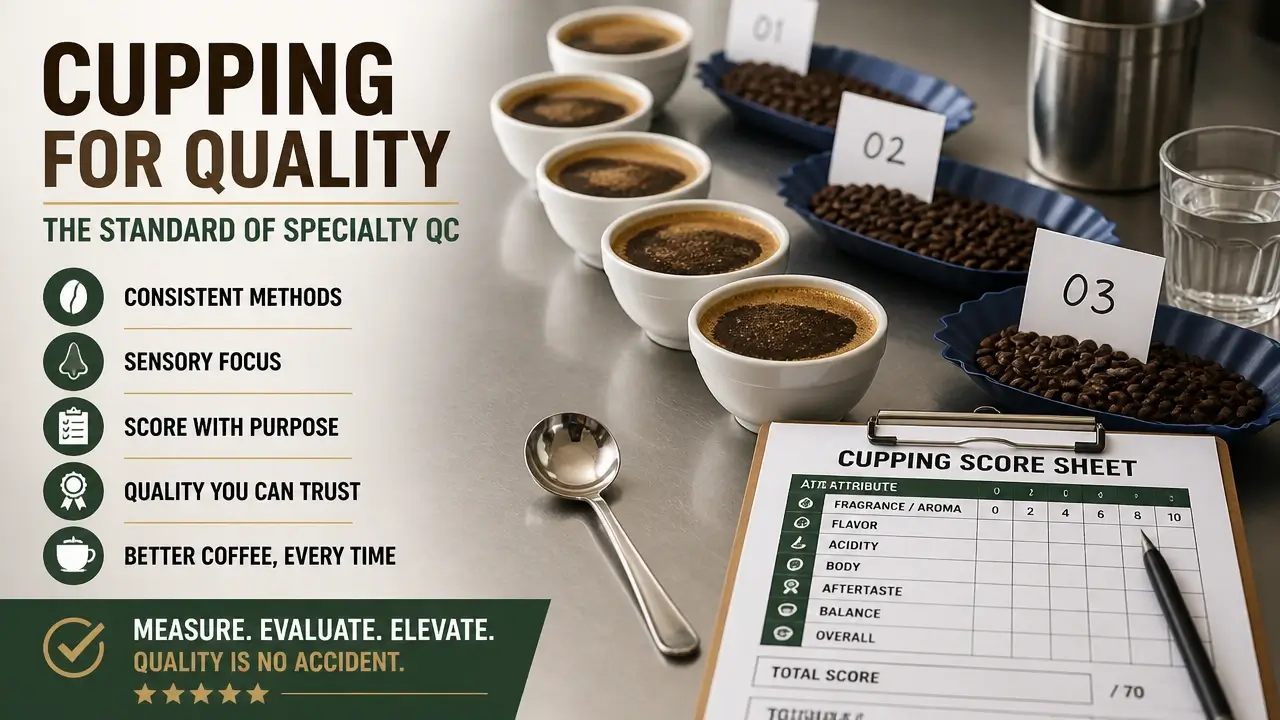
Cupping is the sensory backbone of the entire chain. Each sample is roasted to a standardized light-medium level, ground, and brewed using the SCA protocol’s prescribed water temperature, coffee-to-water ratio, and evaluation timing. Assessors evaluate fragrance and aroma before and after breaking the crust, then taste through flavor, aftertaste, acidity, body, balance, uniformity, clean cup, and sweetness. Defects are noted and subtracted. The result is a score that reflects the cup’s actual performance, not its appearance.
Green analysis runs parallel to cupping and covers moisture content, water activity, screen size distribution, and density. These physical parameters predict shelf life, roasting behavior, and shipping risk. A lot that cups beautifully but carries elevated water activity is a mold risk in a container. Both data streams – sensory and physical – are required for a complete QC picture.
QC does not end at the port. Importers perform arrival cupping and green checks to confirm the shipment matches the approved pre-shipment sample. This step catches any quality drift that occurred during transit – temperature fluctuations, moisture migration, or tainting from adjacent cargo. Roasters then conduct inbound QC when the coffee arrives at their facility: spot-checking green bags, verifying moisture, and cupping against their own approved sample before committing the lot to production.
This chain is the operational reality of specialty coffee QC. But it sits inside a larger framework – one that determines whether these inspections are consistent, calibrated, and traceable. That’s where quality assurance enters the picture.
Quality Control vs. Quality Assurance: Two Sides of the Same Coin
The QC/QA distinction is one of the most consistently misunderstood concepts in specialty coffee operations, and it costs programs real money when the two get conflated.
Here’s the plain-language version. Quality Control is the act of measuring, testing, and deciding: this lot passes, this one doesn’t. It happens at defined inspection points – a cupping table, a moisture meter, a defect-sorting line. It produces a decision. Quality Assurance is the surrounding system that makes that decision reliable: the calibrated equipment, the documented protocols, the trained staff, the audit trail that proves the process ran correctly. QA doesn’t inspect individual lots. It designs the conditions under which inspection produces trustworthy results.
A concrete example cuts through the abstraction. Checking moisture content before hulling is QC – you’re measuring a specific lot at a specific moment. Having a calibrated moisture meter, a written protocol that specifies when and how to sample, and staff who have been trained on the procedure is QA. Without the QA layer, the QC reading might be accurate, or it might reflect a meter that hasn’t been zeroed in three months, a sample drawn from the wrong part of the bag, or an operator who guessed at the procedure. The number looks the same either way. The reliability doesn’t.
The interdependence runs both ways. A roaster who cups every incoming lot (solid QC) but has no supplier scorecard system (no QA) can’t trace whether a recurring off-note comes from one producer, one exporter, one transit route, or their own storage conditions. They keep catching the same problem and never fixing it. Conversely, a producer who writes detailed SOPs for every processing step (strong QA) but never cups their own finished lots (no QC) has no feedback loop. The procedures run, but no one knows if they’re producing the right result.
The specialty coffee industry tends to use “QC” as a catch-all term for the integrated system of both. That’s fine in casual conversation. But professionals designing a quality program need to think in both layers deliberately – because the gaps are almost always in the QA layer. The inspection exists; the calibration, documentation, and training around it don’t.
Who Does What? The QC Roles Across the Supply Chain
Specialty coffee QC is distributed work – no single person owns it, and no single checkpoint is sufficient. Four core stakeholder groups carry specific responsibilities, and the handoffs between them are where quality either gets protected or quietly lost.
Producers and Wet-Mill Operators
Producers are the first QC line. Their responsibilities include cherry selection by ripeness, floatation sorting, fermentation monitoring, drying-bed management, and lot separation by quality tier. At many origins, a single farm or cooperative processes multiple quality grades simultaneously, and the physical separation of those lots from cherry through parchment storage is itself a QC discipline. Cross-contamination at this stage is irreversible.
Small producers frequently lack dedicated QC labs and rely on exporter-provided cupping services or cooperative QC facilities for formal sensory evaluation. The Coffee Quality Institute has invested significantly in building cupping lab capacity at origin precisely to close this gap.
Exporters and Dry-Mill Operators
Exporters and dry-mill operators carry the heaviest formal QC load before shipment. Their responsibilities span hulling, mechanical grading by screen size and density, defect hand-sorting, green analysis (moisture, water activity, screen distribution), sample roasting, formal cupping, pre-shipment documentation, and final approval against the purchase contract. The pre-shipment sample – the reference cup that locks the lot’s sensory identity for the buyer – originates here.
Importers
Importers perform arrival QC: sampling green bags from the incoming container, verifying physical parameters, and cupping against the pre-shipment sample. This is often the last opportunity to identify quality drift before the coffee enters the warehouse and moves toward roasters. If the arrival cup diverges meaningfully from the pre-shipment reference, the importer must decide whether to accept, renegotiate, or reject the lot. That decision requires reliable, documented QC data from both ends of the shipment.
Roasters
Roasters are the final gatekeepers before coffee reaches a customer. Their QC responsibilities include inbound green checks, roast-profile verification against the target development, and cup-quality assessment of roasted samples. Many specialty roasters maintain their own approved samples and cup each production batch against them. Some also share cupping data upstream – back to importers or directly to producers – as part of collaborative quality improvement programs.
This upstream data flow is where the line between QC and quality development blurs productively. A roaster who tells a producer “your lot scored 84 but had a slight ferment note in two of five cups” is providing the producer with actionable feedback that can improve next year’s processing. QC data, when it moves both directions, becomes a shared asset rather than a private gatekeeping tool.
The Protocols That Power QC: Cupping, Grading, and the Q Score
Consistent specialty coffee QC depends on standardized protocols that convert subjective sensory experience into reproducible, comparable data. Without shared standards, a score from one cupper in Ethiopia means something different than a score from another in Seattle, and the entire system of international coffee trade loses its common language.
The SCA Cupping Protocol
The SCA Cupping Protocol is the universal sensory framework. It specifies roast level (Agtron 55-60 on whole bean, 60-65 on ground), water chemistry (clean, odor-free, 200 ppm TDS), grind size, coffee-to-water ratio (8.25 grams per 150 mL), water temperature (93°C ± 1°C), and a precise evaluation sequence from fragrance through final scoring. Every variable is controlled so that differences between cups reflect the coffee, not the method.
The evaluation form covers eleven attributes: fragrance/aroma, flavor, aftertaste, acidity, body, balance, uniformity, clean cup, sweetness, defects, and overall. Each attribute is scored on a continuous scale, and the final Q Score is the sum of those attribute scores minus any defect deductions.
SCA Green Grading
Green grading classifies physical defects into two categories. Category 1 defects – full blacks, full sours, pods/cherries, large stones, large sticks, and mold – each count as one full defect. Category 2 defects – partial blacks, partial sours, parchment, floaters, immature/unripe beans, withered beans, shells, small stones, small sticks, and water damage – count as fractional defects, typically two to five per full defect equivalent depending on the specific type.
The specialty threshold is ≤5 full defects per 350-gram sample. Exceed that count and the lot cannot carry a specialty designation, regardless of its cup score.
The Q Score and What It Actually Signals
The Q Score is a 100-point number that synthesizes the SCA cupping form’s attribute scores into a single market signal. Specialty status requires a minimum score of 80 points, but the scale carries meaningful distinctions above that floor:
| Score Range | Category | Market Signal |
|---|---|---|
| 80.00 – 84.99 | Very Good | Entry-level specialty; standard premium pricing |
| 85.00 – 89.99 | Excellent | High-specialty; significant price premium |
| 90.00 – 100.00 | Outstanding | Micro-lot, auction-grade; exceptional premiums |
A coffee scoring 79.5 and one scoring 80.5 may taste nearly identical in a blind cup, but they occupy different market categories with different price implications. The threshold is a line, not a gradient, which is why calibration matters so much.
Q Graders are the trained sensory assessors who apply these protocols. Certified by the Coffee Quality Institute, Q Graders pass a rigorous 22-test examination covering sensory skills, green grading, and cupping calibration. Their role is not to have the best palate in the room – it’s to apply the protocol consistently enough that their scores are reproducible and comparable to those of other Q Graders globally.
Here’s a walkthrough of what a live SCA cupping session looks like in practice:
Beyond the Defect Sheet: What QC Actually Delivers
Specialty coffee QC generates value well beyond the pass/fail decision on a defect count. The defect sheet is the floor, not the ceiling, and professionals who treat it as the whole job are leaving most of QC’s utility on the table.
The first thing QC delivers beyond defects is lot validation. When an importer cups an arrival sample against the pre-shipment reference and the scores align, that confirmation does more than clear the lot for warehousing. It validates the producer’s processing, the exporter’s handling, and the transit conditions – all at once. Repeated validation across multiple shipments builds the evidentiary record that long-term buyer-seller relationships run on.
The second deliverable is actionable data. Cupping scores, defect analyses, moisture readings, and water activity measurements are not just compliance records. They feed roast development decisions (a denser bean from a high-altitude lot needs a different roast curve), blending logic (a lot with high acidity but thin body can balance a lot with low acidity and heavy body), and marketing narratives (an 88-point lot with jasmine and bergamot notes has a specific story that commands a specific price).
The third deliverable is traceable benchmarks. When QC data flows transparently across the supply chain – from roaster back to importer, from importer back to exporter, from exporter back to producer – it creates a shared record of what this coffee has been at every stage. That record is the infrastructure of trust. Without it, every custody transfer is a leap of faith.
In ICO data covering 2005 to 2014, 43.6% of total volume graded on futures exchanges fell below established standards during that period.
Nearly half the coffee moving through commodity channels during that decade didn’t meet its own exchange’s standards. Specialty coffee QC exists specifically to prevent that outcome – to ensure that what the buyer contracted is what they receive, down to the sensory profile.
There’s a common anxiety in specialty coffee that rigorous QC somehow threatens terroir or flattens distinctive origin character into a homogenized ideal. The logic runs backward. QC does not define what a coffee should taste like – it verifies that it tastes like what it is. A well-executed QC program on a natural-processed Gedeb doesn’t sand down its fermented blueberry character; it confirms that the character is present, consistent, and free of the defects that would mask or corrupt it. Standardized vocabulary (“this is an 86-point floral Ethiopian with stone fruit and tea-like acidity”) makes distinctive profiles marketable, not generic.
What specialty QC ultimately does that generic quality systems cannot: it quantifies beauty. Not the absence of faults – the presence of something worth paying for. That distinction is the entire premise of the specialty category, and QC is the mechanism that makes it real.
Where QC Goes from Here: Specialty vs. Commercial and Your Next Steps
Specialty coffee QC is a protocol-driven, sensory-anchored discipline that protects flavor, eliminates defects, and defends economic value across a distributed chain. That’s the whole article in one sentence. What’s left is the contrast that gives it context and the two paths that deepen your understanding from here.
Commercial coffee QC operates under a fundamentally different mandate. Commercial systems prioritize volume throughput. They are built to move large quantities of coffee efficiently through processing and export, and their defect tolerances reflect that priority – allowing higher defect counts per sample and rarely applying sensory cupping at the rigor that specialty demands. The standard in commercial-grade systems is “acceptable for the blend.” In specialty, the standard is “consistent with the specific lot’s contracted profile.” Those are different questions entirely.
This is not a judgment about which system is better. They serve different markets with different requirements. A commercial roaster blending millions of pounds of coffee for consistent flavor at scale needs a QC system optimized for uniformity across enormous volumes. A specialty importer moving a 20-bag micro-lot from a single producer needs a QC system optimized for preserving and verifying a specific, differentiated profile. The tools overlap; the objectives diverge.
If you want to see exactly how specialty thresholds stack up against the commercial coffee quality standards that govern the broader market, that comparison goes deep on the numbers, tolerances, and structural differences between the two regimes.
And if you’re ready to move from the conceptual framework into the operational detail – the specific defects that QC is trained to identify, classify, and adjudicate – head back to the complete guide to coffee defects and quality control. That guide covers every Category 1 and Category 2 defect, how each one forms, what it does to the cup, and how QC systems catch it.
One final point worth carrying forward: a robust QC program is not a static checklist. The SCA updates its protocols. Sensory science evolves. New processing methods create new defect profiles that existing grading systems weren’t designed to catch. The concepts in this article – the three objectives, the chain of checks, the QC/QA distinction, the role of calibrated protocols – are the non-negotiable foundation. Everything built on top of that foundation will keep changing. The foundation won’t.
Frequently Asked Questions About Coffee Quality Control in Specialty Coffee
What is coffee quality control?
Coffee quality control is the systematic use of standardized measurements and sensory evaluation to determine whether a coffee lot meets its target quality attributes at specific points in the supply chain. It covers both physical grading and cupping, and it operates from cherry selection through roaster inbound checks.
What is the Q score for specialty coffee?
The Q Score is a 100-point composite score derived from the SCA Cupping Protocol. A minimum of 80 points is required for specialty classification, with scores from 85–89.99 considered Excellent and scores of 90 or above classified as Outstanding – each tier carrying distinct price implications in the market.
What’s the difference between quality control and quality assurance in coffee?
QC is the act of inspecting and accepting or rejecting a specific lot at a defined checkpoint. QA is the surrounding system – calibrated equipment, documented protocols, trained staff – that makes those inspections consistent and trustworthy. You need both; one without the other produces either unreliable data or a feedback-free checklist.
What is the 15 15 15 rule for coffee?
The 15-15-15 rule is a cupping preparation guideline: coffee should be roasted at least 15 minutes before grinding, ground no more than 15 minutes before cupping, and cupped within 15 minutes of brewing. It’s a practical calibration standard to minimize variance introduced by stale roast gases or oxidized grounds.
How much does it cost to become a Q Grader?
The Coffee Quality Institute’s Q Grader examination typically costs between $600 and $900 USD for the exam itself, though total costs including preparatory coursework, travel, and lodging can push the investment to $1,500–$2,500 or more depending on location and provider. Certification requires re-calibration every three years.
Why does flavor consistency matter as much as defect counts in specialty QC?
A lot can pass every physical defect threshold and still fail QC if its cup profile has drifted from the contracted sample. In specialty, the buyer purchased a specific sensory experience, not just a clean green analysis. Flavor consistency is the contractual deliverable; defect counts are one of the mechanisms that protect it.
Can small producers run effective QC without their own cupping lab?
Yes – and many do. Small producers frequently access cupping services through cooperatives, exporter-run labs, or Coffee Quality Institute-supported facilities at origin. The key is that formal sensory evaluation happens at some point before the lot is sold, and that the producer receives feedback from those sessions to improve future lots.
Does QC suppress origin character or distinctive processing profiles?
The opposite is true. QC verifies that distinctive character is present, consistent, and free of defects that would mask it. A natural-processed lot’s fermented blueberry notes don’t get standardized away by cupping – they get confirmed as intentional, repeatable, and clean rather than the result of uncontrolled fermentation gone wrong.
References
- Grounding Green Grading | sca.coffee
- How Can Roasters Control Quality When Sourcing Coffee? | perfectdailygrind.com
- Streamlining Quality Control in Your Coffee Roastery | perfectdailygrind.com
- Three Questions With Rwandan Coffee Expert Laetitia Mukandahiro | dailycoffeenews.com
- ICO Document SC-57E: Coffee Gradings 2005–2014 | ico.org