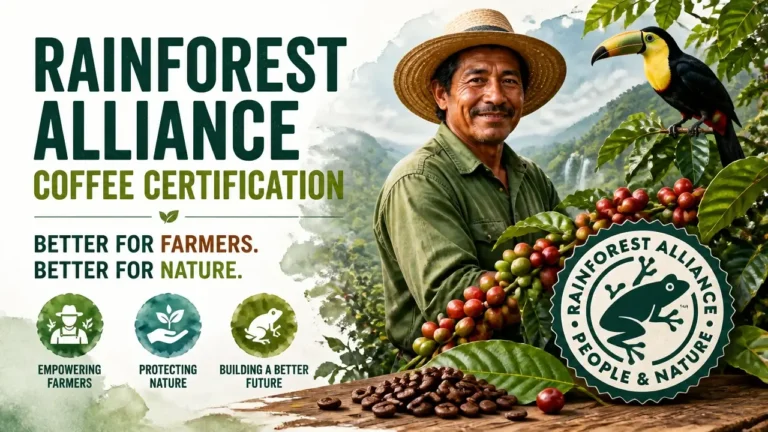

Rainforest Alliance coffee certification is one of the most recognized sustainability labels in the world, and one of the most misunderstood. The green frog seal signals real, audited environmental and social commitments across more than 400,000 coffee producers globally. But it does not guarantee organic farming, a fixed farmer wage, or a traceable price premium.
Understanding what the certification actually does, and where it stays deliberately silent, is the difference between a purchasing decision built on evidence and one built on label design.
To see how these supply chain models compare to alternative sourcing frameworks, it helps to examine Fair Trade and Direct Trade to understand how different certifications impact farmer livelihoods.
When you are shopping for certified coffee, understanding what the certification actually does, and where it stays deliberately silent, is the difference between a purchasing decision built on evidence and one built on label design.
To fully grasp how these individual seals compare across the industry, it helps to examine the broader Coffee Certifications Standards What Every consumer should know before buying their next bag.
Key Takeaways on Rainforest Alliance Coffee Certification
- The green frog seal guarantees at least 90% certified content and independent auditing, not organic farming or a specific farmer wage.
- Rainforest Alliance uses a Sustainability Differential and Sustainability Investment model instead of a price floor, but neither payment amount is publicly disclosed.
- The 2018 UTZ merger and 2020 standard update strengthened traceability requirements and raised the certified-content threshold from 30% to 90%.
- Research on group certification in Uganda found that net income gains for smallholders are real but significantly lower than headline premiums once certification costs are deducted.
- Fair Trade guarantees a public price floor; Organic confirms farming method; Rainforest Alliance delivers environmental and social audit depth that neither provides alone.
- The certification works best as a baseline layer, not a complete answer; pairing it with direct-trade transparency or complementary labels gives a fuller picture of farm-level outcomes.
While the green frog seal ensures rigorous environmental standards, consumers often mistake its focus on shade-grown biodiversity and land management for conventional and organic farming practices regarding chemical inputs.
What Is Rainforest Alliance Coffee Certification?
Rainforest Alliance coffee certification is a program run by the Rainforest Alliance, a global nonprofit founded in 1987, that sets sustainability standards across agriculture, forestry, and tourism. Coffee is its most visible product category, but the organization’s reach extends well beyond your morning cup. Its core mission: conserve biodiversity and secure sustainable livelihoods by treating environmental protection and social progress as the same problem, not two separate ones.
The visual shorthand for all of this is the green frog seal. Under the 2020 Rainforest Alliance standard, any single-ingredient product, including coffee, must contain at least 90% certified content to carry that seal. That rule replaced an older threshold that required only 30%, a change that made the label meaningfully harder to earn.
In 2018, the Rainforest Alliance merged with UTZ, another major sustainability certification body, consolidating two large programs into one. Today, over 400,000 coffee producers participate globally, the majority of them smallholders. The merged organization now operates two distinct certification paths. The first is the Sustainable Agriculture Certification, built on environmental, social, and economic pillars. The second is the newer Regenerative Agriculture Certification, a science-based pathway with stricter requirements for soil health, biodiversity recovery, and climate resilience. Both matter, and they serve different farm contexts.
This article unpacks each layer: the environmental criteria, how audits actually work, what the certification means for farmer income, how it stacks up against Fair Trade and Organic, and what the seal honestly tells you when you’re standing in a coffee aisle. For a broader view of how Rainforest Alliance fits into the wider landscape of coffee labels, see our complete guide to coffee certifications and standards.
The Core Standards: What Rainforest Alliance Requires of Coffee Farms
The Rainforest Alliance certification requirements go well beyond planting a few shade trees. The standard is an integrated system covering how land is managed, how workers are treated, and how the farm’s economics function. These pillars are interdependent by design: a farm cannot ace the environmental section while failing its workers and still earn the seal.
Environmental and Farm Management Standards for Rainforest Alliance Certified Coffee
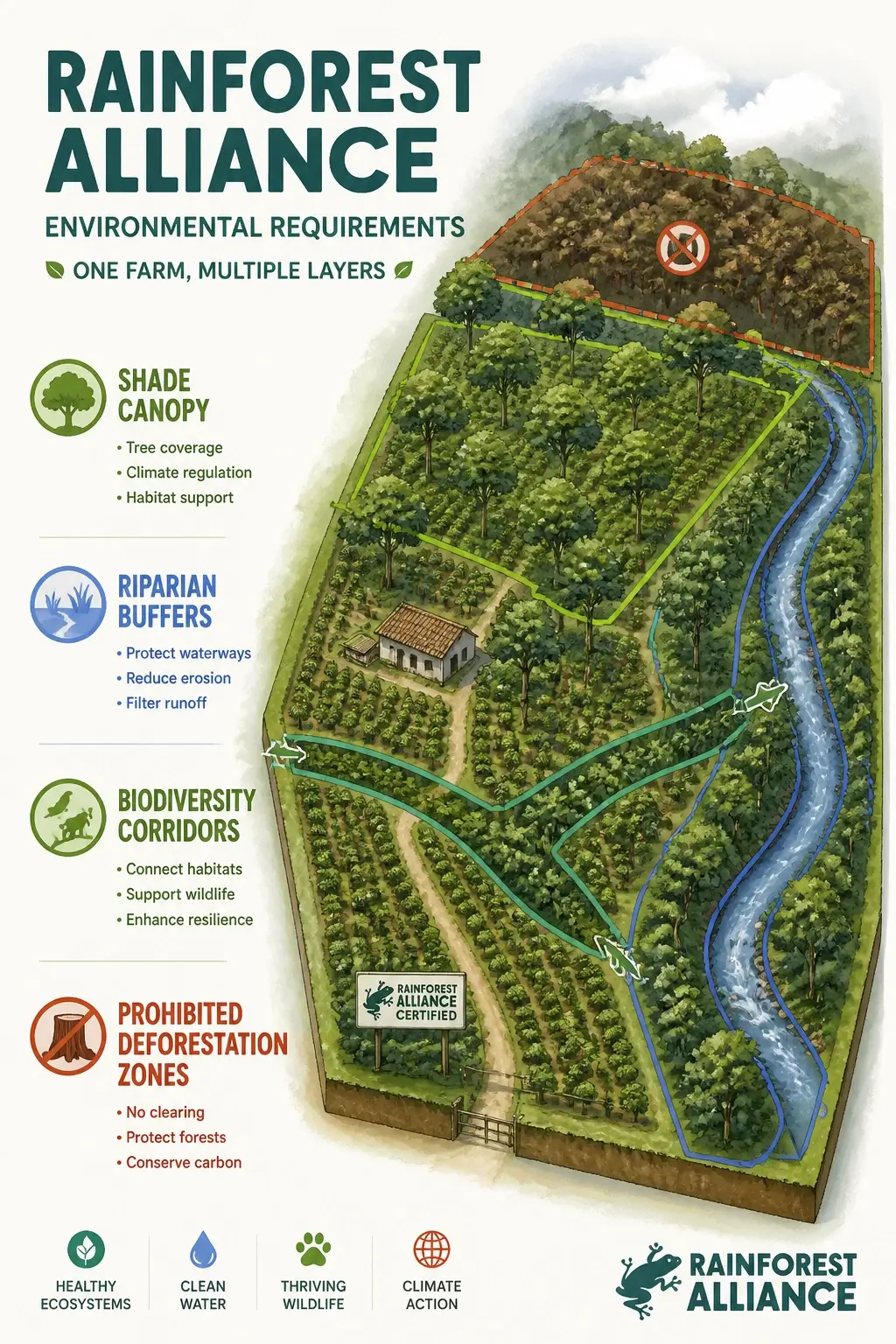
Shade-grown cultivation is one of the most ecologically significant requirements in the standard. Certified farms must maintain forest canopy cover, protect riparian buffers along waterways, and implement wastewater management systems to prevent processing runoff from contaminating local water sources. Deforestation is explicitly prohibited. Farms must also plant shade trees and, where applicable, adopt regenerative practices that actively restore degraded land rather than simply preserving what remains.
Biodiversity protection runs through the entire environmental framework. Certified farms are required to maintain habitat corridors, protect native species, and manage their land in ways that support the surrounding ecosystem rather than treating it as background scenery.
One assumption worth correcting directly: Rainforest Alliance certification does not mean organic. The standard does not prohibit synthetic pesticides or fertilizers. What it requires instead is integrated pest management (IPM), a framework that prioritizes biological and cultural controls and mandates that chemical inputs are handled safely, stored correctly, and applied in ways that minimize environmental harm. Reduced chemical use is encouraged; zero chemical use is not mandated.
The 2020 standard tightened several of these rules. Beyond raising the certified-content threshold to 90%, it strengthened traceability requirements throughout the supply chain, which matters for the verification system described in the next section.
Social and Economic Framework for Coffee Farms under Rainforest Alliance
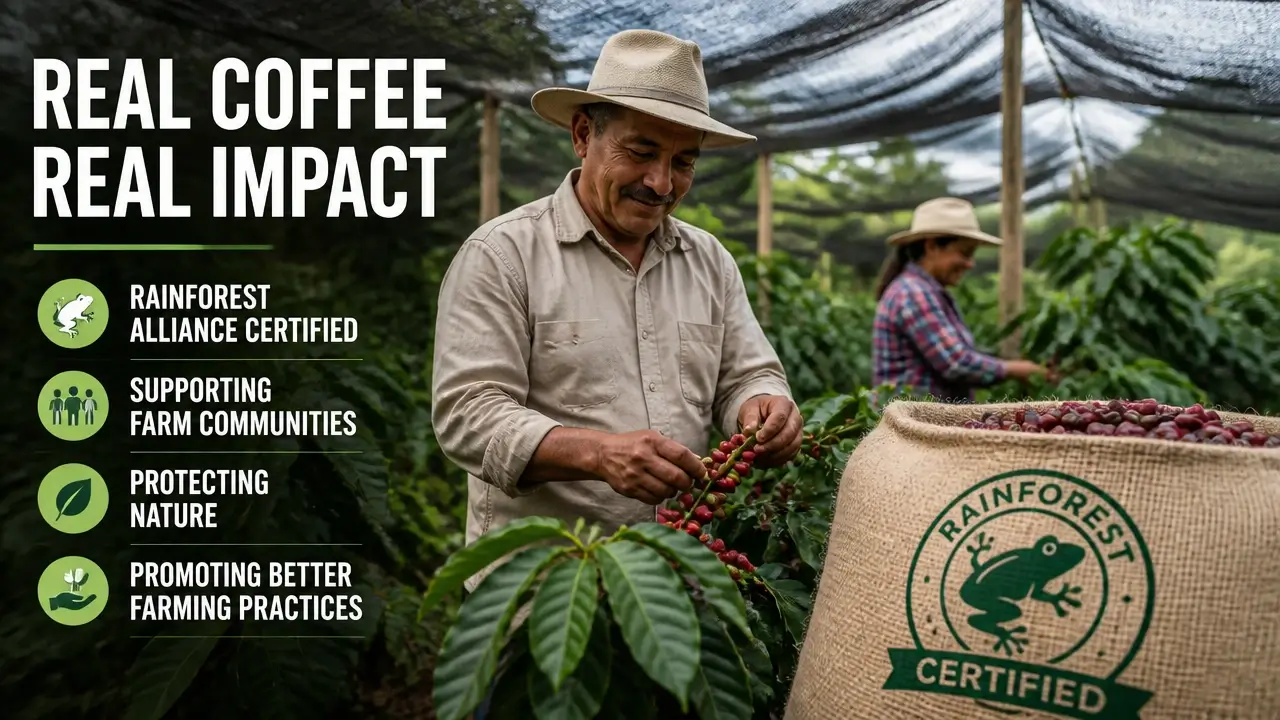
The social pillar covers the people on the farm with the same level of detail the environmental pillar applies to the land. Certified farms must respect workers’ freedom of association, prohibit forced and child labor, enforce non-discrimination policies, and provide safe working conditions. Access to decent housing and respect for indigenous and community land rights are also required, not optional.
Here is where a persistent misconception needs clearing up: Rainforest Alliance does not require a fixed daily wage. The economic component of the standard is handled through a separate mechanism called the Sustainability Differential and Sustainability Investment, which buyers pay to farmers rather than a price floor being set at the farm gate. That mechanism gets its own section later in this article, because the details matter.
What the social framework does establish is a floor of human dignity. A farm cannot pass its audit by excelling at canopy coverage while underpaying workers or ignoring labor rights. The two pillars are evaluated together. That integrated structure is what separates Rainforest Alliance from single-issue labels, and it’s also what makes a direct trade comparison useful context: direct trade can deliver economic transparency that certification cannot, while certification can enforce environmental and social baselines that informal trade relationships may not.
From Farm to Cup: How the Certification Process Actually Works
The Rainforest Alliance certification audit process is not a self-reported checklist. It runs through a two-stage verification architecture that covers both the farm and every actor in the supply chain who handles the coffee afterward.
Third-Party Auditing and Continuous Improvement Process
The first stage is the farm audit. An independent, approved certification body (not Rainforest Alliance itself) assesses the farm against the Sustainable Agriculture Standard. Rainforest Alliance sets the rules; third-party auditors verify compliance. That separation matters because it removes the organization’s financial incentive from the pass-fail decision.
The continuous improvement model is worth understanding precisely. Farms are not assessed on a single pass-fail snapshot. Instead, they are evaluated against a tiered set of requirements: some are mandatory from day one, others must be met within defined timeframes, and others represent aspirational benchmarks that farms work toward progressively. This model acknowledges that a smallholder farm in its first certification cycle cannot meet the same bar as an estate farm in its tenth year. The bar rises as the relationship matures.
The certification cycle runs three years, with annual surveillance checks between full audits. Costs fall on the farm or supply chain actor, not on Rainforest Alliance. That cost structure has real implications for smallholder access, a point addressed directly in the economics section.
The second stage applies to the supply chain. Exporters, importers, and roasters who want to sell coffee bearing the frog seal must obtain a separate supply chain certificate. This confirms they are handling certified coffee correctly, maintaining segregation where required, and meeting traceability obligations.
Traceability Models and Digital Platforms for Certified Coffee
The MyRA portal is the digital backbone of the system. Both producers and supply chain companies register on the platform, submit documentation, manage certificates, and maintain traceability records. For businesses operating in markets covered by the EU Deforestation Regulation (EUDR), MyRA also supports the due-diligence documentation that regulation requires. The platform gives the certification an auditable data trail rather than relying on paper records.
Traceability within the system operates on two models. Identity preserved means the certified coffee is fully segregated from farm to roaster, with a clean chain of custody. Mass balance allows certified and non-certified coffee to mix at certain processing stages, provided that strict bookkeeping accounts for the volumes and that the certified proportion remains accurately recorded. For the consumer-facing product, the 90% rule still applies regardless of which traceability model the supply chain uses upstream.
The 2018 merger with UTZ simplified this considerably. Before the merger, two separate certification systems ran parallel traceability infrastructures. The 2020 standard harmonized requirements under one program, which reduced administrative duplication for farms and buyers that had previously held both certifications simultaneously.
The Economics of Sustainability: Do Rainforest Alliance Farmers Really Earn More?
This is the question that separates a label that does real work from one that does good marketing. Rainforest Alliance coffee certification does not guarantee a minimum price. What it guarantees instead is that buyers must pay two additional sums: the Sustainability Differential and the Sustainability Investment.
Sustainability Differential and Investment: The Rainforest Alliance Economic Model
The Sustainability Differential (SD) is a mandatory cash payment per pound of certified coffee, paid directly to the farmer or cooperative by the buyer. The Sustainability Investment (SI) is a separate payment, directed toward farmer-identified improvement projects: shade-tree planting, processing upgrades, worker facilities, or other farm-level investments. Both payments are required under the standard; neither is optional.
The intended logic is sound. Rather than fixing a price floor that may not reflect market conditions in a given origin or harvest year, the SD/SI model gives farmers a negotiated, flexible income stream and ties buyers into co-investing in farm resilience. In principle, SI payments that fund processing upgrades or shade-tree programs can increase productivity and quality over time, which indirectly lifts farm income. The theory is that flexible co-investment builds more durable farm economics than a static price floor.
Academic Evidence: A peer-reviewed simulation of smallholder coffee producer organizations in Uganda found that group certification can yield a small positive net income effect, but the added value is substantially lower than the headline price premium once entry and operational certification costs are accounted for. Increasing group membership and raising certified delivery volumes were identified as necessary conditions to improve net rewards. From the study Journal of Agricultural Economics – Assessing the Income Effects of Group Certification for Smallholder Coffee Farmers.
That finding is important because it puts a number on the gap between how certification premiums sound in a press release and how they land in a farmer’s account. The gross premium exists. The net benefit, after costs, is real but modest, and it depends heavily on scale.
Transparency Gaps and Cost Burdens in Rainforest Alliance Certification
Set that against the Fair Trade model and the contrast is immediate. Fair Trade guarantees a minimum price of US$1.80 per pound for washed Arabica (as of August 2023) plus a fixed social premium. A buyer, a farmer, and a journalist can all look up that number. It is public, fixed, and auditable in a single sentence.
The Sustainability Differential carries no equivalent public figure. Rainforest Alliance uses the term across its communications, but no published source provides a dollar amount, a calculation method, or a formula that would let a smallholder farmer verify whether the SD they received was correct. For a farmer trying to decide whether certification will cover its costs, that opacity is a structural problem, not a minor detail.
The certification cost burden compounds this. Audit fees, documentation requirements, and the administrative overhead of maintaining compliance across a three-year cycle fall on the farm or cooperative. For large estates with professional management teams, this is manageable. For a smallholder cooperative with limited administrative capacity, the paperwork alone can overwhelm the net benefit, particularly in early certification years before volumes scale.
One more thing deserves plain language: no certification system, Rainforest Alliance included, can guarantee a 100% child-labor-free or perfectly ethical supply chain. Certifications reduce risk and establish enforceable frameworks. They are not guarantees of perfect outcomes. Any marketing that implies otherwise is overstating what the standard actually delivers, and any consumer who expects otherwise is working from an unrealistic baseline.
The information gap is real. The seal on the bag does not tell you how much the farmer was paid. It does not tell you whether the SD was generous or minimal. It confirms that the farm was audited, that standards were met, and that the supply chain is traceable. That is meaningful. It is not complete.
Rainforest Alliance vs. Fair Trade vs. Organic: What Each Certification Actually Delivers
Choosing between certifications is not a matter of picking the “best” label. It is a matter of understanding which dimensions each label actually covers, and which ones it leaves entirely silent.
The comparison framework that matters runs across four dimensions: environmental protection, farmer income model, labor standards, and what the seal actually guarantees versus what it implies.
Rainforest Alliance takes an integrated, multi-pillar approach. Environmental protection is detailed and auditable: shade-grown practices, deforestation prohibition, water management, biodiversity requirements. Labor protections are real and enforceable. The income model uses the SD/SI payment structure rather than a price floor. Synthetic inputs are allowed within an IPM framework. The seal confirms that at least 90% of the product’s content is certified and that the supply chain has been independently audited. It does not confirm a specific price paid to the farmer or a farming method free of synthetic chemistry.
Fair Trade anchors its value in economic security. The minimum price floor for washed Arabica and the fixed social premium are publicly stated and verifiable. The community development fund is a real, trackable payment. Environmental standards exist but are less prescriptive than Rainforest Alliance’s framework. Organic certification can be layered on top but is separate. For a buyer whose primary concern is farmer income stability, Fair Trade certification standards provide a clearer, more auditable economic signal than Rainforest Alliance does.
Organic certification (USDA NOP, EU Organic) operates on a different axis entirely. It strictly prohibits synthetic pesticides and fertilizers and focuses on soil health and ecological farming methods. It carries no built-in labor standards and no income floor. The seal confirms how the crop was grown, not who grew it, under what conditions, or at what price. Organic certification paired with Rainforest Alliance or Fair Trade covers more ground than either does alone.
The overlap problem is real. Some producers hold multiple certifications simultaneously, which can dilute the perceived distinctiveness of any single seal. A bag carrying three labels can feel more like a marketing stack than a coherent story. And for consumers who already struggle to decode one certification, three compounds the confusion rather than resolving it.
One misconception worth closing explicitly: Rainforest Alliance certified coffee is not automatically organic, and organic coffee is not automatically Rainforest Alliance certified. Shade-grown practices are compatible with both, but they require separate audits under separate standards. The two seals can coexist on the same bag. They do not imply each other.
The practical conclusion: no single certification covers every value a conscientious buyer might hold. Environmental depth, income transparency, and farming method purity each live in different programs. Buyers who care about all three may need to look for coffee that carries more than one label, or supplement certification with direct-trade sourcing that provides origin-level financial transparency none of these labels currently deliver on their own.
Decoding the Green Frog: What the Seal Tells You (and What It Stays Silent About)
Guarantees and Common Misconceptions of the Rainforest Alliance Seal
The green frog seal under the 2020 Rainforest Alliance standard communicates three specific things. First, the product contains at least 90% certified coffee by volume. Second, the farms that produced it were assessed against the Sustainable Agriculture Standard’s environmental and social criteria. Third, the supply chain handling that coffee was independently audited by an approved certification body.
That is what the seal confirms. Several things it does not confirm are worth naming directly.
Rainforest Alliance seal guarantees do not include a fixed daily wage. The SD/SI model, as covered earlier, replaces that with negotiated buyer payments whose amounts are not publicly disclosed. The old 30% certified-content threshold, which allowed a product to carry the frog even if most of its ingredients were uncertified, was retired with the 2020 standard. That change is worth knowing because older criticisms of the label sometimes cite the 30% rule, and that rule no longer applies.
The seal also does not mean the coffee is organic. It does not mean the coffee tastes better. Quality is determined by cultivar, terroir, altitude, and processing method, none of which the Rainforest Alliance standard directly governs. And it does not mean the farmer received a specific price. The audit confirms process compliance, not payment amounts.
What the Seal Conceals and How to Use It Responsibly
The information gap at the center of the green frog is the Sustainability Differential itself. Rainforest Alliance’s own communications name the SD as the mechanism by which farmers receive additional income. But no public document defines what that differential is in dollar terms, how it is calculated, or what a buyer is actually required to pay per pound. The label carries the implication of farmer benefit without the data to verify it.
This creates a guarantee expectation gap. Consumers who see the frog tend to read it as a comprehensive promise: ethical treatment, fair pay, environmental protection. The certification delivers on the environmental and social audit components. It does not deliver the income transparency that “ethical” implies to most buyers. That gap is not a flaw in the certification’s intentions. It is a structural limitation of how the economic model was designed.
No third-party certification can promise zero child labor or perfect ethical outcomes on every farm in a global supply chain. Audits catch what auditors can see during an audit cycle. They are not continuous surveillance. Naming this honestly is not a reason to dismiss the certification; it is a reason to use it as one layer of assurance rather than the whole answer.
For consumers, the most useful approach is to treat the frog as a meaningful starting point and then look for additional transparency signals: roaster origin reports, direct-trade sourcing claims, or third-party impact reports that go beyond the audit. For professionals, the certification functions best as a baseline floor, not a ceiling. A supply chain built only on the presence of a frog seal is more transparent than one with nothing, and less transparent than one where the roaster can name the farm, the harvest, and the price paid.
When you see the frog, you can trust the audit. What you cannot trust is the assumption that the audit tells you everything worth knowing.
What Rainforest Alliance Means for Your Next Coffee
Rainforest Alliance certification is a legitimate, science-backed tool operating at genuine scale. Across millions of hectares of certified farmland, the standard actively prevents deforestation, protects waterways, enforces labor rights, and creates auditable supply chains where none existed before. That is real work, and dismissing the certification because it lacks a price floor misreads what it was designed to do.
The SD/SI economic model reflects a deliberate philosophy: flexible co-investment should build more durable farm resilience than a fixed price floor. The intention is sincere. The execution has a transparency problem. Farmers and buyers cannot verify the adequacy of SD payments because no public formula exists. That gap does not erase the model’s value; it limits the confidence with which anyone can claim it delivers economic justice at the level Fair Trade’s price floor can demonstrate.
The program is not static. The Regenerative Agriculture Certification pathway raises the bar for soil health and biodiversity recovery. Digital traceability through the MyRA portal gives the supply chain a data infrastructure that supports compliance with the EU Deforestation Regulation and positions the program to meet rising regulatory and commercial demands for supply-chain accountability. These are meaningful forward movements, not cosmetic updates.
For consumers, choosing a coffee with the Rainforest Alliance seal is a meaningful, partial step. It supports farms that have cleared a high environmental bar and met audited social standards. It does not relieve you of the need to ask roasters harder questions: Where is this from? What did you pay? Can I see your sourcing report? The seal earns a baseline trust. The deeper story requires a conversation the label cannot have for you.
For professionals, the certification works best as a floor. Pairing it with direct-trade relationships, transparent origin documentation, or complementary labels like Organic or Fair Trade certification standards gives a more complete picture of what actually happened on the farm before the coffee reached your roaster. A direct trade comparison is especially useful here: direct relationships can provide the financial transparency the frog seal structurally cannot.
Rainforest Alliance certification is not a hollow marketing label. It is also not a perfect guarantee. Its real-world value is determined by how proactively the industry and coffee drinkers use it alongside a demand for deeper transparency, rather than as a substitute for it. See our complete guide to coffee certifications and standards to map how Rainforest Alliance fits alongside every other major certification in the market.
Frequently Asked Questions About Rainforest Alliance Coffee Certification
What does Rainforest Alliance certified coffee actually mean?
It means the coffee was sourced from farms audited against Rainforest Alliance’s Sustainable Agriculture Standard covering environmental, social, and economic criteria, and that the product contains at least 90% certified content by volume.
How does a farm get Rainforest Alliance certified?
A farm applies through an approved third-party certification body, which conducts an independent audit against the Sustainable Agriculture Standard. Certification runs on a three-year cycle with annual surveillance checks, and farms are assessed on a continuous-improvement model rather than a single pass-fail test.
Is Rainforest Alliance coffee the same as organic coffee?
No. Rainforest Alliance does not prohibit synthetic pesticides or fertilizers; it requires integrated pest management. A coffee must hold a separate organic certification (USDA NOP or EU Organic) to make that claim.
Why doesn’t Rainforest Alliance publish how much extra farmers are paid?
The Sustainability Differential is a negotiated payment between buyer and farmer, not a fixed public figure. Rainforest Alliance sets the requirement that the payment must be made, but the amount is not disclosed in any public standard document, which is the central transparency criticism of the model.
Can a coffee be both Rainforest Alliance certified and Fair Trade certified?
Yes. Some producers hold both certifications simultaneously. They require separate audits under separate standards, and each delivers different guarantees: Rainforest Alliance covers environmental and social auditing; Fair Trade adds a minimum price floor and fixed social premium.
Does the Rainforest Alliance seal guarantee no child labor was used?
No certification can make that guarantee across an entire global supply chain. Rainforest Alliance explicitly prohibits child labor in its standard and audits for compliance, but audits are periodic, not continuous. The seal reduces risk and establishes an enforceable framework; it does not promise zero violations.
What changed in the 2020 Rainforest Alliance standard?
The 2020 update raised the certified-content threshold for single-ingredient products from 30% to 90%, strengthened supply-chain traceability requirements, and consolidated the former UTZ program into a single certification framework.
What is the Regenerative Agriculture Certification and how does it differ?
It’s a newer, science-based certification pathway within Rainforest Alliance that adds stricter requirements for soil health, biodiversity recovery, and climate resilience on top of the existing Sustainable Agriculture Standard. It’s designed for farms ready to move beyond baseline compliance toward measurable ecological restoration.
References
- Journal of Agricultural Economics – Assessing the Income Effects of Group Certification for Smallholder Coffee Farmers: Agent-based Simulation in Uganda | onlinelibrary.wiley.com