

Precise coffee aroma description isn’t a talent reserved for Q graders and competition judges. It’s a skill built on three interlocking tools: a shared vocabulary, a staged tasting protocol, and enough repetition to wire the connections between sensation and language.
The SCA Flavor Wheel, developed with World Coffee Research, gives you the map. The SCAA cupping form gives you the sequence. Your own nose and tongue, trained through deliberate practice, do the actual work. What follows is the complete system, built from the ground up.
Key Takeaways on How to Describe Coffee Aromas and Flavors
- The SCA Flavor Wheel is a hierarchical taxonomy, not a word bank; always work inward from sensation to category to specific descriptor.
- Staged aroma evaluation – dry grounds, wet crust break, cooling cup – reveals different volatile compounds at each phase.
- Flavor is retronasal aroma plus five basic tastes; separating these two channels makes descriptions precise rather than impressionistic.
- Acidity has type and quality: citric, malic, phosphoric, and acetic each produce distinct sensations with identifiable origins.
- Body describes weight and texture – tea-like, creamy, or syrupy – and can be assessed by how the liquid coats your palate after slurping.
- The SCAA cupping sequence (Aroma → Flavor → Aftertaste → Acidity → Body → Balance → Overall) is the repeatable template that keeps your notes consistent across sessions.
Your Sensory Toolkit Is Already Assembled
No expensive equipment stands between you and a precise coffee description. Your nose, your tongue, and your focused attention are the primary instruments. The goal here isn’t to discover that you have a “super palate.” It’s to train the one you already have.
That said, a few low-cost aids make the process sharper. A notepad captures observations before your working memory overwrites them. A spit cup keeps your palate clean during long sessions without caffeine overload. A clean water source resets the tongue between samples. And two cups of different coffees side-by-side accelerate learning faster than any single cup alone, because contrast forces your brain to articulate what’s different.
The most important shift isn’t physical. It’s mental. Suspend the judgment reflex – “I like this,” “this is too bitter” – and replace it with observation. “I detect dried apricot.” “There’s a sharp brightness at the sides of my tongue.” That switch from consumer to analyst is the entire foundation of descriptive tasting.
The SCA Flavor Wheel will enter the picture in the next section as your reference map, but it’s worth saying upfront: the wheel doesn’t do the tasting for you. You don’t scan a poster hoping a word jumps out. You taste first, form an impression, then use the wheel to find the precise language for what you already sensed. The real work happens in the moment, in the cup. Learning how to perform coffee cupping before you dive into description gives you the physical protocol to build on.
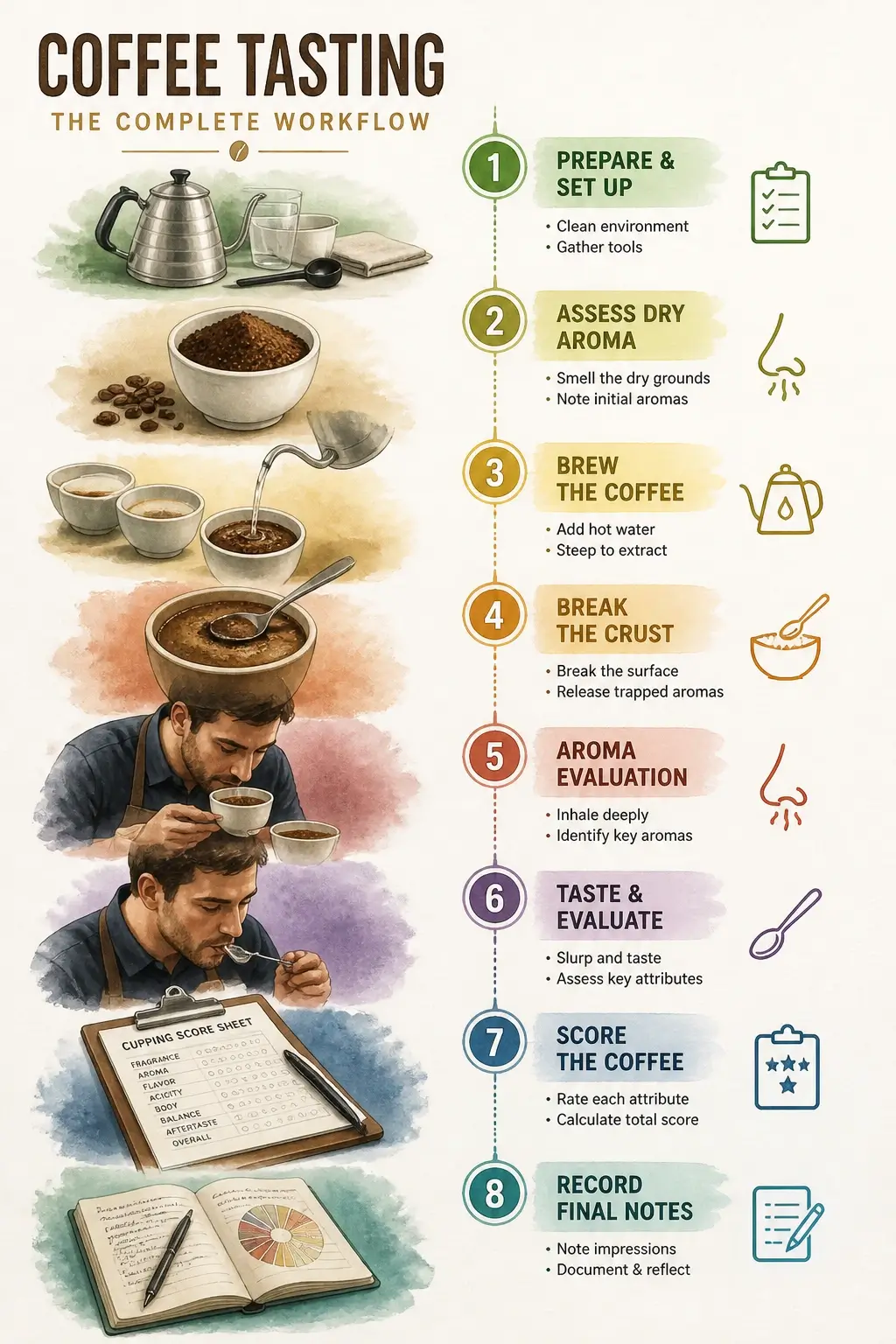
Calibrating your sensory language to a shared standard is where individual perception becomes something communicable. That’s exactly what Dean Kallivrousis, Q grader and Account Manager at Ally Coffee, points to when he explains the purpose of a standardized flavor lexicon:
Dean Kallivrousis describes the flavor lexicon as a tool invented specifically to give coffee professionals a standardized language for discussing flavor, complete with reference points and an intensity scale running from 1 to 15.
That scale matters as much as the vocabulary itself. Saying “citric” is useful. Saying “citric at intensity 7, like fresh lemon zest rather than lemon concentrate” is a complete sensory data point that another taster anywhere in the world can replicate and verify.
Alongside flavor vocabulary, physical sensations on the tongue need their own language. Mané Alves, founder of Coffee Lab International, Q instructor, and former Director of the SCA Technical Standards Committee, offers a clean entry point for one of the most misunderstood sensory signals:
Mané Alves explains that a cupper can define acidity by the sharpness the coffee leaves in the mouth: no sharpness means no acidity, or very low acidity.
This is exactly the kind of physical anchor that makes abstract terms concrete. You’re not deciding whether you “like” the acidity. You’re measuring the sharpness the coffee leaves behind, which is an observable, repeatable sensation. Build that habit of physical observation from the first cup, and the descriptive vocabulary you add later will have something real to attach to.
Step 1: Demystify the SCA Flavor Wheel
The SCA Flavor Wheel is the industry standard for coffee description, developed jointly by the Specialty Coffee Association and World Coffee Research. It isn’t a list of poetic suggestions. It’s a hierarchical taxonomy, structured so that every specific descriptor traces back through a clear chain of categories.
At the center of the wheel sit nine broad categories: Fruity, Floral, Nutty/Cocoa, Sweet, Sour/Fermented, Savory, Roasted, Spices, and Other. Move outward from any category and it splits into subcategories. Move out again and you reach specific descriptors: “blueberry,” “jasmine,” “almond,” “clove.” Each ring adds precision. The center gives you orientation. The outer edge gives you language.
The wheel serves two distinct functions simultaneously. As a calibration tool, it helps you pinpoint the exact note you’re experiencing when your brain offers only a vague impression. As a communication tool, it ensures that your “citrus” and a colleague’s “citrus” refer to the same sensory territory, whether you’re in Portland or Bogotá.
The practical approach that prevents overwhelm: work inward from sensation, not outward from the wheel. Taste the coffee. Notice a broad impression. Is it Fruity? Nutty? Floral? Once you’ve anchored to a broad category, ask yourself what kind. Berry, not just fruit. Then narrow further: blackberry, not just berry. This three-step funnel – category, subcategory, specific descriptor – turns the wheel from a wall of words into a navigable decision tree.
The coffee tasting vocabulary the wheel provides only becomes useful when you connect it to what your nose actually detects in real time. That requires a different kind of technique entirely, built around the stages of aroma release. That’s where we go next.
Step 2: Isolating Aromas Through Staged Evaluation
Staged aroma evaluation solves the problem of aromatic overload. All the volatile compounds in a cup don’t arrive simultaneously at the same intensity. They release in waves, tied to temperature and the physical state of the coffee. Working those stages deliberately lets you hear each instrument in the orchestra separately before the full ensemble plays.
First, a quick distinction that changes how you interpret everything you smell. Orthonasal perception is what happens when you sniff directly – air moves from your nostrils toward your olfactory receptors. Retronasal perception is what happens when aromatic compounds travel up the back of your throat after you swallow. Both contribute to what we call “flavor,” which is why a coffee can smell like one thing and taste like another. You’re using two different pathways.
Stage One: Dry Grounds
Before water touches the coffee, gently shake the cup and inhale. The dry grounds stage captures the most volatile, delicate compounds – the ones that evaporate first and fastest. This is where Floral and lightly Fruity notes from the wheel tend to surface: jasmine, bergamot, stone fruit, honeydew. These aromas disappear quickly once heat and water enter the equation, so this stage is your only window to catch them.
Stage Two: The Wet Crust Break
After adding hot water, a crust of grounds forms on the surface. Let it sit for three to four minutes, then break it with a spoon and lean in immediately. The wet crust break releases the most concentrated burst of aroma in the entire cupping process. This is where Nutty/Cocoa, Spices, and heavier Fruity notes dominate: dark chocolate, toasted walnut, cedar, clove, dried cherry. The heat amplifies the heavier, less volatile compounds that were buried in the dry stage.
Stage Three: The Cooling Cup
As the brewed coffee drops from scalding toward body temperature – roughly 160°F down to 100°F – the Fruity and Sweet zones of the wheel come forward. Many of the organic acids responsible for brightness become perceptible at lower temperatures, which is why a coffee that seemed flat when scorching hot reveals a distinct berry character as it cools. Don’t evaluate a coffee once and set it down. Revisit it at 10-minute intervals.
A useful exercise to run right now: take one coffee and write three separate aroma notes using wheel language, one at each stage. The goal isn’t a final verdict. It’s to see the profile evolve and to train your nose to notice that evolution. Even as those aromas suggest certain flavors, the tongue will confirm or contradict them – and that confirmation happens at a different level of perception altogether.
Here’s a practical walkthrough of the full cupping process to see staged evaluation in action:
Step 3: Breaking Down the Five Basic Tastes in Coffee
Flavor is not the same as aroma. Flavor is the integrated perception of retronasal aroma combined with the five basic tastes your tongue detects: sweet, sour, salty, bitter, and umami. Aroma suggests; the tongue confirms. Getting these two channels separated in your mind is what makes descriptions precise instead of impressionistic.
Each basic taste has a distinct presence in coffee, and each maps to specific zones on the SCA Flavor Wheel.
Sweet registers at the tip of the tongue. In coffee, it connects to ripe fruit, caramel, honey, and chocolate descriptors. On the wheel, sweetness doesn’t occupy a single category – it informs many subcategories across Brown Sugar, Maple Syrup, and Molasses.
Sour is closely tied to acidity. When it’s pleasant, it reads as citric or malic brightness. When it’s unpleasant, it signals over-fermentation or poor processing. The Sour/Fermented and Fruity zones on the wheel are where this taste lives.
Salty rarely dominates, but it appears in certain processing methods and can add a savory dimension that pushes a coffee into the Savory zone of the wheel. It’s easy to overlook because tasters don’t expect it.
Bitter is coffee’s structural backbone. In balance, it reads as dark chocolate or roasted nut. When excessive, it tips into astringency – a drying, coating sensation that’s distinct from simple bitterness. The Bitter and Nutty/Cocoa zones cover this territory.
Umami is the rarest of the five in coffee. It appears as a brothy, savory quality in aged or heavily fermented coffees, and it often surprises tasters who weren’t looking for it.
Locating these tastes on the wheel works best when you treat them as starting points rather than conclusions. If you detect sweetness, the wheel helps you specify what kind of sweetness – brown sugar, vanilla, or ripe peach. The SCAA cupping form scoring categories formalize this process by separating Flavor, Acidity, and Sweetness into distinct scored attributes, which forces you to evaluate each on its own terms rather than blending them into a single impression.
You’ll notice that some sensations don’t fit cleanly into any of the five tastes. The bright zing of a Kenyan coffee or the creamy thickness of a Sumatran aren’t sweet, sour, salty, bitter, or umami. Those are acidity and body, and they need their own dedicated vocabulary.
Step 4: The Invisible Architecture of Acidity and Body
Acidity and body are the two structural qualities that give a cup its character beyond flavor notes. Most tasters can detect them immediately but struggle to articulate them with precision. That gap closes quickly once you have the right reference points.
The Bright Architecture of Acidity
Acidity in coffee isn’t sourness. It’s the lively, vibrant quality that makes you salivate – the sensation that lifts a cup from flat to alive. Two dimensions matter: quality (pleasant and bright vs. sharp and harsh) and type (what kind of acid is producing the sensation).
The four acids you’ll encounter most often:
| Acid Type | Sensory Character | Typical Origin |
|---|---|---|
| Citric | Clean, quick brightness like lemon or orange | East African coffees, especially Ethiopian and Kenyan |
| Malic | Rounder, lingering crispness like green apple or pear | Washed Central American coffees |
| Phosphoric | Effervescent, almost cola-like; sparkling without overt fruit | Kenyan coffees specifically |
| Acetic | Vinegary at high levels; winey complexity at low levels | Natural-process coffees |
Phosphoric acid in particular is worth knowing because tasters often can’t place the sparkling, effervescent quality it produces. It doesn’t read as fruit. It reads as carbonation. Once you’ve identified it once, you’ll recognize it immediately in future Kenyan coffees.
Body: Weight, Texture, and How to Read Them
Body is the weight and texture of the coffee on your tongue. Light, or tea-like. Medium, or creamy. Heavy, or syrupy. These aren’t metaphors – they describe how the liquid physically coats and moves across the palate.
The SCA Flavor Wheel connects body to descriptors like “silky,” “buttery,” “juicy,” “chalky,” and “dry.” Each of those words points to a specific mouthfeel quality. “Silky” means smooth and even coating with no grit. “Chalky” means a dry, powder-like residue. “Juicy” means a sensation of moisture and liveliness, often tied to high acidity.
A fast exercise: slurp the coffee hard enough to spray it across your entire palate, then hold it still for two seconds. Notice the weight. Does it feel like water, whole milk, or cream? Then swallow and notice how it coats the inside of your mouth afterward. Compare a light roast and a dark roast back-to-back for an immediate, visceral contrast.
Once you have both dimensions named, combine them into a single phrase: “bright, malic acidity leading into a silky, medium body.” That’s a complete structural description of a cup. The flavor notes you identified earlier sit on top of this architecture. The puzzle now has all its pieces – the next step is assembling them into a sequence another taster could read and reproduce.
Step 5: Craft a Professional Tasting Note From Start to Finish
The SCAA cupping form provides the exact sequence for assembling everything you’ve gathered into a coherent, professional tasting note. The order matters because it mirrors the sequence in which sensory information actually arrives: Fragrance/Aroma → Flavor → Aftertaste → Acidity → Body → Balance → Overall.
Working through a concrete example is more useful than an abstract walkthrough, so here’s how a complete note builds from the first sniff to the final impression:
Fragrance/Aroma (dry and wet): Dry grounds reveal floral notes and honeydew melon. The wet crust break opens up dark chocolate, toasted walnut, and a faint hint of clove.
Flavor: The first sip delivers blackberry jam and ripe cherry up front, followed by caramel sweetness and a subtle cedar note in the background.
Acidity: Malic and citric acidity at medium intensity – crisp like a green apple, well-integrated with the sweetness.
Body: Medium-full weight; creamy and smooth across the palate with a syrupy finish.
Aftertaste: Long, clean finish with lingering dark chocolate and a faint floral echo that persists for 30 seconds.
Balance: The fruit and chocolate notes support each other without one overwhelming the other. The acidity brightens without sharpening.
Overall: A well-structured, expressive cup with clear terroir character.
This format maps directly onto the SCAA cupping form’s scored attributes, which means it doubles as preparation for formal calibration or Q-grading if you ever pursue that path. The structure also enforces objectivity. Notice that none of the descriptors above say “delicious” or “too intense.” If a coffee has aggressive acidity, the note says “high citric acidity, sharp and unintegrated” – not “too sour for me.” Intensity is described, not judged.
One completed note, written in this sequence, communicates more information than a paragraph of impressionistic prose. Another taster reading it can set up the same coffee, taste it, and verify or challenge each descriptor on its own terms.
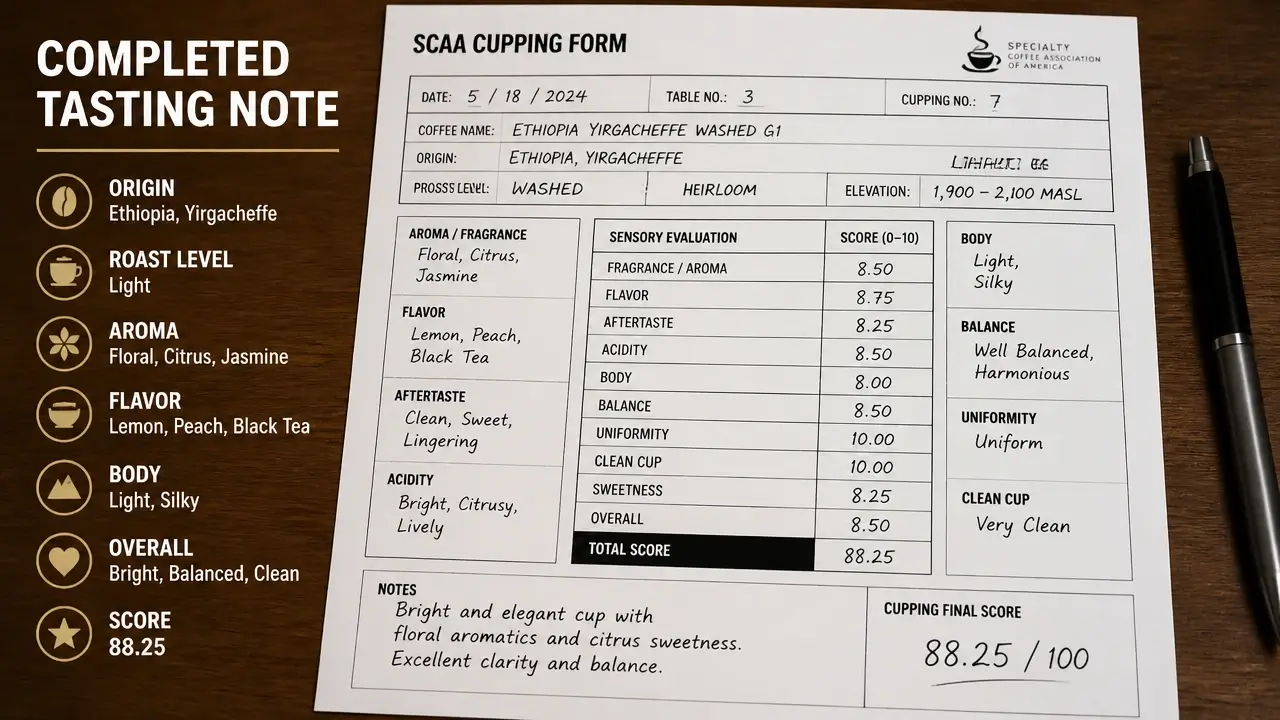
Producing one good note is a start. Producing consistent notes across different days, different coffees, and different moods requires active calibration – and that’s the final piece of the system.
When Your Palate Hits a Wall, Here’s How to Push Through
Every taster runs into three specific walls: “I can smell it but I can’t name it,” “my notes shift too much between sessions,” and “I don’t have enough descriptors yet.” Each has a direct fix.
The naming block is the most common. Your olfactory system recognizes a compound before your verbal system finds a label for it. The fix: don’t search the entire wheel at once. Work the elimination funnel. Is it Fruity or not Fruity? If Fruity, is it berry or citrus or tropical? If berry, is it fresh or dried? If you’re still stuck, go to the source material. Smell an actual almond, then smell the coffee again. Smell a dried apricot, then the coffee. Your brain learns aroma by comparison, not by description. Building a personal aroma library at home – a shelf of spices, dried fruits, nuts, and flowers – gives you reference points to triangulate against.
Inconsistency between sessions usually comes from emotional noise. You taste differently when you’re tired, hungry, or distracted. The antidote is triangulation cupping: set up three cups, two identical and one different. Your only job is to identify the odd one out and describe what makes it different. The forced comparison removes the open-ended pressure of “describe this coffee” and replaces it with a specific question. Your palate answers specific questions more reliably than open ones. Tasting side-by-side with another person and comparing written notes before discussing them out loud accelerates calibration further.
Vocabulary expansion works best when it’s deliberately narrow. Pick one section of the wheel – Nutty/Cocoa, for example – and spend an entire session trying to find every nuance within that zone. Don’t evaluate the whole cup. Hunt one category. This forces depth over breadth and builds the kind of granular discrimination that separates “chocolate” from “dark chocolate” from “baker’s chocolate” from “cocoa powder.” Attending public cupping events and reading published notes from platforms like Coffee Review exposes you to how other trained tasters phrase the same sensations, which adds language faster than solo practice alone.
The SCAA cupping form is your permanent consistency anchor. Even if you never score formally, its seven-attribute structure – aroma, flavor, aftertaste, acidity, body, balance, overall – gives every session the same skeleton. Use it as a checklist until the sequence becomes automatic.
The first tasting note you write today will feel clumsy. The 50th will feel natural. The system works through repetition, not revelation. You’ve moved from a consumer who “likes coffee” to a taster who can describe it – and that changes how you experience every cup from here forward.
Frequently Asked Questions About How to Describe Coffee Aromas and Flavors
What’s the difference between a coffee’s aroma and its flavor?
Aroma is what you perceive through your nose – both by sniffing directly (orthonasal) and through the back of the throat after swallowing (retronasal). Flavor is the combined perception of that retronasal aroma plus the five basic tastes your tongue detects simultaneously.
Why does the same coffee smell different at different temperatures?
Different volatile compounds evaporate at different rates. Delicate floral and light fruit notes release first at high heat, while heavier chocolate, nut, and spice compounds become more prominent as the coffee cools toward body temperature.
How do I tell acidity from sourness when I’m tasting?
Pleasant acidity makes you salivate and feels lively or crisp; it integrates with the other flavors. Sourness from over-fermentation or defects feels sharp, unpleasant, and sits on top of the cup rather than lifting it. The physical sensation is the tell: brightness vs. irritation.
Can I describe coffee aromas accurately without a smelling kit?
Yes. A home shelf of common reference materials – cinnamon, clove, dried apricot, almond, dark chocolate, lemon zest – covers a large portion of the SCA Flavor Wheel’s outer ring. Smelling these alongside the coffee trains your brain through direct comparison, which is how aroma memory actually builds.
What does “clean cup” mean in professional tasting notes?
It means the coffee has no off-flavors, taints, or fermentation defects that intrude on the primary flavor profile. A clean cup lets you taste what’s actually there without interference; it’s an absence of noise, not a flavor characteristic in itself.
How do I describe a coffee when I genuinely can’t find a match on the flavor wheel?
Start with the sensation’s physical character: is it sharp, round, bright, heavy, dry? Then identify whether it’s pleasant or unpleasant. From there, name the closest sensory category even if the specific descriptor doesn’t fit perfectly. “Something in the dried fruit zone, possibly tamarind” is a complete, useful note.
Is body the same as roast level?
Not directly. Body is determined by dissolved solids, oils, and fiber particles suspended in the liquid – all of which are affected by roast level, processing method, and brew ratio. A light-roasted natural-process coffee can have a heavier body than a medium-roasted washed coffee from the same farm.
How many times should I taste a coffee before writing a final note?
Taste it at least three times across different temperature ranges and write observations at each stage rather than waiting for a “final” impression. The profile shifts meaningfully between scorching, warm, and near-room-temperature, and the most informative descriptors often emerge in the middle range.
References
- Coffee Tasting Exercises That Will Improve Your Palate | perfectdailygrind.com
- Why Are Some Coffees More Acidic Than Others? A Brew & Roast Guide | perfectdailygrind.com