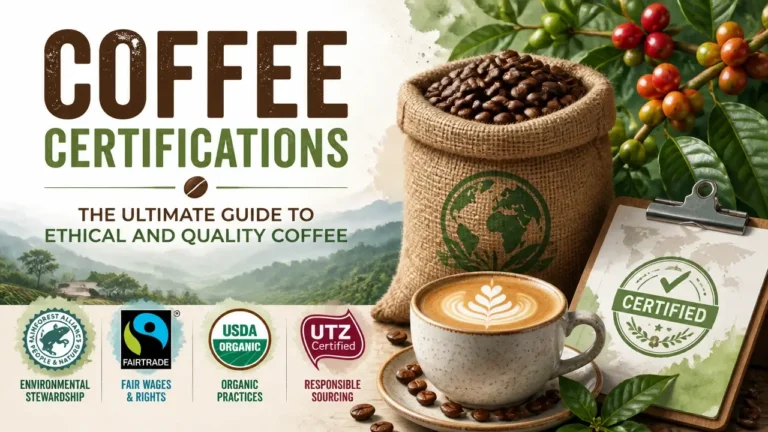

Rigorous coffee certifications standards were built to solve a specific problem: the person growing the coffee and the person drinking it are separated by thousands of miles, three or four middlemen, and zero shared context. Labels like Fair Trade, Rainforest Alliance, and USDA Organic exist to collapse that distance into a single recognizable mark.
But a mark on a bag is only as reliable as the system behind it. Understanding what each certification actually audits, what it costs the farmer to obtain, and where its enforcement breaks down is the difference between buying with conviction and buying with good intentions.
While labels on bags address supply chain ethics, professionals aiming to evaluate the physical and sensory attributes of the brew must master the strict Q Grader certification requirements.
Key Takeaways on Coffee Certifications Standards
- Certifications are trust signals backed by audits, not just marketing language; the logo matters more than the words on the bag.
- Fair Trade protects farmers from market crashes with a minimum price floor; Rainforest Alliance focuses on landscape-level environmental management; they are not interchangeable.
- USDA Organic restricts chemical inputs but says nothing about wages, shade cover, or worker welfare.
- Audit costs and documentation burdens fall primarily on the farmer, and in Ethiopia, certified producers receive less than one-third of the export quality premium for VSS certification.
- Third-party certification audits have four documented structural vulnerabilities: announced timing, auditor conflicts of interest, sampling-only inspection, and a continuous improvement clause that lets non-compliant farms keep their seal.
- SCA quality scores and ethical certifications measure entirely different things; a certified coffee is not automatically a high-quality coffee, and vice versa.
What Coffee Certifications Really Are
Coffee certification is a voluntary, third-party verified commitment: the coffee meets defined standards covering farming practices, environmental protection, and/or social equity. That’s the one-sentence version. The fuller story starts in 1988, in the Netherlands, when the Max Havelaar Foundation launched the first Fairtrade label, connecting Mexican coffee cooperatives directly to Dutch consumers who wanted assurance that farmers were paid fairly. It was a simple idea with a radical structure: a neutral organization sets the rules, an independent auditor checks compliance, and the label signals the outcome.
That model spread fast. By the early 1990s, organic certification had moved from niche health-food stores into regulated territory, with governments formalizing prohibitions on synthetic inputs. Rainforest Alliance entered the picture in 1987, initially focused on biodiversity conservation in tropical forests before expanding into a full agricultural certification program. Each new scheme reflected a different anxiety: labor rights, chemical contamination, deforestation, or all three at once.
They fall across three pillars: social equity (Fair Trade), environmental stewardship (Rainforest Alliance, Organic), and economic transparency through Direct Trade coffee verification.
The coffee industry now operates with multiple certification schemes running in parallel, none of which claims universal authority. They fall across three pillars: social equity (Fair Trade), environmental stewardship (Rainforest Alliance, Organic), and economic transparency (Direct Trade). No single label covers all three completely. That’s not a flaw in the system; it’s a design reality that this guide will help you navigate.
What certifications do, at their core, is bridge an information gap. A consumer in Seattle has no way to verify whether a farmer in Guatemala used pesticides, paid their workers a living wage, or maintained forest cover around their plots. A certification body sends an auditor to check, then translates that verification into a logo. The logo is the trust signal. The audit is what makes it meaningful, or doesn’t.
The Major Certifications Decoded
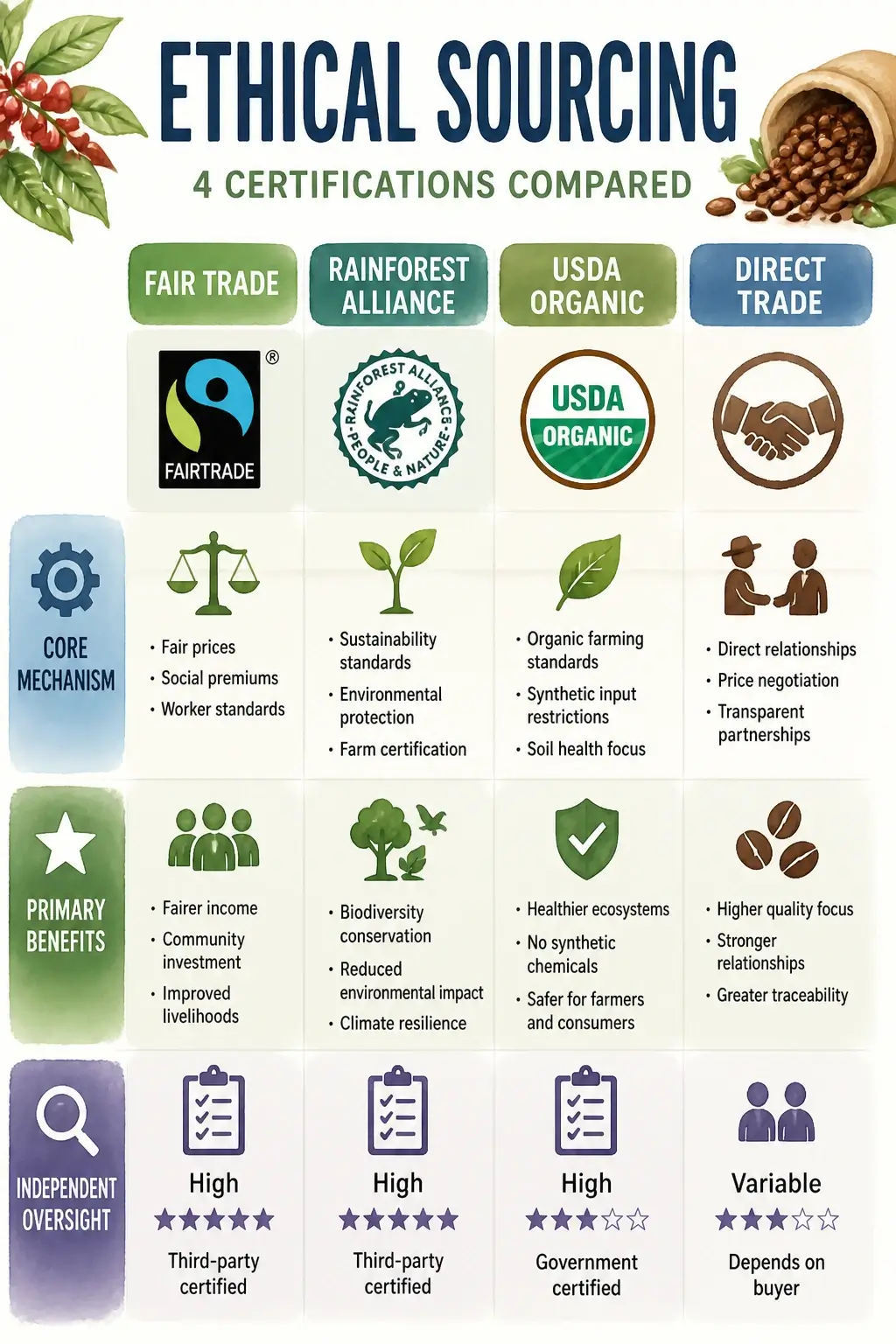
Fair Trade, Rainforest Alliance, USDA Organic, and Direct Trade are the four labels you’ll encounter most often in specialty coffee retail. They look similar on a shelf. They work very differently.
Fairtrade: The Economic Safety Net
Fairtrade (governed by Fairtrade International) operates on a price-floor mechanism. When global commodity prices fall below a set threshold, certified farmers receive the Fairtrade Minimum Price instead, currently $1.80 per pound for washed Arabica. On top of that, buyers pay a Fairtrade Premium of $0.20 per pound, which goes into a communal fund the farming cooperative controls, spending it on infrastructure, education, or equipment. The core promise is economic resilience: farmers don’t get wiped out when the commodity market crashes.
To support these vital financial safety nets while enjoying exceptional profiles, explore various premium organic fairtrade coffee brands that honor both social equity and rigorous environmental standards.
Rainforest Alliance: Conservation with a Business Case
Rainforest Alliance certification, now merged with UTZ Certified, focuses on landscape-level management. Farms must meet criteria across biodiversity conservation, water use, soil health, worker welfare, and management planning. The emphasis is not on a single input restriction but on a holistic farm management approach. Shade cover requirements, buffer zones around waterways, and restrictions on deforestation are central. The certification argues that sustainable land management and commercial viability are not mutually exclusive.
USDA Organic: The Chemical Line
USDA Organic certification draws a hard line around inputs. Synthetic pesticides, herbicides, and fertilizers are prohibited. Genetically modified organisms are excluded. The certification is governed by the National Organic Program and requires a three-year transition period during which the land is farmed organically before the seal can be used. It says nothing about wages, worker conditions, or biodiversity beyond what chemical abstinence implies. See organic vs conventional coffee comparison to understand precisely what that chemical distinction does, and doesn’t, mean for cup quality and farmer economics.
Direct Trade: Relationship Without a Seal
Direct Trade is not a certification in the formal sense. No independent body audits it. No minimum price floor governs it. Instead, it describes a sourcing philosophy: a roaster builds a direct purchasing relationship with a specific farm or cooperative, negotiating prices without commodity-market intermediaries. The premium paid can exceed any certified program’s floor. The accountability, however, rests entirely on the roaster’s transparency. Learn about direct trade coffee and how its mechanics differ from third-party certification systems.
One critical distinction the industry doesn’t emphasize enough: company-specific sourcing programs like Nespresso AAA or Starbucks C.A.F.E. Practices are not independent certifications. They are proprietary supply-chain tools, created and controlled by a single corporation, without independent governance or public accountability. A company program can be revised unilaterally and serves marketing objectives alongside any operational goals. Grouping them with Fairtrade or Rainforest Alliance misrepresents the nature of the assurance. The hierarchy matters.
Many coffees carry multiple seals simultaneously. A bag labeled Fair Trade and Organic addresses both economic resilience and chemical inputs in a single product. Learn about specialty coffee grades and standards to understand how these ethical labels interact with the quality scoring systems that operate on an entirely separate axis.
For consumers looking to bypass bureaucratic oversight entirely in favor of uncompromised traceability, choosing coffee direct from growers establishes an unmediated economic bridge between your cup and the origin.
How the Four Certifications Stack Up
No single certification wins across every dimension. The right way to read this comparison is as a set of trade-offs, not a ranking.
Environmental Impact
Rainforest Alliance sets the most demanding environmental bar. Its standard requires farms to maintain or increase shade cover, protect water sources, manage waste, and demonstrate continuous improvement across a scored assessment. Biodiversity isn’t incidental; it’s the central metric.
USDA Organic restricts chemical inputs, which benefits soil biology and reduces runoff into waterways. But it doesn’t require shade cover, forest buffer zones, or any specific land-management practice beyond the input prohibition. A sun-grown monoculture can be certified organic if no synthetic chemicals touch it.
Fairtrade includes environmental criteria but they are secondary to the social and economic framework. Environmental compliance is required, not the program’s defining feature.
Direct Trade has no environmental standard unless the roaster builds one into their own sourcing criteria.
Farmer Economic Benefits
Fairtrade provides the most transparent economic floor. The $1.80/lb minimum price for washed Arabica and the $0.20/lb social premium are publicly documented and independently audited. Farmers in cooperatives have collective bargaining power under the structure.
Direct Trade can yield the highest per-pound price, but the outcome depends entirely on the roaster’s willingness to pay and the farmer’s negotiating position. There’s no floor and no external check.
Rainforest Alliance premiums exist but are lower than Fairtrade’s floor and are not standardized across buyers. The certification’s economic value comes more from market access than from a guaranteed price.
USDA Organic commands some of the strongest per-pound premiums in the specialty market, often $0.20 to $0.50 per pound above conventional pricing. But discover organic coffee certification details to understand the cost structure that erodes that advantage for smaller producers.
Cost Implications for Farmers
This is where the picture gets uncomfortable. Certification is not free.
| Certification | Typical Audit Cost | Documentation Burden | Annual Renewal |
|---|---|---|---|
| Fairtrade | Moderate (cooperative-level) | High (group records, premium use) | Required |
| Rainforest Alliance | Moderate | High (farm management plan) | Required |
| USDA Organic | High (per-farm or per-group) | Very high (3-year transition records) | Required |
| Direct Trade | None (no third-party audit) | Varies by roaster | N/A |
Fairtrade benefits from cooperative-level certification, which spreads audit costs across many members. Individual farmers don’t absorb the full cost alone, though the cooperative’s administrative overhead is real.
Rainforest Alliance tends to be less expensive per farm than organic, but the continuous improvement requirement means the compliance work never fully ends.
Find out how to get coffee certified for a step-by-step breakdown of what the process actually demands from a producer starting from zero.
Behind the Seal: The Certification Process and Its Uneven Impact on Farmers
Getting certified is not a single event. It’s a multi-year operational commitment that begins long before an auditor arrives and continues indefinitely after the seal is granted.
The Coffee Certification Process: Steps, Costs, and Farmer Burden
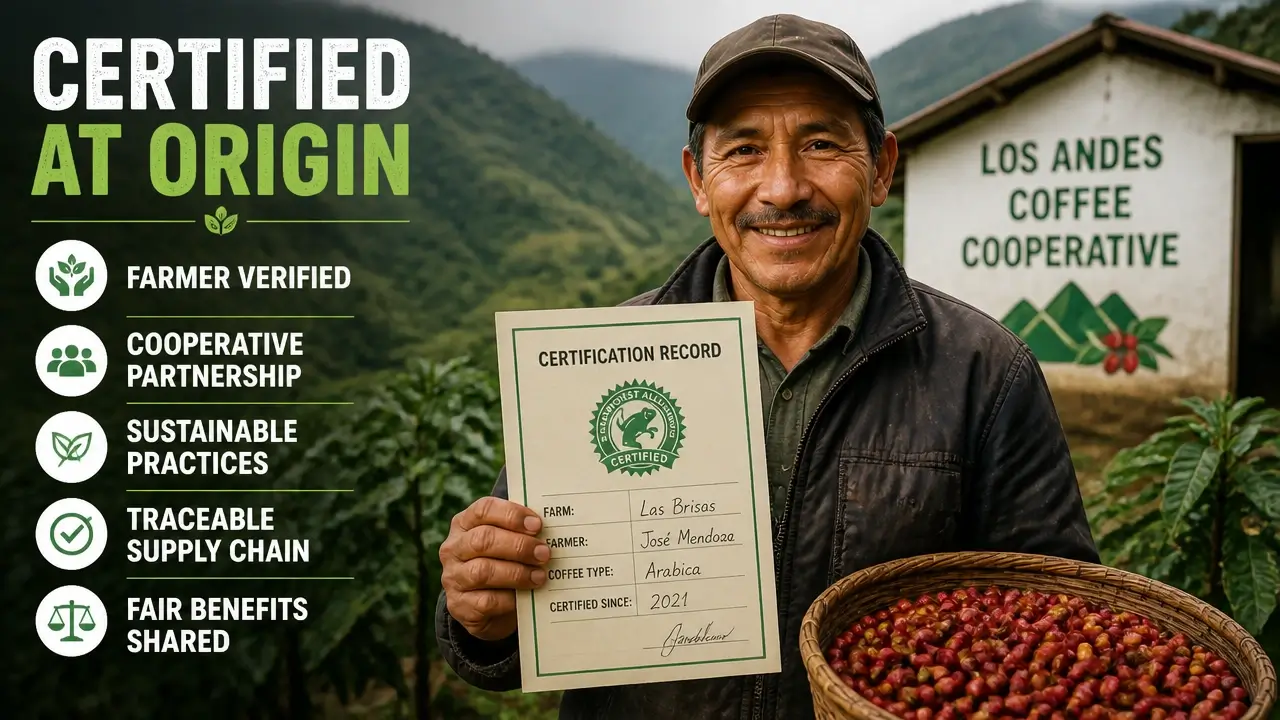
The journey typically starts with farmer group formation: individual smallholders rarely certify alone, so they join or form a cooperative or producer group that can afford the collective administrative infrastructure. That group affiliates with a managing entity, often an exporter or processor, who coordinates documentation and interfaces with the certification body.
From there, farmers document everything: inputs applied to each plot, harvest volumes, processing methods, labor practices, and environmental management steps. This paper trail is not optional. It’s the evidentiary backbone of the audit. An auditor, either in person or reviewing records remotely, evaluates compliance against the standard. For Rainforest Alliance and Fairtrade, group certifications involve sampling: the auditor visits a subset of member farms, not every plot. For USDA Organic, the inspection is more rigorous at the operation level but still relies heavily on submitted records.
The costs of this process fall primarily on the farmer side. Inspection fees, auditor travel, translation of documents, and the time invested in recordkeeping are all borne by the producer or cooperative, not the certification body. Certification is a market-access investment, not a benefit that arrives without cost. Learn more about what coffee certifications and standards are for a grounded look at how the system is structured from the ground up.
The Economic Reality of Coffee Certification: Premiums, Costs, and Net Benefit
Once certified, a farm gains access to buyers who pay premiums and to markets that are otherwise closed. The Fairtrade Minimum Price for washed Arabica sits at $1.80 per pound, with the $0.20 social premium on top. Organic premiums in specialty markets can reach $0.50 per pound above conventional pricing. In theory, these numbers represent meaningful income gains for farmers operating on thin margins.
In practice, the net benefit is hotly debated and varies dramatically by region. Consider Ethiopia. Over 95% of Ethiopian coffee is grown organically by default, using no synthetic inputs, because most smallholders never adopted industrial agriculture. Yet only 5–10% of that coffee carries official organic certification. The gap has nothing to do with farming methods. It’s entirely a paperwork barrier. The farmers are already doing the work; the certification system simply hasn’t reached them at a cost they can absorb.
Premiums, when they do arrive, range from $0.03 to $0.50 per pound depending on the seal. But the full cost of certification, including audit fees, documentation labor, cooperative overhead, and the transition period for organic, can consume a substantial share of that premium for smallholders, leaving the net benefit deeply uncertain.
Statistical Data: Coffee producers in Ethiopia receive less than one-third of the export quality premium for voluntary sustainability standard (VSS) certification. – Source: KU Leuven Institutional Repository
That figure reframes the premium conversation entirely. When the majority of the certified price increase is captured before it reaches the grower, the certification system functions as much as an economic filter as an ethical guarantee. Understand Rainforest Alliance certification to see how one major program addresses, or doesn’t address, this premium distribution problem at the farm level. For a broader view of outcomes, read about the impact of certifications on farmer livelihoods and environmental outcomes across multiple programs. And when you’re ready to make a purchase decision, get tips on how to choose certified coffee using these dynamics as your filter.
Audit Gaps, Fraud Risk, and the Farmer’s Missing Voice
The certification system’s integrity depends on audits. Audits depend on access, documentation, and auditor independence. All three are compromised in ways that rarely appear on the label.
Remote highland farms present a logistical challenge that the system handles imperfectly. Many of the world’s best coffee-growing regions sit at elevations and in terrain that make regular physical inspections difficult and expensive. When auditors can’t reach every farm, they rely on Internal Control Systems: paper trails managed by the cooperative or exporter, not by the individual farmer. That concentrates verification power in the hands of the entity that has the most commercial interest in maintaining certification status.
The scale problem compounds this. A single Fairtrade-certified cooperative might represent hundreds or thousands of individual smallholders. Auditors sample a subset. Non-sampled farms aren’t directly verified. The standard’s integrity, at those farms, rests on the assumption that what’s true of the sample is true of the whole.
Academic Evidence: A peer-reviewed study on compliance with voluntary sustainability standards in Colombia’s coffee belt identified four structural vulnerabilities in third-party certification audits: audits are announced or semi-announced, giving non-compliant producers time to conceal problems; auditors are paid by the auditee, creating a financial conflict of interest; only a sample of producers in group certifications receive direct inspection; and the “continuous improvement” principle allows non-compliant producers to retain certification rather than lose it. The study also found that evidence for certification’s effectiveness in improving livelihoods is mixed, and that compliance behavior is shaped more by external institutional blueprints than by local farmer context. – From the study “Explaining compliance with voluntary sustainability standards: A case study from Colombia’s coffee belt“
These aren’t fringe criticisms. They’re structural features of how group certification works at scale. The system wasn’t designed to be airtight for every individual plot. It was designed to be scalable and commercially viable, which means certain trade-offs were built in from the start.
The deeper discomfort is the power asymmetry in who shapes these standards. Certification criteria are largely designed by Northern consumer-country organizations and certification bodies, calibrated to satisfy European and American buyers’ expectations of what “ethical” looks like. The farmer’s question, “Does this certification make my life materially better, or does it mainly make the buyer feel better?” is largely absent from the guides, training documents, and marketing materials that dominate the public conversation.
Most audit frameworks, including the Internal Control System model described in industry training materials, position the farmer as a subject of compliance rather than a decision-making participant. The standards arrive from outside; the farmer adapts or doesn’t certify. That structural silence is a root cause of the consumer cynicism that surrounds ethical labels. Explore the history of coffee certifications to see how this power dynamic developed over decades of label evolution. Read more about Fair Trade coffee certification for a direct look at how one program confronts, and sometimes avoids, these critiques.
How SCA Quality Scores Sit Alongside Ethical Labels
Ethical certification and cup quality are parallel systems. They measure different things, use different tools, and answer different questions. Conflating them is one of the most common mistakes a coffee buyer makes.
The Specialty Coffee Association cupping protocol scores coffee on a 100-point scale across sensory attributes: aroma, flavor, aftertaste, acidity, body, balance, sweetness, uniformity, and absence of defects. A coffee scoring 80 points or above earns the designation “specialty.” The evaluation is performed by Q Graders, licensed tasters who complete a rigorous SCA-administered examination. The score is a precise measurement of what’s in the cup, nothing more.
A coffee can carry Fair Trade, Organic, and Rainforest Alliance seals and still cup at 74 points. A poorly timed harvest, inadequate fermentation control, or uneven roasting erases the agronomic care that earned those certifications. The label says nothing about what happened during picking, processing, or the roaster’s drum. Compare Fair Trade vs Direct Trade to see how sourcing philosophy intersects with, but does not determine, cup quality outcomes.
The reverse is equally true. Some of the world’s highest-scoring coffees come from certified farms, but the certification didn’t produce the score. Meticulous selective picking, precise fermentation management, and careful drying produced the score. The certification created conditions, access to training, economic stability, investment capacity, that made that precision more achievable. The relationship is facilitative, not causal.
One practical note: the SCA score is a trade-level metric. It lives in cupping labs and green-coffee contracts. Consumers encounter it indirectly, through roaster tasting notes, competition results, or a roaster’s stated sourcing criteria. No SCA seal goes on a retail bag the way a Fairtrade logo does. Quality, in the consumer-facing world, is communicated through reputation, not a standardized mark.
Understanding this separation protects you from two opposite mistakes: assuming that a certified coffee must taste extraordinary, and assuming that an uncertified coffee from a reputable roaster must be ethically compromised. Explore criticisms of coffee certifications for an honest accounting of where the ethical label system falls short, even for buyers who are paying close attention.
A Practical Framework for Choosing Coffee with Confidence
Decoding a coffee label starts with one discipline: look for the official certification logo, not the marketing copy. “Sustainably sourced,” “farmer-friendly,” and “eco-conscious” are phrases with no audited standard behind them. The Fairtrade International seal, the Rainforest Alliance frog, and the USDA Organic seal are backed by documented criteria, third-party audits, and public accountability. The words on the front of the bag are not.
When you see multiple seals, treat it as a meaningful signal. A coffee carrying both Fairtrade and Organic certification addresses economic resilience and chemical input restrictions simultaneously, covering two of the three certification pillars in one product. Multiple seals don’t guarantee perfection, but they reduce the blind spots of any single scheme.
Direct Trade demands a different evaluation. Because there’s no independent seal, the accountability rests entirely on the roaster. Ask what you’d ask of any unverified claim: Is there a transparency report? Does the roaster publish the price paid per pound? Are there named farms or cooperatives with verifiable identities? Poetic packaging language about “relationships with farmers” is not evidence. Specific numbers and named partners are.
A roaster’s website tells you more than their bag does. Look for sourcing philosophy pages, named origin partners, impact reports, or participation in programs like the Relationship Coffee Institute or Cup of Excellence. Certifications are a starting point. The most trustworthy roasters often operate well beyond what any seal requires, and they show their work publicly.
The cluster of articles linked throughout this guide covers each of these dimensions in depth: the history of how these programs developed, the mechanics of specific certifications, the step-by-step certification process for producers, and the quality standards that run parallel to ethics. This article is the map. Those are the territories.
No single certification is perfect. The audit gaps are real, the cost burdens on smallholders are real, and the power asymmetries in standard-setting are real. But an informed buyer who weighs environmental criteria, economic transparency, and cup quality together, and who demands that roasters show their sourcing work, is the most effective market signal the coffee supply chain has. The label is a starting point. Your questions are the pressure that makes it mean something.
Frequently Asked Questions About Coffee Certifications Standards
Can a roaster claim Direct Trade without any independent verification?
Yes, and many do. Direct Trade has no governing body and no third-party audit requirement, so the term means whatever the roaster decides it means. Transparency reports, published farm-level pricing, and named producer relationships are the only accountability tools available to you.
Why do some certified coffees still taste mediocre?
Certification audits farming practices, not what happens after the cherry leaves the tree. Poor picking selection, flawed fermentation, uneven drying, or overroasting can undermine the best-farmed coffee. The seal covers the field; it doesn’t follow the coffee into the processing station or the roaster’s drum.
Is it possible for a coffee to be certified but the farmer still lose money?
Yes. If audit fees, cooperative administrative overhead, documentation labor, and transition costs consume most of the certification premium, the net income gain can be negligible or negative, particularly for smallholders on less than two hectares.
What’s the difference between Fairtrade International and Fair Trade USA?
They split in 2011 over a dispute about certifying large plantations alongside cooperatives. Fairtrade International (the global body) restricts certification to cooperatives and small producer organizations. Fair Trade USA extended certification to estates and hired-labor farms. The seals look similar but represent different eligibility standards.
How do I know if a “sustainable” claim on a bag is real?
You don’t, unless it’s backed by a recognized third-party seal. “Sustainable,” “eco-friendly,” and “responsibly sourced” are unregulated marketing phrases. The Fairtrade International seal, Rainforest Alliance frog, and USDA Organic seal are audited and publicly documented.
Does Rainforest Alliance certification guarantee a living wage for farm workers?
It requires that farms work toward living wage benchmarks and document progress, but it doesn’t mandate a specific wage floor the way Fairtrade mandates a minimum price. Worker welfare criteria are part of the scored assessment, but compliance is measured on a continuous improvement basis rather than as a hard pass/fail threshold.
Why does Ethiopia have so little certified coffee if most of it is grown organically?
The gap is entirely a paperwork and cost barrier, not an agronomic one. Most Ethiopian smallholders already farm without synthetic inputs, but obtaining USDA Organic certification requires three years of documented records, inspection fees, and an administrative infrastructure that most smallholder cooperatives can’t easily absorb.
How often do certification bodies actually update their standards?
Rainforest Alliance completed a major standard revision in 2020. Fairtrade International updates its Generic Fairtrade Standards periodically, typically every few years, with stakeholder consultation periods. USDA Organic standards are governed by federal rulemaking, which moves more slowly. No certification body updates its standard in real time to reflect new research.
References
- Explaining compliance with voluntary sustainability standards: A case study from Colombia’s coffee belt | Wiley Online Library (doi.org)
- Coffee producers in Ethiopia and VSS certification premium distribution | KU Leuven Institutional Repository (lirias.kuleuven.be)