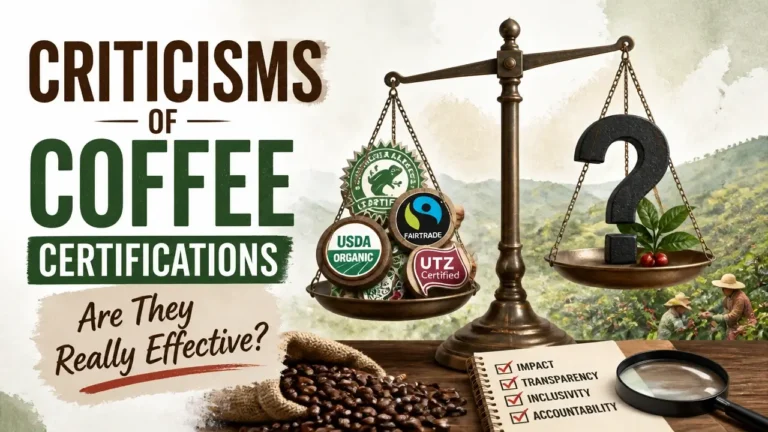

Persistent criticisms of coffee certifications have been building for two decades, but the sharpest one isn’t about fraud or bad intentions. It’s about a data void. From Fair Trade’s price floor to Organic’s paperwork gauntlet, every major scheme shares the same blind spot: no one has ever published audited, net-income figures showing what a certified farmer actually keeps after fees, deductions, and supply-chain markups.
That silence is the story. This article traces the mechanical failures behind each label – the cost barriers, the audit conflicts, the mass-balance loopholes – so you can evaluate any certification, or any alternative, on its actual architecture rather than its marketing copy.
To better understand how these structural failures play out in practice, it is worth examining Fair Trade and Direct Trade criticism to see what these labels actually mean for producers.
That silence is the story, highlighting why understanding Rainforest Alliance limitations helps you evaluate any certification scheme on its actual architecture rather than its marketing copy.
To better understand how these institutional frameworks impact agricultural realities, it is worth examining the distinct economic and ecological trade-offs inherent to organic and conventional coffee.
Key Takeaways on Criticisms of Coffee Certifications
- No mainstream certification has published verifiable net-income data showing what a farmer actually keeps after fees and supply-chain deductions.
- Fair Trade’s price floor functions as a safety net when markets crash but loses financial relevance when commodity prices rise above the guaranteed minimum.
- Organic certification rewards documentation compliance, not farming practice; roughly 92% of Ethiopian farmers use no agrochemicals yet only a fraction hold the certificate.
- The mass-balance loophole allows certified labels on products containing as little as 30% certified content, separating the marketing claim from the supply-chain reality.
- Direct trade and in-house company schemes solve the bureaucratic burden but replace third-party accountability with brand reputation – an unverifiable substitute.
- The EU Deforestation Regulation will require geolocation-verified deforestation-free proof for all EU coffee imports, a standard that could either reinforce or bypass existing certifications entirely.
Where Coffee Certifications Actually Break Down
Coffee certifications carry three structural failures, and they compound each other. The first is cost: the farmer pays to get certified. The second is capture: the premium the consumer pays rarely reaches the farm gate intact. The third is power: the farmer has almost no leverage to change either of the first two. Understanding how these three forces interact is the only way to evaluate any label honestly.
The cost barrier is the most concrete. Certification fees, annual audits, record-keeping infrastructure, and the administrative overhead of running a compliant cooperative add up to thousands of dollars per year for organizations that often operate on thin margins. For a smallholder cooperative in a country like Guatemala or Honduras, those costs don’t disappear – they get subtracted from whatever premium the certification is supposed to deliver. In many cases, the math barely breaks even before accounting for the next year’s renewal.
The premium-capture problem is harder to see but more consequential. When a consumer pays a premium for certified coffee, that money enters a supply chain with multiple actors: the cooperative, an exporter, an importer, a roaster, and a retailer. Each takes a margin. No major study has credibly traced the final net-income increase to the farmer after all those deductions. The number simply doesn’t exist in the published literature. What gets reported instead are gross premium figures – what certification bodies collect – not what farmers keep.
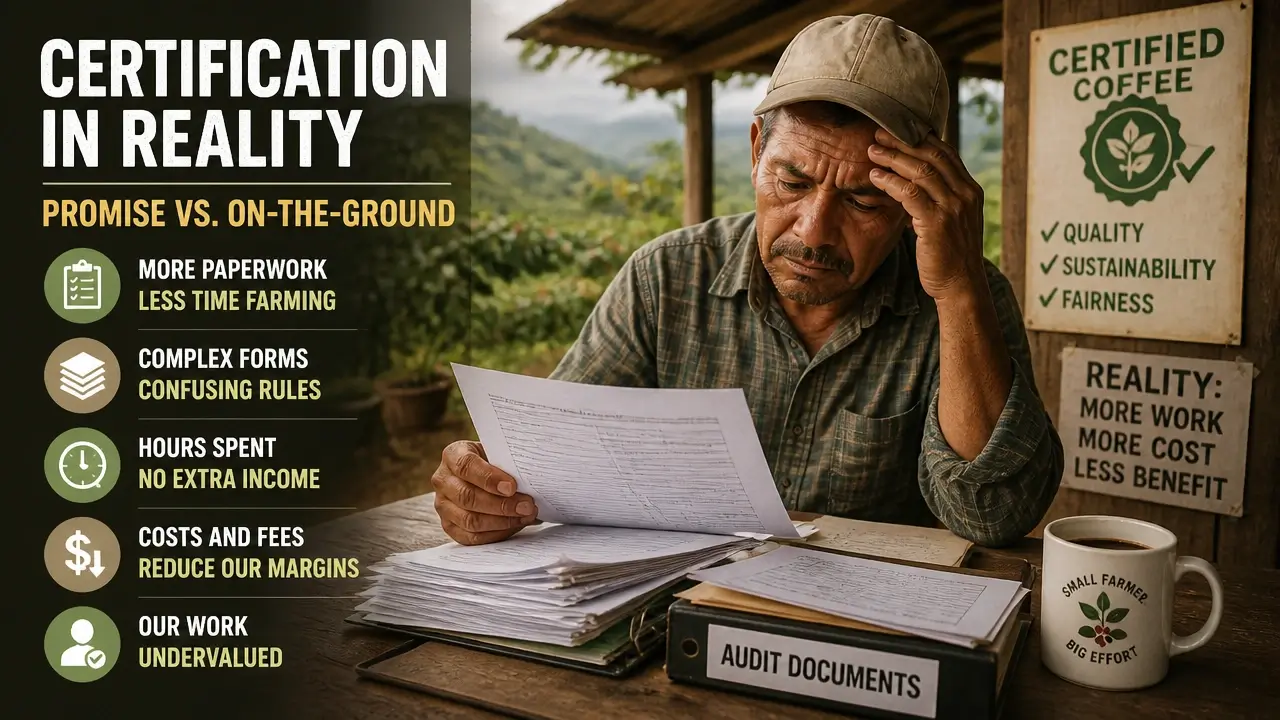
Outside Fair Trade, no mainstream certification sets a binding price floor. That matters enormously. When commodity prices crash – as they did in 2018 and 2019, when C-market prices fell below the cost of production for many growers – farmers without a price guarantee have no safety net. And when prices rise, the relative value of any fixed premium shrinks toward irrelevance. The system provides the most protection precisely when it’s needed least.
According to Janina Grabs, associate professor of sustainability research at the University of Basel in Switzerland, certification systems tend to attract the farmers who are already closest to compliance – because those producers face the lowest conversion costs and stand to gain the most relative benefit. The result is that the additional sustainability actually created by these schemes is likely quite limited.
This is the sharpest version of the critique, and it comes from a researcher who has studied these systems directly. Certification doesn’t lift the most vulnerable producers. It rewards the ones already positioned to comply – which means the gap between certified and uncertified may reflect economic proximity to the standard more than any genuine sustainability difference. The headline promise of “certified means better for farmers” isn’t just unproven. It may be structurally backward.
For a full breakdown of how each scheme is designed, see our complete guide to coffee certifications and standards – the context there makes the failures here easier to map precisely.
The Fair Trade Paradox: A Price Floor That Became a Ceiling
Fair Trade is the certification most consumers trust most, and that trust is partly earned. The core mechanism is real: a guaranteed minimum price of US$1.80 per pound for washed Arabica, plus a social premium of US$0.20 per pound directed toward community development projects chosen by the cooperative. When global coffee prices collapse, that floor genuinely protects growers from the worst of the market’s volatility.
But the floor has a shadow side. When global C-market prices rise above US$1.80 – as they have for extended stretches in recent years – the Fair Trade minimum becomes irrelevant as a financial advantage. Farmers are still bound to the cooperative structure, still paying for annual audits, still navigating the governance requirements that come with certification. The bureaucratic overhead remains constant. The financial upside does not.
This is the floor-becomes-ceiling dynamic. The certification locks farmers into a cost structure that only pays off when market prices are low. When the market rewards quality and scarcity – exactly the conditions under which well-managed farms should capture premium value – the Fair Trade architecture offers no additional leverage. A farmer producing exceptional lots cannot easily route those beans to a specialty buyer at a higher price without breaking from the cooperative model that certification requires.
The social premium deserves its own scrutiny. The intent is genuine: US$0.20 per pound directed toward schools, health clinics, or infrastructure, decided collectively by cooperative members. But evidence that this money reliably translates into measurable individual income improvement or verifiable community development is thin. Distribution records are often opaque, governance varies widely across cooperatives, and the premium gets pooled in ways that make individual benefit difficult to trace.
The deeper disempowerment critique is structural. Large Fair Trade cooperatives can replicate exactly the top-down governance problems they were designed to replace. Smallholder members vote on premium allocation, technically, but in practice the cooperative leadership and external auditors set the terms. The farmer’s actual decision-making power over pricing, market access, and investment remains limited. Fair Trade is not a scam. But its architecture creates perverse incentives – a pattern that becomes even clearer when you examine how the labeling model gets weaponized for marketing purposes.
Organic Certification’s Hidden Cost: Yield, Paperwork, and Exclusion
Organic certification for coffee rests on a straightforward prohibition: no synthetic fertilizers, no synthetic pesticides, no GMOs. Add a mandatory three-year transition period during which the farmer farms organically but cannot sell the coffee as certified organic, and you have the basic architecture. The environmental intention is genuine. The structural outcome is not.
Start with the yield trade-off. Organic coffee farms typically produce less per hectare than conventionally managed farms. The exact gap varies by region and variety, but the direction is consistent. For the premium to make economic sense, it must more than compensate for lost volume and cover certification fees and absorb the cost of additional labor that organic management often requires. That calculation rarely holds at the smallholder scale, particularly in regions where input alternatives to synthetic fertilizers are expensive or hard to source.
The certification process challenges compound the yield problem. Annual inspections require meticulous record-keeping: input logs, harvest records, segregated storage to prevent contamination with non-organic lots. For a farmer in a remote growing region without reliable internet access or administrative support, those requirements are not minor inconveniences. They are genuine barriers to market access.
The cruelest irony sits at the center of the Organic model. Many farmers in origin countries – Ethiopia being the most documented example – already grow coffee without synthetic inputs. Not by choice driven by environmental philosophy, but out of tradition, necessity, and the simple fact that chemical inputs are expensive and often unavailable. These farmers are, in practice, organic producers.
Statistical Data: Approximately 92% of Ethiopian coffee farmers use no chemical fertilizers or other agrochemicals, yet certified organic land accounts for only 0.4% to 2% of total agricultural area in the country. – Source: PMC / National Institutes of Health
That gap is the clearest proof that Organic certification is not capturing the sustainability it claims to measure. It is rewarding documentation, not practice. A farmer who has never used a synthetic input in thirty years of cultivation is invisible to the certified organic market because she cannot afford the paperwork to prove it. Meanwhile, a larger operation with capital to fund the transition and the administrative infrastructure to pass audits earns the label – and the premium – regardless of whether its actual environmental footprint is better or worse.
This is not a bug in the Organic system. It is the system working exactly as designed. The standard measures compliance with a documentation process, not the underlying farming reality. That distinction matters more than any other single fact about environmental coffee certification.
How Certifications Became a Marketing Tool
Certification schemes were built to fix a market failure: consumers couldn’t verify ethical claims, so a trusted third party would do it for them. That logic made sense in 1988. What nobody anticipated was how effectively the label could be separated from the substance it was supposed to represent.
The most technically precise example is the mass balance loophole. Several major certifications allow a product to carry a certified label when as little as 30% of its actual content meets the standard. A roaster can purchase a token volume of certified beans, blend them with uncertified lots, and still display the logo. The consumer sees the seal. The marketing team captures the halo. The certified supply chain receives a fraction of the implied commitment. This isn’t a fringe abuse – it’s a permitted accounting method built into the certification framework.
Audit failures are the second mechanism. The conflict of interest is structural: certification bodies are frequently paid by the companies they certify, or by the retailers who purchase from those companies. The incentive to maintain the client relationship competes directly with the incentive to fail an audit. Inspections are often announced in advance, giving farms time to prepare a compliant presentation. They happen infrequently – sometimes once every three years. Documented cases of child labor and wage theft on certified farms are not rare anomalies; they are evidence that the audit model cannot catch what it isn’t designed to find.
A study examining the Rainforest Alliance’s agricultural certification robustness found that certifiers’ incentives are aligned with the entities being certified or with retail purchasers – not with independent verification. The study concludes that the certification process cannot be classified as robust, which is a precise way of saying the label does not guarantee what it implies.
The rush to scale made all of this worse. Large roasters and retailers need enormous, consistent supply. When a certification body wants to sign Nestlé or JAB Holding Company as a partner, it faces pressure to accommodate industrial-scale plantation sourcing that the original smallholder-focused movement was never designed to serve. Standards flex. Audit frequency drops. The smallholder cooperatives the movement was built around get squeezed out by operations that can meet compliance paperwork at volume.
The term “labor-washing” describes the endpoint of this process: a certification logo that functions as a reputational shield, allowing a corporation to present an ethical face to consumers without changing the underlying power dynamics in its supply chain. The label becomes a marketing asset. The mechanism it was supposed to represent becomes secondary. For the positive impacts of certifications to be real rather than performative, the audit model that backs them needs structural independence – something the current system is not designed to provide.
Direct Trade and In-House Schemes: Same Problem, Different Packaging
Direct trade coffee is the alternative that specialty roasters have championed for two decades, and the core proposition is compelling. Cut out the certification body. Build a direct relationship with a specific producer. Pay above Fair Trade floor prices. Publish a transparency report showing what you paid. Let the relationship itself be the accountability mechanism.
That model has real advantages. No certification fees eating into the producer’s margin. No three-year transition period. No annual audits that the farmer must fund and prepare for. Prices are negotiated bilaterally, which means an exceptional lot can command an exceptional price without being constrained by a cooperative’s pooled-pricing structure. The roaster who knows a single farm in Huila or Yirgacheffe intimately can tell that story in a way no logo can.
But direct trade is a sourcing philosophy, not a codified standard. There is no governing body, no audit requirement, no definition of what “direct” actually means. One roaster’s direct trade program involves annual farm visits, multi-year purchase commitments, and published price data. Another roaster’s program means buying from an importer who has met the farmer once. Both can use the same language.
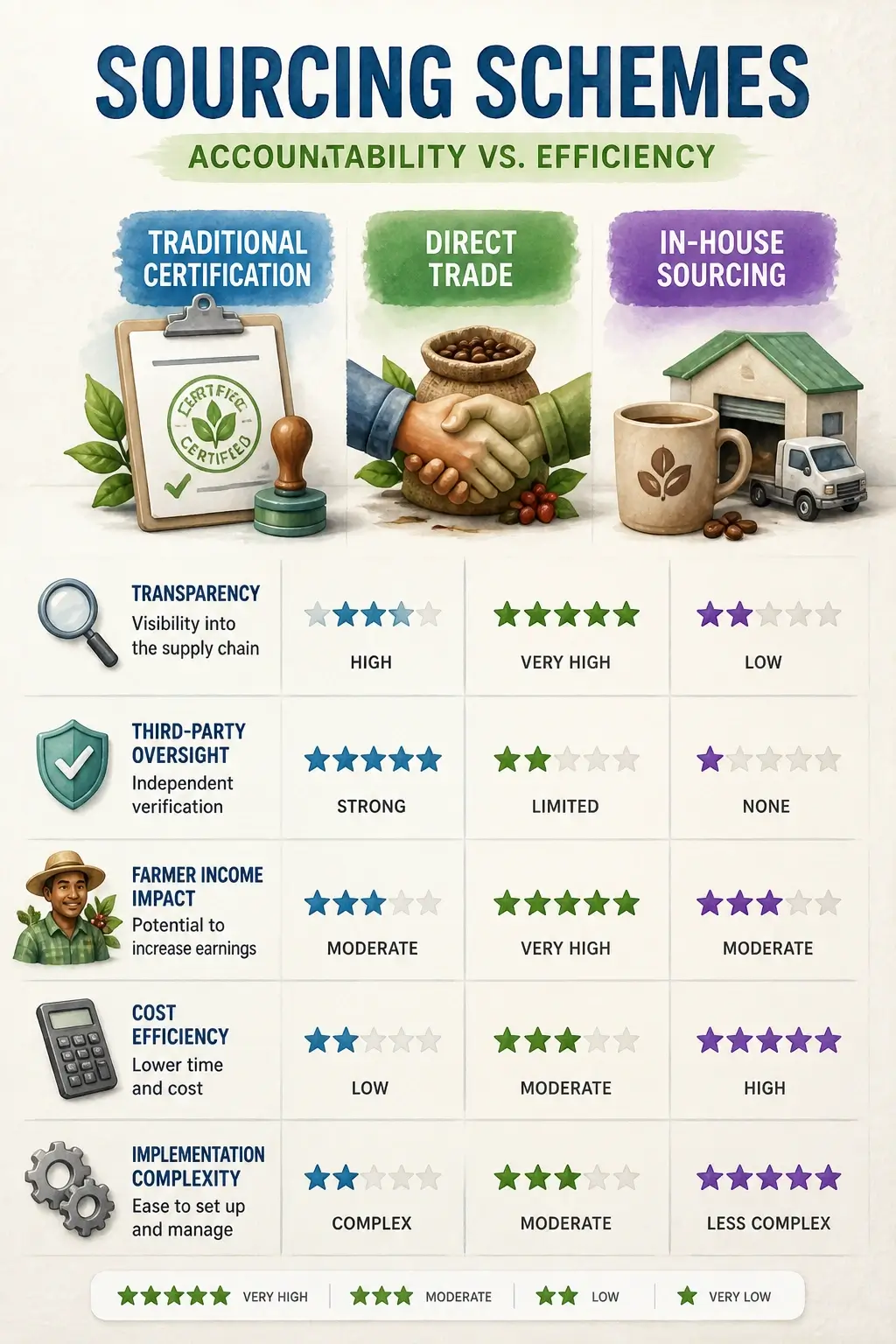
Internal certification programs run by large coffee companies face a different version of the same problem. Companies like Starbucks (with its C.A.F.E. Practices program) or Nespresso (with AAA Sustainable Quality) have built proprietary sourcing standards that use existing supply-chain data and infrastructure efficiently. These programs can reach farms that third-party certifications never will, and they can move faster than a certification body’s committee process.
The catch is self-auditing. A company that writes its own standard, conducts its own verification, and reports its own results has no structural incentive to surface failures. The supply-chain power dynamics that dilute traditional certification premiums operate here without a watchdog. A large buyer can set the narrative – “responsibly sourced” – while the farmer has no independent body to appeal to and no external proof to point to.
Certification fatigue is pushing more producers toward these alternatives, and the logic is understandable. When market prices are high, a farmer paying for three overlapping certifications – Organic, Fair Trade, and Rainforest Alliance – to access different buyer segments is spending real money to maintain credentials whose relative value is shrinking. Letting one or two lapse and working directly with a roaster who pays a relationship premium can be the more rational economic choice.
But the fundamental problem remains identical across every model: no approach – traditional certification, direct trade, or in-house scheme – has demonstrated through independent, audited data that it reliably lifts and maintains farmer net income over time. The accountability vacuum just takes a different shape.
The Certification Overload: Fatigue, Proliferation, and the Looming EUDR Shock
The certification landscape is fracturing under two simultaneous pressures. The first is internal: too many labels, too little differentiation, and a growing population of farmers quietly walking away from the whole system. The second is external: a regulation arriving from Brussels that could make the current certification debate look like a minor tuning argument.
Label Proliferation and Farmer Certification Fatigue
The current label environment includes Fair Trade, Rainforest Alliance (which absorbed UTZ in 2018), USDA Organic, Bird-Friendly, 4C (Common Code for the Coffee Community), and a constellation of smaller regional seals – each with its own fee structure, audit schedule, and compliance requirements. A consumer standing in front of a coffee shelf has no reliable framework for ranking these. A farmer trying to access multiple export markets may need to maintain two or three simultaneously.
The economics of certification fatigue follow a simple logic. When the C-market price for Arabica is high – above US$2.50 or US$3.00 per pound, as it has been in recent years – the fixed premium that a certification delivers shrinks as a percentage of total revenue. The paperwork burden doesn’t shrink. The audit cost doesn’t shrink. The calculation that once justified certification starts to fail, and producers quietly let certifications lapse rather than renew.
Cooperative governance adds another layer. When a cooperative’s leadership decides to pursue or drop a certification, individual smallholder members often have limited say. A farmer who personally values the Organic standard may find her cooperative dropping it because the board decided the fees weren’t worth it. The decision that shapes her market access was made above her.
The EUDR Shock: Regulation That Could Redefine the Certification Landscape
The European Union Deforestation Regulation (EUDR) is the most consequential external force to hit coffee supply chains in a generation. Any coffee imported into the EU after the regulation’s compliance date must be proven deforestation-free after a December 31, 2020 cut-off, backed by geolocation data on every production plot. Not certified sustainable. Not audited by a third party. Geographically verified as deforestation-free.
That requirement creates two possible futures for the certification industry. In the first, certifications become more essential: their existing traceability systems and farm-level data collection give companies a ready-made compliance infrastructure, and certification bodies position themselves as EUDR verification partners. In the second, certifications become redundant: companies build cheaper, proprietary geolocation traceability systems that satisfy the EUDR requirement without paying certification premiums, effectively bypassing the entire label ecosystem.
The honest answer is that no one knows which future arrives. What is clear is that the EUDR blindspot in consumer education is significant. Most consumer-facing guides to coffee certifications don’t mention this regulation at all. A buyer in Germany or the Netherlands who is carefully choosing between Fair Trade and Rainforest Alliance is operating on a framework that may be structurally obsolete within a few years. The certification-versus-traceability race is the most consequential open question in specialty coffee right now, and the public conversation hasn’t caught up to it.
The Verdict: Should You Still Trust Coffee Certifications?
Coffee certifications are not a scam. That framing is too simple and ultimately unhelpful. They do real things: they open market access for cooperatives that would otherwise have no entry point into premium channels, they establish minimum environmental standards that are marginally better than no standards at all, and they function as a floor signal in markets where buyers have no other information. A world with no certifications is worse than the world we have.
But “marginally better than nothing” is a long way from the promise on the label.
The core limitation is one this article has returned to repeatedly: no certification – Fair Trade, Organic, Rainforest Alliance, or any other mainstream scheme – has demonstrated through independent, audited data that it reliably improves farmer net income at scale. The absence of that proof is not a research gap waiting to be filled. It is a structural feature of systems that measure compliance with documentation rather than outcomes in farmers’ bank accounts.
That means treating a certification logo as a holistic solution is a category error. The label tells you the farm passed an audit. It does not tell you what the farmer was paid, what she kept after fees, or whether her household income improved. Those are different questions, and they require different answers.
The more useful framework is a set of sourcing questions directed at the roaster or retailer:
- Does the roaster disclose what they paid at origin? A transparency report with actual price-per-pound data is more informative than any logo.
- Do they buy from the same producers year after year? Relationship continuity is a stronger signal of genuine partnership than a certification renewal cycle.
- Can they name the farm or cooperative and describe the supply chain between there and your cup? Specificity is not a guarantee, but vagueness is a red flag.
- If the coffee is uncertified, how do they know it was produced responsibly? This is the most important question, because the majority of sustainable coffee globally carries no certification at all.
That last point connects back to Ethiopia. If roughly 90% of Ethiopian coffee is grown without synthetic inputs but only a fraction carries Organic certification, then there is an enormous volume of coffee produced under conditions that would meet many certification standards – and none of it shows up in the certified column. Consumers currently have no framework for evaluating that coffee. The entire consumer-education apparatus is built around the certified-versus-uncertified binary, which means it is effectively ignoring most of the world’s sustainable production.
The most honest answer to “should I trust certifications?” is: trust them as a weak signal, not a guarantee. Spend at least as much energy understanding a roaster’s sourcing relationships as you spend reading the back of the bag. The effectiveness of any certification – or any alternative – lives in the chain of verified relationships behind it. The logo is just the surface. Demand proof of what’s underneath.
Frequently Asked Questions About Criticisms of Coffee Certifications
Does Fair Trade certification guarantee a farmer earns more than conventional growers?
Not reliably. The guaranteed minimum price only provides an advantage when market prices fall below it; when commodity prices rise above the floor, the financial benefit of Fair Trade certification shrinks or disappears entirely.
Can a certified coffee product contain uncertified beans?
Yes. Several major certifications permit mass-balance accounting, which allows a product to carry a certified label when as little as 30% of its content actually meets the standard.
Why do so many Ethiopian farmers farm organically but lack Organic certification?
The certification requires a three-year paid transition period, annual audits, and detailed record-keeping. Farmers who already grow without synthetic inputs often lack the capital and administrative infrastructure to meet those documentation requirements, so they remain uncertified despite their actual practices.
What is certification fatigue, and how does it affect farmers?
It’s the point where the annual cost and paperwork burden of maintaining certification exceeds its financial return. When commodity prices are high, the fixed certification premium shrinks as a share of revenue, and many producers quietly let their certifications lapse rather than renew.
Is direct trade coffee more ethical than certified coffee?
It can be, but there’s no way to verify it independently. Direct trade has no governing body, no audit standard, and no consistent definition – so the quality of a direct trade program depends entirely on the individual roaster’s practices and honesty.
What is the EUDR, and why does it matter for coffee certifications?
The European Union Deforestation Regulation requires that coffee imported into the EU be proven deforestation-free after December 31, 2020, backed by geolocation data on every production plot. It could either make certifications more valuable as ready-made compliance infrastructure or render them redundant if companies build cheaper proprietary traceability systems instead.
How do I evaluate uncertified coffee for ethical sourcing?
Ask the roaster three things: what they paid at origin, whether they buy from the same producers annually, and how they verified responsible production. Specific, consistent, documented answers are more reliable than any label.
Are any certifications genuinely independent from the companies they audit?
Independence is structurally compromised across most major schemes because certifiers are frequently paid by the entities they certify or by retail purchasers. Research examining the Rainforest Alliance system found that certifiers’ incentives align with clients rather than independent verification, which undermines the credibility of audit outcomes.
References
- Costa Rica’s Successes in EUDR Compliance Illuminate the Struggles of Others | dailycoffeenews.com
- PMC Article on Ethiopian Organic Coffee Farming Statistics | pmc.ncbi.nlm.nih.gov
- Examining the Rainforest Alliance’s Agricultural Certification Robustness | papers.ssrn.com