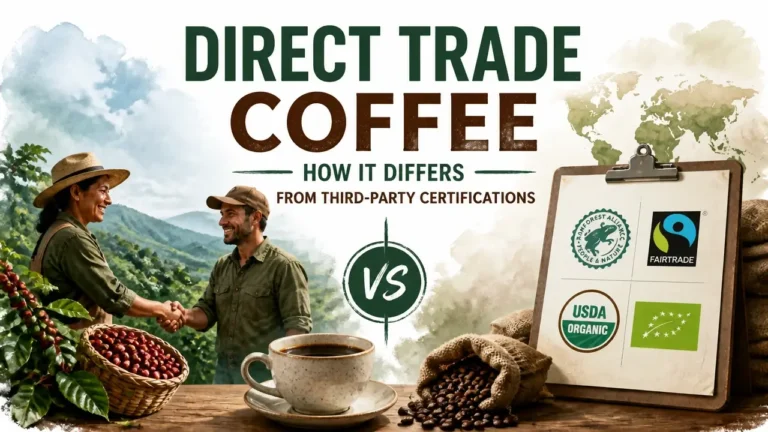

Unregulated direct trade coffee sits at the center of specialty coffee’s most important ethical debate – and most consumers don’t realize the term on their bag carries zero legal weight. No governing body issued it. No auditor verified it. What you’re reading is a sourcing philosophy, not a certification.
That distinction matters more than it seems. The gap between a well-executed direct trade relationship and a hollow marketing claim is enormous, and the only thing separating them is a roaster’s willingness to be transparent. This article maps the mechanics, the genuine benefits, and the structural flaws – so you can read any bag with clear eyes.
When you are shopping for certified coffee, understanding the mechanics of these sourcing models helps you separate genuine ethical commitments from clever marketing.
Key Takeaways on Direct Trade Coffee Certification
- Direct trade coffee carries no certifying body, no universal standard, and no required audit – the term is entirely unregulated and self-defined by each roaster.
- Price in direct trade is negotiated bilaterally based on cup quality, not set by a commodity board, which can push premiums 25 percent or more above Fair Trade protects more farmers with a price floor; direct trade rewards higher quality more generously but offers no safety net if the buyer exits the relationship. minimums.
- Genuine direct trade relationships require transparency reports publishing farm name, price paid, and relationship length – anything less is an unverifiable claim.
- Fair Trade protects more farmers with a price floor; direct trade rewards higher quality more generously but offers no safety net if the buyer exits the relationship.
- Organic certification and direct trade address entirely different supply chain dimensions – one governs farming inputs, the other governs economic relationships – and neither substitutes for the other.
- The verification burden in direct trade falls entirely on the consumer; the standard to demand is published FOB price, multi-year relationship evidence, and independently verifiable quality data.
What Direct Trade Coffee Actually Is (And What It’s Not)
Direct trade coffee is a sourcing model, not a certificate. A roaster buys directly from a farmer or cooperative, cuts out the commodity broker, and negotiates price and quality terms face to face. No seal. No third-party body. No annual audit to keep the claim honest.
That last part is the one most coffee drinkers miss entirely.
Because the term is completely unregulated, its meaning shifts from roaster to roaster. One company’s “direct trade” involves multi-year contracts, published price data, and annual farm visits. Another’s means they once bought a single lot through a slightly shorter supply chain. Both can print the same phrase on their bag, and neither is breaking any rules – because there are no rules.
Responsible proponents of the model do rally around four core principles. The first is price transparency: open disclosure of what was actually paid and to whom. The second is a relentless focus on cup quality, typically measured against the SCA’s 100-point scale. The third is long-term relationships between buyer and producer, not one-off transactions. The fourth is pricing that sits demonstrably above commodity minimums, with many practitioners citing premiums of 25 percent or more above the Fair Trade floor as the baseline.
While direct trade focuses on economic relationships, examining organic versus conventional standards reveals how different certifications govern agricultural inputs and environmental practices.
Contrast that with certified models. Fair Trade, Organic, and Rainforest Alliance each require a certifying body, a defined standard, and a periodic audit. When you see one of those seals, a third party has signed off. For a deeper look at how those systems work mechanically, see our complete guide to coffee certifications and standards. With direct trade, the only thing standing between a genuine relationship and a marketing slogan is the roaster’s integrity and willingness to show their work.
This is what practitioners in the field call the “trust gap.” The quality of a direct trade relationship is only as strong as the roaster’s commitment to transparency – which brings us to the central tension this article is built to resolve.
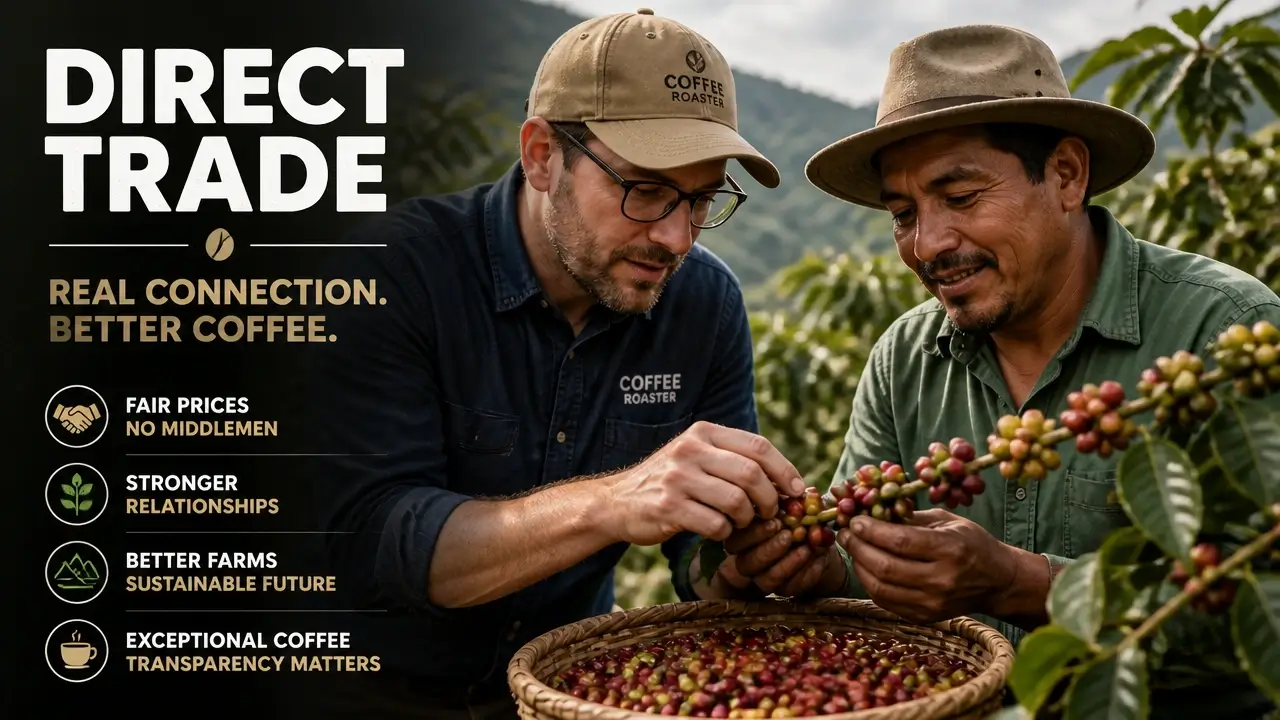
According to Kim Elena Ionescu, Director of Sustainability at the Specialty Coffee Association of America, when “direct trade” carries no clearly stated definition, the term tends to operate more as an aspiration than a program – and companies end up delivering less real benefit to farmers than their customers actually expect.
That framing is honest and damaging in equal measure. A term that means everything ends up meaning nothing, and the farmers the model claims to help bear the cost of that vagueness.
Trish Rothgeb, co-owner and roastmaster of Wrecking Ball Coffee Roasters in San Francisco and former Director of Programs at the Coffee Quality Institute, puts it more bluntly: direct trade, at its core, has no core. While a handful of practitioners – she singles out Intelligentsia’s Geoff Watts as genuinely rigorous – most companies treat the term casually, with little accountability for what it actually requires.
Rothgeb’s critique lands hardest because she isn’t an outsider. She’s a founding figure in specialty coffee’s quality infrastructure. When she says the model is “cavalier,” that’s an industry insider calling out her own community.
The producer side of this equation is equally instructive.
Patrick Murray, producer and owner of Finca Mahajual in El Salvador, describes direct trade as the establishment of a direct channel between two parties – a relationship between producers and roasters in which quality and pricing are defined and agreed upon, with the long term in mind, for mutual benefit.
Murray’s definition is the aspirational version of the model working exactly as intended. Notice what it requires: both parties negotiating openly, both committed to a long-term horizon, both benefiting. That’s a relationship, not a transaction. And it only works when the roaster treats it that way.
Perhaps the most revealing voice in this debate belongs to the other side of the ledger.
Paul Rice, founder of TransFair USA (now Fair Trade USA), said of the direct trade movement: “If they prove themselves better at helping farmers than we are, then more power to them. I hope they beat us.”
Rice isn’t conceding defeat. He’s setting a standard. “Prove it” is the operative phrase – and proving it, without a certifying body to do the proving, is the entire challenge the rest of this article addresses.
The Mechanics: How Direct Trade Functions from Farm to Roaster
Price negotiation in direct trade starts where the commodity market ends. A roaster – often the owner or head green buyer – travels to origin or works through a trusted importer with deep producer relationships, then sits down with a farmer and agrees on a number. No commodity board sets that number. No futures contract anchors it. The price reflects what the coffee actually tastes like.
That’s the engine: cup quality drives price.
Coffees that score 80 or above on the SCA’s 100-point scale qualify as specialty grade, but within direct trade, the premium accelerates sharply above that floor. A lot scoring 86 might earn a moderate premium. A lot scoring 90 commands a substantially higher one. The farmer learns exactly which processing decisions, harvesting choices, and varietals pushed the score up – and the next season, they apply that knowledge deliberately. The roaster’s palate becomes a direct financial signal to the farm.
Payment structures in genuine direct trade relationships typically land 25 to 50 percent above the Fair Trade minimum, and the money flows directly to the producer rather than filtering through a cooperative’s administrative layer or a certification body’s fee structure. That directness is one of the model’s clearest mechanical advantages over certified alternatives.
Long-term commitment reinforces the price signal. Most serious direct trade relationships involve multi-year purchasing agreements, repeat buying across harvests, and occasional roaster investment in producer infrastructure – a drying bed, a fermentation tank, a cupping lab. These aren’t charity. They’re the roaster protecting their supply of exceptional green coffee while giving the farmer the tools to produce more of it.
The consumer-facing layer of this system is the transparency report: a published document listing farm names, lot details, and sometimes the exact price paid per pound. For a buyer trying to evaluate a direct trade claim, this is the most important signal available.
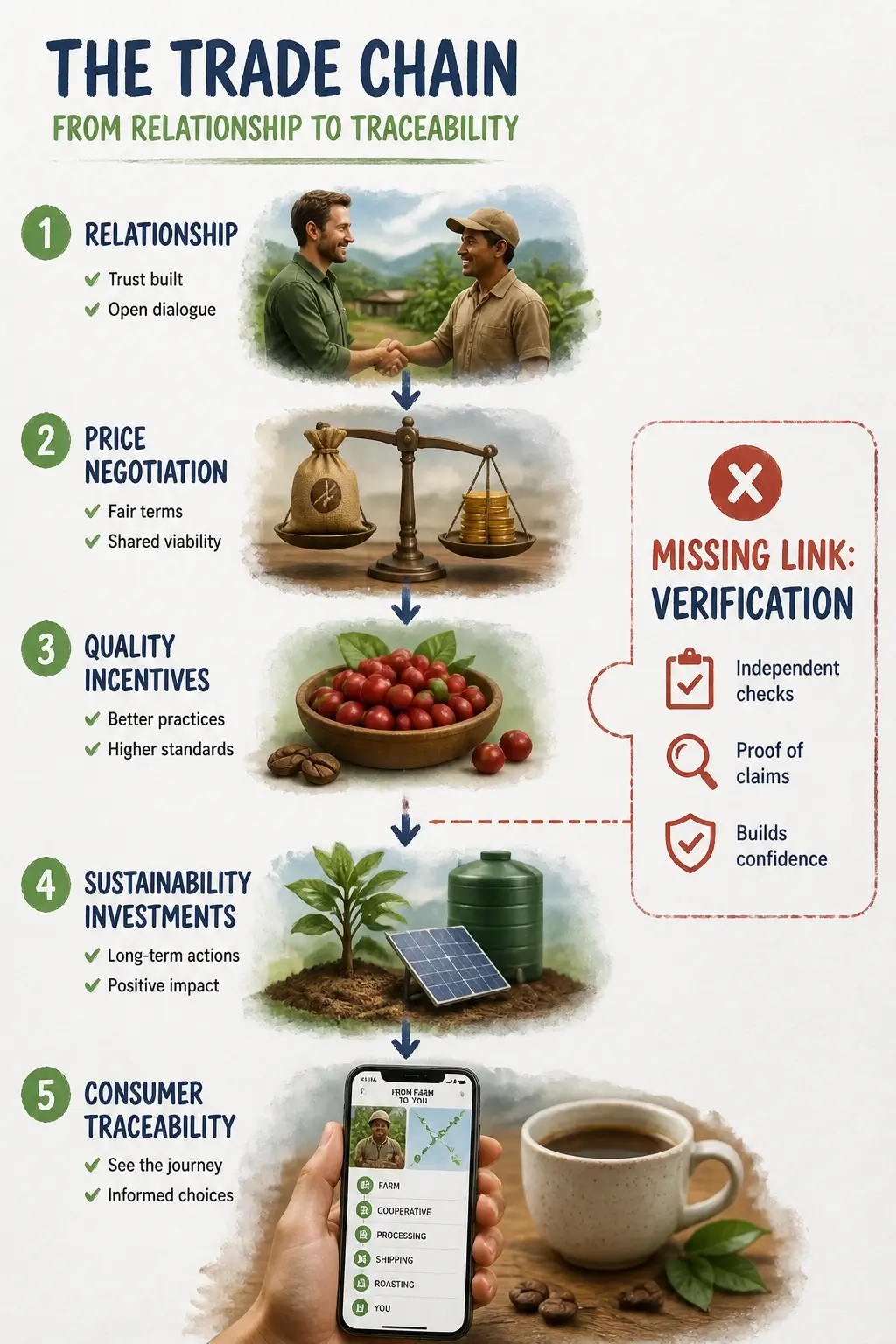
Here the logic maps cleanly as a chain of cause and effect. The relationship enables price negotiation, which creates quality incentives, which fund sustainability investments, which produce consumer traceability. Each link drives the next.
But the chain has a structural break at the final link. A consumer can read a transparency report. They cannot independently audit one. No third-party database cross-references the prices a roaster claims to have paid. No verification mechanism exists between “the roaster published this” and “this is true.” That gap – between reported traceability and verified traceability – is the fault line this model has never resolved, and we’ll examine its full consequences in the next section.
What Farmers and Roasters Actually Gain from Direct Trade
Farmer income is the headline benefit, and the mechanics behind it are real. By cutting out commodity brokers and bypassing certification fees, a larger share of the final retail price can reach the producer directly. Add a quality-based premium on top, and a skilled farmer producing high-scoring lots can receive prices that bear little resemblance to commodity rates.
Statistical Data: Producers in genuine direct trade relationships are paid at least 25 percent above Fair Trade minimum prices. – Source: Borgen Magazine
That 25 percent floor is a starting point, not a ceiling. Some specialty roasters publicly document paying significantly more for exceptional lots. One figure that circulates in specialty coffee content claims farmers can earn 20 to 50 percent more per pound through direct trade for high-quality beans – but this number comes from a single roaster’s self-published materials and has not been independently validated across the industry. Treat it as directionally plausible, not as an audited benchmark. The honest answer is that the premium varies enormously depending on the roaster, the origin, and the quality of the lot.
The quality feedback loop is the model’s most underappreciated benefit. In a commodity system, a farmer ships their harvest and receives a market price regardless of how carefully they processed it. In a direct trade relationship, the roaster cups the coffee, scores it, and communicates what worked and what didn’t. A farmer who learns that extended fermentation pushed their lot from 84 to 87 points – and that the 87-point lot earned 40 cents more per pound – has a direct economic incentive to refine that process. The roaster’s palate and the farmer’s income become genuinely aligned. That alignment is what produces the exceptional coffees that define specialty.
Traceability deepens considerably under direct trade. Because the transaction is direct, the coffee can often be traced to a single farm, a specific washing station, or a named smallholder cooperative rather than a regional blend. For consumers, that specificity is meaningful – it transforms “Ethiopian natural” into “Yirgacheffe, Halo Beriti, washed, 88.5 points, Abebe Urgessa.” That’s a different kind of purchase.
Relationship stability closes the loop for both parties. Multi-year buying commitments give farmers the confidence to invest in their farms – a new fermentation setup, better drying infrastructure, varietal experimentation. Roasters gain reliable access to exceptional lots they helped develop. The relationship becomes genuinely symbiotic rather than transactional.
It’s worth noting here that the income and traceability benefits of direct trade operate in an entirely different dimension from farming-practice standards. When comparing organic certification vs direct trade, the two systems address fundamentally different questions – one governs what goes into the soil, the other governs who receives the money. That distinction matters more than most bags acknowledge.
The Uncomfortable Truths: Where Direct Trade Falls Short
Direct trade’s verification gap is not a minor technical problem. It is a structural flaw that undermines the model’s entire ethical proposition. The benefits described in the previous section are real – when the relationship is genuine. The problem is that nothing forces it to be genuine, and nothing allows you to check.
The Verification Black Hole and Power Imbalance in Direct Trade
No external verification exists for direct trade claims. A roaster can use the term after a single farm visit, after buying through a broker they loosely call a “partner,” or after purchasing a lot from a cooperative without ever meeting the farmers who grew it. None of those scenarios violate any rule, because there are no rules. The term is available to anyone.
This creates a greenwashing risk that is not hypothetical. When a marketing department understands that “direct trade” resonates with consumers and carries no compliance burden, the incentive to apply it loosely is obvious. The phrase earns brand equity at zero accountability cost.
The power imbalance inside many direct trade relationships compounds the problem. In theory, both parties negotiate freely. In practice, a smallholder farmer in a remote origin country, with limited alternative buyers and a harvest ready to move, does not negotiate from equal footing with a well-funded specialty roaster. Farmers may accept lower premiums than the model’s advocates claim, simply to secure the sale. The roaster sets the terms; the farmer accepts or loses the buyer. That dynamic rarely appears in the transparency reports.
The consumer’s position is the most exposed of all. A buyer reading a bag has no practical mechanism to audit the claim. They can read the roaster’s published farm name and price figure. They cannot verify either.
A study published in Agricultural and Food Economics examining credence goods – products whose ethical attributes cannot be verified after purchase – found that information asymmetry creates strong incentives for producers to falsely claim those attributes, and that markets for such goods require well-defined quality standards and third-party verification to prevent fraud. Without external verification, consumers cannot distinguish truthful claims from hollow ones, which leads to a predictable outcome: non-compliant goods drive out authentic ones as the market reward for honesty disappears.
That finding describes the direct trade market with uncomfortable precision.
The verification black hole runs deeper than most consumer-facing content acknowledges. Not one major coffee education platform provides a third-party database, an independent audit tool, or even a structured checklist that a consumer could use to cross-reference a roaster’s self-reported price data. The omission is telling. The practical takeaway: if a roaster’s direct trade claim is genuine, they should be able to publish the actual FOB price paid, the length of the relationship in years, and any external visit records. Those three data points are the minimum bar. Anything less is aspiration dressed as accountability.
For a direct comparison of how a third-party system handles this accountability gap, Rainforest Alliance vs direct trade illustrates exactly what independent auditing adds – and what its absence costs.
Scalability Limits and the Missing Safety Net in Direct Trade
Scalability is the model’s second structural ceiling. Direct trade depends on personal relationships, small-lot production, and high cup scores – a combination that works beautifully at the specialty end of the market and becomes impractical at volume. A roaster buying hundreds of thousands of pounds across dozens of origins cannot maintain genuine bilateral relationships with every producer. The model is architecturally suited to the top tier of specialty coffee, not to the broader market.
The missing safety net is the sharpest contrast with Fair Trade. When commodity prices collapse – and they do, cyclically and severely – Fair Trade’s certified minimum price provides a floor. The farmer may not profit, but they will not lose money below a defined threshold. Direct trade offers no equivalent protection. If the roaster exits the relationship, pivots to a different origin, or simply stops buying, the farmer who built their operation around that premium buyer has no fallback. The higher the premium they were receiving, the steeper the drop when the relationship ends.
This is not a hypothetical risk. Specialty coffee relationships are built on taste, and taste is a moving target. A farm that produced exceptional lots for five years can have a bad harvest from drought or disease. The roaster moves on. The farmer, who may have turned away lower-paying buyers to prioritize the direct trade relationship, is left exposed in ways that a Fair Trade cooperative membership would have prevented.
Direct Trade vs. Fair Trade: A Head-to-Head Reality Check
Fair Trade and direct trade solve different problems, and understanding which problem you’re trying to solve is the only way to evaluate which model serves farmers better in a given context.
The mechanism contrast is fundamental. Fair Trade operates through FLOCERT, its third-party certification body, which verifies that producers receive a certified minimum price and an additional social premium for community investment – schools, clinics, infrastructure. The minimum price is a floor, not a negotiated figure. It exists regardless of cup quality. Direct trade inverts this entirely: price is negotiated bilaterally, pegged to cup score, with no mandated social premium and no external auditor confirming the terms.
This creates a price floor versus quality ceiling dynamic that defines the tradeoff between the two models. Fair Trade’s floor protects farmers when commodity markets collapse. In 2021, the Fair Trade minimum for washed Arabica sat at approximately $1.40 per pound. Specialty-grade coffee – the kind direct trade relationships are built around – frequently traded above $3.00 per pound in the same period. This figure comes from a single specialty coffee source and lacks cross-validation, but the directional gap is consistent with what specialty buyers and producers have reported publicly. If accurate, it means the Fair Trade floor, designed as a protection mechanism, may systematically undervalue the very beans that direct trade was created to reward.
Traceability depth is another meaningful asymmetry. Fair Trade certification typically traces coffee to the cooperative level – you know the general origin, not the individual farm. Direct trade, executed properly, traces to a single farm, a specific lot, or even a named farmer. For consumers who want to understand exactly where their coffee came from, that difference is substantial.
Certification cost and access create a different kind of barrier. Fair Trade’s certification fees, audit requirements, and paperwork burden fall on smallholders who may lack the administrative capacity to manage them. Direct trade imposes no certification cost – but it demands something equally demanding: the ability to produce quality that justifies a premium buyer’s attention, and the infrastructure to deliver consistent lots at the volumes that buyer needs. Both models have gatekeeping mechanisms; they just operate differently.
Auditability is where the asymmetry is sharpest and most consequential. A Fair Trade claim has been verified by FLOCERT. A direct trade claim has been verified by the roaster’s own transparency report. Those are not equivalent forms of accountability, and treating them as if they were is the most common mistake in consumer-facing coffee content.
Neither model is universally superior. Fair Trade protects more farmers across a wider range of quality and market conditions. Direct trade rewards exceptional quality more generously and creates deeper origin relationships. The choice between them depends on whether you’re trying to set a floor or raise a ceiling.
While direct trade relies on bilateral agreements rather than institutional oversight, producers looking to formalize their market access must navigate the rigorous farmer certification steps required by audited programs.
Direct Trade vs. Organic Certification: Economics Meets Agronomy
Organic certification and direct trade operate in entirely separate dimensions of the coffee supply chain, which is why comparing them directly tends to confuse rather than clarify. They answer different questions. Organic asks: what went into the soil? Direct trade asks: who received the money, and how was the price determined?
USDA Organic certification is an agricultural standard. It prohibits synthetic pesticides and fertilizers, requires documented soil management practices, and mandates verification by a USDA-accredited certifier. The focus is entirely agronomic – what happens on the farm’s land, not what happens in the contract between buyer and seller. Direct trade has no agronomic requirements whatsoever. A direct trade coffee can come from a farm that uses conventional inputs without any contradiction in terms.
The cost and time barrier for Organic certification is significant for smallholders. The certification requires a three-year chemical-free transition period before a farm can receive organic status, plus annual inspection fees that can run from hundreds to thousands of dollars depending on farm size and certifier. For a small producer in a low-income country, those costs are not trivial. Direct trade imposes no equivalent financial or procedural burden – the relationship itself is the mechanism, not the paperwork.
Neither model guarantees the other’s benefits. An Organic coffee can be poorly harvested, carelessly processed, and taste flat. The certification says nothing about cup quality. A direct trade coffee can be exceptional in the cup while coming from a farm that uses conventional chemistry. Specialty buyers frequently seek both precisely because each addresses a gap the other ignores: Organic covers environmental integrity; direct trade covers economic fairness and quality incentives.
The combination advantage is real and increasingly common in specialty circles. A coffee that is both Organic-certified and sourced through a genuine direct trade relationship offers environmental integrity, price transparency, and quality-driven premiums simultaneously. That combination is as close to a complete value proposition as the current system can produce.
For the consumer making a purchasing decision: if chemical-free farming and soil health are your primary concern, Organic certification is necessary – direct trade cannot substitute for it. If farmer income, origin traceability, and quality incentives are your priority, direct trade is more directly relevant – Organic certification addresses none of those. Neither label alone covers the full picture.
One edge case that no consumer-facing source explains clearly: what do you do when a bag carries both Organic and direct trade claims? The two systems can genuinely complement each other – a farmer who avoids chemical inputs and receives a direct quality premium may be in the strongest economic and environmental position the current market can offer. But no official framework reconciles or prioritizes these overlapping attributes. You are left assessing the roaster’s transparency on both counts separately, which means applying the same verification standard to both: published price data, documented farm visits, and independently verifiable quality scores. The absence of layered guidance here is precisely the kind of decision void that leaves informed consumers stranded.
Where Direct Trade Fits in the Specialty Coffee Universe
Specialty coffee’s rise made direct trade not just possible but structurally necessary. As roasters in the early 2000s began chasing 85-plus-point lots from specific farms and specific processing methods, the commodity supply chain became an obstacle. Brokers aggregated and blended. Cooperatives averaged out quality. The only way to source a specific microlot from a specific farm in a specific harvest year was to go get it yourself – or build a relationship with someone who could.
That’s the origin of direct trade as a practice. It wasn’t a philosophy first. It was a logistics solution that became a philosophy.
For roasters, the model serves two purposes simultaneously. It secures access to exceptional green coffee that cannot be reliably sourced through commodity channels, and it generates the kind of origin narrative – named farmer, specific farm, documented relationship – that resonates with specialty consumers. For farmers, a genuine direct trade relationship offers a path out of commodity pricing and into a premium structure that rewards the skill and labor they actually invest.
Intelligentsia, Counter Culture, and Stumptown built direct trade programs before the term was widely used, and their early documentation of farm relationships, published price data, and multi-year commitments established the model’s credibility. The consumer expectation they created – that a serious specialty roaster should be able to tell you exactly where the coffee came from and what they paid for it – has now spread across the industry. That expectation is the model’s most durable legacy, even as its execution remains uneven.
Despite its structural flaws, direct trade represents a genuine shift in how the specialty end of the market thinks about supply chains. The move from passive certification-seal purchasing toward active, informed engagement with producer relationships is directionally correct, even when individual executions fall short. The burden of verification, however, has never been resolved – and it falls entirely on the buyer.
The existing landscape of consumer coffee education makes this harder than it needs to be. Major platforms define the labels and then either end abruptly or pivot to product recommendations, without helping readers prioritize one claim over another. When the information environment stops short of real guidance, a term like “direct trade” floats untethered, meaning whatever a roaster wants it to mean. That information vacuum is the model’s most damaging vulnerability – more damaging, arguably, than any structural flaw in the model itself.
The antidote is not a new certification. A new certification would recreate the bureaucratic layer that direct trade was designed to bypass. The antidote is a more demanding, transparency-first consumer culture – one that treats “direct trade” as a claim to be verified, not a signal to be trusted.
The test is straightforward. When you pick up a bag that carries a direct trade claim, ask four questions: Does the roaster name the specific farm? Do they publish the actual price paid per pound? Do they document the length of the relationship? Do they provide quality data that an independent third party could verify? If the answer to all four is yes, the claim has earned its place on the bag. If any answer is missing, you’re looking at an aspiration. Whether that’s enough is your call – but now you know what you’re actually evaluating.
Frequently Asked Questions About Direct Trade Coffee Certification
What does “direct trade certified” actually mean on a coffee bag?
It means nothing legally or formally – there’s no certifying body that issues a direct trade seal, so the phrase is entirely self-reported by the roaster. Whether it reflects a genuine relationship depends on what the roaster publishes to back the claim.
How is the price determined in a direct trade relationship?
Price is negotiated directly between the roaster and producer, typically tied to the coffee’s SCA cup score. Higher scores command higher premiums, which creates a financial incentive for farmers to refine their processing and harvesting practices.
Can a roaster call their coffee “direct trade” after just one purchase?
Yes, and that’s the core problem. Because the term is unregulated, a single transaction through a slightly shorter supply chain technically qualifies under no standard – because no standard exists. Multi-year commitments and published price data are what separate genuine programs from opportunistic labeling.
Does direct trade guarantee better farming practices or environmental standards?
No. Direct trade is an economic relationship model with no agronomic requirements. A direct trade coffee can come from a farm that uses synthetic pesticides and fertilizers. If chemical-free farming matters to you, you need to look for Organic certification separately.
What happens to a farmer if their direct trade roaster stops buying?
They lose the premium with no price floor to fall back on. Unlike Fair Trade, direct trade offers no guaranteed minimum price, so a farmer who built their operation around a single premium buyer is fully exposed if that relationship ends. This scalability and safety-net gap is one of the model’s most serious structural weaknesses.
Why don’t more large roasters use direct trade?
The model depends on personal relationships, small-lot production, and consistent quality – a combination that works at the specialty end of the market but becomes operationally impractical at high volumes. It’s architecturally suited to the top tier of specialty coffee, not commodity-scale sourcing.
How do I actually verify a roaster’s direct trade claim?
Look for four specific pieces of published information: the exact farm name, the price paid per pound (ideally the FOB price), the number of years the relationship has been active, and independently verifiable quality data such as SCA scores. A roaster unwilling to publish all four is asking you to take their word for it.
Is direct trade better than Fair Trade for farmers?
It depends on the context. Direct trade can pay significantly more for high-quality lots, but it offers no price floor protection during market downturns. Fair Trade protects more farmers across a wider quality range. The better model depends on whether you’re trying to raise a ceiling or set a floor.
References
- Is Direct Trade Fair? | Sprudge.com
- A Deep Dive Into Direct Trade With Author Michaele Weissman | Sprudge.com
- What Does Direct Trade Really Mean? | Perfectdailygrind.com
- TransFair on Direct Trade Movement: I Hope They Beat Us | Sprudge.com
- Direct Trade Model Coffee | Borgenmagazine.com
- Lending credence: motivation, trust, and organic certification | Link.springer.com