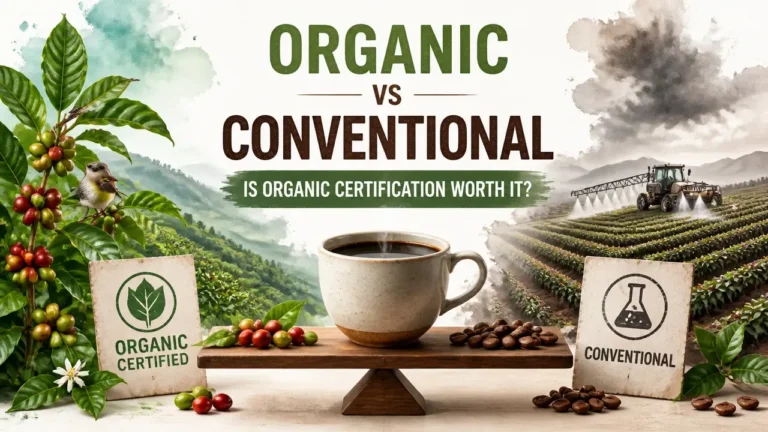

Certified organic coffee sits at the center of one of specialty coffee’s most persistent arguments, with roasters like Equal Exchange, Wandering Bear, and dozens of specialty importers staking real commercial positions on one side of it. The USDA Organic seal costs money to earn, money to keep, and money to buy. What it tells you about what’s in your cup is narrower than most of those roasters will admit.
The honest comparison between organic and conventional coffee doesn’t resolve cleanly in either direction. The environmental case is real but incomplete. The health argument is mostly marketing. The taste difference is undetectable in blind conditions. What you’re actually deciding is which problem you need the label to solve.
When choosing certified coffee brands, consumers often wonder if the price difference genuinely reflects a superior product.
Beyond the standard debate, a deeper look at coffee certification criticisms reveals significant gaps between what these labels promise and what they actually deliver.
While organic standards focus strictly on agricultural inputs, alternative seals such as those governed by Rainforest Alliance certification requirements take a broader approach by evaluating environmental management and labor practices together.
Key Takeaways on Organic vs Conventional Coffee
- Organic certification verifies farming inputs only; it says nothing about roast quality, processing, labor conditions, or cup flavor.
- Roasting at temperatures above 400°F degrades over 73% of glyphosate residues, making the pesticide health argument largely a marketing construct, not a settled safety concern.
- Organic farms show measurable soil carbon and biodiversity gains, but 20-30% lower yields mean producing the same volume requires more land, which partially offsets those gains.
- No blind tasting study has demonstrated that consumers can reliably distinguish organic from conventional coffee; flavor is set by variety, altitude, processing method, and roaster skill.
- The 25-40% retail premium reflects real costs (lower yields, manual labor, certification audits, transition period), but no supply chain mechanism guarantees farmers capture a meaningful share of it.
- Many of the world’s best coffees are uncertified because smallholder farmers with direct buyer relationships can’t recoup the multi-thousand-dollar annual certification cost.
The Organic Label Promise vs. Reality: What “Certified Organic” Actually Means for Your Coffee
Organic certification is an agricultural input standard, full stop. Coffee earns the USDA Organic seal when a third-party auditor verifies that the farm used no synthetic fertilizers, synthetic pesticides, herbicides, or fungicides during production. That verification covers the field. It does not follow the bean through the dry mill, the export warehouse, the roastery, or your grinder.
Conventional coffee is the default production model. Most of the world’s coffee is grown this way, using modern agrochemicals to stabilize yields and manage pests. That’s not a scandal. It’s the same agricultural toolkit used to grow most of the food on your table.
Here’s where the framing typically goes wrong. The organic label tells you about farming inputs. It tells you nothing about roast quality, processing method, labor conditions, or cup score. Paying more for an organic bag and expecting a better-tasting, more ethical coffee is like paying more for a “low-sodium” cereal and expecting it to taste better. The claim and the expectation are operating on completely different axes.
According to Juan Vargas, Coffee Director at Fazendas Klem in Luisburgo, Minas Gerais, Brazil, a well-managed organic operation can match the output of a conventional farm, because the management system itself, not the absence of chemicals, is what drives productivity.
That point matters more than it first appears. If yield parity is achievable through skilled management, then the cost premium consumers pay isn’t primarily compensating for lost production. It’s compensating for the certification apparatus itself, and for the market expectation that organic must cost more. Understanding that structure is the foundation for every comparison that follows.
There’s also a conflict of interest worth naming before we go further. The vast majority of sources promoting organic coffee as environmentally superior, healthier, and better-tasting are roasters and retailers selling organic coffee. When the people guiding your decision profit from one specific answer, their framing deserves scrutiny. For a broader view of how organic fits within the full landscape of coffee quality and ethics labels, our complete guide to coffee certifications and standards lays out every major seal alongside what it actually audits.
The three domains where consumers most expect organic to win are environmental impact, personal health, and sensory quality. Each one deserves a real look.
The Environmental Equation: Soil Carbon vs. Land-Use Reality
Organic coffee farming delivers genuine, documented environmental benefits. The mechanism is straightforward: when you remove synthetic inputs and replace them with compost, shade tree canopy, and natural pest predators, you stop treating the farm as a production unit and start running it as an ecosystem. Soil microbiota recover. Water infiltration improves because organic matter builds soil structure instead of compacting it. Synthetic runoff into nearby waterways drops to near zero.
The biodiversity gains are real and measurable. Shade-grown organic farms, where coffee grows beneath a layered canopy of native trees, function as functional habitat corridors in regions where surrounding forest has been cleared. Migratory bird populations in particular benefit from this canopy structure, which provides both food sources and shelter during long-distance migrations through Central and South America.
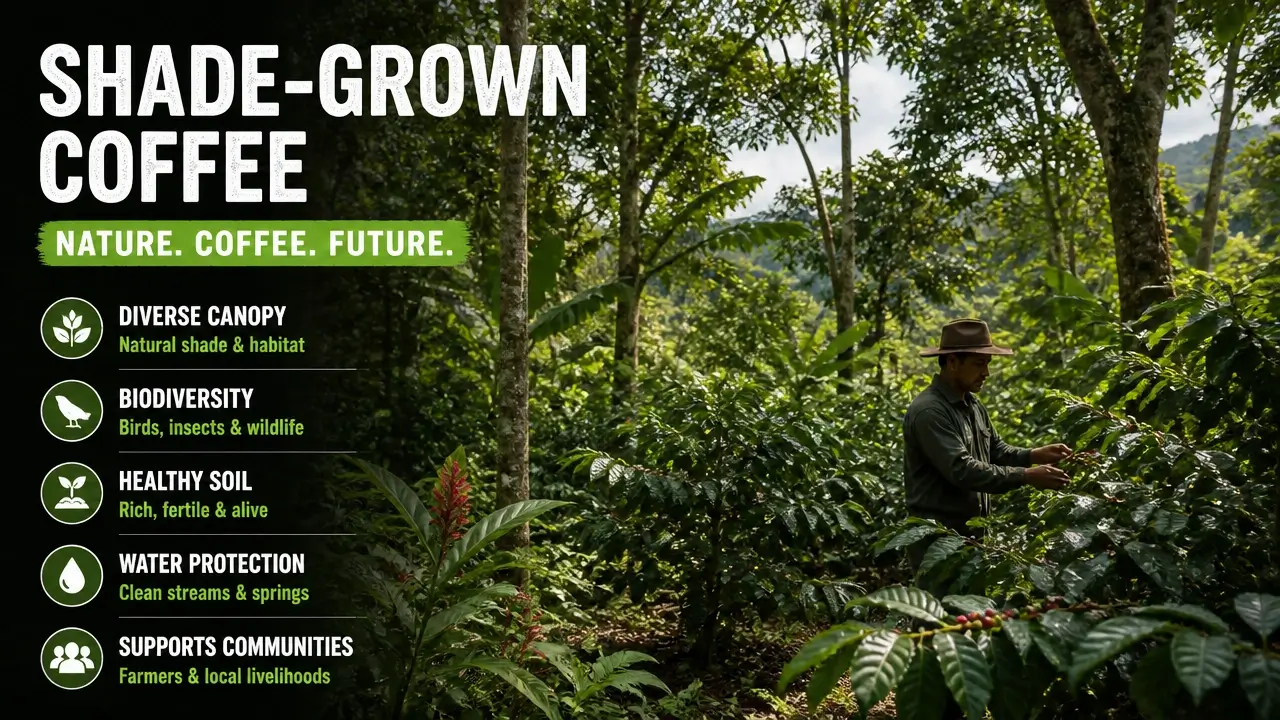
The soil carbon data tells a similar story. Organic systems have shown measurable gains in soil carbon sequestration, while conventional monocultures under continuous chemical management tend to deplete it. These numbers come from individual farm studies, and their generalizability varies by region and management intensity, but the directional finding is consistent.
The Yield Problem Nobody Wants to Publish
Organic coffee yields run roughly 20-30% lower than conventional production on comparable land. That gap has a consequence that pro-organic sources almost universally skip: if you want to produce the same total volume of coffee organically, you need more land.
More land means more forest cleared, more habitat fragmented, more carbon released from soil disturbance. The biodiversity gains on any individual certified farm can be partially or fully offset by the land-clearing required elsewhere to meet demand. This is the land-use trade-off that sits quietly beneath every “organic saves the planet” headline.
The Agroforestry Alternative
The most interesting environmental option rarely appears in the organic-versus-conventional debate because it doesn’t fit neatly into either camp. Agroforestry systems, where coffee grows under a diverse native canopy with minimal external inputs, deliver most of organic farming’s environmental benefits without requiring formal certification. Some farmers practicing these methods choose not to certify because the cost of annual audits exceeds the premium they can recoup, particularly if they sell directly to specialty buyers who visit the farm.
The honest environmental conclusion is this: certified organic farming is better for the land than conventional monoculture on a per-hectare basis. At a systems level, when you account for the land required to close the yield gap, the picture gets complicated fast.
What’s in Your Cup: The Health Debate That Marketing Built
The pesticide residue argument is the emotional core of most organic coffee marketing, and it rests on a factual gap that the advocates themselves can’t agree on.
The claim is familiar: conventional coffee is sprayed with synthetic chemicals, residues cling to the beans, you brew those residues into your cup, and you drink them. Organic coffee skips the sprays, so you’re protected. Equal Exchange and similar advocacy-oriented roasters use language that positions conventional coffee as a genuine health risk.
Here’s the problem with that framing. Green coffee beans are roasted at temperatures exceeding 400°F (204°C). That’s not a gentle warm-up. At those temperatures, the molecular structure of most pesticide compounds breaks down. A peer-reviewed study in Food Additives & Contaminants Part A tracked glyphosate specifically through multiple stages of coffee production and found that roasting at temperatures above 200°C reduced glyphosate residues by more than 73%, with additional removal occurring when the silverskin separates from the bean. That’s for glyphosate, one of the more heat-stable compounds. Less stable pesticide molecules degrade further.
After roasting, the coffee is brewed with water. Any trace residues that survived the roast are further diluted before the liquid reaches you. Regulatory agencies that monitor roasted coffee residues consistently find levels well within established safety thresholds, even in conventionally grown beans.
The Mold Argument Has the Same Problem
Consumer discussions frequently raise Ochratoxin A, a mycotoxin produced by mold that can colonize coffee during drying or storage. The implication is that organic coffee is somehow cleaner in this respect. It isn’t. Mycotoxin risk depends on post-harvest handling conditions, drying method, and storage environment, none of which are governed by organic certification. Both organic and conventional coffee face the same contamination risk, controlled by the same variables.
When the Sellers Disagree With Each Other
The most revealing signal in this debate is internal. Some pro-organic sources describe conventional coffee in genuinely alarming terms. Others, including roasters who sell organic as part of their lineup, acknowledge that roasting eliminates residues. Evidence-based reviewers have stated plainly that research shows no significant health risk from conventional coffee residues.
When the people selling you organic coffee can’t agree on whether conventional coffee is actually dangerous, the health argument stops functioning as science and starts functioning as marketing. For consumers who want to minimize synthetic chemical exposure on principle, organic provides that assurance. That’s a legitimate preference. What it isn’t is a medically meaningful health intervention for the average coffee drinker.
The Taste Test That Doesn’t Exist: Can You Actually Taste the Certification?
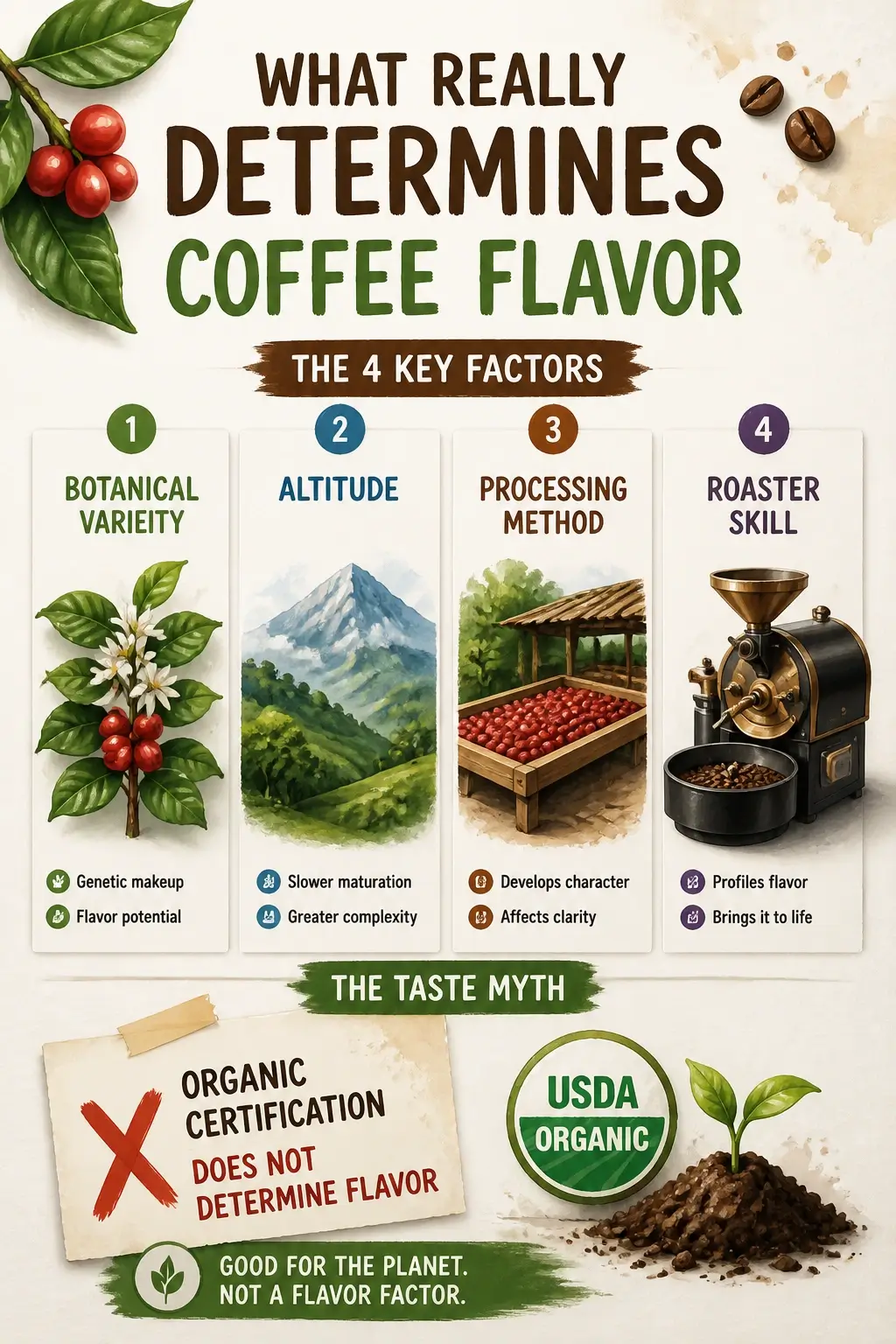
Coffee flavor is not determined by certification status. Full stop. The claim that organic coffee tastes “richer,” “more complex,” or “cleaner” appears across dozens of roaster websites and coffee blogs, but when you look for the blind tasting study that confirms it, you come up empty. No such study exists with any meaningful sample size or methodology.
What actually determines how a coffee tastes: the botanical variety (a Gesha and a Robusta are not the same coffee regardless of how either was grown), the altitude and soil mineral composition of the farm, the processing method (washed coffees taste cleaner and brighter; natural-processed coffees taste heavier and fruitier; honey-processed coffees land somewhere between), and the roaster’s skill in developing the bean’s potential without burning it.
A conventionally grown Gesha from a high-altitude farm in Panama’s Boquete region, roasted with precision, will taste dramatically different from and better than an organic commodity-grade Brazilian Santos roasted past its optimal window. The certification on the second bag changes nothing about what’s in it.
The Polyphenol Sleight of Hand
Some organic advocates point to higher polyphenol content in organic beans as the mechanism behind superior flavor. The data on polyphenol differences between organic and conventional coffee is inconsistent, but set that aside. Even if organic beans consistently contained more polyphenols, the leap from “more polyphenols” to “better flavor” doesn’t hold. Polyphenols are a major driver of bitterness and astringency in coffee. More polyphenols, poorly managed, means a harsher cup. The compounds that produce sweetness, complexity, and the fruity or floral notes that coffee drinkers actually value come from different chemistry entirely.
Roasters who sell organic coffee and are honest about it, like Wandering Bear, have acknowledged that the taste difference between organic and conventional is minimal at best. When a company that profits from organic sales makes that admission, it’s worth taking seriously. The “tastes better” claim persists because consumers pay more, expect more, and therefore perceive more. That’s basic psychology, not a quality signal.
The Price You Pay: Understanding the $8 Premium on a $12 Bag
Organic coffee’s price premium is real and it comes from real places. Understanding where those dollars actually go is different from assuming they flow to the right people.
The premium typically runs 25-40% above comparable conventional coffee at retail, though the range can stretch from 15% to 50% depending on origin, roaster, and channel. That’s not arbitrary markup. The cost structure behind it includes lower yields per hectare, which means more land and labor per pound of sellable coffee; higher manual labor requirements for weeding, pest management, and soil amendment without synthetic shortcuts; the multi-year transition period before certification is granted; and the direct cost of annual third-party audits, which must be paid whether the harvest is good or not.
The transition period is the cruelest part of this structure. A farmer who converts to organic methods must follow all organic practices for three years before they can use the organic label or charge organic prices. During those three years, they bear the full cost of organic farming with none of the revenue upside. Conventional farmers face no equivalent burden.
Where the Premium Goes After the Farm Gate
Here’s the structural problem that the premium’s surface logic obscures. Between the farm and your shelf sit a certifier, an auditor, an importer, a roaster, and a retailer. Each captures a share of the price differential. There is no mechanism in the organic certification system that guarantees the farmer receives a meaningful portion of the premium you paid. The certification verifies farming practices. It says nothing about price transparency or supply chain economics.
A conventional coffee from a roaster who publishes their sourcing contracts, names the specific farms they buy from, and discloses the green coffee price they paid may deliver substantially more money to the actual farmer than an organic coffee routed through anonymous commodity import channels. The direct trade model, explored in depth in our fair trade vs direct trade analysis, exists precisely because certification alone doesn’t solve the farmer welfare problem.
The premium isn’t a scam. The costs are legitimate. But the assumption that paying more for organic means farmers earn more is an assumption the supply chain doesn’t structurally support.
The Certified vs. The Committed: Why Some of the Best Coffee Isn’t Organic
Uncertified specialty coffee is one of the most consistent sources of confusion for consumers who’ve internalized the idea that organic equals better. The specialty coffee world is full of exceptional, ethically sourced, environmentally responsible coffees that carry no organic seal.
The reason is economic, not ethical. A smallholder farmer producing a few hundred pounds of exceptional micro-lot coffee already has direct relationships with specialty importers who visit the farm, cup the coffee, and pay above-market prices based on quality. For that farmer, paying several thousand dollars annually for organic certification, plus the administrative burden of maintaining audit-ready records, may cost more than the certification premium could ever return. The math simply doesn’t work.
What Specialty Buyers Use Instead
Experienced specialty coffee buyers don’t rely on the organic seal because they have better information. Published sourcing reports with farm names, GPS coordinates, and green coffee prices tell a buyer more about a coffee’s provenance than any certification. Farm-visit documentation, cup scores, and long-term direct relationships with producers provide the kind of accountability that a third-party audit, conducted once a year, can’t replicate.
This doesn’t mean certification is worthless. For a consumer buying coffee at a supermarket with no access to roaster sourcing data, the organic seal is the most reliable signal available. It functions as a trust proxy, a way to verify farming practices when you can’t verify them directly. The specialty coffee buyer who knows their roaster and has read their sourcing reports is operating with information that makes the proxy unnecessary.
The Agroforestry Overlap
Many of the farms producing the highest-scoring specialty coffees use agroforestry methods that deliver organic-equivalent environmental outcomes: shade canopy, soil health management, integrated pest management, and no synthetic inputs. They just haven’t paid to have it certified. The birds don’t know the difference. The soil doesn’t know the difference. The only place the certification creates a meaningful distinction is at the retail shelf, where the consumer can’t see the farm.
The Verdict: A Personal Framework for Buying Coffee Without Regret
Here’s what the evidence actually establishes. Organic farming delivers measurable environmental benefits per hectare, but the yield gap creates a land-use trade-off that erases some of those gains at scale. Health differences for consumers are negligible because roasting degrades the vast majority of pesticide residues and remaining traces fall well within regulatory safety thresholds. Taste is determined by variety, altitude, processing, and roaster skill, none of which correlate with certification status. The price premium reflects real cost structures, but no mechanism in the supply chain guarantees that farmers capture a meaningful share of it.
The binary choice between organic and conventional is the wrong frame. The right question is: what specific problem are you trying to solve with this purchase?
Match Your Priority to Your Purchase
If your priority is maximum environmental assurance, look for coffees carrying multiple certifications: Organic plus Shade-Grown plus Bird-Friendly. Each additional certification narrows the claim and increases verification depth. Expect to pay a premium and understand what you’re paying for.
If your priority is farmer welfare, certification is the wrong signal. Find roasters who publish their sourcing contracts, name specific farms, and disclose the green coffee prices they paid. A transparent conventional coffee almost always does more for farmers than an opaque organic one.
If your priority is taste, ignore certification entirely. Buy based on botanical variety, origin, processing method, and the roaster’s track record. The certification status of a Gesha from Finca La Esmeralda is irrelevant to how it tastes.
If your priority is a reliable baseline guarantee when you can’t research further, organic certification is a useful minimum standard. It tells you one specific thing was done right. That’s worth something when it’s the only signal you have.
The Side-by-Side Test
Before committing to a premium, try a side-by-side tasting. Find a roaster who sells both an organic and a conventional coffee from the same origin and roast profile. Brew them identically. Taste them blind. Your palate, unprimed by a label, is more reliable than any marketing claim about what organic is supposed to taste like.
The most satisfied coffee drinkers aren’t the ones who always buy organic or always avoid it. They’re the ones who know what the label can and can’t tell them, and ask the right question before reaching for their wallet.
For readers who want to go deeper on how organic certification fits within the broader ecosystem of coffee labels, including Fair Trade, Rainforest Alliance, and Direct Trade, the full picture requires understanding each seal on its own terms before comparing them.
Frequently Asked Questions About Organic vs Conventional Coffee
Is organic coffee actually better for you than regular coffee?
Not in any clinically meaningful way. Roasting degrades the vast majority of pesticide residues, and what remains in a brewed cup falls well within regulatory safety thresholds. If you want to eliminate all synthetic chemical exposure as a matter of principle, organic provides that assurance, but the health risk from conventional coffee is negligible for most people.
Does organic coffee taste different from conventional coffee?
There’s no blind tasting study showing that people can reliably tell them apart. Flavor is driven by botanical variety, altitude, processing method, and roaster skill, not certification status. A poorly roasted organic bean will taste worse than a well-roasted conventional one every time.
Why does organic coffee cost so much more?
The premium comes from lower yields per hectare, higher manual labor for weeding and pest management, the multi-year transition period before certification is granted, and annual third-party audit fees. Those are all legitimate costs. What the premium doesn’t guarantee is that the farmer received more money.
Can a coffee be high quality without being certified organic?
Absolutely. Many of the highest-scoring specialty coffees in the world are uncertified because the farmers already sell directly to buyers who visit the farms, pay above-market prices, and don’t need a certification to verify practices. For those farmers, the annual certification cost exceeds what it would return.
What’s the difference between organic certification and shade-grown coffee?
They’re separate standards that sometimes overlap. Organic certification covers farming inputs. Shade-grown designation addresses the canopy structure above the coffee plants. A coffee can be one without the other. For maximum environmental benefit, look for coffees that carry both labels, ideally alongside Bird-Friendly certification from the Smithsonian Migratory Bird Center.
Does organic coffee have less mold or mycotoxins than conventional coffee?
No. Mycotoxin risk, including Ochratoxin A, depends on post-harvest drying conditions and storage environment, neither of which organic certification governs. Both organic and conventional coffee face identical mold risks controlled by the same variables.
If I care about where my coffee money goes, is organic the right choice?
Only if you can’t verify anything else. A roaster who publishes their sourcing contracts and green coffee prices will likely deliver more of your money to the actual farmer than an organic coffee routed through anonymous commodity channels. Certification verifies farming practices, not supply chain fairness.
Is there a middle ground between certified organic and conventional commodity coffee?
Yes, and it’s underreported. Agroforestry systems, where coffee grows under native tree canopy with minimal inputs, deliver most of organic farming’s environmental benefits without the certification bureaucracy. Many uncertified specialty coffees come from farms using exactly these methods. They just haven’t paid to prove it on a label.
References
- The Pros & Cons of Growing Organic Coffee | perfectdailygrind.com
- Glyphosate losses through various stages of coffee production and consequences for human exposure | tandfonline.com