
Certified organic coffee is one of the most misread labels in the food industry. Millions of consumers assume the seal is a quality score or a simple “no chemicals” stamp on the bag. The reality is more structural: it’s a legally enforced chain of custody, audited by accredited organizations, that tracks every hand the coffee passes through from soil to shelf.
But the system has a fracture. An estimated 95% of Ethiopian coffee is grown without synthetic inputs, yet fewer than 1 in 10 farms carries the official certification. The gap between grown organically and certified organic reveals something the label cannot tell you on its own.
To better understand these nuances, having coffee certifications defined can help clarify what each label actually represents on your morning brew.
To better understand these nuances when choosing certified coffee labels, buyers need to look beyond the basic seal.
Key Takeaways on Organic Coffee Certification
- Organic coffee certification audits the farming and handling process, not the coffee itself; no chemical residue test determines the seal.
- Every handler in the supply chain must hold a valid certificate; one uncertified link breaks the entire lot’s organic status.
- The three-year transition period forces farmers to absorb costs without the premium, which is the primary reason smallholders don’t certify.
- Ethiopia’s 95% default-organic, sub-10% certified gap proves the system was built for organized estates, not smallholder producers.
- Organic is the only major coffee certification that categorically bans all synthetic pesticides, herbicides, and fertilizers; Fair Trade and Rainforest Alliance do not.
- In specialty coffee, a transparent, named producer relationship often provides more reliable sustainability information than a certification seal alone.
What Organic Coffee Certification Actually Guarantees
Organic coffee certification is not a product test. No laboratory runs your bag of beans through a chemical screen before the USDA seal goes on. What the certification actually audits is the process: every step from the seed in the ground to the roasted coffee in the bag must be handled by an entity that holds a valid organic certificate, verified by an independent accredited organization.
This is the chain of custody model. The farm, the wet mill, the dry mill, the exporter, the importer, and the roaster each need their own certificate. Remove any single certified link from that chain, and the entire lot loses its organic status. The coffee itself may be identical. The paperwork is what changes its legal identity.
Three major regulatory frameworks govern this system. USDA National Organic Program (NOP) controls what can be sold as organic in the United States. EU Organic Regulation 2018/848 sets the standard for European markets. JAS (Japanese Agricultural Standards) governs Japan. Each has its own accreditation structure, but they share the same foundational logic: third-party auditors, not government inspectors, do the field work.
The Three Documents That Actually Matter
For anyone buying, importing, or roasting at a professional level, three documents define whether a lot is legitimately organic.
The farm’s organic certificate confirms the origin is certified under a recognized standard. The handler’s certificate confirms every processor in the supply chain holds current certification. The Transaction Certificate (TC) is the most specific: it covers a particular lot, a particular shipment, and links the physical coffee to the certified entities that touched it.
A farm certificate without a TC is not enough. A TC referencing a handler whose certificate has lapsed is not enough. All three must be current, cross-referenced, and consistent. This is where most supply chain errors occur: not fraud, but administrative gaps in a documentation-heavy system.
One thing the certification does not confirm is cup quality. A farm can pass every organic audit and still produce coffee that scores 78 on a cupping table. The seal speaks to how the coffee was grown and handled. It says nothing about how well it was grown.
The Strict Rules That Earn the Seal
The core requirement for organic certification starts with time. A farm must complete a mandatory three-year transition period during which no prohibited substances are used on the land. The soil needs to be clean for three full harvest cycles before the first certified crop can be sold with the premium. During that window, the farmer absorbs the costs of organic management without access to the organic price.
The input rules are absolute. Synthetic pesticides, synthetic herbicides, synthetic fertilizers, and GMOs are banned. In their place, farms must rely on natural pest control: compost-based soil fertility, biological controls like predatory insects, shade management, and cover cropping. These aren’t suggestions. They’re audited line items.
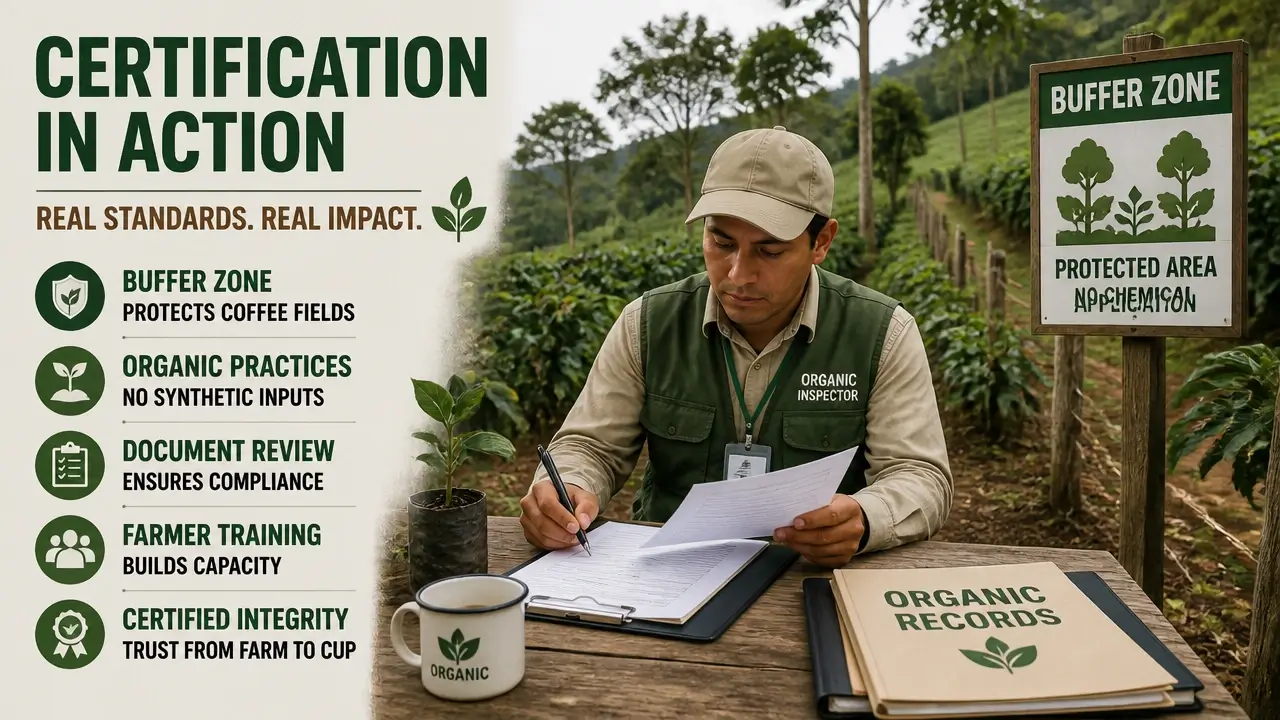
Physical segregation is equally non-negotiable. Organic coffee cannot share processing equipment with conventional coffee unless the facility follows documented, verified cleaning procedures between runs. Buffer zones must exist between certified land and neighboring conventional farms to prevent pesticide drift. A contamination event from a neighboring plot, if not documented and managed, can invalidate a certification.
The documentation burden is significant. Farms must maintain input logs, harvest records, and handling records that auditors can trace backward through every season. Annual on-site inspections verify that what’s on paper matches what’s in the field.
One structural feature of these standards is worth understanding clearly: they are process-based, not outcome-based. The auditor is checking whether the farmer followed the prescribed practices. They are not measuring pesticide residue levels in the soil or the cup. A farm that follows every rule earns the seal. A farm that produces exceptional coffee through practices that deviate even slightly does not.
Why Most Farmers Can’t Afford to Certify
The cost of organic coffee certification is the part of this conversation that almost never makes it onto the bag. The direct fees alone include the initial application, annual audit charges, and in many cases, the cost of a compliance consultant to build and maintain the required documentation infrastructure. For a smallholder farming two or three hectares, that administrative overhead is not a rounding error. It is a structural barrier.
Then there’s the transition hit. For three years, a farmer must operate under organic rules without organic prices. Yields often drop during transition as soil adjusts to lower-input management. The financial case for certification asks a smallholder to absorb losses now for a premium later, and that premium, once certified, ranges from as little as $0.03 to around $0.50 per pound. At the low end of that range, the math rarely closes.
Ethiopia’s Certification Paradox
The Ethiopian coffee sector makes this concrete. An estimated 95% of Ethiopian coffee is grown organically by default: smallholder farmers in regions like Yirgacheffe, Sidama, and Jimma simply don’t use synthetic inputs because they never have and often can’t afford to. The farming practice is organic. The certificate is absent.
Fewer than 5 to 10 percent of those farms hold official certification, because the cost and bureaucratic complexity of the USDA NOP or EU organic process are insurmountable at the individual smallholder level. Some cooperative-level certifications exist, but they cover a fraction of total production.
Here is the knowledge gap that nobody in the trade has adequately closed: there is no published, transparent, farm-level cost-benefit analysis that quantifies whether the $0.03 to $0.50 per pound premium actually compensates for the full cost of certification at the smallholder scale. Market-entry guides reference the premium range. They do not calculate the net return after fees, transition losses, documentation costs, and yield adjustment. Smallholders are being asked to invest in a system whose financial return they cannot measure. That is why the gap between “grown organically” and “certified organic” persists at a scale that should trouble anyone who treats the seal as a complete story.
Fair Trade, Rainforest Alliance, and Organic: What Each Seal Actually Promises
Fair Trade certification addresses a different problem than organic. Its architecture is built around minimum price guarantees and social premiums: a floor price that protects farmers from commodity market crashes, plus a community development fund that producer organizations direct toward schools, infrastructure, or processing equipment. Fair Trade does not require organic farming methods. A certified Fair Trade farm can use synthetic pesticides and fertilizers and remain fully compliant.
Rainforest Alliance certification focuses on ecosystem health, biodiversity conservation, and sustainable livelihoods. Its standard permits controlled integrated pest management, which means some synthetic chemical use is allowed under specific protocols. The Rainforest Alliance frog on a bag signals that the farm met a sustainability benchmark. It does not signal a complete ban on synthetic inputs.
Organic certification is the only one of the three that categorically prohibits synthetic pesticides, herbicides, and fertilizers from seed to shipment. That is its singular, non-negotiable differentiator.
| Certification | Chemical Ban | Price Floor | Biodiversity Focus | GMO Ban |
|---|---|---|---|---|
| USDA Organic | Complete | No | Indirect | Yes |
| Fair Trade | No | Yes | No | No |
| Rainforest Alliance | Partial (controlled use) | No | Yes | No |
The Real Environmental and Health Impact of Organic Farming
The environmental benefits of organic coffee farming are concentrated in three systems: water, soil, and the people working the land.
By banning synthetic pesticides and fertilizers, organic farming eliminates a primary vector for chemical runoff into local watersheds. Coffee is grown in some of the most biologically rich river systems on earth, across the highlands of Ethiopia, Colombia, and Indonesia. Synthetic inputs from conventional farms don’t stay in the field. They migrate into streams, degrade aquatic ecosystems, and accumulate in the soil in ways that take years to reverse. Organic management removes that input at the source.
For farmworkers, the benefit is more immediate. Occupational exposure to chemical pesticides in conventional agriculture is a documented health hazard: skin absorption, respiratory exposure during application, and long-term systemic effects from chronic low-dose contact. Organic methods eliminate that occupational risk entirely. No synthetic inputs means no application events, no protective equipment requirements, and no residue exposure during harvest.
On the consumer side, organic coffee carries no synthetic pesticide residues, a guarantee that conventional coffee cannot make with equal certainty regardless of what roasting temperatures may or may not degrade.
The soil story is where the long-term value accumulates. Composting, mulching, and shade-tree integration build soil organic matter over successive seasons, which improves water retention, supports microbial diversity, and increases the farm’s resilience to drought and erosion. A peer-reviewed study from the Western Ghats found that organic coffee systems showed soil organic carbon levels up to 15.6% higher than conventional plots, alongside a significantly superior Soil Quality Index (0.98 versus 0.87 in conventional systems), with measurable improvements in water retention and microbial diversity.
Academic Evidence: Organic coffee management produced significantly higher soil organic carbon (up to 15.6% increase) and a superior Soil Quality Index (0.98 vs. 0.87 compared to conventional systems), with improved soil structure, water retention, and microbial diversity. – From the study “Scientific Reports: Soil Quality and Microbial Diversity Across Organic and Conventional Coffee in Central Western Ghats, India“
Those numbers matter beyond the farm. Higher soil organic carbon means more atmospheric carbon captured and held in the ground. The climate benefit is real, even if it rarely appears in the marketing copy.
The GMO Rule Nobody Talks About Honestly
The organic standard’s prohibition on GMOs is one of its most frequently cited pillars. There’s a problem with how that rule is presented: as of 2024, no commercially grown GMO coffee exists anywhere in the world. The prohibition is enforced against a risk that is currently zero in commercial coffee production.
This is not a conspiracy or a failure of intent. It is a resource-allocation reality. Auditors spend time verifying GMO compliance for a coffee supply where GMO contamination is not a live threat. Meanwhile, the risks that are real, including synthetic pesticide drift from neighboring conventional plots and cross-contamination on shared processing equipment, may receive comparatively less scrutiny simply because they are less legible in a standard built around categorical prohibitions.
The genuine environmental gains from organic coffee certification come from the input bans, the buffer zone requirements, and the soil health mandates. Those are the provisions that actually bite. The GMO clause, however principled, is currently protecting against a phantom.
Where Organic Certification Fits in Specialty Coffee
In specialty coffee, sourcing transparency is the currency that organic certification was built to provide, but often can’t fully deliver. Cup quality is the primary metric that moves specialty lots. Certification alone does not predict a coffee’s sensory score, and the market knows it.
A significant volume of the world’s highest-scoring specialty coffee comes from origins like Ethiopia, where farms are effectively organic by default but uncertified. Farmers in those regions often make a rational choice: invest limited resources in quality processing equipment and post-harvest practices that directly raise the cup score and the price it commands, rather than in the documentation infrastructure required to earn a seal that adds marginal financial return in the specialty channel.
Specialty roasters and importers have built a parallel verification system to fill that gap. Direct trade relationships, personal farm visits, detailed import documentation, and long-term sourcing partnerships allow buyers to verify sustainable practices without a formal organic certificate. A roaster who has visited the same farm in Yirgacheffe for five consecutive harvests, knows the farmer by name, and can document the inputs used has more reliable information than an annual third-party audit could provide.
What Consumers and Professionals Should Actually Look For
For the consumer, the most useful signal is not the number of logos on the bag. It is whether the roaster transparently names the producer, the specific farm or cooperative, and the practices used. A bag that says “organic certified, sourced responsibly” with no further detail tells you less than a bag that names the farm, the region, the processing method, and the relationship the roaster has maintained with that producer.
For the specialty coffee professional building a sourcing program, the honest framework evaluates agronomic reality alongside formal certification. Ask for the farm’s input records. Ask whether the importer has conducted due diligence beyond document verification. Build criteria that reward transparency, not just compliance.
The certification architecture was designed for organized estates with the administrative capacity to manage documentation. It was not designed for the millions of smallholders who produce the most compelling specialty lots. The organic seal is a beneficial instrument when the system behind it functions as intended. But the most reliable indicator of sustainable farming in specialty coffee is the documented, transparent relationship between roaster and farmer. No single seal replicates that accountability loop.
Frequently Asked Questions About Organic Coffee Certification
What certifications ensure organic coffee?
The primary frameworks are USDA NOP for the US market, EU Organic Regulation 2018/848 for Europe, and JAS for Japan. Each requires third-party auditing by an accredited certifier, but all share the same foundational requirement: no synthetic pesticides, herbicides, fertilizers, or GMOs at any point in the chain.
Does organic certification guarantee better-tasting coffee?
No. Certification is process-based, not quality-based. A farm can meet every organic standard and still produce coffee that scores poorly on a cupping table. Sensory quality depends on variety, altitude, processing, and post-harvest care, none of which certification audits.
Can a coffee be organic without the official seal?
In practice, yes. Millions of smallholder farms, particularly in Ethiopia, grow coffee without any synthetic inputs but lack the resources to pursue formal certification. The farming is organic; the documentation isn’t there to prove it through official channels.
How long does it take to get organic coffee certification?
The minimum is three years from the date a farm stops using prohibited substances. That transition period must be completed before the first certified crop can be sold at an organic premium, regardless of how cleanly the farm operates during that time.
Why do some specialty roasters not prioritize the organic seal?
Many specialty roasters build direct trade relationships that give them more granular information than an annual audit provides. For origins like Ethiopia where default-organic farming is common, the seal adds little verification value over a documented sourcing relationship with a named producer.
What is a Transaction Certificate and why does it matter?
A Transaction Certificate is a lot-specific document that links a physical shipment to the certified entities that handled it. A farm certificate alone isn’t sufficient proof for a specific shipment; the TC is what connects the paper trail to the actual coffee you’re buying.
Does Fair Trade coffee have to be organic?
No. Fair Trade certification focuses on minimum price guarantees and social premiums for producer communities. It encourages sustainable farming but does not require organic methods, and certified Fair Trade farms can legally use synthetic pesticides and fertilizers.
Is the GMO ban in organic coffee certification meaningful right now?
Technically, no commercially grown GMO coffee exists as of 2024, so the prohibition enforces against a risk that isn’t present in the current supply chain. The provisions with real environmental impact are the synthetic input bans, buffer zone requirements, and soil health mandates.
References
- Scientific Reports: Soil Quality and Microbial Diversity Across Organic and Conventional Coffee in Central Western Ghats, India | nature.com