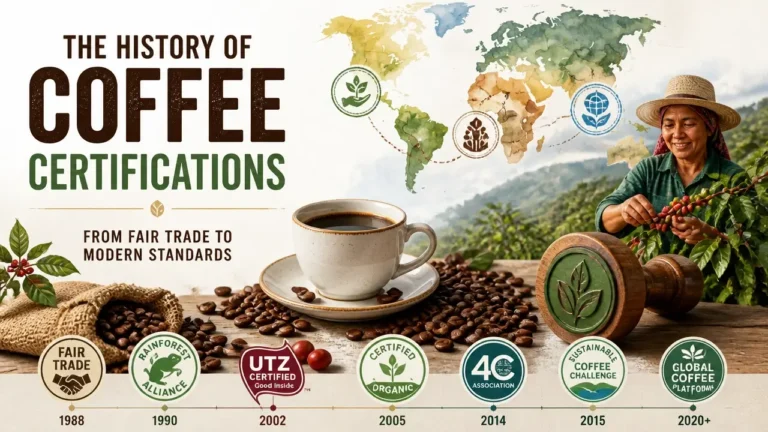

Modern coffee certifications didn’t emerge from a marketing department. They grew out of a political fight – one that started in church basements and solidarity movements decades before a single label reached a supermarket shelf. The Mennonite Central Committee, UNCTAD trade conferences, and Dutch consumer boycotts all left fingerprints on the system roasters and retailers now take for granted.
What followed was 80 years of ideological battles, structural innovations, painful schisms, and corporate consolidation. The story isn’t a clean arc of progress. It’s a story about what happens when moral conviction tries to rewire an economic system – and keeps running into the system’s own logic.
While ethical trade frameworks tried to reshape the economics of the supply chain, the cultural landscape of specialty coffee was simultaneously being redefined by visionary famous coffee roasters who transformed how the world viewed the roast itself.
These evolving economic ideals and structural shifts ultimately laid the groundwork for the aesthetic and ethical values defining modern 3rd wave coffee culture today.
To fully grasp these economic contradictions, it helps to examine the history of big coffee brands and the realities they often conceal from everyday consumers.
Key Takeaways on the History of Coffee Certifications
- The first ethical trade channels were built by religious organizations in the 1940s, not by the coffee industry – certification came decades later as the formalization of an existing political impulse.
- The Max Havelaar label’s true innovation was structural: a third-party minimum price floor and social premium, not just a consumer story, created the architecture every subsequent certification copied or reacted against.
- The cost of proving compliance – audits, paperwork, traceability systems – was an unfunded mandate from day one, quietly filtering out the most marginalized producers the system was built to serve.
- The 2011 Fair Trade USA / Fairtrade International split permanently broke the consumer’s ability to treat a “fair trade” label as a single, coherent signal.
- The Rainforest Alliance / UTZ merger in 2018 marks the certification movement’s maturation into an industrial standardization phase, raising a direct question about what is lost when competitive tension between standards disappears.
- Blockchain traceability doesn’t automatically redistribute power – research shows it can replicate the existing imbalance in a more sophisticated digital form, with producers bearing costs while downstream firms capture data value.
When Morality Entered the Market: The Post-War Roots of Ethical Trade
Ethical coffee trade didn’t start with a consumer label. It started with a political question: could buying habits become a tool for economic justice? Before any seal existed, religious organizations and solidarity activists were already building the infrastructure of conscience that would, decades later, produce the certification systems we recognize today. For a full map of where those systems landed, see our complete guide to coffee certifications and standards.
According to Luuk Zonneveld, then Managing Director of Fairtrade Labelling Organizations International (FLO), most public discourse about fair trade certification covers only a fragment of the real picture – or gets it wrong. The history is more contested, more politically charged, and more structurally complex than the clean narrative typically told about it.
That warning matters here. The history of coffee certifications is not a story of steady moral progress. It is a story of genuine idealism, structural blindspots, and a movement that was forced to confront, repeatedly, the gap between its stated mission and the economic reality it was trying to change.
The Alternative Trade Proof-of-Concept: Religious and Solidarity Groups in the Post-War Era
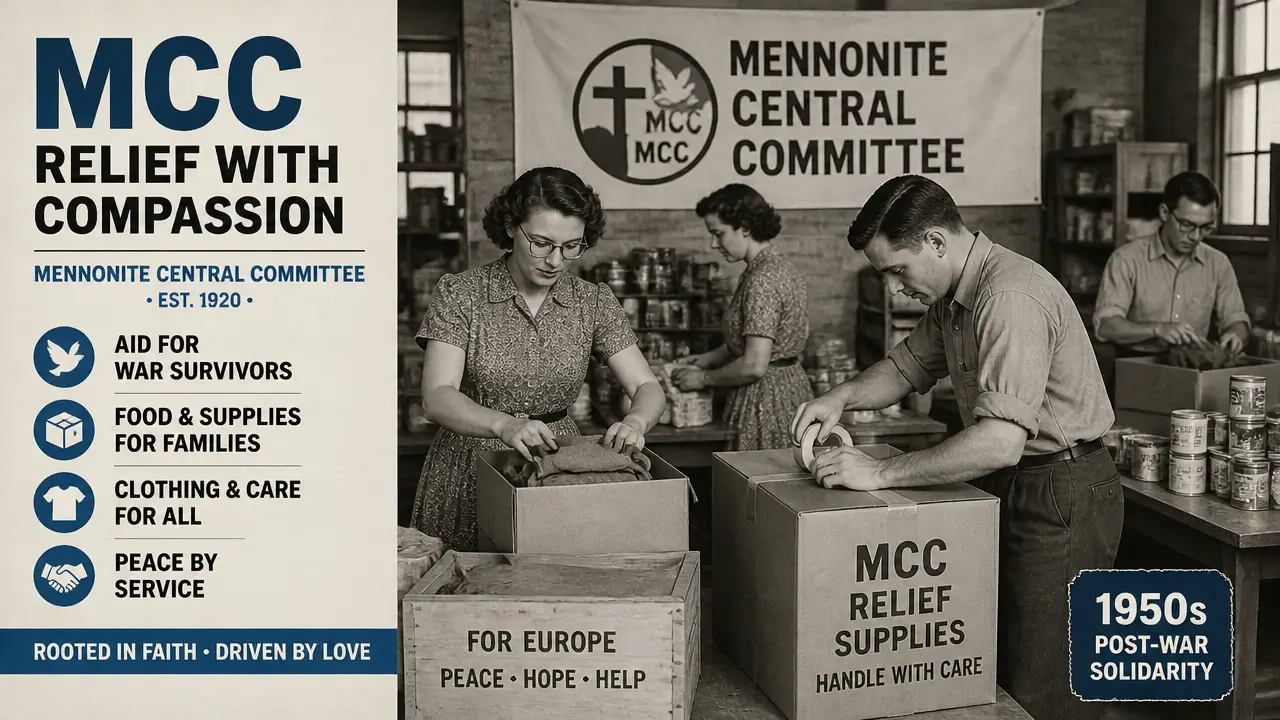
Mennonite Central Committee workers weren’t thinking about coffee in the 1940s. They were thinking about craftspeople in the Global South trapped in a commodity trade that extracted maximum value upward and returned almost none of it. The global trade system after World War II was structurally colonial: prices were set in commodity markets in London and New York, smallholder producers had no negotiating power, and the distance between grower and consumer was designed to stay invisible.
The Mennonite Central Committee’s response was direct. They created alternative trade channels – bypassing conventional wholesale networks to sell handcrafts at prices that reflected real labor costs. Oxfam followed a similar path with its early shops in Britain. Neither organization was building a certification system. They were running a proof-of-concept: that a consumer, given the choice, would pay a price that reflected justice rather than extraction.
These early efforts were political and immediate. They targeted specific producers, specific relationships. What they couldn’t do was scale. And they never asked the question that would define the next 40 years: how do you create a permanent, verifiable system that lets a stranger in Amsterdam fund a better supply chain for a farmer in Guatemala they will never meet?
The architects of the first certification systems saw all smallholder cooperatives as victims of the market. That was accurate. But it contained a blindspot they didn’t see coming. Their assumption – that any cost to access a “fairer” market would be outweighed by the benefit – failed to model that verification systems themselves would create a new kind of exclusion. The most marginalized producers, those with no access to bureaucratic infrastructure, would find the cost of proving compliance just as prohibitive as the original market disadvantage. That contradiction was baked into the foundation.
From “Trade Not Aid” to Political Boycotts: The Ideological Seeds of the Consumer Label
“Trade Not Aid” wasn’t a slogan invented by a marketing consultant. It was a political declaration made at the 1968 UNCTAD conference, and it reframed the entire conversation. Charity, the argument went, maintained dependency. A structural change in trade terms could create dignity. That distinction – between a gift and a fair price – became the ideological seed from which all future certification movements grew.
In the Netherlands, that ideology found its sharpest expression in consumer boycotts. By the 1970s and 1980s, solidarity movements with Central America were targeting coffee specifically – not as a symbolic gesture, but as a calculated economic pressure point. Coffee was identifiable, purchasable, and morally legible to a middle-class consumer. If you could convince someone to stop buying Guatemalan military-linked coffee and buy something else instead, you had a political act dressed as a shopping decision.
The conceptual leap from “don’t buy that” to “buy this instead, and here’s a label to prove it’s different” seems obvious in retrospect. At the time, it was a genuine structural innovation. But this early movement was ideologically monolithic in a way that contained the seeds of its own future rupture. Its focus was exclusively on smallholder cooperatives – democratically organized, independently audited, structurally separate from plantation agriculture. That purity was its moral strength. It was also, as the movement scaled, the fault line along which it would eventually crack.
The Max Havelaar Effect: How a Dutch Label Invented the Modern Certification System
The Max Havelaar label, launched in the Netherlands in 1988, is the single most important event in the history of coffee certifications. Everything before it was a movement. Max Havelaar was a mechanism. It answered the question that the solidarity activists had left open: how do you give a distant consumer a verifiable reason to trust that their purchase actually changed something?
The Narrative and Structural Innovation of the Max Havelaar Label
The name itself was a political statement. Multatuli’s 1860 novel Max Havelaar was a searing indictment of Dutch colonial exploitation in Java – a book that had haunted the Netherlands’ national conscience for over a century. Naming the label after it was not accidental. It reframed the act of buying certified coffee as cultural restitution, not just ethical consumption. Consumers weren’t buying a product. They were participating in a reckoning.
But the narrative power rested on a structural innovation that was genuinely unprecedented. For the first time, a third-party certification model set a specific minimum price for a commodity – a price floor that could not be undercut by market volatility – plus a social premium paid directly to cooperatives for community investment. This effectively created a parallel market that operated outside the International Coffee Agreement’s pricing mechanisms. The label didn’t just tell a story. It changed the math.
The architecture was clean: an independent certifying body set the standards, audited compliance, and licensed the seal. Roasters paid a licensing fee. The premium flowed to producers. The consumer saw a logo and understood, roughly, what it meant. Every major certification system built since 1988 is either a copy of this architecture, a modification of it, or a deliberate reaction against it.
The Exclusive Smallholder Model and the Fragmented International Proliferation
The original criteria were uncompromising. Smallholder cooperative model only. Democratic governance. Independent auditing. No plantations, no estates, no exceptions. This constraint was a feature, not a limitation – it defined exactly what the label was certifying and gave it moral clarity.
The model spread fast. TransFair emerged in Germany. The Fairtrade Foundation launched in the UK. By the early 1990s, a dozen national initiatives were running variations of the same system across Europe and North America. The problem was that “the same system” was not actually the same system. Each national initiative had developed its own standards, its own audit procedures, its own licensing structures. A label that was supposed to give consumers a single, trustworthy signal was now a patchwork of related but not identical guarantees. FLO – the Fairtrade Labelling Organizations International – was founded in 1997 specifically to harmonize this fragmented landscape into a coherent global standard.
While “fair price” was the ethical headline, the system’s real durability came from a less-discussed innovation: the audit trail. Paper-based traceability from farm to shelf was genuinely new, and it created the bureaucratic backbone that gave the label legal and commercial credibility.
That backbone had a hidden price tag. The requirement for democratic cooperative structures, while admirable, was an expensive verification process. Audits, paperwork, traceability systems, annual re-certification fees – these were costs the system never funded. From the first day, the cost of proving compliance was an unfunded mandate that quietly filtered out the most marginalized producers. The farmers the system was built to serve most urgently were, in many cases, the ones least equipped to navigate its paperwork. That silent contradiction was not a later corruption of the model. It was in the model’s DNA.
From Soil to Canopy: The Parallel Rise of Organic and Bird-Friendly Standards
While Fair Trade was building its economic architecture, a separate set of standards was emerging from an entirely different starting point: field science. Organic and Bird Friendly certifications didn’t grow out of solidarity movements. They grew out of laboratories and field surveys, and they introduced something the Fair Trade model had not attempted – measurable, auditable ecological outcomes.
The Regulatory and Scientific Origins: USDA Organic vs. Bird Friendly’s Conservation Crisis
USDA Organic took shape through the 1990s and was formally implemented in 2002. Its approach was regulatory: define environmental good by what you prohibit. Synthetic pesticides, synthetic fertilizers, genetically modified inputs – banned. The standard didn’t require a farmer to improve biodiversity or reduce carbon. It required the absence of specific chemical categories. That prohibition-based logic made compliance verifiable, but it also made the standard ecologically incomplete. A farm could be fully certified organic and still be an ecological monoculture.
Smithsonian Bird Friendly came from a different place entirely. It wasn’t a philosophical preference for natural farming. It was a direct, measurable response to a scientific emergency. Studies by Wunderle & Latta in 1994 and Perfecto and colleagues in 1996 documented catastrophic declines in migratory bird populations across Latin America, traced directly to the conversion of traditional shade-grown coffee farms into sun-cultivated monocultures. Deforestation for coffee wasn’t an environmental side effect. It was the primary driver of habitat loss for dozens of North American migratory species.
The tension behind the Organic standard is worth examining honestly. For sun-coffee farmers who lacked sufficient on-farm organic matter for mulch and soil amendment, compliance meant purchasing external certified organic inputs at prices that often exceeded any premium the label returned. The marketing narrative that organic certification is a universally accessible “choice” obscures a harder reality: it was only ecologically and economically viable for farmers already operating in specific agroforestry systems with the right canopy and soil structure. For everyone else, it was a cost barrier dressed as an environmental standard.
According to Dr. Robert Rice, Research Scientist and co-founder of the Smithsonian Migratory Bird Center’s Bird Friendly certification, the standard’s power comes from its layered design. A roaster he spoke with described Bird Friendly as holding the highest bar for protecting habitat. Because the certification requires organic compliance as a baseline, it addresses soil management simultaneously. Rice notes that over 90% of Bird Friendly farmers are smallholders organized in cooperatives who also hold Fair Trade certification – making the triple-certified farm a rare but genuinely comprehensive signal: social and economic criteria through Fair Trade, environmental and health criteria through organic, and measurable biodiversity outcomes through Bird Friendly.
That stacking logic matters. It means Bird Friendly isn’t just an add-on label. It is a structural multiplier that transforms what other certifications already require into a verifiable habitat outcome.
Measurable Ecological Outcomes: The Precision of Bird Friendly Canopy Standards
Bird Friendly canopy standards didn’t say “grow some shade.” They specified what shade meant as a measurable ecological threshold. To qualify, a farm must maintain a minimum canopy height, a minimum percentage of foliage cover, and at least 11 distinct canopy tree species per hectare. These aren’t arbitrary numbers. They are a scientific hypothesis about the minimum habitat complexity required to support migratory bird populations.
This was the moment certification moved from intention to measurable structural outcome. Fair Trade certified a price relationship. Organic certified an input prohibition. Bird Friendly certified a functioning ecosystem proxy – one that could be independently measured, mapped, and compared over time.
That scientific rigor created a powerful ecological brand. It also created an unintended economic filter. Farmers in regions with naturally lower canopy diversity, or those farming at elevations where specific tree species don’t naturally occur, faced a compliance barrier that had nothing to do with their farming practices and everything to do with their geography. The standard’s precision, which is its greatest strength, is simultaneously the reason it has remained a niche certification rather than a mass-market one.
The deeper point is structural. Bird Friendly works because its criteria are a direct scientific hypothesis about biodiversity. Its success or failure is a measurable scientific question, not a market preference. That makes it unique in the certification landscape – and it raises an uncomfortable question that will matter later: why don’t certifications that claim to empower farmers operate with the same measurable, independently audited economic thesis?
Seals for the Supermarket Shelf: The 1990s–2000s Era of Mainstreaming and Multi-Stakeholder Giants
The second wave of coffee certifications didn’t emerge from church basements or field biology labs. It emerged from a strategic calculation: if you want to change how the world’s largest coffee companies source their beans, you have to build a standard they can actually use. To understand what that shift meant structurally – and what it changed about what certifications actually promise – it helps to start with what coffee certifications are at their most basic level.
The Strategic Rebuke: Rainforest Alliance and UTZ as Mainstream Multi-Stakeholder Initiatives
Rainforest Alliance entered coffee in the early 1990s. UTZ certification (originally Utz Kapeh, meaning “Good Coffee” in the Mayan Kaqchikel language) followed in the early 2000s. Both were a direct strategic response to the limitations of the Fair Trade model – not a rejection of its goals, but a rejection of its architecture.
The pitch was explicit: mainstream transformation, not niche alternative. Instead of a smallholder-only cooperative model, these were multi-stakeholder initiatives – governance structures that included NGOs, corporations, and producer representatives simultaneously. Instead of a mandatory minimum price, they set a broader basket of criteria covering environmental management, worker welfare, and basic social practices. The decoupling from a specific price floor was not an oversight. It was a deliberate design choice that made the certifications accessible to large estates and corporate supply chains that the Fair Trade model structurally excluded.
This was either a pragmatic expansion of the movement’s reach or a dilution of its core promise, depending on who you asked. That debate was never resolved. It simply got louder.
Scalability and Standardization: Appealing to Roasters and Creating Meta-Standards
The appeal to massive roasters was straightforward. Nestlé, Kraft, and their peers were not going to restructure their supply chains around the cooperative-only model. But they were facing growing consumer and regulatory pressure to demonstrate sustainability. Rainforest Alliance and UTZ gave them a path: certify not just the best acre, but the entire volume of a vast estate. Transform procurement at scale without dismantling the procurement structure.
Statistical Data: By 2009, approximately 8% of the global trade in green coffee was covered by mainstream certifications and sustainability standards – Trends in the Trade of Certified Coffees, ResearchGate
Eight percent sounds modest. In a commodity market moving tens of millions of 60-kilogram bags per year, it represented a significant reorientation of sourcing behavior by some of the world’s largest buyers.
The crowded label landscape created a new problem: comparability. How does a procurement officer at a multinational evaluate a Rainforest Alliance audit against a UTZ audit against a Fair Trade audit? The ISEAL Alliance emerged as a meta-standard body, setting credibility criteria for how certification systems themselves should operate – their standard-setting processes, their auditing rigor, their claims. Later, the Global Coffee Platform attempted to create sector-wide alignment. The industry had not just acquired certifications. It had acquired a certification system that needed its own governance layer.
The Great Schism: Direct Trade’s Revolt and the 2011 Fair Trade Rupture
The Fair Trade movement schism didn’t arrive without warning. The pressure had been building for years – from outside the movement, through the Direct Trade revolt, and from inside it, through an unresolved argument about what the original mission actually required. When it broke, it broke in public.
The Direct Trade Revolt: Third-Wave Roasters’ Philosophical Challenge to Certification
Direct Trade was not a certification. That was the point. When Intelligentsia Coffee and Counter Culture Coffee began describing their sourcing practices in the early 2000s, they were making a deliberate argument: that a seal issued by a third party was a bureaucratic ceiling, not a floor. The real signal of equity, they argued, was a long-term direct relationship with a specific producer, with verified premiums paid at prices far above the Fair Trade minimum, and with transparent, published price data.
The structural catalyst was the “decoupling” that Rainforest Alliance and UTZ had institutionalized. A roaster could put a Rainforest Alliance frog on a bag of mediocre commodity coffee, charge an ethical premium, and point to an audit. The actual price paid to the farmer could sit just above the market floor. Third-wave roasters argued this created a “halo of sustainability” – visible on the label, invisible in the producer’s income.
Direct Trade had its own blindspot. It was unverifiable by any third party. The roaster’s word was the only audit. It worked as a philosophy for small, values-driven companies with transparent sourcing. It scaled poorly, and it had no mechanism for accountability beyond reputation.
The 2011 Fair Trade Schism: Plantation Certification and the Collapse of Unity
Fair Trade USA’s decision in 2011 to allow the certification of large plantations – breaking the foundational smallholder-cooperative-only rule – was the single most consequential political event in the history of coffee certifications. CEO Paul Rice framed it as pragmatic inclusion: more farmers helped, more volume certified, more impact at scale.
According to Paul Rice, CEO of Fair Trade USA, the original model’s exclusive focus on price and premium was always a means to an end – better livelihoods for producers – not the end itself. His vision for the future involves a more integrated model that creates measurable value for both producers and the industry simultaneously, built on collaboration rather than a fixed ideological framework. He describes fair trade fundamentally as a handshake between producers and industry, one that must evolve to reflect how value is actually created across the supply chain.
Fairtrade International and the national organizations that stayed with it saw it differently. Certifying plantations meant certifying wage labor on estates owned by wealthy landholders – the precise economic structure the movement had been built to counteract. The smallholder-only rule wasn’t an arbitrary constraint. It was the moral logic of the entire system.
The fallout was immediate and lasting. Fair Trade USA departed from the Fairtrade International network. Two organizations now competed for the same label space on the same supermarket shelves, with meaningfully different standards and, critically, similar-looking logos. Consumers who had been told the seal was a reliable signal were now navigating a contested landscape where two entities claimed the same moral authority with different underlying rules.
The movement’s central promise – singular, consumer-facing clarity – was shattered by its own internal contradictions. The logic of scale (help more farmers by certifying more supply chain actors) had collided with the logic of purity (protect the original mission by maintaining the original structural constraints). Neither side won. The consumer was left to navigate the debris.
The philosophical war between scale and purity left the industry with a messy public dispute. But this ideological turmoil was about to be mirrored by an even more fundamental restructuring – the cold business logic of merger and consolidation.
Artists and Auditors: The Consolidation Era and the SCA’s Separate Peace
Coffee certification consolidation after 2011 followed two distinct tracks. The commodity world moved toward merger and simplification. The specialty world built its own parallel universe of standards, one that had almost nothing to do with farms and everything to do with the cup.
In 2018, Rainforest Alliance and UTZ merged into a single standard. This was not a strategic alliance. It was a Darwinian response to “certification fatigue” – the exhaustion that procurement officers, retailers, and consumers felt navigating a landscape of overlapping, competing seals with similar-sounding claims. A single mega-standard simplified sourcing decisions for the world’s largest buyers. It gave Nestlé one audit to manage instead of two. It gave retailers one frog logo to explain.
The consolidation logic is clarifying. When two major certifications merge, the movement has matured past the phase of ideological proliferation and entered the phase of industrial standardization. The open question that consolidation raises is significant: are we moving toward a single global coffee sustainability standard? And if we are, what is lost when the competitive tension between standards disappears – when there is no longer a rival framework to challenge the dominant one?
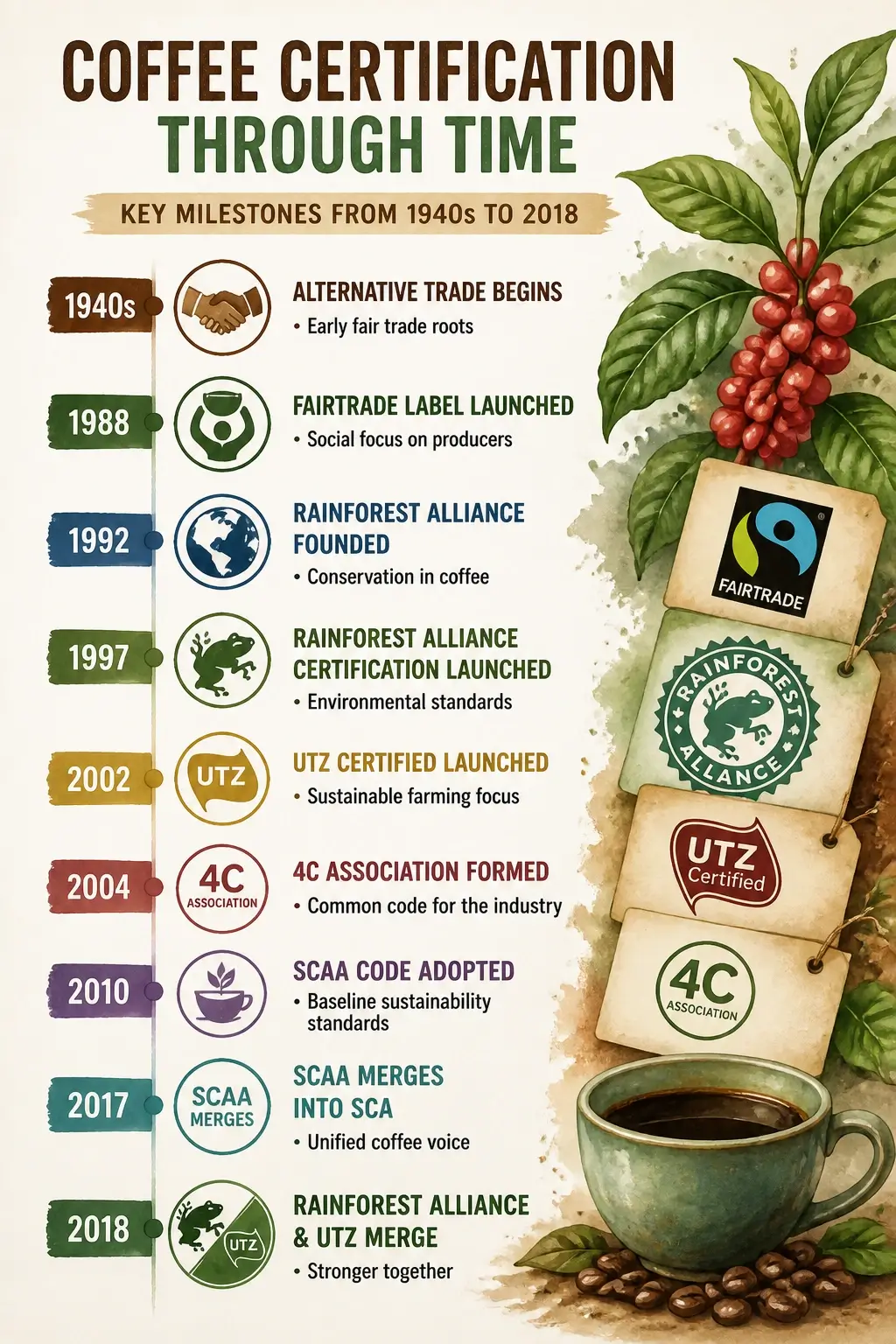
While international certifiers were merging their auditing operations, the Specialty Coffee Association was building something structurally different. The SCA’s origins trace to 1982, and its trajectory has always run parallel to the sustainability certification world without ever fully intersecting it. Where Rainforest Alliance was certifying farms, the SCA was certifying flavor.
The evolution of the SCA cupping form – the standardized sensory evaluation protocol – is the key device here. The SCA built a rigorous, reproducible system for measuring coffee quality on a 100-point scale, with specific criteria for fragrance, aroma, acidity, body, and aftertaste. A coffee scoring above 80 points becomes “specialty” by definition. Below that threshold, it is commodity, regardless of how it was grown or who grew it.
The Q Grader program took this further. Developed in collaboration with the Coffee Quality Institute, it created a licensed human certification – a professional sensory judge qualified to apply the cupping protocol with statistical reliability. The Q Grader is a certified taster, not a certified auditor. The credential verifies a person’s palate and methodology, not a farm’s labor practices.
According to Drew Billups, an independent coffee educator, certified Q Arabica Instructor, and member of the Q steering committee, the relationship between the SCA and the Q system has become a test of institutional confidence. His analysis of the SCA’s recent moves toward controlling the Q program frames it as an insistence on form over function – an attempt to suppress a rival evaluation system not because the rival system is inferior, but because the dominant institution isn’t confident its own form can compete on merit alone.
That institutional friction reveals something about the specialty world’s parallel certification ecosystem: it is not immune to the same power dynamics and consolidation pressures that reshaped the sustainability certification world. The tools are different – sensory scores instead of audit reports – but the organizational logic is the same.
The modern landscape is a two-tier reality. On one tier: a consolidated world of auditing firms managing sustainability risk for commodity supply chains, where the Rainforest Alliance frog signals baseline compliance to procurement departments at multinational roasters. On the other: a fragmented world of roasters, judges, and quality intermediaries using sensory science to certify taste, where an 87-point cupping score and a Q Grader’s signature command a price premium that no sustainability seal can match.
These two tiers rarely speak to each other. A coffee can be triple-certified – Fair Trade, Organic, Bird Friendly – and score below 80 points on the SCA scale. Another coffee can score 92 points and carry no sustainability certification whatsoever. The systems measure different things, and neither one measures everything.
PERSPECTIVE: The Unfinished Revolution – Pixel Trails and the Persistent Gap
The future of coffee certification standards isn’t being written in a certification body’s boardroom. It’s being written in European Union regulatory offices, blockchain development labs, and, most importantly, in the unresolved political question of who owns the data that a more transparent supply chain generates.
The Standards Market and Digital Traceability: Blockchain and Due Diligence
Digital traceability in coffee certification has moved from a pilot project to a competitive frontier. Today’s landscape is not a battle between good and bad actors. It is a competitive market of standards, and the rules of that market are changing. The EU’s mandatory due diligence laws – regulations that require companies to demonstrate that their supply chains are free from deforestation and human rights violations – are converting what were once voluntary certifications into compliance requirements. A standard that was once a marketing differentiator is becoming a legal floor.
Blockchain technology enters this landscape as a proposed solution to the oldest problem in certification: audit integrity. A paper-based audit trail can be forged, backdated, or selectively presented. A blockchain-based record, in theory, creates an immutable, timestamped ledger of every transaction and quality check from farm to roaster. AI-driven farm-mapping adds a satellite layer: independent verification of canopy cover, farm boundaries, and land-use change that doesn’t depend on a human auditor’s field visit.
The promise is genuine. The pixel trail replacing the paper trail could close the fraud window that has allowed some certified coffees to carry seals their supply chains don’t fully support.
The Unfinished Revolution: Visible Supply Chains, Invisible Power Imbalance
The collective legacy of 80 years of coffee supply chain power imbalance work is this: the coffee supply chain is now more visible than at any point in its history. From the Max Havelaar label’s first audit trail to blockchain-enabled lot tracking, the movement succeeded in making opacity costly and transparency commercially valuable.
It did not restructure the power imbalance between roaster and farmer.
The price minimum that seemed radical in 1988 was already below the cost of production for many farmers by the 2000s. The social premium flowed to cooperatives, not individual households. The audit costs were absorbed by producers, not buyers. The premium for certified coffee was captured almost entirely by the roasting and retail end of the chain – the end that was already capturing most of the value.
A 2022 study published in Frontiers in Blockchain examined blockchain-based transparency systems in coffee value chains and found a pattern that should concern anyone who believes that better data automatically produces better outcomes. The study introduces the concept of “data squeeze”: lead firms – roasters and retailers – convert producer-generated data into monetizable assets through branding and marketing, while the upstream producers who generated that data bear the implementation costs and risks. Blockchain doesn’t redistribute power. It creates a new, more sophisticated mechanism for the same downstream capture of upstream value.
That finding is the movement’s original sin made visible in a new technology. The cost barrier that filtered out the most marginalized producers from the first certification systems in the 1980s hasn’t disappeared. It has been digitized. The farmer who couldn’t afford annual audit fees in 1995 is now the farmer who can’t afford the smartphone, connectivity infrastructure, or data management capacity that a blockchain-based traceability system requires.
The Bird Friendly standard offers the most useful model for thinking about what comes next. It works because it was built around a clear, measurable scientific thesis: specific canopy structure supports migratory bird populations. That thesis can be tested. The outcomes can be measured independently. The standard either achieves its stated ecological goal or it doesn’t, and the science will say which.
No major sustainability certification has ever been built around an equivalent economic thesis. None has defined a clear, independently auditable metric for farmer economic empowerment – not “a price above market,” not “a premium paid to the cooperative,” but a measurable change in producer household income, asset accumulation, and economic resilience over time.
Until that metric exists and is independently audited with the same rigor that Bird Friendly applies to tree species counts, the equity claims on certification labels remain a story the industry tells itself. The supply chain is visible. The power imbalance is not.
Frequently Asked Questions About the History of Coffee Certifications
Why did the Max Havelaar label choose coffee as its first product rather than another commodity?
Coffee was already politically charged in the Netherlands – boycotts against Central American coffee had created an informed consumer base willing to pay more for an alternative. It was the one commodity where the demand infrastructure for an ethical label already existed before the label did.
What’s the actual difference between a Fair Trade minimum price and a Direct Trade premium?
The Fair Trade minimum is a contractual floor set by a third party, independent of what any specific roaster is willing to pay. A Direct Trade premium is whatever a specific roaster voluntarily agrees to pay above market – unverified by any independent party, which means it can be as high or as low as the roaster’s conscience and business model allow.
Did the 2011 Fair Trade USA split ever get resolved?
No. Fair Trade USA and Fairtrade International continue to operate as separate organizations with different standards and similar-looking logos. The split is permanent, and consumers navigating both labels in a supermarket today are navigating two genuinely different certification systems with different criteria for what qualifies.
How does a Q Grader certification relate to farm-level sustainability certifications?
They operate in entirely separate systems. A Q Grader is a licensed sensory judge who evaluates cup quality against the SCA’s 100-point protocol. That score says nothing about how the coffee was grown, who grew it, or what they were paid. A farm can be triple-certified for sustainability and score below specialty grade, or score 92 points with no sustainability certification at all.
Why hasn’t the Bird Friendly standard scaled the way Rainforest Alliance has?
Its precision is the constraint. The requirement for a specific canopy height, foliage cover percentage, and minimum of 11 tree species per hectare disqualifies farmers in regions where that ecological profile doesn’t naturally occur – regardless of their farming intentions. Rainforest Alliance set a broader, more flexible basket of criteria that more farms could reach, which made it far more attractive to large-volume buyers.
What does the EU’s mandatory due diligence legislation actually change for certification?
It converts voluntary certifications into legal compliance requirements for companies selling into the EU market. A standard that was previously a marketing differentiator – something a company could choose to pursue for brand reasons – becomes a minimum threshold for market access. That shifts the incentive structure from “this label helps us charge more” to “we need this label to sell here at all.”
Is there any certification that independently measures whether farmers are actually better off economically?
No major certification currently publishes independently audited data on producer household income or economic resilience as a pass/fail criterion. Premiums and price floors are audited, but the downstream economic outcome for the farmer – whether their actual livelihood improved – is not part of any standard’s current compliance framework.
What is “data squeeze” in the context of blockchain coffee traceability?
It’s the mechanism by which lead firms – roasters and retailers – convert the traceability data generated by upstream producers into marketing and branding assets, capturing the commercial value of that transparency while the producers who generated the data bear the implementation costs. The farmer’s harvest data becomes the roaster’s sustainability story, without any corresponding transfer of economic value back to the farm.
References
- ICC-101-4E, International Coffee Organization – ico.org
- Bird Friendly Certification: Decidedly Good for Birds, but What About Farmers? | dailycoffeenews.com
- Emotions and Details Emerge as SCA Plans Takeover of the Q | dailycoffeenews.com
- Fair Trade USA Freezing Price Minimums, Plans to Revise Model | dailycoffeenews.com
- Trends in the Trade of Certified Coffees | researchgate.net
- Coffee Producers’ Perspectives of Blockchain Technology in the Context of Sustainable Global Value Chains | frontiersin.org