

A well-built festive Christmas decaf espresso martini earns its place as the season’s best after-dinner cocktail. It delivers roasted coffee depth, holiday spice warmth, and a thick crema foam crown, all without the caffeine that turns a 10 PM celebration into a 2 AM staring contest with the ceiling.
Getting there requires solving three technical problems in the right order: protecting your sleep architecture, pulling crema from decaf, and introducing spice without destroying the foam. Each has a specific fix.
Key Takeaways on Festive Christmas Espresso Martini Recipe
- Swiss Water Process decaf removes 97-99% of caffeine while preserving the coffee lipids and CO2 that produce thick, velvety crema foam.
- Never add raw ground cinnamon or nutmeg to the shaker; hydrophobic bark particles puncture crema bubbles and collapse the foam before serving.
- Top decaf beans for cocktails: Stumptown Trapper Creek (chocolate, dried fruit), Counter Culture Slow Motion (molasses, caramel), Lavazza Dek (reliable crema at low cost).
- The calibrated ratio is 1.5 oz vodka, 1 oz decaf espresso, 0.75 oz coffee liqueur, 0.5 oz festive spiced demerara syrup; use whole-spice infused syrup only.
- A violent 15-second shake and mandatory double-strain through Hawthorne and fine-mesh sieve are required for microfoam that holds past four minutes.
The Holiday Sleep Paradox: Enjoying Late-Night Indulgence Without 2 AM Waking
Holiday parties run late by design. The problem with a standard espresso martini at 10 PM is that you are combining two molecules that work against each other and against sleep.
Caffeine operates by blocking adenosine receptors in the brain. Adenosine is the compound your body builds up across the day as a fatigue signal. Block those receptors and the signal never registers, keeping you alert regardless of how tired you actually are. Ethanol, working simultaneously, depresses the central nervous system. The result is the well-documented “wide-awake drunk” state: your body is chemically sedated, but the caffeine prevents the brain from entering the restorative sleep cycles that sedation normally enables.
The downstream consequence runs into the next morning. Sleep medicine research shows that consuming 60mg of caffeine past 8 PM delays melatonin release by roughly 40 minutes. Melatonin is the signal that triggers sleep onset. Delay it by 40 minutes with caffeine, compound it with alcohol’s own suppression of REM sleep, and you get elevated resting heart rate, 2 AM awakenings, and morning fatigue that no amount of Christmas coffee reverses.
A standard single espresso martini carries 60-80mg of caffeine. That is precisely the threshold where the damage starts.
Swiss Water Process decaf removes 97-99% of caffeine while preserving everything else in the bean: the roasted pyrazines, the Maillard-reaction caramel compounds, and critically, the coffee lipids that produce crema. Switching to decaf does not produce a lesser drink. It produces the same drink without the pharmacological penalty.
The Crema Chemistry: Why Swiss Water Decaf Beans Produce Flawless Foam
The belief that decaf espresso cannot foam properly is wrong at a basic chemistry level. Caffeine is a water-soluble alkaloid with no surfactant properties whatsoever. It plays zero role in foam formation. Crema is an emulsion of pressurized CO2 gas trapped inside the coffee’s lipid matrix, a network of fatty acids and oils extracted from the bean under 9 bars of hydraulic pressure. Remove caffeine and you have not touched the lipid matrix.
What decaffeination does affect is the bean’s physical cell structure. The Swiss Water Process and Mountain Water Process both saturate green coffee beans with water before stripping the caffeine. This saturation makes the cell walls slightly more porous than a standard caffeinated bean. The practical consequences are two.
First, decaf beans degas faster. CO2 migrates out of porous cell walls more quickly than it escapes from denser caffeinated beans. A freshness window of 2-4 weeks post-roast is not optional; it is the difference between dense, stable crema and thin, collapsing bubbles that vanish before the glass reaches the table.
Second, standard grind settings produce channeling. Because porous decaf grounds offer less hydraulic resistance to water, the machine finds easy paths through the puck, bypassing the dense coffee bed. The result is a fast-running, sour, under-extracted shot with sparse crema. The fix is mechanical: grind 1 to 2 steps finer than your calibrated caffeinated setting and dose at 19g instead of 18g. Together, these adjustments restore the hydraulic resistance the machine needs to build 9 bars of pressure across the full puck surface.
Pull time should stay at 25-30 seconds for a 1:2 ratio. If the shot runs faster than 25 seconds, grind finer. If it stalls past 32, back off one notch.
Mastering this lipid-driven foam stability is essential whether you are pouring a holiday decaf variant or perfecting a classic espresso martini creamy top.
The Best Decaf Coffee Beans for Craft Cocktails
Not all decaf beans are equal in the portafilter or the shaker. The cocktail context has a specific requirement: roast depth and tasting notes must hold their own against spirit heat, liqueur sweetness, and holiday spice without disappearing into a flat, bitter background note.
Stumptown Trapper Creek (Swiss Water Process) is the strongest starting point. Its tasting notes run toward milk chocolate, dried stone fruit, and toasted pecan, a profile that cuts through spirit heat cleanly and integrates with cinnamon and nutmeg without fighting them. The bean density produces reliable crema yield under pressure.
Counter Culture Slow Motion brings a velvety body with molasses sweetness and deep caramel. It extracts with exceptional lipid density, which translates directly into foam thickness and stability. For readers who want the richest, most dessert-like crema, this is the option.
Lavazza Dek is the practical choice. An Italian medium-dark roast calibrated specifically for espresso machines, it delivers thick, consistent crema at a supermarket price point. The flavor profile is straightforward: dark chocolate and roasted grain. It will not produce the specialty complexity of Stumptown or Counter Culture, but it performs reliably in the portafilter and costs a fraction of the specialty options.
What to avoid: any Nordic light roast. Light-roasted decaf carries significant malic acid and citric acidity. Those acids clash against high-proof vodka’s ethanol, amplify in the cold shaker, and produce a sour note that no amount of festive syrup can mask. The tasting notes to select for are baker’s chocolate, dark caramel, and roasted almond. If the bag says “bright,” “citrus,” or “berry forward,” put it back.
The Festive Flavor Architecture: Spices, Syrups, and the Hydrophobic Particle Trap
Adding holiday spice to an espresso martini is where most home bartenders destroy the drink before it reaches the glass.
The instinct is to toss ground cinnamon or freshly grated nutmeg directly into the shaker tin. This is the fatal mistake. Ground cinnamon is composed of insoluble wood bark particles. Those particles are hydrophobic: they repel water and actively migrate to the surface of liquid interfaces. In a cocktail shaker, they seek out the lipid-CO2 bubble membranes of crema, attach to the outer surface, and rupture them. Ground cinnamon in the shaker does not add flavor to the drink; it destroys the foam before you can pour it.
The correct approach is a festive spiced demerara syrup. The method: bring 1 cup water and 2 cups demerara sugar to a low simmer with 2 whole Ceylon cinnamon quills, 4 cracked cardamom pods, 1 star anise pod, and a thumb-sized piece of cracked nutmeg. Simmer for 15 minutes, remove from heat, steep for another 20 minutes, then strain through a fine-mesh sieve until clear. The resulting syrup carries full holiday spice aromatics from the volatile essential oils without a single solid particle that could rupture crema bubbles.
The sucrose dissolved in the syrup provides an additional structural benefit: it increases liquid viscosity, creating a supportive matrix that physically floats and holds the crema microfoam on the surface of the drink.
The calibrated base ratio:
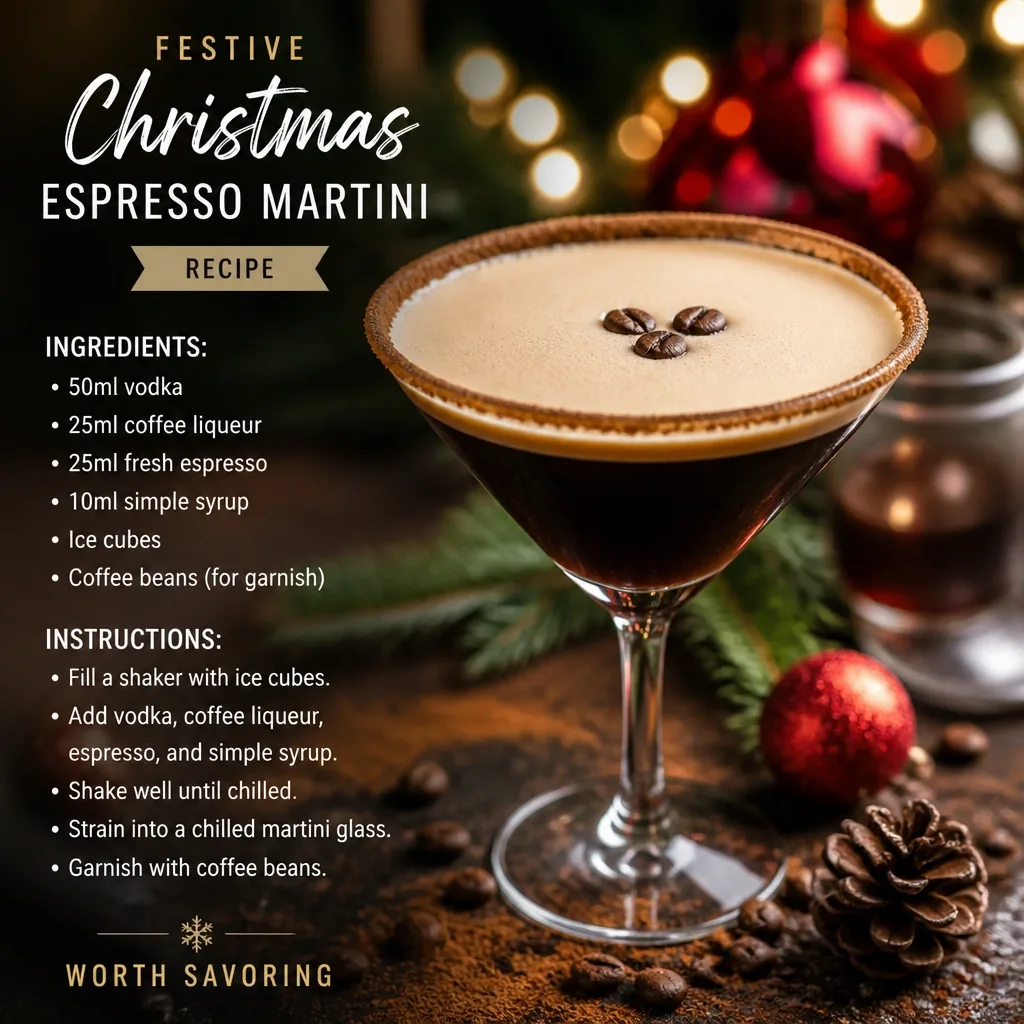
| Ingredient | Amount | |Vodka (or dark spiced rum)| 1.5 oz | |Fresh decaf espresso| 1 oz | |Coffee liqueur| 0.75 oz | |Festive spiced demerara syrup| 0.5 oz |
The espresso is the dominant flavor. The liqueur adds coffee depth and sweetness. The spiced syrup provides the holiday dimension without sweetening the drink into dessert territory. Adjust the syrup to taste after your first build.
Proper spice integration prevents powder clumping, a technique similarly vital when constructing a dramatic Flaming Spanish Coffee Recipe That relies on balanced aromatics.
Step-by-Step Guide: Crafting the Festive Christmas Decaf Espresso Martini
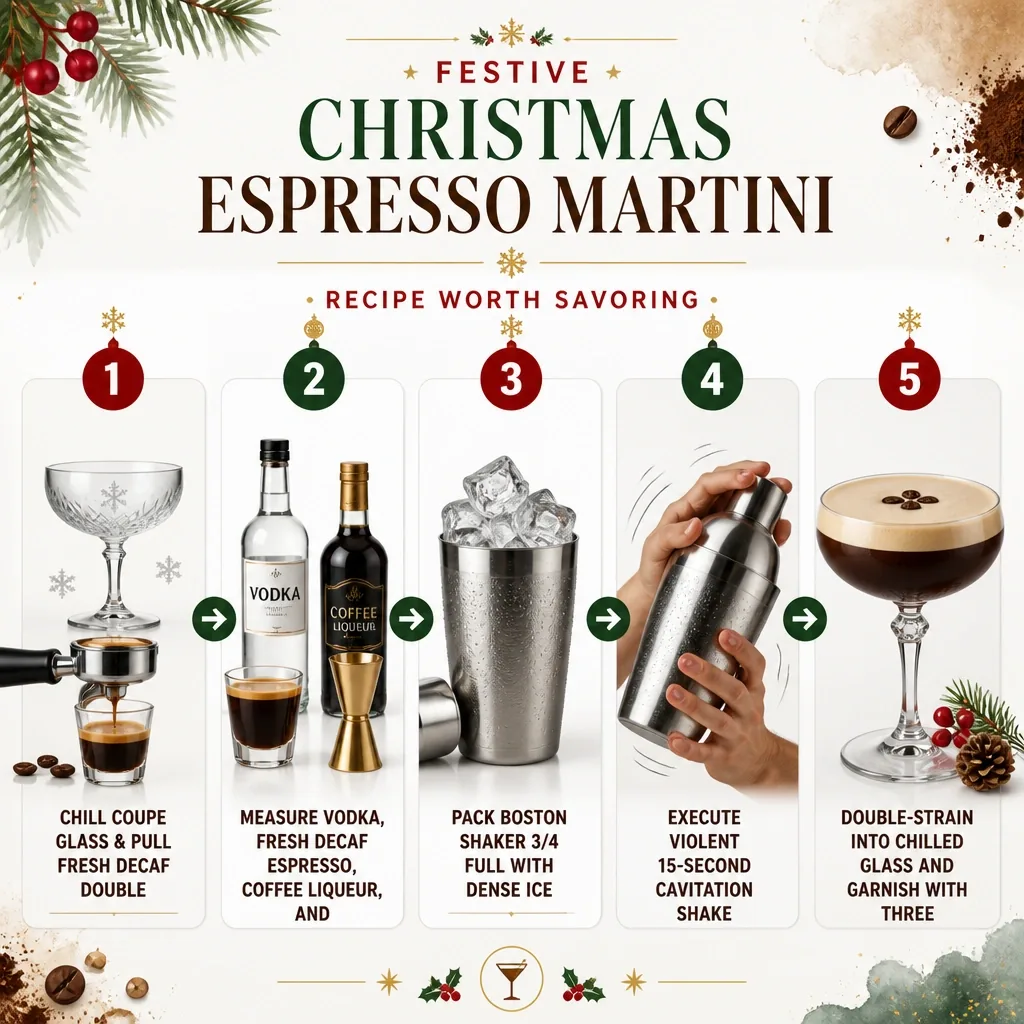
Step 1: Coupe chilling and fresh decaf pull. Fill your coupe or martini glass with ice water and set it aside. Pull your decaf double shot at 1:2 ratio (19g in, 38g out) and rest it for 60 seconds. CO2 concentration in fresh crema is highest in the first 90 seconds after pulling. Do not let it sit longer.
Step 2: Ingredient measuring. Into the larger Boston tin, add 1.5 oz vodka (or dark spiced rum), 1 oz fresh decaf espresso, 0.75 oz coffee liqueur, and 0.5 oz festive spiced demerara syrup. Measure. Do not estimate.
Step 3: Ice loading and the power shake. Fill the Boston tin three-quarters full with large, dense, solid clear ice cubes. Standard hollow freezer-tray ice melts too fast on contact with room-temperature liquid, over-diluting before cavitation completes. Seal the tin and shake violently for 15 seconds. The physics: rapid ice ricochet forces liquid to change direction at high velocity, creating localized low-pressure zones (hydrodynamic cavitation) that trap micro-air pockets inside the espresso lipids. These trapped micro-bubbles are the foam. Anything shorter than 12 seconds does not generate enough kinetic force to emulsify the crema lipids fully.
Step 4: The double-strain. Dump the ice water from your chilled coupe. Position the Hawthorne strainer over the shaker opening and hold the fine-mesh conical sieve between the shaker and the glass. Pour through both simultaneously. The Hawthorne catches ice shards; the fine mesh catches micro-ice fragments that would melt against the foam surface and collapse it within 60 seconds.
Step 5: Festive garnish. For a classic presentation, float three dark-roasted decaf coffee beans on the foam crown alongside a whole star anise pod. For a spice-forward finish, dust the foam lightly with freshly grated whole nutmeg from a microplane. Grated from whole nutmeg directly, this is fine aromatic powder, not the coarse ground product from a jar, and it sits on the foam surface without puncturing the bubbles. Serve immediately.
Creative Holiday Riffs: Gingerbread, Peppermint, and Spiced Rum Variations
The base recipe is a platform. Three ingredient adjustments produce distinct seasonal variations without disrupting the emulsion physics.
Gingerbread Espresso Martini. Add 0.25 oz of fresh ginger juice to the spiced demerara syrup before shaking. Fresh ginger juice carries volatile pungent compounds, gingerols and shogaols, that add sharp warmth without any particle defoaming risk. Rim the coupe with crushed gingerbread cookie crumbs pressed into a thin layer of spiced syrup. Keep the crumb rim on the outside of the glass only; crumbs inside the glass contact the drink and break the foam.
Peppermint Mocha Decaf Martini. Swap 0.25 oz of coffee liqueur for white crème de cacao and add 1 drop of pure peppermint oil (food grade, not extract) to the shaker. White crème de cacao adds white chocolate creaminess without darkening the color. One drop of peppermint oil is enough; two drops is medicinal. Garnish with a single crushed candy cane pressed to the outside of the wet rim.
Spiced Rum Christmas Twist. Replace vodka with aged spiced rum (Mount Gay Eclipse or Sailor Jerry). Aged spiced rum carries its own oak, vanilla, and clove complexity from the barrel, layering directly onto the coffee’s roasted notes and the festive syrup’s cinnamon. The result is a richer, deeper, spirit-forward cocktail that tastes closer to a craft holiday punch than a bar cocktail.
One constraint applies to all three riffs: do not add cream, eggnog, or cream liqueurs into the shaker. Coffee’s natural acidity (pH 4.7-5.0) destabilizes dairy proteins when mixed cold under agitation. Casein in cream curdles on contact with the acidic espresso, producing visible flecks and a broken mouthfeel. If you want a creamy note, float a small layer of lightly whipped cream on top after straining, keeping it separated from the acidic base.
For an even richer dessert-forward profile beyond seasonal gingerbread, incorporate rich Dutch cocoa into your rotation by exploring a decadent chocolate espresso martini recipe.
Frequently Asked Questions About Festive Christmas Espresso Martini Recipe
Can I make a festive espresso martini ahead of time for Christmas parties?
Pre-batch the vodka, coffee liqueur, and spiced demerara syrup up to 48 hours ahead and refrigerate. Pull decaf espresso shots fresh per order and shake each drink individually; batching the espresso destroys the CO2 and produces a flat, foam-free drink.
Does decaf espresso produce as much foam as regular espresso?
Yes, when extracted correctly. Caffeine has no role in foam formation. Crema is CO2 and lipids. Use beans within 2-4 weeks of roast date, grind 1-2 steps finer than your standard setting, and dose at 19g to restore hydraulic resistance.
What are the best decaf coffee beans for an espresso martini?
Stumptown Trapper Creek and Counter Culture Slow Motion are the two specialty choices. Lavazza Dek is the practical everyday option. All three are medium-dark roasts with chocolate and caramel tasting notes that hold up against spirit heat without turning bitter or sour in the glass.
Why did my Christmas espresso martini foam collapse immediately?
Either the espresso was pulled more than 90 seconds before shaking (CO2 escapes fast), the shaker tin was warm (pre-melt the ice before cavitation completes), or raw ground cinnamon was added to the shaker (hydrophobic particles rupture bubbles). Pre-chill the Boston tins, use fresh shots, and keep spice in the syrup only.
Can I use spiced rum instead of vodka in a festive espresso martini?
Yes. Aged spiced rum (Mount Gay or Sailor Jerry) works well and adds oak, vanilla, and clove complexity from its own barrel aging. Keep the rest of the recipe the same; the spiced rum’s flavor layers directly onto the coffee and holiday syrup without breaking the emulsion.
References
- References