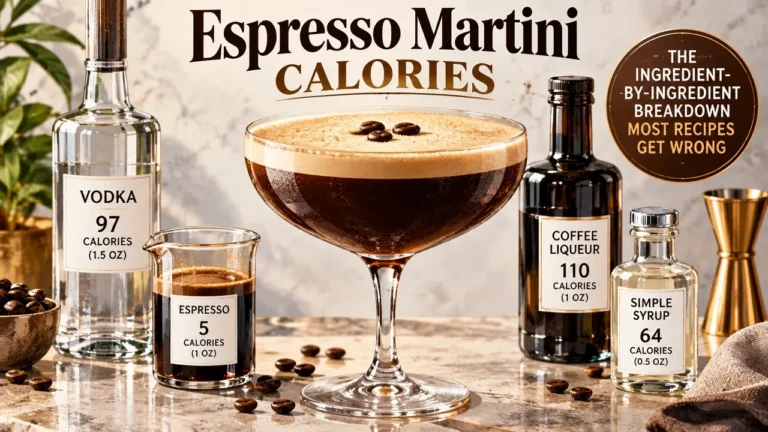

Espresso martini calories are governed by two separate arithmetic lines, and almost every published number conflates them. The ethanol in your vodka delivers 7 kilocalories per gram regardless of what syrup you choose. The sugar in your coffee liqueur delivers an entirely different load that a sweetener swap can actually remove.
Understanding which line you’re cutting – and which one you can’t – is the only way to make sense of the 93-calorie keto claim, the circulating 302-calorie figure, and the “skinny” label that promises more than the arithmetic supports. We’ll build the numbers from scratch, ingredient by ingredient, so you can check every claim yourself.
Key Takeaways on Espresso Martini Calories
- Espresso martini calories run on two independent ledgers – ethanol volume and added sugar – and a sweetener swap never touches the ethanol line.
- Coffee liqueur is a definitional ingredient, not a garnish; its presence or absence changes every calorie figure in the drink.
- The circulating 302-calorie figure is conditional – it belongs to one build, one jigger, one liqueur brand, and one reference body.
- Vodka is carbohydrate-free but not calorie-free; “no carbs” and “low calorie” are different promises, and conflating them is the source of most keto-version confusion.
- A decaf swap drives caffeine to near-zero and leaves the calorie total completely unchanged – the two ledgers are independent.
- Whipped cream and cream-based foam toppings are the most common reason a carefully ordered skinny build lands back near its original calorie total.
The Calorie Map You Can Actually Verify
Espresso martini calories split into two independent ledgers, and that single fact resolves most of the confusion in the category. The first ledger is ethanol volume. Added sugars are another major source of calories. A decaf swap moves your caffeine milligrams toward zero and leaves both calorie ledgers completely untouched. A syrup swap moves your sugar ledger and leaves your ethanol ledger completely untouched. These are not the same problem, and treating them as one is why published numbers conflict so badly.
Four levers move your calorie total, in order of size: the volume of alcohol you pour, the sugar source you use (coffee liqueur carries both ethanol and sugar calories; simple syrup carries only sugar; neither carries zero), the jigger or pour size at the bar, and the total serving volume in the glass. Every “skinny,” “keto,” and “mocktail” variant in the current landscape floats free of any anchor because no source publishes the arithmetic behind its starting point.
A few falsifiable statements worth holding onto before we go further:
- Coffee liqueur is a definitional ingredient, not a garnish. Whether it appears, disappears, or gets substituted changes every number in the drink.
- A spiritless version is not automatically a low-calorie version. Delete the ethanol line and you still have a sugar line, often a larger one.
- “No carbs” and “low calorie” are different promises. Vodka is carbohydrate-free and still delivers roughly 7 kcal per gram of ethanol.
- The circulating 302-calorie figure belongs to one specific build, one jigger size, and one liqueur brand. It is a conditional data point, not a universal law.
This article will not repeat a calorie number without showing the arithmetic behind it.
The Classic Espresso Martini and Why the Baseline Matters
The classic espresso martini is a ratio, not a fixed recipe. That distinction matters because the same drink can deliver meaningfully different calorie totals depending on how that ratio is scaled – and no source in the current landscape publishes a scalable reference point. Without one, every “lighter” version is being compared against a moving target.
London, 1983, and the Original Build
The drink’s documented origin sits in London in 1983, created to order as a caffeinated late-night serve. The original build leaned on coffee liqueur and simple syrup not as an aesthetic choice but as a functional one: the ingredients existed to make fast, under-extracted espresso palatable. Bar espresso in that era was frequently coarse, low-pressure, and short on dissolved solids. Coffee liqueur added sweetness, body, and coffee depth that the shot itself wasn’t delivering. That historical root is the reason the drink’s calorie profile looks the way it does today – the sugar load was engineered in from day one.
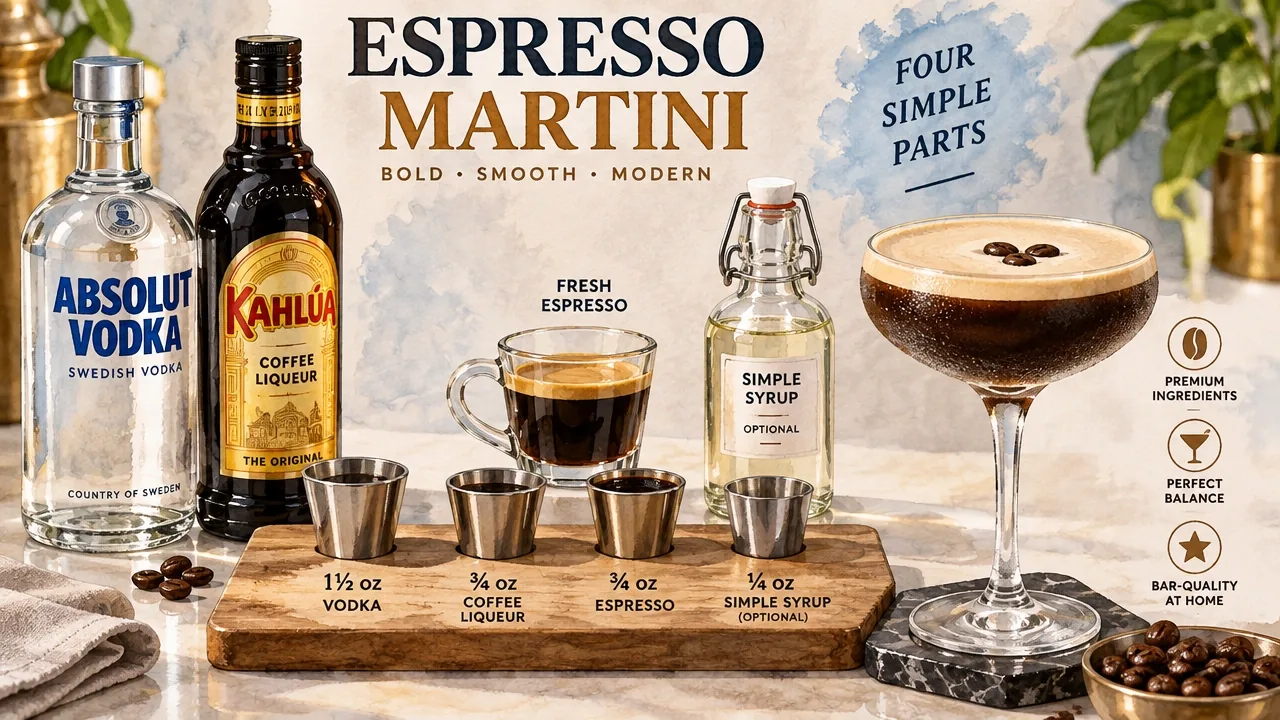
The canonical four-part spec runs volumetrically as follows: 30 ml vodka, 20–30 ml coffee liqueur, 30 ml fresh espresso, and an optional 10 ml simple syrup, shaken hard over ice and served at roughly 120–150 ml total. Serve temperature lands at approximately 0–4°C (32–39°F), which is a deliberate thermal contrast to the hot espresso that went into the shaker. That temperature also means the thermal-injury guidance that applies to hot coffee – drinks above 60°C (140°F) – is simply irrelevant here.
One question worth dispatching in a single line: the “is an espresso martini a ladies’ drink” perception is a marketing artifact, not a formulation one. The spec, and therefore the calorie count, is identical regardless of who orders it.
A natural transition before the build table: here’s what the canonical four-part spec looks like as an assembled drink.
The Ratio Table and Its Fault Lines
Publishing the baseline as a parts ratio lets you scale the build up or down without re-deriving the arithmetic each time. It also gives every later section in this article a fixed reference point to be checked against.
| Component | Volume (ml) | Parts Ratio |
|---|---|---|
| Vodka | 30 | 3 |
| Coffee Liqueur | 20–30 | 2–3 |
| Fresh Espresso | 30 | 3 |
| Simple Syrup (optional) | 10 | 1 |
| Total (approx.) | 120–150 | – |
The definitional fault line in this table is the coffee liqueur column. Across the existing source landscape, one source includes liqueur calories in its nutrition math while omitting it from its ingredient list. Another removes it entirely in favor of sugar-free syrup. Both sources then publish a calorie total as though it applies universally. It does not. Every number in this article is conditional on whether coffee liqueur is present, absent, or substituted – and we will state that condition explicitly each time.
The circulating 302-calorie figure arrives with no attached serving size, no ABV, and no ingredient list. It is a conditional claim about one specific build, not a baseline for the category. We’ll treat it that way.
Where Each Ingredient’s Calories Actually Come From
The ingredient calorie sources in an espresso martini split cleanly across two lines: an ethanol line and a sugar line. Only one of those lines is removable. The Espresso Martini Calorie Map – what comes from where, and why – is the mechanical foundation for every substitution decision that follows.
The Arithmetic, Line by Line
Here is the build, broken into its components:
| Ingredient | Calorie Source | Approximate Calories (per standard measure) | Carbohydrates |
|---|---|---|---|
| Vodka (30 ml, 40% ABV) | Ethanol only | ~65 kcal | 0 g |
| Coffee Liqueur (25 ml, ~20% ABV) | Ethanol + sugar | ~90–110 kcal | 10–14 g |
| Fresh Espresso (30 ml) | Negligible | ~2 kcal | 0 g |
| Simple Syrup (10 ml) | Sucrose only | ~30 kcal | 8 g |
| Cream or Foam Topping | Fat + sugar | ~50–80 kcal | 3–5 g |
Espresso contributes almost nothing calorically. Coffee liqueur is the drink’s dominant sugar engine and carries an ethanol load on top of that. Vodka carries only ethanol.
The mechanism behind the ethanol line is worth stating precisely because it’s the variable most consistently ignored in this category. Alcohol sits on its own energy ledger at 7 kcal per gram – that’s the Atwater factor used in nutrition labelling. It is oxidized preferentially ahead of carbohydrate and fat, meaning your body burns it first. It is not stored as body fat the way surplus sugar is. Its calories are not “offset” by anything else in the glass. They are a fixed cost of every alcoholic version of this drink, and no syrup swap, no sweetener choice, and no garnish decision changes that.
The Carbohydrate-Free Spirit Problem
The label’s flat treatment of the two ledgers is where the misleading claims enter.
A spirit can deliver calories with zero carbohydrate. This is not a paradox – it’s the Atwater factor at work. The keto version of this drink (roughly ¼ cup espresso, ¼ cup sugar-free syrup, ½ cup vanilla vodka, optional whipped cream, yielding two martinis at approximately 93 calories each) carries no carbohydrates precisely because vodka is carbohydrate-free and the syrup’s sugar has been replaced with a non-caloric substitute. The “no carbs” half of that claim is arithmetically honest. The implied “low calorie” half is only true because the pour is controlled. That is the clearest possible proof that “low-carb” and “low-calorie” are different promises.
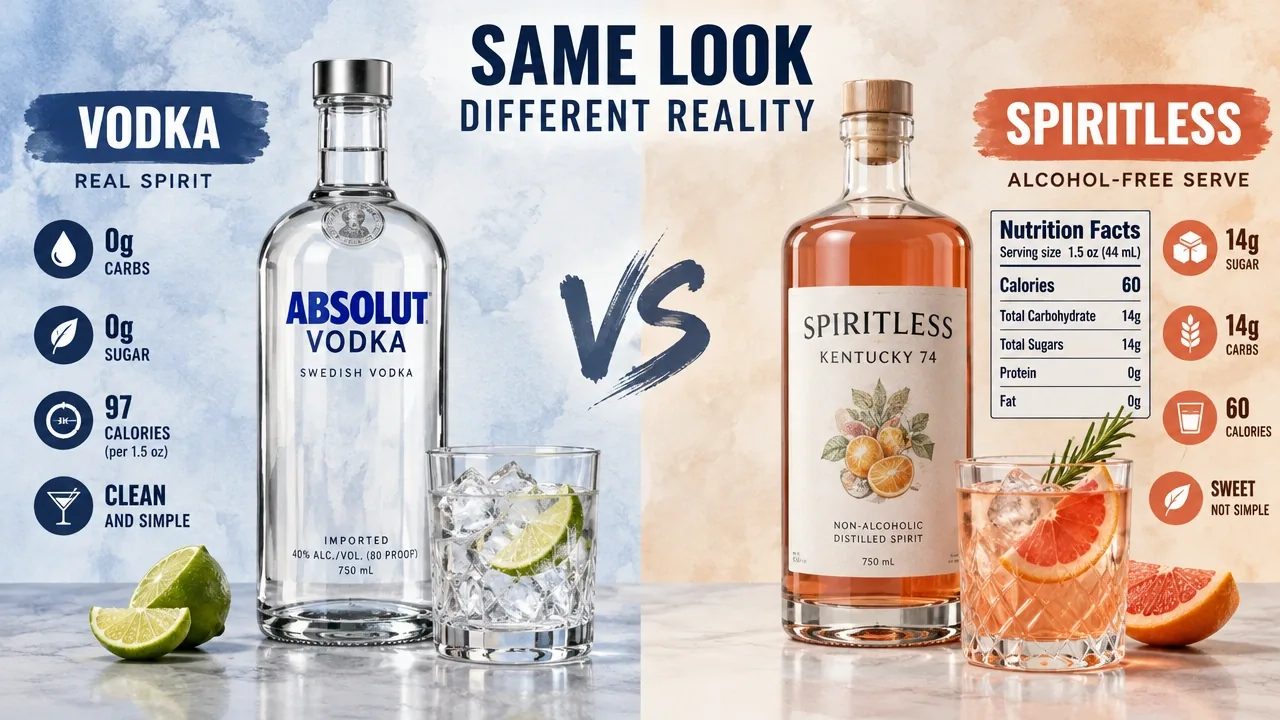
Now run the alcohol-free version’s numbers. A 118 ml spiritless espresso martini product at 35 calories, 8 g carbohydrate, and 7 g added sugars has deleted the ethanol line entirely – and replaced it with a sugar line. The calorie total dropped, but the entire remaining load is now sugar. The drink is lighter not because sugar was removed but because ethanol was removed and sugar was substituted in its place.
One credibility note worth naming openly: the source landscape for this drink contains no named nutritionist, no registered dietitian, and no external citation in the vast majority of cases. At least one author self-discloses as neither. The arithmetic – not an authority figure – is what should persuade you. Build the table yourself and the numbers hold regardless of who published them.
The Caffeine Ledger: Extraction Kinetics, Shot Dose, and Why the Numbers Conflict
Caffeine is the second ledger, and it operates entirely independently from the calorie total. A single shot of espresso contributes almost nothing calorically – roughly 2 kcal – but it supplies essentially all of the drink’s stimulant load. The reason published caffeine figures conflict so widely isn’t inconsistent testing. It’s that no source states its extraction variables.
Brew Pressure and What It Actually Determines
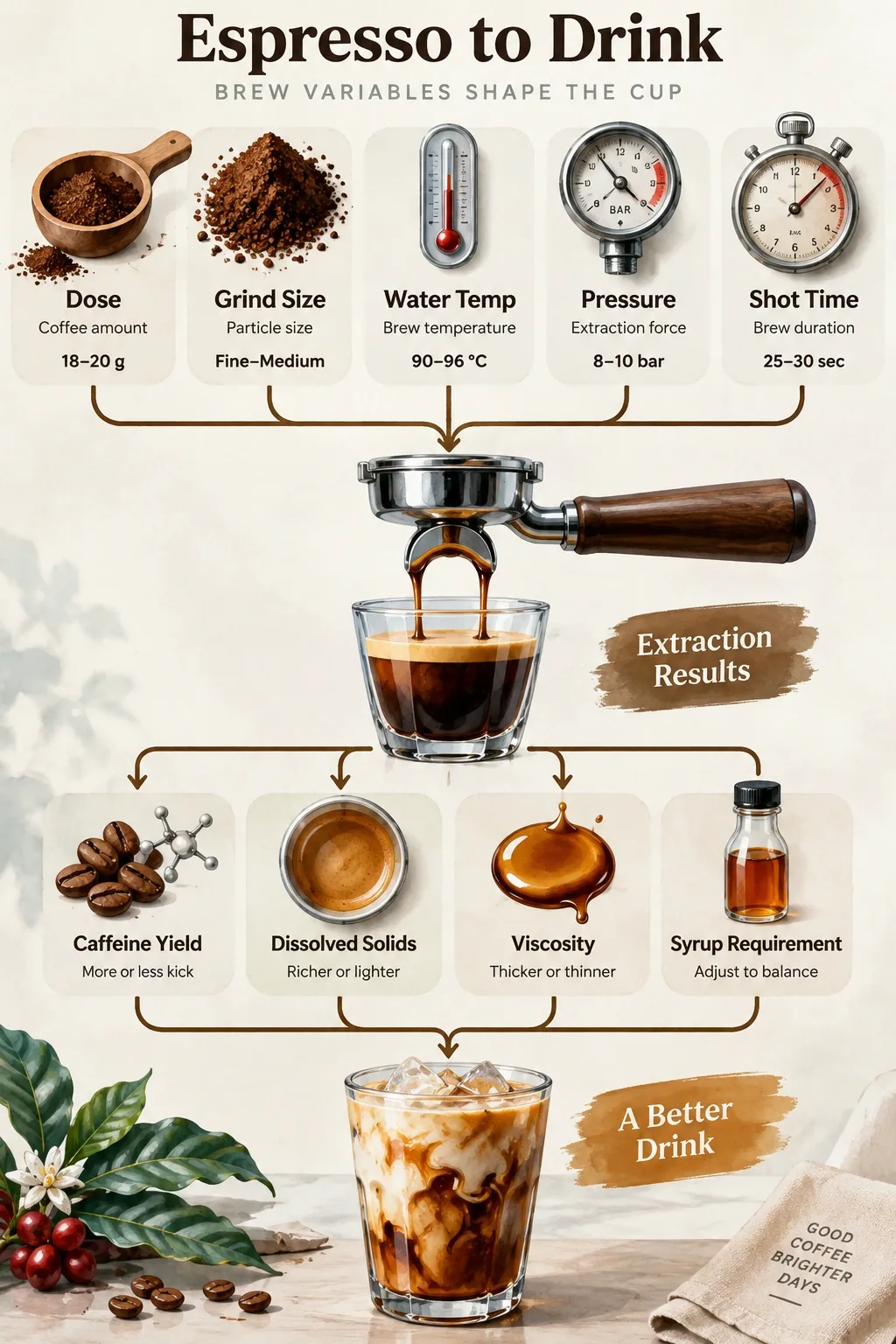
Espresso extraction is a pressure-driven dissolution process, and the caffeine yield of a 30 ml shot is a function of five variables: dose (the mass of ground coffee), grind particle size, water temperature, brew pressure, and shot time. An under-extracted shot – fast, coarse grind, low pressure – delivers less caffeine and fewer dissolved solids overall.
That second consequence matters for the calorie count. Dissolved solids are what give espresso its body and viscosity. A thin, under-extracted shot lacks the weight to carry the drink’s other components, so a recipe built around that shot will “need” more syrup to stay balanced. The under-extraction that lowers your caffeine dose also increases the sugar load your recipe requires to compensate. No recipe source in this category draws that line.
The infographic below maps how brew pressure and dissolved yield interact across a standard extraction curve.
Daily Limits and Genetic Variability
The safety ceilings are specific and sourced. The FDA and EFSA both set the safe upper limit for most healthy adults at 400 mg of caffeine per day, with a single-dose ceiling of 200 mg. During pregnancy, the ceiling drops to 200 mg per day as the total. A standard single-shot espresso martini, built with a well-extracted 30 ml shot, delivers roughly 60–70 mg of caffeine – well under the single-dose ceiling on its own, but not negligible if the reader has already consumed coffee earlier in the day.
The variable that almost no source acknowledges is genetic. The CYP1A2 gene determines how quickly your liver metabolizes caffeine. Fast metabolizers clear a dose in roughly 3–4 hours. Slow metabolizers may take 7–10 hours or more. The same drink, the same night, the same dose – but a slow metabolizer faces meaningfully greater risk of sleep disruption, elevated anxiety, and cardiovascular or renal strain. The drink is constant. The biology of the person drinking it is not.
The category error worth naming plainly: caffeine and calories are independent ledgers. A decaf swap drives the milligram figure toward zero and leaves the calorie figure completely untouched. “Healthy espresso martini” advice routinely presents the two as the same problem. They are not.
Lipid Variables and Thermal Non-Issues
One non-caloric, health-relevant difference from filter coffee deserves a mention. Espresso is not paper-filtered, which means the diterpene lipids cafestol and kahweol remain in the shot.
A long-form review in the Annual Review of Nutrition identified cafestol and kahweol as the specific compounds responsible for coffee’s cholesterol-raising effects, noting that these diterpenes are extracted by hot water and retained by the paper filter – which is why paper-filtered coffee does not raise LDL while unfiltered preparations like cafetière, boiled, and Turkish coffees do. – From the study “The Cholesterol-Raising Factor from Coffee Beans“
Espresso sits in an intermediate position: it’s not paper-filtered, so cafestol and kahweol remain. A reader who switched to paper-filtered coffee specifically to manage LDL cholesterol has quietly reintroduced that variable by drinking this cocktail.
Two caffeine concerns that genuinely do not apply here: the thermal-injury guidance for hot beverages above 60°C (140°F) is irrelevant to a drink served at 0–4°C, and stimulant stacking is only a risk if the reader pairs this cocktail with energy drinks or other caffeinated mixers.
The 302-Calorie Figure Isn’t a Fixed Law
Calorie variance in an espresso martini is structural, not accidental. The 302-calorie figure is real – it belongs to a specific build – but four independent variables determine where any given glass actually lands, and no published source accounts for more than one of them at a time.
Brand, Jigger, and Pour Variables
The four variables that move the total are: coffee liqueur brand (sugar content differs substantially between products), pour size at the bar, total serving volume, and whether simple syrup appears at all. Each one is independently capable of shifting the total by 30–80 calories.
The bar-side mechanism is simpler than it sounds. A free-poured liqueur measure versus a measured jigger is the single largest uncontrolled variable in the drink. The recipe printed on a menu is fixed. The pour that executes it is not. A generous free pour of coffee liqueur alone can add 40–60 calories before the glass is even garnished.
If a single number cannot survive a change in pour size, the honest output is a range with its variables named:
| Variable | Conservative Build | Generous Build | Calorie Swing |
|---|---|---|---|
| Coffee Liqueur (20 ml vs. 35 ml) | ~75 kcal | ~130 kcal | ~55 kcal |
| Simple Syrup (0 ml vs. 15 ml) | 0 kcal | ~45 kcal | ~45 kcal |
| Vodka (30 ml vs. 45 ml) | ~65 kcal | ~97 kcal | ~32 kcal |
| Total Range | ~200 kcal | ~370+ kcal | ~170 kcal |
The 302-calorie figure sits comfortably inside that range. So does almost every other number circulating in the category.
Body-Mass Burn Estimates and Dilution
Burn-time figures attached to calorie counts carry a hidden assumption: they are calculated against a specific reference body, not against the reader. The database footnote attached to the 35-calorie spiritless version is a clean illustration – 15 minutes of walking, 4 minutes of jogging, 4 minutes of cycling, or 6 minutes of swimming, computed for a 25-year-old female at 5’7″ and 144 lb (65 kg). The drink is constant. The burn time changes with every reader’s body composition, age, and metabolic rate. Treat those figures as labelling artifacts, not health claims about the drink.
The dilution variable is worth understanding mechanically. Shaking over ice adds water to the final pour, so the alcohol concentration per millilitre drops. Dilution lowers the density of calories per sip without reducing the total calorie load in the serve. A longer, weaker-tasting drink is not a lighter one. The total is the same; it’s just distributed across more liquid.
The Skinny Espresso Martini: What Actually Lowers Calories
The skinny espresso martini label is doing more work than the arithmetic behind it. “Skinny” in this context means one specific thing mechanically: the sugar ledger has been reduced. The ethanol ledger has not been touched. Whether the result is meaningfully lighter depends entirely on how much of the original calorie load was sugar to begin with.
Sugar-Free Substitutions and Worked Builds
The causal chain is simple. Coffee liqueur is the drink’s sugar engine. The standard skinny adaptation replaces it with sugar-free coffee syrup, which removes the sugar ledger and leaves the ethanol ledger fully intact. That is the whole substitution.
Here is a worked lower-calorie build with the arithmetic shown:
| Ingredient | Volume | Calories | Carbohydrates |
|---|---|---|---|
| Reposado Tequila | 30 ml | ~64 kcal | 0 g |
| Unsweetened Coconut Milk | 60 ml | ~20 kcal | 0.4 g |
| Coffee Liqueur (retained) | ~15 ml | ~34 kcal | 3.6 g |
| Coffee | 60 ml | ~2 kcal | 0 g |
| Total | ~165 ml | ~120 kcal | ~4 g |
Because coffee liqueur remains in this build, the carbohydrate total does not reach zero. The “skinny” label obscures that. A build that genuinely eliminates all added sugar must also eliminate coffee liqueur – which changes the drink’s flavor profile substantially.
For a branded comparison: a 6 oz sugar-free syrup version logs approximately 15 calories and 2 g sugar against a full-sugar version at 50 calories and 11 g sugar. That’s a 70% calorie reduction and an 81% sugar reduction. The sugar reduction outruns the calorie reduction because sugar was never the entire calorie load – the ethanol line was always there, unaffected.
The “93 calories, no carbohydrates” keto claim holds under exactly one condition: vodka plus sugar-free syrup, no coffee liqueur, no cream. The moment a full-sugar liqueur or whipped cream enters the glass, the claim collapses. It is a conditional statement published as a universal one.
Polyol Handling and the Topping Trap
Erythritol appears on nutrition panels as a 4 g line item, and no source in the category explains what that means in practice. Here’s what it means: sugar alcohols are partially absorbed in the small intestine, so they are counted differently from regular sugar on a nutrition label. “0 g sugar” does not mean “0 g carbohydrate” – the erythritol is still there as a carbohydrate, just one with a lower glycemic impact. Higher intakes can cause gastrointestinal discomfort, particularly in people with sensitive digestive systems. That 4 g figure is not zero, and it’s not the same as 4 g of sucrose, but it is not nothing either.
The topping trap is the most common way a carefully ordered skinny drink lands back near its original calorie total. Whipped cream and cream-based foams reintroduce a fat-and-sugar line that the substitution just removed. A standard whipped cream topping adds 50–80 calories and 3–5 g of sugar. Order the skinny build and the sugar-free syrup and then accept the whipped cream garnish, and you’ve recovered most of what you cut.
How to Order a Lower-Calorie Espresso Martini at a Bar
Bar ordering for a lower-calorie espresso martini is a negotiation over three controllable variables. Two of them are almost always available. One depends on house policy. Knowing which is which before you order sets realistic expectations and prevents the one rejected request from derailing the rest.
The Order Script and What a Bartender Can Change
Here is the sequence, mapped to the variables from the calorie discussion:
- Specify your spirit and ask for a measured jigger. This controls the ethanol volume – the largest single lever in the calorie total. Most bars use a jigger as standard, but confirming it costs nothing and prevents a generous free pour from adding 30–50 calories before anything else happens.
- Ask for sugar-free syrup in place of simple syrup. This is almost always an immediate yes. The syrup is either in the well or it isn’t, and the bartender knows in seconds.
- Ask which coffee liqueur the house uses. You won’t always be able to change the brand, but knowing what’s in the glass lets you estimate the sugar contribution accurately.
- Confirm the total serve size before the drink is built. A 120 ml build and a 180 ml build have meaningfully different calorie totals even at identical ratios.
What a bartender can and cannot change: the liqueur brand is a house purchasing decision – the bartender almost certainly cannot swap it. The jigger policy is a house standard – some bars free-pour as a matter of speed. The syrup substitution is almost always within the bartender’s immediate control. Don’t let the one request that fails discourage you from the two that succeed.
For a more specific lower-calorie profile you can request by name: 30 ml reposado tequila, 60 ml unsweetened coconut milk, 60 ml coffee, black walnut bitters in place of simple syrup, chilli-flake garnish. The bitters add aromatic complexity without a sugar load. The coconut milk replaces the liqueur’s volume. The tequila replaces the vodka’s ethanol contribution at a similar calorie density. This build is orderable at any bar with the ingredients on hand.
Stimulant Timing and Clinical Limits
Caffeine timing is an executable instruction, not a general caution. Stop caffeine 8–10 hours before your intended bedtime to protect sleep quality – that window accounts for slow metabolizers at the longer end of the CYP1A2 clearance range. Count the 200 mg single-dose ceiling against your full day’s intake, not just this drink. A double-shot build contributes roughly 120–140 mg, which is a meaningful fraction of that ceiling if you’ve had two or three coffees earlier.
Avoid pairing this cocktail with energy drinks or caffeinated mixers. The stimulant stacking risk is real, and it’s the one caffeine concern in this category that is genuinely within your control at the bar.
If you’re reducing caffeine overall, taper by 10–25% per week to avoid headaches and fatigue. And any reader with heart conditions, anxiety, or active medication regimens should talk to a clinician before making a caffeinated cocktail a regular order. The decaf or half-shot build is always available on request and changes the caffeine ledger without touching the calorie count by a single kilocalorie.
The Two-Ledger Rule
Espresso martini calories are governed by two ledgers. Ethanol volume is the first – larger, non-negotiable, and immune to any sweetener decision you make. Added sugar is the second – smaller in most builds, and the only line that can actually be deleted. Every legitimate substitution in this category must be judged by which ledger it touches. That single framing resolves every conflicting claim.
The decision tree is direct:
- Cutting calories? Cut the sugar ledger. Keep the pour. Replace coffee liqueur with sugar-free coffee syrup, skip the simple syrup, decline the whipped cream. Your ethanol calories remain constant; your sugar calories approach zero.
- Cutting caffeine? Swap to decaf espresso. Expect zero calorie change. The caffeine and calorie ledgers are independent.
- Cutting both? Halve the pour volume and sweeten with a non-caloric syrup. You get a lower-ABV drink in exchange. That’s the trade, and it’s an honest one.
The 302-calorie figure is real. It belongs to one build, one jigger size, one liqueur brand, and one reference body. It is a data point inside a range that runs from roughly 200 to 370 calories depending on those four variables. Treat it as a conditional reference, not a standard.
At the bar, two requests do most of the work: ask for a measured jigger, and ask for sugar-free syrup. Everything else in this article explains why those two requests are the right ones.
Frequently Asked Questions About Espresso Martini Calories
Do espresso martinis have a lot of sugar?
It depends on whether coffee liqueur is in the build. A standard recipe with coffee liqueur and simple syrup can carry 18–22 g of sugar per serve. Skip the syrup and swap the liqueur for sugar-free coffee syrup, and you can bring that figure under 2 g.
Is an espresso martini healthy?
That depends on which variable you’re tracking. The ethanol calories are fixed and non-negotiable. The caffeine load is real and interacts with your genetics, sleep schedule, and any medications you take. It’s not an inherently harmful drink, but it’s not a neutral one either – it’s a stimulant-alcohol combination that warrants the same honest accounting as any other.
Is there a skinny espresso martini?
Yes, and the substitution is specific: replace coffee liqueur with sugar-free coffee syrup, skip the simple syrup, and decline cream toppings. That removes the sugar ledger. The ethanol ledger stays intact, so the calorie reduction is real but not dramatic – expect 30–50% fewer calories, not 80%.
Is an espresso martini a ladies’ drink?
The perception is a marketing artifact. The canonical spec – vodka, coffee liqueur, espresso, optional syrup – is identical regardless of who orders it, and the calorie count follows the spec, not the drinker.
How much caffeine is actually in an espresso martini?
A single well-extracted 30 ml espresso shot contributes roughly 60–70 mg of caffeine. The figure varies based on dose, grind size, water temperature, brew pressure, and shot time – which is why published ranges conflict. Coffee liqueur adds a negligible caffeine amount. The drink stays well under the 200 mg single-dose ceiling on its own, but counts toward your daily 400 mg limit.
Why does shaking over ice make the drink taste weaker but not lighter?
Dilution from the ice adds water to the final pour, lowering the concentration of alcohol and sugar per millilitre. The total calorie count in the glass doesn’t change – those calories are just distributed across more liquid. A longer, weaker-tasting drink is not a lower-calorie one.
Can I ask for a decaf espresso martini without changing the calories?
Yes, exactly. Swapping to decaf espresso drives the caffeine figure toward zero and leaves the calorie total completely unchanged. The calorie and caffeine ledgers are independent, and this is the cleanest proof of that.
Does the type of vodka or tequila affect the calorie count?
Minimally. Most unflavored 40% ABV spirits deliver roughly 64–65 kcal per 30 ml regardless of grain source. Flavored vodkas can carry added sugar, which reintroduces a sugar-ledger contribution. Reposado tequila at the same ABV runs nearly identical calorie figures to standard vodka.
References
- The Cholesterol-Raising Factor from Coffee Beans | annualreviews.org