

A well-calibrated decaf espresso martini is not a compromise drink. Decaffeination removes caffeine; it does not remove the coffee lipids or the CO2 that create crema. Pull the shot right, shake hard enough, and the foam lands on top of your coupe exactly as it should, thick, velvety, and stable for at least four minutes.
The complication is that decaf beans behave differently in the portafilter. They degas faster, channel more easily, and punish lazy grind settings. Solve those three variables first, and everything else in the recipe follows logically.
Key Takeaways on Decaf Espresso Martini Recipe
- The 1:1:1 classic ratio (vodka, decaf espresso, liqueur) is dessert-sweet; the 1.5:1:1 ratio is spirit-forward with cleaner coffee clarity.
- Fresh decaf espresso pulled within 60-90 seconds is mandatory; cold brew concentrate cannot produce crema foam under any circumstances.
- Grind 1-2 steps finer than your standard caffeinated setting to restore hydraulic resistance to porous decaf cell walls.
- Mr Black carries 25-35 mg caffeine per ounce; use Conker Decaf, Luxardo Decaffeinated, or homemade decaf demerara syrup for a fully caffeine-free drink.
- A violent 15-second hard shake with dense solid ice is the minimum threshold for hydrodynamic cavitation and stable microfoam.
The Sleep Paradox: Why Classic Espresso Martinis Sabotage Your Night
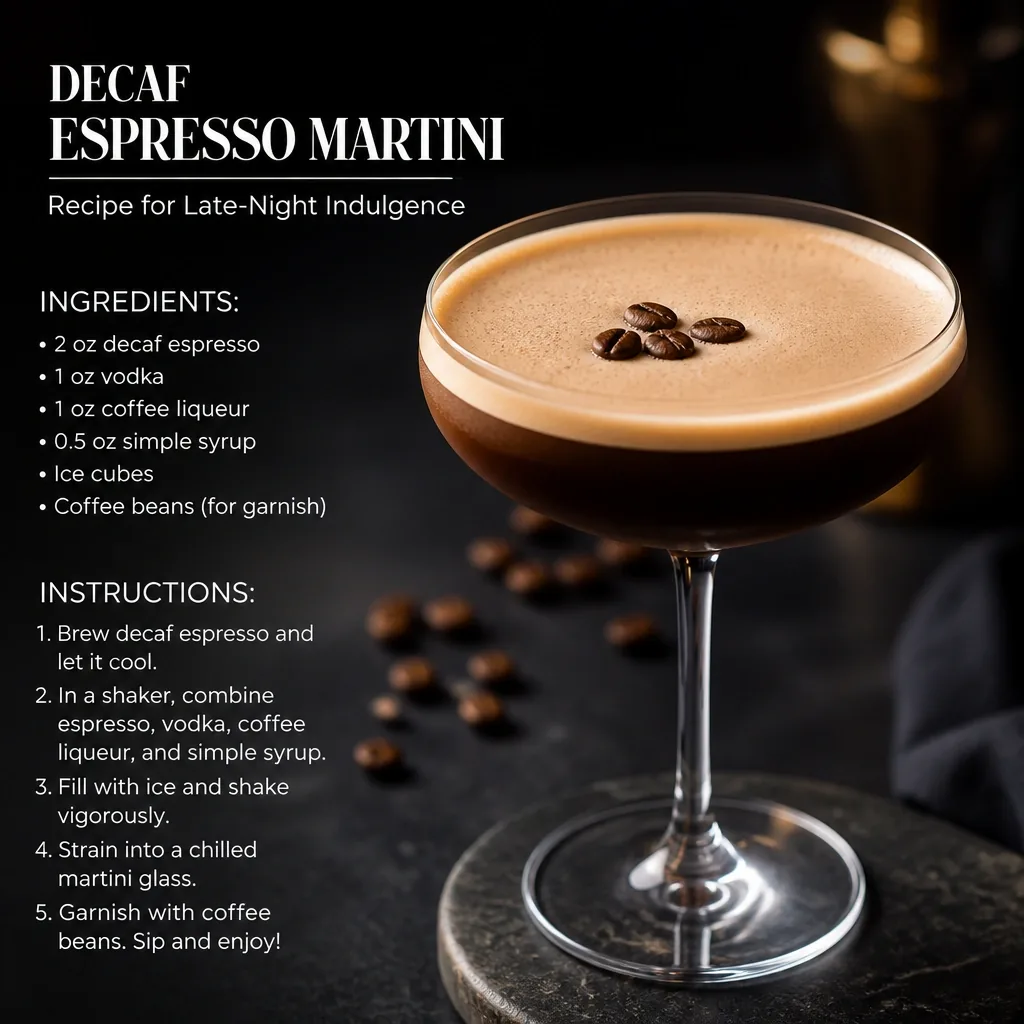
An espresso martini after dinner sounds like a contradiction by design. You are combining a central nervous system stimulant with a depressant and expecting something pleasant to happen at 11 PM. The pharmacological reality is messier than that.
Caffeine works by blocking adenosine receptors in the brain. Adenosine is the molecule your body accumulates across the day to signal fatigue. When caffeine sits in those receptor sites, the fatigue signal never lands. You feel alert. The problem is that alcohol simultaneously depresses the central nervous system, creating what sleep researchers call the “wide-awake drunk” effect: your body is chemically sedated, but your brain cannot complete the transition into restorative sleep.
The downstream consequence is structural. Even small amounts of caffeine consumed within 6 hours of bedtime reduce total sleep time by more than one hour and suppress the deep REM cycles where memory consolidation and tissue repair happen. With a standard espresso martini, you get elevated resting heart rate, fragmented sleep architecture, and a 2 AM wakeup your alarm did not schedule.
Switching to decaffeinated espresso removes 97-99% of the caffeine while keeping everything else intact: the roasted pyrazines, the Maillard-reaction caramel notes, the lipids that generate crema. The sensory ritual stays the same. The neurochemical sabotage does not.
What switching to decaf does not solve automatically is extraction quality. Decaf beans behave differently under pressure, and that difference matters directly for foam.
The Decaf Crema Myth: Understanding Lipid and CO2 Physics
The belief that decaf cannot foam is one of the most persistent errors in home mixology, and it is built on a false premise. Caffeine is a water-soluble alkaloid. Crema is an emulsion of pressurized CO2 gas trapped inside coffee lipids. These are physically separate systems. Removing caffeine does not touch the lipid matrix or the CO2 content of the bean.
What decaffeination does affect is the bean’s cell wall structure. Processes like Swiss Water Process, Mountain Water Process, and Supercritical CO2 extraction all saturate the green bean with water or solvent before pulling the caffeine out. That saturation makes the cell walls more porous than they are in a standard roasted bean. More porous walls mean two things in practice.
First, CO2 degasses faster. A caffeinated bean roasted two weeks ago still has meaningful CO2 pressure. A decaf bean roasted two weeks ago is already losing its gas at a faster rate. This makes roast freshness non-negotiable for decaf: you want beans roasted within 2-4 weeks, and you want to use them before that window closes. Stale decaf produces thin, quickly collapsing foam that no shaking technique can rescue.
Second, hydraulic resistance drops. Standard grind settings calibrated for caffeinated espresso allow water to move through a decaf puck too quickly, producing channeling. Channeling means some water finds easy paths through the puck while bypassing the dense coffee bed entirely. The result is a sour, under-extracted shot with unstable, sparse crema bubbles.
The fix is mechanical: grind 1 to 2 steps finer than your standard caffeinated setting, and dose slightly higher at 19g instead of 18g. Together, these two adjustments restore the 9 bars of extraction pressure the machine needs to generate properly dense crema. The shot should pull at the same flow rate as a normal caffeinated shot (roughly 25-30 seconds for a 1:2 ratio). If it runs faster, grind finer. If it stalls, back off one notch.
Understanding how roasting parameters affect bean composition is crucial, particularly when comparing standard origins against what Does Dark Roast Coffee Have in terms of residual stimulant content.
The Ratio Strategy: Balancing the 1:1:1 Classic Against Modern Palates
The original espresso martini was invented by Dick Bradsell in London in the late 1980s and used a 1:1:1 ratio: equal parts vodka, fresh espresso, and coffee liqueur. That baseline produces a rich, sweet, dessert-forward drink. The coffee liqueur contributes enough dissolved sugar to increase liquid viscosity, which physically helps the microfoam layer stay suspended on the surface rather than sinking back into the drink.
The problem with a straight 1:1:1 for a nightcap is sweetness intensity and caffeine exposure. Standard coffee liqueurs are not caffeine-free.
| Liqueur | Caffeine per 1 oz |
|---|---|
| Kahlua | 4-5 mg |
| Mr Black Cold Brew | 25-35 mg |
| Conker Decaf Liqueur | 0 mg |
| Luxardo Decaffeinated | 0 mg |
| Homemade decaf demerara syrup | 0 mg |
The modern calibrated ratio shifts to 1.5 oz vodka, 1 oz decaf espresso, 0.75-1 oz liqueur. The extra half-ounce of spirit cuts sweetness, gives the drink more structural weight, and lets the coffee clarity come forward rather than being buried under sugar. For first-time makers, start with the 1:1:1 to understand the baseline, then calibrate forward.
Balancing sweetness and bitterness in specialty beverages requires a careful look at constituent stimulants, much like evaluating mocha caffeine and chocolate interactions in traditional café offerings.
Step-by-Step Guide: Crafting the Foolproof Decaf Espresso Martini
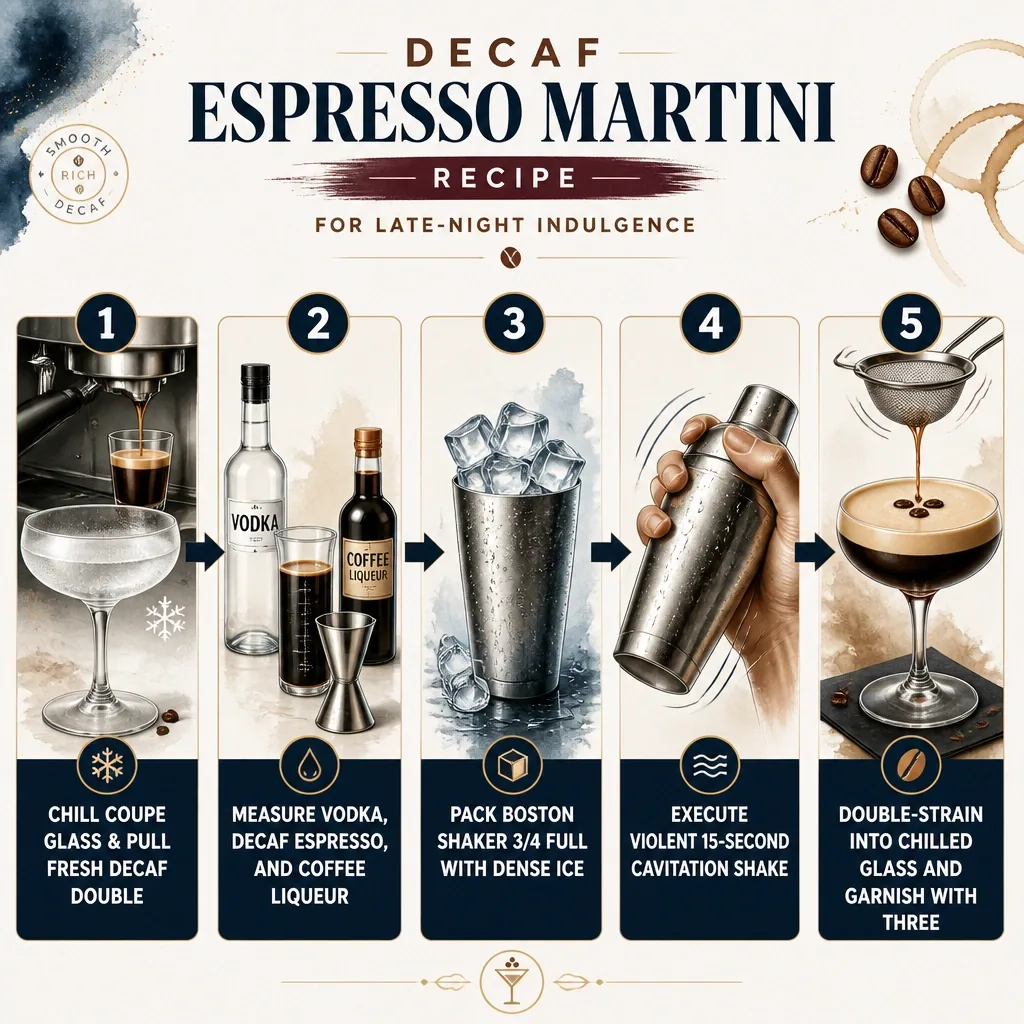
Step 1: Glassware chilling and fresh decaf pull. Fill your coupe or martini glass with ice water and leave it while you work. Pull your decaf double shot at a 1:2 ratio (roughly 19g in, 38g out) and rest it for exactly 60 seconds. This rest allows the initial turbulence to settle and the crema to stabilize. Do not let it sit past 90 seconds; CO2 loss accelerates after that point.
Step 2: Precision measuring. Into the larger Boston tin, measure 1.5 oz vodka, 1 oz fresh decaf espresso, 1 oz decaf coffee liqueur (or 0.75 oz if using homemade syrup), and optionally 0.25 oz simple syrup if you prefer a sweeter baseline. Do not estimate. Consistent results come from consistent measurement.
Step 3: Ice loading and the hard shake. Fill the Boston shaker three-quarters full with dense, solid ice cubes. Hollow freezer-tray ice is thinner and melts faster on contact, which over-dilutes the drink before the foam sets. Seal the Boston tin firmly and shake violently for 15 seconds. The physics in play: rapid ice ricochet inside the tin creates hydrodynamic cavitation, generating micro-bubbles that emulsify the decaf espresso lipids into the liquid surface. This cavitation is what produces the foam blanket. A 5-second shake does not generate enough kinetic energy. Fifteen seconds, maximum force.
Step 4: The double strain. Dump the ice water from your chilled glass. Position the Hawthorne strainer over the shaker opening and hold the fine-mesh sieve between the shaker and the glass. Pour through both simultaneously. The Hawthorne catches ice chunks; the fine mesh catches micro-ice shards that would melt against the foam surface and collapse it within 60 seconds.
Step 5: Garnish and serve. Float three roasted decaf coffee beans across the foam crown. The traditional attribution is health, wealth, and happiness. The functional purpose is aromatic: roasted coffee oils volatilize from the beans’ surface as you drink, extending the sensory experience of each sip beyond the liquid itself. Serve immediately.
Bar Craft and Troubleshooting: Diagnosing Flat Foam and Thin Texture
Thin or collapsing foam. This is almost always a freshness or shake-power problem. Either the decaf beans are past the 4-week window and have lost CO2, the shot sat too long before hitting the shaker (more than 90 seconds), or the shake did not hit 15 seconds at full force. Pre-chilling the Boston tin in the freezer for 10 minutes before assembly solves the third variable: warm metal contacts the ice before shaking begins and pre-melts the outer layer, robbing the shake of kinetic energy.
One more common cause: substituting cold brew concentrate for fresh espresso. Cold brew is not espresso. It contains no crema, no pressurized CO2, and produces no foam regardless of how hard you shake. Fresh decaf espresso pulled under 9 bars of pressure is the only option for a foamed cocktail.
Watery or weak mouthfeel. The ice is the culprit. Standard hollow freezer-tray cubes have a larger surface-area-to-volume ratio than dense, clear cubes. They melt faster on contact with room-temperature liquid and dilute the cocktail before the shaking phase finishes. Use dense, clear 1.25-inch cubes purchased from a bag or made in a directional freezing tray. The difference in final dilution is measurable.
Bitter or astringent finish. The decaf shot ran too long. Extraction past 35 seconds starts pulling chlorogenic acids and harsh tannins that sweeten no further. Check your pull time and tighten the grind if the shot is running fast. When fresh espresso is unavailable and you are working with a lower-quality shot, add 2 drops of 20% saline solution (1 part salt dissolved in 4 parts water) to the shaker before sealing it. Sodium ions selectively suppress bitter taste receptors without adding any perceptible salt flavor. It also amplifies the caramel and chocolate notes already present in the coffee. This is a professional bar technique, not a workaround.
Frequently Asked Questions About Decaf Espresso Martini Recipe
Does decaf espresso really produce as much crema foam as regular coffee?
Yes, when extracted correctly. Caffeine has no role in foam chemistry; crema is CO2 and lipids. The key is grinding finer to compensate for decaf’s more porous cell structure and using beans within the 2-4 week freshness window.
Is there caffeine in coffee liqueurs like Kahlua?
Kahlua contains roughly 4-5 mg of caffeine per ounce, which is low but not zero. Mr Black Cold Brew Liqueur carries 25-35 mg per ounce. For a fully caffeine-free build, use Conker Decaf Liqueur, Luxardo Decaffeinated, or a homemade decaf espresso demerara syrup.
Can I make a decaf espresso martini without an espresso machine?
You can get partial results with a Moka pot or AeroPress, both of which extract under modest pressure and produce some lipid content. Neither generates the CO2 pressure required for true crema, so the foam will be lighter and less stable. There is no non-pressure alternative that matches a pulled espresso shot.
Why did my espresso martini foam disappear after two minutes?
Either the espresso was stale (more than 4 weeks from roast or more than 90 seconds from pull), the ice was hollow freezer-tray ice that added too much water, or the shaker tin was not pre-chilled. Solve all three together: fresh beans, dense clear ice, cold tin, 15-second shake.
Can I batch decaf espresso martinis ahead of time for guests?
Pre-batch the vodka, coffee liqueur, and simple syrup up to 48 hours in advance and refrigerate. Pull decaf shots fresh per order and shake individually. Batching the espresso component destroys the CO2 and produces a flat drink with no foam layer.
References
- Specialty Coffee Association (SCA) – Espresso Extraction and Water Contact Dynamics | sca.coffee
- Swiss Water Decaffeinated Coffee Company – Cellular Structure of Decaffeinated Green Coffee | swisswater.com
- Journal of Clinical Sleep Medicine – Caffeine Effects on Sleep Taken 0, 3, or 6 Hours Before Going to Bed | jcsm.aasm.org