


Making Baileys coffee looks simple on paper. Hot coffee, a pour of Baileys Irish Cream, something creamy on top. But the gap between “tastes fine” and “tastes like a proper after-dinner drink” lives entirely in three variables most recipes never mention: ratio, temperature, and how you treat the dairy.
This guide walks through each step with the actual mechanics behind it. Not just what to do, but why it works. Get those right once and you’ll never need to follow a recipe again.
Key Takeaways on Making Baileys Coffee
- Start at a 2:1 coffee-to-Baileys ratio and adjust toward 3:1 or 4:1 for less boozy results.
- Let coffee cool until steam is gentle, not rolling, before adding Baileys; hot coffee curdles the dairy proteins in the liqueur.
- Temper Baileys by whisking a spoonful of coffee into it first, then pour the mixture slowly into the mug.
- Baileys already contains cream and sugar, so taste before adding any dairy or sweetener.
- Float whipped cream over the back of a spoon; it should pour like glass, not form stiff peaks.
- If the drink curdles fully, strain it and serve over ice rather than trying to restore it hot.
Prerequisites: Equipment, Ingredients, and the Ratio Anchor
Before you brew a single drop, knowing what you need and roughly how much of each ingredient to use saves you from stalling halfway through. The ratio question especially. Most recipes either ignore it entirely or bury a single measurement in a list of steps. We’ll fix that here.
Core Setup and Dietary Checks
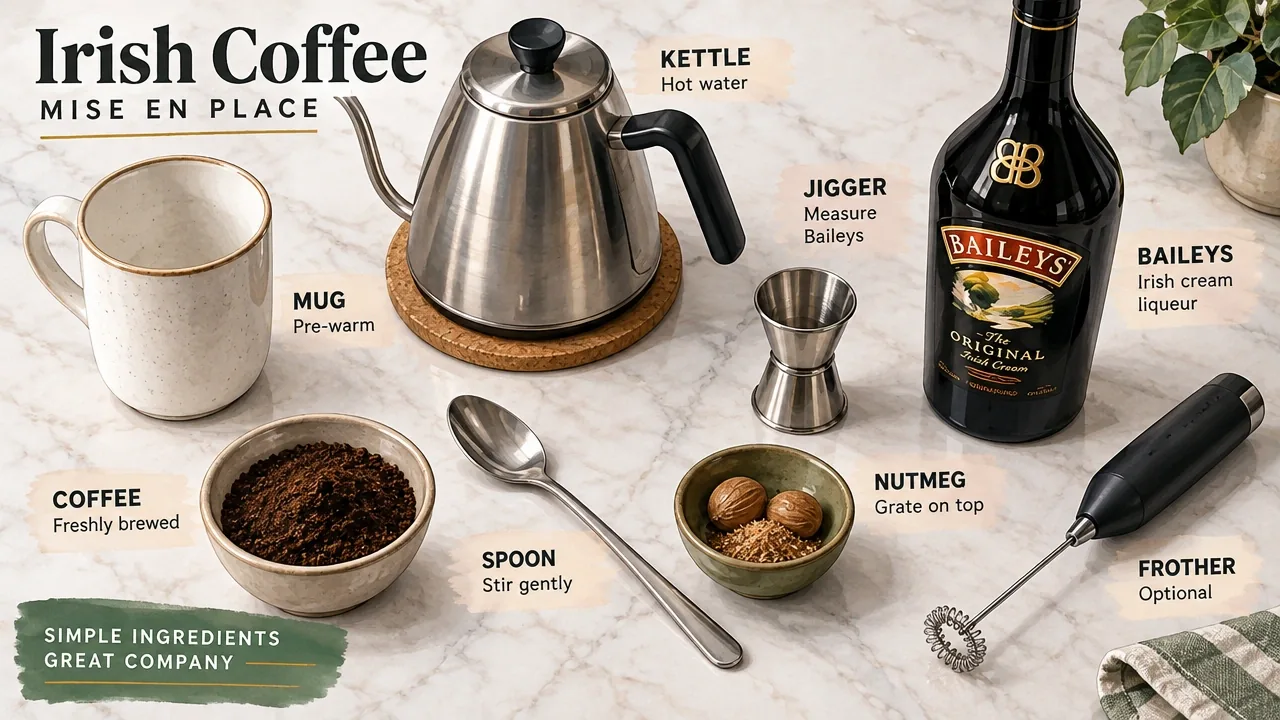
Equipment is minimal but specific. You need a heatproof mug, a kettle or coffee maker, a spoon, and a measuring cup or jigger. If you want whipped cream that actually floats rather than sinking on contact, a small whisk or handheld frother helps. That’s it. No espresso machine required.
Ingredients break into three tiers. The base is hot brewed coffee (strong black, or one to two shots of espresso) and Baileys Irish Cream. The optional layer includes whole milk, half-and-half, or heavy cream if you want a softer texture. Then garnish: softly whipped cream, fresh nutmeg, and a sweetener if needed.
Two things worth flagging before you start. Baileys contains both alcohol and dairy. If you have a milk allergy, are pregnant, take medications that interact with alcohol, or plan to drive, this drink is not appropriate. Coffee adds caffeine on top of that. If any of those apply, consult a health professional before proceeding.
One practical note: several popular recipes assume you already own a milk frother or pod machine. You don’t need either. A mug, a spoon, and the ratio anchor below are enough to make a very good drink.
Liqueur Selection and Coffee Proportions
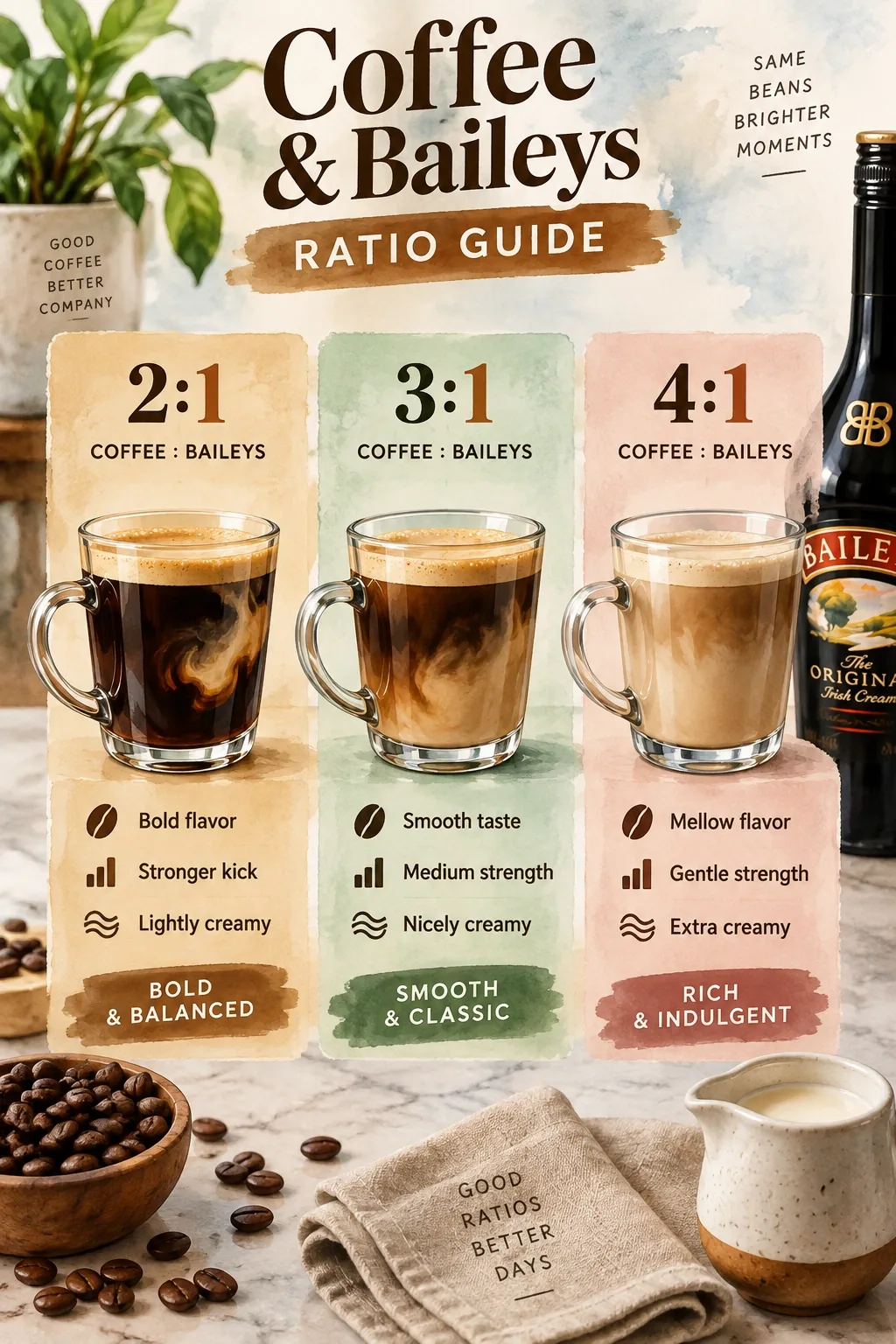
The 2:1 ratio is your starting anchor. Six ounces of hot brewed coffee to three ounces of Baileys. That gives you a drink with real coffee presence and enough Baileys to taste rich without overwhelming the cup.
From there, adjust by feel. A 3:1 ratio (roughly 150 ml coffee to 50 ml Baileys) pulls back the alcohol and lets the coffee lead. A 4:1 ratio (400 ml coffee to 100 ml Baileys) is closer to a lightly spiked latte. Go tighter than 2:1 and you’re in dessert cocktail territory, closer to something you’d sip after a dinner party than a cozy afternoon drink.
One clarification that trips people up: Baileys and Kahlua are not interchangeable here. Baileys is a cream liqueur, meaning it already contains cream, whiskey, and sugar in an emulsified form. Kahlua is a coffee liqueur with no cream. Swapping them changes the texture of the drink entirely. This recipe is built around Baileys specifically because the cream is already built in.
No universal standard exists across sources. Ratios in published recipes range from 2:1 all the way to 4:1. Start at 2:1, taste it, and move from there.
Step 1: Brew Coffee and Bring It to a Baileys-Safe Temperature
Temperature is the single most consequential variable in this drink, and almost no recipe explains why. The short answer: if your coffee is too hot when you add Baileys, the dairy proteins inside the liqueur can coagulate. The drink curdles. It looks grainy, smells off, and cannot be fully fixed.
Brew your coffee strong. Six ounces of hot brewed black coffee works well, or one to two shots of espresso topped with a small amount of hot water. Instant coffee is acceptable if it dissolves completely and has no visible granules floating in the cup.
Do not add Baileys to boiling coffee. Let it sit after brewing until the steam slows from rolling to gentle. The mug should feel warm when you hold it, not scalding. That’s the window.
Here’s a practical test when you’re unsure: the spoon-test. Add one tablespoon of hot coffee to a small cup, then drop in a few drops of Baileys. If the mixture stays smooth and uniform, the temperature is safe. If it separates or looks grainy, wait another minute and test again.
Pre-warming the mug helps too. Pour hot water into the mug, let it sit for thirty seconds, then discard the water before adding your coffee. The mug stays warm longer without requiring the coffee to be dangerously hot.
The science behind the curdling risk is worth understanding. A study published in the Journal of Dairy Science79064-9/pdf) found that cream liqueurs are emulsions of milk fat stabilized by casein proteins, and that both heat and acidic conditions destabilize that emulsion. Heat triggers coagulation through chemical reactions in the protein matrix. Acidity, which brewed coffee has in meaningful amounts, lowers the pH of the mixture and pushes the casein closer to its instability threshold. That’s why both temperature and coffee strength matter: a very acidic, very hot coffee hits the Baileys emulsion from two directions at once.
Gentle steam. Warm mug. Spoon-test when in doubt.
Step 2: Add Baileys with Tempering and Stirring Technique
Tempering is the step most recipes skip, and it’s the one that makes the difference between a smooth drink and a broken one. The idea comes from cooking: instead of shocking a cold or room-temperature ingredient with sudden heat, you raise its temperature gradually so it can adjust without separating.
Here’s how to do it. Measure your Baileys according to your chosen ratio and pour it into a small cup or glass. Take one spoonful of your cooled coffee and whisk it into the Baileys. Then pour that mixture slowly back into the mug while stirring gently. The Baileys temperature rises gradually instead of hitting the hot coffee all at once.
Stir gently but thoroughly after combining. You’re not aerating the drink. A slow, circular motion with a spoon is enough. Do not whisk vigorously at this stage. Taste before you add more Baileys. The flavor balance shifts quickly, and it’s easier to add than to correct.
A smooth result looks uniform and slightly creamy. No graininess, no separation, no oily film on the surface. If you see any of those, stop adding Baileys immediately.
If curdling starts, act quickly. Remove the mug from any heat source, let it cool for a minute, then whisk in a small splash of cold cream or milk. The fat in the cold cream can help re-emulsify a partially broken mixture. If the drink is fully curdled, that fix won’t restore it completely. At that point, strain the liquid through a fine mesh strainer and serve it over ice. It becomes a different drink, but a drinkable one.
For a visual breakdown of whisking mechanics and how agitation affects emulsions, this video is worth a few minutes:
Step 3: Balance Dairy Fats and Sweetness
Baileys already contains cream and sugar. That’s the fact most people forget when they reach for the milk and the sweetener. The liqueur is not a neutral alcohol. It’s a pre-sweetened, pre-creamed product, and adding dairy and sugar on top of it without tasting first is how you end up with something that tastes like melted ice cream rather than a coffee drink.
Start by deciding what style you want. A black-coffee-forward version uses no added milk and lets the espresso character come through clearly. A latte-style version adds whole milk, half-and-half, or a splash of heavy cream for a softer, rounder texture. Both work. The choice depends on how much you want the coffee to show up.
If you add dairy, add it after the Baileys, in small amounts. Whole milk softens the drink without adding much richness. Half-and-half adds body. Heavy cream makes it noticeably richer, though Baileys already brings cream, so this can tip the balance quickly.
For sweetness: taste first, always. If the drink needs it, add sugar, simple syrup, maple syrup, or a drop of vanilla extract. Add in small increments. If you overshoot and the drink tastes too sweet, a small amount of additional coffee pulls it back. A pinch of salt also works, not enough to taste salty, but enough to blunt the sugar edge.
The goal, as Nescafé frames it, is something “rich and creamy in flavour and smooth and velvety in texture.” That balance tips easily in either direction. Cream can mute the coffee. Too much coffee can flatten the richness. Taste between every addition and stop when it’s right.
For dairy-free versions, plant-based milks work in small amounts, and Baileys Almande (an almond milk-based version) replaces the original liqueur. Standard recipes don’t provide tested ratios for these substitutions, so add in small increments and adjust by taste rather than following a fixed measure.
Step 4: Finish with Whipped Cream and Nutmeg
Whipped cream is not just a garnish. It changes how you experience every sip. When cream floats on top of the coffee, each sip passes through the cold, fatty layer before reaching the hot drink underneath. The contrast is part of what makes the drink feel complete.
The technique matters here.
Jillian Vose, Beverage Director at The Dead Rabbit in New York City, explains that most Irish Coffees fail at this step because they use canned aerosol cream. At Dead Rabbit, they use unsweetened, freshly whipped heavy cream with around 35 percent fat content, shaken in a protein shaker with a metal ball inside to control the agitation. The target consistency pours like glass. Thick enough to float, loose enough not to form peaks.
That “pours like glass” standard is the key. Over-whipped cream breaks the surface of the drink on contact and sinks. Under-whipped cream dissolves immediately and adds nothing. You want something in between: cream that holds its shape just long enough to float, then slowly mingles with the coffee as you drink.
To float the cream at home, pour it gently over the back of a spoon held just above the surface of the coffee. The spoon disperses the pour and slows the cream’s descent, letting it settle on top rather than plunging through.
Once the cream is on, grate fresh nutmeg directly over the top. Freshly grated nutmeg has a sharper, more aromatic quality than pre-ground. Cocoa powder or a light dusting of cinnamon work as alternatives or additions.
Serve immediately. The drink is meant to be consumed while the temperature contrast between hot coffee and cool cream still exists. Don’t stir the cream in if you want the visual layer and the textural contrast. Let it sit on top and drink through it.
Troubleshooting: Curdling, Ratio Drift, and Safety
Even with good technique, things go sideways. Here’s how to read what went wrong and what to do about it.
Texture Rescue and Chilled Serving
Curdling has two stages, and the fix depends on which one you’re dealing with.
If you catch it early, meaning the drink looks slightly grainy but hasn’t fully separated, remove it from any heat source and let it cool for sixty seconds. Then whisk in a small splash of cold cream or milk. The fat helps re-emulsify the mixture and can smooth out a partially broken drink. Act quickly. The longer it sits, the harder this becomes.
If the drink is fully curdled, with visible curds floating in cloudy liquid, the honest answer is that it can’t be fully restored. Don’t try to drink it hot. Strain it through a fine mesh strainer to remove the solids, then pour it over ice. The flavor is still there. The texture becomes a different kind of drink, an iced Baileys coffee rather than the original intention, but it’s salvageable.
For an iced version from the start, chill your brewed coffee completely before adding Baileys. Cold temperatures reduce the curdling risk significantly because the dairy proteins in Baileys are more stable at lower temperatures. That said, separation can still occur if the coffee is very acidic or if you add too much Baileys too quickly. Pour slowly and stir as you go.
Proportion Correction and Responsible Consumption
Ratio drift is easy to fix once you know which direction you drifted.
Too boozy? Add more hot coffee, a tablespoon at a time. Too weak or too creamy? Add Baileys in one-teaspoon increments, stirring and tasting after each addition. Too sweet? Add coffee first. If it’s still too sweet, a small pinch of salt will blunt the sweetness without making the drink taste salty.
On the safety side, a few things worth stating clearly because no standard recipe does. Baileys is a cream liqueur, not a light spirit, and its alcohol content means it counts toward your total intake. A standard drink in the US contains 0.6 fluid ounces of pure ethanol. Proof is twice the ABV, so check the label and do the math if you’re tracking intake. Baileys at 17% ABV means a three-ounce pour contains roughly 0.5 fl oz of ethanol, close to a standard drink on its own.
Coffee adds caffeine. The combination can mask how impaired you feel, because caffeine blunts the subjective sensation of alcohol without changing your blood alcohol level. Alternate with water. Know your limits before you start, not after the second cup.
Baileys coffee is not appropriate during pregnancy, while taking medications that interact with alcohol or caffeine, or before driving. If any of those apply, consult a health professional. The non-alcoholic copycat route using Baileys Almande or a homemade cream-and-coffee-syrup substitute exists, though standard recipes don’t provide tested formulations for it.
Frequently Asked Questions About Making Baileys Coffee
How do you make a coffee with Baileys?
Brew strong coffee, let it cool until steam is gentle, then temper Baileys by stirring a spoonful of coffee into it before combining. Start at a 2:1 coffee-to-Baileys ratio, taste, then float softly whipped cream over the back of a spoon and grate fresh nutmeg on top.
Why does Baileys curdle in coffee?
Baileys is a cream emulsion stabilized by casein proteins, and both heat and acidity destabilize that emulsion. Very hot or very acidic coffee shocks the proteins and causes them to coagulate, producing the grainy, separated texture. Let coffee cool slightly and use the spoon-test before combining.
Do you put Baileys or Kahlua in coffee?
They do different things. Baileys is a cream liqueur, so it adds richness and body. Kahlua is a coffee liqueur with no cream, so it adds flavor and sweetness but won’t give you the same creamy texture. For this style of drink, Baileys is the right choice.
Can you give me a recipe for Baileys iced coffee?
Brew strong coffee and chill it completely before adding anything. Pour over ice, then add Baileys at roughly a 3:1 or 4:1 ratio, stirring as you go. Top with whipped cream and nutmeg if you like. Cold temperatures reduce curdling risk, but pour Baileys slowly and stir throughout.
Can you use instant coffee to make Baileys coffee?
Yes, as long as it dissolves completely with no visible granules. Dissolve the instant coffee in hot water first, let it cool slightly, then proceed exactly as you would with brewed coffee. The spoon-test still applies.
What’s the best way to float whipped cream on Baileys coffee?
Use freshly whipped heavy cream with around 35 percent fat content, whipped to a consistency that’s thick but still pourable. Pour it slowly over the back of a spoon held just above the surface of the drink. Over-whipped cream sinks; under-whipped cream dissolves immediately.
How do you fix Baileys coffee that’s too sweet?
Add more hot coffee first, a tablespoon at a time. If it’s still too sweet after that, add a very small pinch of salt. The salt blunts sweetness without making the drink taste salty.
Is it safe to drink Baileys coffee every day?
That’s a personal and medical question. Baileys contains alcohol and dairy; coffee contains caffeine. Regular combined intake of alcohol and caffeine carries health considerations that vary by individual. Consult a health professional if you have questions specific to your situation.
References
- Mastering Irish Coffee Cocktail Recipe: Jillian Vose, The Dead Rabbit NYC | punchdrink.com
- Journal of Dairy Science – Alcohol and Heat Stability of Milk Protein | journalofdairyscience.org
