

A cold brew espresso martini is a fundamentally different engineering problem from a standard espresso martini. Hot espresso pulled under 9 bars generates crema automatically: pressurized CO2 erupts from the shot and creates a stable lipid-gas emulsion on contact with air. Cold brew extraction happens at atmospheric pressure over 16-20 hours. No pressure buildup means no dissolved CO2 means no automatic crema.
The foam in a cold brew version has to be built mechanically through hydrodynamic cavitation during the shake. Getting it right requires a high-TDS concentrate, the right spirit lipids, and 15 seconds of piston-force shaking with dense ice.
Similarly, achieving a rich, velvety top layer in Spanish-style coffee cocktails relies on mastering the shaken carajillo emulsion method for optimal texture and mouthfeel.
Key Takeaways on cold brew espresso martini recipe
- Cold brew contains no dissolved CO2, so crema must be built mechanically through hydrodynamic cavitation; this requires a 1:4 concentrate (TDS 6-8%), not ready-to-drink bottled cold brew.
- Crater Lake Hazelnut Espresso Vodka at 1.0 oz contributes natural hazelnut lipids that supplement the cold brew emulsion matrix and stabilize cavitation micro-bubbles during the shake.
- The master ratio is 1.5 oz neutral vodka, 1.0 oz Crater Lake Hazelnut Espresso Vodka, 1.0 oz 1:4 cold brew concentrate, 0.5 oz dry coffee liqueur, 2 drops 20% saline solution.
- A 15-18 second horizontal linear piston shake at maximum force creates the cavitation needed for a stable 3mm foam head; shaking beyond 18 seconds over-dilutes and breaks the emulsion.
- Double-strain through Hawthorne and fine-mesh sieve, pour into a frozen coupe, and rest 20-30 seconds undisturbed to let the crema cascade and settle.
The Cold Brew Crema Dilemma and Essential Barware Prep
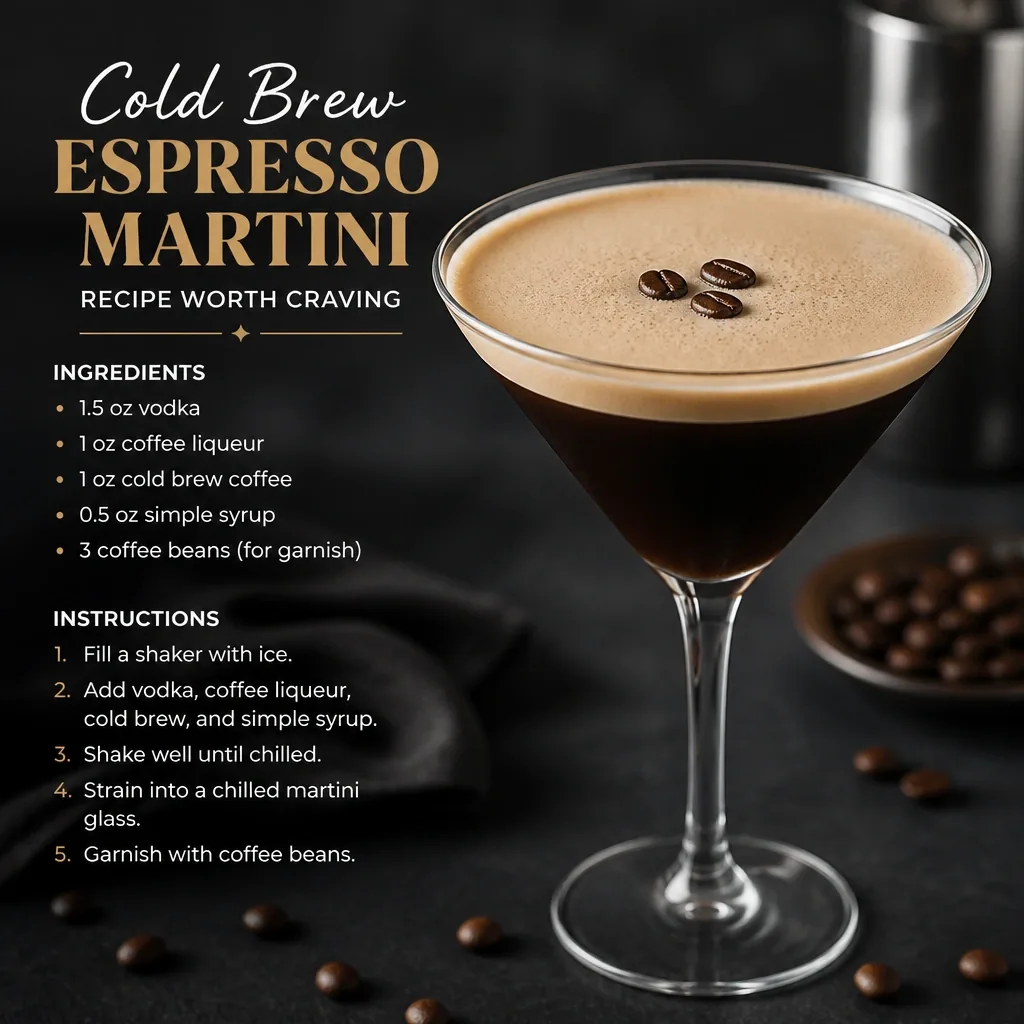
Understanding what crema actually is makes the cold brew substitution problem precise. Crema is a gas-in-liquid emulsion: CO2 micro-bubbles trapped inside a matrix of coffee lipids (fatty acids and triglycerides). Under 9 bars of extraction pressure, CO2 dissolves into the shot liquid. When the shot exits the portafilter, the pressure drops and the CO2 comes out of solution as micro-bubbles, which the bean’s lipid matrix captures and stabilizes at the surface.
Cold brew has no extraction pressure and therefore no dissolved CO2. A standard 1:8 cold brew ratio (used for ready-to-drink bottled cold brew) also has low total dissolved solids, meaning fewer coffee lipids available to form any emulsion matrix at all. This is why grocery-store cold brew produces a flat, lifeless martini regardless of how hard you shake it.
The solution operates on two fronts: concentrate strength and lipid supplementation.
| Coffee Source | CO2 Content | Lipid Density | TDS % | Foam Potential |
|---|---|---|---|---|
| Fresh espresso (9-bar) | High (dissolved) | High | 8-12% | Excellent (automatic) |
| High-TDS cold brew (1:4) | None | Medium | 6-8% | Good (mechanical shake) |
| RTD bottled cold brew | None | Low | 1-3% | Poor (insufficient solids) |
The Physics of Crema: Why Cold Brew Needs Mechanical Emulsion
Without dissolved CO2, foam generation shifts entirely to the shaker. The horizontal piston shake forces atmospheric air into the liquid at high velocity, creating localized low-pressure zones (cavitation) where air pockets nucleate into micro-bubbles. These bubbles need a lipid matrix to stabilize inside; without enough dissolved coffee fats, they collapse immediately. Crater Lake Hazelnut Espresso Vodka contributes natural hazelnut-derived lipids that supplement the cold brew’s lipid matrix, providing additional emulsion scaffolding for the cavitation bubbles to anchor into.
Mastering this hydrodynamic emulsification is essential when aiming for an espresso martini creamy top without relying on machine-extracted CO2.
Essential Barware: Boston Shaker and Strainer Selection
A two-piece Boston shaker is mandatory. The large internal volume provides room for ice kinetic impact during the piston shake, and the metal-to-metal seal does not freeze shut the way cobbler shaker lids do under rapid temperature drop. Two tins, not a tin-and-glass combo: glass does not conduct heat out of the liquid as efficiently as metal and limits the frost formation that signals proper chilling.
For straining: a Hawthorne strainer seated on the larger tin and a conical fine-mesh sieve held above the glass. These work together as a two-stage filter, not a redundant one. The Hawthorne catches ice chunks; the fine mesh catches micro-ice shards that act as nucleation sites accelerating bubble collapse.
Glassware and Ice Architecture
Freeze the coupe glass for a minimum of 10 minutes before building the drink. A room-temperature glass contacts the cold emulsion and causes immediate local warming at the glass wall, separating the foam from the liquid within 60-90 seconds. A frozen coupe holds the emulsion together for 8-10 minutes from pour.
Ice selection: dense, solid 1-inch cubes from a bag or directional-freeze tray. Standard hollow refrigerator machine ice has high surface area relative to its mass and melts on contact with room-temperature liquid before the shake generates the temperature drop needed for cavitation. Dense solid cubes maintain structural integrity through the shake, provide sufficient kinetic impact for micro-bubble formation, and deliver controlled dilution.
Step 1: Measure Ingredients with Precision Ratios
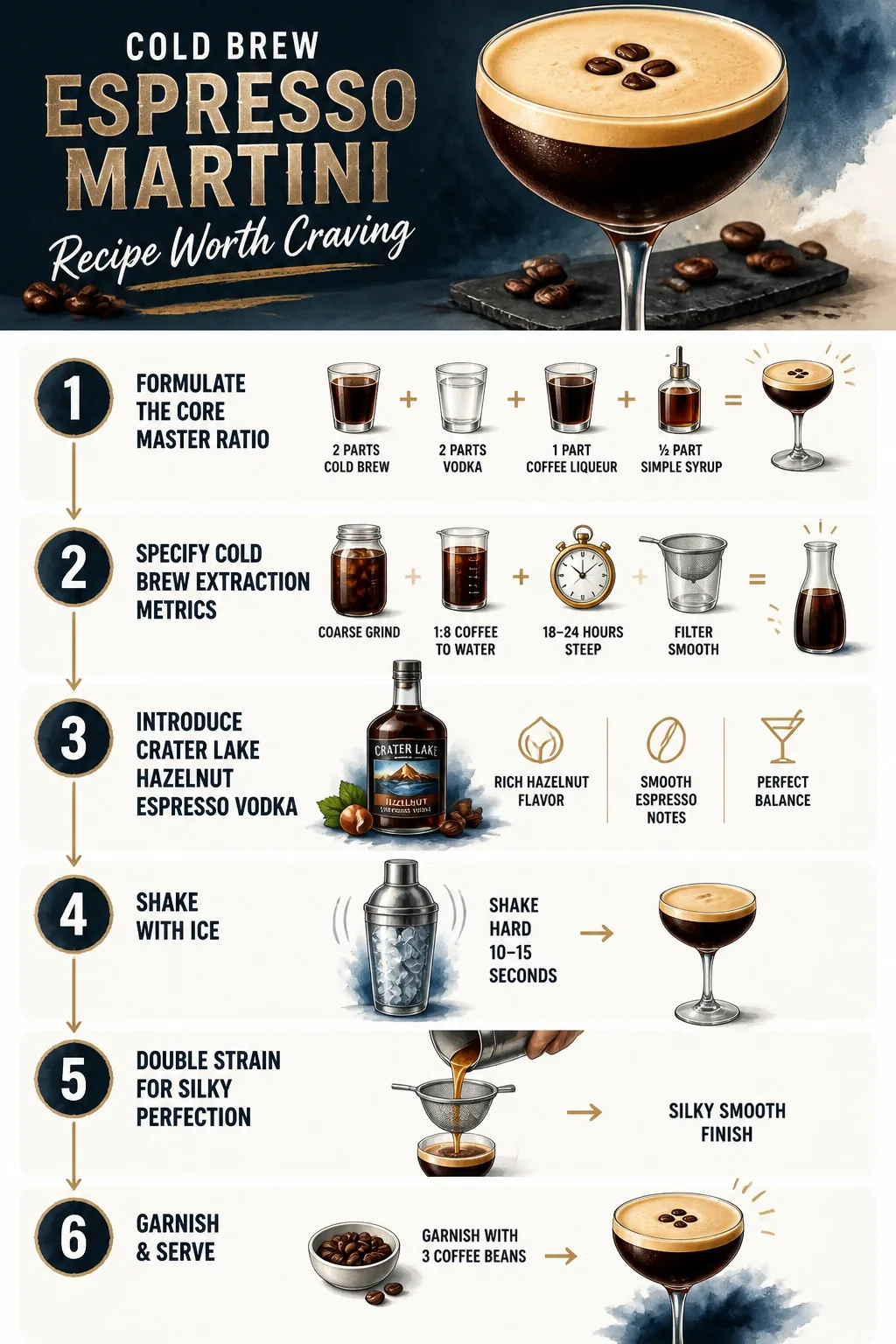
The master ratio: 1.5 oz craft neutral vodka, 1.0 oz Crater Lake Hazelnut Espresso Vodka, 1.0 oz high-TDS cold brew concentrate, 0.5 oz dry coffee liqueur, 2 drops 20% saline solution.
Calibrating each ingredient strictly by volume also allows for a precise espresso martini calorie breakdown based on the exact spirits and sweeteners used.
The 1:4 Steep Standard: Achieving High-TDS Cold Brew Concentrate
Ready-to-drink bottled cold brew (Stumptown, Chameleon, most grocery brands) is calibrated for drinking at 1:8 or 1:10 ratio, targeting TDS of 1-3%. Poured into a shaker with 25% dilution from ice melt, the resulting coffee content in the glass is under 1% dissolved solids: not enough to taste distinctly of coffee and certainly not enough lipids to contribute to emulsion stability.
Make concentrate at 1:4 coffee-to-water ratio by weight: 100g coarse-ground coffee to 400g cold filtered water. Steep in a sealed jar or French press in the refrigerator for 16-20 hours. Strain through a paper filter or fine-mesh sieve. The result is a dense, syrupy coffee liquid with TDS of 6-8% that retains its flavor identity through shaker dilution and provides a lipid-rich base for emulsion formation.
If time is a constraint: Mr Black Cold Brew Coffee Liqueur is a higher-quality commercial concentrate at acceptable TDS. Use 0.5 oz as the coffee source, reduce or eliminate the additional dry coffee liqueur to avoid sweetness stacking, and adjust the recipe accordingly.
Spirit Architecture: Balancing Hazelnut Vodka With Dry Coffee Liqueur
The 1.5 oz neutral vodka provides the structural ethanol base. At 40% ABV, ethanol acts as the primary solvent that extracts and suspends coffee diterpenes from the concentrate into a velvety body.
Crater Lake Hazelnut Espresso Vodka at 1.0 oz functions as a lipid modifier and aromatic bridge, not a flavoring agent. Bendistillery cold-infuses dark-roasted espresso and toasted Oregon hazelnuts directly into the vodka, meaning the hazelnut and espresso character comes from actual extracted lipids and pyrazines rather than artificial flavor compounds. These natural lipids supplement the cold brew’s emulsion matrix during the shake. Keep this at 1.0 oz: below 0.75 oz and the lipid contribution is insufficient; above 1.25 oz and the hazelnut becomes the dominant flavor over the coffee.
The dry coffee liqueur (Kahlua, Mr Black, or cold brew liqueur) at 0.5 oz adds roasted-coffee depth and a moderate sweetness that rounds the spirit edges. Using a sweetened liqueur means the simple syrup may be reduced or omitted entirely depending on palate preference.
Micro-Dosing Saline: Suppressing Chlorogenic Bitterness
Two drops of 20% saline solution (1 part salt in 4 parts water by weight) added to the shaker before sealing. Sodium ions bind to the G-protein-coupled receptors most sensitive to chlorogenic acid bitterness compounds in coffee, reducing the perceived bitter intensity without altering the actual chemistry. The cocktail does not taste salty. What you lose is the harsh, drying bitterness at the back of the palate; what comes forward is the hazelnut’s toasted nut sweetness and the coffee’s caramel roast notes.
Rich demerara syrup (2:1 ratio) at 0.25 oz, optional. If using a sweetened coffee liqueur, taste the build before adding syrup. The goal is balance, not sweetness.
Step 2: Execute the High-Cavitation Linear Shake
The shake in a cold brew martini is not chilling by another name. It is active emulsion construction.
Shaker Loading Technique: Ice Volume and Air Pocket Geometry
Fill the larger Boston tin three-quarters full with dense solid ice cubes. This loading level is not arbitrary. Too little ice reduces kinetic impact mass and limits cavitation force. Too much ice leaves no liquid headspace for the kinetic collision to drive micro-bubbles into the liquid. Three-quarters full gives the liquid 25% headspace for the ice-liquid collision zone where cavitation occurs.
The 15-Second Linear Piston Shake
Seal the Boston shaker. Hold it horizontally with both hands, one on each tin. Shake with maximum force in a linear back-and-forth piston motion, parallel to the ground. The horizontal axis and linear trajectory drive ice through the liquid at higher velocity than a rotational shake, increasing the pressure differential at each collision point and generating more cavitation micro-bubbles per second.
Shake for exactly 15-18 seconds. The physical feedback cues: heavy frost forms across the entire exterior metal surface within 10-12 seconds, and the interior sound transitions from sharp ice cracks to a muffled slush as ice begins to round off and the liquid chills to near-freezing. Stop at this transition, not after. Shaking beyond 18 seconds introduces more melted water than the hazelnut lipid matrix can hold in suspension, and the emulsion breaks.
Reading the Frost: Visual and Auditory Cues of Thermal Equilibrium
The frost line on the exterior tin is the most reliable indicator that the liquid inside has reached sub-freezing temperature (28-30°F). If frost does not form within 12 seconds, your ice cubes are either not dense enough or your ingredients were too warm. Both problems are solvable: use bag ice or directional-freeze cubes, and pre-chill the spirits in the refrigerator for 30 minutes before building.
Step 3: Double-Strain for a Velvety 3mm Crema Head
The Dual-Filter Setup
Remove the coupe from the freezer and dump any condensate water. Position the Hawthorne strainer flat over the opening of the larger Boston tin, spring side inward. Hold the conical fine-mesh sieve directly above the center of the coupe, approximately 2 inches above the glass rim.
Pouring Mechanics: Center-Pour Stream to Protect Surface Tension
Pour in a single, steady continuous stream aimed at the center of the sieve, allowing the liquid to flow through both filters simultaneously without splashing or stopping. A broken pour reintroduces turbulence that disturbs the forming foam layer. Pour at an angle that lets the stream hit the center of the sieve; off-center pours spray liquid against the sieve walls and lose foam density.
The Resting Phase: Watching the Crema Cascade and Settle
After pouring, set the glass down and do not touch it for 20-30 seconds. During this window, the denser coffee-spirit liquid sinks to the bottom of the glass while the lighter aerated foam layer rises to the surface. This cascade effect is visible: a darker liquid separates below a progressively lighter foam crown. The foam settles into a uniform layer approximately 3mm thick. Interrupting this process by moving, tilting, or garnishing the glass immediately after pouring breaks the stratification and produces a thinner, less defined crema.
Step 4: Garnish with Complementary Aromatics
The Traditional Trio: Floating Coffee Beans
Float three whole dark-roasted coffee beans on the center of the foam surface in a triangle formation. The traditional symbolism is health, wealth, and happiness. The functional role is aromatic: roasted bean surface oils volatilize continuously as you drink, delivering coffee aromatics to the nose with each sip. Use whole, unground beans; pre-ground coffee dust punctures the foam surface.
Expressed Citrus Volatiles: Orange Peel Oils to Cut Sweetness
Take a wide swath of fresh orange peel and bend it skin-side down, 45 degrees, 2 inches above the glass surface, toward the foam. The mechanical flexing ruptures the oil cells in the outer peel layer, releasing a fine aerosol mist of d-limonene and other citrus terpenes across the foam surface. These volatile compounds chemically contrast the roasted pyrazines in the hazelnut vodka, brightening the front-of-palate response before the coffee and hazelnut notes develop through the sip. Run the peel around the glass rim and rest it at the edge.
Toasted Hazelnut Dust for Textural Aroma
Using a microplane or fine grater, lightly dust toasted Oregon hazelnuts over the foam surface. The fine hazelnut shavings melt partially into the foam, adding a textural element and releasing warm toasted-nut aromatics that signal the Crater Lake Hazelnut Espresso Vodka before the first sip. Keep the dusting light; heavy nut coverage acts similarly to ground cinnamon and can puncture foam bubbles if the particles are coarse.
Troubleshooting Common Cold Brew Martini Defects
| Symptom | Root Cause | Fix |
|---|---|---|
| Flat or collapsing foam | Low-TDS concentrate, weak shake, warm tools | Use 1:4 concentrate, shake 15s at full force, freeze tins |
| Watery, thin coffee flavor | RTD cold brew or over-shaking past 20s | Brew 1:4 concentrate, cap shake at 15-18s |
| Cloying sweetness | Sweetened liqueur plus added syrup | Omit demerara when using sweetened coffee liqueur |
| Harsh astringent finish | Under-extracted concentrate or too-light roast | Steep 18-20 hours, use medium-dark roast beans |
| Foam forms but collapses in 60s | Micro-ice shards in glass, warm coupe | Double-strain correctly, freeze coupe 10 min minimum |
Fixing Thin Crema: Shaking Power and Liquid Viscosity
If the foam layer is present but thin (under 1mm) or collapses before the drink reaches the table, the problem is almost always one of three variables: insufficient shaking force, low-TDS concentrate, or warm bar tools. Pre-chill the Boston tins in the freezer for 5 minutes before assembly. Verify the concentrate was made at 1:4 and not diluted further. Add one additional drop of saline solution, which improves the perceived body of the emulsion by suppressing competing bitter compounds that thin the palate perception.
For persistent thin foam despite correct technique: check your brewing water. Reverse-osmosis or highly filtered water with very low mineral content produces weaker colloidal coffee structures. Water with moderate calcium and magnesium hardness (50-150 ppm) produces stronger emulsions. Brewing with a small amount of added minerals (a trace of gypsum or calcium chloride) resolves this.
Eliminating Watery Mouthfeel: Dilution Curves and Ice Integrity
A watery mouthfeel means either the concentrate was too weak or the shake ran too long. Both add excess water relative to dissolved coffee solids. At 1:4 concentrate strength, the coffee holds its flavor identity through 25% shaker dilution. At 1:8 ready-to-drink strength, 25% dilution produces a drink that tastes like coffee-flavored water. There is no in-glass correction; the fix happens before the shake.
Balancing Sweetness: Sugar Ratios Against Flavored Spirits
If the finished cocktail tastes cloying, the most common cause is sweetness stacking: a sweetened coffee liqueur plus the hazelnut vodka plus added demerara syrup. Crater Lake Hazelnut Espresso Vodka carries its own natural sweetness from the hazelnut infusion. When pairing it with a sweetened liqueur like Kahlua (which runs at approximately 20% residual sugar), adding 0.25 oz of additional syrup pushes the drink past the ideal sweetness threshold for a coffee cocktail. Reduce the syrup to a single bar spoon or eliminate it entirely. Let the hazelnut vodka carry the sweet register and the coffee liqueur carry the depth.
Frequently Asked Questions About cold brew espresso martini recipe
Can I use store-bought cold brew instead of making my own concentrate?
Ready-to-drink bottled cold brew (Stumptown, Chameleon, most grocery brands) is calibrated at 1:8-1:10 ratio with TDS of 1-3%. After shaker dilution, the coffee content in the glass is too low to taste distinctly and does not carry enough lipids for stable foam. Make a 1:4 concentrate or use Mr Black Coffee Liqueur as a higher-TDS commercial alternative.
Why does my cold brew martini have no foam?
Cold brew has no dissolved CO2, so foam depends entirely on the shake generating hydrodynamic cavitation. Flat result means one or more of: low-TDS concentrate, insufficient shake force or duration, warm tools, or hollow freezer ice that over-dilutes before cavitation completes. Fix all four simultaneously rather than adjusting one at a time.
What does Crater Lake Hazelnut Espresso Vodka add that regular vodka does not?
Regular vodka is neutral by design. Crater Lake Hazelnut Espresso Vodka contributes natural hazelnut lipids from cold infusion of toasted Oregon hazelnuts, which supplement the cold brew emulsion matrix and provide a fatty mid-palate bridge between the vodka’s ethanol and the coffee’s roasted bitterness. It also adds roasted hazelnut and espresso aromatics without artificial flavoring compounds.
How long does the foam last on a properly made cold brew espresso martini?
With a 1:4 concentrate, correct shaking, double-straining, and a frozen coupe, the crema holds visibly for 8-10 minutes. Micro-ice shards in the glass (from skipping the fine-mesh sieve) collapse the foam within 60-90 seconds. A room-temperature glass shortens foam life to 2-3 minutes through thermal separation at the glass wall.
Can I batch this recipe for a party?
Pre-batch the spirits and cold brew concentrate up to 24 hours ahead in a sealed container in the refrigerator. Do not add the saline drops until just before shaking. Shake each drink individually; batched shaking in large volumes does not generate the cavitation velocity needed for stable foam. The concentrate itself keeps in the refrigerator for 5-7 days.
References
- Barista Guild of America, Cold Brew Extraction Standards | baristaguild.com
- Crater Lake Spirits, Hazelnut Espresso Vodka Tasting Notes | craterlakespirits.com