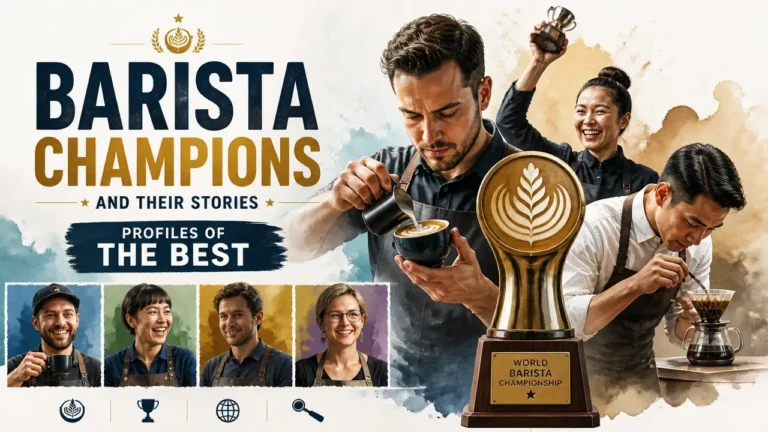

Famous barista champions are built inside one of the most compressed pressure environments in professional craft: a 15-minute stage routine, 12 drinks, and a panel of judges evaluating everything from extraction temperature to emotional presence. The World Barista Championship has run since 2000, and the people who’ve won it have gone on to build roasteries, reshape direct trade, train the next generation, and carry coffee into cultural conversations it had never entered before.
What separates a champion from a finalist isn’t always the coffee in the cup. It’s the architecture behind the routine – the producer relationships, the coaching networks, the interpretive intelligence, and the willingness to compete again after losing. The careers that followed those 15 minutes are where the real story begins.
Beyond the competition stage, innovative famous baristas are continuing to push boundaries and redefine the craft for a global audience.
Before dedicating years and thousands of dollars to a routine, many aspiring professionals weigh the value of coffee competitions against the financial and personal toll required to reach the global stage.
For those looking to master the stage, understanding competition judging criteria is essential to decoding what makes a world-class routine succeed.
While glamorous stage routines celebrate the pinnacle of craft, a much darker reality is explored in Blood Beans amp Billions The, revealing the hidden exploitation and corporate greed that built the global coffee empire.
Key Takeaways on Famous Barista Champions
- The WBC format is 15 minutes, 12 drinks, and six judges – but the real competition begins months earlier in training rooms and producer farms.
- Every major champion competed multiple times before winning; resilience and iteration are prerequisites, not detours.
- The WBC title carries no documented prize fund – its value is the platform, and what champions build with that platform determines their actual influence.
- Raul Rodas’s 2012 win and Agnieszka Rojewska’s 2018 win were structural disruptions, not just personal victories – they exposed access gaps the competition system still hasn’t fully resolved.
- The 2023 infused-coffee rule change gave competitors a new creative frontier, but only those reading the rulebook closely enough to find it could use it.
- The most enduring champions are defined by their post-competition contributions – education, direct trade, representation, and technical innovation – not by the trophy itself.
The Arena That Shapes Champions
The World Barista Championship is a 15-minute performance evaluated by six judges. Each competitor serves 12 drinks: four espressos, four milk beverages, and four signature drinks. Sensory judges score flavor and balance. Technical judges track precision, cleanliness, and process. That’s the format on paper. What it actually is, in practice, is something harder to describe.
The WBC is simultaneously a competition, a global trade event, and a cultural checkpoint for the specialty coffee industry. Barista Magazine has called it a “giant coffee party” where the world’s coffee community converges for a week – and that framing is accurate. Thousands of spectators attend. Equipment brands, green-coffee buyers, and roasters fill the exhibition floor. The competitors on stage are performing for judges, but the ripple effects of a strong routine reach buyers and collaborators who are watching from the crowd.
Getting to the WBC stage takes longer than the 15 minutes it lasts. Every competitor earns their place through sanctioned national qualification events, meaning the journey to a world title is measured in years, not weeks. A barista might spend an entire competition season refining a single routine before stepping onto a national stage, and only the national winner advances to the world event.
The WBC held its first competition in 2000, and in those early years, the event was small enough that most of the coffee industry hadn’t noticed it yet. The 2007 Tokyo host marked the first time the WBC landed outside the Western world, signaling that the competition belonged to a global profession, not a regional one. The 2020 edition was cancelled due to COVID-19 – the first cancellation in the event’s history – which underlined how much the annual rhythm of the WBC had become structural to the specialty coffee calendar.
The WBC’s tagline, “Where Baristas Shape the Future of Coffee,” reads like marketing. But the careers that have come out of this competition suggest it’s closer to a statement of fact. The question is how that shaping actually happens – and who does it.
According to Sonja Björk Grant, an Icelandic veteran judge and longtime WBC organizer, talent accounts for roughly one percent of what produces a world champion. The remaining ninety-nine percent is support system, discipline, opportunity, and family.
That ratio reframes the entire conversation. The WBC doesn’t just test what a barista can do with coffee. It tests the infrastructure around them – and that infrastructure, it turns out, is exactly what the most successful champions built deliberately.
The Pioneers Who Defined the Champion Archetype
Before the WBC had famous barista champions, it had competitors. The gap between those two things was closed by a handful of people who understood that winning was a beginning, not an end.
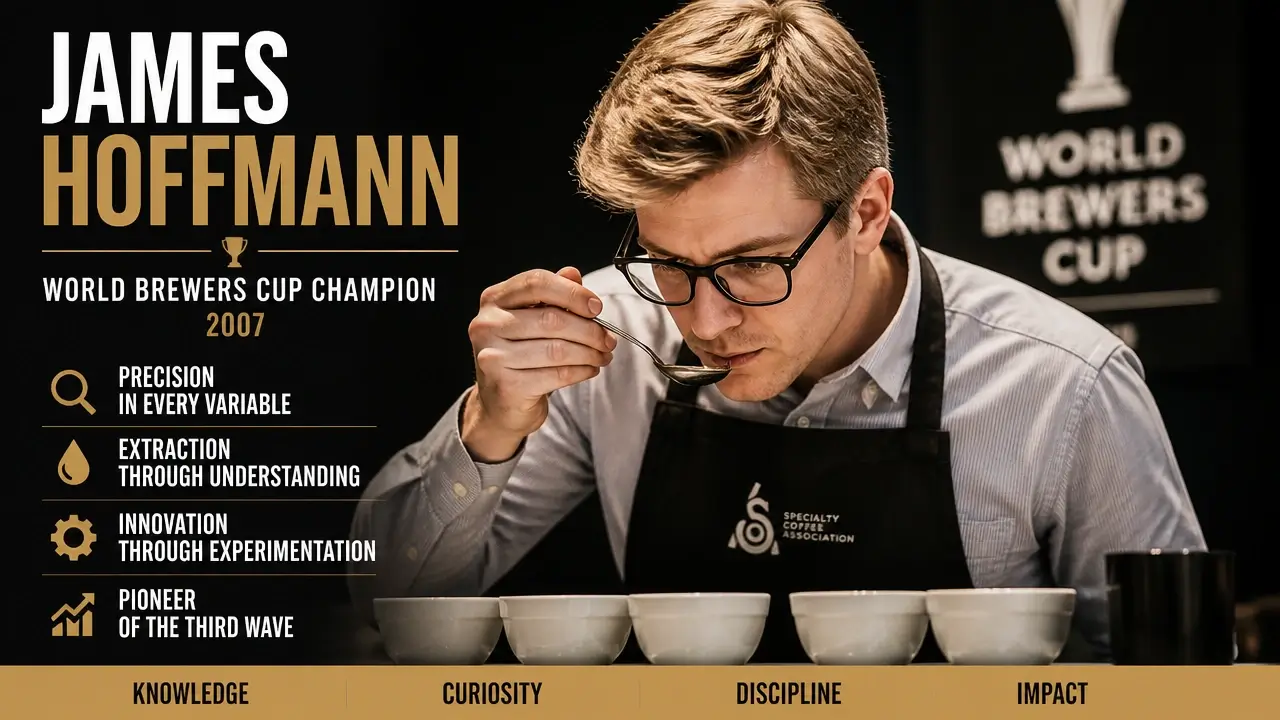
James Hoffmann won the 2007 WBC representing the UK at that Tokyo event. He came to coffee not through culinary training but through dissatisfaction with office work – a trajectory that would become a recurring theme among specialty coffee’s most committed figures. His win marked a specific shift in how the competition was understood: Hoffmann brought intellectual precision and sourcing transparency to the stage at a moment when those values weren’t yet standard. After the trophy, he co-founded Square Mile Coffee Roasters in London, built one of the most-watched coffee education channels on YouTube, and wrote what is widely considered the definitive consumer guide to coffee. His post-competition career didn’t just extend his influence – it multiplied it across audiences that had never set foot in a specialty café.
Gwilym Davies won in 2009, also from the UK, and took a different road. Where Hoffmann moved toward scale and media, Davies moved toward depth and craft transmission. He established Prufrock Coffee in London as a training ground – a place where the standard of coffee knowledge was high enough that subsequent competitors came to refine their own thinking. His ethos was never about the trophy. It was about the practice. Davies represents the perfectionist archetype: the champion whose most enduring contribution is the baristas they helped shape after their own win.
Raul Rodas won in 2012 representing Guatemala, and his victory carried weight that went beyond personal achievement. He was the first champion from a producing country – a nation that grows and exports the raw material the entire industry depends on – and his win directly challenged an unspoken assumption about where elite barista talent could come from. His competitive strategy was itself a statement: he presented two distinct signature drinks rather than one, a structural choice that demonstrated creative confidence and a willingness to rewrite the playbook. The significance of Rodas’s win is sharpened by a pattern that Perfect Daily Grind has noted: despite his breakthrough, competitors from producing countries rarely reach WBC semi-finals. That’s not a talent gap. It’s a structural one – access to competition-grade equipment, training ecosystems, and coaching networks remains unequal across the global coffee economy, and Rodas’s win was an exception that made the rule more visible, not less.
Pete Licata won in 2013 for the USA after multiple competition cycles. His path was not a single brilliant year – it was a sustained commitment to technical refinement across seasons. Post-competition, Licata moved into coffee education and quality assessment work that shaped how the US competition community understood evaluation standards. He represents a third archetype: the champion who turns competitive experience into systemic infrastructure, raising the floor for everyone who competes after them.
What these four pioneers established, collectively, was a new definition of what a barista could be. Before the WBC reached critical mass, “barista” was a job title. After Hoffmann, Davies, Rodas, and Licata, it was a profession with visible career trajectories, global recognition, and a body of intellectual work attached to it.
The first female WBC champion came in 2018, when Agnieszka Rojewska of Poland won – a landmark that arrived 18 years into the competition’s history. That gap isn’t incidental. It reflects the same structural dynamics that made Rodas’s producing-country win remarkable: the WBC’s champion archetype had a shape, and certain people fit it more easily than others. Both wins were disruptions to an unspoken status quo. The reader should feel the weight of that – not as a footnote, but as a feature of how institutions evolve.
Signature Drinks, Secrets, and the 15 Minutes That Changed Everything
Every WBC routine looks like a performance. What it actually is, is the visible surface of an invisible architecture – months of rule interpretation, ingredient sourcing, coaching debates, and strategic decisions that the audience never sees. The 15 minutes on stage are the compression of all of that.
Signature Drink Innovations from Sestic, Wu, and Simpson
Sasa Sestic won the 2015 WBC representing Australia, and his background is unlike most champions in the field. A former Olympic handball athlete, Sestic brought a competitive mindset shaped by team sport – where marginal gains and systems thinking matter as much as individual performance. His signature-drink philosophy centered on showcasing a coffee’s inherent character rather than masking it with additions, a choice rooted in his deep investment in direct producer relationships. The story of Sestic allegedly transporting Australian milk across international borders for his competition preparation has become part of WBC lore – and whether it’s fully literal or partly mythologized, it captures something true about championship-level obsession with ingredient quality. When every variable is a decision, the milk is a decision too.
The video below shows Sestic reflecting on what the win actually meant – and where his thinking went after the confetti settled.
According to Sasa Sestic, 2015 World Barista Champion and owner of Ona Coffee, the morning after his win he woke up in his hotel room and the trophy was still there – and in that moment, the win stopped being about him. His thinking shifted from perfecting his own craft and building his business in Canberra to asking how he could use the platform to grow specialty coffee as a global movement.
That reorientation from personal achievement to systemic contribution is a pattern that appears in nearly every champion’s post-win story. Sestic didn’t stop at the trophy. He built Project Origin, a direct-trade and auction model designed to connect roasters with the farmers who grow their coffee.
Sasa Sestic, as founder of Project Origin, described the auction model not just as a purchasing mechanism but as a relationship-building platform – one where roasters could meet farmers directly, collaborate on future lots, and establish long-term supply relationships regardless of their purchase volume. The logistics infrastructure, he noted, was designed to remove the barriers that typically prevent smaller roasters from participating in direct trade.
Berg Wu won the 2016 WBC representing Taiwan, and his contribution to the competitive canon is one specific technique: cooling the portafilter with ice water immediately before extraction. The logic is precise. Portafilters accumulate heat from repeated use, and that residual temperature affects extraction dynamics in ways that compound across a competition set. By cooling the metal before each pull, Wu controlled a variable that most competitors weren’t actively managing. It’s a small intervention with a measurable effect – and it illustrates the WBC’s central creative dynamic: the competitors who win are often the ones who find the variable everyone else is ignoring.
Jack Simpson won the 2025 WBC representing Australia, and his path to the title was neither fast nor linear. He competed multiple times before winning, each cycle producing refinements in his approach to milk processing and fermentation experimentation. Simpson’s story is the clearest recent evidence that the champion archetype has shifted: single-year brilliance is rarer than sustained iteration. The competitors who reach the podium now tend to be the ones who treated every previous competition as research.
Rulebook Evolution and the Role of Coaching in Competition
In 2023, the WBC updated its rules to allow infused and co-fermented coffees in competition. This is the most significant creative shift the rulebook has seen in years. It opened the door to flavor profiles that were previously either prohibited or existed in a regulatory gray zone – profiles built through controlled fermentation, botanical infusions, and processing interventions that alter the coffee’s chemical composition before it reaches the grinder.
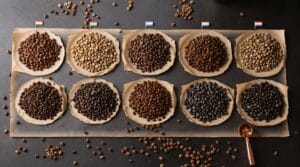
The science behind why this matters is not trivial. A 2023 peer-reviewed metabolomics study analyzing Coffea arabica beans across natural, washed, and honey processing methods identified 2,642 non-volatile and 176 volatile compounds that shift meaningfully depending on how the coffee is processed. Specific metabolites – including lichenin, ethyl alpha-D-glucopyranoside, and maltol – function as flavor precursors that continue transforming during roasting. The study established a technical basis for understanding how controlled fermentation systematically alters sensory attributes like acidity, body, and aroma. In competition terms, that means a barista who understands fermentation science can design flavor outcomes rather than just select for them.
From a technical standpoint, this finding matters because it confirms that processing is a flavor tool, not just a logistics step. When the WBC opened the door to infused coffees, it wasn’t loosening standards – it was acknowledging that the frontier of flavor innovation had moved upstream, to the farm and the fermentation vessel.
What makes this rule change strategically interesting is where the information lives. The 2023 allowance is documented in secondary sources but largely absent from the official WBC site’s most visible pages. Competitors who rely only on official channels may miss it entirely. That’s not an accident of poor communication – it’s a feature of how the WBC has always worked. The rulebook responds to what competitors push, and the competitors who push it are the ones paying close attention to what the rules actually permit versus what convention assumes.
Berg Wu’s portafilter cooling and the 2023 fermentation allowance are part of the same pattern. Champions don’t just execute within the rules. They read the rules more carefully than anyone else, find the space the rules don’t prohibit, and build their routines there. The rulebook is reactive to their creativity. That’s been true since the beginning.
The coaching relationship is where this interpretive work happens most productively. The competitors who reach the WBC podium consistently describe working with coaches – often former champions or experienced mentors – who challenge their assumptions about both the coffee and the presentation. This isn’t passive mentorship. It’s active stress-testing: someone in the room whose job is to find the weakness in the routine before the judges do.
According to Kay Cheon, 2025 US Barista Champion competing out of Dune Coffee Roasters, this year’s preparation involved taking on significantly more ownership of the process than in previous cycles. Working alongside her team, she drove the final decisions on most aspects of the routine – but in areas where a teammate had clearer perspective, she trusted that judgment rather than defaulting to her own.
That’s not a soft skill. That’s competitive intelligence. Knowing when your own perspective is the limiting factor, and having a team structure that can compensate for it, is as technical as knowing when to cool the portafilter.
Life After the Trophy
Winning the WBC doesn’t come with a documented prize fund or a guaranteed career transformation. No public source has quantified the direct financial value of the title. What it comes with is a platform – and what champions do with that platform is where the real divergence begins.
Post-Win Career Trajectories and the Economic Reality
The careers that have followed WBC wins fall into recognizable patterns, each anchored by specific people.
The entrepreneur-educator path is most visibly represented by Hoffmann and Davies. Hoffmann scaled his platform globally through Square Mile, YouTube, and published work that reaches millions of people who will never compete in anything. Davies built Prufrock into a coaching institution. Both used the credibility of the WBC win as a foundation, then built structures that could operate independently of it.
The producer advocate path belongs to Sestic. His post-win work through Project Origin centered on direct-trade infrastructure – connecting roasters to farmers in ways that the competition stage had given him the credibility to facilitate. His signature drinks from champions weren’t just sensory showcases; they were arguments for a supply chain model, and his post-competition career made those arguments structural.
The competition circuit mentor path is where Licata’s post-win work sits. His focus on coffee education and quality assessment standards shaped how the US competition community evaluates and prepares competitors. He didn’t build a consumer-facing brand. He built the scaffolding that other competitors climb.
According to Mikael Jasin, multiple WBC competitor, founder and CEO of So So Good Coffee Company and CATUR Coffee Company, the platform that competition and social media provide carries a responsibility. His framing: the role of those who’ve been given visibility is to help gather people, present new technologies and ideas to a global audience, and do the work alongside others – not above them.
That framing matters. The WBC title doesn’t create influence in a vacuum. It creates access. What champions build with that access is the actual measure of what the win was worth.
The honest version of this story includes a gap: beyond the most visible names, career-outcome data for WBC champions is sparse. There’s no public record of how title wins translate to revenue, investment, or long-term business success across the full field of past champions. The value of winning isn’t invisible – the trajectories of Hoffmann, Davies, and Sestic make it visible – but it’s not universal, and it’s not automatic. The platform works for those who treat it as a starting point rather than a destination.
Alternative Paths: Sustained Commitment and Representation
Ben Put has been a multiple-time Canadian Barista Champion and a consistent WBC presence without a world title to his name. His career is a useful counterpoint to the trophy-as-turning-point narrative. Put’s sustained engagement with competition – competing, coaching, refining across cycles – built Canada’s reputation as a serious competition nation and established him as a figure of genuine influence in North American specialty coffee. The competition was always the vehicle, not the destination.
Agnieszka Rojewska’s 2018 WBC win was the first by a woman in the competition’s 18-year history. Her approach on stage was technically precise and deliberately approachable – a combination that challenged the assumption that accessible presentation and technical rigor were in tension. Her post-win influence on representation within the competition community is harder to quantify than a business venture, but it’s real: the question of who can see themselves on the WBC stage shifted after 2018, and her win is part of why.
The question that the available data can’t yet answer is whether the WBC platform works equally for champions from producing countries, for women, and for competitors without access to established coffee infrastructure. The careers of Hoffmann and Davies are well-documented. The long-term trajectories of champions with less institutional support behind them are not. That data gap is not neutral. It shapes which stories get told, which paths aspiring competitors see as possible, and which structural barriers remain invisible.
For anyone considering the competition path, understanding the sponsor and equipment partnership landscape is part of the preparation. Post-competition opportunities are partly shaped by relationships with brands and equipment manufacturers that official channels rarely examine critically. Champions who build durable careers tend to navigate these relationships with intention. That’s a skill, and it’s worth naming as one.
You can also explore the signature drinks from champions to see how those routines were constructed – because the drink on the plate is always an argument, and understanding the argument helps you build your own.
What Every Aspiring Competitor Should Steal From the Champions
The stories in this article aren’t history. They’re a pattern library. And if you’re building toward competition – or just toward a more serious relationship with your craft – the patterns are worth naming clearly.
Core Patterns for Competitive Success
The resilience pattern is the most consistent finding across champion biographies. Jack Simpson competed multiple times before winning in 2025. Pete Licata cycled through competition seasons before his 2013 title. Ben Put built an entire career of influence without a world title. None of these trajectories were detours. They were the process. The idea that a single brilliant year produces a champion is contradicted by nearly every champion’s actual story. Iteration is the mechanism. Failure is the input.
The team pattern is equally consistent. Sestic’s win was supported by producer relationships that took years to build. Hoffmann’s post-competition reach was amplified by Square Mile’s team. Simpson’s coaching relationships shaped his 2025 preparation. Kay Cheon explicitly named the team structure as central to her 2025 US title. The WBC stage holds one person. The preparation that gets them there holds many. Sonja Björk Grant’s framing – that talent is one percent of what produces a champion – is a description of this reality, not an underestimation of skill.
The authenticity pattern is where the tactical advice gets counterintuitive. Gwilym Davies won by being a purist in an era when that wasn’t the flashiest option. Raul Rodas won by presenting two signature drinks when one was the convention. Agnieszka Rojewska won by pairing technical precision with approachability at a moment when the competition aesthetic leaned toward complexity. None of them won by studying the previous champion and replicating the formula. They won by leaning into their own perspective with enough confidence that the judges couldn’t ignore it.
There’s also a meta-skill that no champion biography states directly but every champion’s career demonstrates: the ability to operate within a partially opaque system. The WBC’s scoring rubric – the actual point weights, the criterion priorities, the judge calibration protocols – is not fully public. The 2023 infused-coffee allowance was documented in secondary sources before it appeared clearly on official channels. Champions navigate this by developing interpretive intelligence: reading between the lines of official communication, understanding what the rules permit rather than what convention assumes, and performing for an audience they can’t fully read. That skill is cultivable. It starts with paying closer attention to what the rulebook actually says versus what everyone assumes it says.
The economic reality lesson follows directly: since the WBC title carries no documented prize fund and no guaranteed career outcome, the competitors who build lasting influence are those who entered the competition asking “what will I build with the platform?” rather than “how do I win?” The platform has value. The value is proportional to what you do with it.
Redefining Fame and Building a Lasting Legacy
The most common question attached to this subject – “who is the most famous barista?” – is the wrong question. Fame in specialty coffee isn’t celebrity. It’s influence. The most recognizable names in the WBC’s history are recognizable because of what they built after the competition, not because of the competition itself. Hoffmann is known by millions of people who’ve never watched a WBC routine. Davies is known by baristas who trained at Prufrock years after his win. Sestic is known by farmers and roasters across multiple continents because of Project Origin.
If you’re thinking about becoming a coffee competition judge, understanding how champions are evaluated from the inside is one of the fastest ways to sharpen your own competitive preparation – the judge’s perspective and the competitor’s perspective are complementary, not separate.
The 2023 fermentation rule change, the ongoing conversation about equity and access in competition, and the next generation of competitors from producing countries and underrepresented backgrounds mean the champion archetype is still being written. The WBC’s history is not a closed archive. It’s an evolving argument about what coffee excellence looks like, who gets to define it, and what a 15-minute stage performance can launch.
The champions who matter most in this story can be grouped by the dimension of their legacy:
The Educators – Hoffmann, Davies, Licata – changed how baristas learn. Their most enduring contribution isn’t a trophy; it’s the knowledge infrastructure they built.
The Sourcing Innovators – Sestic – reshaped the supply chain by treating producer relationships as a competitive and ethical priority simultaneously.
The Representation Pioneers – Rodas, Rojewska – expanded who can see themselves on the podium. That expansion is still in progress.
The Technical Boundary-Pushers – Wu, Simpson – redefined what’s possible within the rules by reading those rules more carefully than anyone else.
These aren’t rankings. They’re lenses. The reader who aspires to compete should ask not just “how do I win?” but “which of these dimensions do I want to contribute to?” Champions are not defined by a single 15-minute performance. They’re defined by the careers and communities they build. The 15 minutes is just where it starts.
According to Dominika Piotrowska, two-time Austrian Barista Champion and Coffee in Good Spirits Champion, the technical elements of competition – flavor, extraction, process – are measurable, but hospitality operates differently. It’s built from intention, awareness, and emotional intelligence, and it rarely announces itself loudly on stage. The competitors who master it aren’t performing warmth; they’re expressing it.
That distinction – between performing a quality and embodying it – is the final thing that separates the champions who are remembered from those who simply won.
Frequently Asked Questions About Famous Barista Champions
How does a barista actually qualify for the World Barista Championship?
Competitors must win their country’s sanctioned national barista championship first. There’s no direct application to the WBC – the national title is the only path in, which means the journey to a world stage typically spans a full competition season or more.
Has any country won the WBC more than once?
Yes. The UK, Australia, and the USA have each produced multiple WBC champions across different years. Australia in particular has become a consistent presence on the podium, with Sasa Sestic in 2015 and Jack Simpson in 2025.
Why do so few competitors from coffee-producing countries reach WBC semi-finals?
It’s a structural issue, not a talent gap. Access to competition-grade equipment, established coaching networks, and the financial cost of international competition travel are unevenly distributed across the global coffee economy. Raul Rodas’s 2012 win remains a notable exception rather than a trend.
What happens to the WBC title holder after the competition year ends?
There’s no formal “reign” structure like in some sports. The title is permanent, but the champion’s influence depends entirely on what they do next. Some build roasteries and media platforms; others move into education, direct trade, or competition mentoring.
Are WBC scoring criteria publicly available?
The general framework – sensory judges, technical judges, and head judge – is publicly documented. The specific point weights, criterion priorities, and judge calibration protocols are not fully public. Competitors who reach the podium consistently demonstrate an ability to interpret unwritten expectations alongside the written rules.
What’s the significance of the 2023 infused-coffee rule change?
It allowed co-fermented and infused coffees in competition for the first time, opening the door to flavor profiles built through controlled processing interventions. It’s the most significant expansion of creative freedom the WBC rulebook has seen in years – and it’s better documented in secondary sources than on the official WBC site.
Do WBC champions make money directly from winning?
No public source documents a prize fund attached to the WBC title. The financial value is indirect: the platform, credibility, and network that a win provides become leverage for building businesses, securing partnerships, and accessing opportunities that weren’t available before.
What’s the best way for an aspiring competitor to start preparing?
Study the current rulebook carefully – not convention, the actual text. Build a team before you build a routine. Compete in smaller events first, treat every loss as data, and decide early what you want to build with the platform, whether or not you ever win.
References
- An Interview with Sasa Sestic, World Barista Champion | sprudge.com
- Relationship Coffee: What Makes Sasa Sestic’s Best of Auctions Special | perfectdailygrind.com
- Calling the Shots: 20 Years of the World Barista Championship | sca.coffee
- What Coffee Competitions Teach Baristas About Hospitality | perfectdailygrind.com
- Mikael Jasin Profile | specialprojects.sprudge.com
- Fermentation – Effects of Different Primary Processing Methods on the Flavor of Coffea arabica Beans by Metabolomics | mdpi.com