
A winning signature drink coffee competition entry is never the most creative one in the room. It’s the one built backwards from the score sheet, calibrated to the coffee’s own chemistry, and stress-tested against the same sensory standards the judges apply.
The World Barista Championship and World Coffee In Good Spirits Championship don’t reward novelty. They reward integrated systems where the concept, the recipe physics, the thermal stability, and the presentation script all point at the same single idea. This guide builds that system from the ground up.
Key Takeaways on Signature Drink Coffee Competition
- The WBC’s “predominant taste” rule is a sensory standard, not a volume formula – your espresso’s flavor identity must survive every ingredient you add.
- Concept development starts with the coffee’s origin data: processing method, varietal, and terroir are the blueprint, not the tasting notes on the bag.
- Syrup density (~1.3 g/mL) and spirit density (~0.79–0.97 g/mL) produce completely different sensory results at the same weight ratio – calibrate by palate, not by scale.
- The double-dilution lock method gives you independent control over temperature and dilution, preventing melting ice from dictating both simultaneously.
- Grinder retention between shots introduces flavor inconsistency that is invisible in practice but fully audible in a judge’s score – flush a sacrificial dose before each drink’s shot.
- A drink that fails the blind triangle test has already lost its primary competition criterion before a judge takes a sip.
How Competition Scoring Dictates Your Signature Drink’s Architecture
Competition scoring tells you what to build before you decide what to make. Every structural choice in your signature drink – the ratio, the ingredients, the presentation language – is either earning or bleeding points on a score sheet you already have access to. Read it first.
The World Barista Championship rule is unambiguous: the espresso must be the “predominant taste” in the signature beverage. That phrase doesn’t mean the espresso has to be the loudest ingredient by volume. It means the coffee’s flavor identity must survive the other ingredients. A judge should be able to taste your drink and recognize the coffee’s character through everything else you’ve added. If they can’t, the drink fails its most fundamental test before anyone writes a number.
The three primary WBC scoring domains that matter most for the signature drink are Taste Experience, Presentation, and Creativity. Taste Experience carries the highest weight. That ordering is the whole game. Synergy and balance outweigh novelty every single time. A technically fascinating preparation method that produces an unpleasant or unbalanced drink will score below a simple, beautiful, perfectly calibrated one.
The World Coffee In Good Spirits Championship adds structural complexity. In the preliminary round, competitors must prepare six drinks: two Irish Coffees and four signature drinks. The final round requires four drinks, one of which incorporates a mandatory randomly selected alcohol component. That constraint isn’t a burden – it’s an architectural prompt. Your signature drink concept must be flexible enough to absorb an unknown spirit without collapsing its core identity.
Here’s the test that defines whether your concept is genuinely competition-ready: if your drink could work with any random espresso pulled off any grinder, it fails. The beverage must be inextricably linked to the specific coffee you’re using. The espresso is not a vehicle for your other ingredients. It’s the subject of the entire performance.
As a practical starting guideline, the espresso-to-other-ingredients ratio runs 1:1 to 1:1.2 by weight. An 80g espresso paired with 80–96g of other ingredients including ice. That ratio is a launchpad, not a law. Its purpose is to protect espresso dominance while giving your supporting ingredients enough presence to do their job. Before you can prepare for barista competition with confidence, this ratio needs to be internalized as a sensory principle, not just a formula.
According to Sam Low, New Zealand Barista Champion and Latte Art Champion, the first high-scoring section of the signature beverage category asks whether your drink is well explained, introduced, and prepared. His advice: relentlessly ask yourself “why” for every decision you make. If the judges never need to ask that question themselves, you’ve already done the work of explanation for them.
That insight reframes the entire presentation section of your routine. You’re not narrating a drink. You’re preemptively answering every question a curious, skeptical judge might form. The presentation is a preemptive defense of every choice, delivered before the defense is requested.
According to Darleen Scherer, founder of Gorilla Coffee and Supercrown Roasters in New York City with over two decades in the industry, customization in coffee isn’t a departure from quality. It’s an expansion of what quality means – one that now includes not just the purity of the coffee’s flavor, but the creativity of the complete beverage experience.
That distinction matters for competition. The judges aren’t asking you to choose between a pure espresso and a creative drink. They’re asking you to build a creative drink that is also a pure expression of the espresso. Those two goals must converge in the same glass.
According to Tohm Ifergan, Founder and CEO of Dayglow Coffee, a signature drink concept can begin with a visual or textural idea and work backwards into flavor. His team infused a nonalcoholic coffee spirit with activated charcoal for a crude-oil appearance, then froze it with blood orange, coconut cream, monk fruit, and vanilla until it reached an almost frosty mouthfeel.
The mechanism here is worth unpacking. Ifergan’s process shows that texture and visual identity can be the concept’s anchor, provided every ingredient still serves the coffee’s story. The activated charcoal isn’t decoration. It transforms a familiar ingredient into something that demands explanation – and that explanation is where the “why” lives.
According to Leah Vautrot, co-owner of Coffee Science in New Orleans, their Espresso Nebula was created specifically to make dalgona coffee using fresh-roasted beans instead of instant. The concept was born from a desire to honor the coffee’s actual quality rather than work around it.
That’s the cleaner model for competition. The concept starts with the coffee’s specific qualities and asks what technique can best reveal them – not what technique is most impressive on its own.
Mining Your Coffee’s Origin for an Undeniable Concept
Coffee origin is the blueprint your signature drink should be built from, not a theme applied afterward. The difference between those two approaches is the difference between a drink that has a story and a drink that is a story.
Start with a deep analysis of your competition coffee that goes well past the tasting notes on the bag. Examine the producer’s story, the specific processing method – washed, honey, natural, anaerobic – the varietal, and the terroir. Each of those variables leaves a chemical signature in the cup. A washed Ethiopian Yirgacheffe and an anaerobic natural from the same region will produce fundamentally different flavor profiles, different acidity structures, different aromatic compounds. Those differences are your raw material.
The synergy principle works like this: identify the flavor compounds that already exist in your coffee, then find ingredients that share those same compounds or that fill a gap the coffee leaves open. A stone-fruit-forward natural Ethiopian coffee has chemical overlap with peach, apricot, and cherry. An ingredient from that family doesn’t add a new flavor to the drink – it amplifies one that’s already there, making the espresso taste more like itself. That amplification is what judges perceive as cohesion.
Your chosen ingredients must advance the coffee’s story, not merely taste pleasant alongside it. The concept should compress into a single declarative sentence. “This drink honors the anaerobic fermentation process of a Colombian Castillo by pairing it with a lacto-fermented hibiscus shrub that shares its wine-like acidity.” That sentence is a concept. “This is a coffee drink with hibiscus and coconut” is a description. Competition requires the former.
The tribute principle is the discipline behind that sentence. If your espresso carries a distinct tropical acidity, your drink should amplify or honor that quality – not mask it with sweetness, not redirect attention to an unrelated flavor note. The espresso’s natural personality should determine the drink’s personality. You’re not the author. You’re the editor.
One of the most documented failure points in competition is building a drink that is more interesting than delicious. It’s a real trap. You find a fascinating fermentation connection, a rare ingredient with a compelling origin story, and a preparation method that looks extraordinary on stage. The judges taste it and score the Taste Experience low because the drink is academically interesting but sensorially unpleasant. Creativity does not rescue a drink that doesn’t taste good. Understanding how signature drinks are judged makes clear that the Taste Experience score is not a participation metric – it’s the primary verdict.
The bridge between concept and execution is integration at the level of preparation technique itself. Consider competitor Shabaya, whose signature drink featured a flower-pot tower not as a garnish or a prop, but as the actual innovative preparation method that delivered the drink. The presentation wasn’t about the tower. The tower was the drink’s genesis. The story and the liquid were a single, indivisible entity. Your concept must reach this level of integration. If you can remove the narrative from the preparation technique and both still make sense independently, the concept isn’t unified enough.
Mastering this foundational extraction requires an appreciation for the vast varieties of coffee drinks found across global traditions.
Balancing the Unseen Forces: Density, Sugar, and Espresso Dominance
Ingredient density is the hidden variable that makes two drinks with identical recipes taste completely different. The weight ratio gives you a framework. Understanding the physics of what you’re actually weighing gives you control.
The Weight Ratio and Ingredient Density Trap for Espresso Dominance
Flavor balance in a signature drink is the harmonious integration of the espresso’s natural acidity and bitterness with the sweetness and texture of everything else. The failure modes are specific: too sour, too fruity, or too sweet. Each of those failures has a mechanical cause, not just a recipe cause.
The 1:1 to 1:1.2 weight ratio gives you a starting point. In practical terms: 80g of espresso combined with 80–100g of other ingredients including ice. That range is workable. The problem is that “80g of other ingredients” is not a fixed sensory unit.
Syrups run approximately 1.3 g/mL. Spirits run approximately 0.79–0.97 g/mL depending on alcohol content. An 80g addition of simple syrup delivers roughly 62mL of liquid. An 80g addition of vodka delivers roughly 100mL. The ratio is technically identical. The volume, the mouthfeel, and the sensory impact are completely different. A syrup-heavy drink at the 1:1 ratio will taste thicker, sweeter, and more viscous than a spirit-heavy drink at the same ratio. Calibrate by sensory impact, not just scale weight.
High sugar content chemically suppresses the perception of acidity and bitterness. A drink containing 25g of sugar will make the espresso seem to disappear compared to one with 15g, even when the espresso volume is identical. Fat from dairy or alternative milks coats the palate and rounds the coffee’s edge. Both effects are real and measurable in the cup. The practical rule: adjust your non-espresso volume based on its sugar content and fat content, not just its mass.
The “Start with Delicious” Rule and Blind Sensory Calibration for Espresso Body
The safety check against prioritizing technique over taste is simple: start with a delicious drink, then find an innovative preparation method to deliver it. Never reverse that sequence. A brilliant delivery mechanism for a mediocre-tasting drink is still a mediocre-tasting drink in front of a judge.
Espresso body must be present in the finished drink. A watery or thin result is a documented scoring penalty. The espresso’s mouthfeel – its weight, its texture, its viscosity – should survive the combination process. If your final drink feels like flavored water, you’ve either over-diluted or your non-espresso ingredients lack the body to complement the espresso’s natural density.
The most reliable way to find the correct ratio isn’t arithmetic. It’s the blind sensory calibration method. Abandon the idea of a perfect fixed number. Systematically adjust your non-espresso volume, tasting blind between iterations, until you can confidently identify your espresso’s specific origin note through the other ingredients. Not just “coffee flavor” – the specific note. Blackberry. Bergamot. Dried fig. When that note is the clear, leading voice without overpowering everything else, you’ve reached the correct “predominant taste” equilibrium. That’s the number you lock in.
The Texture and Temperature Lock-In
Texture lock-in is the engineering problem that kills more competition drinks than bad recipes do. A cold, perfectly balanced drink built in a test kitchen and a cold, perfectly balanced drink built on stage under competition lighting are not the same drink. The physics between them are different, and that difference has a name: dilution.
Dilution Control: The Frozen Ingredient Technique and Thermal Runway Problem
Dilution is the primary structural enemy of a competition signature drink. A drink that begins perfectly calibrated – correct ratio, correct body, correct espresso dominance – can become unrecognizable within minutes as ice melts and water works its way through the balance you spent weeks building. Under warm stage lighting, that process accelerates.
The frozen ingredient technique addresses this directly. Instead of relying solely on fresh ice as your cooling medium, use frozen coffee ice cubes made from your competition coffee, frozen fruit, or other pre-chilled components. These elements chill the drink without contributing immediate water dilution. Fresh ice melts on contact. Frozen espresso cubes melt into more espresso. The thermal work gets done without the structural damage.
The thermal runway problem is more insidious than the ice itself. In a 15-minute competition routine, your signature drink station is idle while you pull shots and steam milk for other courses. Your mixing vessels and tins are sitting in open air, gaining heat from the environment. If your ice sits in a warm mixing vessel for even 30 extra seconds before you begin building the drink, the initial melt shock is catastrophic – a sudden surge of dilution that you cannot recover from once the drink is in the glass.
The solution is pre-cooling all drink-building vessels on a dedicated ice bed in your staging area. Not on your competition table. A separate, purpose-built cooling station. Retrieve each vessel only at the exact moment you begin building that specific drink. The 30-second difference in vessel temperature is not a minor variable.
Temperature and Texture Lock-In: The Double-Dilution Lock Method
Temperature plays two roles simultaneously, and they pull in opposite directions. Low enough temperature locks in volatile aromatics and delivers sensory pleasure. Too-cold temperature numbs the judge’s palate and masks the coffee’s flavor. The target is maximum refreshment with full flavor transparency – a narrower window than most competitors account for.
Texture maintenance is a separate challenge. The finished drink should retain a silky, viscous body that echoes the espresso’s own mouthfeel. Controlled agitation, specific emulsifiers, or the natural pectin in certain fruits can all contribute to this. The mechanism matters less than the outcome: the drink should feel like an extension of the espresso, not a dilution of it.
The most reliable system for controlling both temperature and dilution simultaneously is the double-dilution lock method. It works in two steps.
First, use a frozen ingredient – frozen espresso spheres made from your specific competition coffee work best – as the primary cooling agent. This chills the drink without any initial water dilution. The thermal work is done by a frozen version of your own ingredient, so every drop of melt contributes to the drink’s flavor rather than subtracting from it.
Second, add a measured, smaller amount of fresh ice only for the final shake or stir. This provides the precise, calculated dilution needed to open the drink’s aromatics without breaking its structure. That final controlled dilution is what releases the volatile top notes that make the first sip vivid.
The result is independent control over temperature and dilution as two separate variables, rather than letting melting ice dictate both at once.
Designing the 3-Part Sensory Delivery System
A sensory delivery system is what transforms a technically excellent drink into a perceived high-level experience the moment it reaches the judge’s table. The liquid alone doesn’t communicate. The vessel, the garnish, and the words you use are all part of the same signal.
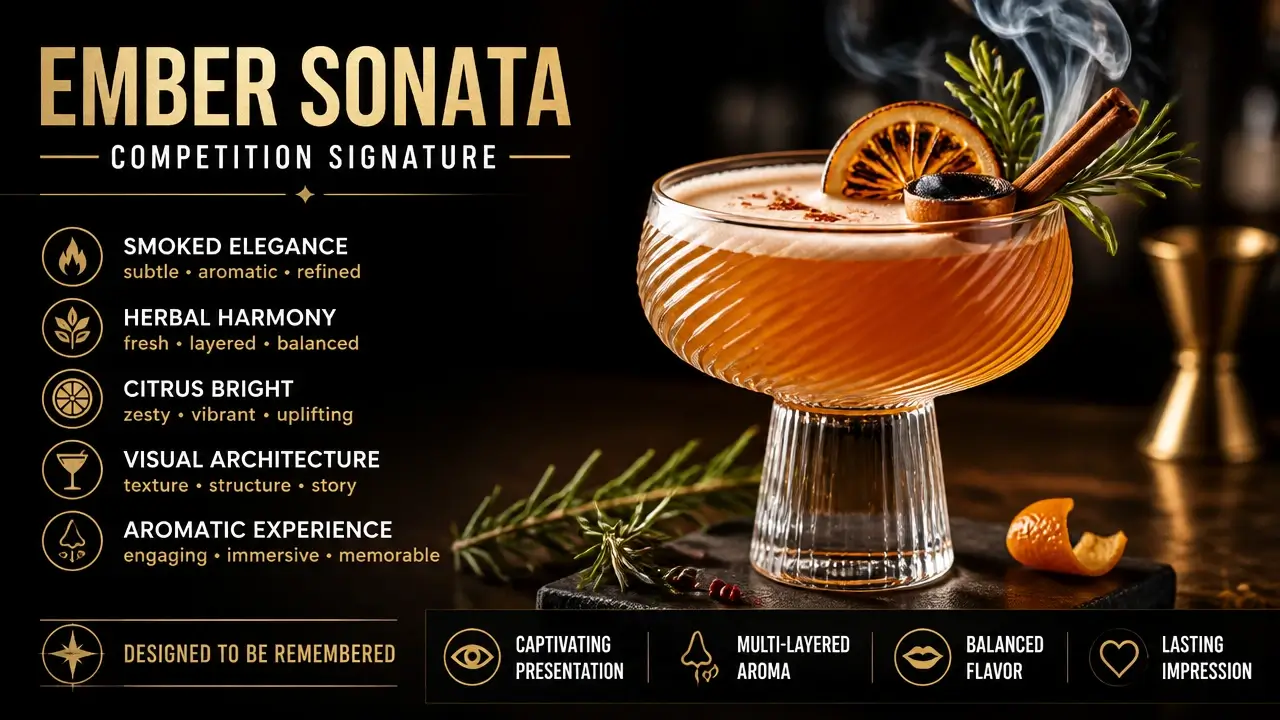
Visual architecture starts with glassware. The vessel must be chosen for both function and narrative alignment simultaneously. A rustic clay cup for an earthy, processed Sumatran communicates something before the judge takes a single sip. A crystalline coupe for a delicate washed Gesha signals precision and clarity. The container is the first argument for your concept. Choose it the way you choose an ingredient: with a reason.
The garnish follows the same logic. It must be aromatic, edible or clearly functional, and never arbitrary. An arbitrary garnish – one placed for visual interest without a connection to the drink’s concept – is a coherence penalty waiting to happen. If a judge asks “why is that there?” and the honest answer is “it looked nice,” the garnish has failed.
The “What, Why, How” script is the non-negotiable structure for your judge communication. Three parts, in order: (1) What the ingredient is; (2) Why it was chosen in relation to the coffee’s specific story; (3) How it contributes to the flavor, texture, or aroma experience of the finished drink. This is a prepared script, not an improvised explanation. Every word in it has been chosen in advance and rehearsed until it sounds spontaneous.
Synesthetic description is the technique that makes abstract flavor accessible to a judge who is tasting your drink for the first time. Describe taste in sensory cross-references: “The cascara syrup adds a dried-fruit sweetness that mirrors a Kenyan summer sunset” links flavor to a tangible feeling or image that reinforces your story. The judge’s brain makes the connection between the flavor and the image, and the image makes the flavor memorable. That’s the mechanism.
The coherence rule is the failure point most competitors discover too late. A beautiful drink presented with a story that feels bolted on loses coherence points. The presentation must feel like an inevitable expression of the liquid. If your drink is a vibrant, tropical meditation on acidity, the glassware must signal vibrancy, the garnish must signal precision, and the words must reinforce both. A mismatch between the drink’s sensory character and its visual or verbal framing registers as incoherence – and judges score what they perceive, not what you intended.
This intentional curation mirrors the subtle art of discovering coffee drink profiles that resonate with an individual’s intrinsic sensory preferences.
The Invisible 80%: Mastering Workflow for Flawless Execution
Workflow execution is the 80% of competition performance that no recipe blog covers and most competitors never systematically solve. The recipe is the easy part. Delivering it four times in sequence, under a 15-minute clock, with clean stations, consistent grind, and a coherent presentation – that’s the actual competition.
Most available advice focuses exclusively on what goes into the cup. The execution mechanics – cleaning protocols, physical staging, timing sequences, error recovery – are treated as self-evident, as if a great recipe automatically produces a great routine. It doesn’t. The gap between a written recipe and a 15-minute live performance is where competition runs die.
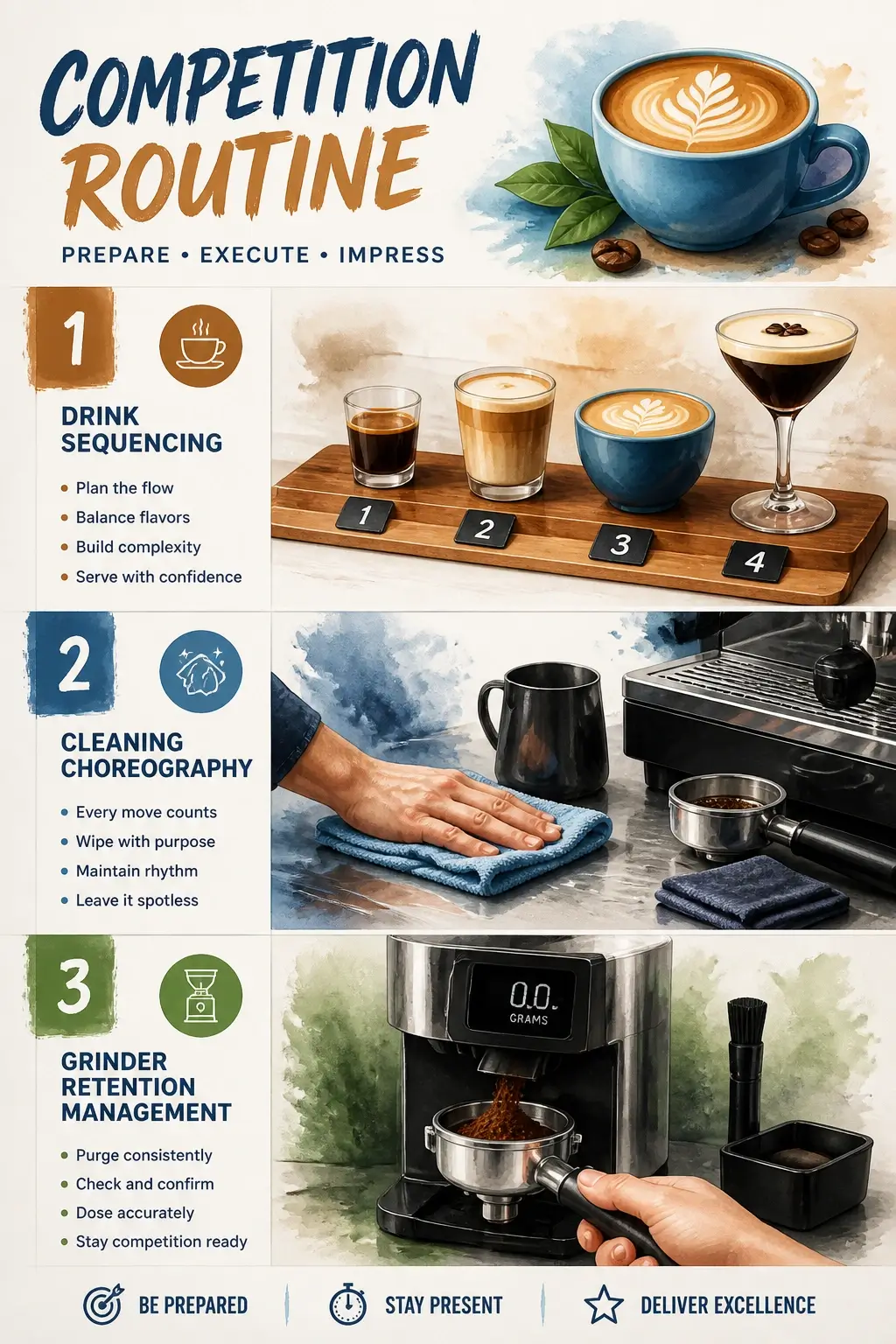
Map your mandatory drink counts to a physical staging plan before you walk into a single practice run. For WBC, you’re building three espressos, three milks, and one signature drink in a sequence that must feel inevitable. For WCIGS, the preliminary round demands two Irish Coffees and four signature drinks – six drinks with different temperature profiles, different preparation sequences, and different timing requirements. Your competition table must be a mirrored, time-efficient reflection of your mise en place. Every tool lives in one place. Every ingredient has one position. Deviation from that map costs time you don’t have.
The 6-drink workflow challenge in WCIGS is a sequencing problem, not a speed problem. Heavy-cream floats and hot-water preheating for Irish Coffees must run on parallel, non-interruptive timelines alongside your cold-drink stirring and your espresso pulls. If those timelines aren’t mapped in advance, they collide at the espresso machine. A single delayed shot cascades through every remaining drink – the timing breaks, the temperatures break, and the final drink’s balance breaks with them.
Cleaning as scored choreography is the mindset shift most competitors resist. In a WBC or WCIGS routine, every wipe of the steam wand and every purge of the group head is a scored element of professional workflow. Each cleaning action must be scripted into the timeline with a dedicated, unmovable 5–10 second window. A dirty station isn’t a minor slip. It’s a routine break. Judges’ eyes track mess automatically, and a messy station pulls attention away from your presentation at the exact moment you need full focus on your words.
The grinder retention silent killer is the most invisible consistency threat in the entire routine. Between your first and sixth shot, ground coffee sits in your grinder’s burr chamber and chute exposed to air, heat, and humidity. A shot pulled at minute 14 from grounds that have been sitting for 13 minutes tastes fundamentally different from one pulled at minute 1. That flavor inconsistency is completely invisible to you unless you’ve built a single-dose workflow into your practice. Flush one sacrificial dose through the grinder immediately before pulling each drink’s shot. This purges retained, stale grounds and guarantees flavor consistency from the first judge’s cup to the last.
The Pre-Competition Validation Gauntlet
Pre-competition validation is the step that separates baristas who hope they’re ready from baristas who know it. Subjective confidence built through solo practice is not competition readiness. Your drink needs to survive a suite of controlled discrimination tests before a judge’s score delivers the only verdict that actually counts.
The standard self-check – “would this drink work with any other espresso?” – is a useful filter, but it’s not sufficient for competition readiness. It’s a pass/fail question with no measurement behind it. You need protocols that generate objective, reproducible data about your drink’s performance.
Start with a full dress rehearsal of your complete competition routine. All drinks. Full timer. At least one knowledgeable coach in the room who will pressure-test both your communication and your workflow in real time. Not a supportive audience. A critical one. The rehearsal exists to break your routine so you can fix it before the competition does.
Before that rehearsal, confirm three non-negotiable operational details: every ingredient measurement is reproducible across multiple batches, your supply chain for perishable ingredients is confirmed and has a backup, and your equipment has been tested for stability across a full 15-minute sequence. Equipment failure mid-routine is rare. Discovering it in practice rather than on stage is the entire point of this phase.
The blind triangle test is the ultimate measure of espresso dominance. Have an assistant prepare three identical-looking drinks: your full signature beverage made with your competition coffee, and two versions made with a different espresso of similar roast level. You, the creator, run this test first. If you cannot identify your own coffee’s origin note in your own drink, the espresso is not predominant, and the drink fails the WBC’s primary rule before it reaches a single judge. Your coach must also pass this test independently. If an unbiased taster cannot identify the coffee, a judge won’t either.
The 3-minute dilution test measures structural integrity under realistic judging conditions. Pour your finished, chilled drink into a clean glass. Set a timer for 3 minutes – the realistic window a judge may take to taste and evaluate. At the end of the timer, taste the 3-minute version blind against a freshly made one. If the older version is perceptibly more watery, flatter, or has lost its aromatic top notes, your thermal lock strategy from H2-4 has failed. The drink’s flavor balance must be stable for the entire judging window, not just the moment of delivery.
The judge simulation tests whether your sensory delivery system is actually communicating. Hand your finished, undiluted drink to an impartial taster who has not heard your presentation script. After tasting, ask three specific questions: “What is the dominant flavor?” “Describe the texture.” “What do you think this drink is trying to say about the coffee?” If their answers don’t map directly onto your core concept from the origin analysis section, the drink is not speaking for itself. Your speech is trying to be a translator rather than an amplifier – and that’s a structural failure in the concept, not a presentation problem.
Studying famous champions and their signature drinks reveals a consistent pattern: winning drinks pass all three of these tests without requiring explanation. The liquid communicates the concept. The presentation confirms it. The execution delivers it repeatedly. That’s the system. The gauntlet exists to verify that yours does the same.
Frequently Asked Questions About Signature Drink Coffee Competition
What does “espresso must be the predominant taste” actually mean in practice?
It means a judge should be able to taste your finished drink and identify the specific flavor character of your espresso through all other ingredients. If the espresso flavor disappears, the drink fails its most basic scoring requirement regardless of how creative the concept is.
How many practice runs should I complete before a WBC competition?
There’s no magic number, but the minimum threshold is this: you must complete enough full dress rehearsals – timed, with a critical observer – that your workflow runs without conscious thought, freeing your attention entirely for presentation quality.
Can I use the same concept for both WBC and WCIGS competitions?
Structurally, yes, but WCIGS adds the mandatory random alcohol component in the final round. Your concept needs to be flexible enough that an unknown spirit can be integrated without breaking the drink’s core logic, so design for that variable from the start.
What’s the difference between a garnish that scores well and one that loses coherence points?
A scoring garnish is aromatic, functional, and directly connected to the drink’s concept. A coherence-losing garnish looks interesting but has no logical relationship to the coffee’s story. Judges notice when decorative choices contradict the narrative you’ve built.
How do I handle the WCIGS Irish Coffee requirement if my concept is built around cold drinks?
Treat the Irish Coffee as its own scored category with its own preparation logic, not as a warm version of your signature drink. Master it separately, then map its preparation timeline so it runs in parallel with your cold drinks without creating a sequencing collision at the espresso machine.
Is a more complex preparation method always better for competition?
No. Complexity earns points only when it serves the drink’s flavor or the story’s logic. A preparation method that is technically impressive but adds nothing to the taste experience – or worse, distracts from it – is a net negative on the score sheet.
What’s the biggest mistake competitors make when testing their recipe before competition?
Testing in isolation rather than under simulated competition conditions. A drink calibrated at a quiet bench in a familiar kitchen performs differently under time pressure, warm stage lighting, and the stress of live judging. The 3-minute dilution test and full dress rehearsals exist specifically to expose that gap.
How do I know if my concept is genuinely tied to the coffee or just a themed drink?
Run the judge simulation: hand an untasted version to someone who hasn’t heard your presentation and ask them what the drink is trying to say about the coffee. If their answer doesn’t match your concept, the coffee and the concept are not yet unified.
References
- Secrets of a Barista Competitor: Sam Low | baristamagazine.com
- Why Customised Coffee Drinks Will Become More Popular | perfectdailygrind.com
- On the Menu: I’ll Drink Your Milkshake at Dayglow Coffee | sprudge.com
- On the Menu: The Strawberry Nebula at Coffee Science in New Orleans | sprudge.com