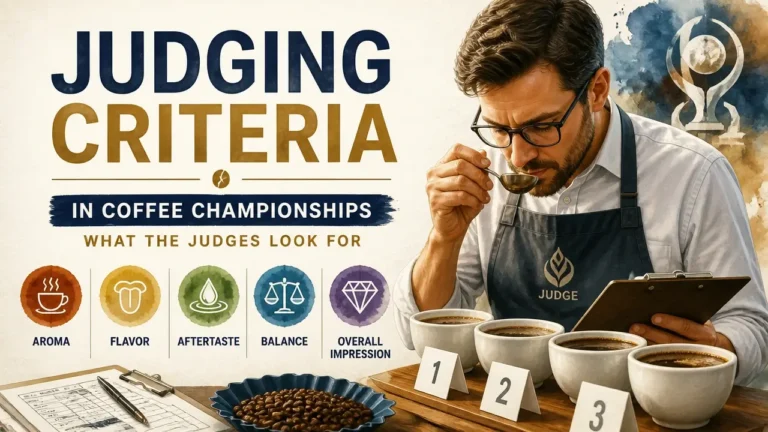

Rigorous judging criteria at coffee championships are not a matter of taste preferences or strong opinions held by people with clipboards. The World Coffee Championships built a certification system, a calibration protocol, and a three-pillar evaluation framework specifically so that scores reflect consistent, reproducible standards across every country where competition runs.
What most competitors never realize is that the system was designed primarily to train judges, not to educate the people being judged. Once you understand that gap, the entire scoring architecture looks different – and so does your preparation.
Just as standardized evaluation protocols elevate competition standards, famous baristas shaping culture continue to push the boundaries of innovation behind the bar.
To see how top competitors master these exacting standards, studying famous barista champions strategies reveals how elite professionals consistently conquer the scoring architecture.
Before committing your time and resources to the stage, evaluating coffee competitions value can help you weigh these rigorous scoring standards against the actual career and financial returns you can expect.
While modern competitions emphasize pristine standardization, the global industry has a much darker past to reckon with, as detailed in Blood Beans amp Billions The.
Key Takeaways on Judging Criteria Coffee Championships
- WCC certification requires a two-day test plus ongoing calibration training, meaning judges share a specific, teachable definition of quality before they ever score your coffee.
- Your final competition score is a panel consensus negotiated through calibration, not an independent measurement from any single judge.
- Three judge types evaluate different things simultaneously: Head Judges manage calibration, Sensory Judges taste, and Technical Judges watch your hands.
- The practical scoring range in competition runs from 6.50 to 9.00; the half-point difference between 7.50 and 8.00 is often the advancement margin.
- Sensory judges evaluate your coffee across three temperature points – 70°C, 40°C, and 25°C – meaning your flavor trajectory matters as much as your initial cup quality.
- Presentation scores rise when your flavor descriptions are verified by what judges actually taste, turning your script into evidence-based communication rather than storytelling.
Who Judges Coffee Championships and Why Their Certification Shapes Your Score
Certified judges at coffee championships are not enthusiasts with strong palates and free weekends. They are professionals who passed a structured, two-day, test-based certification process administered internationally by the World Coffee Championships (WCC), the governing body that oversees six of its seven championship formats. That certification is the foundation of everything – it defines what judges look for, how they describe what they taste, and how they apply numbers to sensory experience.
The certification process requires more than passing a test. Judges commit to calibration training, ongoing palate development, and active competition attendance to maintain their standing. This professional infrastructure exists for one reason: to make scoring consistent across panels, venues, and countries. When a judge in Seoul and a judge in Melbourne both score an espresso as “Very Good,” they should be describing the same sensory experience.
The WCC Certification System and Governing Authority
The WCC certification runs internationally throughout the year. Candidates go through a two-day, test-based program that covers the latest competition rules, sensory evaluation techniques, and scoring protocols. Once certified, judges can evaluate competitors across WCC championship formats using a shared, standardized framework.
Becoming a certified judge is a serious professional commitment. Calibration training alone requires hours of dedicated palate work before a judge ever sits at a competition table. Add ongoing competition attendance and periodic recalibration, and the picture becomes clear: the people scoring your routine have invested significantly in understanding what “good coffee” means by a defined, teachable standard.
There is a structural reality worth knowing here. The entire WCC judging infrastructure is built judge-outward. Certification materials, calibration protocols, and supporting documents are created for judges, by judges. The NZSCA resource hub, for example, promises to help competitors understand what judges look for – but its library runs to 22 PDF documents, only one of which directly addresses the competitor’s perspective on bias. This orientation means that public-facing explanations of judging criteria often assume knowledge that certified judges carry but competitors may not have encountered. One additional anomaly: across official WCC documentation, the identity of the one championship format that does not require certified judges is never disclosed or explained. That information gap is not an accident – it is a product of a system designed from the inside out.
The practical consequence is straightforward. Competitors who treat the judging criteria as a fully transparent, fully documented system will encounter surprises. Competitors who understand that the system was built primarily to train judges will know to seek the implicit rules alongside the published ones.
The Judge’s Role and Common Misconceptions
Judges exist to maintain competition integrity and ensure that championships function as fair, globally standardized events. Their expertise and dedication are what make a score in a regional qualifier mean something comparable to a score at a world final.
The most persistent competitor misconception is that judges are critics hunting for flaws. They are not. A certified judge applies a standardized framework to assess execution against published criteria. Their job is to measure your performance against a known standard – not to find reasons to deduct points.
According to Dan Streetman, USBC Head Judge, flavor balance has historically been one of the most difficult concepts for judges to communicate to competitors. He explains that balance does not require equal intensity of sweetness, acidity, and bitterness – it requires those elements to work together cohesively so the espresso delivers a unified tasting experience, not a checklist of components.
That distinction matters enormously in practice. Judges are not tallying flavor attributes like items on a grocery list. They are evaluating whether the coffee works as a whole. A competitor who designs an espresso with textbook acidity and sweetness numbers but no cohesion between them will score lower than one whose espresso simply tastes complete.
There is also the problem of score inflation.
Krzysztof Blinkiewicz, Founder of Red Ink Coffee, Authorised SCA Trainer, and Q Grader, defines “pointwashing” as the inflation or misrepresentation of coffee scores – whether intentional or accidental – that assigns a coffee more value than it actually has.
The certification and calibration system exists precisely to counteract this. Certified judges are trained to resist score inflation and to anchor their numbers to the defined scale, not to the social pressure of a competition environment.
The Three Judge Types and What Each One Tracks on Your Scoresheet
Three distinct types of judges are watching your routine simultaneously, each tracking entirely different things. Understanding who is watching what is not a minor detail – it is the structural map you need before any of the scoring mechanics make practical sense.
Judge Types and Panel Architecture
The WCC judging panel at a major event typically includes approximately twelve Sensory Judges, three Head Judges, and a comparable team of Technical Judges. Each type uses a different scoresheet, and your final score combines evaluations from both the sensory and technical domains.
Here is what each judge type actually tracks:
- Head Judge: Oversees the entire panel, manages calibration throughout the competition day, and intervenes when individual scores deviate from group consensus. The Head Judge does not typically score beverages directly. Their job is procedural integrity – keeping the panel aligned, not adding their own taste preferences to your total.
- Sensory Judges: Focus exclusively on the quality of what ends up in the cup. Taste, aroma, flavor balance, acidity, body, aftertaste, and overall sensory experience are their domain. They evaluate nothing that happens behind the machine – only what they experience when they drink.
- Technical Judges: Assess everything that happens during preparation. Skills, workflow, hygiene, food safety practices, and adherence to competition rules are their territory. A Technical Judge is watching your hands, your station, your timing, and your consistency – not tasting your coffee.
These two evaluation tracks run in parallel. A competitor can execute a flawless sensory performance and lose significant ground on the technical scoresheet through workflow inefficiency or hygiene lapses that Sensory Judges never see.
Head Judge Calibration and Competitor Implications
The Head Judge functions as a calibration anchor across the entire competition day. When any judge scores more than 0.5 points from the group average, the Head Judge steps in – not to override the score, but to have the judge verbalize their sensory experience and reconcile their language and number with the panel’s consensus.
For competitors, this architecture has a direct practical consequence. Your routine must satisfy two independent evaluation tracks at the same time, each staffed by people watching for entirely different things. The Sensory Judges are focused on your cup. The Technical Judges are focused on how you made it. Optimizing for one while neglecting the other is the most common structural mistake competitors make.
The Scoring Scale: What 6.00, 8.00, and 10.00 Actually Mean
The WCC scoring scale runs from 6.00 to 10.00, and every increment has a defined meaning that judges are trained to apply consistently. If you have been reading competition leaderboards without knowing what those numbers represent in the judge’s language, you have been reading them in the wrong frame.
Scale Definitions and Scoring Precision
The scale definitions are precise:
| Score | Definition |
|---|---|
| 6.00 | Good |
| 7.00 | Very Good |
| 8.00 | Excellent |
| 9.00 | Extraordinary |
| 10.00 | Perfect |
A score of 10.00 is theoretically achievable. In practice, it does not exist. It represents a standard of absolute perfection with no room for improvement on any dimension – a standard that leaves no credible argument for a higher score anywhere on the scoresheet. No documented instance of a 10.00 being awarded in WCC competition exists.
What the published scale does not tell you is how judges actually arrive at the number they write down. The calibration protocol reveals the mechanism: when a judge scores more than 0.5 points away from the group average, the Head Judge intervenes and works with that judge to reconcile their sensory description with their score. If their language aligns with the group but their number does not, the number adjusts. If their language diverges, the discussion continues until it resolves.
This process is presented as a calibration tool. It also functions as a conformity mechanism. Your final score is not what any single judge would assign in isolation – it is what the panel agreed upon after that negotiation process ran its course.
A study on consensus methodology in sensory panels from the IVES Conference Series examined this dynamic directly in wine evaluation. The researchers found that because social exchanges are inherent to consensus-based sensory methods, they introduce bias: social dynamics can affect individual judgments and compromise objectivity. Scores derived from consensus panels reflect a negotiated group agreement, not an independent measurement.
From the study “IVES Conference Series – Influence of social interaction levels on panel effectiveness in developing wine sensory profiles using consensus method“: social exchanges inherent to consensus methods introduce bias as social dynamics can affect judgments and compromise objectivity, meaning scores reflect negotiated group agreement rather than independent measurement.
This is not a flaw unique to coffee judging – sensory science broadly relies on consensus panels because individual taste perception varies too much to be reliable on its own. But the competitive implication is significant. You are not optimizing for a hypothetical perfect espresso. You are optimizing for panel agreement. A routine that produces ambiguous or divisive sensory experiences creates scoring disagreement, which calibration then corrects toward the group mean – effectively erasing the outlier scores that might have been your highest individual evaluations.
Practical Scoring Range and Competitive Strategy
The 1.00–5.00 range on the WCC scale is effectively unused in competition. Competitive routines rarely score below 6.50. The real action happens between 7.00 and 8.50, where the difference between “Very Good” and “Excellent” determines whether you advance.
The gap between a 7.50 and an 8.00 is not large in absolute terms. In competitive terms, it is often the margin between qualifying and going home. Understanding what pushes a score from “Very Good” to “Excellent” – what specific sensory, technical, or presentation quality the judge observed that warranted a full half-point increase – is the core strategic question every serious competitor should be building their routine around.
This same logic applies to signature drink scoring, where the evaluation criteria carry their own unique weighting and the half-point increments can swing a final ranking just as decisively as they do in the espresso round.
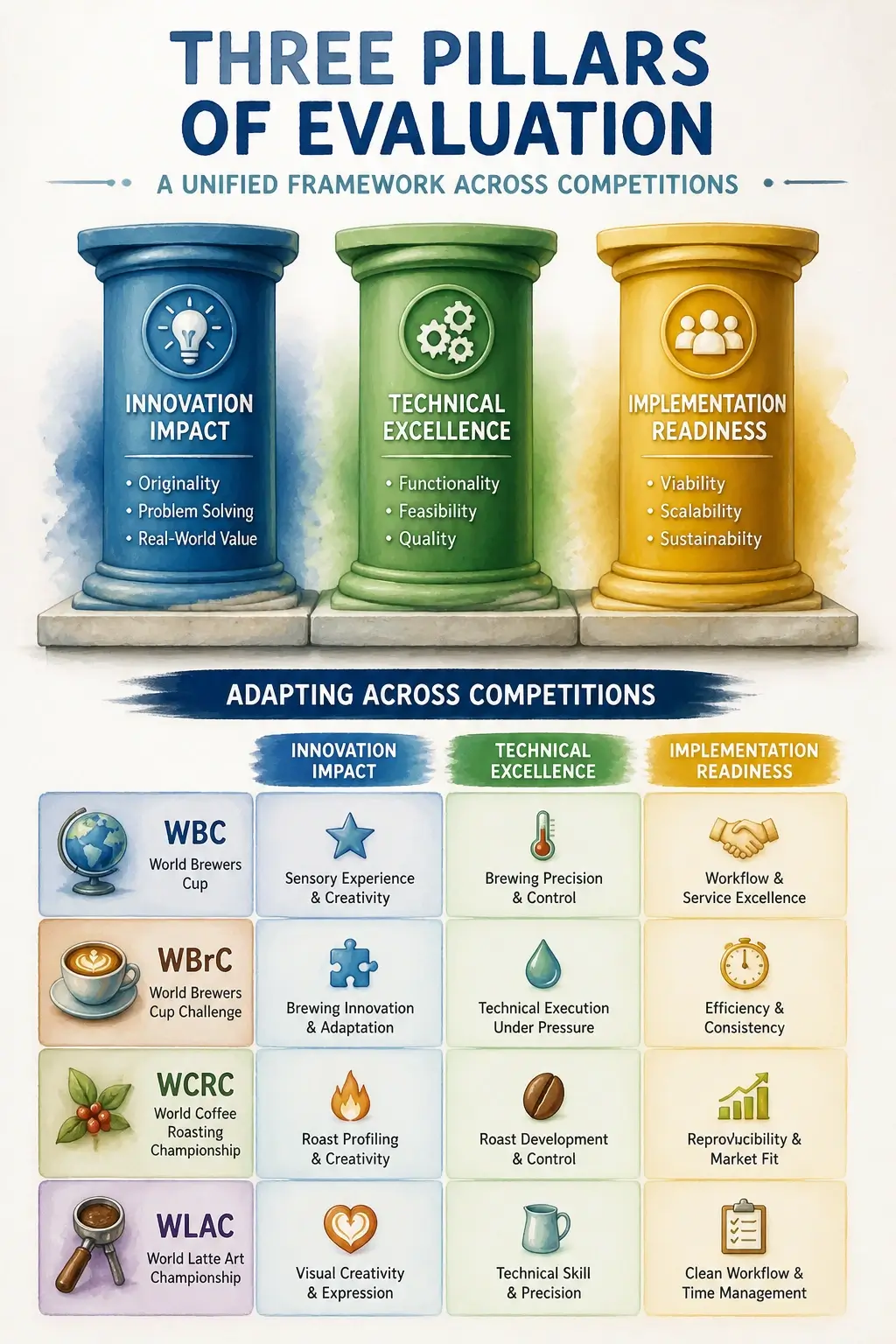
The Universal Three-Pillar Framework: Sensory, Technical, and Presentation Evaluation
Every WCC competition format evaluates competitors across three distinct pillars. The pillars are universal. Their specific content and relative weighting shift depending on which championship you are entering.
Framework Overview Across Competitions
The three-pillar framework in its base form covers:
- Sensory: Quality of the coffee and beverages – taste, aroma, flavor balance, acidity, body, aftertaste.
- Technical: Skills, workflow, hygiene, food safety, efficiency, and rule compliance during preparation.
- Presentation: Professionalism, communication, ability to engage judges and audience, and the competitor’s capacity to inspire a deeper connection to coffee.
Across competition formats, these pillars adapt to the specific craft being evaluated:
| Championship | Pillar 1 | Pillar 2 | Pillar 3 |
|---|---|---|---|
| World Barista Championship (WBC) | Sensory | Technical | Presentation |
| World Brewers Cup (WBrC) | Sensory | Brew Control | Service |
| World Coffee Roasting Championship (WCRC) | Green Analysis | Roast Execution | Sensory Outcome |
| World Latte Art Championship (WLAC) | Visual | Creativity | Execution |
Here is a visual breakdown of how the three-pillar framework maps across WBC, WBrC, WCRC, and WLAC:
Beverage-Specific Evaluation and Competitor Strategy
Within the World Barista Championship, each beverage category receives its own separate evaluation. Espresso, milk beverage, and signature drink each generate distinct sensory and technical scores. Presentation is scored holistically across the entire routine – judges assess the cumulative impression of your professionalism and communication, not a per-beverage presentation score.
The strategic implication is worth sitting with. You are not making three types of coffee and hoping each one lands well. You are delivering a single, coherent performance that must simultaneously satisfy three distinct evaluation dimensions, each monitored by different judges watching for different things. Sensory judges are tasting. Technical judges are observing. And across all of it, your presentation score accumulates from the first word you say to the moment you step off the stage.
Inside Sensory Evaluation: How Judges Taste Your Coffee Across Three Temperatures
Sensory evaluation is the highest-weighted pillar in WBC, and it follows a structured protocol that most competitors have never seen described in full. Understanding it changes how you design your coffee, not just how you serve it.
Temperature Evaluation Protocol
Sensory judges evaluate in a defined sequence. They assess aroma first, then taste the beverage across three distinct temperature points: 70°C (hot), 40°C (warm), and 25°C (cold). Each temperature reveals different attributes. Acidity structure often reads most clearly at 70°C. Body and mouthfeel become more apparent as the coffee cools. Aftertaste persistence and overall balance are frequently assessed at the lower temperatures where the heat no longer dominates the palate.
The practical implication for routine design is direct: your coffee must taste balanced and expressive across the full cooling arc, not just during the initial service window. A coffee that opens brilliantly at 70°C and collapses into bitterness or flatness at 40°C will lose points even if the judge’s first sip was exceptional.
This video explains the underlying science of why coffee expresses itself so differently across that temperature range:
The temperature evaluation protocol also interacts with palate fatigue in a way that competitors rarely account for. Judges taste dozens of beverages across multiple competitors, each evaluated at three temperatures, often in consecutive sessions. A coffee that tastes dramatically different at 40°C versus 70°C creates scoring ambiguity – judges tasting at slightly different moments in the cooling curve will report different experiences. That ambiguity triggers calibration intervention, pulling scores toward the panel mean. The competitor whose coffee maintains balance across the full window eliminates that source of disagreement entirely.
The three-cup requirement adds a second layer of scrutiny. The Head Judge monitors technical consistency across all three cups served to sensory judges. If any cup deviates visibly – in crema color, volume, or extraction appearance – it signals unreliability that affects both sensory and technical scores. The rule exists because reproducibility under pressure is the core skill being tested. One exceptional cup proves you can make great coffee. Three identical cups prove you can perform.
Three-Cups Rule and Descriptor Language
The prohibition on split beverages is explicit in WCC rules: serving three separate, identically-prepared beverages is required because anyone can produce a single outstanding cup. The three-cup rule forces competitors to demonstrate that their skill is replicable, not situational.
During calibration, judges pair their numerical scores with verbal descriptors – specific flavor language that the panel aligns on before scoring begins. “Stone fruit acidity” maps to a specific score range. “Caramel body” describes a textural quality the panel has agreed to recognize and score consistently. This shared language is what allows twelve sensory judges to arrive at scores within 0.5 points of each other. It also means that when you describe your coffee’s flavor profile during your presentation, you are speaking directly to a vocabulary the judges already have calibrated in their heads. Precision in your language is not just communication – it is a scoring tool.
Technical and Presentation Scores: Where Cleanliness, Workflow, and Story Win Points
Technical and presentation scores are not soft categories. They are structured evaluation tracks with specific, observable criteria – and they are where most competitors leave the most points on the table.
Technical Evaluation Details
Technical judges watch everything. Workflow efficiency, station organization, hygiene and food safety compliance, waste management, and adherence to competition rules are all scorable. Every movement at the station is observable. There is no moment during your routine where the technical scoresheet is not active.
Common technical deductions include:
- Improper tamping technique or inconsistent dosing
- Spills or station messes left unaddressed
- Failure to purge group heads between shots
- Touching non-food surfaces and then handling food-contact items without sanitation
- Time management failures that create visible hesitation or rushing
- Inconsistent milk steaming temperature across beverages
Technical judges note whether your extraction parameters are repeatable and whether your workflow shows deliberation or uncertainty. Every moment a competitor looks unsure of their next step is a moment a technical judge records as inefficiency.
The station tells a story before the coffee does.
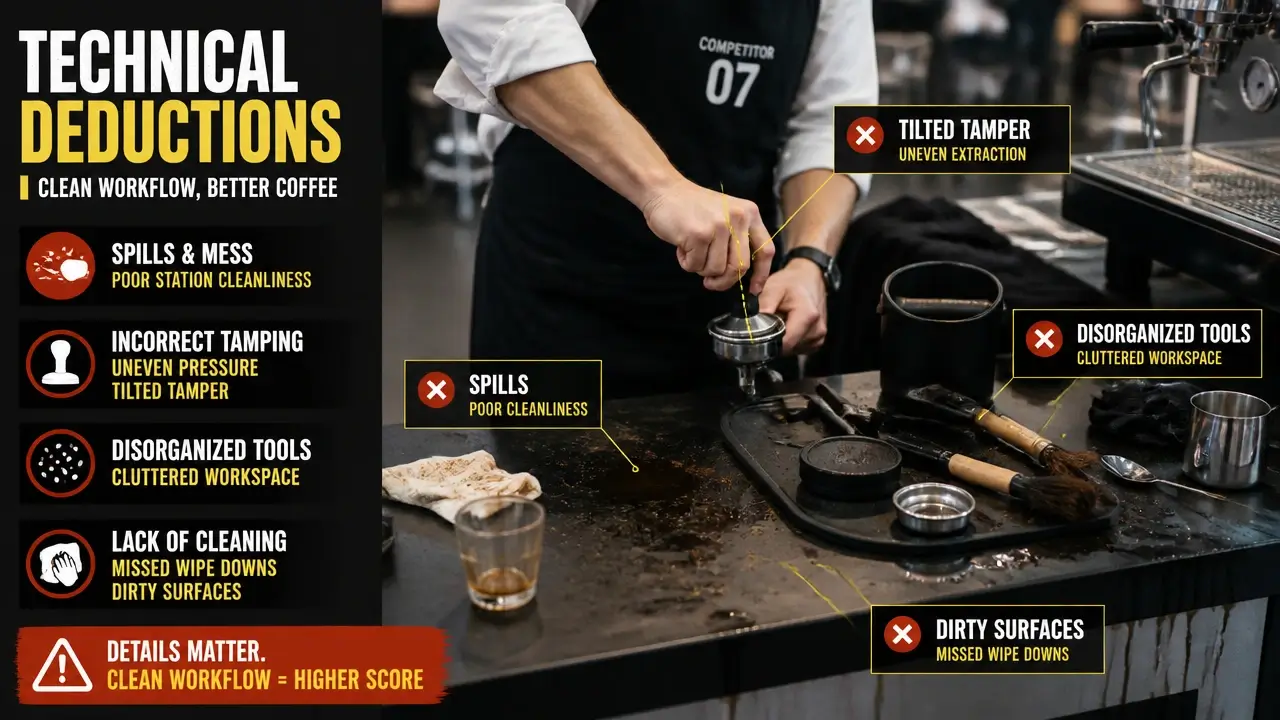
Strong competition preparation means drilling your workflow until every movement is automatic – not because flair impresses technical judges, but because automaticity is the visible evidence of genuine mastery.
Presentation Evaluation and Bias Considerations
Presentation is scored holistically. There is no line-item checklist for it. Judges assess professional appearance, communication clarity, narrative coherence of the routine, ability to engage both the panel and the audience, and whether the competitor inspires a genuine connection to the coffee being served.
High-scoring presentation technique has a consistent pattern. Competitors who name their producer with specific detail, explain their processing method with technical precision, and describe flavor notes that judges can then verify in the cup score higher than those who deliver generic origin information. The mechanism behind this is a verification loop: when a competitor says “this anaerobic natural Gesha will express stone fruit acidity and jasmine florals,” and the judges then taste exactly that, the presentation score rises because the communication was accurate and evidence-based. The script was not poetry – it was a prediction that the coffee confirmed.
Maintaining eye contact, staying composed under pressure, and structuring the routine narrative so that it builds rather than wanders all contribute to presentation scores in ways that judges can observe and document.
On the bias question: judges are explicitly trained to leave their biases at the door regarding competitor identity, coffee origin, processing method, and personal taste preferences. Dedicated bias awareness documents exist in official WCC resources specifically because bias is recognized as an ongoing challenge – not a solved problem. The training addresses it. That it requires dedicated training confirms it is real.
What Judges Actually Prioritize: Calibration, Consistency, and the Real Path to Higher Scores
Now that the criteria, the scale, and the three pillars are clear, the single most important strategic shift is this: you are not competing against a scoring standard. You are competing against the calibration process.
Calibration Mechanics During Competition
Judges arrive at competition having already invested significant time in alignment. Initial certification includes nine hours of calibration training. Each competition morning adds another 1.5 hours of pre-competition calibration to align the panel’s palate, language, and scoring expectations before any competitor steps on stage.
During competition, calibration runs continuously. When any judge’s score deviates more than 0.5 points from the group average, the Head Judge intervenes. The process is not a correction – it is a consensus-building conversation. The judge describes their sensory experience verbally. The panel compares language. Either the score adjusts to match the language, or the language adjusts to match the group’s shared framework. The goal is consensus within tolerance, not individual accuracy.
The competitive consequence of this is precise. Your score is the number the panel agreed on after that process completed. Outlier scores – high or low – get pulled toward the group mean. A routine that produces ambiguous sensory experiences, or coffee that tastes meaningfully different at 40°C than it did at 70°C, creates the conditions for scoring disagreement. Calibration then smooths that disagreement. The competitor who benefits is the one whose coffee gave every judge, at every temperature point, a similar experience to describe.
Competitor Checklist and Advancement Strategy
The path to higher scores runs through predictability, not perfection. Here is what the judging system actually rewards:
- Design beverages that taste balanced across all three temperature evaluation points. The full 70°C→40°C→25°C window is being evaluated. A coffee that collapses at warm temperature is a coffee that generates scoring disagreement.
- Build a workflow that is clean, efficient, and perfectly repeatable. Technical judges reward consistency. Hesitation and improvisation are both visible and scorable.
- Prepare a presentation script where every claim about origin, processing, or flavor is verifiable in the cup. The verification loop between what you say and what judges taste is the highest-leverage presentation tool available.
- Understand that judges are trained to evaluate innovation within the framework, not against it. Novelty for its own sake does not score. Novelty that produces excellent, consistent, verifiable sensory outcomes scores well because it satisfies the criteria on all three pillars.
On advancement: approximately 12 competitors advance from qualifier to nationals in most WCC-affiliated events. When sensory scores cluster within a narrow range – which happens frequently at the top of a competitive field – the margin between advancing and going home is often decided by technical and presentation scores. Those are the pillars competitors most consistently under-prepare.
The formal appeals process exists for competitors who believe scoring procedures were misapplied. Understanding the documented WCC appeals procedures is part of serious competition preparation – not because you expect to need it, but because knowing the system’s accountability mechanisms tells you something about how it is designed to function.
The one thing the published criteria never state explicitly is also the one thing the entire system is built to produce: a panel that agrees. Design your routine so that agreement is easy to reach.
Frequently Asked Questions About Judging Criteria Coffee Championships
How many points separate competitors who advance from those who don’t?
At the regional and national qualifier level, the gap between the last competitor to advance and the first to miss the cut is often less than one total point. Technical and presentation scores frequently decide this margin when sensory scores cluster tightly at the top of the field.
Can a competitor request to see their scoresheet after competition?
Yes. WCC-affiliated competitions provide competitors with their scoresheets after results are announced. Reviewing your sheet is one of the most efficient ways to identify which pillar cost you the most points and where calibration pulled your scores toward the mean.
Why do judges sometimes score the same espresso differently before calibration resolves it?
Individual taste perception varies even among trained evaluators. Temperature at the moment of tasting, palate fatigue, and differing sensory thresholds all produce natural variation. Calibration exists specifically to manage this variation – it’s not a sign the system is broken, it’s how the system corrects for human biology.
Does the order in which you compete during a session affect your scores?
Palate fatigue is a documented challenge for sensory panels, and judges tasting late in a session may perceive flavors differently than those tasting early. WCC calibration protocols are designed to mitigate this, but competitors competing later in a session face a panel whose palates have processed more stimuli. It’s a structural variable, not a scoring rule.
How does a judge score a beverage they personally dislike?
Judges are explicitly trained to separate personal preference from criteria-based evaluation. A judge who dislikes natural-processed coffees is trained to assess the coffee’s quality within the defined sensory framework, not against their own taste preferences. Bias awareness training exists because this separation requires active, ongoing effort.
What happens if a competitor believes a judge made a procedural error?
WCC provides a formal appeals process through documented procedures. A competitor can file an appeal regarding procedural violations, but appeals address process failures – not disagreements with a judge’s sensory assessment. Understanding the distinction before you compete is important.
Do technical judges communicate with sensory judges during a routine?
No. Technical and sensory judges operate on separate scoresheets and evaluate different criteria. They do not discuss scores with each other during a competitor’s routine. The Head Judge oversees both tracks but manages calibration within each group independently.
Is there a minimum score a competitor must achieve to advance, regardless of ranking?
WCC advancement is rank-based, not threshold-based in most formats. The top competitors by total score advance, regardless of whether any specific minimum score was hit. This means the competitive standard shifts with the field – a score that advances you at one qualifier might not at another.
References
- The Rules of Extraction: A Look Inside the USBC Rule Changes | Sprudge.com
- Resolving Discrepancies in Coffee Cup Scores | Perfectdailygrind.com
- Influence of social interaction levels on panel effectiveness in developing wine sensory profiles using consensus method | Ives-openscience.eu