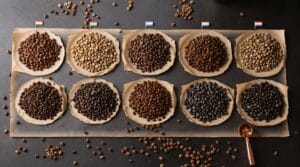

Common coffee defects carry a flavor signature long before they reach the cupping table. A single full black bean on a 350-g tray ends a lot’s specialty ambitions outright. Five partial sours, two broken beans, and a handful of floaters can quietly push a borderline lot past the SCA’s five-equivalent ceiling before you’ve finished counting.
Understanding the why behind each defect – the microbial chemistry, the physical damage, the processing lapse – is what separates a grader who documents from one who diagnoses. This guide walks through every major defect in the SCA Green Grading Framework, from primary disqualifiers to the secondary flaws that erode score one equivalent at a time.
Key Takeaways on Common Coffee Defects Flavor Impact
- One primary defect on a 350-g tray disqualifies a lot from specialty status regardless of cup score.
- Full black beans produce rancid oil and compost flavors; full sour beans produce acetic vinegar – both are instant specialty fails.
- Fungal damage survives processing and delivers musty, medicinal, chlorophenol notes; severe cases may involve ochratoxin A.
- Secondary defects are dangerous in aggregate: five partial blacks, four chips, and three floaters can collectively breach the five-equivalent ceiling.
- Quakers are invisible on the green tray and only appear post-roast; always pick through the roasted sample before cupping.
- Defect counts are a buying tool, not just a pass/fail gate – a lot at three equivalents carries real procurement risk for unseen damage downstream.
The SCA Green Grading Framework: Severity, Sample Size, and Scoring
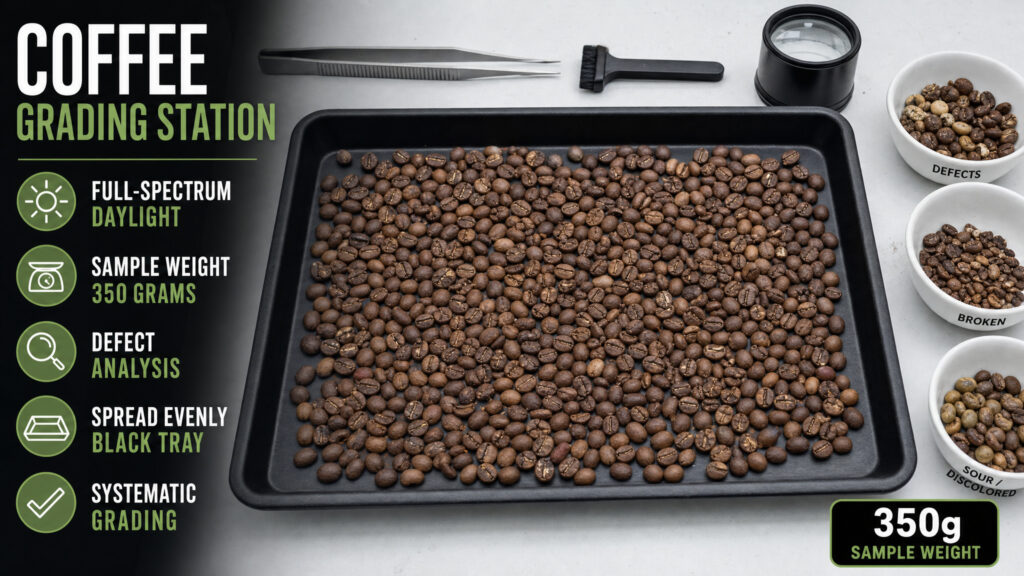
SCA green grading starts with a fixed physical constraint: you analyze exactly 350 grams of green coffee, spread under full-spectrum daylight lighting that renders true color without the warm cast of incandescent bulbs. That sample size isn’t arbitrary. It’s large enough to be statistically meaningful for a commercial lot, small enough to sort by hand in under twenty minutes. Every defect you pull from that tray gets classified into one of two categories, and the math that follows determines whether a lot earns the specialty designation or doesn’t.
A primary (Category 1) defect operates on a one-strike rule. Find one full primary defect equivalent in your 350-g sample – one full black bean, one full sour, one stone over threshold – and the lot cannot be graded specialty. Full stop. No cupping score, however extraordinary, overrides that disqualification. The green grade and the cup score are recorded separately, but a primary defect failure closes the door before the kettle boils.
Secondary (Category 2) defects work differently. They convert to full defect equivalents through counting ratios. Three partial black beans equal one full secondary equivalent. Two to three partial sours equal one equivalent, depending on coverage. The specialty-grade ceiling sits at five full secondary defect equivalents per sample. A lot with four equivalents passes. A lot with five passes, barely. Six fails.
The arithmetic runs like this: primary defects count as an automatic disqualifier at any quantity above zero. Secondary defect equivalents must total five or fewer. So a sample with two partial blacks (one equivalent), four chipped beans (one equivalent), and two floaters (one equivalent) sits at three equivalents – still inside the window, but with little margin for the quakers you haven’t counted yet.
What the defect score sheet doesn’t capture directly is flavor. The SCA records green defects as a number, not a sensory description. The connection between a defect on the tray and a specific off-note in the cup is the knowledge this article is designed to build. Each section below fills one slot on that score sheet with a visual profile, a causal mechanism, and the exact flavor consequence you’ll taste if that defect makes it through to roast.
Full Black Beans: The Rancid Ferment
Full black beans sit at the most severe end of the defect spectrum, and they announce themselves clearly under daylight. The bean appears entirely black and opaque – no brown undertone, no residual green flesh, no translucency at the edges. It’s often shrunken, wrinkled, and noticeably lighter in weight than healthy beans of the same screen size. If you press it lightly, it tends to crumble rather than resist. That fragility is diagnostic.
The cause is fermentation that ran past any useful stage. Inside the cherry, microbial activity consumed the sugars, broke down the cell structure, and essentially composted the seed. This happens when cherries sit too long on a drying patio in direct sun without turning, when over-fermented mucilage generates enough heat to cook the bean from the outside in, or when cherries are harvested overripe and pile up before processing. The result is a bean that is, chemically speaking, decomposed organic matter.
In the cup, the flavor is unambiguous: rancid oil is the dominant note. Behind it comes over-ripe fruit that has already turned – not a pleasant fermented fruit, but something closer to compost. There’s a heavy, sour-bitter finish that doesn’t clean up on the palate. Once you’ve smelled it, you won’t misread it again.
The grading consequence is absolute. One full black bean on your 350-g tray is a primary defect and a specialty disqualification. Don’t spend time debating it. The visual distinction to confirm: the discolouration must penetrate the entire bean. A dark crescent on one edge or a brownish tip is a different defect – partial black – with a different counting rule. Full black means the entire bean surface is uniformly dark, with no green or brown flesh visible anywhere on the exterior.
Full Sour Beans: Sharp Vinegar Acidity That Cuts Through the Cup
Full sour beans fool new graders because they’re not dramatically dark. The visual tell is subtler: a yellow-green or amber fluorescence across the entire bean surface, sometimes with a slightly waxy, translucent quality. Hold the bean up to daylight and rotate it. A healthy green bean reflects light evenly. A full sour has an almost glassy sheen, like a piece of amber, and the color sits in the yellow-to-orange range rather than the blue-green of well-processed coffee.
When you’re uncertain, break the bean. If the interior is uniformly yellow-brown all the way through and carries a smell of sour mash – sharp, fermented, faintly alcoholic – log it as full sour.
The origin is over-fermentation in the wet mill. Cherries left too long in the fermentation tank, or pulped fruit that sat in warm, stagnant water for hours past the optimal window, allow acetic acid bacteria to dominate. Those bacteria don’t just break down mucilage. They acidify the bean itself, altering the cellular chemistry permanently. No amount of washing reverses it.
The cup consequence is distilled white vinegar – a sharp, pungent acidity that prickles the back of the nasal passage before the liquid even hits the tongue. There’s zero sweetness. The finish is astringent and metallic. The key distinction from a “sweaty” over-ripe fruit note is that full sour is acetic, not fruity. It’s a chemical sharpness, not a fermentation complexity. One full sour bean on the tray is a primary defect and an immediate specialty fail.
Fungus-Damaged Beans: Musty, Medicinal, and Mouldy
Fungus-damaged beans carry their identity on the surface. Train your eye to look for yellowish-white cottony fibres – the visible mycelium of mould growth – or brown and black powdery spore patches that sit on the bean like a dusting of cocoa powder. In more advanced cases, the bean surface itself appears pitted or etched, as if the outer layer was partially dissolved. That pitting is exactly what happened: fungal enzymes broke down the bean’s outer cells.
Check the fissure first. Fungal growth almost always colonises the crack that runs along the bean’s flat face, where moisture clung longest after drying. If you see discolouration concentrated in that groove rather than spread across the surface, probe it – fungus in the crease is still fungus.
The flavor consequence reaches the cup as musty, earthy, damp cellar. Depending on the specific mould species involved, you may also detect a medicinal note described as chlorophenol – an antiseptic, almost iodine-adjacent quality that sits on the mid-palate and lingers. Certain moulds from the Aspergillus family produce ochratoxin A, a mycotoxin with documented health implications beyond sensory quality. That’s not primarily a grading concern, but it reinforces why fungal damage is treated as a Category-1 primary defect when coverage extends beyond a minor surface spot.
The easy confusion is with silver skin – the thin papery membrane that sometimes clings to the bean’s surface. Silver skin is harmless, flat against the bean, and has no texture. Fungus is furry. It stands away from the surface, and the bean color underneath it has changed. If you’re not sure, scratch it gently. Silver skin flakes off cleanly. Fungal growth takes bean material with it.
Insect Damage: Coffee Berry Borer and Other Pests
Insect-damaged beans carry a signature that’s nearly impossible to fake: small, circular entry holes, typically 1 to 2 mm in diameter, drilled near the bean’s tip or centre. These are the work of the Coffee Berry Borer (Hypothenemus hampei), the most economically destructive coffee pest in the world. The holes are neat, symmetrical, and sometimes filled with fine powdery frass – the insect’s waste material. When you tap a heavily affected bean over a white surface, that dust falls out.
The severity threshold matters for scoring. A single clean entry hole that penetrates the endosperm into the bean’s interior is a primary defect. Minor surface etching or shallow marks that don’t break through to the interior may qualify as secondary damage, but when in doubt, apply the rule of thumb: if the hole goes all the way through, treat it as serious.
In the cup, insect-damaged beans produce a sour, fermented, dirty profile. The mechanism is straightforward: once the borer breaches the endosperm, oxygen enters and oxidizes the exposed interior. The damaged tissue ferments unevenly during processing, producing acetic and lactic acid compounds that survive roasting. There’s sometimes a harsh vegetal note layered underneath – the oxidized remnants of the bean’s cellular structure.
Robusta lots tend to show higher incidence of severe borer damage. The counterintuitive reason is that while Robusta’s elevated caffeine content does deter some pests, the plant is predominantly grown at lower altitudes where temperatures favor the borer’s reproductive cycle, and where farm management practices may be less intensive. High-altitude Arabica farms in cooler climates provide a natural check on borer populations.
Dried Cherry / Pods: The Whole-Fruit Disaster
Dried cherry pods are sometimes mistaken for stones, and the confusion is understandable. They are dark brown to black, irregular in shape, dense, and hard. But unlike a stone, a dried cherry still contains one or two beans locked inside a hardened mucilage shell. Run your thumbnail across the surface: a stone is uniformly hard and cold. A dried cherry has a slightly fibrous, organic texture under pressure, and may show a faint remnant of the cherry’s skin pattern.
When you need to be certain, tap it with a metal probe on a hard surface. A stone rings. A dried cherry thuds.
The origin is simple: unharvested cherries left on the tree past full ripeness, or cherries that fell to the ground and dried there before being swept up with the harvest. Inadequate flotation sorting at the wet mill – where dried cherries should float and be skimmed off – allows them to slip through into the export lot.
The flavor consequence is severe and distinctive. Phenolic, iodine, medicinal, ashy – a dried cherry doesn’t add an off-note so much as it overwrites the cup. A single pod in a roast batch can contaminate the entire batch with its volatile compounds, because the hardened mucilage shell chars at a different rate than green beans and releases phenolic compounds that adsorb onto surrounding beans.
This is a Category-1 primary defect. One dried cherry on the tray ends specialty qualification. Origins with a strong dry-processing tradition – Ethiopian naturals, some Brazilian lots – carry a statistically higher incidence of dried cherry contamination, so visual screening should be more intensive when working with those coffees.
Foreign Matter: Stones, Sticks, and Non-Coffee Contaminants
Foreign matter is the clearest category in green grading, but the scoring threshold requires precision. A stone, stick, metal fragment, or husk chunk that is clearly not coffee bean or cherry material qualifies as foreign matter – but size determines whether it counts as primary or secondary.
A stone or stick approximately 12 mm (½ inch) or larger counts as a primary defect and immediately disqualifies the lot from specialty status. Multiple smaller stones can accumulate under secondary counting rules, but a single large piece of foreign material on the tray signals a mill screening failure serious enough to close the conversation.
Foreign matter itself has no flavor. Stones don’t contribute a taste profile. But their presence on the tray tells a specific story about what else might be in the lot: a mill that allows 12 mm stones through its screening has almost certainly allowed smaller quality lapses through as well. The correlation between poor foreign matter control and elevated biological defect counts is not coincidental. It reflects the same systemic lapse in processing hygiene.
The practical grading move is to pre-sift your 350-g sample through a screen before beginning defect analysis. This catches stones and large fragments early, lets you re-weigh the sample to confirm you’re still working with 350 g, and clears the tray so smaller defects are easier to spot. Stones hiding under a cluster of beans are easy to miss in a visual pass alone.
This defect category is ultimately about mill hygiene and food safety, not cup quality. A lot with foreign matter present isn’t just a specialty fail – it’s a lot that raises legitimate handling questions.
Partial Black and Partial Sour: When Only a Sliver Damages the Whole
Partial black and partial sour are the defects where grader judgment matters most. Both exist on a continuum between “clearly fine” and “clearly full defect,” and the SCA counting rules exist precisely to handle that gray zone systematically.
Partial black is a bean with black discolouration covering less than 50% of the surface – a charcoal smudge on an otherwise green bean. Partial sour is the same principle: a golden-amber stain on less than half the bean’s surface. The SCA counting ratio for partial black is 2 partial black beans = 1 full secondary defect equivalent. Partial sour runs at 2 to 3 beans per equivalent, depending on the extent of coverage.
When you’re unsure whether a discoloured bean is partial or full, cut it. If the discolouration penetrates only the outer layer and the interior shows normal green-white flesh, log it as secondary. If the interior is uniformly discoloured all the way through, treat it as a full defect.
The flavor impact is proportionally diluted compared to the full versions. Partial black brings a mild ferment note, slightly earthy, without the full rancid-oil intensity. Partial sour delivers a sharp, wine-vinegar quality – noticeable but not the chemical assault of a full sour. Both reduce cup cleanliness and, in sufficient quantity, flatten sweetness.
The scoring math catches graders off guard. Five partial blacks equal 2.5 secondary equivalents. Add four chipped beans (one equivalent) and three floaters (one equivalent), and you’re at 4.5 – dangerously close to the five-equivalent ceiling with defects that individually look minor. This is why counting discipline matters more than individual defect severity at the secondary level.
Broken, Chipped, and Shell Beans: Physical Imperfections That Undermine Roast Evenness
Broken, chipped, and shell beans don’t smell wrong, don’t fluoresce, and don’t carry any biological contamination. Their damage is mechanical and thermal – and it shows up in the roaster before it shows up in the cup.
A broken bean is fractured to less than 75% of its original size. A chipped bean has a small piece missing, typically from mechanical hulling where the hulling gap was set too tight. A shell bean – sometimes called an elephant ear – is a genetic irregularity where one cotyledon develops as a thin, curved flap that separates from the main bean during processing. Shells are easy to spot: they look like a crescent or ear shape, pale and papery.
The roasting problem is density. A whole bean and a broken fragment have different masses. In a drum roaster, they absorb heat at different rates. The fragment reaches target temperature first, scorches at the tip, and produces a papery, slightly acrid surface compound while the whole beans are still developing. The result in the cup is straw, papery, or flat notes – not a dramatic off-flavor, but a dullness that suppresses sweetness and reduces overall cup clarity.
The SCA counting rule puts 2 to 4 broken or chipped beans (depending on fragment size) at one secondary defect equivalent. A shell counts as one secondary equivalent per bean. These defects accumulate silently. A lot that looks clean on primary inspection can carry twelve broken beans – three equivalents – before you’ve finished the secondary pass. Examine the sample under magnification if needed; chips smaller than a pinhead still count.
Quakers: The Hidden Defect That Only Roasting Reveals
Quakers are the defect that makes a clean green grade feel incomplete. They originate from immature or unripe cherries – fruit harvested before the sugars in the endosperm have fully developed. On the green tray, they often look acceptable. The bean may be slightly smaller or lighter in color than its neighbors, but nothing about it screams defect. That’s the problem.
The reveal happens in the roaster. During roasting, mature beans caramelise: their sugars brown through the Maillard reaction and develop the aromatic compounds that define the cup. Immature beans don’t have those sugars. They don’t caramelise. They stay pale – flat tan or light brown – while the rest of the batch reaches its target development. Post-roast, quakers are immediately visible: pale, papery-surfaced beans that crush to powder under light pressure instead of fracturing cleanly.
The flavor is peanut husk, straw, under-cooked cereal. There’s no sweetness, no acidity, and no body contribution. What quakers do add is a thin, astringent mouthfeel that coats the palate and suppresses the clarity of better beans in the same cup.
Per SCA protocol, quakers are counted as a secondary defect after roasting, typically identified in the cupping sample before grinding. A single quaker in a five-cup cupping set can mask delicate floral or citrus acidity – not because it’s overpoweringly bad, but because its flat, papery presence pulls the overall sensory register down. Pick through the roasted sample before cupping. Document every quaker you pull. They contribute to total secondary equivalents and they explain cup scores that underperform relative to the green grade.
For a deeper look at why immature cherry harvesting and other upstream decisions produce these defects, the causes of coffee defects article traces the full chain from farm to export, which is the logical next step once you can identify what you’re looking at on the tray.
Parchment, Husk, and Floaters: Processing Debris That Steals Clean Cup
Parchment, husk, and floaters are the last category of secondary defects, and they share a common origin: inadequate mechanical processing at the mill.
Parchment is the dry, papery endocarp that should be fully removed during hulling. When hulling pressure is set incorrectly or the machinery is worn, fragments of parchment cling to the bean’s surface or break free as small papery pieces in the lot. Husk refers to fragments of dried fruit skin – the exocarp – that survived pulping and drying. Both are visually easy to identify: thin, pale, papery material that is clearly not bean.
Floaters are low-density beans that rise to the surface when submerged in water. The low density can indicate a hollow interior from insect damage, a severely underdeveloped bean, or advanced desiccation. To identify them in the sample, submerge a portion of the 350-g lot in water and count what rises. Those beans come out of the sample and get tallied separately.
The SCA counting rule assigns a certain number of parchment or husk pieces to one secondary equivalent; floaters are counted individually, each contributing as a secondary defect. The flavor consequences follow logically: parchment and husk contribute papery, woody, flat notes when they make it through to roast. Floaters, depending on why they float, can add sour, fermented, or earthy notes – a hollow, insect-damaged floater behaves like a miniature insect-damaged bean.
Collectively, these defects point to the same mill-level failure: poor density sorting and insufficient hulling calibration. Individually, none of them is catastrophic. Together, they can tip a lot from four equivalents to six without a single biological defect on the tray. Meticulous counting is the only protection.
Integrating Defect Detection Into Your Quality Workflow
Defect detection becomes defensible only when it follows a consistent, repeatable sequence. Knowing what each defect looks like and how it scores is necessary. Applying that knowledge in the same order, every time, on every lot, is what makes the data meaningful across shipments and origins.
Phase 1: Visual sort under daylight. Spread the full 350-g sample on a clean white tray. Work from left to right in a systematic pass, pulling primary defects and foreign matter first. These are your disqualifiers. Removing them first prevents them from contaminating your secondary count. If you pull a primary defect, log it and note the lot number – but continue the secondary count anyway. That secondary data informs buying decisions even on a failed lot.
Phase 2: Secondary defect tally with a counting sheet. Once primary defects and foreign matter are clear, work through the remaining sample and sort secondary defects into groups: partial blacks, partial sours, broken/chipped, shells, parchment, husk, floaters. Convert each group to full equivalents using the SCA ratios. Sum the equivalents. A lot at three equivalents has room; a lot at four and a half is one bad handful away from failing.
Phase 3: Post-roast check and sensory confirmation. Roast a representative sample and pick through it before grinding. Pull quakers. Add them to your secondary equivalent count. Then cup. The sensory session is not a replacement for green grading – it’s confirmation. A lot that scores well on both passes is genuinely clean. A lot that passes green grading but cups poorly almost always has a secondary defect category you undercounted. For a structured approach to that sensory step, coffee cupping for defect detection provides a protocol that ties the sensory findings directly back to the green grade.
The table below summarizes every defect covered in this guide with its category, visual cue, flavor consequence, and SCA counting rule:
| Defect | Category | Visual Cue | Flavor Consequence | SCA Counting Rule |
|---|---|---|---|---|
| Full Black | Primary (Cat. 1) | Entirely black, opaque, shrunken | Rancid oil, compost, sour-bitter | 1 bean = 1 full primary |
| Full Sour | Primary (Cat. 1) | Yellow-green/amber fluorescence, waxy | Acetic vinegar, astringent, metallic | 1 bean = 1 full primary |
| Fungus Damage | Primary (Cat. 1) | Cottony fibres, powdery spores, pitting | Musty, earthy, medicinal, iodine | 1 bean = 1 full primary |
| Severe Insect Damage | Primary (Cat. 1) | 1–2 mm circular holes, frass in interior | Sour, fermented, dirty, vegetal | 1 bean = 1 full primary |
| Dried Cherry / Pod | Primary (Cat. 1) | Dark, dense, irregular, hardened mucilage | Phenolic, iodine, medicinal, ashy | 1 pod = 1 full primary |
| Large Foreign Matter | Primary (Cat. 1) | Stone, stick, metal ≥ 12 mm | None direct; signals systemic lapse | 1 piece = 1 full primary |
| Partial Black | Secondary (Cat. 2) | Black on < 50% of surface | Mild ferment, earthy | 2 beans = 1 equivalent |
| Partial Sour | Secondary (Cat. 2) | Amber stain on < 50% of surface | Sharp wine-vinegar, less astringent | 2–3 beans = 1 equivalent |
| Broken / Chipped | Secondary (Cat. 2) | Fractured or missing piece | Straw, papery, flat if scorched | 2–4 beans = 1 equivalent |
| Shell Bean | Secondary (Cat. 2) | Crescent/ear shape, thin cotyledon | Flat, low body contribution | 1 bean = 1 equivalent |
| Quaker (post-roast) | Secondary (Cat. 2) | Pale tan post-roast, crushes to powder | Peanut husk, straw, astringent | 1 bean = 1 equivalent |
| Parchment / Husk | Secondary (Cat. 2) | Thin papery fragments in sample | Papery, woody, flat | Several pieces = 1 equivalent |
| Floater | Secondary (Cat. 2) | Rises when submerged in water | Sour, fermented, or earthy | 1 bean = 1 equivalent |
Origin-specific patterns are worth building into your intake criteria. Robusta lots and lower-altitude Arabicas carry higher insect damage risk. Dry-processed naturals – Ethiopian, Brazilian, and Yemeni coffees especially – show elevated incidence of dried cherry and fungal damage. High-altitude washed lots tend toward quakers, because selective harvesting is difficult to enforce uniformly at scale and some immature cherries always slip through. Adjust your visual screening intensity accordingly before you even open the bag.
Defect counts also inform the economics of green buying. A lot sitting at three secondary equivalents has already consumed more than half its allowance. Any unseen damage in the rest of the shipment – quakers you haven’t counted, floaters you haven’t dunked – could tip it to failure. That’s a procurement risk, not just a quality observation. Build equivalent thresholds into your purchase criteria the same way you build screen size and moisture content requirements.
The green grade tells you what’s on the tray. To understand why those defects appeared in the first place – and how to work with origin partners to reduce recurrence – go back to the complete guide to coffee defects and quality control, which covers the full upstream picture from farm decision to export.
Frequently Asked Questions About Common Coffee Defects Flavor Impact
Can a lot pass the SCA green grade and still cup poorly?
Yes, and it happens more often than most buyers expect. Quakers are the most common culprit – they don’t register on the green tray but flatten sweetness and add peanut-husk astringency in the cup. Phenolic taints from fungal damage can also survive at sub-threshold levels that don’t trigger a primary defect count but still show up sensorially.
How do I distinguish a partial black from a naturally dark bean variety?
Cut the suspect bean. A naturally dark bean – some Robustas or aged coffees with heavy melanoidin development – will show uniform, consistent coloring through the interior. A partial black has discolouration concentrated on the surface or in a defined zone, with normal green-white flesh underneath.
Does the SCA defect count apply to all coffees, or only washed Arabica?
The SCA Green Coffee Classification system is the reference standard for specialty-grade Arabica. It’s widely applied to washed and natural Arabica. Robusta has its own grading protocols under different standards, though the defect categories overlap substantially.
Why does a single dried cherry contaminate an entire roast batch when other defects don’t?
Dried cherry pods contain hardened, concentrated mucilage that chars at a different temperature than green beans. The phenolic and iodine-adjacent volatile compounds released during that charring are fat-soluble and adsorb onto the surface of surrounding beans in the drum. One pod can affect every bean it contacts.
Is minor insect damage always a primary defect, or can it be secondary?
It depends on penetration depth. Surface etching and shallow marks that don’t break through the endosperm into the bean’s interior may be logged as secondary damage. Once the hole fully penetrates the bean, it’s a primary defect. When in doubt, apply the conservative call – the grader’s job is to protect the roastery’s quality standard, not to pass marginal lots.
How do floaters differ from just being small or light-roasted-looking beans in the green sample?
Floaters fail the water test – they rise when submerged. A small but dense bean sinks. Floaters are low-density because they’re hollow, severely underdeveloped, or insect-damaged internally. Their size on the tray tells you nothing; their behavior in water tells you everything.
What’s the practical difference between logging five equivalents versus four in a purchasing decision?
At five equivalents, the lot barely passes. Any additional defects in the broader shipment – missed in sampling, present in a different bag – push it to fail. At four equivalents, you have a one-equivalent buffer. Most experienced buyers set an internal threshold below the SCA ceiling precisely because sampling error is real and lot consistency isn’t guaranteed across an entire container.
Can roasting fix a lot that failed green grading on secondary defects?
Roasting can mask some minor off-flavors at darker profiles, but it can’t eliminate them and it can’t recover specialty status. The SCA classification is determined by the green grade. A lot that failed at the green stage is not specialty coffee, regardless of how it’s roasted or presented.
References
- What Causes Coffee Defects? From Farm to Cup | coffeefactz.com
- How to Perform Coffee Cupping for Defect Detection: A Step-by-Step Guide | coffeefactz.com
- The Complete Guide to Coffee Defects and Quality Control in Specialty Coffee | coffeefactz.com