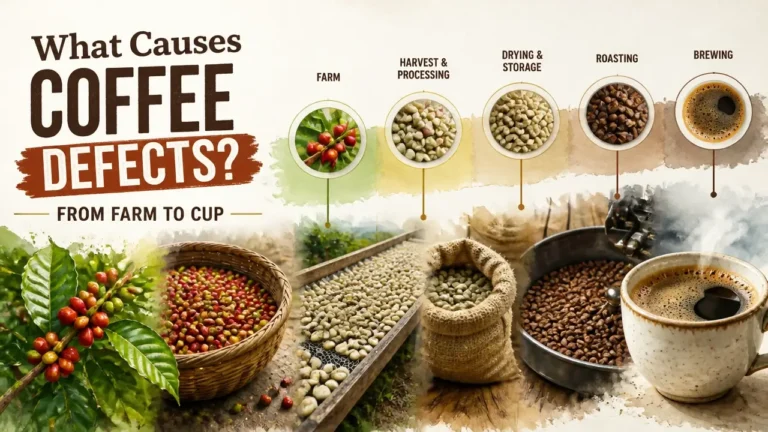

The causes of coffee defects are scattered across six distinct stages of production, yet most quality investigations start – and stop – at the roaster. A black bean, a sour note, a flat cup: each carries a chemical signature pointing to a specific failure point, whether that’s a fermentation tank left uncleaned overnight, a huller set a fraction too tight, or a container that sweated its way through the tropics.
Understanding where defects actually originate changes everything about how you prevent them. The SCA grading system, fermentation microbiology, and roast-curve analysis each tell part of the story. This guide connects them into one chain.
Key Takeaways on Causes of Coffee Defects
- Structural, sensory, economic, and roast defects are four distinct categories; conflating them creates attribution errors that cost money and waste diagnostic time.
- Most sensory defects originate in fermentation chemistry, not the roaster; acetic and butyric acid buildup from uncontrolled microbial activity is the direct mechanism.
- Harvest timing and cherry sorting are the highest-leverage farm-level controls, because immature and over-ripe cherries create defect conditions no downstream process can fully correct.
- Case hardening during drying seals internal moisture that reads correctly on a surface meter but causes storage mold months later.
- Hermetic packaging reduces oxygen transmission below 0.1%, which is the single most impactful storage intervention for slowing lipid oxidation in green coffee.
- Differential diagnosis follows a fixed sequence – green inspection, then roast profile analysis, then extraction variables – and skipping any step produces a wrong attribution.
What Actually Counts as a Defect? The Four Lenses That Shape Prevention
Coffee defect classification is not a single concept. It’s four overlapping ones that professionals routinely collapse into one, and that confusion is where most misattribution begins. Before you can prevent defects, you need a precise taxonomy – because a control practice that targets a structural defect does almost nothing to prevent a roast defect, and vice versa.
The first lens is the SCA green grading standard: the transactional, economic definition. It sorts defects into two categories. Category 1 (Primary) defects – full black beans, full sour beans, pods, fungus-damaged beans, foreign matter, and severe insect damage – carry zero tolerance for specialty classification. A single full black bean in a 350 g sample disqualifies the lot. Category 2 (Secondary) defects – partial blacks, partials sours, broken beans, shells, and light insect damage – are capped at a cumulative equivalent of 5 full defects per 350 g. This standard functions as an economic gatekeeper: exceed the threshold and the lot drops below specialty grade, triggering a direct price discount.
The second lens is the structural definition. A bean can be physically compromised at the cellular level – observable under microscopy, as documented in Wintgens’ foundational work on coffee plant physiology. Black beans show complete cellular dissolution; insect-bored beans carry 0.3–1.5 mm entry tunnels that allow secondary fungal colonization; mold-invaded beans have degraded internal cell content. These are not aesthetic problems. They are mechanical failures in the bean’s architecture that alter how it roasts and what it tastes like.
The third lens is the sensory definition: off-flavors detectable in the brewed cup, independent of whether the bean looks intact. A bean can pass a green visual inspection and still deliver ferment, phenol, earthy, or baggy notes. These flavors arise from chemical compounds formed during processing, storage, or aging – not from visible physical damage.
The fourth lens is the roast defect category. Scorching, tipping, and facing are visual markers caused by the roasting machine and its operator. Baked, underdeveloped, and over-roasted are taste-based phenomena caused by time-temperature mismanagement inside the drum. None of these originate at the farm.
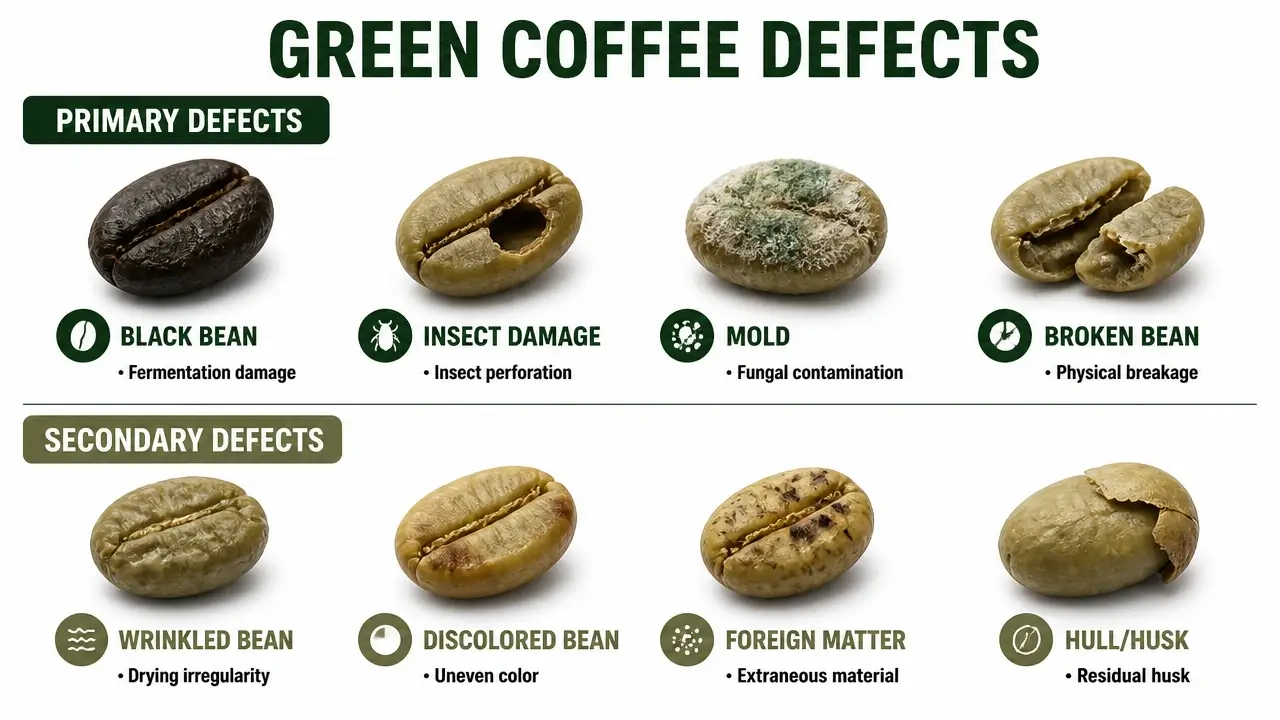
Here’s the critical insight: these four lenses are not interchangeable. A bean can be structurally intact and produce a sensory defect – if it spent 18 hours in an over-warm fermentation tank. A bean can carry a roast defect and be perfectly sound green coffee – if the drum temperature spiked. The industry’s habit of conflating these categories creates costly attribution errors: a black bean (structural) gets misread as a roast defect during cupping, or a scorched bean (roast defect) triggers an unjustified complaint to the green supplier.
Dr. Sebastian Opitz, a green coffee expert and project lead at ZHAW, notes that defect identification is rarely a clean binary process – the same physical bean can present ambiguous signals depending on the evaluation context and the evaluator’s reference framework.
This ambiguity is not a reason for imprecision. It’s a reason to hold all four lenses simultaneously. The flavor-based descriptors – “baked,” “underdeveloped,” “fermented” – are not purely subjective. Science anchors them: under-roasted beans retain measurably elevated chlorogenic acid levels; baked roasts display a stalled Maillard reaction traceable to a flat or dipping Rate of Rise; black beans show complete cellular dissolution under a microscope. A claim of “baked” should always be paired with a documented RoR signature, not left as a sensory opinion. That discipline is what separates a process correction from a cupping-table argument.
Pre-Harvest and Harvest: Root Causes Already in the Bean
Farm-level defect origins are the most upstream failures in the chain – and the hardest to reverse downstream. By the time an agronomic problem shows up as a quaker in the roaster or a woody note in the cup, every subsequent stage has had the chance to amplify it. The question isn’t just what went wrong. It’s when.
Agronomic Stressors and Pest Infestation in Coffee Plants
Soil nutrition sets the ceiling on cherry quality before a single picker enters the field. Deficiencies in potassium or phosphorus, low soil pH, or micronutrient imbalances stress the coffee plant at a metabolic level, producing cherries with incomplete bean fill, reduced density, and thin cell walls – all of which translate directly into higher susceptibility to insect attack and greater defect risk during processing.
Climate and altitude layer additional stressors onto that foundation. Drought during the maturation period produces shriveled, low-density beans that pass through grading screens intact but deliver a hollow, lifeless cup. Excessive rainfall during flowering or at harvest promotes anthracnose and fruit rot, compromising bean integrity from the inside out. Frost damage at high altitudes creates partial cellular destruction that is nearly invisible to visual grading but detectable on the cupping table.
The coffee berry borer (Hypothenemus hampei) is the most economically significant insect vector for defects worldwide. The female bores a 0.3–1.5 mm entry hole directly into the developing cherry and lays eggs inside the seed. The damage is twofold: the mechanical tunnel destroys cell structure in the affected area, and it opens a pathway for secondary fungal invasion. The resulting cup note is characteristically woody, sometimes medicinal – a signature that experienced cuppers recognize immediately but that is easy to confuse with storage age or mold contamination if the green sample wasn’t inspected first.
What the literature has not established is the infestation threshold at which a cupper reliably detects that woody note. No published study has quantified how many CBB-bored beans per kilo cross a sensory detection limit. This gap is consequential: producers currently set pest tolerance thresholds by intuition, not evidence.
Harvest Timing, Cherry Sorting, and Prevention Practices
Harvest timing is the single most controllable variable at the farm level, and it’s the one most often compromised by labor economics. A mixed pick – combining under-ripe, optimally ripe, and over-ripe cherries in the same basket – creates a heterogeneous batch that cannot process evenly. Under-ripe cherries become quakers: pale, under-roasted beans that survive the green sort but fail to brown properly in the drum, delivering grassy, starchy flavors. Over-ripe cherries have already begun partial fermentation on the tree, introducing microbial activity before the cherry even reaches the pulping station.
Cherry floating at the farm gate is the first physical filter. Over-ripe, insect-damaged, and hollow cherries float in water; sound, dense cherries sink. Retaining only sinkers for specialty processing is not just a best practice – it’s the earliest point in the chain where a structural defect can be physically removed before it contaminates an entire lot. Floaters correlate strongly with flat, lifeless cups, though the precise chemistry of that flavor loss remains unquantified.
Prevention at this stage combines three mechanisms: integrated pest management (CBB traps, biological control with Beauveria bassiana fungus), balanced soil nutrition programs calibrated to soil test results, and selective hand-picking at peak ripeness with rapid delivery to the processing station. The last point matters more than most producers account for: every hour between picking and pulping is time for uncontrolled fermentation to begin inside the cherry.
Processing and Fermentation: The Crucible Where Defects Multiply
Inadequate processing is where a lot of sound cherries can become a defective lot of green coffee in under 24 hours. The mechanism is direct: processing creates the conditions for microbial activity, and microbial activity, left uncontrolled, generates the exact organic acids and enzymatic byproducts that define sour, stinker, and black bean defects. The processing method determines which risks dominate.
Risks of Wet, Dry, and Honey Processing Methods
Wet processing concentrates its risk at two points: depulping delay and fermentation duration. If depulping is delayed beyond 12 hours after picking, uncontrolled fermentation begins inside the intact cherry. Once in the fermentation tank, time and temperature govern the microbial population. A clean fermentation at 18–22°C for 24–36 hours produces the bright acidity that defines washed coffee. Push that tank past optimal time or temperature and acetic acid and butyric acid accumulate – the chemical signatures of sour and stinker beans respectively. Contaminated water introduces mold spores and geosmin-producing bacteria that deliver earthy, musty cup notes with no visible warning on the green bean.
Dry (natural) processing moves the fermentation risk from the tank to the drying bed. Over-ripe cherries that weren’t sorted at intake continue fermenting on the ground or raised bed. If the cherry mass is too deep, or if it isn’t turned frequently enough, the interior temperature rises and fungal colonization begins. The result is black beans – not from the roaster, but from combined fungal attack and overheating inside the drying cherry. Uneven drying within the fruit mass produces partial rot that shows up as moldy notes in the cup.
Honey and pulped natural processing sits between these two in risk profile. The residual mucilage layer left on the parchment is a dense, sugar-rich substrate. Under-managed drying of honey-processed coffee generates patchy fermentation across the batch, producing off-flavors that closely mimic over-fermented washed coffee – which makes attribution particularly difficult during cupping.
Defect Chemistry, Equipment Hygiene, and Prevention
The chemistry of black bean formation is a cascade. Fungal enzymes begin breaking down the pectin layer; over-fermentation and high ambient heat accelerate cellular destruction; the result is a dark, brittle bean with completely dissolved internal cell content. In the cup, that destruction reads as ashy, burnt, or metallic – notes that are easily confused with scorching if the green sample wasn’t inspected beforehand.
Sour bean formation follows a different pathway. Uncontrolled yeast and bacterial populations convert pectinaceous sugars into acetic acid and other carboxylic acids during fermentation.
Microorganisms active during coffee fermentation produce acetic acid, butyric acid, and other higher carboxylic acids as metabolic byproducts of pectinaceous sugar breakdown – From the study “The Role of Microbes in Coffee Fermentation and Their Impact on Coffee Quality” published in the Journal of Food Quality
The study confirms that these acids are generated during the fermentation process itself, establishing the biochemical foundation for sour and stinker bean formation. What it does not resolve – and what no published guidance has addressed – is how a given fermentation outcome interacts with roast development. A lightly fermented coffee may taste clean at a light roast but expose hidden sourness at a medium-dark roast. The inverse is also possible. This interaction effect is entirely unstudied, which means roasters making profile decisions for processing-variable lots are working without a map.
Equipment hygiene is not a supporting variable. It’s a primary one. Dirty fermentation tanks, demucilagers, and washing canals are standing reservoirs of spoilage organisms. A one-day lapse in cleaning is sufficient to inoculate an entire lot with the microbial population from the previous batch’s over-fermentation.
Prevention at this stage requires strict time-temperature-pH logging throughout fermentation, water treatment (chlorination or UV sterilization), physical separation of floaters before fermentation begins, immediate pulping after intake, and daily sanitation of all contact surfaces. These are not optional refinements. They are the difference between a controlled biochemical process and an uncontrolled one.
Drying and Milling: Where Moisture and Mechanics Turn Latent into Defective
Drying and milling defects are the supply chain’s most deceptive category. The bean looks sound at the end of the fermentation tank. It looks sound coming off the drying bed. It looks sound after hulling. Then it arrives at a roastery six months later and cups flat, moldy, or physically inconsistent – and no one can say exactly when the failure happened.
Moisture Management and Drying Rate Defects
The 10–12% moisture window is not a guideline. It’s a hard boundary with a different failure mode on each side. Below 10%, the bean becomes brittle; micro-cracks that are invisible to the naked eye propagate during hulling, creating fragments that roast unevenly and count as secondary defects under SCA standards. Above 12%, fungal and bacterial activity resume – the same organisms that processing protocols worked to eliminate. And moisture must be uniform across the lot. A 1% internal gradient within a single bean creates pockets of elevated water activity that foster localized mold growth, invisible until the lot is roasted or stored.
Case hardening is the drying defect that most consistently escapes detection at origin. When the external shell of a parchment-covered bean dries too fast – typically during high-heat mechanical drying or aggressive afternoon sun on a concrete patio – it forms a semi-impermeable barrier that seals internal moisture inside. The bean reads correctly on a surface moisture meter. The interior is damp. In storage, that trapped moisture creates exactly the conditions for mold development that the drying stage was supposed to prevent.
Raised beds improve airflow around individual beans and reduce the risk of case hardening compared to concrete patios. Mechanical dryers must ramp temperature gradually – high initial temperatures are the direct mechanical cause of case hardening. Frequent turning during sun drying is not optional; it’s the mechanism that exposes all surfaces to airflow and prevents moisture stratification within the drying mass.
Floating beans post-drying are a reliable indicator of developmental failure: beans that didn’t fill properly, were damaged during processing, or dried unevenly. They correlate strongly with lack of body and flat flavor in the cup. The precise threshold at which floaters become a detectable cupping liability – is it 1 floater per 350 g sample, or 5? – has never been established in the literature. Every producer and roaster currently sets an arbitrary internal standard.
Milling Defects, Density Sorting, and Prevention
Milling introduces a distinct category of mechanical defects. Huller settings calibrated too aggressively crush beans or shear them into fragments; mis-sized grading screens allow excessive broken beans to pass; metal friction during polishing generates surface burns. All of these register as secondary defects under SCA standards and cause uneven roasting – fragments and whole beans reach different internal temperatures at the same drum setting.
Density sorting after milling is the last physical filter before packing. Density tables separate hollow, under-weight beans that survived processing and drying intact but lack the internal structure for consistent roasting. This step catches defects that originated at every upstream stage – agronomic stress, incomplete fermentation, uneven drying – but it is a filter, not a fix. Density sorting removes defective beans; it cannot restore quality to beans that were marginally compromised but still dense enough to pass.
Prevention at this stage combines constant turning during sun drying, calibrated moisture meters used at multiple points during the drying curve (not just at the end), gentle hulling parameters verified against a broken-bean count, density sorting post-milling, and immediate hermetic packing after the moisture target is confirmed. The pattern here mirrors the rest of the chain: the industry has robust standards for visible, countable defects and almost no quantitative data on the sensory impact of incremental quality losses. That gap becomes even wider in storage.
Storage and Transport: The Silent Quality Erosion That Erases a Season’s Work
Storage and transport conditions are the supply chain’s longest defect-formation window, and the least monitored. A lot that graded specialty at the mill can arrive at a roastery as old-crop without a single documented event explaining the change. The defects that accumulate here are slow, invisible, and cumulative – which makes them the hardest to attribute and the easiest to ignore until they cross a sensory threshold.
For a full reference on what these accumulated defects look and taste like at the cup, the common coffee defects list covers each type with its flavor signature and identification markers.
Environmental Conditions and Time-Dependent Aging
Ideal storage sits at 15–20°C and 55–65% relative humidity. These aren’t arbitrary comfort zones. Temperature fluctuation is the active damage mechanism: as ambient temperature swings up and down, moisture migrates within the bag and condenses on the inner surface. That condensation drips back onto beans, creating localized high-humidity pockets that reactivate mold and bacterial populations. RH above 65% accelerates this process across the entire lot. RH below 50% dries the bean past the 10% moisture floor, causing the same brittleness and micro-cracking that under-dried milling produces.
Lipid oxidation is the mechanism behind time-dependent aging. Even under optimal conditions, the oils in green coffee oxidize progressively. The cup expression of this process is baggy, woody, or papery notes – the unmistakable signature of old-crop coffee. For most washed arabicas, the peak quality window is 6–9 months from dry milling. After 9–12 months, the degradation becomes detectable to any trained cupper.
Pest ingress adds a physical damage vector. Warehouse moths, cigarette beetles, and rodents cause direct mechanical damage and leave biological contamination. Controlling them requires fumigation – but fumigation residues themselves can alter flavor, a trade-off that receives almost no attention in quality management literature.
Packaging, Container Dynamics, and Prevention
Hermetic bags (GrainPro and equivalent products) reduce oxygen transmission to below 0.1%, which slows lipid oxidation and blocks moisture migration between the bean and the ambient environment. Jute bags, still widely used in commodity coffee logistics, allow full environmental exchange. They are responsible for a significant share of transit-related quality loss – not because of any single catastrophic event, but because every day in a jute bag is a day of unimpeded oxidation.
Container sweat is the most underestimated transit risk. When a shipping container crosses from a cool zone into a warm, humid one – or vice versa – moisture condenses on the container roof and walls. That condensate drips onto the top bags. Temperature spikes above 40°C inside a container accelerate aging at a rate that no post-arrival cupping can fully account for. Shared containers add cross-contamination risk from other cargo.
Prevention requires pre-shipment moisture testing, hermetic packaging, real-time temperature-humidity data loggers traveling with the lot, and first-in-first-out rotation at the warehouse. These tools don’t prevent aging. They document it – which is the only way to answer the question a roaster needs answered when a lot arrives flat: did this happen in storage, or was it latent from the mill?
That accountability gap connects directly back to the green-roast knowledge disconnection. A roaster receiving baggy, lifeless coffee may never establish whether storage duration was the cause or whether the beans arrived at the warehouse already high-moisture. The data trail stops at the mill gate. The next section gives you the diagnostic method to cut through that ambiguity at the cupping table.
Diagnosing Defects: How to Separate Green from Roast from Extraction
Defect diagnosis starts with a sequencing problem. An ashy cup can come from a black bean, from scorching, or from over-extraction. Without a systematic protocol, professionals misattribute the source – and the result is roasters adjusting profiles to compensate for green flaws, or producers receiving complaints that originated in the drum.
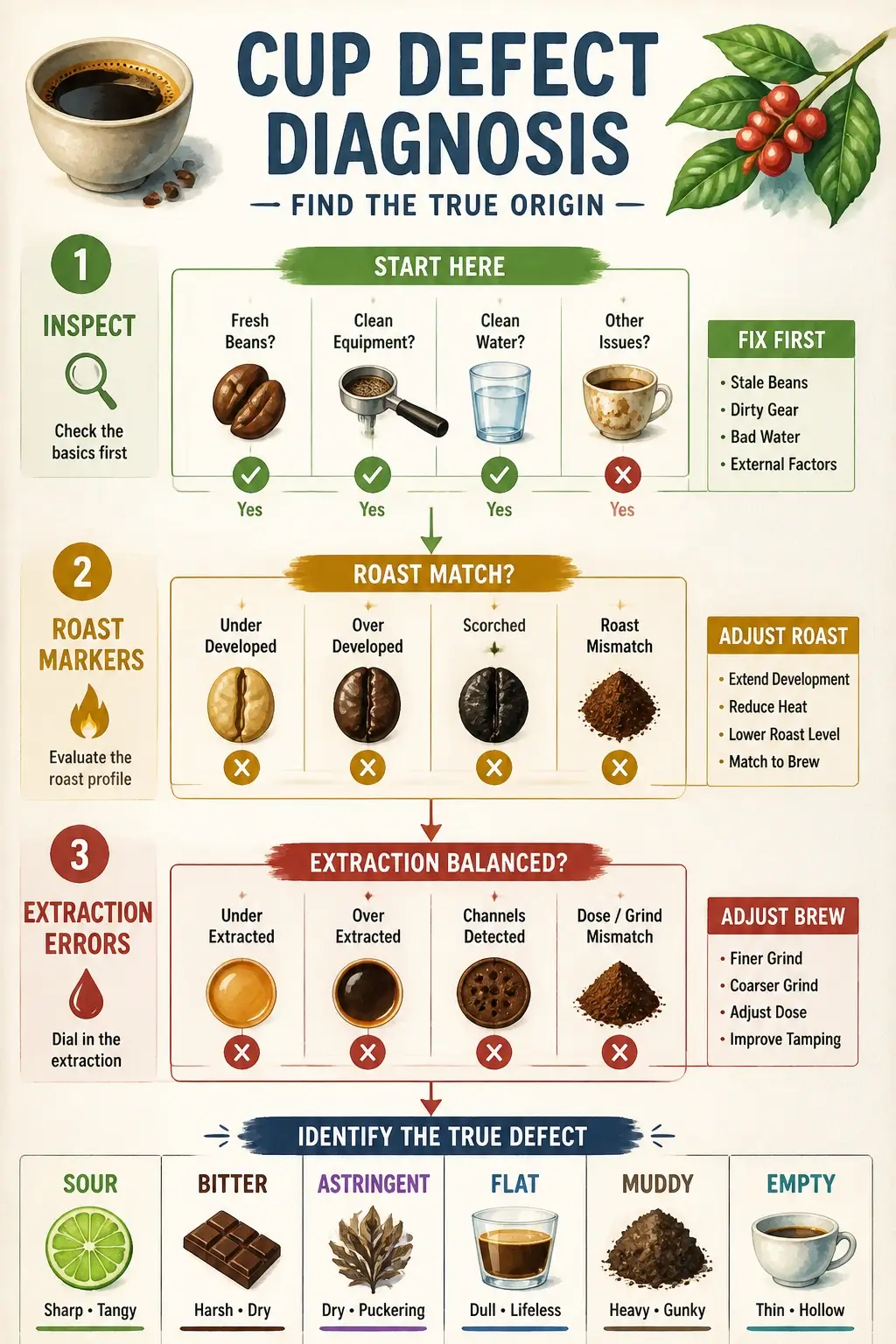
The diagnostic sequence is always the same: green first, roast second, extraction third.
Visual inspection is the first filter. Pull a representative green sample and look for black beans, insect holes, mold patches, and color inconsistency. Then inspect a roasted sample from the same lot for scorching (small blackened surface specks caused by direct flame contact), tipping (a dark spot at the germ end caused by excessive drum temperature at charge), and facing (charred edges on the flat side from beans resting against the drum). These are roast defects. They are visible. They are separable from green defects if you look at both samples before you cup.
SCA cupping across multiple separate roast batches of the same lot is the gold standard for attribution. If a defect appears consistently across all roast batches – regardless of profile variation – the origin is green. If it appears in only one batch, the roast profile is at least partially responsible.
Green-bean chewing bridges the gap between visual inspection and cupping. Bite into a whole raw bean twice: once at room temperature, once after lightly toasting it in a dry pan. Fermentation defects – sour, moldy, vinegary – are detectable in the raw bean before it ever hits a roaster. Woody or earthy notes suggest insect damage or storage age. This method establishes a pre-roast sensory baseline that can cut the number of diagnostic test roasts in half. It isn’t a substitute for formal cupping – it misses quakers and roast-expression defects entirely – but it tells you immediately whether the problem predates the drum.
Roast defect markers each have a measurable process signature. Underdeveloped roasts taste grassy or vegetal because chlorogenic acids weren’t fully degraded – check the development time ratio. Baked roasts taste flat or bready because the Maillard reaction stalled – look for a flat or dipping Rate of Rise in the development phase. Over-roasted coffee is dominated by carbon notes that can closely mimic the ash of a black bean, which is precisely why the green inspection must come first.
Ruling out extraction is the final step. Brew the same coffee at different grind sizes and water temperatures. If the defect shifts in intensity or character with brewing variables, the extraction is at least partially responsible. Over-extraction bitterness is one of the most common false positives for defect bitterness.
Three edge cases demand specific recognition:
- Quakers are pale, non-browning beans visible post-roast. They originate from immature green cherries – a harvest selectivity failure – but are frequently and incorrectly blamed on roasting.
- Peaberries are not defects. They are a natural morphological variation, often with a distinct and brighter flavor profile. Sorting them as defective is a grading error.
- Facing on the drum can produce visually alarming char marks with zero detectable flavor impact. A visual roast defect is not automatically a sensory defect.
The green-coffee literature and the roasting literature treat defects as belonging to separate disciplines, with no integrated workflow connecting them. Blogs covering green defects never discuss how roast profile alters the expression of a black bean. Roast-defect resources rarely ask whether a “baked” cup started with a low-density green bean more susceptible to RoR stalling. This chasm is the single greatest structural source of misattribution in the industry. The diagnostic protocol above – green, roast, extraction, in that order – is the only reliable way to close it.
Prevention Blueprint: The Critical Control Points That Guarantee a Clean Cup
The prevention framework for coffee defects is not a new set of practices. It’s the right practices, sequenced by impact, tied back to the four defect definitions, and closed with a cupping feedback loop that verifies everything upstream. Every stage from farm to warehouse is a lever. The question is which levers move the needle most.
Critical Control Points and Audit Checklist
Ranked by their impact on defect elimination, the critical control points are:
1. Harvest selectivity. Only fully ripe, unblemished cherries enter the processing stream. Any visibly wounded, over-ripe, or insect-damaged cherry is separated at the cherry-grading table. This is the earliest structural filter in the chain.
2. Fermentation control. Time, temperature, and pH are logged throughout the fermentation window. Water meets potable standards. Full cleaning cycles run between every batch. This is the highest-leverage biochemical control point – the one where black beans and sour beans are either prevented or created.
3. Uniform drying. Moisture is mapped with a calibrated meter at multiple points during the drying curve, not just at the endpoint. Target: 10–12% moisture with a maximum 1% variation within the lot.
4. Density and defect sorting post-milling. All floaters, broken beans, and hull fragments are removed before packing. This step catches defects that originated at every upstream stage.
5. Hermetic storage and monitored shipping. GrainPro-type bags, pre-shipment moisture testing, and data loggers that record temperature and humidity throughout transit. First-in-first-out rotation at every warehouse.
The following audit checklist translates these control points into operational questions:
| Stage | Audit Question |
|---|---|
| Harvest | Do you have a written protocol for maximum time between picking and pulping? |
| Harvest | Is there a defined ripeness standard for acceptable cherry color at intake? |
| Cherry sorting | Do you float-sort 100% of cherries before depulping? |
| Fermentation | Do you log fermentation start time, ambient temperature, and pH at minimum every 6 hours? |
| Fermentation | Is there a written sanitation schedule for tanks, canals, and demucilagers? |
| Drying | Do you take moisture readings at multiple points during drying, not just at endpoint? |
| Drying | Is your mechanical dryer temperature-ramped, or does it start at full heat? |
| Milling | Do you measure broken-bean percentage after hulling to verify huller settings? |
| Milling | Are density tables calibrated and verified against a floater-count standard? |
| Storage | Are temperature and humidity logged continuously in your storage facility? |
| Storage | Do you use hermetic bags for all specialty-grade lots? |
| Shipping | Do data loggers travel with every container? |
Cupping is the feedback loop that validates all of the above. Schedule cuppings at green arrival, immediately post-roast, and again after shipping. The method for cupping to detect defects systematically connects what you taste to what happened upstream. Defects not caught at the cupping table make every upstream control point irrelevant – because the system has no verification that it worked.
Integrating Frameworks, Future Frontiers, and a Call to Action
Each control point maps back to a specific defect category from the opening framework. Structural defects – black beans, insect-bored beans – are prevented by harvest selectivity and milling integrity. Sensory defects – ferment, sour, baggy, earthy – are prevented by fermentation control and storage management. Economic defects are prevented by meeting SCA grade thresholds at every sorting stage. Roast defects fall outside this blueprint but are diagnosable with the differential protocol in the previous section.
The honest frontier: the industry still lacks quantitative sensory thresholds for most of these defects. How many CBB-bored beans per kilo before a cupper reliably detects the woody note? At what floater-per-sample rate does cup quality measurably decline? These numbers don’t exist in the published literature. The interaction effects between processing outcomes and roast development are barely studied. A lightly fermented lot may cup clean at a light roast and reveal hidden sourness at a medium-dark. No guidance document addresses that.
Your own lot-tracking data is the closest thing to a research base that currently exists for your specific origin, variety, and process. Record fermentation pH alongside cupping scores across multiple roast levels. Track moisture at drying endpoint against storage duration against cup score at arrival. Over time, those records will identify patterns that the published literature cannot predict.
To return to the complete guide to coffee defects and quality control for the broader framework this prevention blueprint fits into – including defect identification, grading standards, and commercial implications – that resource covers the full scope.
The path from a “good enough” lot to a reliably defect-free one is a closed loop. Prevention without cupping verification is assumption. Cupping without process records is guesswork. The only way to know which lever needs adjusting is to cup intelligently, record precisely, and resist the temptation to blame the nearest stage in the chain instead of the right one.
Frequently Asked Questions About Causes of Coffee Defects
Can a processing defect be fixed by adjusting the roast profile?
Rarely. A fermentation defect baked into the green bean’s chemistry – acetic acid, butyric acid – doesn’t disappear with a different roast curve. In some cases, a lighter roast hides a latent sourness that a darker roast exposes, but that’s concealment, not correction.
How quickly does over-fermentation produce detectable cup defects?
At ambient temperatures above 25°C, detectable acetic acid buildup can begin within 12–18 hours of delayed depulping or an extended fermentation window. Cooler temperatures slow the process but don’t stop it.
What’s the difference between a stinker bean and a sour bean?
Both originate from uncontrolled fermentation, but sour beans deliver vinegar-like sharpness from acetic acid, while stinker beans carry a more intense, sulfurous or rotten note linked to butyric acid and advanced putrefaction. In the cup, stinkers contaminate the entire brew even at low concentrations.
Why do quakers survive green grading and only show up after roasting?
Quakers come from immature cherries that were picked before full ripeness. The green bean looks physically normal – no visible damage, correct size – but its internal starch-to-sugar conversion was incomplete. That incomplete development only becomes visible as a failure to brown during roasting.
At what point in storage does lipid oxidation become detectable to a trained cupper?
Under optimal storage conditions (15–20°C, 55–65% RH, hermetic packaging), most washed arabicas hold peak quality for 6–9 months. After 9–12 months, baggy and papery notes become detectable to experienced cuppers. Jute-bagged coffee stored in fluctuating conditions degrades measurably faster.
Is “container sweat” a real risk, or is it overstated in the industry?
It’s real and routinely underestimated. When a container moves between temperature zones – say, a cool port into a humid tropical transit – moisture condenses on the container’s metal ceiling and drips onto the top layer of bags. Without data loggers in the container, the damage is invisible until the coffee is cupped at the roastery.
Why are peaberries sometimes sorted out as defects?
Peaberries form when only one ovule develops in the cherry instead of two, producing a single rounded bean rather than two flat-sided beans. They’re a natural morphological variation with no defect chemistry. The confusion arises because they roast differently from flat beans at the same screen size, which can cause uneven development in a mixed lot – but the peaberry itself isn’t defective.
How do fumigation residues in warehouse storage affect cup flavor?
This trade-off is genuinely understudied. Some fumigants, particularly phosphine-based compounds, can leave trace residues that alter flavor perception in sensitive cuppings. The practical guidance is to ensure adequate aeration time post-fumigation and to cup a sample before releasing a fumigated lot for export.
References
- SCA News: Grounding Green Grading | sca.coffee
- The Role of Microbes in Coffee Fermentation and Their Impact on Coffee Quality | Journal of Food Quality via doi.org