
Rigorous coffee defects quality control is what keeps a specialty lot worth what you paid for it. One primary defect in a 350-gram sample pulls the entire lot below the SCA specialty threshold. The price differential between an 80-point lot and a commercial-grade rejection can swing tens of cents per pound – across a full container, that math gets brutal fast.
This guide runs the full circuit: defect taxonomy, root causes, SCA grading protocol, and cupping as a sensory backstop. By the end, you’ll have the mental model to catch problems earlier, grade more accurately, and protect the relationships those lots represent.
Key Takeaways on Coffee Defects Quality Control
- A single primary defect in a 350-gram sample disqualifies the entire lot from specialty status under SCA standards.
- Defects are built into lots through upstream handling decisions – cherry selection, fermentation control, drying, and storage – not discovered at the grading table.
- Visual green grading and cupping are complementary tools; fungal taints confirmed by Food Research International were undetectable by eye alone.
- The specialty price premium of +30 to +41 cents per pound over New York C pricing disappears the moment a lot drops below an 80-point cup score.
- Container rejection, forced downgrade, and re-sorting costs make defect prevention significantly cheaper than defect correction at the point of delivery.
- Direct-trade relationships are the most fragile asset in the specialty chain; one defect-tainted shipment can end a partnership built over years.
What Specialty Coffee Quality Control Actually Demands
Specialty coffee quality control is a systematic discipline, not a final inspection. It fuses visual defect analysis, cupping, and conformity to SCA standards into a continuous chain of evaluation that runs from pre-shipment contracts through arrival inspection. Understanding the definition of coffee quality control in specialty coffee is the starting point, because the stakes here are categorically different from commercial coffee.
In commercial-grade supply chains, sorting is minimal, cupping rarely drives pricing, and the quality bar accepts defects that specialty would reject outright. Specialty operates on a different logic. Cup scores directly set price differentials. Direct-trade relationships depend on lot-to-lot consistency. A single shipment that falls short doesn’t just cost you money on that container – it costs you the trust a roaster built over years of buying from you.
That’s the pressure QC is designed to absorb. Every step in this system, from cherry selection to the cupping table, either builds or erodes the value of the lot.
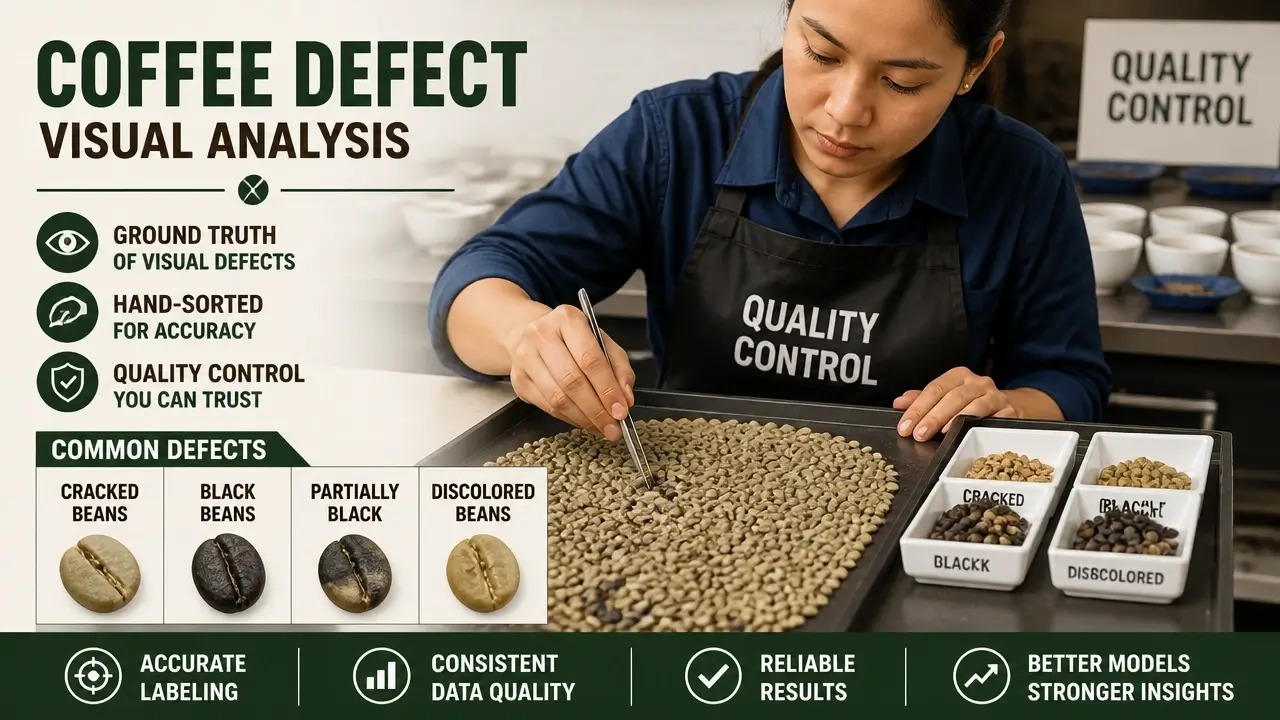
Anne Lunell, co-owner of Koppi Roasters in Sweden, puts the producer-side risk plainly: defects don’t just lower a score – they can trigger outright rejection of a lot, stripping a producer of income they’ve already invested months of work to earn.
The practical implication is stark. A producer who loses a specialty contract because of preventable defects doesn’t just take a one-time financial hit. They lose the premium pricing, the direct relationship, and often the market access that took years to build. QC is the mechanism that protects all of that – on both sides of the transaction.
What follows in this guide is the core lens through which that system operates: the defect taxonomy itself, its origins, and the two-pillar detection framework that grades it.
The Defect Taxonomy and Its Sensory Footprint
Green coffee defects split into two categories under the SCA framework, and the distinction between them isn’t just organizational – it determines whether a lot qualifies for specialty at all.
Category 1 (primary) defects are instant disqualifiers. A single primary defect found in a 350-gram sample removes the lot from specialty consideration, full stop. The primary defect list includes:
- Full black beans – beans that have fully deteriorated, typically from overfermentation or disease
- Full sour beans – completely soured beans from uncontrolled fermentation
- Dried cherry/pod – unpulped or undried cherries that survived processing
- Fungus/mold damage – visible fungal contamination on the bean surface
- Foreign matter – stones, sticks, or other non-coffee material
- Severe insect damage – beans with three or more insect entry holes
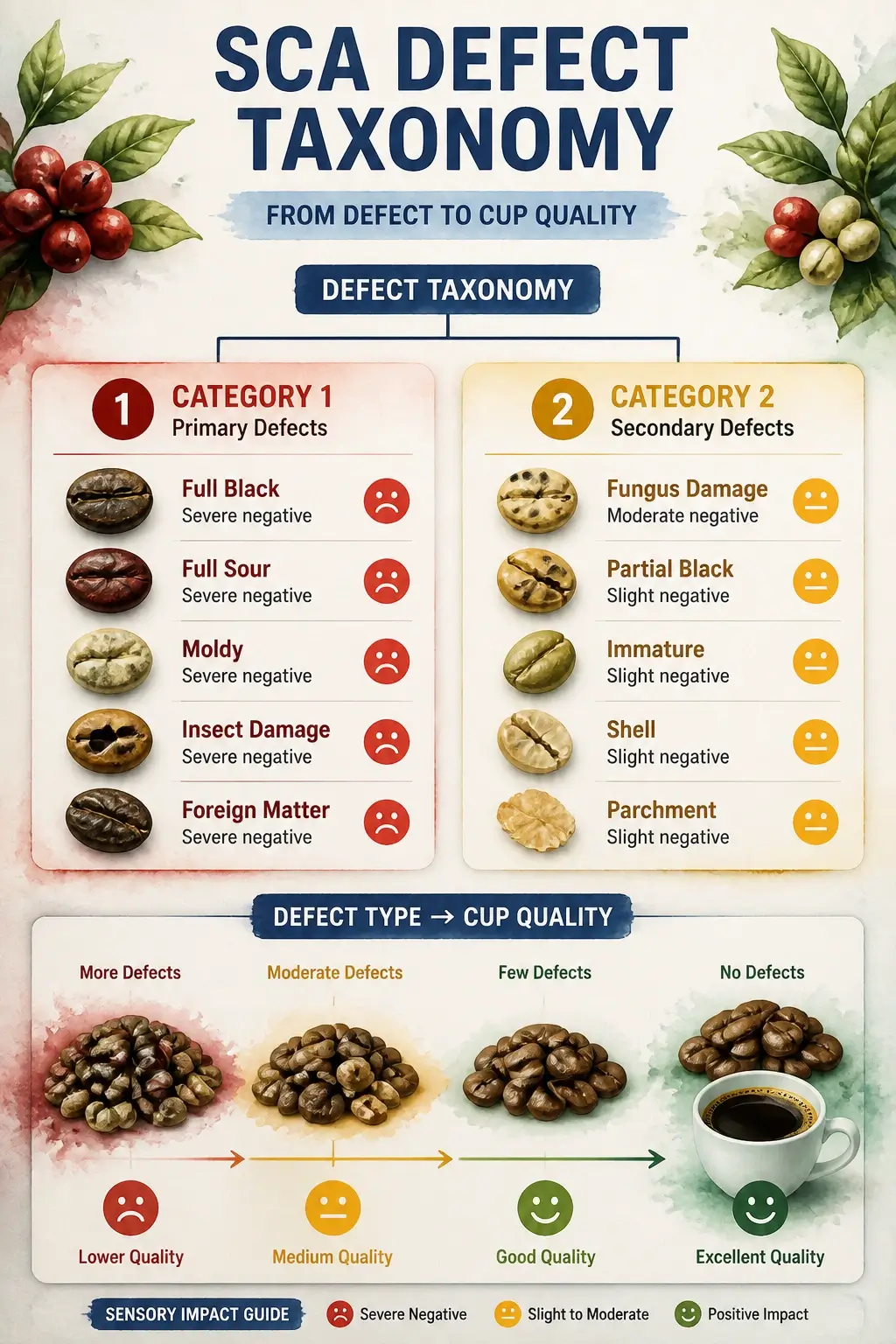
Category 2 (secondary) defects work on accumulation. Individual partials are converted into full defect equivalents using the SCA’s equivalence table – for instance, two to three partial black beans typically equal one full secondary defect. The specialty threshold is zero primary defects and no more than five full secondary defect equivalents per 350-gram sample. Secondary defects include partial black, partial sour, broken or chipped beans, immature beans (quakers), shells, and other partial damage.
The sensory consequences follow a predictable pattern. Full sour beans introduce fermented, vinegary notes that contaminate the entire cup even at low concentrations. Fungus-damaged beans carry musty or moldy taints. Severe insect damage tends toward harsh bitterness. Immature beans produce astringency and a flat, underdeveloped character that drags down sweetness and body scores.
Here’s the blind spot worth flagging now: some microbial and fermentation defects are nearly invisible to the naked eye. A bean can look clean and still carry a taint that surfaces only under the cupping protocol. That’s not a failure of the taxonomy – it’s the reason cupping exists as a second, non-negotiable pillar. We’ll get there in H2-5. First, let’s trace where these defects actually come from.
Where Defects Are Built Into the Lot
Defects don’t appear at the grading table. They’re manufactured upstream, through cumulative handling decisions across the entire farm-to-export chain.
Cherry selection is the first control point. Overripe cherries ferment too aggressively during processing, producing full sour or ferment defects. Underripe cherries become the immature beans – quakers – that refuse to develop properly in the roaster and drag down cup scores with astringency and grassiness.
Processing is where the most consequential errors happen. In wet-processed coffee, poorly controlled fermentation – wrong duration, contaminated water, temperature spikes – is the primary driver of full sour and ferment defects. In dry-processed coffee, uneven or interrupted drying creates pockets of moisture that feed fungal growth. A lot spread too thick, turned too infrequently, or caught in unexpected rain can accumulate mold damage that’s hard to detect and nearly impossible to reverse.
Milling introduces a different category of damage. Hulling equipment set too aggressively, or run on beans at the wrong moisture content, creates excessive broken and chipped beans. These are secondary defects, but they accumulate fast and push a lot toward the five-defect threshold.
Storage and transport close the chain. Humidity and temperature swings after milling encourage residual mold growth and musty taints. Pest intrusion during warehousing adds insect damage to lots that may have passed green grading at origin. A lot can be clean at the mill door and defect-laden by the time it reaches an importer’s warehouse.
The through-line is this: every defect has a decision attached to it. Proactive quality assurance – farm protocols, moisture monitoring, cleanliness standards, equipment calibration – is the actual foundation of defect reduction. Reactive grading at the end of the chain can only measure the damage; it can’t undo it.
[YouTube]: This video shows coffee beans examined under UV light, revealing fungal contamination and surface defects completely invisible under normal lighting – a visceral demonstration of why visual inspection alone has hard limits.
`[Youtube]:
`
Once you understand the origins, you need a calibrated yardstick to measure what’s actually arrived. That’s the SCA grading protocol.
The SCA Grading System: Counting Toward Qualification
The SCA green grading protocol is the industry’s standard measurement tool, and it’s more procedurally specific than most people realize when they first encounter it.
The process starts with a representative 350-gram sample drawn from the lot. That sample is hand-sorted, and every defect is identified and assigned to either primary or secondary category. From there, the counting rules are strict.
One primary defect ends the evaluation. The lot fails specialty qualification immediately, regardless of how the rest of the sample looks. Secondary defects are converted into full defect equivalents using the SCA equivalence table – the conversion ratios vary by defect type, but the logic is consistent: multiple partials combine into one full equivalent, and the cumulative total must stay at or below five full secondary defects for the lot to qualify.
Passing green grading is necessary. It’s not sufficient. Specialty status also requires a minimum screen size – to confirm physical bean development – and a cup score of 80 or above on the SCA’s 100-point scale. That last requirement is where the grading protocol hands off to cupping.
For a detailed side-by-side look at how these thresholds compare to commercial-grade requirements, the comparison of specialty vs commercial coffee quality standards covers the full picture across grading frameworks and market expectations.
The open loop in visual grading is real. The SCA protocol is excellent at catching physical defects, but it cannot detect flavor flaws that leave no visible trace on the bean. That’s the gap cupping is built to close.
Cupping: The Sensory Backstop Visual Grading Can’t Replace
Cupping is where the detection system catches what the eye misses. A lot can pass green grading without a single primary defect and still fail specialty – because ferment taint, phenolic contamination, mustiness, or bagginess are flavor-layer problems, not surface problems.
The SCA cupping protocol controls every variable that could introduce noise into the sensory evaluation: roast degree, grind size, water temperature, steeping time, and scoring methodology. Evaluators score across nine attributes – fragrance/aroma, flavor, aftertaste, acidity, body, balance, uniformity, clean cup, and sweetness – on a 100-point scale. A total score of 80 or above is the specialty threshold. Anything below is commercial grade, regardless of how clean the green sample looked.
The gatekeeper function is direct. A lot that sailed through visual grading can still cup at 78 because a fermentation error at origin left a taint that bonded to the bean’s cellular structure without marking its surface. That lot loses specialty status, and with it, the price premium.
A Food Research International study on mycobiota in coffee beans found that Aspergillus section Nigri contamination produced moldy, dirty, and fermented sensory attributes in brewed coffee – in samples that were not visually distinguishable from uncontaminated beans.
That finding closes the argument for cupping as a mandatory second pillar. Fungal contamination at a level below visual detection still degrades the cup. No grading protocol built on visual inspection alone can catch it. The full picture of common coffee defects and their flavor impact makes clear just how many taints operate this way – process-borne, invisible, and fully destructive to the sensory profile.
The research gap is worth acknowledging honestly: there is currently no fully reliable physical or chemical marker that maps one-to-one with every sensory defect. That’s not a flaw in the SCA system – it’s the reason cupping remains indispensable. It’s also why understanding the causes of coffee defects from farm to cup matters: prevention is the only reliable upstream defense against defects that grading can’t always catch downstream.
The Real Price of Defects: Dollars, Relationships, and Brand
Defect economic cost is easier to calculate than most producers and importers want to admit – and harder to recover from than most expect.
Start with the price cascade. The specialty premium isn’t a flat bonus on top of commodity pricing. It’s a bracket system tied directly to cup score.
The implied price differential for specialty coffee scoring between 80 and 83.9 points over the New York C price ran +30 to +41 cents per pound across the 2021/22 to 2023/24 harvest years. – Source: New Zealand Specialty Coffee Association Transaction Guide
On a 275-bag container at 69 kilograms per bag, a 30-cent-per-pound differential translates to roughly $12,500 in lost revenue – from a score drop that might trace back to a single fermentation error at origin. Push that lot below 80 points entirely, and it exits the specialty market altogether.
The market execution consequences compound the math. Discovery of a primary defect during arrival inspection can trigger container rejection, forced downgrade to commercial pricing, or costly re-sorting contracts. Each outcome eats directly into the importer’s or exporter’s margin, and every one of them generates friction with the buyer.
Brand equity takes the longest to rebuild. A roaster who receives a defect-tainted lot doesn’t just absorb a financial loss – they face a consistency problem with their own customers. When that happens repeatedly, or even once at the wrong moment, direct-trade partnerships built over years of calibrated buying dissolve. The roaster finds a more reliable source. The producer loses the relationship that made the premium pricing sustainable in the first place.
Rigorous QC is the insurance against all of that. The cost of a proper quality program – sample grading, moisture monitoring, cupping calibration, cleanliness protocols – is a fraction of a single rejected container. The step-by-step coffee cupping for defect detection guide gives you the operational framework to run that sensory evaluation correctly, every time.
Your Quality Control Roadmap: Six Spokes, One System
A complete quality control roadmap doesn’t live in a single article. The concepts introduced here – defect taxonomy, root causes, SCA grading, cupping protocol – each have enough operational depth to warrant dedicated study. The six spoke articles below are that depth, built to be read in sequence or consulted as targeted reference material.
Spoke 1 – Defining Coffee Quality Control expands on what QC means across different supply-chain roles: producer, exporter, importer, and roaster each have different leverage points and different failure modes.
Spoke 2 – Specialty vs. Commercial Standards puts the grading thresholds side by side, with market expectations and pricing implications for each tier. If you’re sourcing across both segments, this is the calibration you need.
Spoke 3 – The Complete Defect Library goes deep on every primary and secondary defect: detailed profiles, visual identifiers, and cup-taint correlations. This is the field reference you’ll return to during actual grading sessions.
Spoke 4 – Root Causes and Prevention Protocols turns the upstream analysis from this article into actionable farm and mill checklists. If you’re working directly with producers, this is where QC conversations get productive.
Spoke 5 – The Cupping Guide walks through the full SCA protocol step by step, with calibration techniques and the sensory vocabulary needed to score consistently across evaluators.
Spoke 6 – Grading Systems in Depth covers the specialty coffee grading systems SCAA SCA alongside CQI and other frameworks, with equivalence tables and sampling best practices for each.
Treat this hub and its spokes as a sequential curriculum. The mental model you’ve built here – defects as manufactured upstream, detected through two complementary pillars, and priced into every transaction – is the foundation. Each spoke article operationalizes one dimension of it.
Start with the article that addresses your most pressing gap. The value specialty coffee commands exists because someone, somewhere in the chain, is doing this work rigorously. Make sure that someone is you.
Frequently Asked Questions About Coffee Defects Quality Control
What counts as one “full defect equivalent” under SCA rules?
The SCA equivalence table converts partials into full defect equivalents based on defect type – for example, two to three partial black beans typically combine into one full secondary defect. The cumulative limit for specialty qualification is five full secondary defect equivalents per 350-gram sample.
Can a lot pass visual grading and still fail specialty status?
Yes. A lot with zero primary defects and fewer than five secondary defect equivalents still needs a cup score of 80 or above to qualify as specialty. Microbial taints and fermentation faults that leave no visible mark on the bean can push the cup score below that threshold.
What is the 15/15/15 rule for coffee?
The 15/15/15 rule is a storage guideline: keep green coffee at no more than 15°C, at 15% relative humidity, and for no longer than 15 months. It’s a rough benchmark for slowing moisture migration and mold development in warehoused green coffee, not an SCA grading standard.
How many defects are allowed in a specialty-grade lot?
Zero primary defects. No more than five full secondary defect equivalents per 350-gram sample. Both conditions must be met simultaneously – passing one without the other doesn’t qualify the lot.
Why do quakers keep showing up even after careful cherry selection?
Quakers – immature beans – are notoriously hard to remove at the cherry stage because underdevelopment isn’t always visible through the skin. They typically reveal themselves after roasting, when they fail to develop color at the same rate as mature beans, making post-roast sorting a practical last line of defense.
At what point in the supply chain does QC have the highest leverage?
At origin, during cherry selection and processing. Defects introduced there compound through every subsequent step – milling, transport, storage – and become progressively harder and more expensive to remediate. Upstream prevention is structurally more efficient than downstream detection.
How does insect damage get classified – primary or secondary?
It depends on severity. Severe insect damage, defined as three or more entry holes per bean, is a primary defect and an instant disqualifier. Lighter insect damage with fewer holes falls into the secondary category and is counted toward the five-defect threshold.
Does moisture content affect defect classification directly?
Moisture content isn’t a defect category itself, but it’s a root-cause driver. Beans above roughly 12% moisture at rest create the conditions for mold growth and fungal contamination – which are primary defects. Monitoring moisture through storage is one of the most cost-effective controls in a QC program.
References
- Coffee Defects: How to Avoid Them – A Producer’s Guide | perfectdailygrind.com
- The mycobiota of coffee beans and its influence on the coffee beverage | sciencedirect.com