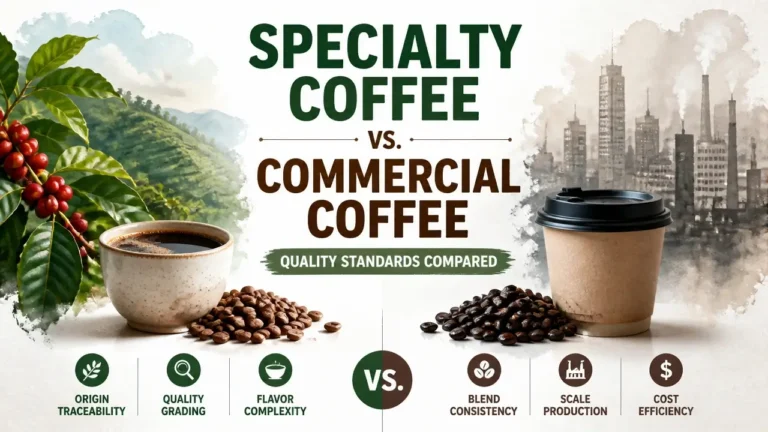

Specialty vs commercial coffee quality standards split the entire global supply chain at a single threshold, and most professionals working near that line are making decisions based on an incomplete picture of what each system actually requires. The SCA cupping scale, Q Grader certification, and a strict defect tolerance framework govern the specialty side. The commodity market runs on a fundamentally different logic.
Understanding both systems at the mechanical level – not just the marketing version – is what separates buyers who negotiate with confidence from those who get burned by score inflation, hidden defects, and contracts that borrow specialty language without delivering specialty accountability.
Key Takeaways on Specialty vs Commercial Coffee Quality Standards
- A green coffee must score 80 or above on the SCA’s 100-point cupping scale and pass a strict physical defect standard to qualify as specialty – the score alone is not enough.
- Within specialty, the tier structure (80–84.99, 85–89.99, 90+) means the category spans a wide quality range; sourcing decisions should reflect that spread, not treat all specialty as equivalent.
- Zero Category 1 defects are permitted in a specialty lot; a single full black bean disqualifies the entire sample regardless of cupping score.
- Q Graders show high individual consistency but low cross-cupper agreement, which means a single origin-side score should be triangulated against at least two independent evaluations before a purchase commitment.
- Specialty green coffee trades at $4–$12 per pound above the commodity C-market price, but no published formula maps SCA score increments to farm-gate earnings – that opacity rewards buyers with direct relationships and in-house cupping capacity.
- The SCA governs specialty through a structured, six-step standards process covering cupping protocol, green coffee standards, and equipment certification; the commercial market has no equivalent sensory standard, only contract-based quality specifications anchored to the NY ‘C’ contract.
The 80-Point Threshold: Where Specialty Begins
The SCA cupping scale is the single most important reference point in this comparison, and its core rule is simple: any green coffee that scores 80 points or above on the SCA’s 100-point scale, as assessed by a certified Q Grader, qualifies as specialty. Everything below 80 is commercial grade by default, regardless of origin story, processing method, or marketing label.
That commercial category is broad. It covers high-volume espresso blends, supermarket cans, and instant coffee alike. There is no sensory tier system on the commercial side. The 80-point cutoff is the only universally recognized boundary in the global trade.
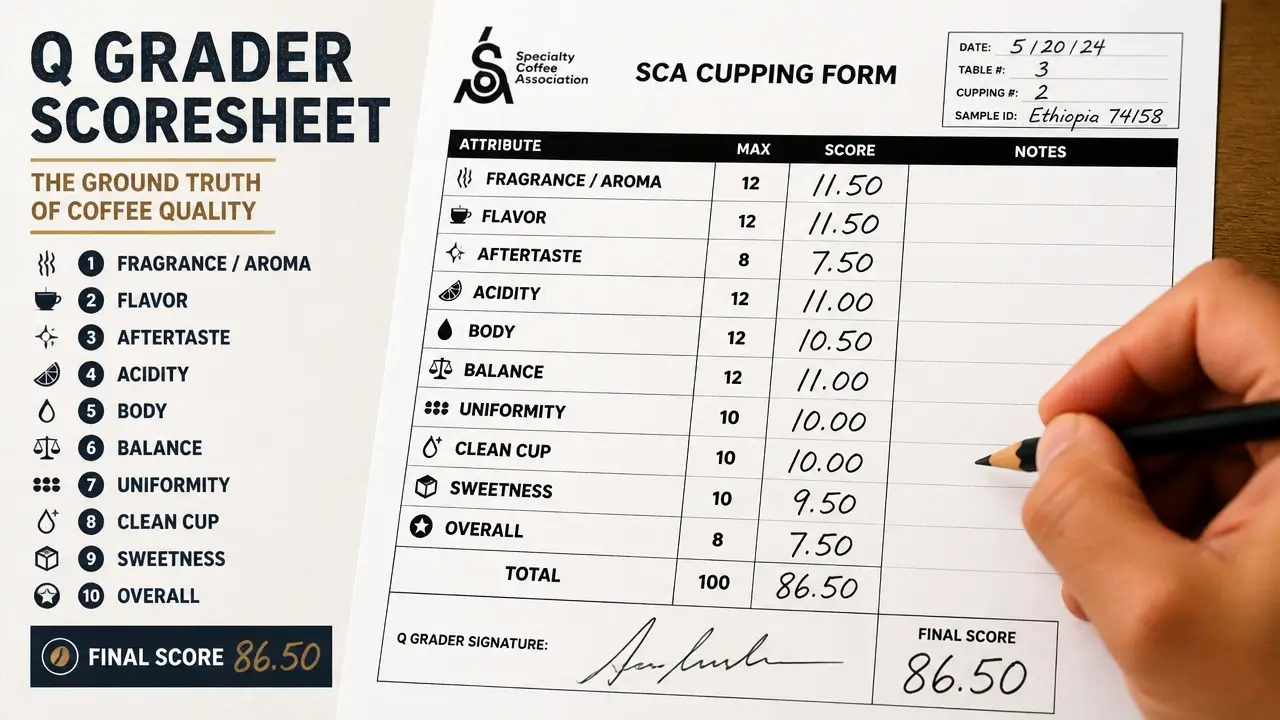
Within specialty, the scale keeps subdividing. A score of 80–84.99 earns the designation Very Good. 85–89.99 is Excellent. Anything at 90 or above is Outstanding – a category that represents a small fraction of annual production worldwide. “Specialty” is not a monolith. A roaster sourcing an 81-point washed Honduran and one sourcing a 92-point natural Ethiopian are both technically working with specialty coffee, but the sensory and economic realities of those two lots have almost nothing in common.
The scoring itself works across ten categories: fragrance/aroma, flavor, aftertaste, acidity, body, balance, uniformity, clean cup, sweetness, and overall impression. Each category is rated on a 6–10 scale, and the scores are summed. That structure matters because three of those categories – sweetness, clean cup, and uniformity – function as practical gatekeepers. A coffee that scores perfectly on flavor and acidity but shows inconsistency in uniformity will hit a ceiling on its final number.
“The Q Program is a system for identifying and certifying lots as specialty. A certified Q Coffee scores 80 and above on the SCAA cupping form, is free of primary defects, and has no more than 5 full secondary defects.” – Trish Rothgeb, Director of Programming at the Coffee Quality Institute and coiner of the term “Third Wave of Coffee”
Rothgeb’s framing is precise: the score is necessary but not sufficient. A lot must clear both the sensory threshold and the physical defect standard simultaneously. A coffee that cups at 82 but carries a primary defect is not specialty. That dual requirement is what makes the classification meaningful – and what gets quietly ignored when sellers market borderline lots.
Sam Klein, green coffee buyer at Partners Coffee, frames the current moment with unusual honesty: the specialty sector has long justified its value proposition through a combination of better quality and fairer pricing. But as commodity prices rise and cheap coffee disappears from the market, the question becomes whether specialty companies will hold to that mission when the cost gap between the two tiers narrows.
That pressure makes a clear understanding of what the standards actually require more valuable, not less. When the price differential shrinks, the only defensible basis for a specialty premium is the documented quality behind it.
Here is where the 80-point threshold creates a genuine blind spot for buyers who stop at the headline number. A lot scoring 79.5 can be sensorially indistinguishable from one at 80.5. The coffee hasn’t changed. The market’s treatment of it has. One moves as a premium; the other enters the commodity stream at a fraction of the price.
The practical defense against that distortion is straightforward: always request the full cupping form, not just the final score. The ten individual category scores and the written sensory descriptors reveal what the number hides. Two lots can share the same final score with completely different flavor profiles and defect histories. The form is the evidence. The score is the summary.
Defect Tolerances and the Physical Quality Gate
Even a coffee that cups beautifully fails specialty classification if its physical condition doesn’t meet the standard. The SCA green coffee standard is explicit: a 350-gram sample may contain zero Category 1 (primary) defects and a maximum of five Category 2 (secondary) defects. Both conditions must be satisfied.
Primary defects are the disqualifiers. A single full black bean – oxidized through the cherry wall to the core – fails the lot. So does a full sour bean (fermented beyond the acceptable threshold, identifiable by its vinegar-like smell), or a bean showing severe insect damage where the borer has penetrated through both faces. One bean. The entire lot.
Secondary defects are more permissive but still bounded. Partial black, partial sour, broken or chipped beans, parchment, and slight insect damage each count toward the five-defect ceiling. A partial black counts as three-tenths of a full defect. A broken bean counts as one-fifth. The math matters because a handful of visually similar defects can aggregate to the limit faster than a quick visual inspection suggests.
Understanding the definition of coffee quality control is essential here because the SCA’s physical standard is not a post-processing check – it is a system that should be built into every hand-off in the supply chain, from the sorting table at the wet mill to the green sample at the importer’s warehouse.
Commercial coffee operates on a different logic entirely. Defect counts are dramatically higher, and the primary purchasing criteria shift to screen size uniformity, absence of foreign matter, and moisture content. The NY ‘C’ contract and private buyer specifications define acceptable defect levels on a contract-by-contract basis, creating a patchwork of standards rather than a single global protocol. A commercial buyer in one market might accept 30 full defects per 300-gram sample; another might accept 50. There is no universal floor.
Moisture content is one area where both markets share a nominal target: 10–12% is the accepted range for both specialty and commercial green coffee. But the reason each market cares about moisture is slightly different. For specialty, tight moisture control preserves flavor clarity and extends shelf life in ways that protect the scored sensory profile. For commercial, moisture is primarily a weight and mold-risk concern. The number looks the same; the underlying priority is not.
The deeper point is this: a Certificate of Analysis from the exporter documents what the lot looked like when it left origin. It does not guarantee what arrived. The physical inspection and independent cupping conducted at import – or at the roastery – is the real quality gate. A buyer who accepts a COA without running their own defect count on arrival is trusting a document, not the coffee.
Watch this breakdown of the sensory and visual differences between commercial and specialty microlots to see the defect categories in a real-world context: [Youtube]:
Cupping, Q Graders, and Regional Score Variability
A cupping score is only as reliable as the person who assigned it and the context in which they worked. That’s the friction point most buyers skip past, and it’s where sourcing decisions go wrong.
The Q Grader Certification and SCA Cupping Protocol
A licensed Q Grader earns that credential by passing 22 sensory examinations covering triangulation, olfactory identification, organic acids, and SCA cupping protocols, then maintaining calibration through ongoing retesting. They are the only individuals formally recognized to assign SCA cupping scores that determine specialty status. No Q Grader credential, no valid SCA score – that’s the rule.
In specialty, cupping happens at multiple checkpoints: at origin after processing, at export, upon import, and at the roastery before the lot is committed to a blend or single-origin program. Each checkpoint is a purchase decision gate. In commercial supply chains, sensory evaluation is minimal. A basic pass/fail check for off-flavors – ferment, phenol, mold – is standard. Systematic scoring across ten categories is not.
A collaborative study published by the SCA adds an important complication to the scoring picture. The research found that the current cupping protocol mixes descriptive and affective assessments, which leads cuppers toward holistic appraisals rather than systematic, attribute-by-attribute evaluation. The study also documented that cuppers show high intra-rater repeatability – meaning an individual cupper is consistent with themselves – but low inter-rater agreement across different cuppers. In plain terms: two Q Graders cupping the same coffee on the same day, in the same room, will often land on different numbers.
That finding does not invalidate the system. It clarifies what the system actually is: a calibrated, structured method for generating reproducible sensory signals within a cupper’s own palate, not a universal objective measurement. The SCA’s six-step standards development process – proposal, review, expert drafting, stakeholder feedback, revision, final approval – keeps the protocol evolving, but it cannot standardize what individual palates have been trained to value. Protocol uniformity and palate culture are two different problems.
For anyone relying on a single origin-side score to make a purchase decision, this is the most important thing to understand about the Q Grader system.
Regional Score Variation and Multi-Source Verification
Regional score variation is real and consistent. A coffee scored 87 in Japan might receive an 84 in California, not because the coffee changed between sessions, but because calibration groups develop local consensus norms over time. Japanese specialty culture has historically prized delicate acidity and floral clarity. West Coast American palates often favor body and sweetness. Both panels are using the same SCA cupping form. The scores still diverge.
This does not mean one market is right and the other is wrong. It means a single origin-side score is a data point, not a verdict. Importers and roasters who understand common coffee defects and their impact on grading already know that the physical record and the sensory record need to be read together. The same logic applies across geographies: triangulate results from at least two or three independent cuppers before committing to a lot, ideally from cuppers whose calibration norms reflect the market where the coffee will be sold.
The green buyer who visits farms, verifies processing firsthand, and cups every lot independently is the real economic gatekeeper in specialty. A COA that arrives with an 88-point claim from an origin cupper deserves verification, not blind trust. For roasters without a dedicated green buyer, building a network of trusted cuppers across multiple consuming markets is the most reliable hedge against score inflation.
Price Premiums and the Economics of Each Supply Chain
The quality standards described above are not academic. They translate directly into how coffee is priced, traded, and sourced – and the two markets operate on fundamentally different economic logic.
Specialty coffee commands a price premium because of what it costs to produce: selective hand-picking to harvest only ripe cherries, meticulous processing with controlled fermentation and drying, farm-level traceability, and the cupping infrastructure needed to document quality at every stage. These are real costs, and they are baked into the price. Commercial coffee optimizes in the opposite direction: volume, mechanical harvesting, strip-picking, and origin blending to hit a consistent flavor target at the lowest possible cost per unit.
The documentation requirements reflect that difference. Specialty buyers expect a full dossier: farm name, variety, altitude, processing method, harvest date, and cupping scores. That transparency does two things. It reduces risk by creating an audit trail, and it enables relationship-based trade where price premiums can be justified and defended. Commercial buyers work with broad origin blends traded on futures contracts through the ICE exchange. Individual lot identity disappears the moment coffee enters a commercial blend. What you’re buying is a specification, not a story.
Specialty green coffee typically trades at premiums ranging from $4 to $12 per pound above the commodity C-market price – Tower of Records Coffee
That range is wide, and the width is itself informative. A $4 premium reflects a solid 82-point coffee from a well-documented but not exceptional origin. A $12 premium reflects a competition-level micro-lot with provenance, processing innovation, and a score north of 90. The specialty market does not have a published formula that maps score increments to farm-gate earnings. That relationship is real but opaque, and it creates friction in price negotiations that both buyers and producers feel.
Peter Roberts, founder of the Specialty Coffee Transaction Guide, makes the structural point directly: specialty green coffee pricing could be as disconnected from the NY ‘C’ price as specialty retail prices already are. The SCTG exists to give buyers and sellers a more relevant benchmark for those negotiations – one that isn’t anchored to a commodity exchange that has no sensory quality component.
The commodity market does have a visible baseline: the NY ‘C’ price provides a transparent (if imperfect) floor for commercial green coffee. Specialty’s quality premium floats on buyer relationships, regional scoring norms, and trust built over multiple harvests. That’s not a flaw in the specialty system – it’s a feature for buyers who invest in direct relationships. For those who don’t, it’s a liability.
Martin Mayorga, founder and CEO of Mayorga Coffee, puts the operational reality plainly: direct-trade sourcing requires projecting annual volumes and taking on real risk, because coffee carries physical logistics challenges, perishable inventory, and tight margins that software businesses don’t face.
The supply chain philosophy differs at every node. Specialty tracks quality at each hand-off – producer, wet mill, dry mill, exporter, importer, roaster. Commercial consolidates, warehouses, and optimizes for a consistent, price-stable product that large-scale roasters can buy by the container. Specialty producers who want access to premium markets must invest in processing infrastructure and cupping labs to meet buyer expectations. Commercial producers can move volume through cooperatives with fewer quality gate requirements – but at lower margins and with no differentiation story.
The practical takeaway for roasters: budget for in-house cupping capacity. Without it, you’re paying specialty prices based on someone else’s assessment of quality, with no independent verification. That’s not a sourcing strategy. It’s a trust exercise with financial consequences.
The Standards Ecosystem: SCA Protocols vs. Commodity Contracts
The Specialty Coffee Association is the institutional backbone of specialty coffee’s quality system. It owns the cupping protocol, the green coffee standard, the water quality standard, and the equipment certification programs that make reproducible brewing possible. These are not guidelines. They are governed documents, maintained through a defined six-step process: proposal, Standards Development Panel review, expert drafting, stakeholder feedback, revision, and final approval. That process means the cupping form you use today is a living document, not an artifact from 1999.
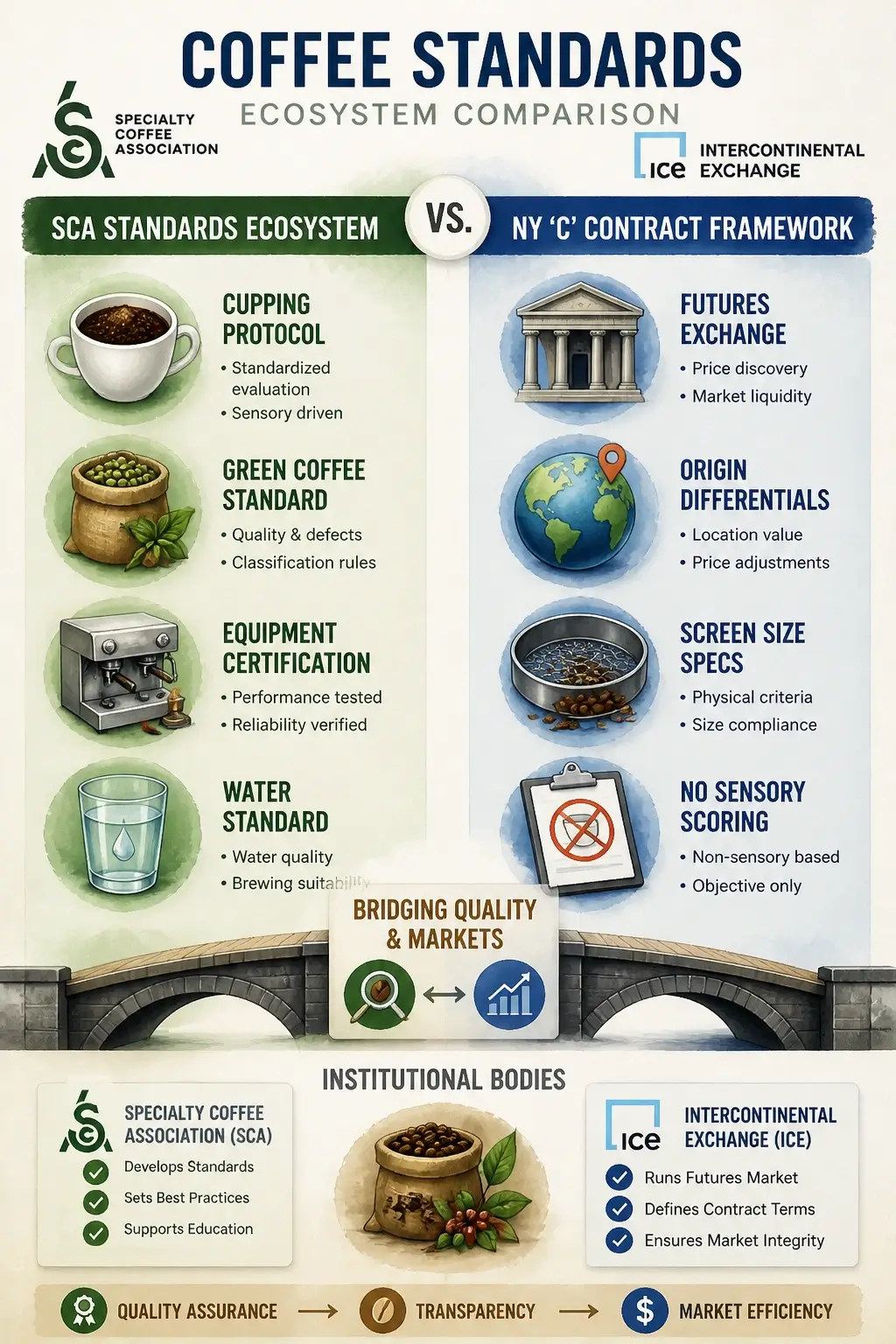
The commercial market has no equivalent. The Intercontinental Exchange (ICE) NY ‘C’ contract defines a baseline of “fair average quality” through origin differentials and screen size specifications. It tells you where the coffee came from and how big the beans are. It tells you nothing about how the coffee tastes. There is no sensory scoring component, no cupping protocol, and no certified evaluator in the commercial contract framework.
That gap creates a specific problem: commercial contracts increasingly borrow specialty language. A bag labeled “premium,” “single-origin,” or even “specialty” in a commercial context carries no enforceable meaning without Q Grader verification and SCA protocol adherence. The term becomes a marketing claim, not a certified classification. Buyers who don’t know the difference between a certified Q lot and a self-described “specialty” product are the ones most exposed to that gap.
The SCA’s reach extends further than most roasters realize. Its equipment certification programs – brewers under SCA-310, grinders under SCA-320, water quality under SCA-350, and venues under SCA-510 – set hardware standards that ensure the scored sensory profile of a green lot can actually be reproduced in the cup. A roaster who sources an 88-point coffee and brews it on uncertified equipment is introducing a variable that undermines the entire premium. The scored profile becomes a promise the equipment can’t keep.
None of that infrastructure exists in the commercial chain. Volume brewing prioritizes consistency at scale and shelf stability over precision. The hardware standard is invisible because the sensory target is different: not “reproduce what the Q Grader tasted” but “deliver a consistent, acceptable cup at the lowest cost per serving.”
Geographic and origin differences affect both systems, but in opposite ways. The SCA’s specialty standards treat terroir and processing method as intrinsic quality variables – the reason an Ethiopian Yirgacheffe and a Colombian Huila can both score 87 while tasting completely different. The commodity market treats origin primarily as a price differential on the futures board. Colombian Milds trade at a positive differential to the C price; Robusta trades at a discount. Quality is proxied by origin, not measured by palate.
Navigating the Quality Landscape for Your Business
The choice between specialty and commercial coffee is a strategic alignment decision, not a quality judgment. Specialty rewards those who can invest in traceability, sensory talent, and relationship-based trade. Commercial rewards those who can manage volume, logistics, and price risk at scale. Neither is inherently superior. Superiority is determined by how well the standard fits the business model.
The guidance looks different depending on where you sit in the supply chain.
For roasters: If your brand is built on origin stories, flavor transparency, and premium retail pricing, the investment in a dedicated green buyer and in-house Q Grader capacity is not optional – it’s the infrastructure that makes your brand promise defensible. If your model is high-volume, consistency-focused, and margin-sensitive, commercial blends sourced against contract specifications offer more stability and less sourcing overhead. Many roasters operate both models simultaneously, using commercial volume to fund specialty exploration.
For importers: Specialty demands a network of calibrated cuppers across multiple consuming markets, direct producer relationships, and the financial capacity to carry inventory that moves on relationship timelines rather than spot-market speed. Commercial requires expertise in futures hedging, logistics, and bulk warehousing. A hybrid model – using commodity volume to fund specialty development – is how many of the most resilient importers have structured their businesses.
For producers: Specialty market access requires upfront investment in processing infrastructure, defect sorting capacity, and cupping labs. That investment makes sense when the farm’s terroir and processing consistently produce lots scoring 83 or above – the range where buyers begin paying meaningful premiums and building multi-harvest relationships. Commercial channels provide a reliable offtake for lower-scoring lots and off-grade beans that would otherwise represent pure loss. The two channels are not mutually exclusive; the most economically stable producers use both.
One structural reality deserves direct acknowledgment: a significant volume of coffee scoring 78–79.5 is sensorially excellent but ends up priced as commodity because of a single defect, a borderline calibration session, or a regional scoring norm that didn’t favor its profile that day. The most agile buyers actively search for these borderline lots as hidden value. They understand that the 80-point cutoff is a market convention, not a physical law, and they use their own cupping capacity to find the gap between what the market prices and what the coffee actually delivers.
For anyone deepening their sourcing practice, the complete guide to coffee defects and quality control provides the full technical framework for evaluating lots on both sides of that line.
The final point is forward-looking. SCA protocols evolve. The commercial sector continues borrowing specialty language and, increasingly, specialty practices. The professional who stays current on both systems – not just the one their current business model requires – retains the most options when the market shifts.
Frequently Asked Questions About Specialty vs Commercial Coffee Quality Standards
Can a coffee score above 80 and still fail specialty classification?
Yes. A lot must clear both the sensory threshold and the SCA physical defect standard simultaneously. A coffee that cups at 82 but carries even one Category 1 defect – a full black bean, a full sour bean – does not qualify as specialty, regardless of score.
What is the 15-15-15 coffee rule?
The 15-15-15 rule is an SCA brewing guideline, not a quality classification standard. It refers to the recommended parameters for filter coffee: a 15-gram dose, 15 fluid ounces of water, and a 15-minute brew window – though the exact figures vary by source and application. It’s a reproducibility tool for café environments, separate from the cupping and green coffee standards that define specialty classification.
Is Starbucks coffee specialty grade?
Starbucks markets its coffee as high quality, but its supply chain operates primarily on commercial-grade procurement logic – volume, consistency, and price stability across global contracts. Individual lots in its Reserve line may cup above 80, but the company’s core commercial infrastructure, blending practices, and lack of transparent Q Grader certification across its supply chain place it outside the specialty classification framework as the SCA defines it.
How often do Q Graders need to recalibrate, and does lapsed certification affect a score’s validity?
Q Graders must pass a recalibration exam every three years to maintain active status. A score assigned by a lapsed Q Grader technically lacks formal SCA certification, though in practice many buyers accept it if the cupper’s track record is established. For high-stakes purchase decisions, verifying the grader’s active certification status before relying on their score is worth the extra step.
Why do specialty buyers request the full cupping form rather than just the final score?
The ten individual category scores reveal what the summary number hides. Two lots can share the same final score – say, 84 – with completely different flavor profiles, one excelling on acidity and flavor but scoring low on body, the other balanced across all categories. The written sensory descriptors and category breakdown are the actual evidence; the final number is a compression of that evidence.
What happens to borderline lots that score 78–79.5?
They enter the commercial stream and are priced accordingly, often at a significant discount to what their sensory profile would justify. Experienced green buyers actively source these borderline lots as hidden value, running independent cuppings to verify quality before negotiating a price above commodity but below certified specialty. The 80-point cutoff is a market convention, not a physical threshold – the coffee doesn’t change at 79.9.
How does the NY ‘C’ contract differ from SCA standards in practical terms?
The NY ‘C’ contract defines acceptable commercial coffee through origin differentials and screen size specifications – it tells you where the coffee came from and how it was graded physically, but contains no sensory scoring component. SCA standards govern specialty coffee through a cupping protocol, a defect tolerance framework, and certified evaluator requirements. One is a commodity exchange mechanism; the other is a quality governance system.
Can a producer sell the same harvest into both specialty and commercial channels?
Yes, and many do. A harvest produces a range of quality across different lots and processing batches. Lots that clear the SCA’s sensory and physical thresholds go to specialty buyers at premium prices. Off-grade beans, lower-scoring lots, and processing byproducts move through commercial channels at commodity prices. Running both channels simultaneously is how the most financially stable producers reduce waste and manage income risk.
References
- Q&A: 5 Q’s with the New Director of the Q | Sprudge.com
- High Coffee Prices and the Divide Between Specialty and Commercial | Perfectdailygrind.com
- The 2024 Specialty Coffee Transaction Guide Is Here | Dailycoffeenews.com
- Operating and Scaling a Coffee Roaster With Investment | Perfectdailygrind.com
- How Do Cuppers Cup? Evaluating and Evolving Elements of the SCA Cupping Protocol | SCA.coffee
- Coffee Price Economics | Coffee.towerofrecords.com