A professional 3D rendered coffee maker with stylized repair icons for how to fix drip coffee maker problems.
Brewing

Common Drip Coffee Maker Problems and How to Fix Them: A Step-by-Step Repair and Maintenance Guide

Drip coffee makers fail for four fixable reasons: a clogged valve, mineral buildup blocking the water reservoir, a misaligned filter basket, or trapped air causing overflow. We isolate each culprit using a structured safety checklist before disassembly, then restore full function through targeted cleaning, reseating, and a validated brew cycle that confirms the repair held.


Common Drip Coffee Maker Problems and How to Fix Them: A Step-by-Step Repair and Maintenance Guide Read More »

A stylized, professional infographic showing how to make cheap drip coffee maker taste better with a high-end coffee aesthetic.
Brewing

5 Simple Hacks to Make Your Cheap Drip Coffee Maker Taste Like a Pro

A cheap drip coffee maker produces café-quality results when we apply five targeted interventions: dialing in a precise 1:16 coffee-to-water ratio, blooming grounds for 30–40 seconds to release CO₂, pre-heating water to 195–205°F, rinsing an unbleached paper filter before brewing, and adding a pinch of salt to suppress bitterness through sodium-sensitive taste receptors.

5 Simple Hacks to Make Your Cheap Drip Coffee Maker Taste Like a Pro Read More »

A stylized, professional 3D infographic showing steps on how to clean and descale coffee maker equipment with watercolor textures.
Brewing

How to Clean and Descale Your Drip and Pod Coffee Maker: A Complete Step-by-Step Process

Cleaning and descaling a drip or pod coffee maker removes calcium deposits and rancid coffee oils that silently degrade every cup you brew. White vinegar or commercial descaling tablets dissolve mineral buildup inside the water lines, while a dedicated rinse cycle flushes residual acids. We combine both chemical and mechanical steps so your machine restores full flow rate and flavor clarity within one session.

How to Clean and Descale Your Drip and Pod Coffee Maker: A Complete Step-by-Step Process Read More »

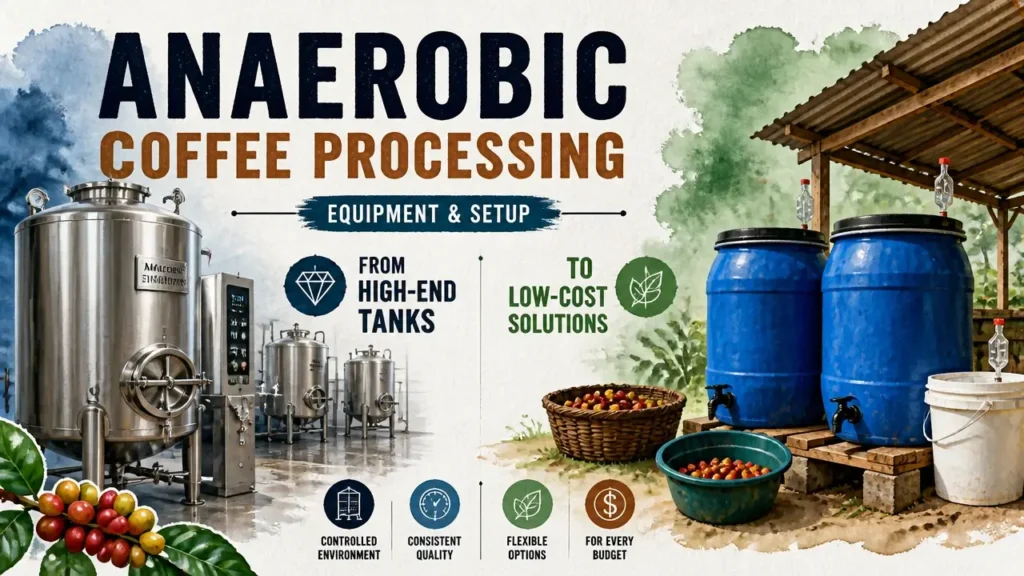
A professional 3D infographic showing how to compare anaerobic coffee processing tanks from high-end industrial units to cost-effective home setups.
Coffee Beans

Anaerobic Coffee Processing Tanks Compared: Stainless Steel, HDPE Barrels, and GrainPro Bags — Plus the Full Setup Workflow

Anaerobic fermentation demands five interdependent hardware components before a single cherry enters the tank: a CO₂-purged container, a one-way pressure-release valve, a temperature logger calibrated to the 15–18 °C window, and a pH/Brix meter verified against buffer solutions. We use this integrated setup to control gas exclusion, chemical endpoints, and thermal stability simultaneously—transforming equipment selection from guesswork into a repeatable, failure-resistant workflow.

Anaerobic Coffee Processing Tanks Compared: Stainless Steel, HDPE Barrels, and GrainPro Bags — Plus the Full Setup Workflow Read More »

A stylized hyper-realistic 3D rendering comparing a Keurig and Nespresso coffee machine side-by-side with a modern infographic layout.
Buying Guide Brewing

Keurig vs Nespresso: Which Pod Coffee Machine Is Actually Right for You?

Pod coffee machines divide cleanly into two systems—Keurig and Nespresso—each engineered around fundamentally different decision criteria. Keurig prioritizes pod variety and low pod cost, while Nespresso delivers high brew pressure and genuine crema. We use these measurable differences in machine price, milk-frothing capability, and environmental impact to match each system to the drinker it actually serves.

Keurig vs Nespresso: Which Pod Coffee Machine Is Actually Right for You? Read More »

High-quality graphic featuring Geisha and Catimor coffee cherries in a 3D artistic style representing anaerobic fermentation process.
Coffee Beans

The Best Coffee Varieties for Anaerobic Fermentation: From Geisha to Catimor, Ranked and Explained

Anaerobic fermentation coffee varieties determine cup complexity by controlling which esters and organic acids develop inside sealed, oxygen-free tanks during coffee processing. Geisha dominates this field because its dense sucrose load feeds *Saccharomyces cerevisiae* T58, generating ethyl acetate and isoamyl acetate at concentrations we rarely achieve with Catimor’s thinner mucilage layer.

The Best Coffee Varieties for Anaerobic Fermentation: From Geisha to Catimor, Ranked and Explained Read More »

A stylized 3D infographic comparing the anaerobic washed coffee process to honey processed beans with bright artistic textures.
Coffee Beans

Anaerobic Washed & Honey Processing: How Clarity, Sweetness, and Complexity Are Built from the Tank Up

Anaerobic coffee processing transforms sealed-tank fermentation into a precision flavor tool by stripping oxygen from the environment so lactic-acid bacteria convert mucilage sugars into esters under controlled CO₂ pressure. When we apply this mechanism to depulped beans, we get clean brightness; when we retain mucilage for the honey variant, we unlock extreme sweetness—two distinct outcomes driven by one oxygen-free system.

Anaerobic Washed & Honey Processing: How Clarity, Sweetness, and Complexity Are Built from the Tank Up Read More »

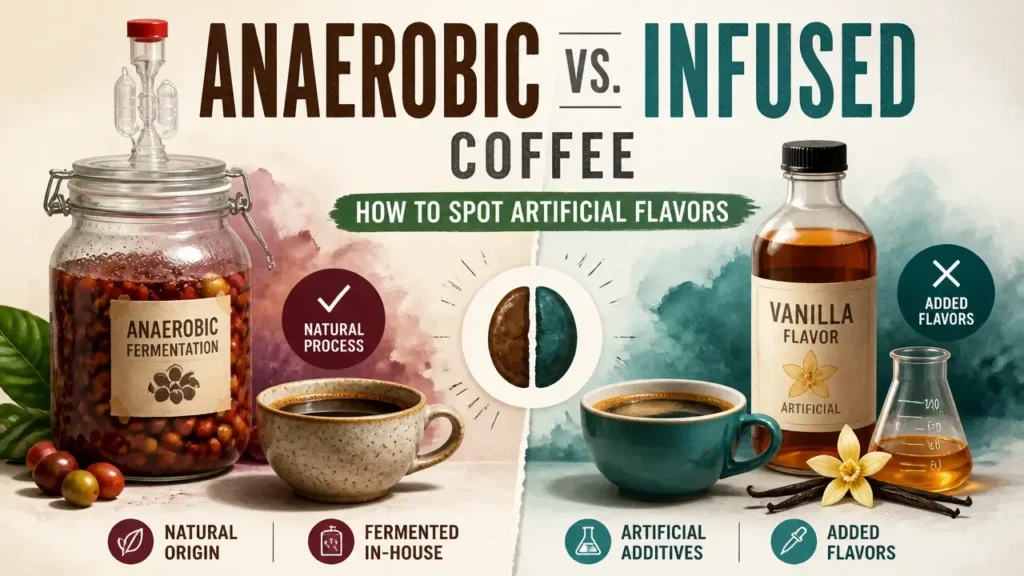
A side-by-side comparison of natural anaerobic coffee beans and chemically infused coffee, highlighting the difference between anaerobic coffee flavor vs artificial flavor.
Coffee Beans

Anaerobic vs. Infused Coffee: How to Spot the Real Flavor Difference

Coffee flavor reveals its true origin through three measurable scoring dimensions—acidity intensity, fruit-forward clarity, and mouthfeel smoothness—that separate fermentation-driven complexity from added compounds. Anaerobic fermentation builds layered, evolving profiles across all three dimensions, while artificial flavoring delivers single-note predictability. We use this rubric to give you a reliable, criteria-based method for identifying exactly what’s in your cup.

Anaerobic vs. Infused Coffee: How to Spot the Real Flavor Difference Read More »

A stylized 3D artistic rendering showing the brewing process of anaerobic coffee with sensory flavor profile icons.
Uncategorized

How to Brew Anaerobic Coffee: Cold-Bloom, Pulse-Pour, and Sensory Checkpoints for a Repeatable Cup

Anaerobic coffee demands a fundamentally different brewing approach because its sealed-fermentation process produces highly porous beans that release soluble acids and volatile compounds faster than any conventional roast. We control this accelerated extraction through a cold-bloom pre-infusion, a coarser grind size, low-temperature water, and a disciplined pulse-pour schedule that together preserve the process’s signature fruit aromas.

How to Brew Anaerobic Coffee: Cold-Bloom, Pulse-Pour, and Sensory Checkpoints for a Repeatable Cup Read More »

Hyper-realistic 3D magazine cover showing anaerobic coffee beans contrasted with traditional coffee beans, rendered with a hand-painted watercolor texture and bright studio lighting.
Coffee Beans

Anaerobic vs. Traditional Coffee Processing: What the Real Differences Mean for Your Cup

Coffee processing method determines every sensory outcome in your cup—acidity sharpness, body weight, and batch-to-batch stability—before brewing even begins. Anaerobic fermentation locks beans in oxygen-free tanks, concentrating lactic acids and syrupy body, while traditional aerobic methods produce cleaner, more predictable flavor profiles. We use five criteria—acidity, body, stability, extraction difficulty, and price premium—to show exactly where each method wins.

Anaerobic vs. Traditional Coffee Processing: What the Real Differences Mean for Your Cup Read More »

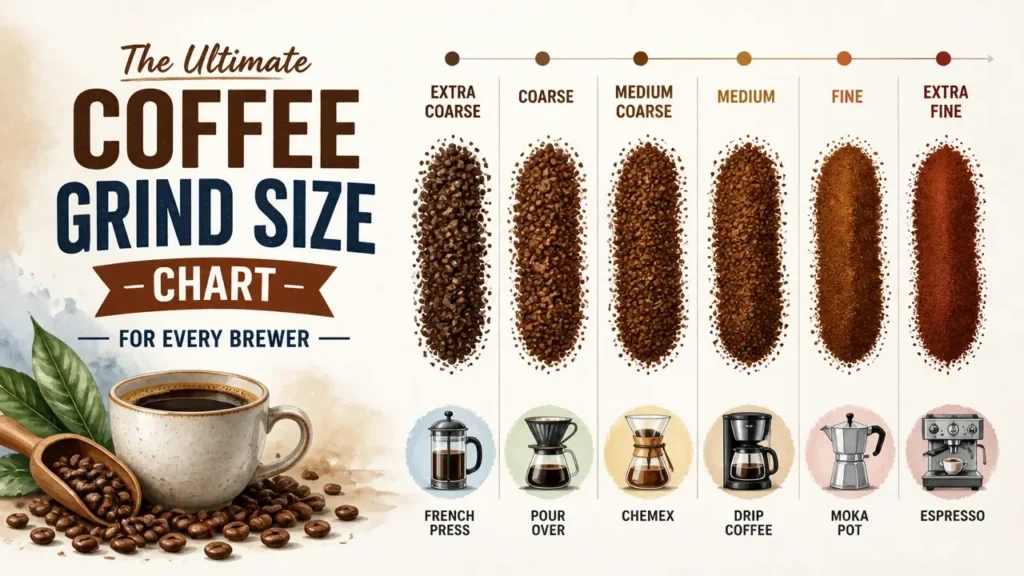
A professional infographic showing a coffee grind size chart for various brewing methods including espresso, pour-over, and French press.
Brewing

The Complete Coffee Grind Size Chart: Micron Ranges, Brewing Methods & Calibration for Every Brewer

A coffee grind size chart maps grind size categories — from extra-fine espresso particles at 100–300 microns to coarse French press grounds at 700–1,000 microns — directly to brewing methods through the surface-area principle. We use this micron-to-method relationship as a calibration baseline, but burr grinder uniformity and co-dominant brewing variables determine whether that baseline actually delivers repeatable extraction.

The Complete Coffee Grind Size Chart: Micron Ranges, Brewing Methods & Calibration for Every Brewer Read More »

Hyper-realistic 3D render of a steaming cup of black coffee on a glossy surface, with watercolor texture accents and modern infographic layout, bright studio lighting
Brewing

Black Coffee Done Right: A Complete Guide From Bean Quality to Brewing Method

Black coffee transforms fresh, high-quality beans into a pure, additive-free cup where every flavor note stands exposed. Bean origin, water mineral content, grind consistency, and brewing temperature function as interdependent variables—adjust one, and the extraction shifts measurably. We use these four levers together to build a repeatable process that produces a balanced, deeply flavorful black coffee every single time.

Black Coffee Done Right: A Complete Guide From Bean Quality to Brewing Method Read More »

Scroll to Top