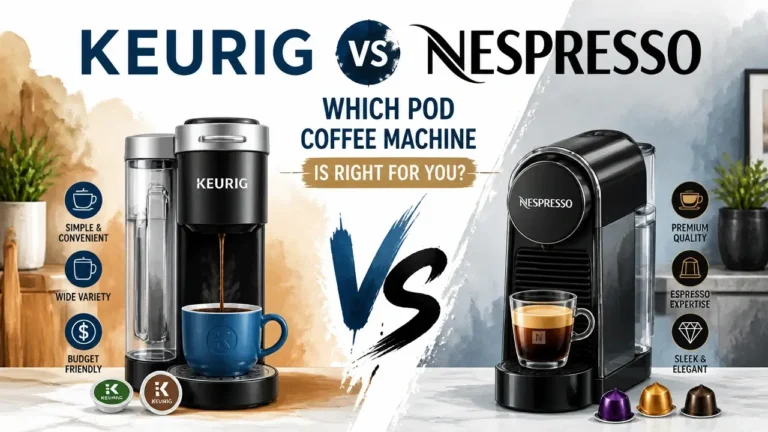

Pod coffee machines split cleanly into two philosophies: maximum variety or maximum quality. Keurig bets on convenience (thousands of K-Cup flavors, lower pod costs, and machines you’ll find everywhere). Nespresso bets on craft: 19 bars of pressure, real crema, and an espresso-like result that a drip brewer simply can’t fake.
Neither system is universally better. The right one depends entirely on who you are as a drinker: your budget, your daily cup, and how much that crema actually matters to you.
What really matters when choosing a pod coffee machine
The key decision criteria for pod coffee machines span nine distinct factors (pressure, cost per cup, pod variety, availability, machine price, durability, milk-frothing, cleaning, and environmental impact), and each one pulls your budget or daily routine in a different direction. That might sound like a lot to hold at once, but these aren’t arbitrary checkboxes. They’re the nine places where Keurig and Nespresso made fundamentally different engineering and business decisions. Understanding what each criterion actually measures, not just what it’s called, is how you figure out which system fits your life before you spend a dollar.
Here’s what each one means in practice, and why it matters to you:
- Brew pressure & crema: Nespresso extracts at roughly 19 bars of pressure. That force emulsifies oils from the coffee grounds into tiny suspended droplets, which rise to the surface as crema, the golden foam you see on an espresso. Keurig uses low-pressure drip extraction, closer to a standard drip machine. No crema forms, because the pressure isn’t high enough to emulsify those oils. If a café-like espresso experience is what you’re after, this is the single biggest mechanical difference between the two systems.
- Pod cost per cup: This is your long-term budget lever. Keurig K-Cups typically run $0.35–$0.80 per cup; Nespresso pods land at $0.70–$1.60. But that gap is narrowing: recent pricing data shows the real-world spread has tightened to roughly $0.45 (Keurig) vs. $0.85 (Nespresso) at the midpoint, and in some regions, K-Cup prices have climbed to $0.70–$0.80, which cuts Keurig’s cost advantage dramatically. If you’re brewing two cups a day, even a $0.30 difference adds up to over $200 a year.
- Pod variety: Keurig’s open licensing model means thousands of brands, from Starbucks to Dunkin’ or local roasters, produce K-Cups. Nespresso runs a tighter ship: most pods are proprietary, especially on the Vertuo line. Third-party Nespresso-compatible pods exist for the Original line, but the selection is narrower.
- Pod availability: K-Cups sit on shelves in virtually every grocery store, Target, Walmart, and warehouse club. Vertuo pods are sold primarily online or through Nespresso boutiques. If you run out at 7 a.m. on a Tuesday, that difference is very real.
- Machine price: Keurig entry models start around $55–$150. Nespresso entry models run $130–$200. The upfront gap matters most if you’re budget-constrained at purchase, but the per-cup cost difference can flip the math over 12–18 months of daily use.
- Durability & reliability: Both brands have reported failure rates, but Nespresso users specifically flag higher breakdown rates when using reusable or third-party pods (likely because the machine’s pressure system is calibrated tightly to proprietary pod geometry). Keurig’s lower-pressure mechanism is more forgiving of pod variation.
- Milk-frothing capability: Nespresso offers dedicated milk-frothing accessories; some machines have them built in, others pair with an Aeroccino frother. Keurig doesn’t include frothing in its core design: you’d need a separate standalone frother. If lattes and cappuccinos are your daily drink, Nespresso’s ecosystem is built for that. Keurig’s isn’t.
- Ease of cleaning: Nespresso auto-ejects used pods into a collection container after each brew. Keurig requires manual pod removal and more frequent descaling cycles. Neither is difficult, but the friction adds up if you’re brewing multiple times a day.
- Environmental impact: Nespresso’s aluminum pods are recyclable through a mail-in program. Aluminum is one of the most efficiently recyclable materials on the planet, and the closed-loop program exists specifically because loose aluminum pods contaminate curbside streams. K-Cups are primarily plastic, and most municipal recycling programs don’t accept them. Nespresso’s system requires the extra step of mailing pods back, but the actual recyclability rate is meaningfully higher.
Jeffree Yang, CEO of AFPAK, (a company that manufactures coffee capsules at scale) puts the broader market pull into plain terms:
“There are five factors driving the growth of the coffee capsule market: convenience, ease of use, affordability, product diversity, and an increasing focus on improving sustainability.”
Notice that all five of those factors map directly onto the criteria above. The market isn’t growing because capsule coffee is fashionable: it’s growing because each of those five pressures is real, and different machines answer them differently. Now the question is: how do Keurig and Nespresso actually perform against each one, head to head?
Evaluating machine longevity across brands requires looking beyond pod compatibility to examine how best coffee makers handle long-term thermal stability.
Here’s how Keurig and Nespresso actually stack up, criterion by criterion
A direct head-to-head comparison across pod coffee machines reveals that pressure, pod cost, pod variety, and environmental impact each tell a different story, and those stories don’t always point the same direction. The machine with the higher pressure doesn’t automatically win. The brand with the greener marketing doesn’t always deliver the greener reality at your kitchen counter. Let’s lay it all out flat so you can see exactly what you’re trading when you pick one over the other.
| Criterion | Keurig | Nespresso |
|---|---|---|
| Pressure & Crema | No true espresso; K-Cafe offers concentrated “shots”; limited/no crema on standard models | Original line: 19 bars of pressure with genuine crema; Vertuo line: 7,000 RPM centrifusion technology producing rich crema |
| Pod Cost Per Cup | Lower average cost per K-Cup | Higher per-cup cost across the board |
| Pod Variety | 75+ authorized brands available | Limited selection; sold exclusively by Nespresso and Starbucks |
| Pod Availability | Widely available at mainstream retail | More limited; brand and Starbucks exclusive |
| Machine Price | More affordable entry models | Slightly lower machine price at entry level |
| Durability | Cheaper models may burn out around year 3 with heavy use | Longer-term durability implied by quality reputation |
| Milk Frothing | Requires a separate frother sold apart from the machine | Often includes or pairs with the Aeroccino milk frother |
| Ease of Cleaning | Minimal effort required | Minimal effort required |
| Environmental Impact | Recyclable pods available with select brands; check local facilities | Free recycling program with bags provided on order; third-party reusable pod options exist |
Now let’s talk about what those numbers actually mean in practice, because a few of these rows deserve more than a one-liner.
Pressure and crema: the most misread row on that table
Nespresso’s 19 bars sounds like a clear technical win. And on paper, it is. But pressure alone doesn’t guarantee a better-tasting cup. Across Reddit and home-barista forums, a consistent thread of Nespresso users report bitterness and over-extraction (both classic symptoms of too much pressure applied to finely ground coffee). Meanwhile, some Keurig drinkers report a more satisfying caffeine kick, partly because Keurig brews at higher water temperatures, which pulls more caffeine into the cup even without espresso-level pressure. The expert claim that 19 bars equals superior espresso is a mechanical truth, whether it equals your preferred taste is a different question entirely.
Dissecting the mechanics of pressure extraction naturally bridges the gap when weighing an espresso maker vs coffee maker for your daily countertop routine.
Pod cost and variety: where Keurig’s real advantage lives
K-Cups run cheaper per cup and come from over 75 authorized brands. You can grab them at any grocery store, gas station, or big-box retailer. Nespresso pods are sold primarily through Nespresso’s own channels and authorized retailers. That exclusivity is a real friction point for beginners who expected the same grab-it-anywhere convenience they get with K-Cups.
There’s also a gap between Nespresso’s eco-friendly marketing and what users actually experience: the free recycling bag program sounds great in an ad. In practice, you have to remember to order the bag, fill it, and mail it back. For a lot of people, that extra step quietly disappears from the routine. Keurig’s recyclable pod options aren’t perfect either (local facility compatibility varies), but the variety of third-party sustainable K-Cup options is wider.
Brew strength: the hidden lever most beginners never touch
Here’s something neither brand puts on the box: machine pressure is not the only dial controlling how strong your cup tastes. If you find Keurig’s standard brew too thin, loading a reusable K-Cup with extra coffee grounds pulls significantly more flavor and caffeine into the same volume of water. On the Nespresso side, choosing a higher-dose Vertuo pod achieves a similar effect. In both cases, you’re exploiting dose, the amount of coffee the water has to push through, rather than pressure. That one adjustment changes the character of the cup more than most people expect, and it costs nothing extra.
Milk frothing: a cost that doesn’t show up in the machine price
Keurig’s machine price looks friendlier at entry level, but if you want lattes or cappuccinos, you’re buying a separate frother. Nespresso bundles the Aeroccino frother with several of its machines or sells it as a close companion product. By the time a Keurig buyer adds a decent frother, the price gap between the two systems often closes or flips.
The comparison makes one thing clear: neither machine dominates every row. What matters is which trade-offs you can actually live with, and that depends almost entirely on who you are as a drinker.
Achieving true microfoam often demands investing in a dedicated best latte machine rather than relying on peripheral frothing attachments.
Which pod coffee machine fits your life?
A sharp, persona-based verdict cuts through the noise by matching three distinct everyday-drinker types (the budget-focused dripper, the cafe-style enthusiast, and the eco-conscious minimalist) to the system that actually serves their priorities. The data from the head-to-head comparison doesn’t point to one universal winner. It points to three different ones, depending on what you value most.
Here’s how to find yourself in the mix.
The Budget-Focused Dripper: Keurig
Affiliate Disclosure
This post contains affiliate links, meaning I may earn a commission if you make a purchase through these links, at no additional cost to you. As an Amazon Associate, I earn from qualifying purchases. I only recommend products I genuinely believe will add value.

Keurig K-Supreme Single Serve K-Cup Pod Coffee Maker, MultiStream Technology, 4 Brew Sizes, 66oz Dual-Position Removable Reservoir, Black
- MULTISTREAM TECHNOLOGY: Extracts more flavor and aroma* in every brew. *vs Keurig leading K-Classic brewer wit…
- CUSTOMIZE YOUR CUP: Brew a stronger cup, or brew hot over ice for refreshing iced coffee.
- MULTIPLE BREW SIZES: Brew a 6, 8, 10, or 12 oz. cup.
- 66 oz. DUAL-POSITION RESERVOIR: Choose the perfect position for optimal counter space. Removable reservoir mak…
- FAST & FRESH-BREWED: Coffee made in minutes.
You want coffee that shows up, doesn’t cost a fortune, and comes in enough flavors to keep things interesting. Keurig was essentially built for you.
The upfront machine cost sits around $80, and K-Cups average about $0.45 each. Run that math over a year of one cup a day and you’re looking at roughly $245 in pods. Three-year total cost of ownership: around $325. That’s not a typo. For a daily coffee habit, that’s less than most people spend on streaming subscriptions.
The trade-off is quality ceiling. You’re getting convenient, consistent drip-style coffee, not espresso. But if that’s what you drink anyway, there’s no ceiling to bump into.
- Cost: 5/5
- Quality: 3/5
- Convenience: 5/5
- Sustainability: 2/5
The Cafe-Style Enthusiast: Nespresso
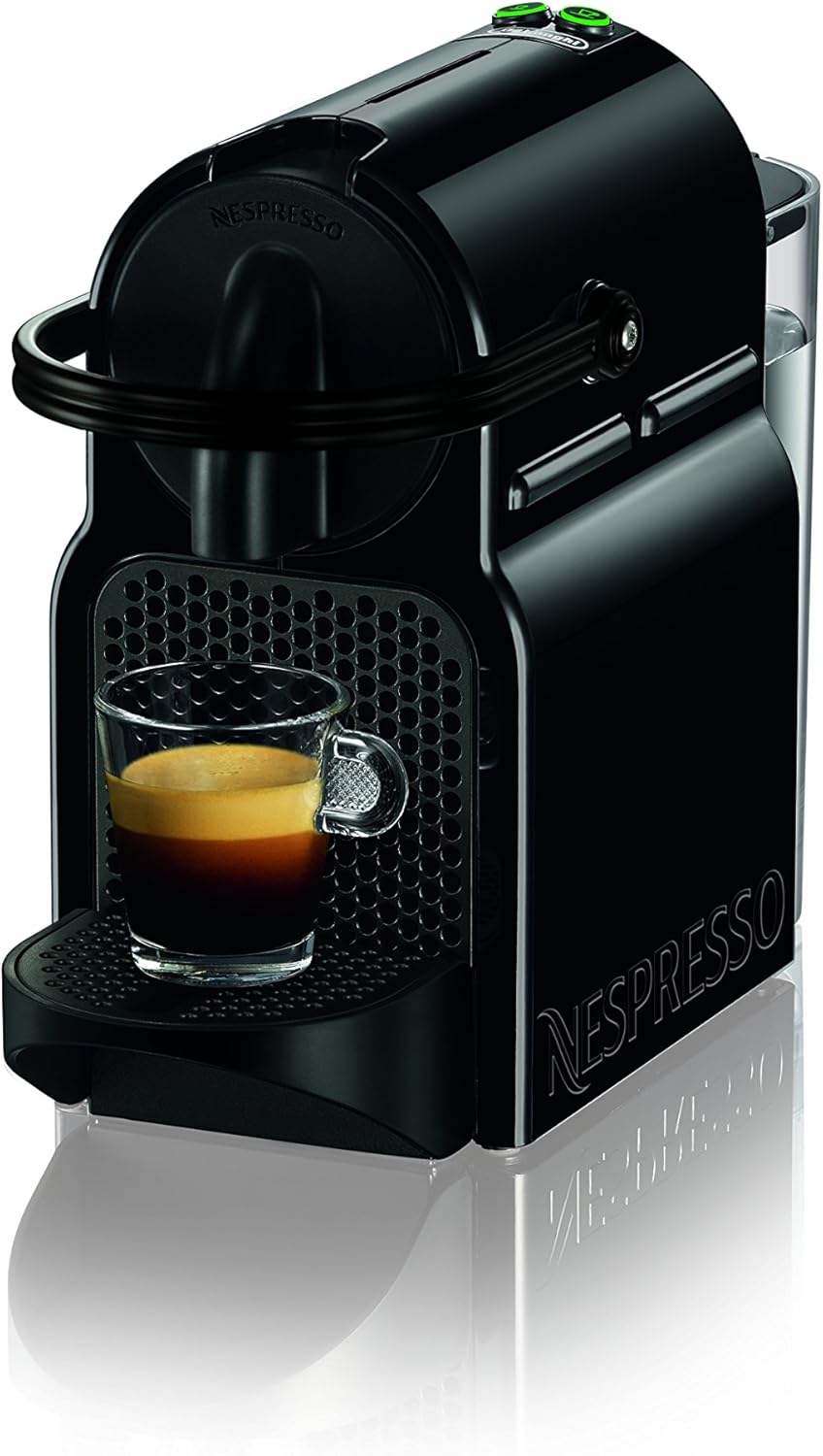
Nespresso Inissia Espresso Machine by De'Longhi,24 oz, Black
- Please refer to user guide or user manual or user guide (provided below in PDF) before first use
- Versatile and smart coffee machine: Adjustable cup size with two programmable espresso and Lungo buttons; A fo…
- VERSATILE AND SMART COFFEE MACHINE: Adjustable cup size with two programmable Espresso and Lungo buttons; A fo…
- The folding drip tray Accommodates larger cup sizes, and drops down automatically when you remove your mug to …
You want crema. You want a latte that looks like something a barista handed you. You’re willing to pay for it.
Nespresso’s Original Line machines start around $150, and capsules run about $1.20 each. One capsule a day for a year adds up to roughly $590 in pods. Three-year TCO: around $740, more than double the budget dripper’s number. But you’re buying a fundamentally different product. The 19-bar pressure system extracts oils and produces crema in a way that drip brewing physically cannot replicate.
Pair it with a milk frother and you have a home setup (that genuinely competes with café drinks). Aurimas Vainauskas, Founder of Bean puts it plainly:
“Many also find them convenient for their small size and easy transportation. It’s also a great choice for smaller families who enjoy only a few cups [between them] every day.”
That compact footprint matters more than people expect. Nespresso machines take up less counter space than most drip brewers, and the drink quality punches well above their size.
- Cost: 2/5
- Quality: 5/5
- Convenience: 4/5
- Sustainability: 3/5
The Eco-Conscious Minimalist: Nespresso
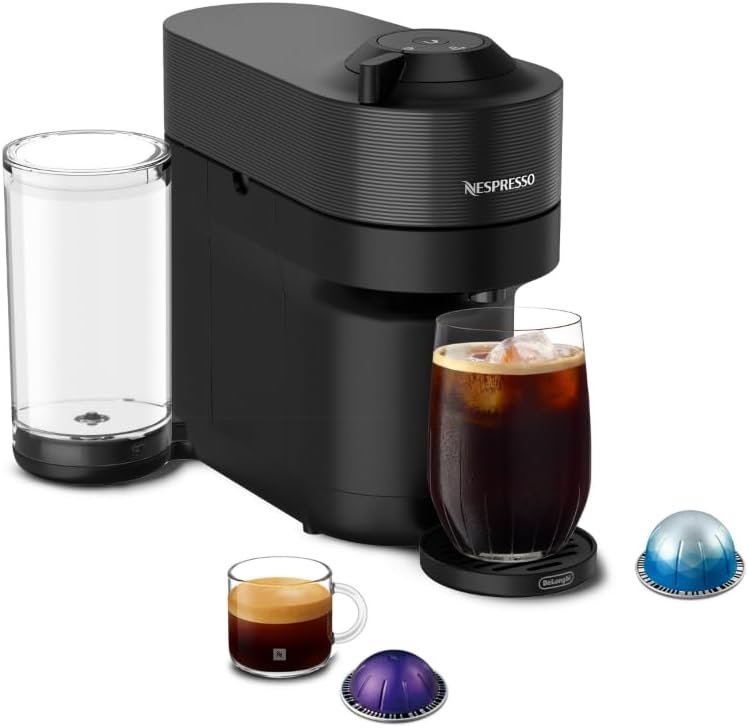
Nespresso Vertuo Pop+ Coffee and Espresso Machine by De'Longhi, Black
- SIGNATURE COFFEES AND ESPRESSOS: Vertuo Pop+ coffee maker offers a variety of coffee formats in 5 sizes, inclu…
- COMPACT: Compact design to fit small spaces, with removable 25 fl. oz water tank placed on the side for easy a…
- SIMPLE AND CONVENIENT: One-touch coffee system, 30 second heat up time with descaling alert and adjustable dri…
- PRECISION BREWING: unlocks a smooth full-bodied coffee topped with a velvety layer of coffee foam, for a perfe…
- PREMIUM COFFEE BLENDS: Nespresso offers an array of over 40 permanent specialty Vertuo coffees, from dark and …
You’re not trying to be cheap. You’re trying to be deliberate: about waste, about materials, about what ends up in a landfill. This is where Nespresso’s aluminum capsules make a real difference.
Aluminum is infinitely recyclable without quality loss. Nespresso runs its own take-back program specifically for used capsules, which addresses the biggest pain point of pod systems: single-use plastic waste. K-Cups have improved, but most are still plastic-dominant and harder to recycle at scale.
The cost is real: capsules average about $1.30 each, putting the three-year TCO at roughly $774. That’s the highest of the three personas. But for someone whose top criterion is environmental impact, the aluminum pod system offers something K-Cups can’t: a closed-loop recycling path that actually exists and is easy to use.
- Cost: 2/5
- Quality: 5/5
- Convenience: 4/5
- Sustainability: 5/5
Most buying guides stop at price-per-pod and call it a day, and the three-year numbers tell a different story: one where the “cheaper” system and the “premium” system are solving completely different problems for completely different people. Once you know which persona you are, the right machine picks itself.
Real Talk: What Most People Miss About Pod Coffee Machines
Q: Why do Nespresso users complain about bitterness if 19 bars of pressure is supposed to be better?
A: High pressure extracts faster and harder, pulling bitter compounds from finely ground coffee if you’re not careful. Keurig’s lower-pressure brew actually pulls more caffeine because it runs hotter water longer, giving you a stronger kick without the over-extraction bite. It’s a trade-off: pressure doesn’t automatically mean better taste, just different extraction mechanics.
Q: If K-Cups are cheaper per pod, why doesn’t Keurig dominate the sustainability conversation?
A: K-Cups are plastic-heavy and most municipal recycling facilities reject them outright. Nespresso’s aluminum pods are infinitely recyclable without quality loss, but here’s the catch: you have to mail them back through their program. Most people forget or skip it. The system exists, but behavioral friction kills adoption. Nespresso’s marketing claims win even when execution stumbles.
Q: What happens to your machine if you use third-party or reusable pods in a Nespresso?
A: Nespresso’s 19-bar system is calibrated tightly to proprietary pod geometry. Third-party pods have different thickness or density, causing pressure inconsistencies that stress the pump. Users report higher failure rates with reusables. Keurig’s lower-pressure mechanism is more forgiving because it doesn’t rely on precise pod geometry to function. Freedom versus reliability is the real trade-off.
Q: Can you actually get espresso-quality crema from a Keurig, or is that marketing myth?
A: Keurig’s K-Cafe line produces concentrated shots, but true crema requires 9+ bars of sustained pressure to emulsify coffee oils into suspended droplets. K-Cafe’s higher pressure gets close, but most standard Keurig models physically cannot generate enough force. You’re getting strong coffee, not espresso. It’s a real mechanical ceiling, not user error.
Q: Why does the three-year total cost of ownership flip the perceived price advantage?
A: Keurig’s $80 machine sounds cheaper until you factor in the separate frother ($40-60), occasional descaling solution ($5-10), and higher replacement rates after heavy use. Nespresso’s $150 entry point often includes the frother already. Over three years with daily use, Nespresso’s upfront cost spreads thin while Keurig’s “cheap” machine compounds with hidden expenses and lower durability. Math beats perception.
Q: What’s the real environmental difference between recycling a K-Cup locally and mailing back a Nespresso pod?
A: Most K-Cups end up in landfills because plastic pod recycling isn’t standardized across municipalities and most facilities actively reject them due to mixed materials. Nespresso pods are pure aluminum in a closed-loop program designed specifically for scale. Mailing feels inconvenient, but aluminum’s actual recycling rate is 75%+ compared to K-Cups’ <5% in practice. Friction matters less than final destination.
Q: Does pod choice actually matter more than machine pressure when it comes to taste?
A: Yes. Dose (amount of coffee grounds) and water temperature influence taste as much as pressure does. Load a reusable K-Cup with premium grounds or choose a higher-dose Vertuo pod and you’re manipulating flavor more than machine specs allow. Most beginners never experiment with dose because they assume the machine handles it. Pressure gets the credit; dose does the work.