

A dirty coffee maker doesn’t just taste bad: it brews slower, runs hotter, and quietly ruins every cup while you blame the beans. Mineral scale and coffee oils build up fast, and white vinegar or a commercial descaling tablet is usually all it takes to fix it.
This guide walks you through the full process: disassembly, the descaling cycle, rinsing, and reassembly (plus a salt-and-ice hack for stubborn buildup and a troubleshooting checklist if the first pass doesn’t clear the indicator light).
Once your machine is running smoothly again, you can also explore how different carafe types and thermal retention affect the flavor and temperature of your daily brew over time.
Before breaking down the steps, it helps to understand how internal buildup affects drip coffee maker brewing mechanics over time.
Basic safety precautions make cleaning your coffee maker risk-free
Solid safety precautions connect directly to three non-negotiable starting points: unplug the machine, clear out any used grounds or pods, and have your supplies within arm’s reach before a single drop of water or white vinegar goes anywhere near the machine. That sequence isn’t arbitrary, these safety precautions separate a routine cleaning job from a genuine hazard.
Here’s why the order matters. Your coffee maker heats water to near-boiling inside a sealed chamber. If you introduce a cleaning solution (especially something acidic like white vinegar) into a machine that’s still plugged in and warm, you’re pressurizing a cavity that wasn’t designed to hold pressure from a chemical reaction. The steam has nowhere safe to go. Unplugging first lets the heating element cool completely, so the solution moves through the machine as a liquid, not a volatile vapor.
Same logic applies to reassembling or wiping down a wet machine while it’s connected to power. Water and electricity share pathways they shouldn’t. A soft cloth gets the exterior and the removable parts dry before anything goes back together.
Once the machine is unplugged and emptied, pull together everything you’ll need:
- Descaling solution: white vinegar diluted 1:1 with water, a commercial descaling tablet dissolved per the package instructions, or (for a mechanical approach) coarse salt and ice (more on that in a later section)
- Cleaning tools: mild dish soap, a soft cloth, and a container large enough to catch a full carafe’s worth of waste water during the cycle
- Model check: glance at your machine’s control panel before you start. Many drip and pod machines have a dedicated “Clean” or “Descale” indicator light. If yours does, note whether it’s lit: that light is the machine telling you mineral buildup has already crossed a threshold it can detect. If it’s not lit, you’re doing preventive maintenance, which is the better place to be.
One last thing worth flagging: never try to speed up the process by boiling your descaling solution on the stove before adding it. Superheated liquid poured into cold plastic components causes warping and can crack the carafe or the water reservoir. The machine’s own heating element will bring the solution to the right temperature at the right rate: that’s exactly what it’s built to do.
Step 1: Disassemble Your Machine Properly
Proper disassembly of a drip or pod coffee maker separates three distinct removable parts: the carafe, the filter basket, and the water filter: each of which traps a different kind of buildup and needs to come out before any cleaning solution touches the machine. The carafe holds oily residue from brewed coffee. The filter basket collects grounds and oils at the source. The water filter (if your model has one) sits inside the reservoir and will absorb whatever you pour in, so it has to come out first, or it’ll soak up descaling acid instead of doing its actual job.
Start at the reservoir. If there’s a removable water filter cartridge clipped inside (usually a small charcoal cylinder) pull it out and set it aside. These aren’t dishwasher-safe, and descaling solution will ruin them. Next, lift out the filter basket. Give it a light shake over the trash to drop any loose grounds, then set it on a clean, dry surface. Finally, slide the carafe off the warming plate.
Once all three parts are on your counter, flip each one over and look for a dishwasher-safe symbol: it looks like a small rack with water droplets above it. If you see it, that part can go straight into the top rack later. If you don’t see it, plan on hand-washing.
Now that the machine is safely unplugged and the removable parts are laid out, you can introduce the cleaning solution directly into the water chamber.
Step 2: Add Your Cleaning Solution to the Reservoir
Right cleaning solutions for your coffee maker fall into three distinct categories: distilled white vinegar, commercial descaling tablets, and a mechanical salt-and-ice method, each working through a different mechanism to break down what’s built up inside your machine. Vinegar and commercial tablets both attack scale chemically, but they do it differently. The salt-and-ice approach skips chemistry entirely and goes physical (which matters a lot when you’re deciding what’s safe for your specific machine).
Here’s the practical reality before you pick one: scale is calcium carbonate. It’s a mineral deposit that forms when hard water heats up and the dissolved minerals crystallize onto your heating element and internal tubing. Acid dissolves it. That’s why vinegar works: acetic acid reacts with the calcium carbonate and breaks the deposit apart. Commercial tablets work the same way, just with acids that are specifically formulated to be gentler on rubber seals and internal components than vinegar tends to be.
Once you’ve picked your solution, the add step is simple: pour it into the water reservoir until it reaches the MAX fill line. Don’t go over: the machine meters water through a float valve, and overfilling can cause it to skip parts of the cycle.
The table below lays out all three options side by side so you can make the call quickly.
| Solution Type | Proportion | How to Prepare | Key Advantages / Drawbacks |
|---|---|---|---|
| White Vinegar (Distilled) | 1:1 or 1:3 ratio | Mix equal parts white vinegar and filtered water in a pitcher. |
|
| Commercial Descalers (Affresh®, Urnex®) | Per package dose | Dissolve tablet in warm water or pour liquid dose directly as instructed. |
|
| Citric Acid Powder (Food Grade) | 2 Tbsp per 1L water | Stir powder into warm water until completely dissolved and clear. |
|
⚠️ Important Note: Never put salt or ice inside your coffee maker’s water reservoir. Salt is highly corrosive to the heating element, and ice can damage the internal pump. Use the Salt + Ice hack only for scrubbing the glass carafe (see Step 8).
One honest note on the salt-and-ice method: it’s better suited for cleaning the carafe’s interior walls than for running through the machine’s internal pathways. Save it for that job, and let an acid-based solution handle the actual scale inside the heating element and tubing.
With the solution in place, the next step is to let the machine’s internal pathways soak and break down the scale before you run the full cycle.
Step 3: Run the Descaling Cycle
The active descaling cycle pushes your cleaning solution through the heating element and water lines: and whether you press a dedicated Clean button or trigger Descale Mode manually determines how well the solution actually works. Most machines have one or the other. Keurigs, for example, don’t have a single “Clean” button: you hold the 8 oz and 12 oz buttons simultaneously for three seconds until the descale light stops blinking. Standard drip machines usually have a clearly labeled Clean button on the control panel. Either way, the goal is the same: get the solution moving through the parts of the machine you can’t reach by hand.
Here’s where most people shortcut the process and wonder why it didn’t work.
If you’re using white vinegar, don’t start the brew cycle immediately after filling the tank. Let the solution sit in the reservoir for 15 to 30 minutes first. Vinegar works through prolonged acid contact: the longer the mineral deposits are exposed, the more the acetic acid can break the calcium carbonate bonds holding scale to your heating element. Running the machine right away cuts that contact time short and turns a descaling session into a glorified rinse.
Commercial descaling tablets and liquid descalers are a different story. Those are formulated to work during the brew cycle itself, so you run the machine immediately: no soak needed.
Affiliate Disclosure
This post contains affiliate links, meaning I may earn a commission if you make a purchase through these links, at no additional cost to you. As an Amazon Associate, I earn from qualifying purchases. I only recommend products I genuinely believe will add value.
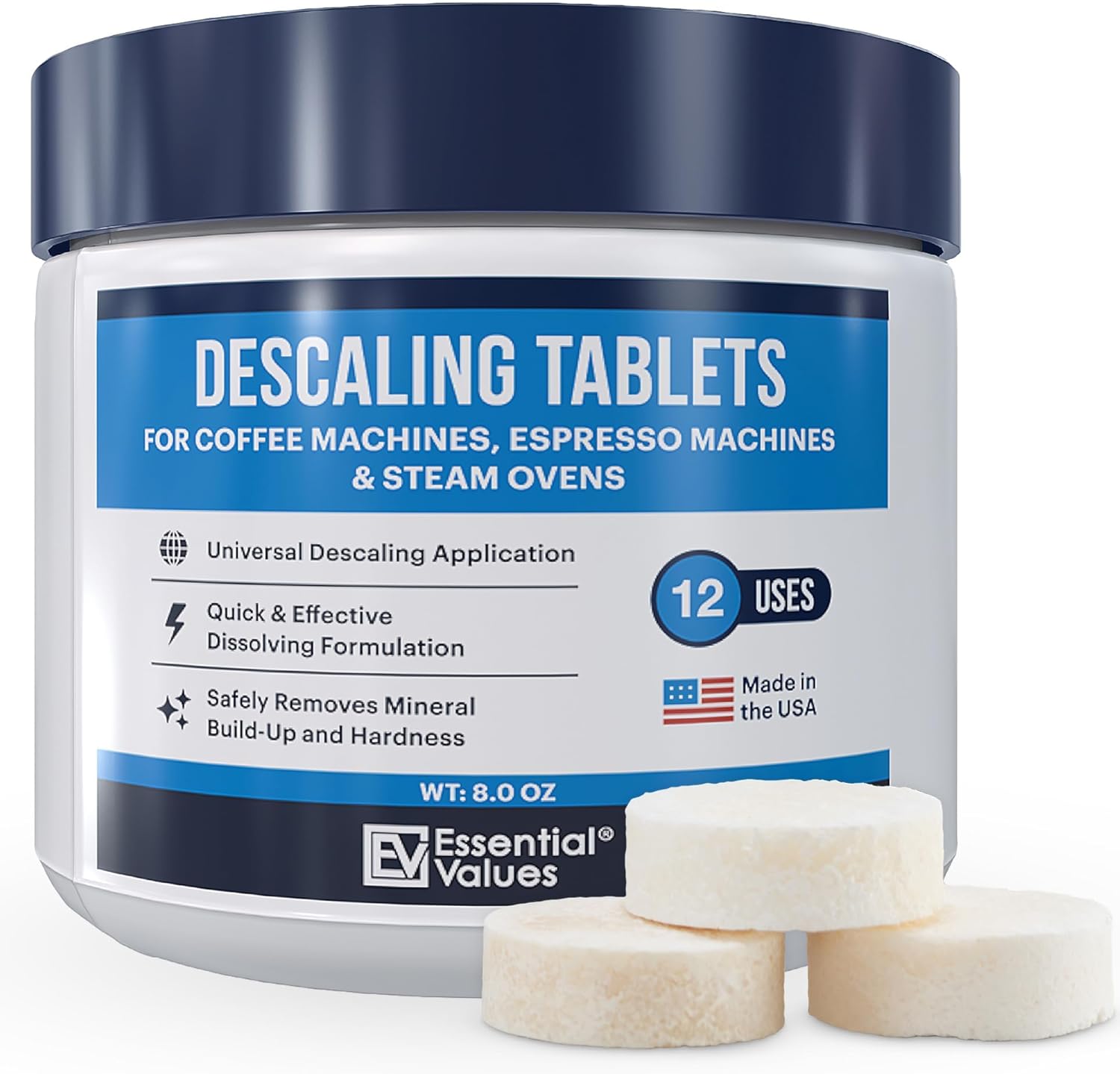
Essential Values Descaling Tablets, Descaler for Keurig Coffee Machines, Coffee Maker Cleaner for Breville, Delonghi, Jura, Miele, Bosch, Tassimo Espresso Machines and Miele Steam Ovens (Pack of 12)
- Effective Maintenance: Regular use of keurig descaling-solution ensures your coffee machine operates at peak p…
- Comprehensive Cleaning: The nespresso descaling kit is designed to remove mineral buildup efficiently; ensures…
- Versatile Application: The breville descaling solution works seamlessly with various coffee makers; provides a…
- Specialized Formula: The nespresso descaling solution targets tough limescale deposits; guarantees a hassle-fr…
- Multi-Brand Compatibility: The delonghi descaling solution and breville descaler are suitable for a range of m…
Once the soak is done (or skipped, if you’re using tablets), start the cycle. The machine will pull the solution from the reservoir, heat it, and push it through the water lines and out through the brew head. That path is exactly where scale accumulates, so you want the solution to travel the full route, not just sit in the tank.
Coffee equipment expert Edwin, interviewed by Perfect Daily Grind, puts it plainly:
“For a batch brewer, he says to fill the tank with the solution and let the cycle run through two or three times. Then repeat the process with fresh water a few more times.”
That’s the part most instructions leave out. One pass through the machine rarely clears heavy buildup: running the solution two or three times gives the acid repeated contact with stubborn deposits that one cycle can’t fully dissolve. If your machine has been neglected for a while, treat the first cycle as a loosening pass, not a finishing one.
If you’re a visual learner or your Keurig’s button sequence isn’t clicking (no pun intended), this walkthrough covers every model:
After the cycle finishes, lingering acid or mineral particles may remain inside the water lines, so a thorough rinse is the next essential step before you brew anything you’d actually want to drink.
Step 4: Rinse the Fresh Water Through Completely
Thorough rinsing with fresh, cool water, run across 2–3 full brew cycles, is what separates a clean machine from one that brews coffee with a faint vinegar aftertaste. The descaling solution has done its job by now, but it doesn’t just disappear on its own. It’s sitting in the reservoir, the lines, the heating element, and the spray head, waiting to end up in your next cup.
Here’s the thing about vinegar or citric acid: both are food-safe, but neither belongs in your morning coffee. Even a small residue changes the flavor profile enough that you’ll notice it (and not in a good way).
The fix is straightforward. Fill the reservoir all the way to its maximum line with fresh, cool water: no solution, no additives. Run a complete brew cycle just as you would if you were making a full pot. Let it run all the way through, then dump what comes out.
Repeat that process two more times. Three full cycles is the standard. By the third pass, the water running through should look clear and smell neutral. If you’re still catching a sharp vinegar smell after three cycles, run one more. The smell is the signal: trust it over the cycle count.
The extra cycles aren’t overkill. Vinegar smell lingers in the heating element longer than it lingers in the water lines, so the first rinse clears the easy stuff and the second and third cycles flush out what’s trapped in the warmer sections of the system.
With the interior flushed clean, the removable components, the carafe, basket, and filter, are the last pieces that need attention before the machine is fully restored.
Step 5: Hand-Wash the Carafe, Basket, and Filter
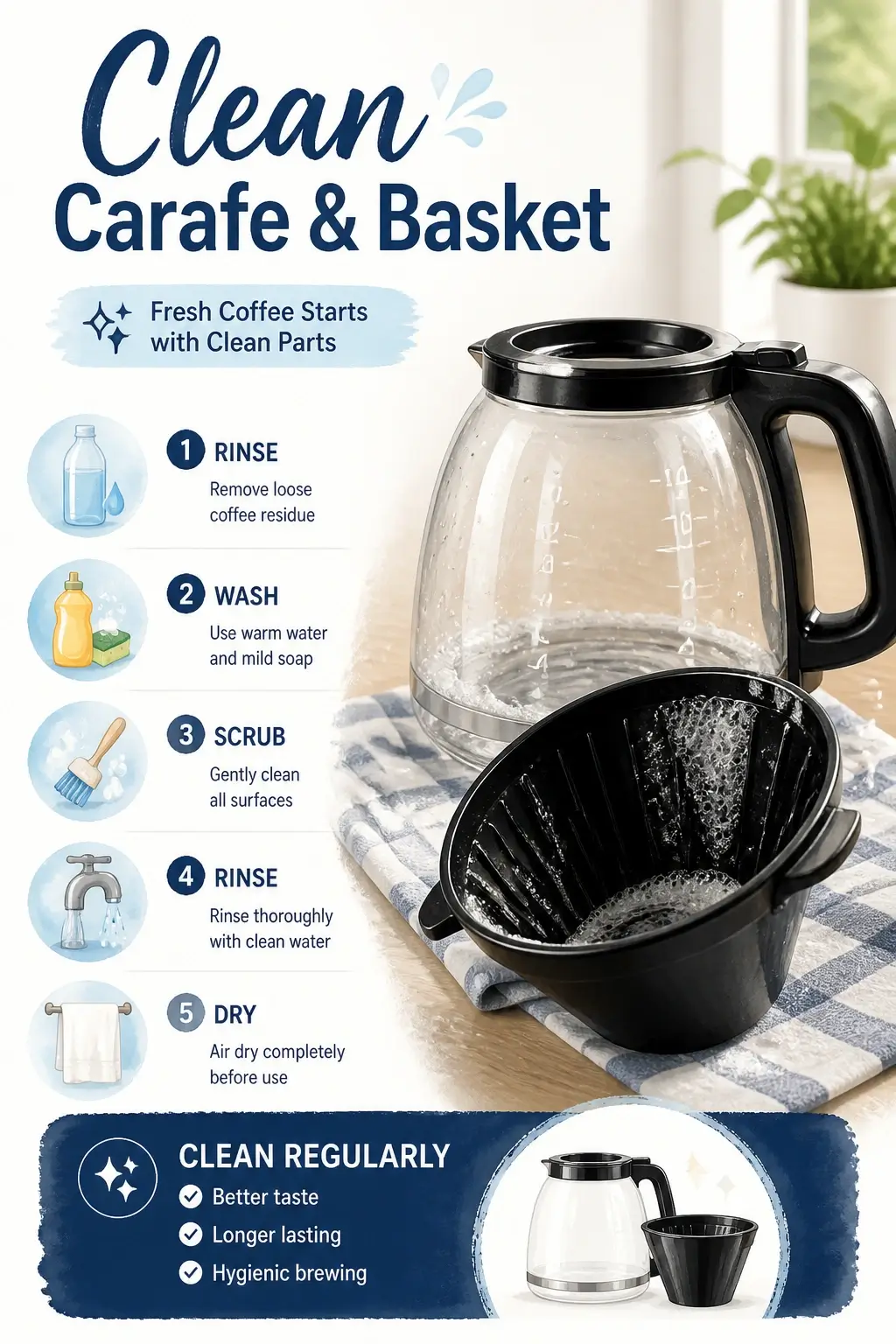
Thorough hand-washing with warm, soapy water is the safest way to clean your carafe, basket, and paper or reusable filter, because it gives you direct control over pressure and scrubbing angle that a machine cycle can’t replicate. Coffee oils are sneaky. They don’t rinse off with water alone; they need the surfactant in dish soap to break the bond they’ve formed with the glass or plastic. A non-abrasive sponge lets you work that soap into every corner without scratching surfaces that would then trap even more residue going forward.
Here’s the workflow that keeps everything intact:
Give the carafe, basket, and filter a full soak in warm, soapy water for a minute or two before you scrub. That softens dried coffee oils and makes the actual scrubbing much lighter work. Then go over every surface with a non-abrasive sponge: pay extra attention to the bottom of the carafe where oils concentrate, and the mesh or rim of the basket where grounds like to pack in tight.
If your parts are labeled dishwasher-safe, the top rack is fine. The top rack runs cooler and keeps water pressure gentler, which matters for plastic components that can warp under the heat and force of a bottom-rack cycle. When in doubt, check the manufacturer label on the part itself: not just the manual, because some parts get updated between model runs.
After washing, rinse each piece under running water until the water runs completely clear and you can’t detect any soapy smell. Then either dry with a clean cloth or set them out lid-open to air-dry fully before reassembly. Putting wet parts back into the machine traps moisture, which is exactly the environment mold needs to get started.
Here’s a quick visual of the full workflow: disassembly through drying: so you can see how all the steps connect before putting everything back together:
Now that everything is clean and dry, you’re ready to put the machine back together and confirm the cleaning actually worked.
Once you have mastered manual dish care for your automatic brewer, exploring immersion brewing techniques is made effortless with The Ultimate Guide to 12 Cup French Press Brewing.
Step 6: Reassemble and verify with a water-only brew cycle
Solid verification starts the moment you seat the last part back into place: a single water-only brew cycle is your proof that the clean and descale coffee maker process actually worked, and it tells you everything you need to know before the next real cup.
Here’s why that test cycle matters. Any residual descaling acid or cleaning solution still clinging to the internal tubing gets flushed out in that one pass. You’re not just confirming the machine runs, you’re confirming what comes out of it is clean.
Putting it back together correctly, is the part people rush, and it’s where small mistakes happen. Work in this order:
- Seat the water filter firmly in its housing if your machine has one. A loose filter lets unfiltered water bypass it entirely.
- Drop the basket into its track and make sure it clicks or sits flush: a tilted basket causes overflow during the brew cycle.
- Set the carafe on the warming plate with the handle aligned to the front. Some machines won’t start if the carafe isn’t triggering the sensor underneath.
Once everything is seated, plug the machine back in. Fill the reservoir with fresh, cold water only: no solution, no vinegar, nothing added. Run a full brew cycle.
Watch for four things when it finishes:
- Indicator light: The descale or clean light should be off. If it’s still on, the machine’s internal sensor didn’t register a complete cycle, and you’ll need to run the process again.
- Water clarity: The water in the carafe should be completely clear. Any cloudiness or film means residue is still moving through the lines.
- Brew time: It should match your machine’s normal pace. Noticeably faster or slower can signal a partial blockage or an air pocket still working itself out.
- Smell and taste: Take a quick sniff of the carafe water. No vinegar, no chemical bite, no off-odor. If anything lingers, run a second water-only cycle before brewing coffee.
Most machines pass all four checks on the first try after a proper descale. If yours doesn’t, that’s not a failure: it’s the verification step doing exactly what it’s supposed to do, catching the problem before it ends up in your cup.
Beyond this basic routine, a weekly habit can keep flavor consistency even sharper.
A simple weekly deep-clean keeps your coffee tasting fresh
Stubborn coffee-oil residue builds up inside your carafe and basket within days, and a weekly deep-clean using Dawn dish soap and a non-abrasive sponge is the fastest way to stop that buildup from quietly ruining your cup.
Here’s what’s actually happening. Coffee oils are hydrophobic: they don’t rinse away with plain water. Every brew leaves a thin film behind, and that film oxidizes over the next 48 to 72 hours. By the time you’re four or five brews in, you’re not just tasting today’s coffee. You’re tasting a week’s worth of rancid oil layered on the glass and plastic. It’s the same reason a coffee mug left unwashed starts smelling stale even before you pour anything into it.
The fix is simple and takes about ten minutes. Once a week, fill the carafe with warm water and add a few drops of Dawn dish soap (not a full squeeze, just enough to cut the oil). Let it soak for five minutes, then scrub the interior with a non-abrasive sponge using circular strokes. Rinse thoroughly until the water runs completely clear and you can’t detect any soap smell.
The basket needs the same attention, but its geometry makes it trickier: coffee grounds pack into the corners and the small perforations, and a flat sponge can’t reach them. Use a soft brush (an old toothbrush works perfectly) to work into every corner and along the rim where the basket seats into the machine. Rinse under running water until no residue comes through.
That’s the whole routine. Ten minutes, once a week, and the oils never get a chance to oxidize and stack up.
The Salt-and-Ice Hack for Sparkling Glass
The simple salt-plus-ice hack is the best way to remove burnt-on coffee oils from your glass carafe without any chemical smell.
Here’s how to run it:
- Pour 1 cup of crushed ice and 1 tsp of coarse salt into the empty carafe.
- Gently swirl the carafe for 30 seconds. The salt acts as a non-scratch abrasive, while the ice provides the weight to scrub the walls.
- Rinse thoroughly with warm water.
Warning: Do not use this method inside the water reservoir. Salt is highly corrosive to the metal heating elements and can ruin your machine’s internal pump.
Still seeing scale or smells? Here’s how to fix it.
Persistent descaling failure almost always traces back to one of four signals: the indicator light stays on after a full cycle, a vinegar or acid smell lingers in the brew, the machine still gurgles unevenly, or the brew time is noticeably slower than it used to be. Each of those is the machine telling you the same thing: mineral buildup is still partially blocking the system, or the cleaning solution didn’t fully flush out.
Let’s work through each one.
Indicator light won’t turn off. Most machines reset their descale light based on cycle count, not on water quality. If the light stays on, run the full descaling cycle a second time. One pass through heavily scaled plumbing often isn’t enough to dissolve everything in one shot.
Vinegar smell that won’t quit. This one’s almost always a rinse problem, not a descaling problem. Run two extra plain-water cycles after you think you’re done. If the smell still hangs around, the fix is to switch solutions entirely. A citric-acid solution (about 1 to 2 tablespoons per liter of water) removes scale just as effectively as vinegar but leaves behind a neutral scent. No lingering odor to chase out.
Continued gurgling or slow brew time. This usually means partial scale blockage is still present in the heating element or the internal tubing. Run another full descaling cycle, and this time let the solution soak for 20 to 30 minutes mid-cycle before completing the brew. The soak time gives the acid more contact time with stubborn deposits.
One thing worth knowing if you have hard tap water: switching to distilled water for your rinse cycles makes a real difference. Tap water re-deposits minerals with every rinse, which means you’re partially re-scaling the machine while trying to clean it. Distilled water contains nothing to leave behind, so the rinse actually rinses.
On the question of which solution to use: Keurig’s official position is that only their branded descaling solution works in their machines. Community testing tells a different story. White vinegar, citric-acid powder, and denture-cleaner tablets all achieve the same scale removal. The real variable is odor tolerance and budget, not effectiveness. Citric acid wins on both if vinegar smell is a problem for you.
Your four-point success check before you call it done:
- Indicator light: off, with no prompt to descale on the next brew.
- Water flow: running clear, at normal temperature, at normal speed.
- First brew: no off-flavor, no chemical smell, no sourness.
- Removable parts: carafe and basket feel clean and smell neutral to the touch.
If all four pass, the machine is clean. If any one of them flags, run another rinse cycle and recheck. The process is the same every time: what changes is how many passes your specific water hardness and buildup level require.
Real Talk: What Most People Miss About Coffee Maker Cleaning
Q: Why does running the descaling cycle just once rarely actually work?
A: Most machines need two to three passes through heavily scaled plumbing because one cycle isn’t enough contact time to dissolve stubborn mineral buildup. Scale is calcium carbonate, and acid dissolves it gradually. Running the solution through multiple times gives the acid repeated exposure to deposits that a single pass can’t fully break apart, which is why you still see a descale light on after what feels like a complete clean.
Q: What’s the actual difference between vinegar, commercial tablets, and the salt-and-ice hack if they all remove scale?
A: They attack scale through different mechanisms. Vinegar uses acetic acid that works best with a 15 to 30 minute soak, but leaves lingering odor. Commercial tablets are formulated to work during the brew cycle itself without soaking, and they’re gentler on rubber seals. Salt and ice create rapid thermal shock to loosen deposits mechanically, not chemically. Pick based on odor tolerance and whether you have hard-water tolerance—not effectiveness, since all three actually work.
Q: Why does distilled water for rinsing matter more than most guides mention?
A: Tap water contains dissolved minerals that re-deposit onto your heating element with every rinse cycle, which means you’re partially re-scaling the machine while trying to clean it. Distilled water contains nothing to leave behind, so a rinse actually rinses instead of just swapping one mineral layer for another. This matters significantly if you live in a hard-water area.
Q: What does it actually mean when the descale light won’t turn off after a full cycle?
A: Most machines reset their descale light based on cycle count, not water quality or actual scale removal. If the light stays on, the machine’s internal sensor didn’t register a complete cycle, which almost always means mineral buildup is still partially blocking the system and you need to run the full descaling process again before that light will respond.
Q: Why does vinegar smell linger longer in the heating element than in the water lines?
A: The heating element sits in a warmer zone where vinegar vapors get trapped and slowly release during each brew. Water lines are cooler and flush more easily. This is why three fresh-water rinse cycles are standard but the smell test—not the cycle count—is your real signal. If vinegar lingers after three cycles, that thermal zone needs extra flushing time.
Q: Can you actually use denture-cleaner tablets or citric acid as drop-in replacements for name-brand descaling solutions?
A: Community testing shows white vinegar, citric-acid powder, and denture-cleaner tablets all achieve identical scale removal to premium branded solutions. Keurig officially claims only their tablets work, but real-world results prove otherwise. The real variable is odor tolerance and budget, not effectiveness. Citric acid wins on both fronts if vinegar smell bothers you, because it descales just as well but leaves a neutral scent.
Q: Why does putting a wet machine back together trap mold instead of just drying eventually?
A: Moisture trapped inside the heating element and internal tubing creates exactly the warm, damp environment mold needs to colonize. Once it takes hold in those hidden spaces, it’s nearly impossible to reach with cleaning tools and will contaminate every brew until you disassemble and manually dry those areas again. Always air-dry removable parts completely before reassembly.