
Rigorous coffee grading and scoring form the backbone of every specialty transaction-from the Ethiopian washing station to the European roastery dock. The SCA framework, reinforced by CQI certification, gives importers, roasters, and quality managers a shared professional language that cuts through the noise of origin-specific labeling and marketing claims.
What makes the system powerful isn’t any single number. It’s the sequence: physical criteria must pass before a sensory score even matters. Miss that order, and the 80-point threshold becomes a number without a foundation.
To fully understand how these sequential checks protect green coffee value, it helps to examine the foundational framework detailed in specialty coffee grading standards.
Key Takeaways on Coffee Grading and Scoring
- Coffee grading inspects the physical green bean; coffee scoring evaluates the roasted cup-they are sequential, not interchangeable.
- The SCA/CQI specialty threshold requires both a physical pass (zero primary defects, max five secondary per 300g) and a cupping score at or above 80 points.
- Commercial grade is a range, not a single quality point-origin labels like Kenya AA describe physical size, not sensory score.
- Only a certified Q Grader can issue an official SCA/CQI score; non-calibrated evaluations do not satisfy specialty contract requirements.
- The SCA Cupping Form scores 10 sensory categories plus defect deductions, and calibration is what makes those scores comparable across evaluators.
- A defensible specialty buy requires three aligned proof points: a passed physical grade, an official 80+ score, and contract terms that match pre-shipment samples to arrival lots.
Coffee Grading vs Coffee Scoring: Two Separate Quality Controls
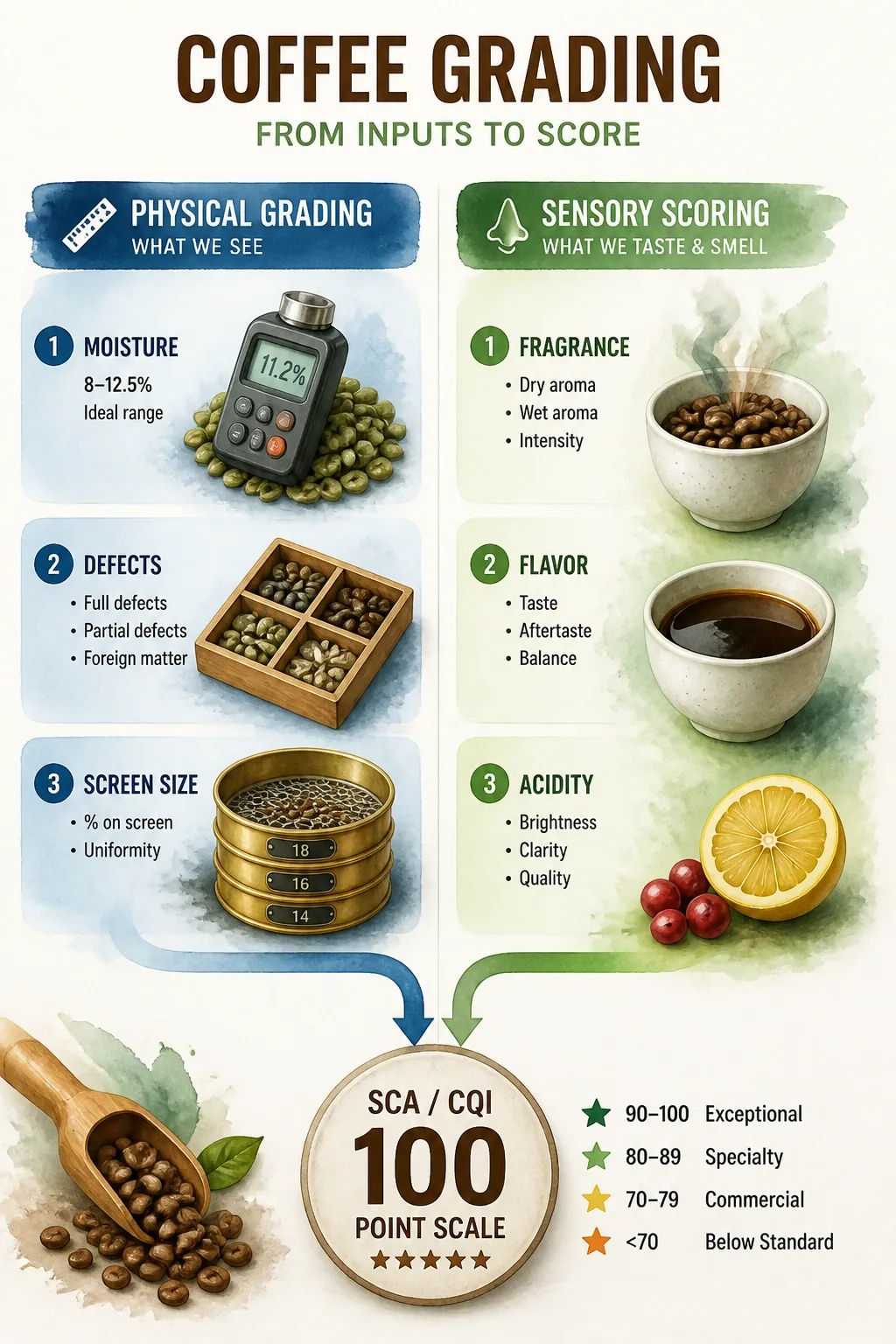
Coffee grading and coffee scoring measure different things at different moments in the supply chain-and conflating them is one of the most common mistakes in green procurement. Grading is a physical inspection conducted on unroasted green beans; scoring is a sensory evaluation conducted on the roasted cup. They are sequential, not interchangeable.
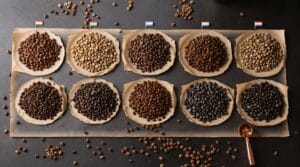
Grading examines what you can see and measure before roasting: primary and secondary defects, moisture content, screen size, and bean density. A defect count tells you whether a lot is structurally clean enough to cup. Moisture content-typically evaluated alongside density-signals stability and storage risk. Screen size indicates consistency of bean development. None of these measurements tell you how the coffee tastes. They tell you whether it’s worth finding out.
Before trying to uncover the truth about espresso beans, grading examines what you can see and measure before roasting: primary and secondary defects, moisture content, screen size, and bean density.
Understanding these visual flaws requires looking beyond simple bean counts to examine the flavor impact of coffee defects once the batch is roasted and cupped.
Coffee scoring, by contrast, happens after roasting. It places the cup on the SCA/CQI 100-point scale through a structured sensory evaluation called cupping. The evaluator scores attributes like fragrance, flavor, acidity, body, and aftertaste-categories that no visual inspection can capture. A cupping score is a sensory judgment, not a physical measurement.
There is no single universal coffee grading system. Origin-specific standards-Ethiopia’s ECX grades, Kenya’s auction system, Brazil’s COB classification-each define quality parameters differently, which means a “Grade 1” from one origin is not directly comparable to a “Grade 1” from another. The SCA framework provides the common professional cross-market language that allows buyers to compare lots across origins on consistent terms.
It’s worth noting that the SCA has introduced the Coffee Value Assessment (CVA), a more granular framework that separates physical, descriptive, affective, and extrinsic assessments. The CVA reflects a growing recognition that quality is multidimensional. However, the SCA/CQI cupping score remains the standard numeric baseline for the vast majority of specialty contracts in active use today.
The practical takeaway is structural: grading and scoring are not two ways of doing the same thing. They are two gates in the same sequence. A lot must pass the physical gate before the sensory gate opens.
The SCA/CQI Specialty Threshold: What “80 Points” Actually Requires
Specialty coffee begins at a cupping score of 80 points or above on the SCA/CQI scale-that is the baseline, not a target to aspire toward. But the score alone does not qualify a lot. The physical criteria must clear first.
Under SCA standards, a specialty-grade green sample must contain zero primary defects and no more than five secondary defects per 300-gram green sample. Primary defects-full blacks, full sours, pods, large stones-are disqualifying on their own. Secondary defects are tolerated in limited numbers. Any lot that fails the physical screen is not eligible for specialty classification, regardless of how well it cups.
Real-world procurement often goes beyond the SCA minimum. Many green buyers inspect a control sample of 350 grams rather than the standard 300 grams, giving a slightly larger data set for defect detection. Moisture content is another critical checkpoint: green beans that settle between 10% and 12% offer the stability needed for transit and storage without risking premature aging or mold. Lots outside that range carry risk that no cupping score can offset.
Understanding the full weight of each sensory attribute behind that 80-point threshold is essential before entering a cupping session. The SCA cupping form scoring attributes cover exactly how each category contributes to the final number-and why a score of 79.5 is not a rounding error but a disqualification.
Specialty classification is a quality tier, not an origin label. A coffee from Colombia, Ethiopia, or Guatemala is not specialty because of where it comes from. It is specialty because it met both the physical and sensory criteria. Origin can influence the probability of meeting those criteria-terroir, altitude, and processing discipline all matter-but origin alone guarantees nothing.
Specialty Grade vs Commercial Grade: The Line Below 80
Specialty grade and commercial grade are not points on the same continuum that buyers can slide between based on budget. They represent fundamentally different quality commitments, with different physical tolerances and different sensory expectations built into the contract.
Specialty grade demands a cupping score at or above 80 points alongside clean physical criteria-zero primary defects and a tight secondary defect ceiling. The cup must be free of taints and faults. Commercial grade carries no such floor. Scores fall below 80, defect tolerances are wider, and the sensory profile is evaluated against a different standard-or not formally evaluated at all. For a deeper grounding in what these distinctions mean in practice, the coffee grading and scoring meaning framework explains how the SCA system structures these tiers from the ground up.
Commercial grade is a range, not a monolith. Within commercial classification, there are still meaningful quality differences. Exchange-grade coffees meet minimum requirements for commodity trading. Off-grade coffees may carry significant defect loads or moisture problems that affect roasting consistency. Buyers operating in the commercial segment still need to specify which tier of commercial they’re purchasing-“commercial grade” is not a single quality point any more than “specialty” is.
The distinction that trips up most buyers involves origin-specific labels. Kenya AA/AB designations refer to screen size-they describe bean size, not flavor quality. Brazil COB (Cereja Descascada/Despolpada) describes a processing method and physical standard, not a cupping score. These labels carry real market value and genuine quality signals within their own systems, but they do not substitute for the SCA threshold. A Kenya AA can cup below 80; a Brazil Natural can cup above it. Understanding specialty coffee grade vs commercial grade distinctions requires separating origin nomenclature from universal quality classification.
A peer-reviewed study in the Journal of Agricultural and Applied Economics, examining Cup of Excellence data, found that the physical sensory attributes most strongly associated with elevated specialty scores-fruity, floral, sweet, spice, and clean acidity-are categorically distinct from the bitterness and defect-driven profiles that characterize lower-tier commercial lots. Importantly, the same study demonstrated that origin-specific symbolic attributes-country of origin, altitude, certifications-exert an independent influence on perceived quality and price, explaining a meaningful portion of the grading variation across geographies beyond intrinsic sensory performance alone.
That finding has a direct implication for buyers: origin prestige and sensory quality are correlated but not equivalent. A lot from a prestigious origin with a strong market reputation can still fail the specialty threshold. The score and the physical grade are the proof-not the label.
The Q Grader: The Licensed Professional Behind the Official Score
An official SCA/CQI cupping score is not simply a number produced by anyone who has attended a cupping workshop. It is a certified output issued by a Q Grader-a licensed professional who has completed one of the most rigorous sensory credentialing programs in the food industry.
Q Graders undergo intensive sensory calibration and defect-identification training administered by the Coffee Quality Institute (CQI). The training covers triangulation exercises, organic acid identification, olfactory discrimination, and blind cupping calibration-the full battery of skills needed to apply the SCA framework consistently across lots, origins, and roast profiles. That calibration is not a formality. It is the mechanism that makes a score from one Q Grader meaningful in the same context as a score from another, thousands of miles away.
[Photo]: https://coffeefactz.com/wp-content/uploads/2026/08/q-grader-calibrated-cupping-session.webp, 53000
Scores produced by non-calibrated individuals-however experienced or palate-trained-are not official SCA/CQI scores. They may be useful internal reference points, and skilled buyers develop genuine sensory acuity over time. But when a contract specifies an 80+ specialty score, the number must come from a Q Grader. Any other source does not satisfy that contractual requirement.
For buyers and quality managers building or auditing sourcing programs, understanding the full scope of the Q Grader certification requirements clarifies exactly what that credential represents-and why score credibility depends on it.
The SCA Cupping Workflow: What Happens Before the Number
The SCA cupping workflow is not a casual tasting exercise. It is a controlled sensory protocol with specified parameters at every step-because any deviation from those parameters changes what the evaluator is actually measuring.
The process begins with sample preparation. Grind size is set to a coarse-medium specification immediately before brewing to preserve volatile aromatics. The brew ratio is fixed at 8.25 grams of coffee per 150 ml of water-a ratio that concentrates flavor compounds enough for accurate sensory detection without masking nuance. Water temperature follows SCA standards: freshly boiled water applied just off the boil, targeting approximately 93°C (200°F) at pour.
Once brewed, the evaluator works through a defined sensory sequence. Fragrance is assessed dry, before water contact. Wet aroma is evaluated immediately after the hot water saturates the grounds. The crust break-pushing through the floating grounds layer at around four minutes-releases a concentrated aromatic burst that the evaluator captures with three deliberate passes of the nose. After the crust is fully cleared and the cup cools to an appropriate temperature, slurping begins: a sharp, aerated draw that sprays the liquid across the full palate for even sensory coverage.
Each attribute window is time-sensitive. The evaluator scores while the cup is still within the correct temperature range, because flavor compounds shift as the coffee cools-and some of the most diagnostic information about acidity and sweetness only becomes legible at lower temperatures. Final score tabulation closes the session.
Watch the full protocol in action to see how each step connects before the form is filled:
The following video demonstrates the SCA cupping form in real time, showing how evaluators move through each sensory stage and translate their impressions into scored attributes:
Reading the 100-Point SCA Cupping Form
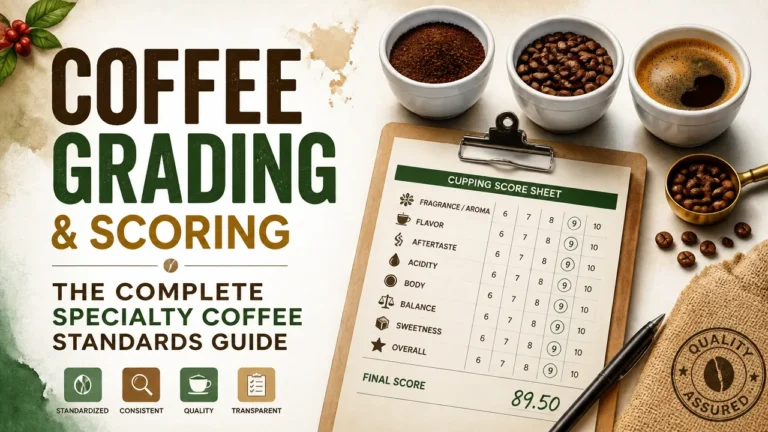
The SCA Cupping Form converts sensory experience into a defensible number through 10 scored categories plus defect columns. Each category captures a distinct dimension of cup quality; together, they produce a total score that reflects the coffee’s full sensory profile.
The 10 scoring categories are:
| # | Category | What It Captures |
|---|---|---|
| 1 | Fragrance / Aroma | Dry and wet aromatic intensity and quality |
| 2 | Flavor | Overall taste impression at mid-palate |
| 3 | Aftertaste | Length and quality of the finish |
| 4 | Acidity | Brightness, liveliness, and perceived quality of acidity |
| 5 | Body | Tactile weight and texture in the mouth |
| 6 | Balance | Harmony across flavor, acidity, body, and aftertaste |
| 7 | Uniformity | Consistency across the five cups in the sample set |
| 8 | Clean Cup | Absence of non-coffee taints from first impression to finish |
| 9 | Sweetness | Perceived sweetness and its contribution to overall quality |
| 10 | Overall | Holistic impression-the evaluator’s gestalt judgment |
Beyond the 10 categories, the form includes defect deductions: taints (detectable but not dominant off-notes) subtract 2 points per occurrence; faults (dominant off-notes that compromise the cup) subtract 4 points. These deductions are applied to the subtotal before the final score is confirmed.
Each scored attribute runs on a 10-point scale with descriptors anchored at key intervals. The evaluator does not simply assign a number-they locate the coffee’s performance relative to a calibrated reference standard. That calibration is precisely why Q Grader training exists. Without it, two evaluators scoring the same cup on the same form can produce results that are not comparable. With it, the form becomes a reliable instrument rather than a subjective impression.
Peter Giuliano, Head of the Coffee Science Foundation (CSF), has noted that current green grading guidelines rest on tradition rather than sensory science-a structural gap that the form’s sensory architecture is only beginning to address.
The implication is significant: the 100-point scale is the most rigorous instrument currently in widespread use, but the field is still developing the sensory science needed to fully validate its underlying assumptions. For buyers and quality managers, that means treating the form as a powerful professional tool-not an infallible oracle.
From Score to Contract: Aligning Grading Protocols Before You Sign
Specialty classification is a quality tier with a defined entry point, and the 80-point score is the minimum-not the average, not the target, not the aspiration. A defensible specialty buying decision requires three things to align simultaneously: a passed physical grade, an official 80+ sensory score from a Q Grader, and contract terms that lock pre-shipment samples to arrival lots.
The first step is confirming which grading protocol applies to the lot in question. Regional systems define quality differently, and a lot described as “Grade 1” or “AA” under an origin-specific system may or may not meet SCA specialty criteria. That determination requires an explicit SCA/CQI cupping score-not an inference from the origin label. Before any contract is signed, buyers should establish which physical standard governs the lot and whether that standard has been verified against SCA parameters.
The metrics to align before signing are specific: grade designation, moisture content, defect count, cupping score, and sample identity. Each of these should appear in the contract with defined tolerances-not as approximate descriptions but as measurable, verifiable specifications. Moisture content between 10% and 12%, a defect count within SCA specialty limits, and a cupping score at or above 80 from a named Q Grader are the minimum proof points.
Pre-shipment samples must match arrival lots-in both physical condition and sensory profile. This is where many sourcing relationships break down. A pre-shipment sample that cups at 83 points creates a reasonable expectation; an arrival lot that cups at 78 points on the same form represents a material discrepancy. That mismatch should trigger negotiation, not acceptance. Building sample retention and re-cupping protocols into the contract terms is not excessive caution-it is standard quality assurance.
Wendelien van Bunnik-Verver, 2019 World AeroPress Champion and Authorized SCA Trainer, makes a point that reframes how buyers should think about the 80-point threshold: a coffee that falls short of it isn’t necessarily bad or inferior-it simply isn’t specialty. It can still be good coffee, purchased and used honestly as commercial grade.
That distinction matters contractually. Buyers who understand the threshold as a classification boundary-rather than a quality judgment on every cup below it-make cleaner purchasing decisions. They can source commercial-grade lots with confidence when the use case supports it, and they can defend specialty classifications when the documentation is solid.
A defensible specialty buy rests on three aligned proof points: a physical grade that passes SCA criteria, an official 80+ score issued by a certified Q Grader, and a contract that ties the pre-shipment sample identity to the arrival lot. Remove any one of those three, and the classification becomes an assertion rather than a verified fact.
Frequently Asked Questions About Coffee Grading and Scoring
What are the three grades of coffee?
The most commonly referenced tiers are specialty grade (80+ cupping score, strict defect limits), commercial grade (below 80, wider defect tolerance), and off-grade (significant defect loads that disqualify the lot from standard trade channels). Origin-specific systems add their own internal subdivisions within these tiers.
How does coffee scoring work?
A certified Q Grader evaluates a roasted coffee across 10 sensory categories on the SCA/CQI 100-point scale-fragrance, flavor, aftertaste, acidity, body, balance, uniformity, clean cup, sweetness, and overall-then subtracts points for any detected defects to arrive at a final score.
What is grade 4 coffee?
Grade 4 is a classification used in some origin-specific systems, most notably Ethiopia’s ECX grading framework, where it indicates a higher defect load than Grade 1 or Grade 2. It doesn’t map directly to the SCA specialty threshold-a Grade 4 lot would almost certainly fail the SCA physical criteria for specialty classification.
What is the 15-15-15 rule for coffee?
The 15-15-15 rule isn’t a formal SCA standard-it’s a practical guideline some buyers use for moisture and storage management, referring to keeping green coffee at roughly 15°C, 15% relative humidity, and turning stock within 15 months. The SCA’s own moisture guidance targets 10–12% moisture content in the bean itself, which is a different measurement than ambient humidity.
Can a coffee cup above 80 and still fail specialty classification?
Yes. If the green sample contains even one primary defect, the lot is disqualified from specialty classification regardless of the cupping score. Physical criteria are a prerequisite, not a parallel track-the sensory score only counts after the physical gate clears.
Why do origin labels like Kenya AA not guarantee a specialty score?
Kenya AA designates screen size (beans retained on a size-18 screen), not flavor quality. A large, well-formed bean can still carry flavor defects or cup below 80 points. Origin nomenclature and SCA classification operate on different criteria and should never be treated as equivalent.
How often do pre-shipment samples fail to match arrival lots?
There’s no universal failure rate published across the industry, but discrepancies between pre-shipment and arrival samples are common enough that most experienced green buyers build re-cupping protocols directly into their contracts. Differences in moisture gain during transit, storage conditions at origin, and lot blending are the most frequent causes of sensory drift between sample and delivery.
Does the Coffee Value Assessment replace the SCA cupping score for contracts?
Not currently. The CVA offers a more granular, multi-dimensional quality framework, but the SCA/CQI cupping score remains the standard numeric baseline in the vast majority of active specialty contracts. Buyers and sellers should confirm explicitly which framework governs their agreement rather than assuming one supersedes the other.
References
- WHAT EXPLAINS SPECIALTY COFFEE QUALITY SCORES AND PRICES: A CASE STUDY FROM THE CUP OF EXCELLENCE PROGRAM | Cambridge University Press (Journal of Agricultural and Applied Economics) – doi.org
- Grounding Green Grading | sca.coffee
- Specialty Coffee Language & Definition: Is It Still Relevant for Sustainability? | perfectdailygrind.com