
Formal coffee competitions are among the most misunderstood events in the specialty coffee world. Most people assume they’re glorified taste tests or barista showdowns. They’re not. They’re timed, scored, rule-bound performances where professionals are evaluated on technique, sensory precision, and creativity by certified judging panels – with results that ripple outward into café menus, equipment trends, and the global conversation about what great coffee actually is.
Understanding how these events work changes how you read a coffee bag, evaluate a café’s credibility, and follow the sport. This guide builds that foundation from the ground up.
To truly appreciate how modern events have evolved, it helps to look back at the history of the World Barista Championship and see how it grew from its early roots into a premier international stage.
While modern competitions highlight precision and craft, understanding the industry’s complex reality also requires examining exposés like Blood Beans amp Billions The to appreciate the broader economic forces shaping the bean in your cup.
Key Takeaways on What Is a Coffee Competition
- A coffee competition is a formal, scored event with certified judges and regulated routines – not a marketing label or a popularity contest.
- Six distinct world championships exist under the WCE umbrella, each testing a different professional skill: espresso, brewing, roasting, cupping, latte art, and coffee cocktails.
- Judging panels split into sensory and technical roles, using blind evaluation and SCA-aligned scoring rubrics to produce an objective point total.
- The qualification path runs from local preliminaries through national championships before a competitor reaches the world stage.
- Competing at a serious level costs upward of $10,000 per season, creating a financial barrier that shapes who can realistically participate regardless of skill.
- A competition medal signals what a professional can do under controlled conditions – it doesn’t certify the consistency of every product they sell afterward.
What a Coffee Competition Is (and What It Definitely Isn’t)
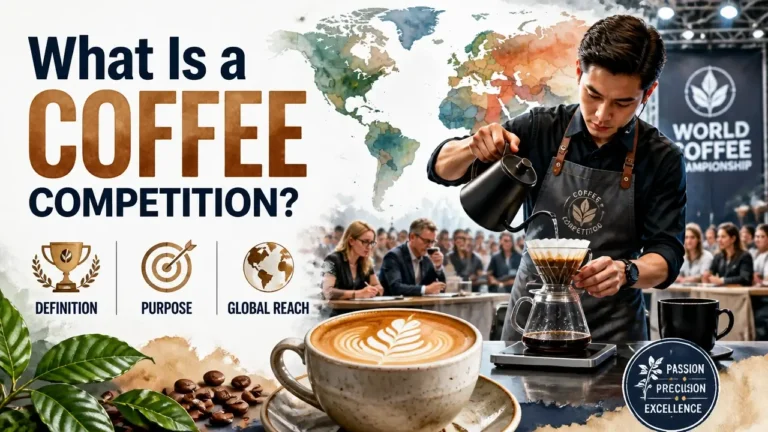
A coffee competition is a formal event where coffee professionals perform regulated routines under the scrutiny of certified judges to determine the best in a specific discipline. The purpose is threefold: to showcase professional skill at its highest level, to promote measurable quality standards across the specialty coffee industry, and to create a global community where technique and innovation get shared, challenged, and advanced.
That definition matters because the term gets stretched beyond recognition in everyday marketing. A bag labeled “award-winning” might reference a regional popularity poll, a trade show booth prize, or a self-submitted tasting panel with no independent verification. None of those are coffee competitions in the formal sense. Real competitions run on rigorous rulebooks, use trained and certified judging panels, and produce scores – not opinions.
The gap between a formal competition and a casual café contest is also the gap between a marathon and a jog around the block. Both involve running. Only one involves months of structured training, measured splits, and a certified course. Competitors at the national and world level spend months sourcing exceptional green coffee, developing recipes down to the gram, and rehearsing precise physical movements. The routine a barista performs on stage often represents a full season of preparation. That depth of commitment is what separates competition from recreation – and it’s why the titles carry weight.
Competitions also function as a proving ground that feeds back into everyday coffee culture. New extraction methods, unusual varietals, and equipment innovations frequently surface at world championships before they ever appear on a café menu. The influence travels downstream. But “downstream influence” is not the same as a retail guarantee. A competition win signals what a professional can do under controlled conditions. It doesn’t automatically certify every bag they sell afterward.
For a full breakdown of the competitive landscape – formats, disciplines, and the culture surrounding them – the ultimate guide to coffee competitions covers the circuit in much greater depth.
According to Amy Ball, SCA Events Officer, the ongoing evolution of competition rules – such as permitting plant-based milks – reflects a deliberate effort to give competitors more flexibility in how they choose to highlight their coffee, rather than locking them into a single stylistic framework.
This design philosophy matters. Competitions aren’t trying to crown one “correct” way to make coffee. They’re trying to find the most skilled, most thoughtful interpretation of a discipline – and the rules get adjusted over time to keep that ambition honest.
According to Saša Šestić, World Barista Champion, founder of ONA Coffee and Project Origin, and coach of 2021 World Barista Champion Martin Shabaya, the most compelling competition journeys are built around the coffee itself and the producer behind it – not the barista’s ego or showmanship. He describes Shabaya’s 2021 WBC run as a “producer-led” story, where the triangle of coffee, producer, and barista created something that felt genuinely meaningful on stage.
That framing reorients how you watch a competition. The barista is the messenger. The coffee, and the chain of decisions that produced it, is the actual story being told.
To fully understand how these structured events differ from standard café service, examine this modern coffee competitions overview.
Inside the Arena: The Drink Formats and Key Participants
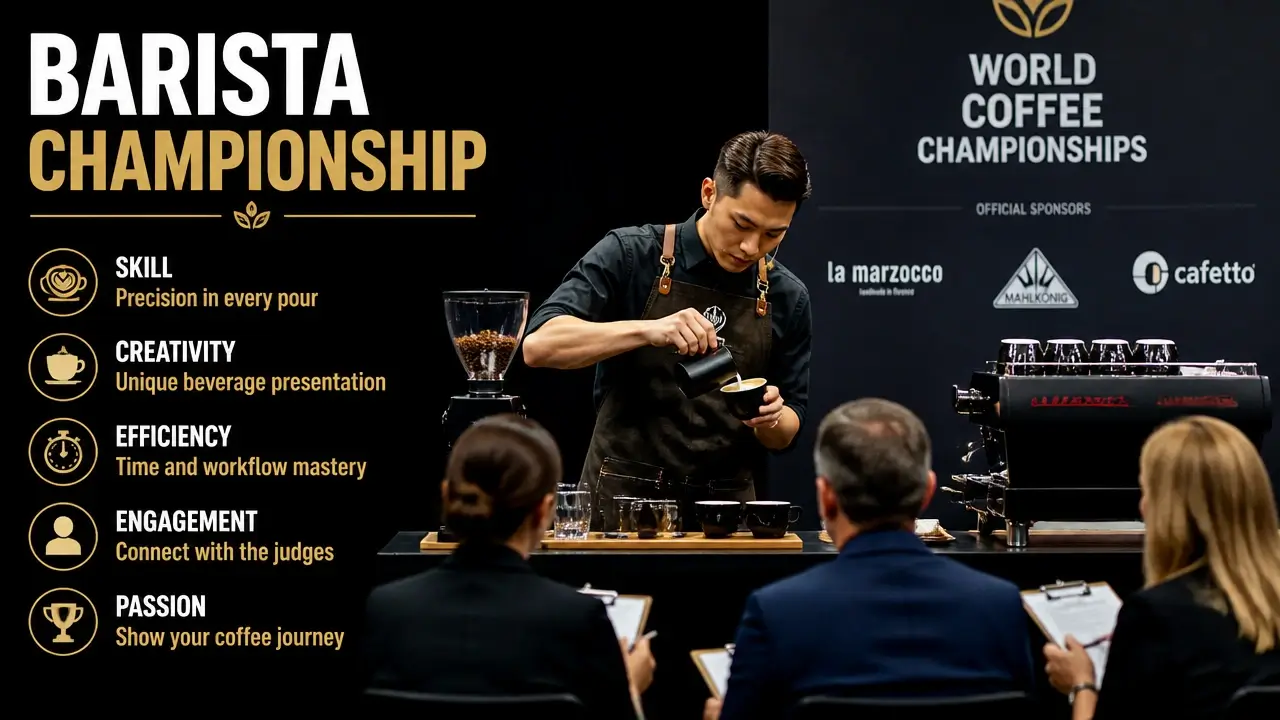
When a competitor walks onto a competition stage, the clock starts immediately. In the standard barista competition format, the competitor must prepare and serve a sequence of three drink categories: espresso, milk-based drinks, and a unique “signature beverage” of their own design. All of it happens within a strict 15-minute window, during which judges evaluate taste, technical execution, and presentation simultaneously. Twelve drinks. Fifteen minutes. Every movement tracked.
Here’s a look at the video from the 2025 World Barista Championship Finals to see what that pressure actually looks like on stage.
But the barista format is only one lane in a much wider circuit. The World Coffee Championships umbrella covers several distinct disciplines, each testing a different professional skill set:
| Competition | What It Tests |
|---|---|
| World Barista Championship | Espresso preparation, milk technique, signature drink creativity, and presentation within a timed routine |
| World Brewers Cup | Manual brewing precision – filter methods, extraction control, and the ability to highlight a coffee’s character without an espresso machine |
| World Coffee Roasting Championship | Green coffee analysis, roast profiling, defect identification, and the ability to produce a target roast under pressure |
| World Cup Tasters Championship | Pure sensory speed and accuracy – competitors identify the odd cup in a series of triangle tests (three cups, two the same, find the different one) against the clock |
| World Latte Art Championship | Milk-steaming technique and the precision to pour complex, symmetrical designs into espresso – scored on visual quality and difficulty |
| World Coffee in Good Spirits | Coffee-based cocktail preparation, combining barista technique with mixology |
According to Piyapat ‘Flook’ Lapteerawut, two-time U.S. Latte Art Champion, competition scoring actively shapes what designs competitors choose to attempt. When Italian competitor Manuela Fensore won the World Latte Art Championship in 2019 with portrait designs – a rooster head, an eagle face – it opened a new scoring pathway that the broader competition community quickly recognized and began to pursue.
This is how competition culture evolves in real time. A single champion’s creative choice becomes a new reference point for what’s possible, and the next wave of competitors builds on it. The Cup Tasters format, by contrast, strips away all creativity and tests raw sensory hardware. Competitors taste through triangle sets as fast as they can. Speed and accuracy both count. A professional coffee cupper who can process eight triangle sets in under eight minutes with zero errors is demonstrating a different kind of mastery than a barista perfecting milk texture – but the rigor is equivalent.
The participants reflect that diversity. Professional baristas, coffee roasters, master brewers, and sensory specialists each have their own championship track. Competitions are specialized by design. Not every competitor does the same thing, and not every skill set competes against every other.
How a Champion Is Made: Judging, Scoring, and Blind Tasting
Judging panels at formal coffee competitions are not assembled from enthusiastic volunteers with strong opinions. They divide into two distinct roles with clearly separated responsibilities. Sensory judges evaluate what’s in the cup: taste, balance, complexity, and the overall sensory experience. Technical judges assess what happens at the machine: workflow cleanliness, technique precision, and adherence to the competition’s procedural standards. Both sets of scores feed into the final tally.
The mechanism that keeps this honest is blind evaluation. Drinks are presented without branding, packaging cues, or any identifying information about the competitor or roaster. The judge evaluates what’s in the cup, not who made it. Reputation earns nothing at the scoring table.
Scoring follows structured rubrics aligned with SCA cupping protocols – the same framework used across the specialty coffee industry for quality assessment. Judges measure specific attributes: aroma, flavor, aftertaste, acidity, body, and balance. Each attribute gets a numerical score. Those scores aggregate into a point total that determines placement. Timing penalties for going over the time limit subtract directly from the final score. Technical errors – an improperly calibrated grinder, a spilled drink, a skipped procedural step – cost points in the technical column.
Many competition judges hold Q Grader certification from the Coffee Quality Institute, which requires passing 22 separate exams covering sensory skills, green coffee analysis, and cupping protocols. It’s one of the most demanding professional credentials in the industry. Their presence on the panel adds a layer of verified expertise that casual tasting panels simply don’t have.
The highest aggregate score wins. Personal preference doesn’t enter the equation – at least not beyond the limits of human perception, which is why judge training and calibration matter so much. The system is designed to be objective. Whether any scoring system can be perfectly objective is a fair philosophical question. But the structure is built to minimize drift and maximize consistency.
One caveat worth holding onto: a competition win evaluates a single performance of a single coffee under controlled conditions. That’s meaningfully different from auditing a roaster’s supply chain, their batch-to-batch consistency, or the quality of the bag sitting on a retail shelf six months after the championship. A medal is a strong positive signal about capability. It’s not a third-party audit of an entire operation.
The Road to the World Stage: Qualifying, Tiers, and the Hidden Cost
Getting to a world championship doesn’t start with a plane ticket. It starts with a local preliminary round, often held at a regional coffee event or café expo, where competitors earn enough points or placements to move up. The path is tiered, and each tier filters the field.
For a broader look at how the different disciplines structure their own paths, the breakdown of types of coffee competitions covers the full range from barista to brewers cup and beyond.
The Qualification Ladder: From Local Preliminaries to National Championships
The qualification structure follows a consistent pattern across most disciplines. Local or regional preliminary rounds feed into national championships. The winner of a national championship earns the title of national champion and the right to represent their country at the world event. That world event then runs its own elimination structure.
At the World Barista Championship, for example, more than 55 national champions compete in the opening rounds. The top 15 performers advance to semi-finals, sometimes with a wildcard slot available. From the semi-finals, the top 6 move to the finals. Each discipline – barista, roasting, cupping, latte art – runs its own parallel world championship with separate qualification paths. Winning one doesn’t qualify you for another.
The Malaysia National Coffee Championship is a good illustration of how national-level events function within this system. It runs its own qualifying rounds, crowns a national champion in each discipline, and sends those champions to represent Malaysia at the corresponding world event. The structure is consistent globally, even if the scale and resources behind each national body vary considerably.
Many competitors start not by entering but by watching. Volunteering at competitions, working as a table runner or steward, gives aspiring competitors a view of the scoring process, the pressure, and the standard they’ll eventually need to meet. That floor-level experience is often where the serious training commitment begins.
The Hidden Costs and Training Commitment of Coffee Competition Participation
The training commitment at the top level is significant. Competitors at national and world-level events typically spend months preparing a single routine. That process involves sourcing exceptional green coffee – sometimes directly from a specific farm for a specific flavor profile – developing custom extraction recipes, and rehearsing physical movements until they’re automatic under pressure.
A 2024 industry analysis by The Pourover Coffee examined the full financial picture of competition participation and found that costs routinely exceed $10,000 per season when travel, lodging, equipment shipping, green coffee procurement, and coaching are totaled. Competitor Morgan Eckroth estimated $10,000–$12,000 per competition cycle. For competitors without institutional sponsorship – like María Elena Rivera, who lacked access to coaches or a support team – those costs represent an insurmountable barrier rather than a manageable investment.
The qualification ladder is merit-based and transparent on paper. But there’s a second filter running underneath it that the scorecard doesn’t show: money. Entry fees, international travel, equipment shipping, and the cost of sourcing rare competition-grade coffee accumulate quickly. A competitor without a roaster sponsor, a café group backing them, or personal financial resources faces a structurally different path than one with full institutional support.
This creates what the analysis describes as a wealth filter. Well-funded operations and competitors from wealthier countries with established industry infrastructure have a measurable structural advantage. That doesn’t invalidate the results – the judging is still blind, the scoring is still rigorous – but it does mean that the absence of a competition credential on a barista’s or roaster’s resume may say more about their access to resources than about their quality. That’s an important distinction to carry forward when you encounter competition titles used as marketing claims.
The Global Map: Major Events, Governing Bodies, and How to Follow
The World Coffee Championships circuit is the top tier of formal competition globally. It covers six flagship discipline-specific events: the World Barista Championship, the World Brewers Cup, the World Cup Tasters Championship, the World Coffee Roasting Championship, the World Latte Art Championship, and World Coffee in Good Spirits. Each runs annually and crowns a single world champion per discipline.
The governing structure behind all of it is a two-layer system. The Specialty Coffee Association (SCA) sets the industry standards – the cupping protocols, the green coffee grading frameworks, the training and certification infrastructure. The World Coffee Events (WCE) organization, operating under the SCA, manages the championships directly: the rulebooks, the judging certification, the host city selection, and the competition calendar.
Events rotate through host cities across continents. Recent and upcoming hosts have included Dubai, San Diego, Bangkok, Geneva, and Panama. That rotation reflects the genuinely global nature of the circuit – this isn’t a competition that happens in one country and exports its results. National champions travel from every coffee-producing and coffee-consuming region in the world.
Watching is accessible. The WCE and SCA both maintain official channels where major events are live-streamed, and archives of past championships are available for replay. For a new enthusiast, watching a WBC final – seeing the 15-minute routine, hearing the judges’ feedback, watching the scores posted – is one of the fastest ways to understand what “professional skill” actually looks like in this industry.
One practical note: if you start researching past champions, use official WCE and SCA sources as your primary reference. External sources, including Wikipedia’s World Barista Championship entry, have contained factual errors in their winners tables – in one notable case, attributing the championship to the same person for the majority of the event’s history. That kind of error spreads quickly when people cite it without checking. Verify through official records.
According to Dan McCloskey, co-founder and Chief Creative Officer of CYA Cover Your Assets and a two-decade veteran of the coffee industry, the specialty coffee world excels at producing great coffee but consistently struggles to manage the hidden operational costs that run underneath the quality conversation.
That observation applies directly to competitions. The public face – the routines, the scores, the champion announcements – is polished and compelling. The operational reality underneath, including the financial barriers, the logistical complexity, and the gap between competition performance and retail consistency, is where the more nuanced understanding lives. Now you have both layers.
Frequently Asked Questions About What Is a Coffee Competition
How do coffee competitions work?
Competitors perform a timed, regulated routine – making specific drinks in a set sequence – while a certified panel of sensory and technical judges scores each element. The highest aggregate score wins, and timing penalties or technical errors subtract directly from the final tally.
What is the most prestigious coffee competition?
The World Barista Championship, organized by World Coffee Events under the SCA, is widely considered the flagship event. It draws national champions from more than 55 countries and receives the most media coverage within the specialty coffee industry.
What is a competition coffee?
Competition coffee refers to the specific lot a competitor sources and prepares for their routine – typically a rare, high-scoring green coffee chosen to showcase particular flavor characteristics. It’s often a micro-lot or single-origin selection that wouldn’t appear on a standard retail menu.
Can anyone enter a coffee competition, or is it invite-only?
Most national-level competitions are open to working coffee professionals. Entry typically requires meeting eligibility criteria set by the national organizing body, not an invitation. Many competitors start at open preliminary rounds before advancing.
Why do competition results matter to everyday coffee drinkers?
Techniques, equipment, and rare varietals that surface at world championships frequently migrate into specialty cafés and retail offerings within a few years. Competition results don’t tell you what to buy tomorrow, but they do signal where the industry’s creative edge is moving.
Does winning a coffee competition guarantee better coffee in the bag?
No. A competition win evaluates a single performance under controlled conditions. Batch-to-batch retail consistency, supply chain management, and roast quality over time are separate variables that a competition score doesn’t measure.
How are competition judges trained and certified?
Judges undergo formal training programs run by the SCA and WCE, which cover sensory calibration, cupping protocol, and competition-specific scoring standards. Many hold Q Grader certification from the Coffee Quality Institute, which requires passing 22 separate exams.
Why do some talented baristas never compete?
Financial barriers are a primary reason. Travel, equipment shipping, green coffee procurement, and coaching costs regularly exceed $10,000 per season. Without sponsorship from a roaster or café group, many skilled professionals simply can’t afford to participate – which means the absence of competition credits doesn’t indicate the absence of quality.
References
- Plant Milk Rule at the World Barista Championship | perfectdailygrind.com
- WBC 2021: Reflecting on How Coffee Producing Countries Took Centre Stage | perfectdailygrind.com
- The Cost of Competing | thepourover.coffee
- How Coffee Businesses Can Use Data | perfectdailygrind.com