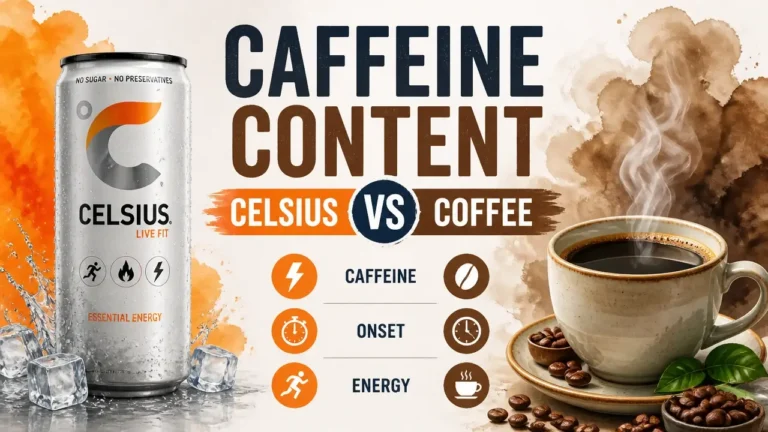

Celsius vs coffee is one of the most practically important fuel decisions an athlete can make, yet most people settle it on habit rather than data. One delivers a single, pre-measured 200 mg caffeine hit with a proprietary supplement stack. The other gives you a stripped-down, antioxidant-rich caffeine source at a fraction of the cost.
The real question isn’t which one tastes better – it’s which one hits the physiological sweet spot for your body weight, your wallet, and your gut before a hard training session.
What Athletes Need From a Caffeine Source
Solid caffeine source evaluation criteria go well beyond the buzz – they start with the dose at which caffeine actually changes your performance. A standard 8 oz cup of black coffee delivers roughly 95 mg of caffeine, while a single can of Celsius delivers 200 mg, and that gap isn’t cosmetic. It maps directly onto the physiological window where caffeine stops being a wake-up call and starts being an endurance drug.
Most athletes know caffeine sharpens focus. Fewer know that the effect on endurance performance is dose-dependent and well-documented. The research benchmark is 3–6 mg per kilogram of body weight. For a 68 kg (150 lb) athlete, that’s roughly 200–408 mg – which means a single Celsius can lands right at the low end of the performance window, while a single cup of coffee lands well below it.
That framing changes how you evaluate every other variable. Here’s what the four pillars of a useful pre-workout caffeine source actually look like in practice:
- Clean, crash-free energy curve: For athletes, “clean energy” means no sugar spike, no inflammatory gut load, and no sharp drop-off mid-session. A true crash comes from spiked blood sugar, not caffeine itself – so the real filter is whether the source contains sugar or compounds that destabilize blood glucose.
- Sufficient caffeine dose: Below the 3 mg/kg threshold, performance effects are inconsistent. Above 6 mg/kg, the side effects – anxiety, GI upset, heart palpitations – start to outweigh the gains. The sweet spot is narrow, and knowing your serving’s milligram count is the only way to hit it intentionally.
- Minimal gastrointestinal distress: Anything that sends you to the bathroom during a run or causes reflux during heavy lifting is a non-starter, regardless of its caffeine content.
- Reasonable daily cost: An athlete training five days a week needs a fuel source that’s financially sustainable. A $2.50 can used daily adds up to over $600 a year – a number worth keeping in mind before building a dependency.
The Journal of the International Society of Sports Nutrition’s position stand on caffeine and exercise performance puts this in hard numbers: caffeine at 3–6 mg/kg body mass consistently improves exercise performance, with the primary mechanism being adenosine-receptor antagonism in the central nervous system. A meta-analysis of 46 endurance studies embedded in that same review found a mean power output increase of 2.9% and a time-trial completion improvement of 2.3% at that dose range. Those are real, measurable gains – not marketing copy.
One more number worth knowing: the FDA’s 400 mg daily ceiling for caffeine. That’s a population-level safety guardrail, not a target. If you start your morning with a cup of coffee (95 mg) and then crack a Celsius before your afternoon workout (200 mg), you’re already at 295 mg before accounting for anything else – tea, soda, a post-workout protein shake with added caffeine. Your total daily ledger matters more than any single serving.
Dr. Samuel Schmidgall, lead researcher on cognitive and metabolic neuromodulation models, puts the acute vs. sustained picture in useful terms:
“Acute energy drink consumption enhances energy expenditure, fat oxidation, and some cognitive measures, while 28-day use sustains energy expenditure and select cognitive benefits.”
That finding matters for athletes who are thinking about this as a daily habit, not a one-off. The benefit is real – but it doesn’t compound indefinitely, and the dose discipline has to hold over time.
Understanding how standard black coffee compares to alternative infusions begins with analyzing How Much Caffeine in Black tea leaves yield per brewing cycle.
Inside Celsius: Ingredients, Caffeine, and the “Metabolism” Claim
Celsius energy drink positions itself as more than a caffeine vehicle – the can promises thermogenesis, accelerated metabolism, and a functional blend that goes to work before you even warm up. The ingredients are real. Whether the claims hold up to independent scrutiny is a different question, and that tension is worth sitting with before you make it your daily pre-workout.
Celsius’s Caffeine Sources and Functional Compounds
Celsius caffeine sources aren’t just a single extract – the 200 mg dose is built from a combination of green tea extract standardized to EGCG (epigallocatechin gallate), guarana seed extract, and what the label describes as natural caffeine. Those three sources don’t just stack milligrams; they each bring additional compounds that affect how the energy lands.
Green tea extract contributes catechins – antioxidant polyphenols, with EGCG being the most bioactive – alongside a modest amount of caffeine. Guarana seed extract adds theobromine-adjacent alkaloids that are sometimes credited with a slightly smoother, more sustained stimulation curve compared to isolated caffeine. Taurine, an amino acid included in the blend, has been studied for its role in cellular hydration and muscle contractility, though the evidence for a direct performance boost at the doses found in energy drinks is mixed.
The rest of the functional stack includes a B-vitamin complex (B2, B3, B5, B6, and B12), which supports energy metabolism at the cellular level – useful, but only if you’re actually deficient. The drink clocks in at roughly 10 calories with no sugar, sweetened instead with sucralose and stevia.
Here’s what the label looks like in practice:
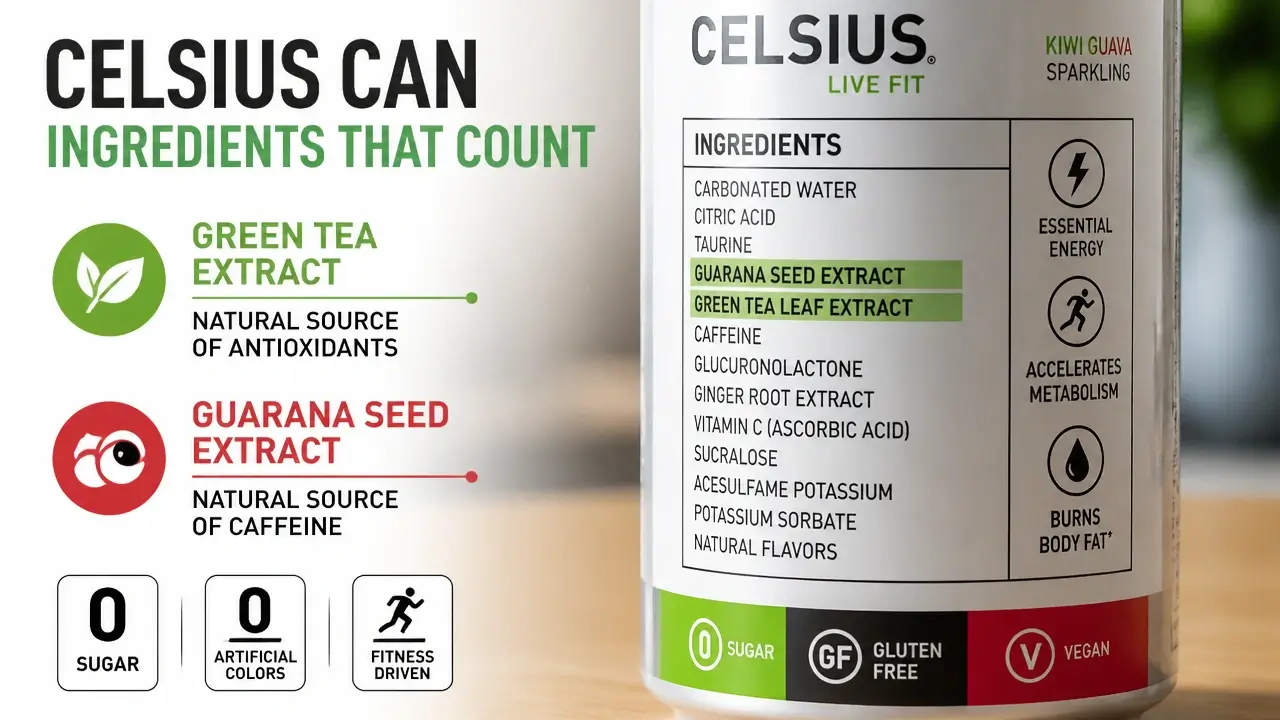
One practical note on the 200 mg dose: it’s well-calibrated for a 68 kg athlete hitting the 3 mg/kg performance window – but it’s also half the FDA’s daily 400 mg ceiling in a single can that’s easy to finish in 10 minutes. A smaller athlete, say 55 kg, would be overshooting the optimal performance dose with a full can. In that case, drinking half and saving the rest for the next session is a more precise tool than treating the can as a single serving.
The MetaPlus® Metabolism Claim and Sweetener Trade-Offs
MetaPlus® is Celsius’s proprietary blend – the combination of ingredients the company credits with its thermogenic and metabolism-accelerating effects. The zero-sugar positioning is genuine and relevant for athletes avoiding insulin spikes: the drink won’t trigger the blood sugar rollercoaster that derails energy mid-workout. But the sweeteners used are artificial, with sucralose as the primary agent.
Most users tolerate sucralose without issue, but some athletes – particularly those with sensitive guts or those training at high intensity – report a mild GI response. It’s not a universal problem, but it’s worth a test run before race day.
The harder conversation is about the metabolism claim itself. The only published study that directly tested Celsius as a product was a 2010 company-funded trial. That study did show a modest fitness improvement in participants – a roughly 2–3% increase in VO₂ max – but it found no significant thermogenic or weight-loss effect that was independent of a caloric deficit. In other words, Celsius didn’t burn fat on its own; the participants who improved their body composition also happened to be in a caloric deficit. The full trial data is available here.
That’s an important distinction for an athlete making a purchase decision. The MetaPlus® blend may contribute something real to the energy experience – particularly through the catechin and taurine combination – but the fat-burning marketing is an oversimplification that isn’t supported by independent research. The caffeine is doing most of the heavy lifting.
Coffee: The Natural Pre-Workout With Hidden Trade-Offs
Coffee as natural pre-workout earns its reputation on simplicity and science, not marketing. A standard 8 oz cup of black coffee delivers approximately 95 mg of caffeine, roughly 2 calories, zero sugar, and a dense supply of chlorogenic acids – a class of antioxidant polyphenols with documented anti-inflammatory properties that give coffee a biological edge Celsius doesn’t replicate with its blend.
That simplicity is also a strategic advantage for athletes who want to know exactly what they’re ingesting. There’s no proprietary blend, no hidden alkaloid stack, no second-guessing what’s in the can. It’s a single-source caffeine delivery system with a well-understood absorption curve.
The trade-off shows up in the gut. Coffee’s natural acidity – combined with the irritant effect of chlorogenic acids on the gastric lining – makes it a genuine risk for runners, cyclists, and anyone doing high-intensity work that compresses the abdomen. Reflux, cramping, or an urgent bathroom stop mid-workout aren’t rare complaints. They’re predictable responses for athletes with even mildly sensitive digestive systems, and they’re worth taking seriously as a performance variable, not just a comfort issue.
Coffee also falls short on dose efficiency for athletes targeting the 3–6 mg/kg performance window. At 95 mg per cup, a 68 kg athlete needs approximately two cups to reach 190 mg – close to the performance threshold but requiring more liquid volume right before exercise, which adds its own GI risk.
Here’s the practical workaround that bridges the gap between coffee’s simplicity and Celsius’s functional stack:
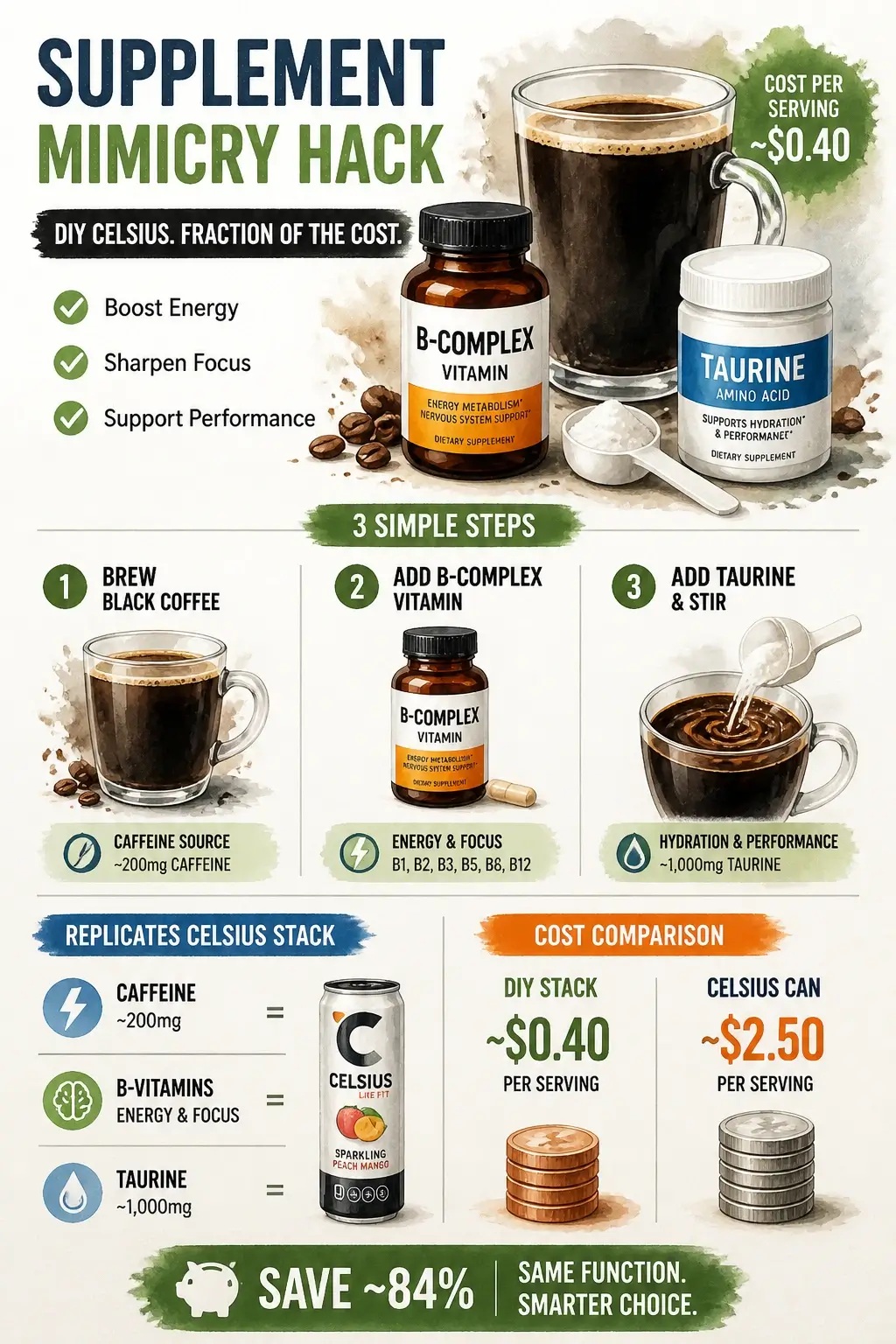
When switching from Celsius to coffee as your primary pre-workout, take a standard B-complex vitamin alongside roughly 500 mg of taurine. This approximates the supporting nutrient backdrop that Celsius bundles in, at a fraction of the cost. It’s not a validated protocol in controlled trials, and the performance science is clear that caffeine is still the prime mover – but for athletes who want to replicate the “complete” feeling of Celsius without the price tag, it’s a sensible, low-risk strategy.
The cost math makes this approach hard to ignore. A home-brewed cup of coffee costs roughly $0.15. A B-complex and a taurine capsule add maybe another $0.10 per day at bulk supplement pricing. You’re looking at $0.25 per pre-workout session versus $2.00–$2.50 for a Celsius can – and the caffeine payload, with two cups, is ergogenically equivalent.
Celsius vs. Coffee: Caffeine, Cost, and Clean Energy Head-to-Head
The Celsius vs coffee comparison gets real when you stop talking about taste and start running the numbers. On the metrics that actually determine whether a pre-workout fuel is worth building a habit around – caffeine per serving, cost per milligram, ingredient transparency, and gut risk – the two options land in very different places.
The caffeine equivalency is the anchor: one Celsius can equals approximately 1.4 to 2 standard cups of black coffee, depending on your brew strength. That means an athlete targeting 200 mg doesn’t get there with a single cup of coffee. They need to either drink more volume or accept a lower dose.
On the clean energy question, both options clear the most important bar: neither causes a sugar spike. Black coffee has no sugar and no sweeteners. Celsius has no sugar but does use artificial sweeteners – sucralose and stevia – which are benign for most people but represent a variable that black coffee simply doesn’t introduce. Neither will produce the mid-workout energy crash that a sugary energy drink or sports beverage creates. The difference is in what they add, not what they remove.
Here’s the full side-by-side breakdown:
| Metric | Celsius (12 oz can) | Black Coffee (8 oz cup) |
|---|---|---|
| Caffeine per serving | 200 mg | ~95 mg |
| Calories | ~10 kcal | ~2 kcal |
| Sugar | 0 g | 0 g |
| Sweeteners | Sucralose, stevia | None |
| Ingredient complexity | Proprietary blend (MetaPlus®) | Single ingredient |
| Cost per serving | ~$2.00–$2.50 | ~$0.15 (home-brewed) |
| Cost per mg of caffeine | ~$0.010–$0.013/mg | ~$0.0016/mg |
| Cups of coffee equivalent | – | 1.4–2 cups |
The cost-per-milligram column is where the gap becomes undeniable. Celsius runs approximately $0.01 per mg of caffeine. Home-brewed coffee runs about $0.0016 per mg – roughly six times cheaper per unit of the compound that’s actually driving your performance. For an athlete caffeinating five days a week, that difference is several hundred dollars a year.
Real-world user behavior confirms this plays out exactly as the math suggests. In athlete and fitness communities, the most consistently cited reason for abandoning Celsius as a daily driver isn’t the taste or the sweeteners – it’s the cost of sustained use. Athletes on tighter budgets migrate to coffee plus supplements not because coffee is superior, but because the economics of daily caffeine dosing make Celsius unsustainable as a habit.
When evaluating commercial beverages against specialty coffee and fitness drinks, analyzing Mountain Dew caffeine content provides a revealing baseline for mainstream stimulant delivery.
How to Time Your Intake and Stay Within Safe Limits
Caffeine intake timing is the variable most athletes get right intuitively but wrong precisely. The standard recommendation – consume your caffeine source 30–60 minutes before exercise – exists because that window aligns peak blood caffeine concentration with the most demanding phase of your session. You want the adenosine-receptor blockade firing when you’re pushing hardest, not wearing off by the time the real work starts.
That timing window applies equally to Celsius and coffee, with one practical difference: coffee’s preparation time is variable, while Celsius is grab-and-go. If you’re training at 6 a.m. and don’t want to brew two cups while half-asleep, that convenience gap is real.
The FDA’s 400 mg daily ceiling is the outer boundary, but the more useful mental model is your total daily caffeine ledger. One Celsius can at 200 mg consumes exactly half that ceiling in a single serving. Add a morning coffee at 95 mg, and you’re at 295 mg before your afternoon pre-workout. Add a post-lunch tea or a soda, and you may be flirting with 350–380 mg before accounting for anything else. That’s not dangerous territory for most healthy adults, but it leaves almost no buffer.
Symptoms worth watching for: heart palpitations, jitteriness, elevated resting anxiety, and GI upset are the early signals that your intake is outrunning your tolerance. A performance-recovery cycle that starts deteriorating – poor sleep, elevated resting heart rate, reduced training quality – is a more subtle but more important signal.
Sleep is the hidden casualty of poor caffeine timing. Consuming 200 mg within six hours of bedtime can meaningfully disrupt sleep architecture even in people who feel like they “sleep fine” after caffeine. If your training window is late afternoon or evening, a half-can of Celsius or a single cup of coffee is a more defensible choice than a full pre-workout dose.
The genetic dimension matters here too. The CYP1A2 enzyme is responsible for metabolizing caffeine in the liver. Roughly 50% of the population carries a slow-metabolizing variant of this gene, meaning caffeine lingers in their system significantly longer than in fast metabolizers. For slow metabolizers, a 200 mg dose at 3 p.m. may still be measurably affecting sleep at 11 p.m. – and they often don’t know which group they’re in until they start tracking their sleep data honestly.
Dr. Sara Mahdavi, post-doctoral fellow at Harvard University and lead author of the Nurses’ Health Study on caffeine, frames the individual variability clearly:
“While this study adds to prior evidence suggesting coffee intake may be linked with healthy aging, the benefits from coffee are relatively modest compared to the impact of overall healthy lifestyle habits… women going through menopause, who are pregnant, or using oral contraception experience hormonal transitions that can affect how the body processes caffeine.”
The principle generalizes beyond that specific population: any condition or biological variable that alters caffeine metabolism – hormonal shifts, certain medications, cardiovascular conditions – changes where your personal safe ceiling actually sits. The 400 mg number is a starting point, not a finish line. Track your resting heart rate, your sleep latency, and your perceived anxiety on high-caffeine days. Those three data points will tell you more about your real ceiling than any population-average guideline.
The Verdict: Choosing Your Athletic Fuel
Athlete fuel choice criteria ultimately come down to three honest questions: What’s your primary training goal? How does your gut respond to each option? And what’s your daily budget for caffeine? The performance science doesn’t crown a universal winner – it gives you the lenses to make a clear-eyed call based on your specific profile.
The ergogenic equivalence is real and important: 200 mg of caffeine from Celsius and 200 mg from two cups of black coffee will produce the same core performance effect. Caffeine is the prime mover in both cases. The question is what surrounds that caffeine dose, and whether those surrounding variables – cost, gut tolerance, convenience, artificial sweeteners – matter to you.
Performance and Budget Personas: Choosing Between Celsius and Coffee
Persona-based recommendation cuts through the noise faster than a generic “it depends.” Here’s how the decision actually maps:
For the performance-focused athlete who trains with high intensity, prioritizes endurance output, and can tolerate 200 mg of caffeine without GI issues: Celsius is a defensible choice. One can, 30–60 minutes pre-workout, lands squarely in the 3–6 mg/kg performance window for a 68 kg athlete and delivers the taurine and B-vitamin support without requiring separate supplementation. If you’re smaller than 68 kg – say, 55–60 kg – consider starting with half a can to stay within the optimal dose range rather than overshooting it.
For the budget-conscious athlete who trains four to six days per week and needs a financially sustainable daily fuel: two cups of black coffee, timed 30–60 minutes before exercise, gets you to approximately 190 mg of caffeine at a cost of about $0.30. Add a B-complex and 500 mg of taurine for another $0.10, and you’ve approximated the Celsius nutrient backdrop for roughly $0.40 per session versus $2.00–$2.50 for the can. If coffee’s acidity is a limiting factor for your stomach, cold brew is a lower-acid alternative that delivers the same caffeine without the gastric irritation.
The real consumer dilemma – confirmed repeatedly in athlete communities – isn’t safety. It’s whether you can extract the same focus and endurance benefit from coffee at a dramatically lower cost. The qualified answer is yes. The supplement-mimicry stack gets you close on the nutrient side, and the performance science is unambiguous that 200 mg from coffee is ergogenically equivalent to 200 mg from Celsius. What you may not fully replicate is the specific mental crispness some athletes attribute to the full Celsius blend’s synergy – but that effect hasn’t been isolated or validated independently from caffeine alone.
Sensitive Athletes and Clean Energy: Final Principles
Sensitive athlete considerations deserve their own decision branch. If you’re caffeine-sensitive, stomach-sensitive, or both, the calculus shifts before you even get to cost or performance:
Caffeine-sensitive athletes – those who feel jittery, anxious, or experience elevated heart rate at 200 mg – should start with half a can of Celsius (approximately 100 mg) rather than a full serving. This reduces the GI load, keeps you within a more conservative dose, and still delivers a measurable performance benefit. If caffeine must be minimized further, a small cup of decaf coffee provides the ritual and the minimal chlorogenic acid benefit without the stimulant load. In either case, monitor total daily intake from all sources before assuming a half-can is automatically “safe.”
Stomach-sensitive athletes – particularly runners and those doing core-intensive training – may find coffee’s acidity genuinely problematic regardless of dose. In that scenario, Celsius’s neutral pH and zero-acid profile is a practical advantage that justifies the price premium, especially if switching to cold brew doesn’t fully resolve the issue.
The metabolism-boosting marketing around Celsius should play no role in this decision. The independent evidence doesn’t support fat burning as a meaningful, standalone benefit of the drink. Judge it on what’s proven: a reliable 200 mg caffeine dose, a gut-friendly pH, and a clean no-sugar formulation. Judge coffee on what’s proven: an effective, natural caffeine source with anti-inflammatory antioxidants, a lower cost per milligram, and a higher acid load.
The clean energy both options deliver – free from sugar spikes, free from the blood glucose crash that undermines steady-state performance – is the real common ground. Neither option is the enemy. The enemy is dosing without intention, timing without awareness, and choosing by brand loyalty instead of biology.