
Why Your Chai Latte Isn’t Just ‘Tea’
The Starbucks Chai Tea Latte isn’t brewed from tea bags – it’s built on a pre-sweetened chai concentrate that determines your caffeine and sugar intake before the barista makes a single move. That concentrate is the structural foundation of the drink, and it changes everything a cautious drinker needs to know. Reach for it as a cozy alternative to coffee, and you’re making a reasonable call – but don’t mistake “tea” for “free pass.”
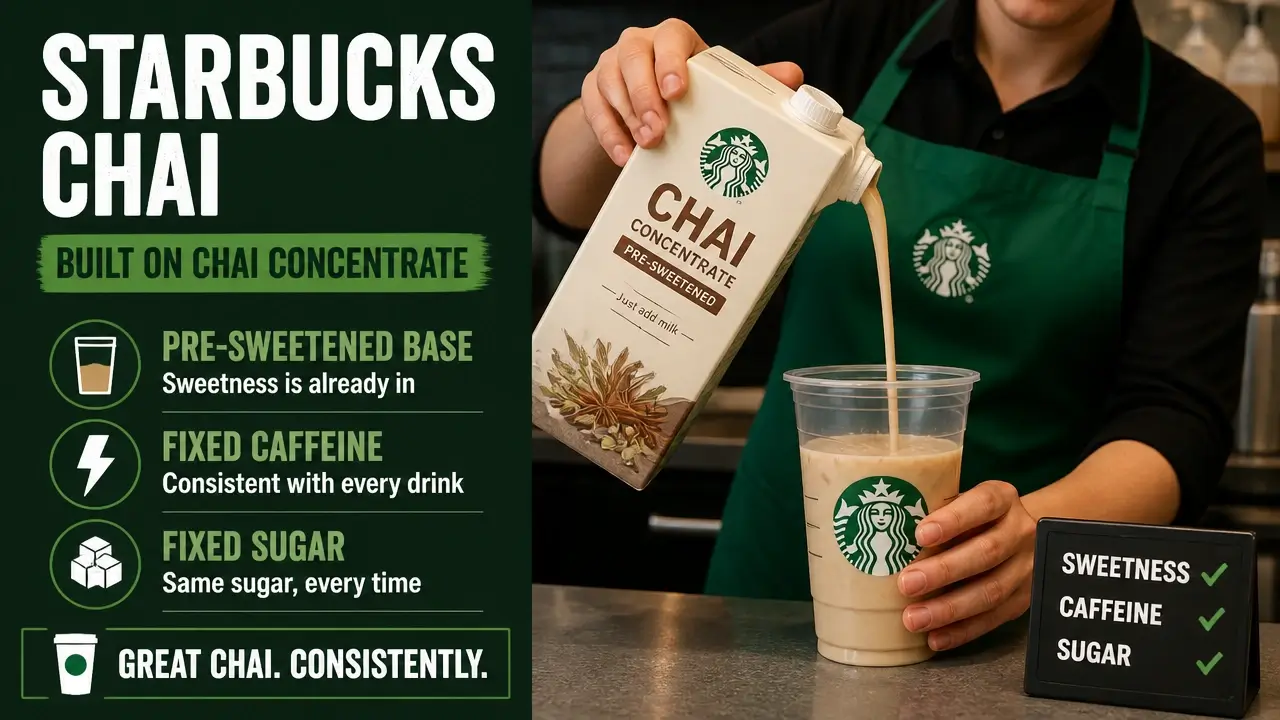
Most people picture a chai latte as hot milk poured over some spiced tea. What’s actually happening is that pumps of a thick, intensely flavored, factory-sweetened concentrate are combined with steamed milk. The concentrate is engineered for consistency and sweetness at the production level – not for customization at the counter. That’s not a barista limitation; it’s a structural fact about the ingredient itself.
Here’s what that means in practical terms: a Tall Chai Tea Latte typically falls in the 40–70 mg caffeine range on standard nutrition labels, but independent real-world testing places it closer to 95 mg. That makes it the highest-caffeine tea drink on the Starbucks menu – ahead of even the Matcha Tea Latte, which clocks in around 80 mg in a Grande. Many health-conscious customers switch to matcha assuming it’s the stronger option. The data says otherwise.
Sugar is part of that same equation. Because it’s baked into the concentrate, there’s no version of this drink without it. That single fact reshapes how you should think about ordering – and it’s the thread that runs through everything that follows.
Here’s a look at what that concentrate actually looks like going into your cup:
Amy Rothstein, Founder of Dona Chai and NYU Steinhardt Food Studies alumna, put the problem with mass-market chai bluntly:
“a sugar explosion, a grainy powder, or a weak tea steeped with milk.”
That description captures exactly what separates a thoughtfully made chai from a convenience product – and it’s the lens every cautious drinker should carry into the next section.
The Biggest Myth: Chai Is Caffeine-Free
The most common assumption about a Starbucks Chai Tea Latte is that the aromatic spices – cinnamon, cardamom, ginger, cloves – mean the drink must be herbal and caffeine-free. That assumption is wrong, and it matters. The spices are real, but the base they ride on is black tea, which naturally contains caffeine. Starbucks’ concentrate uses black tea extract, so every cup carries a measurable stimulant dose.
It’s worth drawing a clean line here. True masala chai – the original – is brewed from black tea steeped with spices. That’s what Starbucks is approximating with its concentrate. What it is not is a rooibos chai or a caffeine-free “chai-flavored” herbal blend, which are entirely different products. If you’ve been drinking this latte thinking you were avoiding caffeine, you’ve been drinking black tea all along.
For scale, a Tall Chai Tea Latte sits in roughly the same caffeine neighborhood as a small cup of home-brewed black tea – meaningful, but not alarming. It’s significantly less than a drip coffee. But it is categorically not zero.
According to data from independent testing and menu analysis, the Starbucks Chai Tea Latte contains approximately 95 mg of caffeine in a Tall, placing it above the Matcha Tea Latte and at the top of the tea-based drink category on the menu. The concentrated format intensifies the caffeine per ounce compared to freshly steeped leaves – so you get a more potent dose from the same cup size than you might expect from “just tea.”
Janice Chinna Kanniah, Specialist Coffee Journalist and Industry Researcher, clarifies the drink’s actual composition:
“A chai latte is made by mixing steamed milk with black tea that has been infused with spices… [including] masala chai [which] is made by steeping black tea in water.”
That’s the reality underneath the warm, spiced exterior. Knowing it doesn’t mean you have to give up the drink – it means you can order it with accurate expectations instead of pleasant but incorrect ones.
Caffeine by Size: From a Gentle Short to a Buzzing Venti
The caffeine content of a Starbucks Chai Tea Latte scales directly with size – and the mechanism is simpler than most people realize. Every pump of chai concentrate adds both flavor and caffeine, and Starbucks increases the pump count as the cup gets bigger: Short gets 2 pumps, Tall gets 3, Grande gets 4, and Venti gets 5. More pumps, more caffeine – it’s a straight line.
Here’s where the official numbers and real-world measurements start to diverge, and that gap matters for cautious drinkers. Starbucks’ published nutrition data places a Tall at roughly 40–70 mg. But independent testing consistently clocks it closer to 95 mg. That’s not a rounding error – it’s a potential 25–50 mg overshoot per order if you’re tracking your intake and relying on the lower figure.
The practical breakdown, using the more conservative official figures as a floor and real-world observations as a ceiling:
- Short (8 oz, 2 pumps): ~50 mg
- Tall (12 oz, 3 pumps): ~70–95 mg
- Grande (16 oz, 4 pumps): ~95–120 mg
- Venti (20 oz, 5 pumps): ~120–150 mg
Even at the high end, a Venti Chai Tea Latte stays well below a typical 16-oz drip coffee, which often clears 200 mg. So this isn’t a drink that should alarm most healthy adults. But for a cautious drinker – someone who’s caffeine-sensitive, pregnant, managing anxiety, or simply watching their daily total – a Grande consumed at 4 p.m. is a real sleep event, not background noise.
The FDA recommends a daily maximum of 400 mg for healthy adults. A Venti Chai Latte at the upper end of real-world estimates (~150 mg) eats up more than a third of that budget in a single cup. Size selection, in that context, isn’t just about thirst – it’s portion control.
These figures apply to the classic hot Chai Tea Latte made with 2% milk. Iced versions follow the same pump-count logic, though ice volume can slightly dilute per-sip concentration without changing the total caffeine in the cup.
The ‘Slow Burn’ Effect: Why Chai Energy Feels Different from Coffee
L-theanine, a naturally occurring amino acid found in black tea, is the reason a Starbucks Chai Tea Latte tends to feel smoother than a comparably caffeinated coffee. It doesn’t reduce how much caffeine you absorb – it changes the rate at which that caffeine hits your system, producing a steadier, more prolonged alertness instead of a sharp spike. That’s not marketing language; it’s documented neurochemistry.
Compare that to a Starbucks Pike Place Roast, which delivers caffeine rapidly with no buffering compounds. The result most coffee drinkers know well: a quick, steep-edged peak followed by a noticeable crash a few hours later. With chai, the curve is gentler – most drinkers report feeling awake but calm, focused rather than anxious, and without the stomach jitters or racing heart that a strong coffee can trigger.
The milk in a latte may contribute a slight additional moderating effect on absorption, but L-theanine is doing the real work here. And it’s worth being clear: this doesn’t mean the caffeine doesn’t count. A large enough dose will still over-stimulate a sensitive person. The delivery mechanism is kinder, not invisible.
Dr. Andrew Scholey and colleagues at the Brain Sciences Institute documented this effect directly in research published in Biological Psychology:
“These results suggest that beverages containing l-theanine and caffeine may have a different pharmacological profile to those containing caffeine alone… ‘Headache’ and ‘tired’ ratings were reduced and ‘alert’ ratings increased [under the combined dose].”
For scale, consider what sits at the other end of the Starbucks spectrum. A Venti Pike Place Roast delivers roughly 410 mg of caffeine with zero L-theanine – a raw, unmodulated jolt. A Venti Blonde Roast pushes that to approximately 475 mg, which alone exceeds the FDA’s daily recommended limit. Against that backdrop, even a chai latte’s upper-end 120–150 mg, paired with L-theanine’s buffering effect, is a fundamentally different neurochemical event – not just a smaller version of the same experience.
This is why the Chai Tea Latte can be one of the smartest choices on the menu for someone who wants sustained energy without the adrenaline-dump feeling – right up until they start customizing.
To better understand how these restorative phytochemicals compare to other brews, consult our comprehensive black tea caffeine guide.
The Dirty Chai Equation: When Espresso Rewrites the Numbers
A Dirty Chai – a Starbucks Chai Tea Latte with one or two shots of espresso added – is the single most common customization that turns a moderate-caffeine tea drink into a coffee-level stimulant event. The math is blunt: each standard Starbucks espresso shot adds 75 mg of caffeine. Add one shot to any size and you’ve already crossed into different territory. Add two, and you’ve built something that rivals a medium black coffee.
The numbers by size, with a single added shot:
- Short + 1 shot: ~50 + 75 = ~125 mg
- Tall + 1 shot: ~95 + 75 = ~170 mg
- Grande + 1 shot: ~120 + 75 = ~195 mg
- Venti + 2 shots (common default): ~150 + 150 = ~270 mg
A Tall Dirty Chai at 170 mg already out-caffeinates many small plain lattes and sits in the same range as a medium black coffee. A Venti with two shots approaches the level of a large drip coffee. For a cautious drinker who ordered a “chai with a little extra kick,” this is not what they mentally signed up for.
There’s a second layer of unpredictability here. “Dirty chai” is not a standardized build at Starbucks. Barista interpretation varies by store and by shift – many locations automatically add two shots to a Venti, which is why that 270 mg figure is a real-world outcome, not a worst-case hypothetical. You could walk out thinking you got one shot and be carrying nearly 50% more caffeine than your mental math assumed.
It compounds further: the bitterness of espresso mixed with the sweetened concentrate often nudges people to request extra syrup pumps to balance the flavor. What started as a “healthier tea choice” can quietly become a full-on sugar-and-caffeine double hit – a disguised coffee drink that no longer resembles what a cautious drinker intended to order.
For context: 42 grams of sugar is more than a 12-oz can of Coca-Cola, which contains about 39g. That’s a dessert-level load in a drink most people categorize as tea.
The key point – and the one that surprises almost everyone – is that you cannot ask for less sweetness in any meaningful way. The sugar isn’t a separate ingredient that can be withheld. It’s part of the concentrate itself, manufactured in before the product ever reaches the store. There is no “sugar-free chai concentrate” option. There is no “unsweetened” version of this drink as it’s currently built.
The only lever you can pull is pump reduction. Ask for fewer pumps of chai, and you get less sugar – but you also get less caffeine and less chai flavor proportionally. A Grande with 2 pumps instead of 4 drops the sugar to roughly 21g and caffeine to around 60mg, but the result is a noticeably thinner, milkier drink that tastes quite different from what you ordered.
Compare that to the Matcha Latte: unsweetened by default, full sugar control in your hands. The Chai Tea Latte sits on the opposite end of that spectrum – it’s one of the few core Starbucks beverages where sweetness customization hits a hard wall.
Some online workarounds suggest ordering a brewed Chai Tea from tea bags with steamed milk and a drizzle of honey. That’s a legitimate drink, but it’s a different one – thinner, less spiced, and still requiring added sugar to approximate the latte experience. It’s not a hack; it’s a different order entirely.
Action on Sugar, a UK health and public nutrition advocacy charity, has documented the broader pattern:
“commercial ‘hot flavoured drinks’ are frequently overloaded with added syrups, resulting in ‘sugar explosions’ that mandate these beverages be strictly ‘occasional treats’.”
The bottom line is straightforward: if you want the classic, satisfying Starbucks Chai Tea Latte, the sugar is part of the deal. Knowing that, informed size choice becomes the only real control you have.
The Cautious Drinker’s Ordering Playbook
The Starbucks Chai Tea Latte can absolutely be part of a thoughtful daily routine – but only if you order it with the full picture in hand. Here’s what that picture looks like distilled into action: chai is caffeinated and meaningfully so, its slow-burn L-theanine profile is a genuine advantage over coffee, a Dirty Chai rewrites the caffeine rules entirely, and the sugar is non-negotiable. Size and timing are the two levers you actually control.
Here’s a practical framework based on caffeine sensitivity level:
Before getting into the tiers, a single table pulls all the key numbers together so you can see your options side by side.
| Size | Pumps | Caffeine (est.) | Sugar | Best For |
|---|---|---|---|---|
| Short (8 oz) | 2 | ~50 mg | ~21g | Minimal impact; sensitive drinkers |
| Short, 2 pumps | 2 | ~50 mg | ~21g | Lowest dose, full flavor ratio |
| Tall (12 oz) | 3 | ~70–95 mg | ~32g | Moderate energy; morning or midday |
| Grande (16 oz) | 4 | ~95–120 mg | ~42g | Higher alertness; before 3 p.m. only |
| Venti (20 oz) | 5 | ~120–150 mg | ~50g+ | Avoid if caffeine-sensitive |
| Tall Dirty Chai | 3 + 1 shot | ~170 mg | ~32g | Avoid if goal is gentle stimulation |
Minimal caffeine impact: Order a Short with 2 pumps. You get the full chai experience at the lowest dose the menu allows – around 50 mg of caffeine and roughly 21g of sugar. This is the cautious drinker’s sweet spot when the ritual matters more than the lift.
Moderate, smooth energy: A Tall with standard pumps gives you the drink as designed – 70–95 mg of caffeine, L-theanine buffering, and the flavor profile intact. Consume it in the morning or early afternoon and your sleep is unlikely to be affected.
Higher alertness without jitters: A Grande works, but treat it as a before-3-p.m. drink. Given that real-world testing places a Grande closer to 120 mg than the published floor suggests, build that buffer into your daily tally rather than assuming the lower number.
Avoid entirely if cautious: A Venti pushes past the point where the L-theanine advantage fully offsets the caffeine load for sensitive drinkers. A Dirty Chai in any size crosses into coffee-level stimulant territory – if you want a genuine boost, consider ordering a Short Americano alongside your chai rather than adding espresso to it. That keeps the tea’s gentler profile intact and gives you exact caffeine control over the coffee component.
Zero-caffeine alternative: If you love the warm cup ritual but can’t handle any stimulants, Starbucks’ herbal teas – Peach Tranquility, Mint Majesty – deliver a zero-caffeine option without a single milligram of compromise.
One final consideration worth building into your mental model: a Venti Chai Latte on its own won’t exceed the FDA’s 400 mg daily ceiling. But pair it with a morning Pike Place Roast, and a caffeine-sensitive person can easily cross into uncomfortable territory before noon. Treat your chai as a drink with a built-in stimulant – a pleasant one, a gentler one – but not a caffeine-free comfort blanket.
Abhishek Trivedi, Strategic Marketing Director and Specialty Beverage Formulator, frames the consumer tension well:
“Consumers are looking for options that fit into their definition of healthy, while still indulging in great-tasting drinks… small substitutions leave consumers feeling like they’ve made a healthier choice without sacrificing taste.”
That’s exactly the dynamic at play here. The Chai Tea Latte feels like a healthy substitution – and with the right size and timing, it can genuinely be one. The goal isn’t to stop enjoying it. It’s to enjoy it with your eyes open.
Key Takeaways on Starbucks Chai Tea Latte
- The Starbucks Chai Tea Latte is built on a pre-sweetened concentrate, not brewed tea bags, making caffeine and sugar unavoidable from the first pump.
- A Tall can carry up to 95 mg of caffeine by real-world measurement, making it the strongest tea drink on the Starbucks menu.
- L-theanine in the black tea base creates a smoother, steadier energy curve than coffee – but it doesn’t eliminate the caffeine.
- A Dirty Chai adds 75 mg per espresso shot; a Tall Dirty Chai can hit 170 mg, rivaling a medium black coffee.
- A Grande contains 42 grams of sugar – more than a 12-oz Coca-Cola – and no barista can remove it because it’s locked into the concentrate.
- Pump reduction is the only way to lower sugar and caffeine, but it also weakens the chai flavor proportionally.
Frequently Asked Questions About Starbucks Chai Tea Latte
Is a Starbucks Chai Tea Latte actually high in caffeine compared to other teas?
Yes – it’s the highest-caffeine tea drink on the Starbucks menu. A Tall clocks in around 95 mg by independent testing, which beats the Matcha Tea Latte and every other tea-based option they offer.
Can I order a Starbucks Chai Tea Latte with less sugar?
You can’t reduce the sugar directly, because it’s built into the concentrate itself. The only workaround is requesting fewer pumps of chai, which cuts sugar and caffeine together – but also noticeably dilutes the flavor.
Does the iced version of the Chai Tea Latte have the same caffeine as the hot version?
The pump count stays the same for the same size, so the total caffeine in the cup is essentially identical. Ice dilutes the concentration per sip but doesn’t change what you’re actually consuming.
What happens to my caffeine intake if I add vanilla syrup or other syrups to my chai latte?
Added syrups don’t change the caffeine – they’re sugar-based, not caffeinated. But they do stack more sugar on top of the 32–42g already in the concentrate, which is worth factoring in if you’re watching total sugar intake.
Is a Chai Tea Latte safe to drink during pregnancy?
Current guidance generally places the safe caffeine limit during pregnancy at 200 mg per day. A Tall Chai Latte at ~95 mg uses up roughly half that budget in one drink, so it’s worth discussing with your doctor rather than assuming it’s fine because it’s “just tea.”
Why does my chai latte sometimes taste sweeter or stronger than usual?
Pump counts can vary slightly by barista or store, and the concentrate itself can have minor batch differences. If you’re getting inconsistent results, asking for a specific pump count by number – “three pumps of chai, please” – gives you more control than ordering by size default.
Can I get a caffeine-free version of the Starbucks Chai Tea Latte?
Not with the standard concentrate – there’s no decaf or herbal version of it. If you want zero caffeine, you’d need to switch to a completely different drink, like a steamed milk with cinnamon and honey, or one of Starbucks’ herbal teas like Peach Tranquility.
Does the Chai Tea Latte have more caffeine than a Starbucks latte made with espresso?
A standard Tall Latte with one shot of espresso contains 75 mg. A Tall Chai Tea Latte can hit 95 mg – so yes, the chai can actually carry more caffeine than a single-shot espresso drink, which surprises most people who switched to chai to reduce their caffeine intake.
References
- How Much Caffeine in a Starbucks Chai Tea Latte – calabashislandeats.com
- Amy Rothstein on Dona Chai and the State of Commercial Chai – sprudge.com
- What Is a Chai Latte? – perfectdailygrind.com
- L-Theanine and Caffeine: Neuropsychological Effects – sciencedirect.com
- Sugar in Hot Drinks: Public Health Survey – actiononsugar.org
- Healthy Beverage Customization and Consumer Behavior – baristamagazine.com