
A standard Venti latte doesn’t come with a fixed caffeine number – it comes with a rule that most people have never been told. The hot version and the iced version are built differently, and that single difference changes your caffeine intake by 75 mg before you’ve even thought about roast type or customization.
Once you know how the shot count works, every other variable – Blonde Roast, half-caf, chai, overseas orders – falls into place on its own. This is the full picture.
The Shot Count Rule: Hot vs. Iced Venti Lattes
A hot Venti latte contains 2 espresso shots, while an iced Venti latte contains 3 – and the reason is purely physical, not a secret menu trick. The iced Venti cup holds 24 fl. oz. compared to the hot Venti’s 20 fl. oz., and roughly 4 of those extra ounces are taken up by ice. Starbucks adds a third shot to compensate for the flavor dilution that ice creates.
This matters because most people assume “Venti” is a caffeine unit. It isn’t. Venti just means large. The shot count is determined by the drink recipe for that size and temperature – and that recipe changes depending on whether your cup has ice in it.
Here’s what catches people off guard: both a Grande latte and a hot Venti latte use exactly 2 espresso shots. When you upgrade from a Grande to a hot Venti, you’re paying for more milk, not more caffeine. The same rule applies to cappuccinos, flat whites, and most espresso-based milk drinks – the temperature-and-size logic runs across the menu.
The iced version being more visible online is what creates the confusion. Search “Venti latte shots” and most results – including what the Starbucks app defaults to – will show you the iced recipe with 3 shots. Many customers ordering a hot Venti assume they’ll receive 3, then either never find out they didn’t, or find out at the counter when it’s too late to matter. Baristas confirm this app quirk is one of the most consistent sources of in-store misunderstanding they deal with.
There’s also a cost angle worth knowing. Adding an extra shot to a Grande latte typically costs around $0.80 on top of the base price. An iced Venti latte – which already includes 3 shots by default – often costs less than a modified Grande. If you want three shots and a large drink, the iced Venti is frequently the more cost-effective order without any modification at all.
Understanding how these physical cup dimensions dictate your final stimulant totals ultimately depends on knowing the baseline potency behind the espresso shot numbers.
The Chai Tea Latte Anomaly: “Latte” Without Espresso
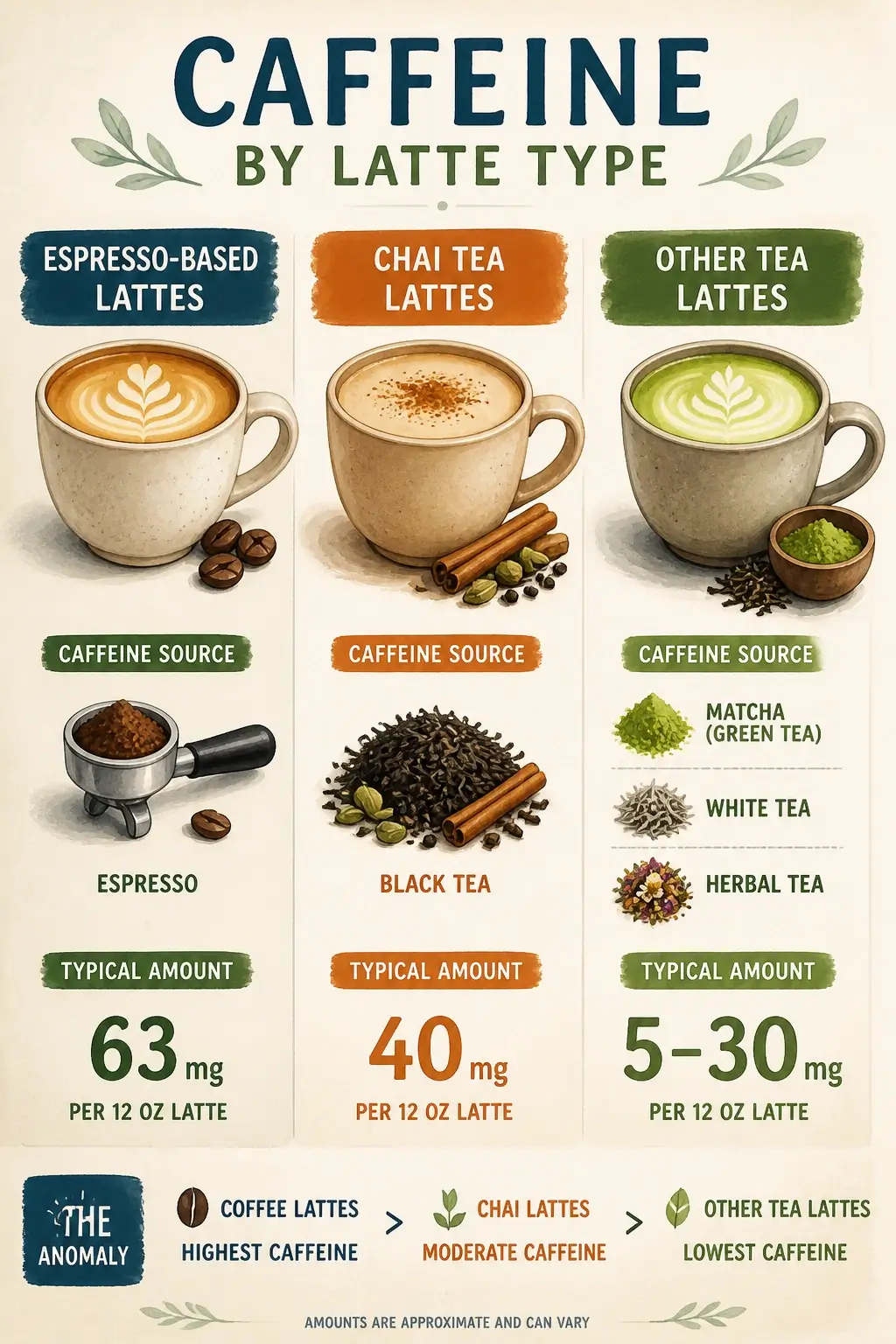
Chai tea concentrate – not espresso shots – is what delivers caffeine in a Venti Chai Tea Latte, and that single fact changes everything about how you read the drink. There are no espresso shots to count, no Blonde Roast variable to consider, and no shot-count math to apply. The caffeine is baked into the concentrate Starbucks uses, and the Venti size delivers approximately 120 mg.
To put that in context: a hot Venti standard latte gives you 150 mg, and an iced Venti gives you 225 mg. So the Chai Tea Latte sits below both – but it’s meaningfully higher than what most people expect from a “tea drink.” It’s not a low-caffeine alternative to espresso; it’s a moderate-caffeine drink in its own category.
This anomaly extends to other tea-based lattes on the Starbucks menu. A Matcha Latte gets its caffeine from matcha powder. A London Fog gets it from Earl Grey tea bags. None of these follow the espresso shot-count rule, and none of them will update in the app the same way an espresso drink does when you modify shots – because there are no shots to modify.
The one customization that does work: you can ask for an espresso shot added to a Chai Tea Latte. That brings it from ~120 mg to ~195 mg. But the base caffeine from the concentrate doesn’t change; you’re layering on top of it.
Here’s a side-by-side look at how chai and espresso-based Venti lattes compare in caffeine content:
Janice Chinna Kanniah, Specialty Coffee Writer at Perfect Daily Grind, puts the fundamental distinction cleanly:
“The chai latte is hot, milky, fragrant, gently spicy, and popular in cafés everywhere. However, despite the fact that it’s served in coffee shops and named after the latte, it actually contains no coffee whatsoever… A chai latte is made by mixing steamed milk with black tea that has been infused with spices.”
That’s the clearest way to think about it. The word “latte” describes the milk format, not the caffeine source. Once you apply that lens, the rest of the tea-latte menu stops being confusing.
Your Venti, Your Way: A Smart Ordering Cheat Sheet
Venti latte caffeine summary comes down to one decision point: which version are you actually ordering? Every variable – temperature, roast, customization, country – feeds into a single number, and that number should match what your body and your day actually need.
Here’s the full picture in one place:
| Venti Latte Variant | Shots | Approx. Caffeine | Key Note |
|---|---|---|---|
| Hot Venti latte (standard) | 2 | ~150 mg | Same shot count as Grande |
| Iced Venti latte (standard) | 3 | ~225 mg | Default for iced drinks |
| Iced Venti Blonde latte | 3 | ~255 mg | Lighter roast = more caffeine |
| European Venti latte (typical) | 1 | ~75 mg | Varies by country – always ask |
| Half-caf hot Venti | 2 (half-caf) | ~75 mg | 50/50 regular and decaf blend |
| Decaf Venti | 2 (decaf) | ~12–15 mg | Trace caffeine remains |
| Venti Chai Tea Latte | 0 espresso | ~120 mg | Caffeine from tea concentrate |
Three common ordering scenarios cover most use cases:
Maximum alertness: Order an iced Venti Blonde latte as-is. No modification needed – 3 Blonde shots at ~255 mg is the highest caffeine you’ll get from a standard Venti latte build.
Moderate caffeine: A hot Venti standard latte at ~150 mg is the middle ground. If that’s still more than you want, a hot Venti half-caf brings it down to ~75 mg without changing the drink’s texture or flavor profile noticeably.
Minimizing caffeine: A decaf Venti is as low as the espresso menu goes, but remember the residual 12–15 mg. If you genuinely need near-zero caffeine, a non-espresso tea latte like a steamed herbal option is the cleaner route.
All of these numbers are approximations. Roast batch variation, barista pour technique, and machine calibration all introduce small fluctuations – typically within ±10 mg per shot. The figures above are reliable for planning purposes, not pharmaceutical precision.
For pregnant individuals or anyone working against a medical directive, the math is worth running explicitly. The American College of Obstetricians and Gynecologists (ACOG) cites the widely used clinical guideline:
“Various organisations have established guidelines recommending caffeine consumption of no more than 200 mg/day (equivalent to approximately two ground coffees) for women who are pregnant… Risk of miscarriage and preterm birth was similar to the risk for those consuming no caffeine.”
Using the options above, staying under 200 mg is straightforward: a hot Venti half-caf at ~75 mg, a decaf Venti at ~12–15 mg, or a Venti Chai Tea Latte at ~120 mg all leave meaningful margin. The iced Venti standard at ~225 mg exceeds the guideline on its own, so that’s the one to avoid or modify during pregnancy.
The app is your best tool for real-time verification – modify the drink, check the updated nutrition panel, and order with confidence.
Analyzing these beverage variables requires a comprehensive look at the various latte content factors that influence your daily stimulant intake.
Key Takeaways on Venti Latte
- A hot Venti latte contains 2 espresso shots (~150 mg caffeine); an iced Venti contains 3 shots (~225 mg) because the larger cup needs ice room.
- Upgrading from a Grande to a hot Venti gives you more milk, not more caffeine – both use exactly 2 shots.
- Starbucks’ Blonde Espresso Roast adds roughly 10 mg per shot, pushing an iced Venti Blonde to approximately 255 mg total.
- European Venti lattes often contain just 1 shot (~75 mg) – “Venti” is a size, not a global caffeine standard.
- Decaf espresso is not caffeine-free; residual caffeine of 12–15 mg remains after decaffeination.
- A Venti Chai Tea Latte delivers ~120 mg of caffeine from tea concentrate, not espresso – the shot-count math doesn’t apply.
Frequently Asked Questions About Venti Latte
Does a Venti latte have more caffeine than a Grande?
Only if it’s iced. A hot Venti latte and a Grande both use 2 espresso shots, so the caffeine is identical at around 150 mg – you’re just getting more milk in the Venti.
What Starbucks drink gets you closest to 200 mg of caffeine?
An iced Venti standard latte at ~225 mg is the closest standard build, but if you want to land right at 200 mg, a hot Venti with one extra shot (~225 mg) or a half-caf iced Venti (~113 mg) brackets the target from either side.
Can diabetics drink a Venti latte at Starbucks?
The espresso shots in a plain Venti latte contain no sugar – the carbohydrate load comes entirely from milk and any added syrups. A Venti latte made with unsweetened almond milk and no syrup is significantly lower in carbs, but anyone managing blood sugar should verify the full nutrition panel in the app before ordering.
Does the type of milk change the caffeine in a Venti latte?
No. Oat milk, almond milk, whole milk, and every other milk option contribute zero caffeine. Swapping milk only changes the calorie, fat, and carbohydrate profile – not the stimulant content.
Is a Venti latte stronger than a Venti Americano?
Usually not. A Venti Americano is made with 4 espresso shots, delivering roughly 300 mg of caffeine – well above both the hot and iced Venti latte. The Americano is the higher-caffeine choice if intensity is the goal.
What happens to the caffeine if I add extra pumps of syrup to my Venti latte?
Nothing – syrups are sugar-based and caffeine-free. Adding vanilla, caramel, or hazelnut pumps changes the sweetness and calorie count but leaves the caffeine number exactly where it was.
If I order a Venti latte every day, am I close to the daily caffeine limit?
A hot Venti standard latte at ~150 mg puts you at about 38% of the FDA’s 400 mg daily guideline, leaving room for other caffeine sources. An iced Venti Blonde at ~255 mg uses about 64% of that ceiling in one drink – worth tracking if you’re also having tea, energy drinks, or a second coffee.
Why does the Starbucks app show 3 shots when I select a Venti latte?
The app defaults to the iced Venti recipe, which does use 3 shots. If you’re ordering hot, double-check the temperature toggle – the shot count and caffeine number in the nutrition panel will update once you switch to hot.
References
- Starbucks Beverage Nutritional Facts (June 2024) – starbuckspr.com
- Variations in caffeine and chlorogenic acid contents of coffees: what are we drinking? – pubs.rsc.org
- Which? Consumer Group: Caffeine in UK Coffee Chains – which.co.uk
- Chai Latte Guide – perfectdailygrind.com
- American College of Obstetricians and Gynecologists (ACOG): Caffeine and Pregnancy Guidelines – acog.org