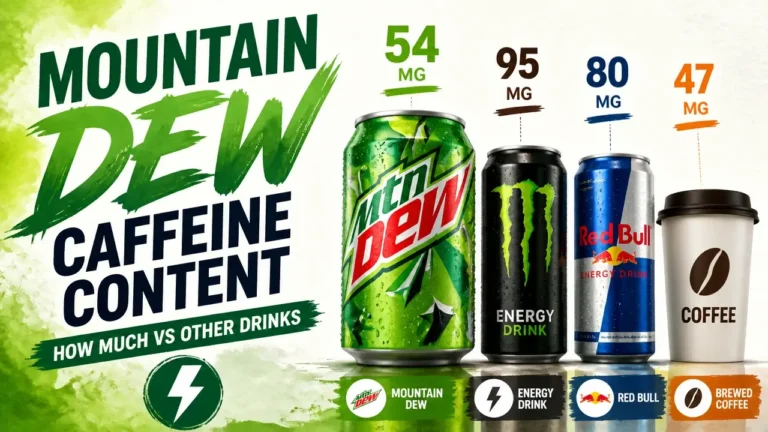

Surprisingly misunderstood Mountain Dew caffeine content sits at 54mg per 12oz-already 60% stronger than a Coke-but that number only tells half the story. Sugar content, real-world serving sizes, and your own biology all shape what you actually feel when you crack that can.
Before you grab whatever’s coldest in the fridge, it’s worth knowing what each drink is actually doing to your energy levels. We’re putting Mountain Dew head-to-head with Coke, Pepsi, Monster, and coffee so the choice makes sense before you make it.
The Caffeine Lineup: What We’re Comparing
Caffeine comparison across drinks sounds simple until you realize most people are comparing a 12oz soda to a 20oz bottle to a 16oz energy can-and calling it even. We’re not doing that here. We’re putting Mountain Dew, Coke, Pepsi, Monster, and standard brewed black coffee side by side using a consistent set of rules so the numbers actually mean something.
Here’s the framework we’re working with: all soda comparisons use a 12oz can, energy drinks use a standard 16oz can, and coffee uses an 8oz cup of home-brewed black. Where real-world sizes matter-like that 20oz Dew you grabbed at a gas station-we’ll call those out specifically.
Caffeine alone isn’t the full story either. The sugar load in a drink affects how fast that caffeine hits and how hard the crash lands. A 54mg caffeine hit wrapped in 46 grams of sugar behaves differently in your body than 54mg in plain black coffee. Speed of absorption, sugar spike, and what comes after all matter to the actual experience.
The FDA’s daily caffeine limit for a healthy adult is 400mg. That’s our ceiling. Every number in this comparison exists somewhere on that scale, and knowing where your drink lands-and how quickly you can stack up to that limit without realizing it-is the whole point of this exercise.
Dr. David Valenzuela, lead researcher in nutritional neuroscience and cognitive performance, found something worth knowing before we even get to the numbers:
“The sensory drivers of refreshing perception are likely to have [effects] on cognitive performance and mental energy… leading to a more ‘immediate’ and a more consistent effect on sustained attention, compared to caffeine alone.”
That’s a clinical way of saying the carbonation itself-not just the caffeine-changes how alert you feel, and how fast. So when you’re comparing a fizzy soda to a cup of coffee, you’re not just comparing caffeine milligrams. The delivery vehicle is part of the equation.
Mountain Dew: The Soda With a Surprising Kick
Reliably underestimated Mountain Dew caffeine content opens at 54mg per 12oz can-the highest of any mainstream soda you’ll find in a standard cooler. That’s the classic, full-sugar version. Scale up to the 20oz bottle most people actually buy at a gas station, and that number climbs to 91mg in a single serving.
The sugar situation is worth understanding here. A standard 12oz Mountain Dew carries up to 46 grams of sugar. That sugar load is a big part of why Dew feels like a fast, punchy hit-the sugar spike accelerates how quickly you feel the caffeine, and it’s also what sets up the crash about an hour later. Caffeine and sugar are working together on the way up, and against you on the way down.
What most people don’t know is that Mountain Dew’s zero-sugar version quietly turns the caffeine dial up, not down. When manufacturers strip out the sugar, they often compensate with more caffeine to maintain the perceived energy effect.
According to caffeine data tracked by Eat Healthy 365, zero-sugar soft drinks average a meaningful caffeine increase over their full-sugar counterparts-and Mountain Dew is a clear example of this pattern. A 12oz zero-sugar Mountain Dew contains 68mg of caffeine compared to 54mg in the regular version. A 20oz zero-sugar bottle carries 113mg versus 91mg in the full-sugar form. That’s roughly a 24% caffeine increase with zero sugar added to your system.
Then there’s the energy drink side of the Mountain Dew brand, which is an entirely different category. Mountain Dew Rise delivers 180mg per 16oz. Amp runs 142mg per 16oz. Fast Twitch pushes to 200mg per 16oz. Game Fuel Mystic Punch sits at 114mg per 20oz. These aren’t sodas-they’re energy drinks with added B-vitamins and taurine-but they carry the same brand name, so it’s worth knowing what you’re actually picking up when you see “Mountain Dew” on the can.
If caffeine is the reason you’re reaching for a Dew, the zero-sugar soda or the energy variants give you substantially more kick than the classic can-without the sugar avalanche.
Coca‑Cola: The Classic Contender
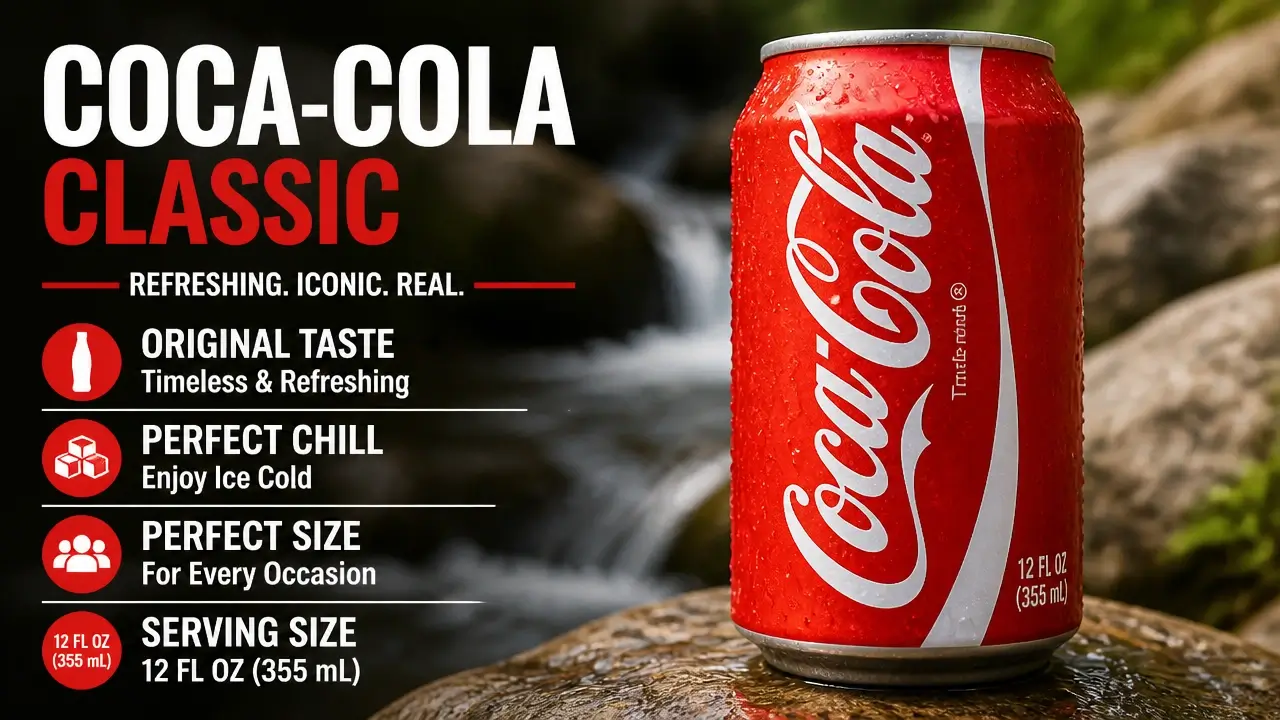
Standard Coca-Cola caffeine sits at 34mg per 12oz can-and that single number explains a lot about why Mountain Dew has a reputation for being the stronger soda. At 54mg, Mountain Dew delivers about 60% more caffeine than a regular Coke, which is a meaningful gap if caffeine is what you’re after.
One thing that levels the playing field slightly: sugar. A 12oz Coke contains roughly 39 grams of sugar, putting it in the same general territory as Mountain Dew’s 46 grams. The sugar experience is similar; the caffeine gap is where these two drinks actually diverge.
Here’s a detail worth knowing about Diet Coke and Coke Zero. Unlike what you might expect, going zero-sugar on the Coke side doesn’t change the caffeine equation. Diet Coke and Coke Zero both contain roughly the same caffeine as regular Coke-around 34mg per 12oz. So if you’re choosing a Coke variety hoping for a caffeine upgrade, the flavor and sugar profile change, but the energy won’t.
When you’re standing in front of the cooler deciding between a Coke and a Mountain Dew, you’re essentially choosing between a mild lift and a noticeably stronger one.
Pepsi: A Touch Sweeter, a Little Less Caffeine
Pepsi’s caffeine count lands at 38mg per 12oz can-slightly ahead of Coke, but still well behind Mountain Dew’s 54mg. The gap between Pepsi and Dew is about 42%, which is noticeable if you’re using soda as a functional energy source rather than just a drink.
Sugar-wise, Pepsi runs about 41 grams per 12oz can, placing it squarely between Coke (39g) and Mountain Dew (46g). The three sodas are in the same neighborhood on sugar, so that’s not where you make your decision. Caffeine is the real differentiator across all three.
Pepsi Zero Sugar follows the same pattern as Coke’s diet options-the caffeine content doesn’t shift significantly from the full-sugar version. You’re still getting roughly the same 38mg whether you go full-sugar or zero. So across the cola landscape, Mountain Dew holds the caffeine lead, and no zero-sugar cola swap is going to change that picture.
Monster: The Energy Drink That Leaves Soda Behind
Standard Monster Energy operates in a different weight class entirely-a 16oz can contains 160mg of caffeine, which is about three times what you get from a 12oz Mountain Dew and nearly double what’s in a 20oz Dew bottle. That’s not a marginal difference; it’s a category jump.
The sugar load matches the ambition. A standard 16oz Monster packs roughly 54 grams of sugar-more than any of the sodas in this comparison. You’re getting a heavy sugar hit alongside a serious caffeine surge, which creates a more intense spike-and-crash cycle than any soda can deliver.
Monster also makes zero-sugar versions that keep the 160mg caffeine without the sugar, and the brand’s stronger lines push even further. Monster Reign, for example, reaches 300mg per 16oz-which starts to blur into pre-workout supplement territory rather than casual refreshment.
Dr. Eliza Blicharska, pharmaceutical chemist and heavy metal toxicity researcher, puts the energy drink category in plain terms:
“They typically contain large amounts of caffeine, added sugars, other additives, and legal stimulants such as guarana, taurine, and L-carnitine. These legal stimulants can increase alertness, attention, and energy…”
That’s the key distinction between Monster and soda. Mountain Dew’s caffeine is the whole story. Monster’s caffeine is part of a stack that includes other stimulants your body is processing simultaneously.
For anyone loyal to the Mountain Dew brand who wants Monster-level caffeine, the Dew energy line-Rise at 180mg and Fast Twitch at 200mg-matches or exceeds Monster’s original 160mg. So the real question isn’t just “Monster vs soda.” It’s whether you want to stay in familiar brand territory or cross into a different product category entirely.
While Monster sets a high ceiling for canned stimulants, gamers evaluating alternative high-potency beverages can examine the NOS drink caffeine numbers for a complete picture of extreme-energy options.
Coffee: The Caffeine Champion Without the Sugar
The Caffeine-Per-Ounce Edge of Black Coffee
Calorie-free black coffee dominates the caffeine-per-ounce comparison, and it’s not particularly close. Home-brewed coffee delivers between 95 and 150mg of caffeine per 8oz cup. Scale that up to a 12oz small from a coffee shop, and you’re easily looking at 200–300mg in a single order.
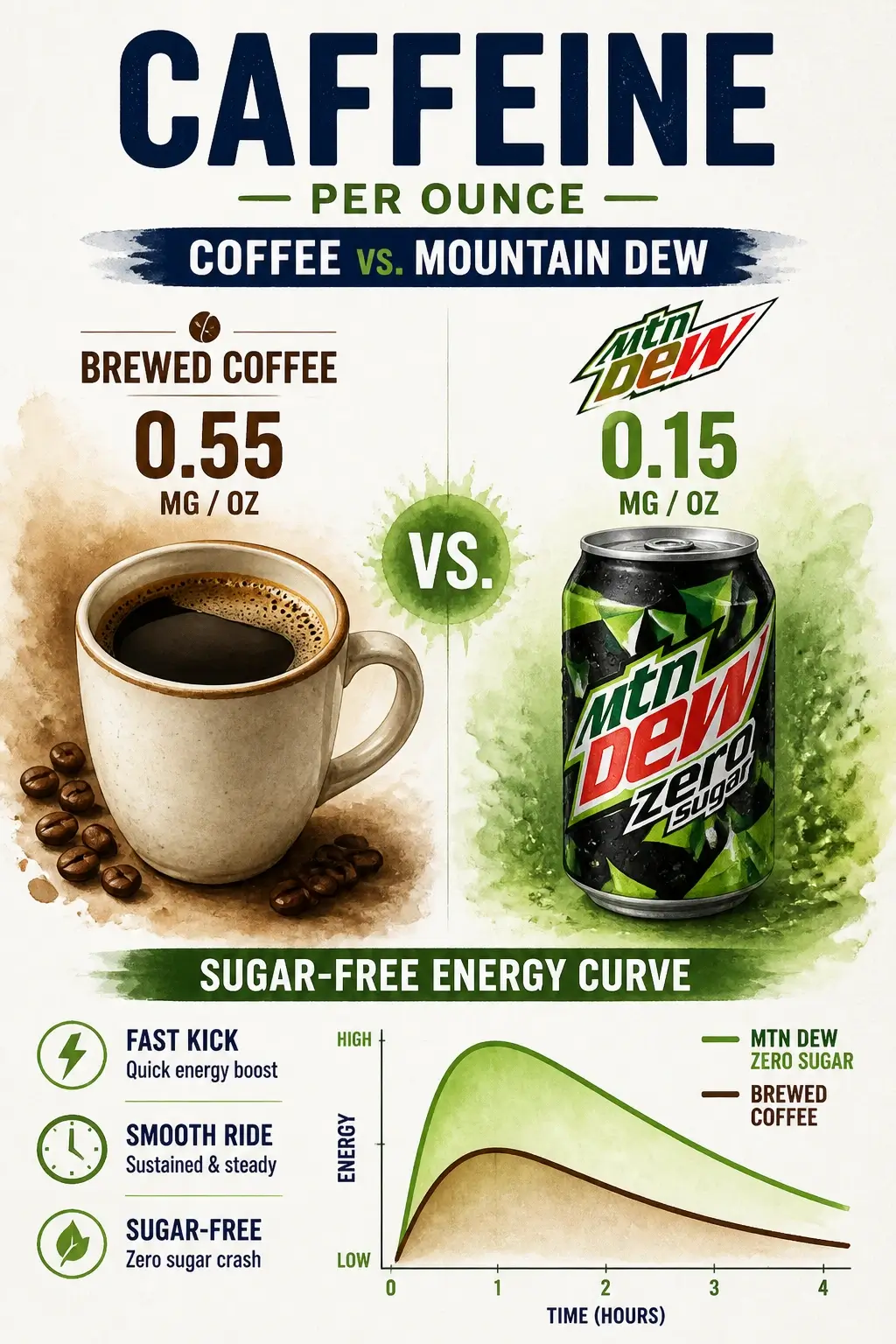
Put that next to Mountain Dew: an 8oz cup of black coffee already contains nearly double the caffeine of a 12oz Dew, and it does so with zero grams of sugar. That’s a fundamentally different energy experience. Without the sugar spike, coffee delivers a smoother, more gradual energy curve-the caffeine climbs steadily rather than spiking fast and dropping hard. Mountain Dew’s sugar load creates a faster, joltier burst that feels more immediate but fades more sharply.
Dr. Małgorzata Kowalska, food technology and clinical nutrition scientist, points out that even the way you brew matters:
“The caffeine content, a bioactive compound of coffee, depends on many factors, including the brewing method… suggesting that even minor variations in brewing method parameters may affect the content of the active ingredient.”
In practical terms, that means the 95–150mg range isn’t a fixed number-your brewing method, grind size, and steep time can all push that number higher or lower. The infographic below shows how coffee’s caffeine-per-ounce advantage plays out visually against Mountain Dew across common serving sizes.
Caffeine Tolerance and the 400mg Limit
Careful caffeine management gets complicated fast when large coffee servings enter the picture. A single large coffee-shop order can carry 300mg or more-meaning one drink gets you 75% of the way to the FDA’s daily ceiling before lunch.
The 400mg daily limit is worth treating as a rough guide rather than a universal guarantee of safety. That ceiling is based on a healthy adult with no underlying conditions, and real-world sensitivity varies significantly. Some people experience heart palpitations and anxiety at 200mg-well below the “safe” limit. The reason often comes down to genetics.
A gene variant called CYP1A2 controls how quickly your liver breaks down caffeine. Research published in the Journal of Caffeine and Adenosine Research measured serum caffeine concentrations in cyclists classified by genotype and found that people carrying the C-allele variant showed significantly higher caffeine levels in their blood one hour after the same dose-11.7 ppm for fast metabolizers versus 14.2 ppm for slow metabolizers. A separate study in the British Journal of Clinical Pharmacology confirmed the same pattern: the C→A variant in the CYP1A2 gene meaningfully changes how quickly caffeine clears your system. A systematic review in Nutrients covering 26 studies concluded that these CYP1A2 variants consistently associate with differences in caffeine consumption patterns and metabolic rate.
What that means practically: if you’re someone who gets jittery from a single strong coffee, your body may be a slow metabolizer. In that case, a zero-sugar Mountain Dew at 68–113mg might give you a more predictable, tolerable boost than an equivalent-caffeine coffee dose.
There’s one more factor most caffeine comparison articles skip entirely: withdrawal. Caffeine is an FDA-recognized drug, and regular daily consumers who miss their usual dose can experience headaches, fatigue, and irritability within 12–24 hours. If you’re deciding to make coffee your daily go-to based on this comparison, that’s worth factoring into the decision-not as a reason to avoid it, but as a reason to stay aware of how much you actually need versus how much you’re consuming out of habit.
Navigating the threshold for daily stimulants extends beyond brewed coffee and soda, requiring similar vigilance when measuring Starbucks chai latte caffeine contents.
The Final Verdict: Which Drink Should You Actually Grab?
Practical caffeine decision-making doesn’t require a chemistry degree-just a clear mental picture of what each drink actually delivers and what it costs you in sugar and stimulant load. Here’s how it breaks down by scenario.
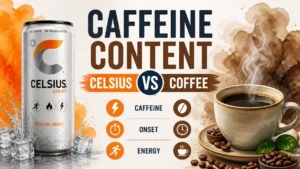
Celsius Vs Coffee Explained visually against Mountain Dew across common serving sizes.
The comparison table below puts all five contenders on the same page before we get into the recommendations.
| Drink | Serving Size | Caffeine (mg) | Sugar (g) |
|---|---|---|---|
| Black Coffee | 8 oz | 95–150 | 0 |
| Mountain Dew Zero Sugar | 12 oz | 68 | 0 |
| Mountain Dew (Regular) | 12 oz | 54 | 46 |
| Mountain Dew (Regular) | 20 oz | 91 | 77 |
| Pepsi | 12 oz | 38 | 41 |
| Coca-Cola | 12 oz | 34 | 39 |
| Monster Energy | 16 oz | 160 | 54 |
| Monster Zero Sugar | 16 oz | 160 | 0 |
| Mountain Dew Rise | 16 oz | 180 | varies |
| Mountain Dew Fast Twitch | 16 oz | 200 | varies |
Here’s how to read that table when you’re standing in front of the cooler:
- Pure caffeine kick, no sugar: Black coffee wins per ounce, every time. A small black coffee gives you more caffeine than any soda can, with zero sugar and zero crash from a sugar spike.
- Best caffeine boost in a soda: Mountain Dew Zero Sugar is the highest-caffeine mainstream soda without the sugar load. It’s the smart pick if you want the soda experience and a real lift.
- Mild midday bump: Coke or Pepsi at 34–38mg are fine for a gentle lift, but know you’re also taking in 39–41 grams of sugar for that small caffeine payoff.
- Maximum caffeine: Monster or the Dew energy line (Rise at 180mg, Fast Twitch at 200mg) are in the same territory. Just remember these are energy drinks with additional stimulants, not sodas.
On the 400mg daily ceiling: that looks like roughly 7 cans of classic Mountain Dew, 11 cans of Coke, just over 2 standard Monsters, or 2–3 medium coffees. It’s surprisingly easy to overshoot with large coffee shop orders and energy drinks stacked throughout the day.
The sugar reality check matters too. Every full-sugar soda and standard Monster dumps 39–54 grams of added sugar into your system per serving. The American Heart Association recommends no more than 25–36 grams of added sugar per day for adults. One full-sugar soda or energy drink can blow past that in a single sitting. Zero-sugar options solve the sugar problem but introduce artificial sweeteners, which carry their own ongoing debate about long-term effects.
One last option worth knowing: if you want coffee-level caffeine without the jittery edge, pairing a zero-sugar Mountain Dew or a Game Fuel Mystic Punch (114mg/20oz) with an L-theanine supplement-the amino acid that gives green tea its calm-alert quality-can replicate the smooth, sustained focus of a strong tea at roughly the same caffeine level. It’s an underused hack for people who like soda but find straight coffee too peaky.
Dr. Jose Antonio, professor of exercise science and co-founder of the International Society of Sports Nutrition, frames the energy drink caffeine question this way:
“The caffeine content of EDs [energy drinks] would be considered safe as 174 mg of caffeine is well below the 400 mg threshold established by the Food and Drug Administration, which has been proposed as an upper limit to avoid adverse effects.”
That’s reassuring context for moderate energy drink use-but it’s worth remembering that “below the limit” and “right for your body” aren’t the same thing. Your genetics, your daily caffeine habit, your stress levels, and whether you’ve eaten that day all shape how a given dose actually lands. The best pick isn’t always the one with the most milligrams. It’s the one that gives you steady, sustainable energy without costing you a crash or a sleepless night.
Key Takeaways on Mountain Dew Caffeine Content
- Mountain Dew’s 54mg per 12oz makes it the most caffeinated mainstream soda, beating Coke by 60% and Pepsi by 42%.
- Zero-sugar Mountain Dew contains 68mg per 12oz-about 24% more caffeine than the full-sugar version, with no added sugar.
- Black coffee delivers 95–150mg per 8oz, more caffeine per ounce than any soda, with zero sugar and a smoother energy curve.
- Monster Energy’s 160mg per 16oz triples a standard Dew can, but also includes additional stimulants beyond caffeine.
- The FDA’s 400mg daily limit is a ceiling for healthy adults-genetics, medications, and health conditions can lower your personal safe zone significantly.
- Sugar load matters as much as caffeine: full-sugar sodas and standard Monster can push you past the daily added-sugar limit in a single serving.
Frequently Asked Questions About Mountain Dew Caffeine Content
How much caffeine is in a 20oz Mountain Dew compared to a 12oz can?
A 20oz Mountain Dew bottle contains 91mg of caffeine, compared to 54mg in a 12oz can-so you’re getting nearly 70% more caffeine just by upgrading the size. If you’re buying the larger bottle without thinking about it, that’s a meaningful difference in your daily caffeine total.
Does Mountain Dew have more caffeine than Red Bull?
Yes, in most size comparisons. A standard 8.4oz Red Bull contains 80mg of caffeine, while a 12oz Mountain Dew has 54mg-but scale up to a 20oz Dew at 91mg and it pulls ahead. The Mountain Dew energy line (Rise at 180mg, Fast Twitch at 200mg) leaves Red Bull well behind.
Is it safe to drink Mountain Dew every day?
One 12oz can a day is well within the FDA’s 400mg daily caffeine limit, but the sugar load is the bigger concern-46 grams per can is already at or above the American Heart Association’s daily added-sugar recommendation for adults. Zero-sugar Mountain Dew solves the sugar problem while keeping the caffeine.
What’s the 2-hour coffee rule and does it apply to Mountain Dew?
The 2-hour coffee rule is the informal guideline to avoid caffeine within 2 hours of waking so you don’t blunt your natural cortisol peak, and to cut off caffeine at least 6 hours before bed so it doesn’t wreck your sleep. It applies to any caffeinated drink-including Mountain Dew-since caffeine’s half-life in your system runs 5–7 hours regardless of the source.
Can caffeine affect creatinine levels?
Caffeine can temporarily raise creatinine levels by increasing kidney filtration rate and muscle metabolism, which may skew a creatinine blood test if consumed right before it. If you’re getting a kidney function panel, it’s worth skipping caffeinated drinks-including Mountain Dew-for a few hours beforehand.
Does caffeine negate ashwagandha?
They don’t directly cancel each other out, but they do work in opposite directions-caffeine stimulates the central nervous system while ashwagandha is an adaptogen that helps regulate cortisol and stress response. Taking them together doesn’t eliminate either effect, but the calming quality of ashwagandha may feel blunted by a high-caffeine drink like Mountain Dew.
What’s the unhealthiest energy drink option in this comparison?
Standard Monster Energy at 160mg of caffeine and 54 grams of sugar per 16oz can is the heaviest hitter in terms of combined stimulant and sugar load. The Mountain Dew Fast Twitch at 200mg per 16oz surpasses it on caffeine, but sugar content varies by flavor-check the label before assuming zero-sugar.
Why does zero-sugar Mountain Dew have more caffeine than regular?
When manufacturers remove sugar from a beverage, they often increase caffeine to compensate for the loss of the fast-energy sensation sugar provides. With zero-sugar Mountain Dew, that tradeoff results in 68mg per 12oz versus 54mg in the regular version-more caffeine, less sugar, but the energy experience still feels similar to the original.
References
- The Matrix Matters: Beverage Carbonation Impacts the Timing of Caffeine Effects on Sustained Attention – mdpi.com
- The Ultimate Guide to Caffeine in Sodas From Coke to Pepsi – eathealthy365.com
- The Dark Side of Energy Drinks: An Impact on the Human Body – mdpi.com
- Quantitative Analysis of Caffeine in Roasted Coffee – mdpi.com
- The Effect of the CYP1A2 −163 C > A Polymorphism on Caffeine Metabolism and Subsequent Cycling Performance – liebertpub.com
- Functional Significance of a C→A Polymorphism in Intron 1 of the Cytochrome P450 CYP1A2 Gene Tested With Caffeine – pmc.ncbi.nlm.nih.gov
- Impact of Genetic Variability on Physiological Responses to Caffeine in Humans: A Systematic Review – pmc.ncbi.nlm.nih.gov
- Common Questions and Misconceptions About Energy Drinks – mdpi.com