
Coca-Cola caffeine content is one of the most searched nutrition questions in the beverage aisle – and one of the most consistently misreported. Most people assume Diet Coke has less caffeine than Classic. It has more. Most people assume a can of Coke is close to a cup of coffee in caffeine. It’s not even half.
This guide builds the full picture: every product, every retail size, cross-brand comparisons against Mountain Dew, Pepsi, and Red Bull, the metabolic reason a Coke crash feels different from a coffee crash, and the FDA’s 400 mg daily ceiling in real-can terms. By the end, you’ll know exactly which number in the can is the one worth watching – and it isn’t caffeine.
Key Takeaways on Coca-Cola Caffeine Content
- Classic Coke contains 34 mg of caffeine per 12 oz; Diet Coke is higher at 46 mg, not lower – most people have this backwards.
- Caffeine scales linearly with volume: a 20 oz bottle of Classic delivers about 57 mg, and a 2 L bottle delivers roughly 191 mg.
- A 12 oz can of Coke has less than half the caffeine of an 8 oz cup of brewed coffee; the “they’re equal” claim is false when serving sizes are normalized.
- Red Bull’s 80 mg caffeine per 8.4 oz can is more than double Classic Coke’s dose – and additional compounds like taurine may amplify that effect beyond what the label shows.
- The FDA’s 400 mg daily adult limit requires roughly 11 to 12 cans of Classic Coke to approach; caffeine is rarely the constraint.
- One 12 oz regular Coke delivers about 35 g of added sugar – essentially the full daily AHA allowance for women. That’s the number that limits how often a regular Coke fits in a healthy day.
Caffeine in Every Coke at 12 Ounces: The Quick Answer
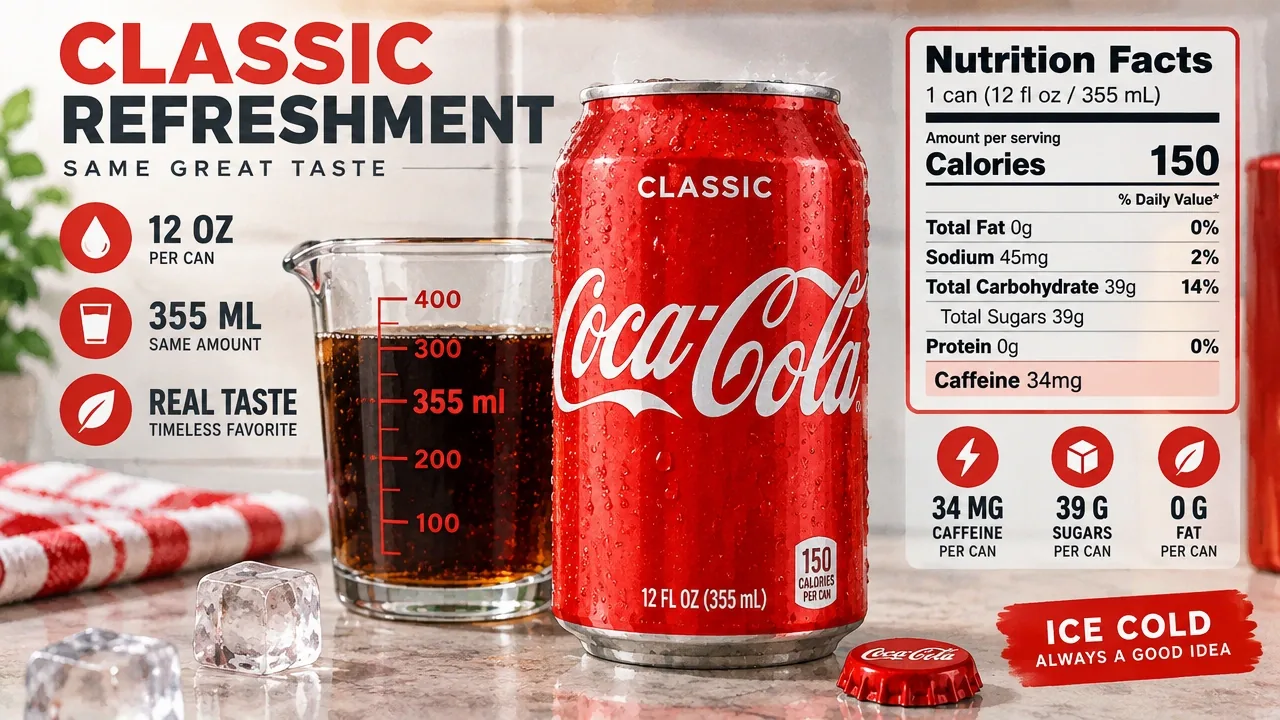
Coca-Cola caffeine content varies across the product line, but the range is narrow. Here are the official figures for every mainstream Coke variant, all measured at the 12 oz (355 ml) standard serving:
| Coca-Cola Variant | Caffeine per 12 oz (355 ml) |
|---|---|
| Classic Coca-Cola | 34 mg |
| Diet Coke | 46 mg |
| Coke Zero Sugar | 34 mg |
| Cherry Coke | 34 mg |
| Mexican Coke | 34 mg |
| Caffeine-Free Coke | 0 mg |
Caffeine is a mild stimulant measured in milligrams. Every figure in this article is tied to a stated serving size – not a vague “can” or “bottle” – because the container you actually buy is rarely 12 oz, and the caffeine scales with every ounce.
The practical ceiling: across the entire Coke line, caffeine tops out at 46 mg per 12 oz. The FDA’s reference limit for healthy adults is 400 mg per day. That gap is large enough that for most people, caffeine is not the number in this can that deserves attention.
Every Coke, Every Size: The Full Breakdown
The 12 oz can is the reference point, not the reality of what most people buy. A 20 oz bottle is the default convenience-store single-serve. A 2 L bottle sits in the fridge for days. Here’s how caffeine scales across the full Coca-Cola product line and every major retail size.
Product Line Caffeine Matrix
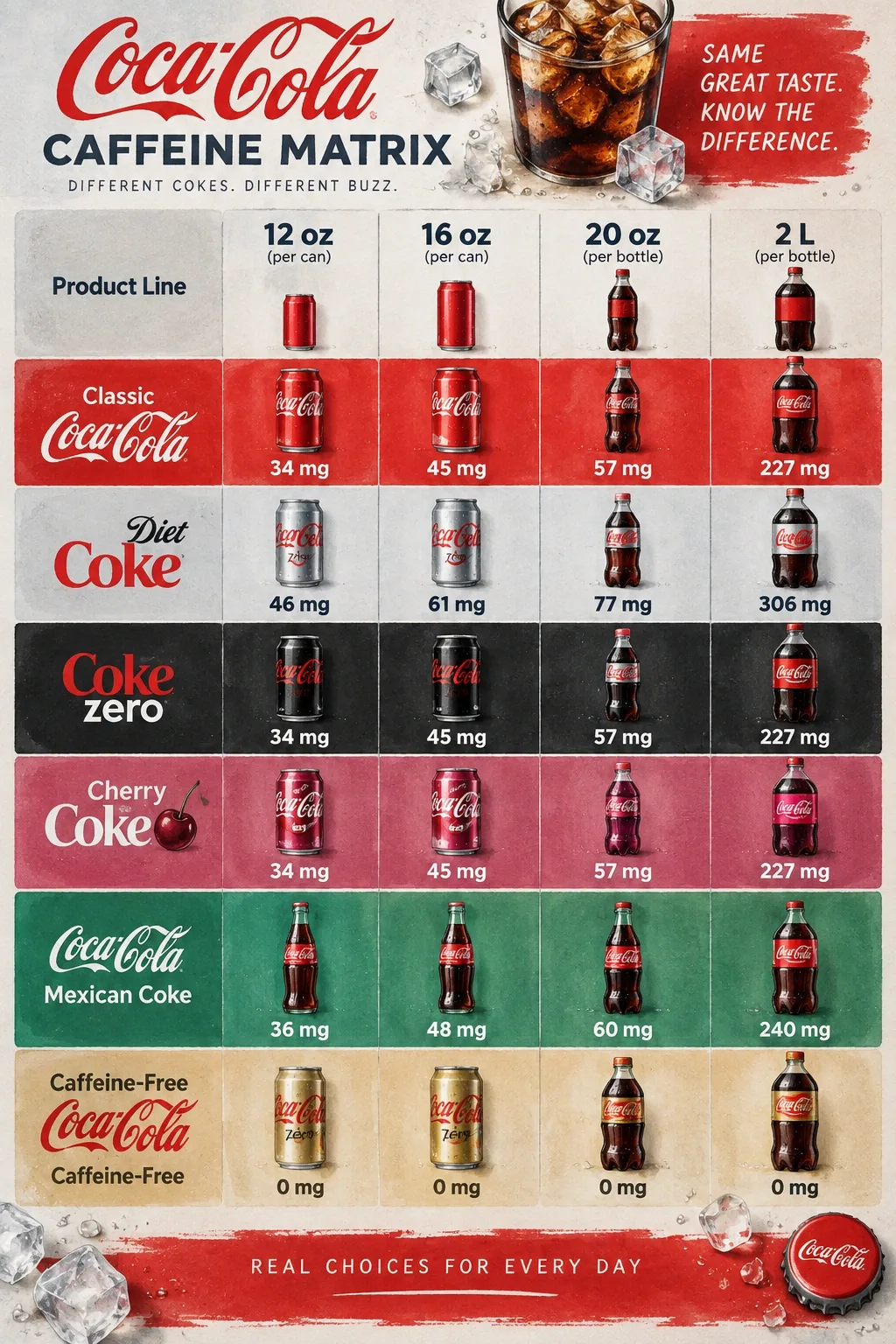
All values in the table below use the manufacturer-reported 12 oz / 330 ml baseline from Coca-Cola’s consumer FAQ and CSPI’s beverage caffeine database. Figures for 16 oz, 20 oz, and 2 L are calculated from that published baseline and are labeled as such – they are not independently manufacturer-published values.
| Variant | 12 oz (355 ml) | 16 oz (473 ml) | 20 oz (591 ml) | 2 L (2,000 ml) |
|---|---|---|---|---|
| Classic Coca-Cola | 34 mg | 45 mg | 57 mg | 191 mg* |
| Diet Coke | 46 mg | 61 mg | 77 mg | 259 mg* |
| Coke Zero Sugar | 34 mg | 45 mg | 57 mg | 191 mg* |
| Cherry Coke | 34 mg | 45 mg | 57 mg | 191 mg* |
| Mexican Coke | 34 mg | 45 mg | 57 mg | 191 mg* |
| Caffeine-Free Coke | 0 mg | 0 mg | 0 mg | 0 mg |
\Calculated from the published 12 oz baseline. Not a manufacturer-published value.*
One data conflict worth naming openly: at least one widely cited beverage blog lists Diet Coke at 30.4 mg per 12 oz – a direct 15 mg conflict with both Coca-Cola’s own consumer FAQ and CSPI’s independently maintained database. This table defaults to the manufacturer and CSPI figures. If you’ve seen the lower number elsewhere, you’ve been comparing against the wrong baseline. The counterintuitive fact – that Diet Coke carries more caffeine than Classic – is consistent across every official source.
Mexican Coke is worth a specific note: the glass bottle, cane sugar, and old-world mystique change nothing about the caffeine load. It matches Classic at 34 mg per 12 oz, full stop.
Capacity Scaling and Purchase-Format Effects
Caffeine scales linearly with volume. Double the liquid, double the caffeine. A 2 L bottle holds roughly 5.6 twelve-ounce servings – so a 2 L of Classic Coke carries approximately 191 mg of caffeine across the whole bottle. Caffeine-Free Coke stays at 0 mg at every size, no arithmetic needed.
The size that surprises people most isn’t the 2 L. It’s the 20 oz bottle – the one you grab at a gas station without thinking. That single bottle delivers about 57 mg of caffeine from Classic, or 77 mg from Diet Coke. That’s meaningfully more than the 12 oz can most people visualized when they first asked the question.
Why Is There Caffeine in Coke at All?
Caffeine in cola is there primarily as a flavor component, not a stimulant payload. It contributes bitterness and body to the taste profile – the same role it plays in dark chocolate and certain teas. That’s why the amount is small and locked to the formula rather than adjusted upward for effect.
Caffeine is a mild stimulant by nature, but its content in any given beverage is a property of that specific product, not a property of the word “soda.” Mountain Dew has more. Sprite has none. The number is set by the recipe, and Coke’s recipe hasn’t changed.
The clearest way to see this: compare Coke’s fixed formula against brewed coffee’s moving target. A can of Classic Coke contains 34 mg of caffeine. Always. Every can. But an 8 oz cup of brewed coffee can land anywhere from 80 mg to over 140 mg depending on the bean variety, roast level, grind size, water temperature, and brew time. Coffee’s caffeine is an estimate; Coke’s is a constant. This distinction matters every time someone tries to compare the two – and most comparisons get it wrong by ignoring the serving size underneath both numbers.
Coke vs the Soda Aisle: Mountain Dew, Dr Pepper, Pepsi, and Sprite
Coke sits mid-pack in the mainstream soda category. Here’s the normalized view, all figures at 12 oz (355 ml):
| Soda | Caffeine per 12 oz (355 ml) |
|---|---|
| Mountain Dew | 54 mg |
| Dr Pepper | 41 mg |
| Pepsi | 38 mg |
| Coca-Cola Classic | 34 mg |
| Sprite | 0 mg |
Mountain Dew is the highest-caffeine mainstream soda in this set. Sprite is the caffeine-free clear-soda option. The spread across the entire mainstream category runs from 0 to 54 mg – under 60 mg of difference between the most and least caffeinated options. Nobody in this group is close to a cup of coffee.
The one rule worth carrying out of this section: a “diet” or “zero” label is not a reliable signal for lower caffeine. The Coke line proves this directly – Diet Coke has 12 mg more caffeine per 12 oz than Classic. The label or the brand’s official website is the only trustworthy source.
One structural problem runs through almost every cross-brand comparison table published online: the serving sizes are never normalized. One source measures cola per 8 oz, another per 12 oz, a third uses “one can” without defining it. A caffeine table that doesn’t print its serving basis isn’t a comparison – it’s a coincidence. Every table in this article is built on a stated 12 oz / 355 ml basis. Apply that same test to every other table you encounter.
Coke vs Coffee: 34 mg Against 95–140 mg, and Why the Kick Feels Different
Brewed Beverage Dose Equivalence
The head-to-head, with both serving sizes defined: an 8 oz cup of brewed coffee delivers approximately 95 mg of caffeine, ranging to roughly 140 mg at stronger brew strengths. A 12 oz can of Classic Coke delivers 34 mg.
The can holds 1.5 times the volume of the cup. And it still has less than half the caffeine.
The widespread claim that a can of Coke has about as much caffeine as a cup of coffee is false. The reason it persists is that most sources publish both numbers without ever placing them on a normalized, equal-volume basis. When you do the math – 34 mg in 12 oz of Coke versus 95 mg in 8 oz of coffee – the gap is obvious. The myth survives because the arithmetic is skipped, not because the numbers are close.
Metabolic Delivery Dynamics
The caffeine dose is only part of why these two drinks feel different. The delivery vehicle does the rest.
Coffee delivers caffeine alongside chlorogenic acids, compounds associated with a measurable effect on glucose and insulin response. A randomized crossover trial published in the American Journal of Clinical Nutrition found that chlorogenic acids may slow intestinal glucose absorption, while caffeine’s own metabolic effects can partially mask that response – producing a flatter, more gradual post-drink glucose curve than you’d get from sugar alone.
Regular Coke works differently. It pairs a 34 mg caffeine dose with a fast high-fructose corn syrup-driven glycemic spike. Blood sugar rises quickly, insulin responds, and the drop that follows is what most people describe as a “crash.” The caffeine dose is real but small. The sugar curve is fast and steep.
This is why people consistently overestimate how much caffeine is in a Coke. The feeling of drinking one – the quick lift, the subsequent slump – tracks the sugar curve far more than the stimulant dose. The caffeine and the crash are two separate events happening in the same can.
Coke vs Energy Drinks: 34 mg Against Red Bull’s 80 mg
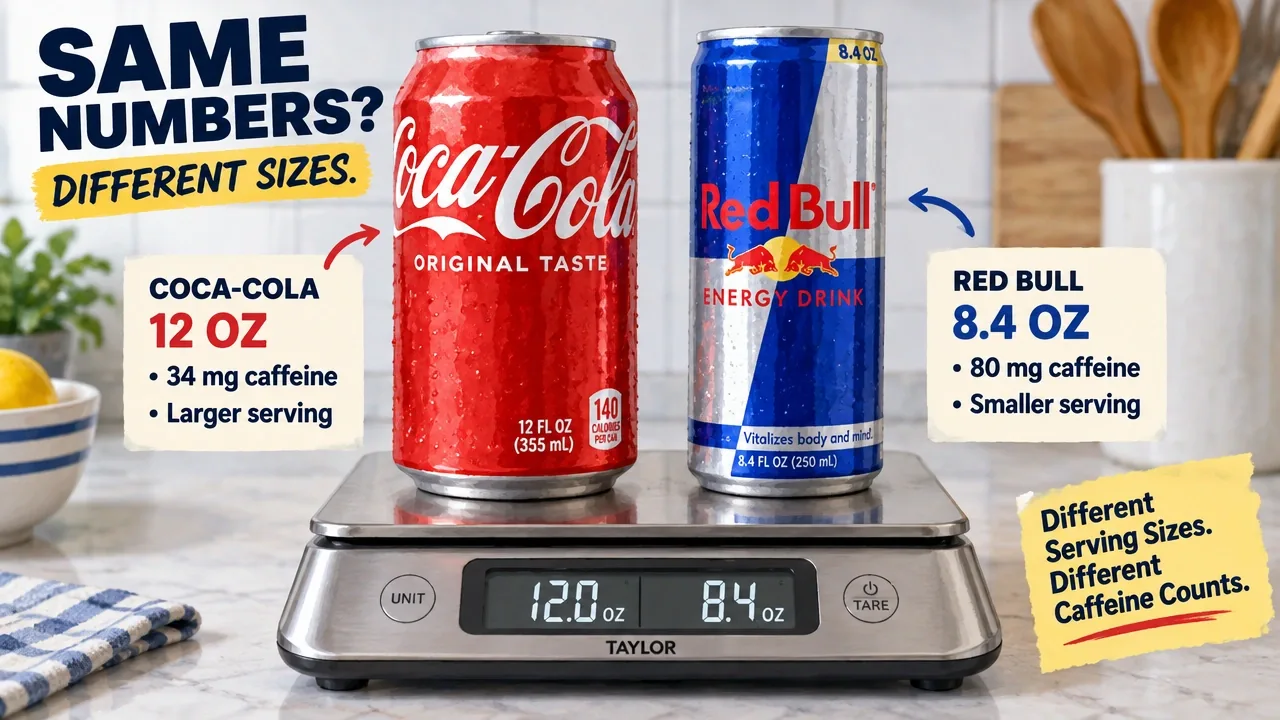
A standard 8.4 oz (250 ml) can of Red Bull contains 80 mg of caffeine. A 12 oz can of Classic Coke contains 34 mg. Red Bull delivers more than double the caffeine in a smaller container.
But caffeine isn’t the whole story with energy drinks. The expert caution that matters here: energy drinks often contain additional compounds – taurine, B-vitamins, and synthetic caffeine – that can increase the perceived and physiological effect of the caffeine itself. Taurine is an amino acid, not a stimulant on its own, but it appears to enhance caffeine’s effect in the central nervous system. B-vitamins support cellular energy metabolism. Synthetic caffeine is chemically identical to the caffeine in coffee and cola, but it’s absorbed faster, producing a sharper onset.
The result: a can of Red Bull at 80 mg doesn’t always feel like 80 mg of caffeine from a Coke would – it often feels like more. The caffeine number understates the total stimulant load when these co-ingredients are present.
This distinction matters most for parents. A Coke is a sugary soda with a moderate, well-characterized caffeine dose. An energy drink is a different category entirely – one where the caffeine label is a floor, not a ceiling, for what you’re actually consuming. That’s where the daily-limit conversation becomes less academic.
The Daily Ceiling: FDA’s 400 mg, Pregnancy’s 200 mg, and Who Needs to Adjust
Adult and Prenatal Intake Thresholds
The FDA’s reference limit for healthy adults is 400 mg of caffeine per day. At 34 mg per 12 oz can, that’s roughly 11 to 12 cans of Classic Coke before you approach the ceiling – a calculated figure, not a manufacturer recommendation. The caffeine in Coke almost never breaches this limit on its own, which is precisely why most adults don’t think about it.
For pregnancy and breastfeeding, the guidance drops to 200 mg per day. At that threshold, the math is tighter: about five to six cans of Classic, or four to five cans of Diet Coke. Still a large number in absolute terms, but the ceiling is real, and other caffeine sources stack on top of it.
Sensitivity symptoms – sleep disruption, jitteriness, and palpitations – can appear well below the 400 mg ceiling in people with higher caffeine sensitivity. The more underreported edge case: caffeine withdrawal can occur from daily intake as low as 100 mg, which is approximately three 12 oz cans of Classic Coke per day. If you drink that much consistently and stop abruptly, the headache is real and physiologically explained.
A note on using Coke as a late-night caffeine strategy: A full 2 L bottle of Classic Coke delivers roughly 200 mg of caffeine – calculated at the commonly cited 10 mg per 100 ml. That’s approximately equivalent to two 8 oz cups of coffee. It can technically keep a person awake. But that 200 mg arrives alongside an enormous simultaneous sugar and calorie load. Solving a sleep-deficit problem with 2 L of regular soda creates a metabolic problem that outlasts the alertness. This is not a workaround.
Pediatric Intake Guidance
For children and adolescents, the guidance from health organizations is categorical rather than numerical: prioritize water and plain milk. Sodas, energy drinks, and juice drinks all belong outside the daily routine for kids – not because any single can is dangerous, but because the habit pattern is what accumulates.
One assumption parents make that the data doesn’t support: diet soda is not a kid-friendly workaround. Artificial sweeteners are not recommended for children due to limited long-term safety data. Swapping a regular Coke for a Diet Coke doesn’t solve the pediatric concern – it trades one problem for an unresolved one.
Caffeine stays well inside the adult daily limit. The next question is what else is in the can.
The Verdict: The Caffeine Is Not the Problem – The Sugar Is
Coca-Cola caffeine content tops out at 46 mg per 12 oz across the entire product line. The FDA’s adult reference sits at 400 mg per day. For most healthy adults, caffeine is not the limiting factor in how often a Coke fits into the day. What comes with it is.
A single 12 oz regular Coke contains approximately 35 grams of added sugar. The American Heart Association’s daily added-sugar recommendation is 25 g for women and 36 g for men. One can of Classic Coke accounts for essentially the entire day’s allowance for women and nearly all of it for men – before any other food or drink is factored in.
The broader health context isn’t subtle. Daily consumption of sugar-sweetened beverages is associated with a 27% higher risk of type 2 diabetes. Carbonated soft drinks are linked to obesity, cardiovascular disease, hypertension, and dental decay. The moderation argument for regular Coke is built entirely around the sugar matrix, not the stimulant. The caffeine debate was never the right frame.
Here’s the actionable read on each variant:
- Caffeine-Free Coke is the only true 0 mg caffeine option at every size. If caffeine is the concern, this is the only Coke that removes it entirely.
- Diet Coke and Coke Zero Sugar remove the sugar but carry 46 mg and 34 mg of caffeine respectively. They’re not recommended for children, and the artificial sweetener question remains open in the pediatric literature.
- Prebiotic sodas (brands like Olipop and Poppi) are lower in sugar than regular Coke, but they belong in the occasional-treat category – not as daily staples replacing water or milk.
The caffeine number in a Coke is moderate, consistent, and label-stable across every variant and every size. The sugar number is the one that determines how often a regular Coke belongs in the day. Every source in this space counts milligrams of caffeine while quietly omitting the gram count that’s actually out of range.
According to Coca-Cola’s official FAQ, a 12 oz can of Classic Coke contains 34 mg of caffeine and Diet Coke contains 46 mg – the company itself notes this is three to four times less caffeine than a same-sized serving of coffee, which runs 140 mg or more.
That comparison is accurate and worth keeping. A Coke is not a coffee. The caffeine dose is a fraction. But the sugar load is the number that changes the frequency equation – and that’s the one most guides never get around to mentioning.
Frequently Asked Questions About Coca-Cola Caffeine Content
How much caffeine is in a Coke vs coffee?
A 12 oz can of Classic Coke has 34 mg of caffeine; an 8 oz cup of brewed coffee typically runs 95–140 mg. The can holds more liquid and still delivers less than half the caffeine – they’re not close.
Is 200 mg of caffeine a lot?
For healthy adults, 200 mg is half the FDA’s 400 mg daily reference limit, so it’s moderate. For pregnant or breastfeeding individuals, 200 mg is the daily ceiling, not a midpoint – context matters.
What soda has the highest caffeine?
Among mainstream sodas, Mountain Dew leads at 54 mg per 12 oz, followed by Dr Pepper at 41 mg, Pepsi at 38 mg, and Classic Coke at 34 mg. Sprite contains no caffeine.
How much caffeine is in 330 ml of Coke?
A 330 ml serving of Classic Coke contains approximately 34 mg of caffeine – Coca-Cola’s published figure uses a 330–355 ml baseline, so the number is consistent across that range.
Why does Diet Coke have more caffeine than regular Coke?
It comes down to formula, not a health decision. Diet Coke is a distinct recipe from Classic Coke – not just Classic with sweetener swapped – and its formulation results in a slightly higher caffeine level at 46 mg per 12 oz versus 34 mg.
Does Mexican Coke have more caffeine because it uses cane sugar?
No. Mexican Coke matches Classic at 34 mg per 12 oz. The sweetener type – cane sugar versus high-fructose corn syrup – doesn’t affect caffeine content. The glass bottle changes the experience; it doesn’t change the stimulant dose.
Can drinking Coke daily cause caffeine withdrawal if you stop?
It can, but only at a meaningful daily volume. Withdrawal symptoms have been documented at consistent daily intake around 100 mg – roughly three 12 oz cans of Classic Coke per day. Below that threshold, the risk is low for most people.
Is Caffeine-Free Coke truly caffeine-free at all sizes?
Yes. Caffeine-Free Coke contains 0 mg of caffeine regardless of serving size – 12 oz, 20 oz, or 2 L. It’s the only Coke variant where no caffeine scaling applies.
References
- What is caffeine? Coca-Cola FAQ | coca-cola.com
- Coffee acutely modifies gastrointestinal hormone secretion and glucose tolerance in humans | pubmed.ncbi.nlm.nih.gov