
Highly variable caffeine in coffee is the reason two people can drink the same “large coffee” and feel completely different an hour later – one wired and anxious, the other barely awake. The gap isn’t willpower or tolerance mythology. It’s biology, brewing physics, and a scoop size nobody ever told you to measure.
An average 8-ounce (240 ml) cup of standard brewed coffee contains approximately 95 mg of caffeine (with a normal range between 70 mg and 140 mg). The FDA puts the daily safe ceiling at 400mg for healthy adults—roughly four standard 8-ounce cups. But that number only means something once you know what’s actually in your specific brew. Espresso, cold brew, drip, instant – each delivers a wildly different dose. Below, you will find the exact lab-tested numbers per serving and the biological variables that control how your body processes every milligram.
For an even deeper dive into how different roasts, origins, and brewing methods impact your daily intake, you can consult this complete guide to caffeine content.
While managing your caffeine intake is essential for safety, understanding how your daily cup fits into a healthy lifestyle is equally important, as explored in Coffee Benefits Unlocked The Definitive.
The 400mg Safety Baseline: What the FDA Says (And Who Should Ignore It)
The FDA’s caffeine safety limit for healthy adults is 400 milligrams per day – a number that sounds precise until you realize most people have no idea how many milligrams are in the cup sitting in front of them. That’s not a scare. It’s just the gap this article closes.
To make 400mg feel real: it’s roughly four standard eight-ounce drip coffees, or about two and a half of the large takeaway cups most of us actually order. For the average healthy adult, staying under that line keeps you in territory the agency considers free from dangerous negative effects.
The U.S. Food and Drug Administration puts it plainly:
“For healthy adults, the FDA has cited 400 milligrams a day-that’s about four or five cups of coffee-as an amount that is not generally associated with dangerous, negative effects. However, the FDA has not set a level for children, but the American Academy of Pediatrics discourages the consumption of caffeine and other stimulants by children and adolescents.”
That qualifier – healthy adults – is doing a lot of heavy lifting. The 400mg line was never meant to be universal, and for several groups it’s far too generous.
The American College of Obstetricians and Gynecologists recommends pregnant women stay under 200mg daily. Nursing mothers should also limit intake, since caffeine passes into breast milk. The American Academy of Child and Adolescent Psychiatry caps teenagers aged 12–18 at 100mg. Children under 12 should avoid caffeine entirely. And older adults – even without changing a single habit – often become more sensitive over time, meaning the 400mg ceiling may still be too high for them even though they’ve been drinking the same amount for decades.
Think of the FDA number as a starting coordinate, not a finish line. It tells you the outer boundary of the map. Where you personally should operate within it depends on variables we’re about to walk through together.
Why Your Coffee’s Caffeine Can Vary by 300%
Wildly inconsistent caffeine in coffee isn’t a mystery – it’s the predictable result of several variables stacking on top of each other, most of which never appear on a menu or a bag. The jittery Tuesday and the flat Wednesday probably came from the exact same coffee shop. Here’s why.
Bean Species: Arabica vs. Robusta
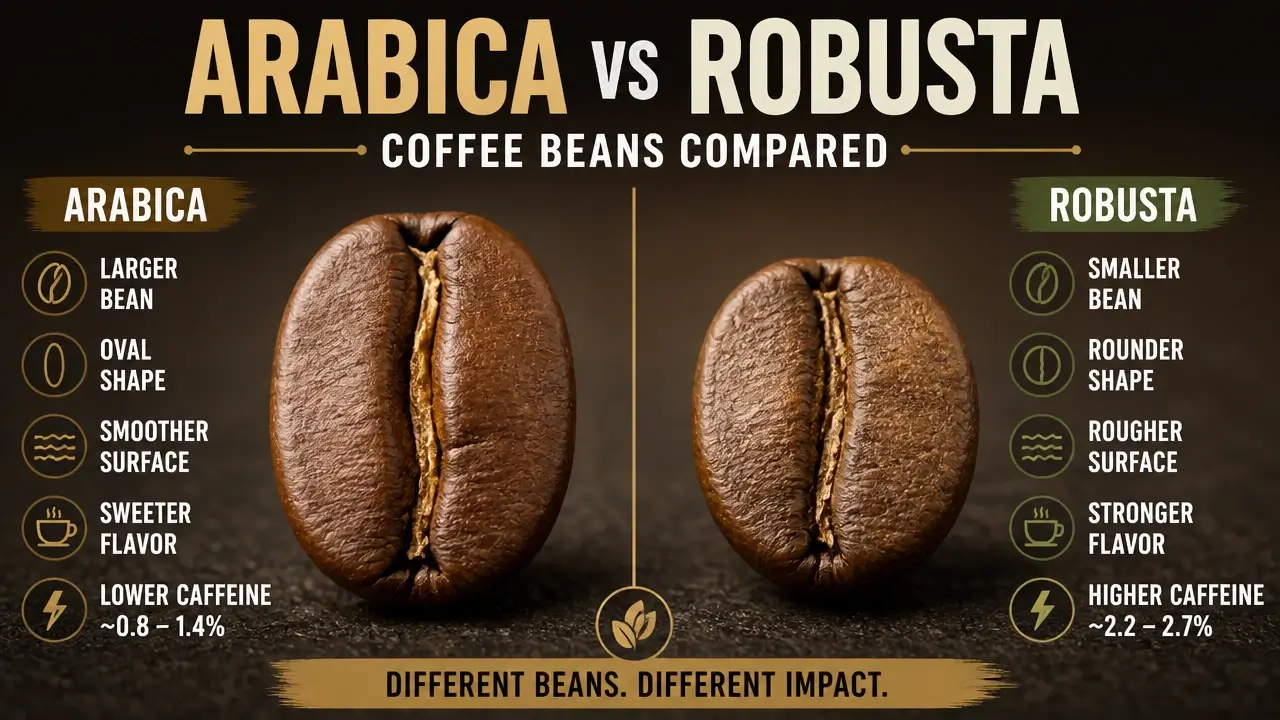
The two dominant coffee species – Arabica and Robusta – aren’t interchangeable. Arabica, which makes up the vast majority of specialty and premium coffee, carries roughly 1.2% caffeine by dry weight. Robusta sits at about 2.2%. That’s nearly double the caffeine load in the same scoop of grounds. Robusta shows up in cheaper blends, supermarket coffee, and most instant coffee, often without any labeling that would tip you off.
The Dark Roast Myth
Most people assume a bold, dark roast must be stronger. The reality is more nuanced. Roasting does break down a small amount of caffeine, but the difference between a light and dark roast is so minor it barely registers in your cup. What actually shifts is bean density: dark roasting causes beans to expand and lose mass, so if you measure by volume – a tablespoon of dark roast grounds versus a tablespoon of light – you’re scooping fewer beans by weight, which can mean slightly less caffeine. If you measure by weight, the difference nearly disappears. Neither roast is meaningfully “stronger” in caffeine terms.
The image below captures just how far apart Arabica and Robusta sit on the caffeine spectrum – a gap that follows your coffee all the way to the cup.
Researchers at the Accademia del Caffè Espresso found that roast level alone doesn’t determine how much caffeine ends up in your cup:
“While it is true that dark roast coffee has higher levels of available caffeine by weight, it is ultimately up to the brewer to pull it out. For maximum extraction efficiency, the Moka pot is the clear winner, ‘thanks to the water temperature of over 90°C and the extraction time.'”
Brewing Method and Extraction
Different brewing methods extract caffeine at different rates. French press and drip methods steep grounds in hot water for several minutes, pulling out more caffeine over time. Espresso works fast – high pressure, hot water, roughly 25–30 seconds – but serves a tiny one-ounce volume. Cold brew sits at the opposite extreme: a high coffee-to-water ratio steeped for 12–24 hours creates a concentrate that can be dangerously potent, even when diluted before serving.
The Most Overlooked Variable: Your Scoop Size
Here’s the lever almost nobody talks about. The coffee-to-water ratio is the single most controllable variable in your daily caffeine intake, and it’s almost entirely absent from consumer caffeine guides. Going from one tablespoon of grounds per eight ounces of water up to three tablespoons can triple the caffeine in your mug without changing the cup size by a single ounce. Consumer Reports uses a consistent standard of two tablespoons per eight ounces in their testing – yet their own brand data shows a 12-ounce serving of Café Bustelo reaching 524mg, likely because home brewers routinely exceed that ratio. Without knowing your scoop size, every caffeine estimate is a guess.
And then there’s the definition of “a cup.” A 12-ounce home mug, a 20-ounce gas station coffee, and a 6-ounce café demitasse are all called a cup. They are not the same thing.
From Espresso to Cold Brew: Real Caffeine Numbers Per Serving
Caffeine content per serving is where the abstract variables from the last section become numbers you can actually use. The espresso-versus-drip debate is the perfect place to start, because the popular assumption gets it exactly backwards.
Espresso is more concentrated – up to 4.2mg of caffeine per milliliter, according to food scientist Dr. Emma Beckett of the University of Newcastle. But concentrated and high-dose are two different things:
“If we focus on caffeine concentration, on a milligram per milliliter (mg/ml) basis, espresso methods are typically the most concentrated, able to deliver up to 4.2 mg/ml. This is about three times higher than other methods like Moka pot (a type of boiling percolator) and cold brewing at about 1.25 mg/ml. Drip and plunger methods (including French and Aeropress) are about half that again… Based on this math, cold brew actually comes out as the highest dose of caffeine per serve with almost 150mg-even higher than the 42-122mg totals found in finished espresso.”
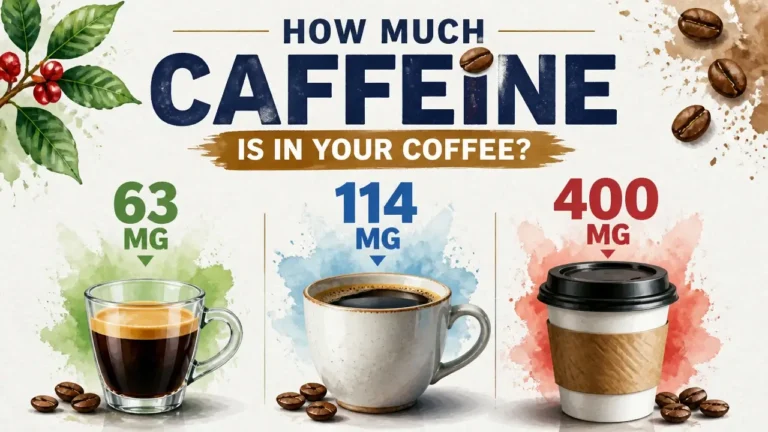
A single one-ounce espresso shot delivers around 63mg. A double is roughly 125mg. Compare that to a 16-ounce drip coffee, which can carry 200mg or more, and the “espresso is stronger” myth falls apart at the serving level.
Here’s how the common options stack up side by side:
| Coffee / Tea Type | Serving Size | Typical Caffeine Range |
|---|---|---|
| Drip coffee | 8 oz | 95–200 mg |
| Drip coffee (12 oz) | 12 oz | 113–247 mg |
| Espresso (single shot) | 1 oz | 42–75 mg |
| Espresso (double shot) | 2 oz | 85–130 mg |
| Instant coffee | 8 oz | 30–90 mg |
| Cold brew (ready to drink) | 12 oz | 155–240 mg |
| Decaf coffee | 8 oz | 2–15 mg |
| Black tea | 8 oz | 28–46 mg |
| Starbucks Venti drip | 20 oz | ~410 mg |
| Café Bustelo (12 oz brewed) | 12 oz | ~524 mg |
The Starbucks Venti alone puts a healthy adult at or past the FDA’s daily ceiling in a single cup. Café Bustelo at a typical home brew strength crosses it by more than 100mg before lunch.
A 2023 analysis of 299 coffee samples found that franchise and café coffees contain on average three times more caffeine than a homemade cup brewed with a modest one-teaspoon dose of grounds. An Americano averaged 143mg per serving while homemade coffee measured just 23mg at that conservative dose. Two takeaway coffees can push you past 400mg before you’ve eaten a single meal – even when you order “regular.”
The math breaks down fast once you factor in real-world cup sizes. If your morning routine involves a 16-ounce drip and an afternoon cold brew, you’re likely well above 400mg on a routine basis without realizing it.
When Your Cup Bites Back: Jitters, Insomnia, and Palpitations
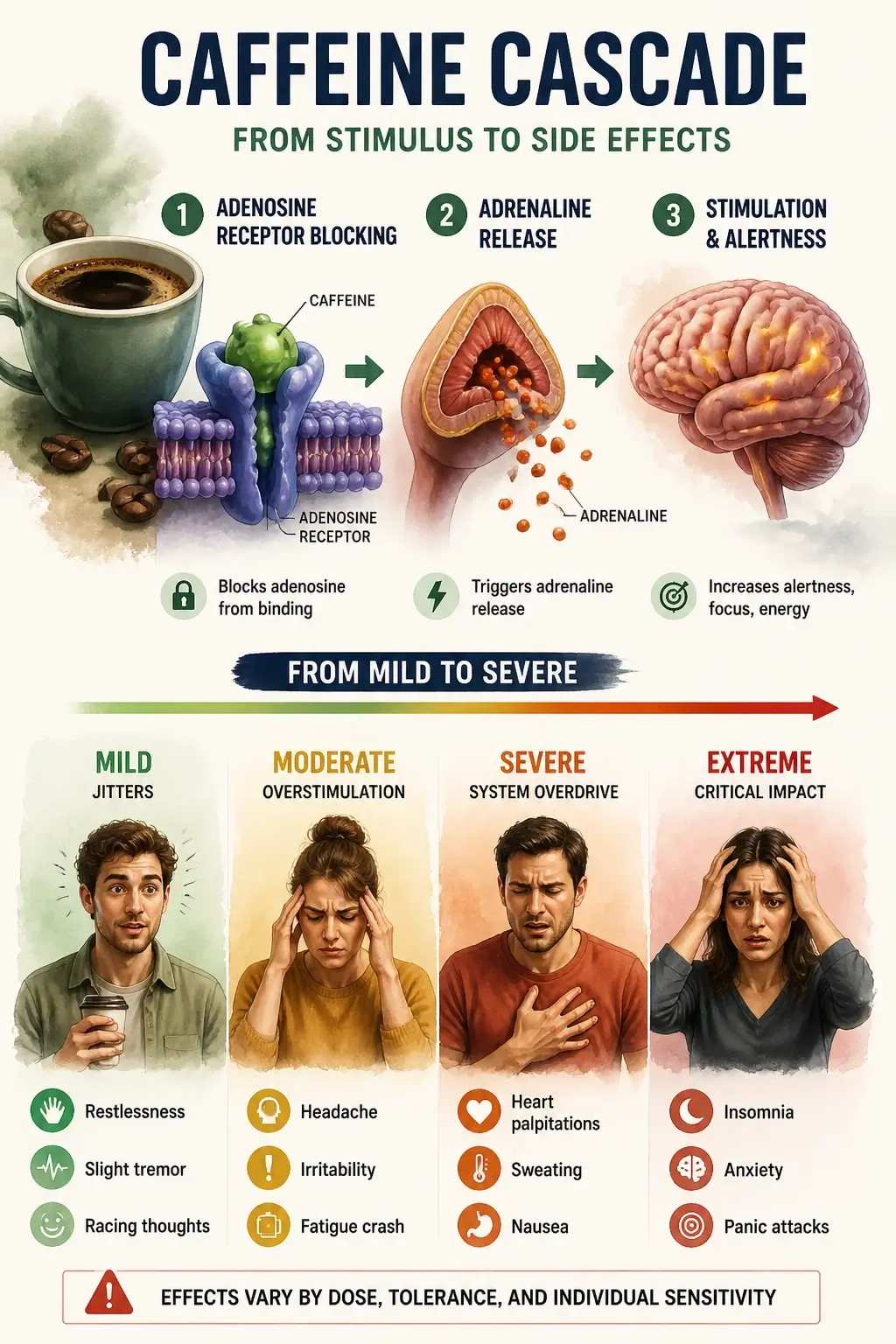
Caffeine side effects don’t arrive all at once – they build on a cascade that starts the moment caffeine crosses into your bloodstream, and the mechanism explains why the symptoms feel so physically real. Understanding it makes the warning signs much easier to recognize before they escalate.
Caffeine’s primary action is blocking adenosine receptors. Adenosine is a calming neurotransmitter that accumulates in your brain throughout the day, gradually making you feel sleepy. When caffeine plugs those receptors, the sleepiness signal gets muted – but the adenosine doesn’t disappear. Simultaneously, the blocked receptors trigger a surge of adrenaline, leaving your nervous system in a prolonged “alert but artificially revved” state that your body didn’t actually need.
The symptoms that follow track the intensity of that state. At mild excess: jitters, restlessness, a slight buzz of anxiety. Push further and the adrenaline surge starts affecting your heart – palpitations, the sensation of a skipped or pounding beat, are one of the most common complaints when daily intake creeps past a person’s personal threshold. The heart rhythm itself is usually fine; it’s the nervous system signaling that it’s been pushed too hard for too long.
Here’s a visual breakdown of how that biological cascade unfolds from the first sip to the point of overstimulation:
At higher doses, the picture gets more serious. Dr. Adriana Farah, Professor of Food Science and Nutrition at the Federal University of Rio de Janeiro, describes the full clinical picture:
“Such ingestion results in ‘caffeinism’, which refers to a syndrome characterized by a range of symptoms, for instance, restlessness, nervousness, anxiety, irritability, agitation, muscle tremor, insomnia, headache, diuresis, tachycardia, arrhythmia, pulse irregularity and increased frequency, elevated respiration and gastrointestinal disturbances (e.g., nausea, vomiting, diarrhea)… and unconsciousness, especially at doses around 80 mg/kg of body weight.”
That last threshold – 80mg per kilogram of body weight – is extreme and not a realistic risk from coffee alone. But the lower end of that symptom list? Anxiety, insomnia, palpitations, and digestive upset are common at doses well within the range of a heavy coffee habit.
The insomnia connection deserves its own moment. Caffeine has a half-life of three to six hours, meaning half of a noon coffee is still circulating in your bloodstream at 6pm, and a quarter of it at 9pm. If your liver processes caffeine slowly, that noon cup is still a factor at midnight. The tiredness you feel at bedtime isn’t your body winning – it’s the built-up adenosine finally getting through after hours of being blocked.
None of this is a reason to quit coffee. It’s a reason to know your numbers and learn your early warning signs. The goal is to stay on the right side of your personal line, not to treat every cup like a threat.
Sensitive, Average, or Fast Metabolizer: Finding Your Caffeine Footprint
Caffeine metabolism genetics are the reason two people can drink identical coffees and have completely different days afterward – and it’s also the reason the FDA’s 400mg ceiling fits some people perfectly and fails others entirely. The difference isn’t psychological. It’s enzymatic.
The CYP1A2 Enzyme: Your Body’s Caffeine Dial
Your liver breaks down caffeine primarily through an enzyme called CYP1A2. How efficiently that enzyme works is largely determined by which genetic variant you carry. Research published in the Journal of Caffeine and Adenosine Research measured serum caffeine levels one hour after ingestion and found that slow metabolizers – those carrying a C allele variant – had significantly higher caffeine concentrations in their bloodstream (14.2 ± 1.8 ppm) compared to fast metabolizers with the AA variant (11.7 ± 1.7 ppm). That gap means caffeine stays active in a slow metabolizer’s system for far longer, amplifying every effect from alertness to anxiety to disrupted sleep.
Three Real Sensitivity Profiles
Practically speaking, people fall into three broad groups:
- Sensitive / Slow Metabolizer: A single small cup may trigger palpitations, anxiety, or sleep trouble that stretches well into the night. These individuals often feel “wired” for hours after a modest dose and tend to self-limit naturally – though they may not understand why coffee hits them so hard.
- Average / Moderate Metabolizer: Can comfortably enjoy two to three cups daily without significant side effects. The standard 400mg guideline was essentially designed for this group.
- Fast Metabolizer / High Tolerance: Processes caffeine rapidly, can drink coffee close to bedtime without sleep disruption, and may need higher doses to feel any meaningful effect. The risk here is subtler – fast metabolizers can push toward unhealthy intake levels precisely because the feedback signals are muted.
Non-Genetic Factors That Shift Your Metabolism
Genetics set your baseline, but several other factors can temporarily or permanently move your position on that spectrum. Pregnancy is the most dramatic example.
Dr. Jennifer L. Temple, Director of the Nutrition and Health Research Laboratory at the University at Buffalo, explains the mechanism:
“Compared to non-pregnant women, pregnant women have a slower caffeine metabolism with 1.5–3.5 times longer half-life needed to eliminate caffeine… Fetal exposure to caffeine depends not only on maternal consumption but on the rate at which caffeine is metabolized by the mother… Pregnancy slows caffeine metabolism due to a reduction in cytochrome P-450 1A2 (CYP1A2) activity.”
Hormonal contraceptives can also slow CYP1A2 activity, as can certain medications including some antibiotics and antidepressants. Age gradually reduces metabolic efficiency across the board. None of these shifts are visible from the outside – which is exactly why a rule built for average metabolizers leaves so many people confused about why the “safe” amount doesn’t feel safe to them.
A practical self-check: if coffee after 2pm consistently ruins your sleep, or one cup leaves you wired for four-plus hours, you’re operating with a slower clearance rate than the guideline assumes. If you can drink espresso at 9pm and fall asleep easily, you’re on the fast end. Neither is a flaw. It’s just the biology you were handed – and the information you need to set your own personal ceiling rather than borrowing someone else’s.
How to Cut Back Caffeine Without the Withdrawal Headache
Caffeine reduction methods don’t have to be dramatic to be effective – and the best ones don’t require giving up coffee at all. The goal is to bring your daily intake under your personal threshold gradually enough that your body never registers a deprivation signal.
Pete Licata, 2013 World Barista Champion and co-founder of Caffeine Control Coffee, frames the whole approach around comfort rather than sacrifice:
“The worst symptoms of caffeine withdrawal typically last two to four days, and our goal is to ease people into the reduction without feeling like they are sacrificing a comfort… The reduction to decaf is meant to provide a ‘tolerance reset.'”
That framing matters. Caffeine withdrawal – headaches, fatigue, brain fog – is real and predictable, but it’s also entirely avoidable if you taper instead of cut. Dropping your intake by roughly 50mg every few days gives your adenosine receptors time to recalibrate without sending your nervous system into protest mode.
Here’s where to start, in order of ease:
Measure your ratio first. Using the Consumer Reports benchmark of two tablespoons of grounds per eight ounces of water as your baseline, simply reducing by half a tablespoon at a time can cut your caffeine meaningfully while keeping the flavor largely intact – especially if you shift to a slightly darker roast to compensate for the reduced volume.
Try the espresso switch. If your morning routine involves a 16-ounce drip coffee – which can carry 200mg or more – switching to a double espresso brings you down to around 125mg for that same coffee moment. You still get the ritual, the warmth, and the taste. You’ve just eliminated over 75mg without any sense of deprivation.
Blend in decaf. Half-caff – one scoop of regular grounds, one scoop of decaf – cuts caffeine by roughly 50% with almost no detectable change in flavor for most people. This is particularly useful for the second or third cup of the day, where the goal is comfort rather than stimulation.
Rethink the afternoon takeaway. Café coffees deliver on average three times the caffeine of a modest home brew. Requesting “half-strength” at a café, or replacing an afternoon coffee with black tea (28–46mg per cup), eliminates a large dose without disrupting the break-time habit that most people actually value. That switch alone – from a large afternoon drip to black tea – can shave 150mg or more off your daily total.
Handle the takeaway trap at the source. Based on the 2023 sample analysis, switching from a 16-ounce takeaway drip to a standard double espresso can eliminate over 170mg in a single transaction – enough to bring most people comfortably under 400mg even with a second coffee later in the day.
Your coffee habit doesn’t need to be all-or-nothing. Small, specific changes – measure your ratio, swap one large drip for espresso, lean on black tea in the afternoon – let you stay under your personal red line while keeping every cup you actually enjoy.
Key Takeaways on Caffeine in Coffee
- The FDA’s 400mg daily limit applies to healthy adults only – pregnant women, teenagers, and older adults operate under significantly stricter thresholds.
- Caffeine in coffee varies by up to 300% depending on bean species, brew method, serving size, and coffee-to-water ratio – not just cup count.
- Espresso is more concentrated per milliliter than drip coffee, but a typical serving delivers far less total caffeine than a 12- or 16-ounce mug.
- Cold brew often delivers the highest caffeine dose per serving due to its high coffee-to-water ratio and long steep time, not just its concentration.
- Your CYP1A2 enzyme variant determines how quickly your body clears caffeine – slow metabolizers can experience side effects at doses well below the 400mg guideline.
- Gradual tapering by 50mg every few days prevents withdrawal symptoms; abrupt cuts trigger headaches, fatigue, and brain fog within 12–24 hours.
Frequently Asked Questions About Caffeine in Coffee
How much caffeine is in a 12-oz cup of black coffee?
A 12-ounce black drip coffee typically contains between 113 and 247mg of caffeine, depending on the bean species, roast density, and how much coffee was used to brew it. That range means a strong 12-ounce home brew can already account for more than half your daily FDA limit in one cup.
Does coffee raise cortisol levels?
Yes – caffeine triggers an adrenaline response that temporarily elevates cortisol, particularly when consumed first thing in the morning when cortisol is already naturally peaking. Drinking coffee 90 minutes after waking, once your cortisol curve has started to fall, is a practical way to reduce the hormonal overlap without giving up the boost.
Does coffee make Vyvanse less effective?
Caffeine and Vyvanse both act on the central nervous system, but they work through different pathways – caffeine blocks adenosine receptors while Vyvanse increases dopamine and norepinephrine. There’s no strong evidence that coffee directly blunts Vyvanse’s therapeutic effect, but the combined stimulant load can amplify side effects like elevated heart rate, anxiety, and insomnia, especially in slow metabolizers.
Is coffee safe to drink with cirrhosis?
This one requires a direct conversation with a hepatologist rather than a general guideline. The liver metabolizes caffeine through the same CYP1A2 pathway that cirrhosis impairs, which means caffeine clearance slows significantly and the stimulant stays in circulation much longer. Some research actually associates moderate coffee consumption with slower fibrosis progression, but the dose and timing considerations for someone with cirrhosis are individual enough that no general rule applies safely.
Can you build a tolerance to caffeine’s effects?
Yes, and it happens faster than most people expect. Regular daily consumption causes your brain to upregulate adenosine receptors – essentially growing more of the targets caffeine normally blocks – which means you need progressively more caffeine to achieve the same alertness effect. Periodic tolerance resets, where you taper down to minimal intake for a week or two, restore sensitivity and let you get the same benefit from a smaller dose.
Is decaf coffee actually caffeine-free?
No. Decaf still contains between 2 and 15mg of caffeine per eight-ounce cup depending on the decaffeination method and the original bean. For most healthy adults that’s negligible, but for sensitive individuals, pregnant women, or people with caffeine-related anxiety, multiple cups of decaf across a day can add up to a meaningful dose.
Why does coffee sometimes cause anxiety even at low doses?
Even a modest amount of caffeine in coffee can trigger anxiety symptoms in people who are slow metabolizers, who are already stressed, or who have underlying anxiety sensitivity – because caffeine’s adrenaline surge adds stimulation to a nervous system that’s already running hot. Timing also plays a role: coffee on an empty stomach absorbs faster and peaks more sharply, amplifying the anxious edge compared to the same cup taken after eating.
At what time of day should you stop drinking coffee?
Given caffeine’s three-to-six-hour half-life, cutting off consumption by 2pm is a reasonable starting point for average metabolizers who want to protect sleep quality. Slow metabolizers – those who feel wired for hours after a single cup – may need to stop by noon or earlier. Fast metabolizers may tolerate an afternoon coffee without sleep disruption, but even they carry residual caffeine into the evening hours.
References
- Spilling the Beans: How Much Caffeine Is Too Much? – fda.gov
- How Much Caffeine Is in Your Coffee Depends on Roast and Brew Method – sprudge.com
- Plunger, Espresso, Filter: Just Because Your Coffee Is Bitter Doesn’t Mean It’s Stronger – dailycoffeenews.com
- Caffeine and the Pharmacology of Coffee – mdpi.com
- The Effect of the CYP1A2 −163 C > A Polymorphism on Caffeine Metabolism and Subsequent Cycling Performance – liebertpub.com
- Caffeine Metabolism and Pregnancy – sciencedirect.com
- A Question of Caffeine: The Search for Modulation, the Quest for Moderation – sprudge.com