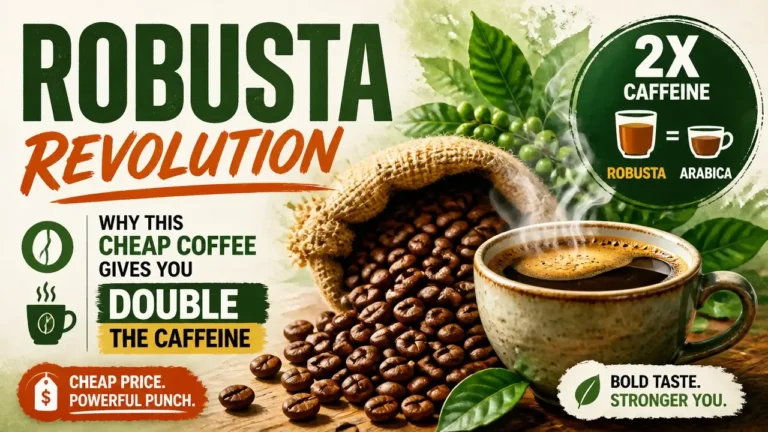

Robust Coffea canephora didn’t earn its reputation by accident. Bred tough at lower altitudes, resistant to pests, and loaded with up to 2.7% caffeine by weight, Robusta hits nearly twice as hard as Arabica, and most drinkers have no idea what they’re actually pouring into their cup.
That gap matters. At 265 mg per 8 oz cup, a single Robusta brew can push you close to the FDA’s 400 mg daily ceiling before lunch. The biology, the roast science, and the dosage math all deserve a closer look.
Beyond bean genetics, brewing methods play a massive role, so understanding filtered coffee caffeine content helps you map out your daily intake more accurately.
Beyond sheer stimulant power and dosage math, understanding how this daily habit impacts your overall wellness is thoroughly explored in Coffee Benefits Unlocked The Definitive guide.
Robusta Coffee’s Real Caffeine Numbers
Robusta coffee’s caffeine content sits at 2.2%–2.7% by weight, roughly double the 1.2%–1.5% you get from Arabica, and that gap translates directly into your cup as somewhere between 140 and 265 mg of caffeine versus a typical Arabica’s 80–100 mg. That’s not a rounding difference. That’s a fundamentally different stimulant load from the same scoop of grounds.
Beyond sheer genetics, variables such as coffee terroir soil chemistry also play a massive role in shaping how these resilient plants develop their distinct alkaloid and flavor profiles.
Think about what that means practically. If you’re dosing 18 g of coffee for a brew, a Robusta bean is carrying nearly twice the alkaloid payload of an Arabica bean at the same weight. You’re not changing your routine—your grinder setting, your dose, your mug size—you’re just getting dramatically more caffeine out of the same ritual.
That range matters, though. Not all Robusta is identical. Bean genetics and growing conditions pull that number in different directions, and some heirloom Robusta varieties push the ceiling even further—closer to 3% caffeine by weight, according to specialty green‑buyer reports. The 2.2%–2.7% figure is the commercial baseline, not the absolute maximum.
Here’s the comparison laid out cleanly:
| Bean Type | Caffeine by Bean Weight | Caffeine per 8‑oz Cup | Cost‑per‑mg of Caffeine |
|---|---|---|---|
| Arabica | ~1.2%–1.5% | ~95–150 mg | Higher |
| Robusta | ~2.2%–2.7% | ~160–265 mg | Lower |
That last column is the one that tends to surprise people. Robusta is already the cheaper bean on the commodity market—it’s grown at lower altitudes, it’s hardier, it yields more per plant. Stack the lower price on top of the higher caffeine density, and you end up with a bean that delivers more stimulant per dollar than almost anything else in your grocery aisle.
That 265 mg ceiling on the high end isn’t just a bragging point, though. One strong cup of Robusta drip coffee can put you at roughly 66 % of the FDA’s 400 mg daily limit before you’ve even thought about a second cup. It matters more than most people realize.
For now, the core fact stands: you’re not getting a marginal bump. You’re getting a different category of caffeine delivery. The next question worth asking is why a bean produces that much alkaloid in the first place, and the answer has nothing to do with processing or roasting.
Understanding these specific weight metrics helps clarify how much caffeine in your cup when transitioning from standard specialty blends to higher-potency beans.
Nature’s Insecticide: Why Robusta Produces So Much Caffeine
Robusta coffee’s extreme caffeine load isn’t a quirk of breeding; it’s a survival weapon the plant built for itself. Coffea canephora grows at lower, warmer altitudes where insects are relentless and fungal disease is constant, so the plant evolved to saturate its beans with caffeine as a chemical barrier. The higher the caffeine concentration, the more hostile the seed becomes to anything trying to eat it.
Research published in the Journal of Agricultural and Food Chemistry documents exactly how this works: the elevated caffeine naturally present in Coffea canephora doesn’t just taste bitter to insects—it causes physiological paralysis, functioning as an innate deterrent that stops feeding before it starts. The bean is, chemically speaking, a tiny hostile environment.
Arabica never needed to go that far. At higher, cooler elevations—1,800 to 2,200 m—the insect pressure drops sharply. Fewer pests means less evolutionary incentive to produce extreme alkaloid concentrations. Arabica developed complexity of flavor instead; Robusta developed armor.
That same biological toughness shows up in every other part of the plant. Because Coffea canephora evolved to handle heat, humidity, and pest pressure, it’s significantly more disease‑resistant and produces higher yields per hectare than Arabica. Less crop loss plus less labor‑intensive growing conditions equals cheaper beans at the farmgate. The low price tag on Robusta coffee is essentially the market reflecting how well this plant has solved its own survival problems.
Which means when you brew a cup of Robusta, you’re not drinking a low‑grade commodity. You’re harnessing a chemical defense system the plant spent millennia perfecting—and pointing it at your own adenosine receptors instead of a beetle.
The next question is what happens to all that built‑in chemistry when you apply heat. Because the internet has some strong, and mostly wrong, opinions about roasting and caffeine.
Roast Level and Robusta Caffeine
The internet can’t agree on whether dark roasting destroys caffeine, and the reason both sides keep talking past each other is that they’re measuring different things. This isn’t a controversy about chemistry. It’s a controversy about units.
Here’s what’s actually happening inside the roaster.
How Bean Expansion Distorts Volume Measurements
When Robusta coffee goes through a dark roast, the beans absorb heat, expand, and shed water. By the time they hit a dark profile, they’ve lost roughly 15–20 % of their original mass. The bean is now physically larger but lighter, like a popcorn kernel after it pops.
That single fact is the root of every conflicting blog post you’ve ever read.
Pull out a scoop and fill it with dark‑roasted Robusta. Now fill the same scoop with light‑roasted Robusta. The dark‑roast scoop looks identical, but it holds fewer beans by mass. Less mass means less caffeine. So if you’re measuring by volume—a tablespoon, a scoop, “two heaping spoonfuls”—dark roast genuinely delivers less caffeine to your cup. That part of the claim is correct.
Why the Scale Tells a Different Story
Weigh your coffee instead, and the picture flips. When you dose by grams, you’re accounting for that mass loss automatically. You’re pulling the same number of coffee molecules into the equation regardless of roast level.
At that point, the caffeine difference between a light and dark roast of the same Robusta bean is roughly 10 %, and dark roast actually retains slightly more caffeine per gram of roasted coffee, because so much of what burned off was water, not alkaloids. Caffeine is a heat‑stable compound. It doesn’t vaporize at roasting temperatures the way aromatic compounds do. The bean loses weight around it; the caffeine mostly stays put.
This is what reconciles sources like Driven Coffee, which report dark roast having meaningfully more caffeine, against sources like Driftaway Coffee, which say roast level has almost no effect. They’re both right—they’re just using different rulers.
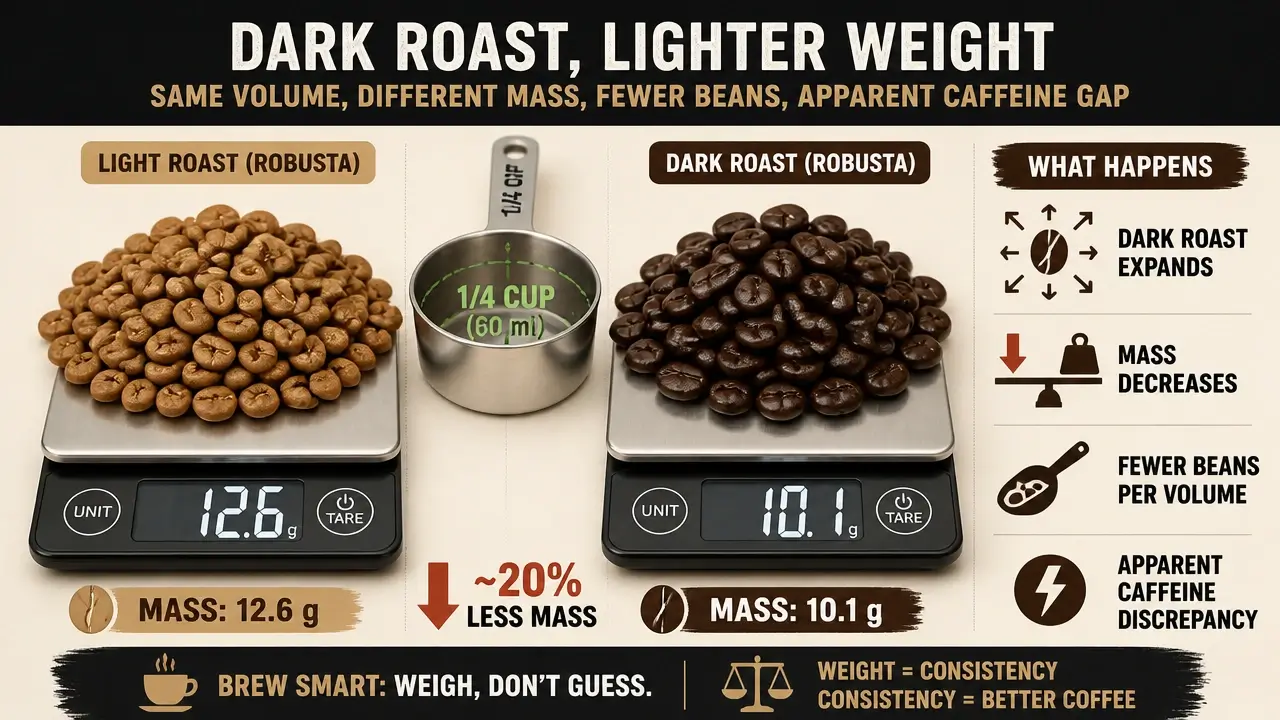
The practical answer is simple: use a scale. The moment you switch from scoops to grams, the entire roast debate becomes irrelevant. Your high‑caffeine Robusta coffee stays high‑caffeine from light roast to dark roast, because you’re controlling for the one variable that actually changes—mass.
Buy whatever roast level tastes best to you. Just weigh it.
The Extraction Equation for Robusta Coffee
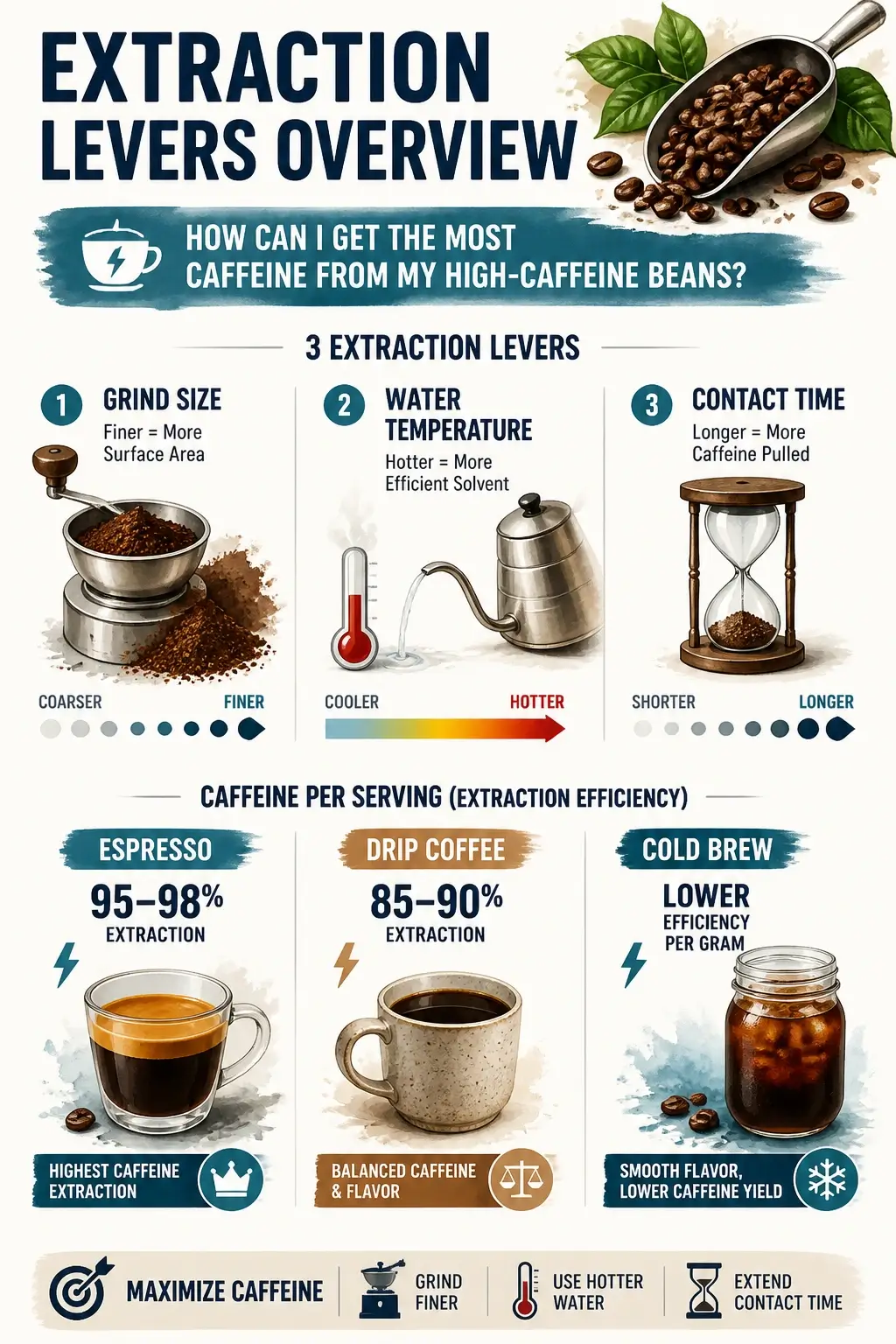
Robusta coffee’s high caffeine content is potential energy—what lands in your cup depends entirely on how well you extract it. Three mechanical levers control that conversion: grind size, water temperature, and contact time. Pull them right, and you’re squeezing every milligram the bean can offer. Pull them wrong, and you’re leaving caffeine in the grounds.
Grind size controls surface area. A finer grind exposes more of the bean’s interior to water, which means more caffeine‑rich cell walls get dissolved in less time. A coarser grind does the opposite—water has to work harder to reach the center of each particle, and a lot of it just runs past. This is why espresso, ground to a near‑powder, extracts so efficiently even though water touches the grounds for only 25–30 seconds.
Water temperature controls solvent strength. Caffeine is water‑soluble, but hot water is a far more aggressive solvent than cold. Every degree you drop below 195 °F, you’re asking the water to do the same job with weaker chemistry. This is the hidden cost of cold brew—we’ll get to that in a moment.
Contact time controls how long the solvent has to work. But here’s something most people miss: caffeine extracts early in the brew cycle. It’s one of the first compounds to dissolve, well before the heavier oils and bitter compounds come out. So a longer steep isn’t always a higher‑caffeine steep—past a certain point, you’re just pulling out things that taste bad.
Espresso vs. Drip: Efficiency vs. Total Volume
The confusion between espresso and drip coffee is worth clearing up, because most people get this backwards.
Espresso achieves 95–98 % extraction efficiency, meaning it pulls nearly all the available caffeine from the grounds it uses. That’s a direct result of high pressure forcing hot water through a finely ground puck at around 200 °F. Drip coffee, by comparison, sits at 85–90 % extraction efficiency, which is still solid, but it’s leaving more on the table per gram of coffee.
So espresso wins on efficiency per gram of coffee used.
But a standard double shot uses only 18–20 g of coffee and produces about 2 oz of liquid. A full mug of drip coffee uses 15–18 g but produces 8–12 oz. When you account for total volume and total grounds, drip and French press often deliver more total milligrams of caffeine per serving—even at lower extraction efficiency—simply because of scale.
The practical takeaway: if you’re trying to maximize caffeine from a fixed budget of beans, short, hot, high‑pressure methods like espresso give you the best milligrams‑per‑gram ratio. If you’re measuring by the cup, drip and immersion methods can still outperform espresso in raw totals.
Why Cold Brew’s Caffeine Claim Doesn’t Hold Up
The “cold brew has the most caffeine” claim is everywhere, and it sounds logical—long steep, lots of coffee, big caffeine hit. But it hides a measurement trick.
Cold brew recipes typically use a coffee‑to‑water ratio around 1:5. Drip coffee runs 1:16 to 1:18. That means a cold brew concentrate is starting with roughly three times the coffee grounds per ounce of water. When you standardize the comparison to equal coffee weight—same grams of Robusta, same final volume—room‑temperature water is simply a weaker solvent. Cold brew’s extraction efficiency trails hot methods because the chemistry is slower and less aggressive at ambient temperatures.
Cold brew isn’t a caffeine hack. It’s a concentration trick. You’re not extracting more efficiently; you’re using more coffee to compensate for less efficient extraction.
The Real Goal: Maximum Extraction Within a Drinkable Cup
One more thing worth anchoring before we move to the brewing playbook: your goal is not to extract 100 % of the available caffeine. That would taste like battery acid—over‑extracted, harsh, and bitter beyond what Robusta’s natural profile already brings.
The target is to approach maximum extraction within a drinkable flavor profile. For Robusta, that means dialing in a fine‑to‑medium grind, keeping water between 195–205 °F, and matching your contact time to your brew method—not pushing past the point where the cup turns on you. The caffeine is already there. Your job is to pull it cleanly.
Brew for Maximum Jolt
The gap between knowing Robusta is potent and actually getting that potency into your cup comes down to two variables you control every morning: how much coffee you use and how finely you grind it. Get those right, and the extraction equation does the rest. Get them wrong, and you’re leaving caffeine on the table—or worse, drinking something that tastes like burnt rubber.
Weighing and Fine Grinding: The Technical Foundation
Consistent coffee scale dosing protocols are the single biggest upgrade most home brewers skip. A kitchen gram scale costs less than a bag of specialty beans, and it turns your morning brew from a rough estimate into a repeatable formula.
Scoops lie. A heaping tablespoon of coarse‑ground Robusta and a level tablespoon of fine‑ground Robusta can differ by 3–4 g—and at 2.5 % caffeine by weight, that gap is roughly 75–100 mg of caffeine swinging in either direction. Weigh your beans before you grind, every time.
Once you’re weighing consistently, grind fine—but treat it as a dial, not a switch. A finer grind increases surface area, which speeds up extraction and pulls more caffeine from each gram. The catch is that Robusta’s dense, low‑oil structure is already prone to bitterness, and an over‑extracted cup will punish you for going too far. Start at a medium‑fine setting, taste it, then nudge finer by one click at a time until you hit the edge of bitterness—then back off one click. That’s your sweet spot.
Now, here’s where the extraction equation turns your gram scale into a caffeine calculator. The formula is straightforward:
Caffeine (mg) ≈ Coffee weight (g) × Bean caffeine % × Extraction efficiency %
For Robusta, use 0.025 as your mid‑range bean caffeine figure (2.5 %). For a well‑executed hot brew—drip, pour‑over, Aeropress—extraction efficiency sits between 85–95 %. Plug in a conservative 90 % and the math looks like this:
15 g × 0.025 × 0.90 = ~338 mg
That’s one cup. If you’re targeting 200 mg, you’d use about 9 g. If you want to stay under the FDA’s 400 mg daily ceiling, you know exactly where your ceiling is before you brew—not after you’ve already poured a second cup.
Blending and Milk Pairing: Taming Robusta’s Boldness
Straight Robusta isn’t for everyone on its own—and it doesn’t have to be. Smart coffee blending is how you keep the caffeine punch while making the cup something you actually want to drink.
A 50/50 blend with a sweet Arabica is the most practical starting point. The Arabica floral notes and fruit‑forward brightness sit on top of Robusta’s dark, earthy base like a high note over a bass line. You’re not diluting the caffeine significantly—you’re rounding the flavor profile. If 100 % Robusta tastes like a forest floor with a cigarette in it, a good 50/50 blend tastes like dark chocolate with a clean, bright finish.
Milk fat content variations change the equation further. Robusta’s heavy body and dark‑chocolate, nutty character are built for milk—the fat softens the bitter edges and amplifies the chocolate notes in a way that lighter Arabica‑based coffees can’t match. It’s why Vietnamese iced coffee is built on Robusta. That combination of strong, dark brew over ice with sweetened condensed milk isn’t just a cultural tradition—it’s a technically sound pairing. The condensed milk’s sugar and fat are doing exactly what they’re supposed to: balancing the bitterness and making a high‑caffeine drink genuinely enjoyable rather than medicinal.
If you’re pulling espresso‑based drinks at home, Robusta in your blend is what gives a latte or cappuccino enough backbone to cut through steamed milk without disappearing. Most Italian espresso blends have known this for a century.
Where to Find Quality Robusta That Actually Tastes Good
Modern specialty Robusta has almost nothing in common with the chalky, burnt‑rubber sludge hiding inside cheap instant coffee blends. The same plant that spent centuries as filler in commodity blends is now being sourced directly, roasted with care, and sold as a single‑origin product—and the tasting notes look nothing like what you’d expect: dark chocolate, roasted nuts, earthy depth, low acid.
Three brands are worth knowing right now.
Nguyen Coffee Supply is the easiest entry point for anyone who wants to understand what Robusta actually tastes like at its best. They work directly with farmers in Vietnam—one of the world’s largest Robusta‑growing regions—and the transparency in their sourcing shows up in the cup. Clean, bold, no bitterness that doesn’t belong there.
Yeri Coffee 100 % Robusta sits at the accessible end of the price range and is available at Walmart, which matters if you want to experiment without committing to a specialty order. Dark roast, low acid, and genuinely drinkable on its own.
Crema 100 % Robusta comes from the European specialty market, where Robusta has always had more respect than it gets in American coffee culture. Well‑reviewed, well‑roasted, and worth trying if you want a benchmark for what the bean can do at its ceiling.
All three span a wide price range, but here’s the number that reframes the whole conversation: even the premium options cost you less per milligram of caffeine than equivalent specialty Arabica. You’re buying roughly twice the caffeine per gram of bean. The math works in your favor at every price point.
The best way to actually learn the bean is to buy a bag of whole‑bean Robusta and run two experiments back to back—brew it straight first, then blend it 50/50 with your usual Arabica. Straight Robusta will show you exactly what you’re working with: the body, the bitterness, the energy. The blend will show you why espresso roasters have been quietly adding it for decades. The versatility is a real part of the value.
One practical trick worth knowing before you start: because Robusta carries roughly twice the caffeine by weight, you can use 50 % less coffee by mass to hit the same caffeine target as your usual Arabica dose. If you normally brew 20 g of Arabica to get around 100 mg of caffeine, about 10 g of Robusta gets you to the same place.
The catch is purely about flavor, not safety. Drop the coffee mass without adjusting anything else and you change the brew ratio—less dissolved material in the same volume of water means under‑extraction, which shows up as sour, thin, weak flavor. The fix is simple: grind finer, or reduce your water volume proportionally to keep the ratio intact. Don’t blame the bean for a bad cup that’s actually a math problem.
Two Robusta Cups Already Break the Limit
The FDA’s daily caffeine ceiling for healthy adults is 400 mg—and a single 8‑oz cup of brewed Robusta can deliver 265 mg. That’s 66 % of your entire day’s safe allowance in one mug before you’ve even had breakfast.
Do the math on a second cup and you’re at 530 mg. You’ve crossed the guideline by 130 mg, and your morning isn’t over.
That number matters because Arabica drinkers almost never bump into this problem. A standard 8‑oz Arabica cup runs 95–120 mg. You’d need four or five cups to hit the ceiling. Robusta cuts that margin to two. The pot‑sized coffee habit that’s perfectly fine with Arabica becomes a genuine dosage issue the moment you switch beans—and almost nobody tells you that when they hand you the bag.
The symptoms of going over aren’t subtle. Jitters, racing heart, anxiety that feels like your nervous system is running a fire drill—these aren’t personality quirks or stress. They’re your body signaling that the adenosine receptors caffeine blocks are completely saturated and the sympathetic nervous system is running unchecked. Insomnia is the slow‑burn version of the same problem: caffeine’s half‑life is 5–6 hours in an average adult, so a 3 PM second cup is still half‑active at 9 PM.
The 400‑mg guideline is also worth understanding for what it is: a population‑level recommendation for healthy adults, built largely around Arabica consumption patterns. It was never calibrated for someone drinking Robusta like it’s a regular drip coffee habit.
The numbers get sharper as you push higher. Serious adverse effects—chest tightness, severe anxiety, vomiting, dangerous heart rhythm changes—become likely around 1,200 mg. Four 8‑oz cups of Robusta gets you to roughly 1,060 mg. That’s not theoretical anymore; that’s three cups past where most people should stop, and one cup away from a range where medical attention becomes a real conversation. The estimated lethal dose sits between 10,000 and 14,000 mg, but the point where your body is in genuine distress lands well below that.
The rule here isn’t complicated: one cup of Robusta is a strong dose. Two cups is your daily ceiling. Three is a risk. Four is a problem. Count milligrams, not cups—because “a few cups” means something completely different with these beans than it does with everything else on the shelf.
There’s one more variable the 400‑mg number can’t account for, and it has nothing to do with how much you drink.
Why Robusta Hits Some People Twice as Hard
Caffeine sensitivity isn’t just about how much coffee you drink—your liver is running a completely different program than your friend’s. Body weight, tolerance, and liver health all shift your personal ceiling, which is why two people can drink the same Robusta cup and land in completely different places two hours later.
But underneath those familiar variables sits a genetic switch most people have never heard of.
The CYP1A2 Enzyme and Robusta’s Extended Hit
Your liver clears caffeine almost entirely through a single enzyme: CYP1A2. Think of it as the drain in a sink. Fast metabolizers have a wide‑open drain—caffeine moves through quickly, the half‑life stays around 3–5 hours, and the cup is essentially done with you before lunch. Slow metabolizers have a partially blocked drain. The caffeine sits there, active and circulating, long after the cup is empty.
That’s not a metaphor. Research published in Nutrients confirms that roughly 10 % of the population—specifically those homozygous for the CYP1A2 1F allele—are slow caffeine metabolizers who experience a caffeine half‑life up to 4× longer than fast metabolizers.
Run that math against a Robusta cup. A modest 200 mg dose—well within a single strong drip serving—can stay pharmacologically active for 10+ hours in a slow metabolizer. That morning cup you drank at 8 a.m.? For some people, it’s still half‑strength in their bloodstream at 6 p.m. The sleep disruption isn’t anxiety or stress. It’s molecular.
What This Means for Your Personal Robusta Limit
The FDA’s 400 mg daily ceiling was built around population averages. It doesn’t know which side of the CYP1A2 distribution you’re on—and neither do you, unless you’ve paid attention.
The signals are there if you look for them. If afternoon Robusta bleeds into restless nights, if a single morning cup leaves you wired past dinner, if you feel a second cup long after most people have forgotten they had a first—that’s not a quirk. It’s a data point pointing to slower clearance.
For slow metabolizers, the practical ceiling isn’t 400 mg. It might be 150. It might be 200. The number is personal, not universal.
This is where Robusta’s power‑per‑dollar proposition gets its final condition. Yes, you can get double the caffeine at a fraction of the cost. Yes, you can brew smarter, blend strategically, and hit meaningful energy without paying espresso bar prices. But the whole equation only works sustainably if you treat your own response as the most important variable in the system. Weigh your beans, track your milligrams, and watch what your body actually does with them—because the person who gets the most out of Robusta long‑term isn’t the one who drinks the most. It’s the one who knows exactly how much is enough.
Key Takeaways on Robusta Coffee
- Robusta isn’t just stronger coffee; it’s a different stimulant category that demands you count milligrams, not cups.
- A single Robusta cup can deliver 265 mg of caffeine, pushing you to two-thirds of the daily limit before breakfast.
- Using a gram scale and the extraction formula turns your morning brew into a precise, repeatable dose.
- Robusta’s bitterness comes from its caffeine load, not your brewing skill—blend or pair with milk to tame it.
- If you’re a slow caffeine metabolizer, Robusta’s half-life can stretch past 10 hours, so your personal limit may be far below 400 mg.
- The best Robusta isn’t a cheap filler; single-origin specialty Robusta offers chocolate and nut notes at a fraction of Arabica’s cost per milligram.
Frequently Asked Questions About Robusta Coffee
Q: Why does Robusta taste so bitter even when you don’t over-extract it?
A: Caffeine itself is intensely bitter, and Robusta packs roughly double the alkaloid load of Arabica. Even a perfectly brewed cup carries that inherent bitterness because you’re tasting the plant’s natural insecticide, not a roasting or brewing flaw.
Q: How much caffeine is actually in a double shot of Robusta espresso?
A: A standard double shot uses about 18 grams of coffee. With Robusta’s 2.5% caffeine and espresso’s 95% extraction efficiency, you’re looking at roughly 427 mg of caffeine—more than the entire 400 mg daily limit in a single serving.
Q: Can I blend Robusta with decaf beans to hit a specific caffeine target?
A: Absolutely. Use the extraction formula to calculate your blend. For example, a 50/50 mix of Robusta and decaf halves the caffeine per gram while keeping the body, letting you dial in a precise dose without sacrificing mouthfeel.
Q: How does a cup of Robusta compare to a standard energy drink in caffeine?
A: An 8-oz cup of brewed Robusta delivers up to 265 mg of caffeine. Most energy drinks top out around 150 mg per can, so a single mug out-caffeines the majority of them while costing a fraction of the price.
Q: What happens if I brew Robusta in a moka pot?
A: A moka pot combines fine grind, pressure, and near-boiling water, which pushes extraction efficiency close to espresso levels. That means a small, concentrated serving can pack a massive caffeine punch—measure your dose carefully.
Q: Why does Robusta espresso have less crema than Arabica?
A: Robusta beans are naturally low in oils compared to Arabica. Since crema is an emulsion of coffee oils and gases, the lower oil content produces a thinner, faster-dissipating foam, even though the shot itself is intensely caffeinated.
References
- Caffeine as a natural insecticide in Coffea canephora – Journal of Agricultural and Food Chemistry (pubs.acs.org)
- Caffeine metabolism and CYP1A2 genotype study – Nutrients (pmc.ncbi.nlm.nih.gov)