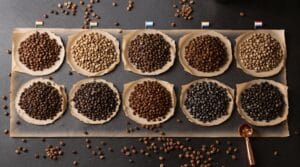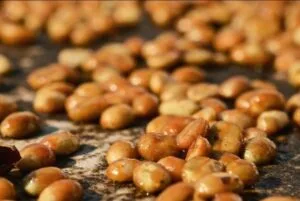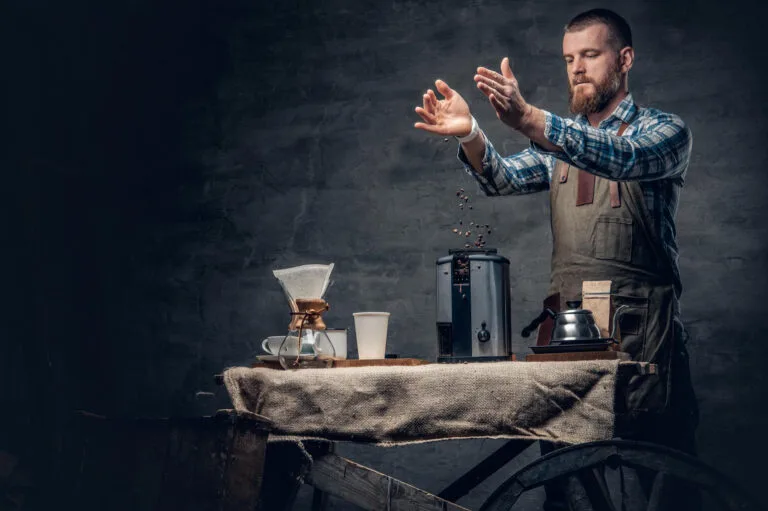

Third wave coffee is not a roast level, a shop aesthetic, or a price point. It is a set of values that treats coffee the way serious producers treat wine or single-origin chocolate: as a craft agricultural product whose flavor is determined by where it grew, how it was processed, how it was roasted, and how precisely it was brewed.
The problem is that the term gets applied to everything from serious specialty roasters to any cafe that serves oat milk. This manual separates the philosophy from the shorthand, and gives baristas, enthusiasts, and roasters the biochemical and sourcing mechanics to work from.
Key Takeaways on Third Wave Coffee
- Third wave coffee is a craft-agricultural philosophy defined by traceable origin, measurable extraction, and documented roast intent, not by shop aesthetics or price point.
- The specialty quality floor is an SCA cupping score of 80 or above, with supply chain traceability to a specific farm or cooperative.
- Light roast preserves volatile aromatic esters responsible for fruity and floral notes; dark roast drives cellulose toward pyrolytic carbonization, chemically overwriting origin character.
- SCA Gold Cup extraction targets are 1.15 to 1.45 percent TDS and 18 to 22 percent extraction yield, measured with a refractometer at 91 to 94 degrees Celsius.
- “Direct trade pays 2 to 3 times commodity price” is a sourcing claim, not verified producer impact; ask suppliers for the farm-gate price and verification chain.
- Roasted coffee is at peak quality within 21 days of the roast date; a bag without a roast date gives you no useful freshness information.
What “Third Wave” Actually Means, and Why the Label Is Applied Inconsistently
Third wave coffee has a working definition and a marketing definition, and they are not the same thing. The working definition treats coffee as an artisanal crop whose flavor reflects origin, processing, roast, and brew, the same logic applied to fine wine, craft beer, single-origin chocolate, and quality olive oil. The marketing definition is whatever a city guide decides it means this week.
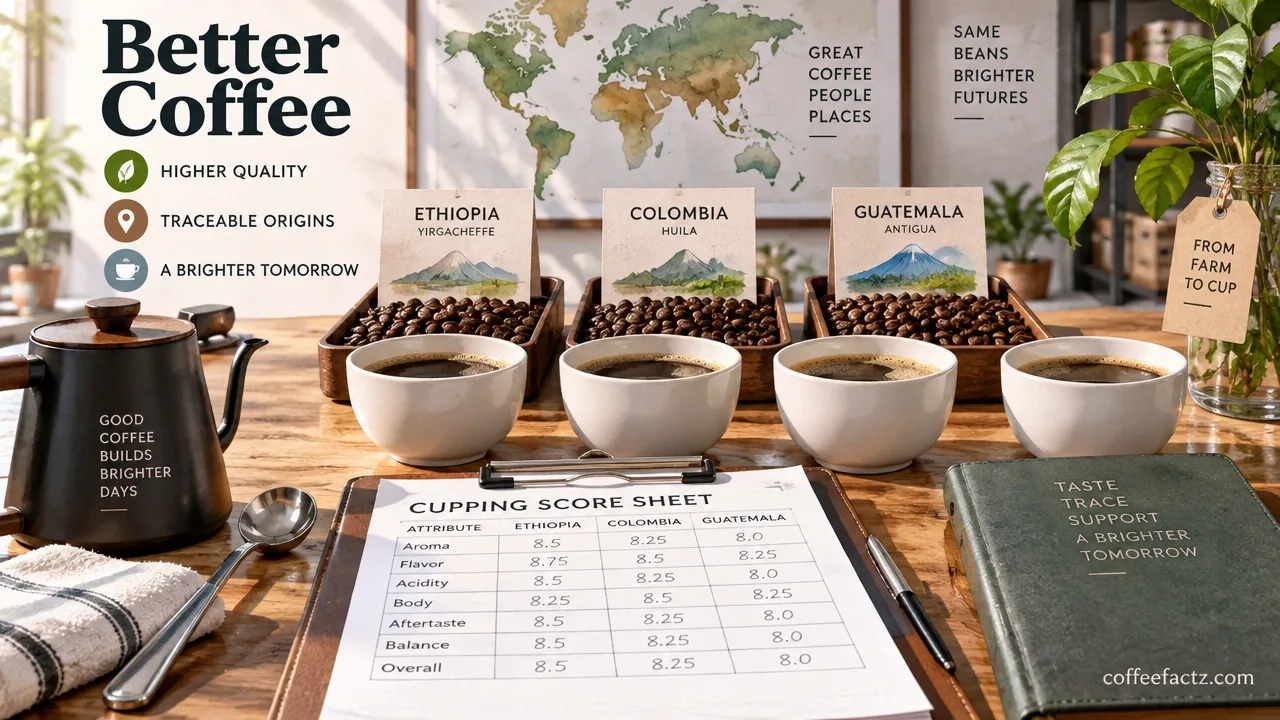
The quality floor is specific. Specialty coffee scores 80 or above on a 100-point scale, judged by certified tasters using standardized cupping protocols. The supply chain is traceable to specific farms or cooperatives, not just a country of origin. Those two criteria together, measurable cup quality and documented provenance, are the minimum entry requirements. Everything else is downstream of that.
The definitional gap opens because explainer sources treat third wave as a craft-agricultural philosophy, while city guides and marketing copy use it as an undefined scene label. That distinction matters practically. If you treat the term as a philosophy, you can apply it consistently and teach it. If you treat it as a scene label, it means nothing at all.
The cleaner frame is to treat the three waves as shifts in values rather than shifts in product or serving method. First wave valued ubiquity. Second wave valued experience. Third wave values connoisseurship, meaning the specific, documented, reproducible qualities of a specific lot. Local roasting and manual brewing are symptoms of that value shift. They are not the definition.
Trish Rothgeb, the coffee roaster who coined the term, described the third wave not as a rupture but as a continuation: a movement built on what the second wave established about regional origin and brewed-to-order craft, taken further toward treating coffee as a culinary achievement worthy of genuine celebration.
The insight Rothgeb points to is that each wave inherited something from the one before it. Third wave did not appear from nowhere. It took second-wave origin awareness and added biochemical rigor, supply chain accountability, and measurable extraction standards. That inheritance is what makes the philosophy coherent rather than just aspirational.
The Three Waves: From Ubiquity to Experience to Connoisseurship
The wave model gives the industry a shared vocabulary for a value shift that happened over roughly 130 years. Understanding where each wave started and what it was reacting to tells you more about third wave coffee than any single definition can.
Mass-Market and Cafe-Culture Eras
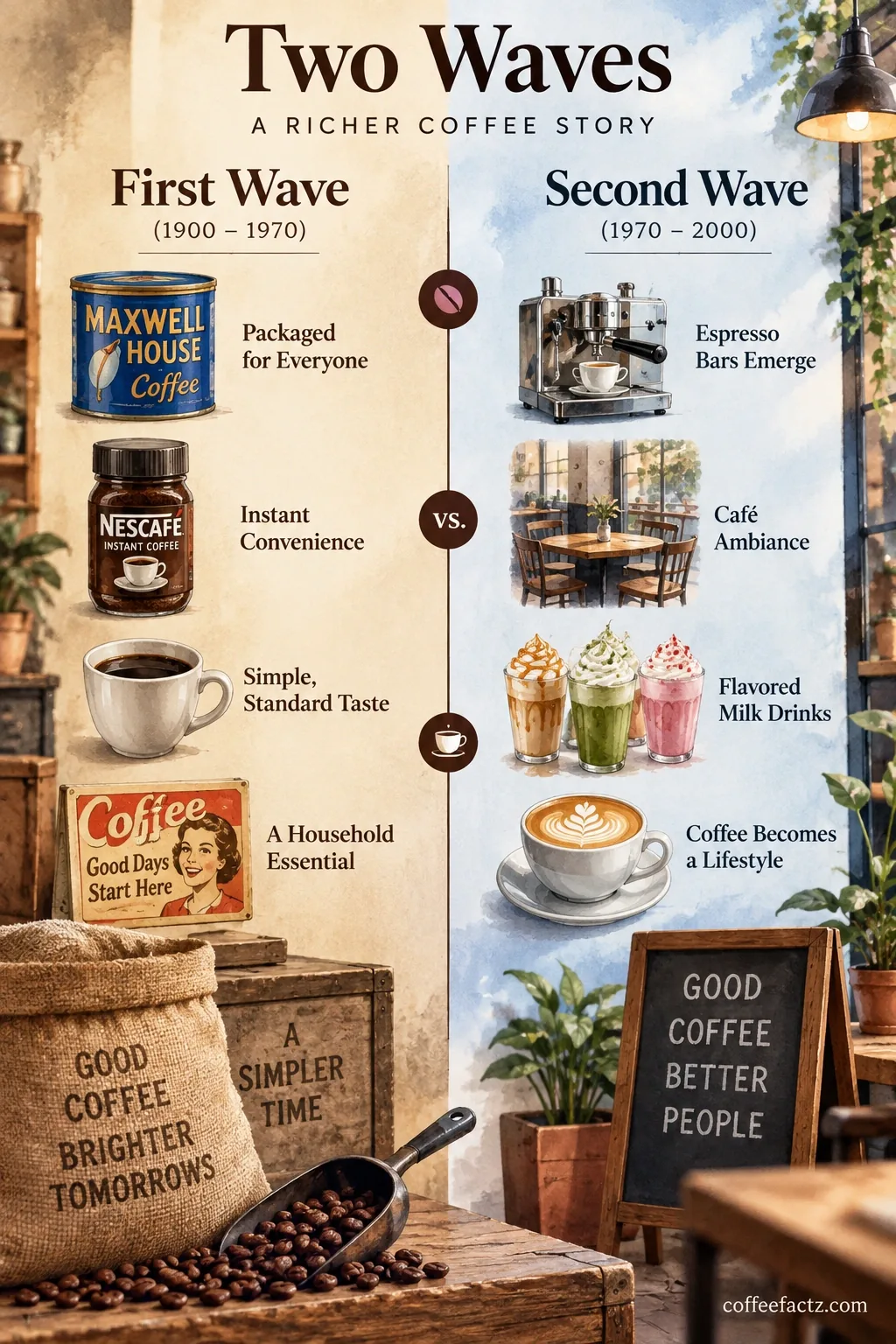
First wave coffee ran from the late 19th century through the 1960s. The goal was mass availability at low cost with indefinite shelf life. Vacuum packaging and instant coffee crystals, Folgers, Maxwell House, Nescafé, solved a logistics problem. You could ship coffee anywhere and store it indefinitely. The trade-off was flavor: dark commodity Robusta blending kept costs low and shelf life long, but it also meant every cup tasted roughly the same as every other cup, which was more or less the point.
Second wave coffee emerged in the 1970s and ran through the 1990s. Starbucks and Peet’s Coffee built a different proposition: the cafe as a destination, espresso-based milk drinks, dark-roasted specialty origins, Italian beverage nomenclature, and flavor syrups. The product was still heavily roasted and often sweetened, but the experience was the point. Ambiance and customization replaced pure convenience.
One honest caveat about the wave model: it is largely North American in scope. European cafe culture, which had been serving quality espresso and origin-aware coffee for decades before Starbucks existed, does not map cleanly onto this chronology. The model describes a specific cultural arc, not a universal one.
Artisanal Crop Paradigm and Origin Claims
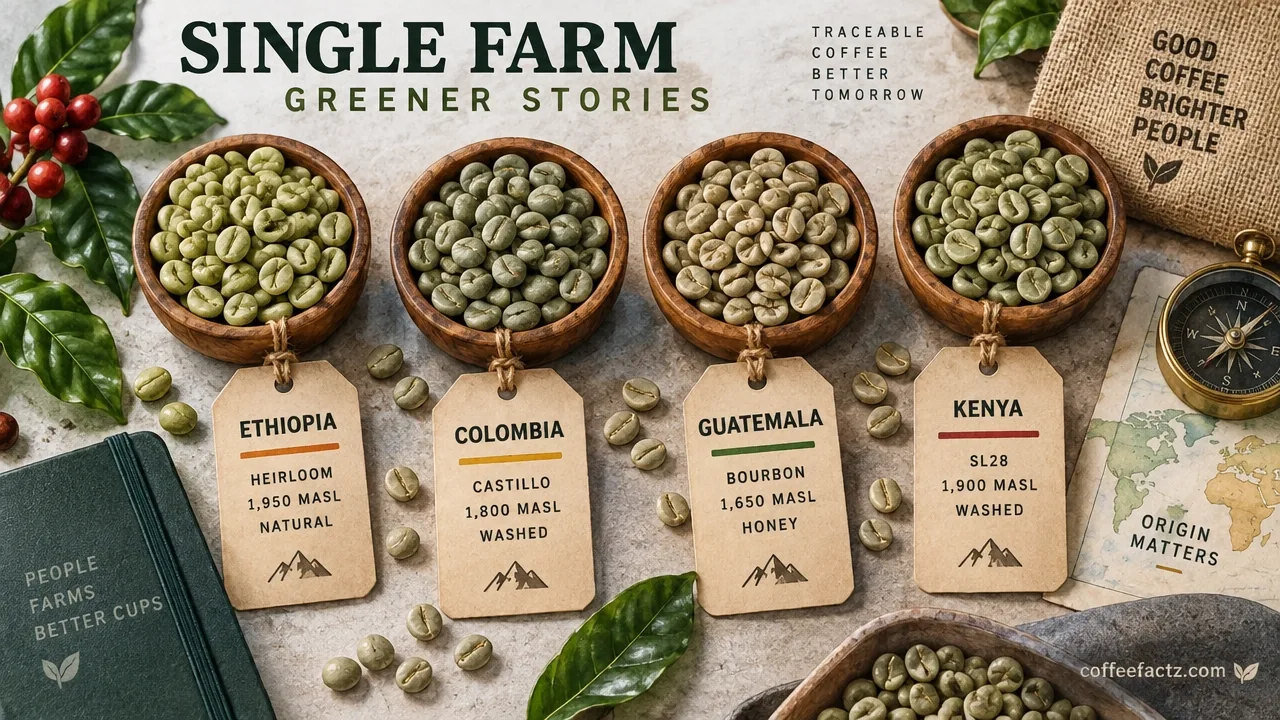
Third wave coffee began taking shape in the late 1990s and continues into the present. The core shift: coffee treated as an artisanal crop comparable to fine wine, with flavor understood as a product of botanical variety, micro-climate terroir, single-farm traceability, lighter roast profiles, and precision extraction. Pioneering roasters, Counter Culture, Stumptown, and Intelligentsia Coffee & Tea, built sourcing relationships and roasting protocols that made those claims verifiable rather than decorative. Barista competition standards created a reference frame for what “well-extracted” actually meant in measurable terms.
The origin story of the term itself is messier than the standard retelling. Rothgeb is credited in some sources as coining “third wave coffee” in 2002, and in others as 2003. Wikipedia also records Timothy J. Castle publishing “Coffee’s Third Wave” in the December 1999 / January 2000 issue of Tea & Coffee Trade Journal. The honest position is that multiple people were converging on the same idea around the same time, and no single founder’s claim resolves cleanly. What matters for working professionals is not who coined the term but what the term describes.
Eric Faust of Duluth Coffee Company frames the third wave approach this way: every actor in the chain, the farmer at origin, the roaster, and the barista at brew, meaningfully shapes the cup. Terroir is not a metaphor borrowed from wine. It is a real variable that the professional takes seriously at each stage.
That chain-of-custody thinking is what separates third wave as a practice from third wave as a label. It requires the roaster to know the farm. It requires the barista to know the roast intent. And it requires both to make decisions that serve the coffee’s intrinsic character rather than mask it.
The Biochemistry of Light Roast: Why Third Wave Roasters Stop Short of Dark
Light roast is not an aesthetic preference. It is a decision about which compounds survive the roasting process and which ones get destroyed. To understand why third wave roasters consistently stop short of dark roast, you need to know what is actually happening inside the bean at temperature.
Green coffee contains hundreds of organic compounds that produce the flavor and aroma of the finished cup. Among the most important are the intrinsic organic acids, malic, citric, and phosphoric, which contribute brightness and structure; enzymatic fruit florals produced during fermentation and drying; and delicate sugars that caramelize during roasting. These compounds are volatile. They degrade under heat, and they degrade faster as roast temperature climbs and duration extends.
Nordic-style light-to-medium roast profiles are designed to stop the roast before those compounds break down. The roaster is preserving the flavor signature the farm and the processing method built into the bean. Dark roast does the opposite: prolonged high-heat development drives cellulose toward carbonization, producing pyrolytic compounds, phenols, pyridines, and pyrroles, that generate the bitter, ashy, one-dimensional character associated with heavily roasted commercial coffee.
A review published in the International Journal of Food Science and Technology on postharvest processing and aroma formation in roasted coffee found that light and mild roasting preserves delicate volatile esters, including compounds like 2-furan methanol acetate and propanoate, which contribute the fruity and floral notes characteristic of well-sourced specialty lots. At higher roasting intensities, those esters degrade. Volatile acids decompose and feed into pyridine and pyrrole formation. At the extreme end, intensive pyrolytic reactions break down cellulose-rich endocarp material into carbonized, undesirable products, with phenols, pyridines, and pyrroles increasing at the direct expense of nuanced aroma.
This is the biochemical answer to the “third wave is snobby” critique. The light roast and the unflavored pour-over are not gatekeeping moves. They are the only brewing conditions under which the volatile aromatic esters the roaster worked to preserve actually reach the cup. Add artificial flavoring or push the roast to dark, and you are chemically overwriting the origin character the supply chain spent months developing. The decision is about chemistry, not cultural signaling.
Brew temperature for light-roast extraction sits at 91 to 94 degrees Celsius. Light roast beans are denser than dark roast and require that temperature range to dissolve the compounds you paid for. Drop below it and you under-extract. The physics are not negotiable.
Precision Extraction and the Chemistry of Measurement
Precision extraction is where roast chemistry becomes a repeatable result in the cup. The equipment and the numbers are both part of the practice.
Pour-Over Geometries and Flow Dynamics
Each single-cup brewer produces a different extraction profile based on its physical geometry and filter design.
- Hario V60: Cone-shaped, single large hole, fast flow. Gives the barista maximum control over pour rate and turbulence. Rewards skill. Punishes inconsistency.
- Kalita Wave: Flat-bed dripper with three small holes. Slows flow, promotes even saturation across the bed, reduces the risk of channeling. More forgiving for new brewers.
- Chemex: Thick bonded filter removes most oils and fine particles. Produces a clean, bright cup with low body. The filter itself is a flavor variable.
- AeroPress: Immersion plus applied pressure. Shorter contact time, higher extraction efficiency, more flexible with grind and temperature. Produces a concentrated brew that can be diluted or served as-is.
These are not interchangeable. The geometry determines how water moves through the coffee bed, which determines which compounds dissolve and in what proportion. Choosing a brewer is a flavor decision, not just a preference.
Measurement Benchmarks and Diagnostic Logic
The Specialty Coffee Association’s Gold Cup Standard sets the quantitative targets: Total Dissolved Solids (TDS) between 1.15 and 1.45 percent, and Extraction Yield (EY) between 18 and 22 percent, measured with a refractometer and a brewing control chart.
The SCA’s published brewing standards specify a minimum beverage strength of 1.15% to 1.45% solubles concentration, resulting from an extraction yield of 18.0% to 22.0% from the weight of coffee in the brew basket, as determined by a refractometer and brewing control chart.
Those numbers give you a diagnostic language. Under-extraction reads sour and hollow in the cup: you pulled too few compounds, likely from too coarse a grind, too low a temperature, or too short a brew time. Over-extraction reads bitter and dry: you dissolved too many compounds, typically from too fine a grind or too long a contact time. Both problems have specific mechanical corrections. You do not need to guess.
Water temperature: 91 to 94 degrees Celsius, consistent with the light-roast extraction requirement from the previous section. This is not a range you approximate. It is a parameter you measure.
Starter recipe for a new barista: 15 g of coffee to 250 g of water at 93 degrees Celsius. Begin with a 50 g bloom pour, hold for 30 seconds to allow CO2 off-gassing, then complete the remaining water in controlled pours. Target total brew time of approximately 3 minutes 30 seconds. For the same light-roast logic applied to espresso, work with ratios of 1:2.5 to 1:3 (dose to yield by weight). These numbers are a starting point, not a ceiling. The refractometer tells you whether to adjust.
Direct Trade and the Transparency Ledger
Direct trade is the sourcing mechanism that makes origin claims verifiable rather than decorative. The basic structure: a roaster builds a direct relationship with a specific farm or cooperative, agrees on a price disconnected from the volatile C-Market commodity index, and receives a specific lot with documented processing information.
The pricing claim you will hear most often is that direct trade pays 2 to 3 times the commodity price for the right lot. That premium reflects the roaster’s demand for exclusivity, traceability, and consistent quality, things the commodity market does not price.
Processing transparency is the other half of the direct-trade proposition. Anaerobic maceration, thermal shock, and experimental yeast fermentations are processing methods that produce specific, distinctive flavor profiles. When those methods appear on the bag, the roaster is disclosing a verifiable fact about how the coffee was handled after harvest. That disclosure is what separates a traceable origin claim from a marketing story.
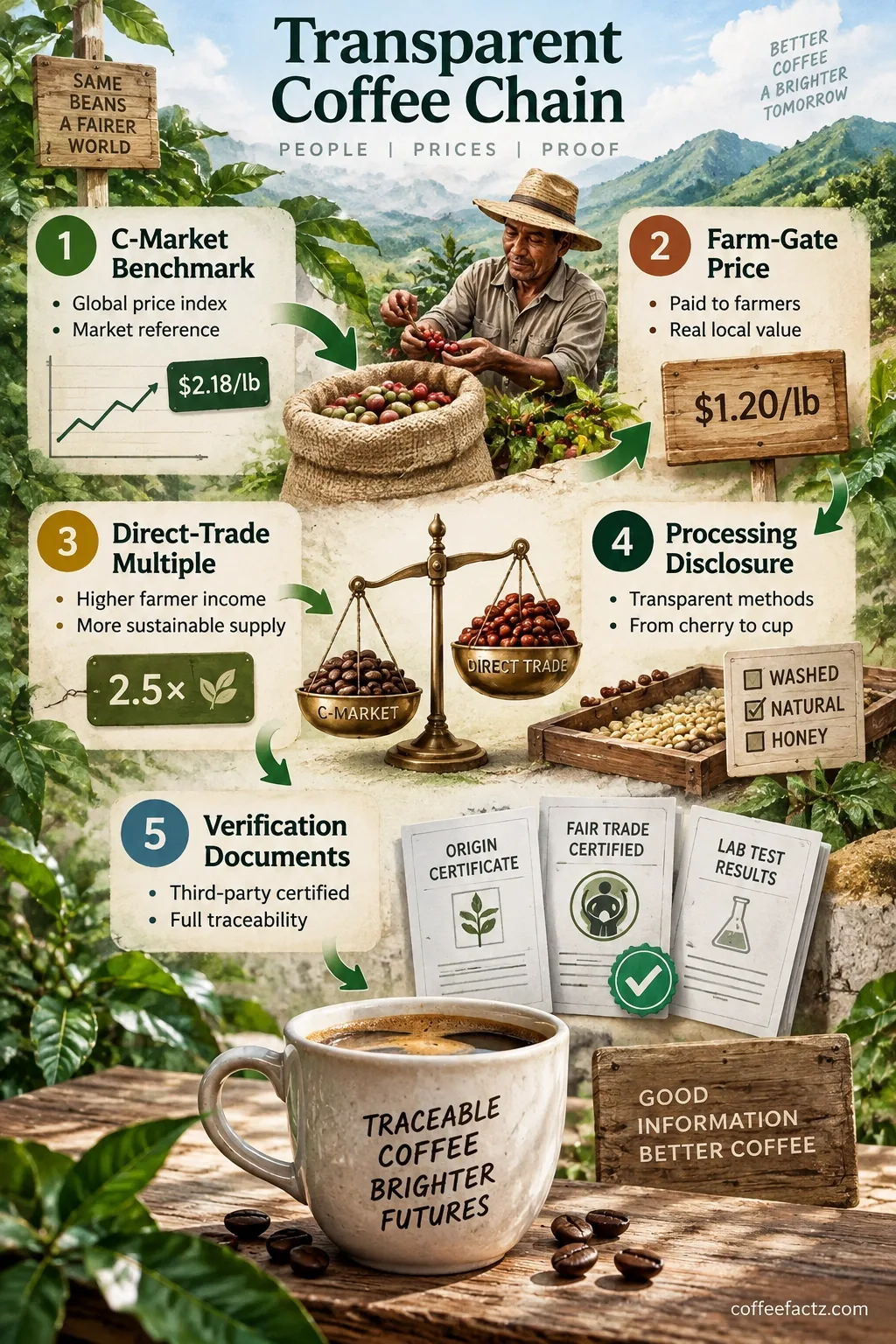
Here is the honest limitation: the price multiple is the headline. Verification is the fine print most sources skip entirely. No industry-wide standard governs what “direct trade” means. No third-party body audits the farm-gate price, labor conditions, or community outcomes the way Fair Trade certification does, however imperfectly. The roaster’s word is often the only evidence available.
Treat “2 to 3 times commodity” as a sourcing claim, not as proof of producer impact. When a supplier makes that claim, ask for the verification chain: What was the actual farm-gate price paid? What was the C-Market price on that date? Who verifies labor conditions? A roaster with genuine direct relationships can answer those questions. One using the term as marketing shorthand usually cannot.
The Price of Craft: Access, Elitism, and the Social Edge Case
Price and access are the part of the third wave conversation that most coffee blogs actively avoid. They should not be avoided here.
When you frame coffee through fine-wine and craft-beer analogs, you are implicitly describing a premium-priced product. That is accurate. Third wave coffee costs more than commodity coffee, and the cost drivers are real: quality premiums paid at origin, direct-trade pricing structures, small-lot logistics, and the skilled labor required to roast and brew to measurable standards. None of those costs are artificial.
The elitism critique is a legitimate social edge case, not a misunderstanding to be corrected away. A product whose quality floor requires a certified taster, whose supply chain requires direct relationships with specific farms, and whose brewing requires a refractometer and precise temperature control is structurally inaccessible to a large portion of the population, on both the consumer side and the producer side. That is worth naming plainly.
The biochemical argument from the roast chemistry section is the most honest response to the elitism charge. The light roast and the unflavored brew preserve volatile aromatic esters. The dark roast and the flavored drink chemically overwrite them. Those are not judgments about taste preferences. They are statements about what the compounds in the cup actually are. A person who prefers dark roast is not wrong. They are drinking a different product with a different chemical profile.
The craft model costs what it costs because the supply chain it requires costs what it costs. A $22 bag of single-origin Ethiopian natural process is not expensive because third wave culture decided to be exclusive. It is expensive because traceable, high-scoring lots from specific farms are scarce, the logistics of moving small lots from origin to roaster are complex, and the labor at every stage is skilled and paid accordingly. Understanding that cost structure does not resolve the access problem. But it prevents the conversation from being dishonest about where the price comes from.
The Working Professional’s Benchmarks: Third Wave FAQ
Professional benchmarks are what close the gap between understanding the philosophy and being able to apply it during a shift or explain it to a customer. These are the operational facts you need to have ready.
Roast Freshness and Package Label Data
Roast freshness is the most commonly misunderstood variable in the retail bag. Coffee is at its best within 21 days of the roast date. In the first few days after roasting, CO2 off-gassing from the bean is still active enough to interfere with extraction, which is why most roasters recommend a 5 to 7 day rest before brewing. After 21 days, oxidation accelerates and the volatile compounds that define the coffee’s character begin to degrade noticeably.
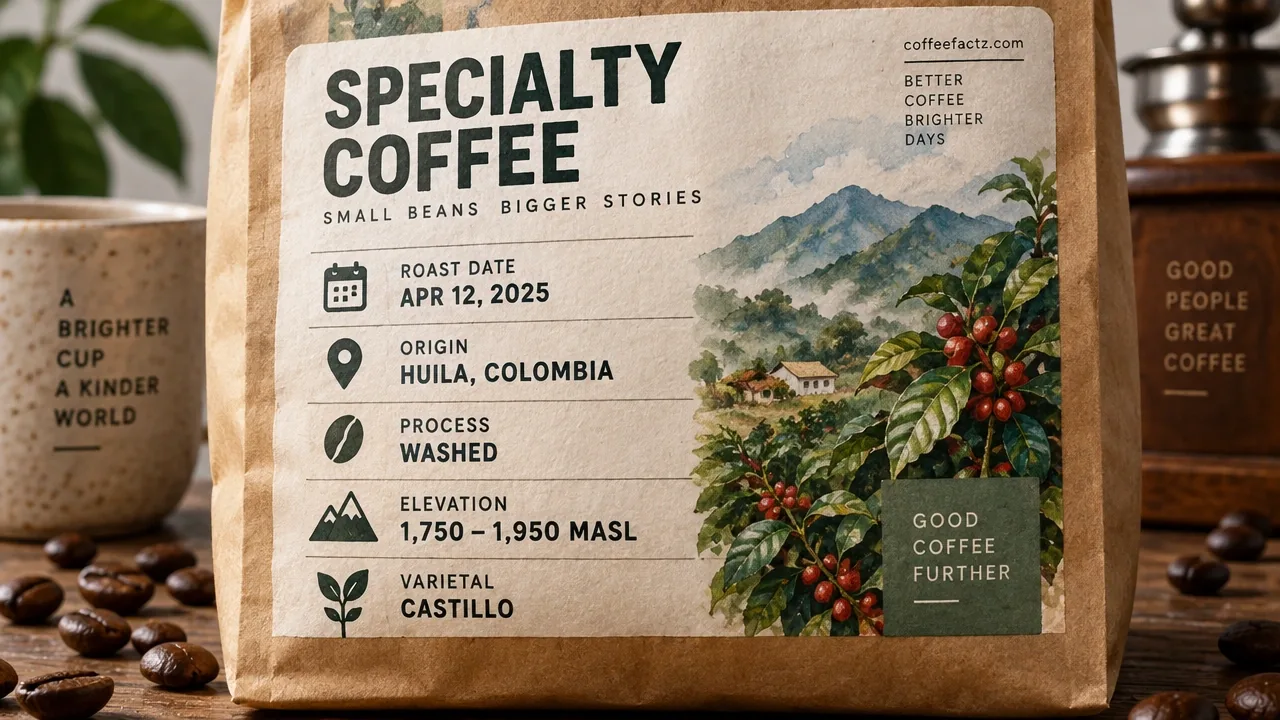
The roast date is the first thing to check on a bag. A “best by” date without a roast date tells you almost nothing useful, since roasters define their freshness windows differently. Look for the roast date itself.
Beyond freshness, a properly labeled specialty bag should carry four pieces of information: origin (country and ideally region or farm), process (washed, natural, honey, anaerobic, etc.), elevation (in meters above sea level, which correlates with bean density and flavor complexity), and varietal (Bourbon, Gesha, SL28, Typica, etc.). Those four data points are the minimum traceability standard. If a bag is missing two or more of them, the origin claim is incomplete.
Industry Certification and Historical Reference
The Specialty Coffee Association is the trade body that sets the technical standards the industry works from: cupping protocols, brewing benchmarks, green coffee grading, and professional certification programs for baristas and roasters. SCA certification is the credential that signals a professional has been trained to those measurable standards, not just to a shop’s internal preferences.
When a customer asks what the first wave of coffee was, the answer is straightforward: mass production, instant coffee, and shelf-stable commodity pricing. Folgers, Maxwell House, and Nescafé built a global market for coffee by solving a logistics problem. Flavor was not the priority. Availability and cost were. That context makes the third wave’s emphasis on measurable quality and traceable origin legible as a deliberate correction, not just a trend.
Why the Craft Model Matters: The Paradigm Shift Resolved
The craft model resolves into a single operating principle when you pull the three domains together: the wave values, the roast and extraction chemistry, and the sourcing ethics all act on the same brewed cup.
The value shift from ubiquity to experience to connoisseurship explains why third wave professionals ask different questions than first or second wave operators did. The chemistry explains why those questions produce different cups. Volatile aromatic esters versus pyrolytic ash is not a metaphor. It is the literal difference between a coffee that expresses its origin and one that expresses its roast. The sourcing ethics explain why the supply chain has to be structured differently to make origin expression possible in the first place: you cannot brew what the farm built if you do not know what the farm built, and you cannot know that without a direct, documented relationship.
The elitism tension dissolves when you trace it to cost structure and biochemistry rather than cultural preference. The price premium reflects real costs at every stage of a traceable, quality-controlled supply chain. The light roast and the unflavored brew are not taste gatekeeping. They are the only conditions under which the esters survive to the cup. A professional can explain both of those things without being defensive about either.
The operating principle for a working professional: judge coffee by traceable origin, roast intent, measurable extraction, and verified sourcing, not by label aesthetics or price point. A $14 bag with a roast date, a named farm, and a processing disclosure tells you more than a $30 bag with a glossy label and a country of origin.
Standards will keep moving. The SCA updates its benchmarks as research accumulates and the industry evolves. Track those updates rather than the slogans. The philosophy is stable. The specific numbers are a living document.
Frequently Asked Questions About Third Wave Coffee
What was the first wave of coffee?
The first wave was mass-market coffee built around availability and shelf life: vacuum packaging, instant crystals like Folgers, Maxwell House, and Nescafé, and dark commodity Robusta blends. Flavor consistency was not the goal. Getting coffee into every home at low cost was.
Is smoking allowed in Third Wave Coffee?
If you’re asking about a specific café called Third Wave Coffee, policies vary by location and local law. If you’re asking whether smoking fits the third wave philosophy, the answer is practical: smoke is an aroma contaminant that interferes with the sensory evaluation the entire model is built on.
How do I know if a coffee is genuinely specialty grade?
Look for an SCA cupping score of 80 or above, a roast date within the last 21 days, and label data that includes origin, process, elevation, and varietal. A bag missing two or more of those data points is not making a traceable origin claim.
What is the difference between direct trade and Fair Trade?
Fair Trade is a third-party certification with audited standards for minimum pricing and labor conditions. Direct trade is an unregulated term describing a direct relationship between a roaster and a farm, with no standardized verification. Both aim at better producer outcomes, but only Fair Trade involves independent auditing.
Why does third wave coffee often taste sour compared to dark roast?
Sourness in a light roast can mean two different things. The organic acids, malic, citric, phosphoric, that light roasting preserves are intentional and contribute brightness and complexity. Sourness from under-extraction is a brewing error, caused by too coarse a grind, too low a temperature, or too short a brew time. The refractometer tells you which problem you have.
What coffee trends are shaping the industry heading into 2026?
Experimental processing methods, particularly anaerobic fermentation and precision-controlled drying, continue to push flavor complexity at origin. Refractometry and data-logged roasting are becoming standard rather than specialty tools. The SCA’s evolving brewing standards reflect ongoing research into extraction variables that earlier benchmarks did not account for.
Who sets the technical standards for third wave coffee?
The Specialty Coffee Association sets the industry benchmarks: cupping protocols, green coffee grading scales, brewing control standards including the Gold Cup TDS and extraction yield targets, and professional certification for baristas and roasters. Those standards are the reference frame working professionals use to separate measurable quality from marketing claims.
Can espresso be third wave coffee?
Yes. Espresso brewed from a traceable single-origin light roast, pulled to a 1:2.5 to 1:3 ratio by weight, and measured for extraction yield fits the third wave model exactly. The brewing method is not the defining variable. The sourcing transparency, roast intent, and measurable extraction are.
References
- The Third Wave Coffee Question | trishrothgeb.substack.com
- Eric Faust of the Duluth Coffee Company | heavytable.com
- Effects of Postharvest Processing on Aroma Formation in Roasted Coffee: A Review | academic.oup.com