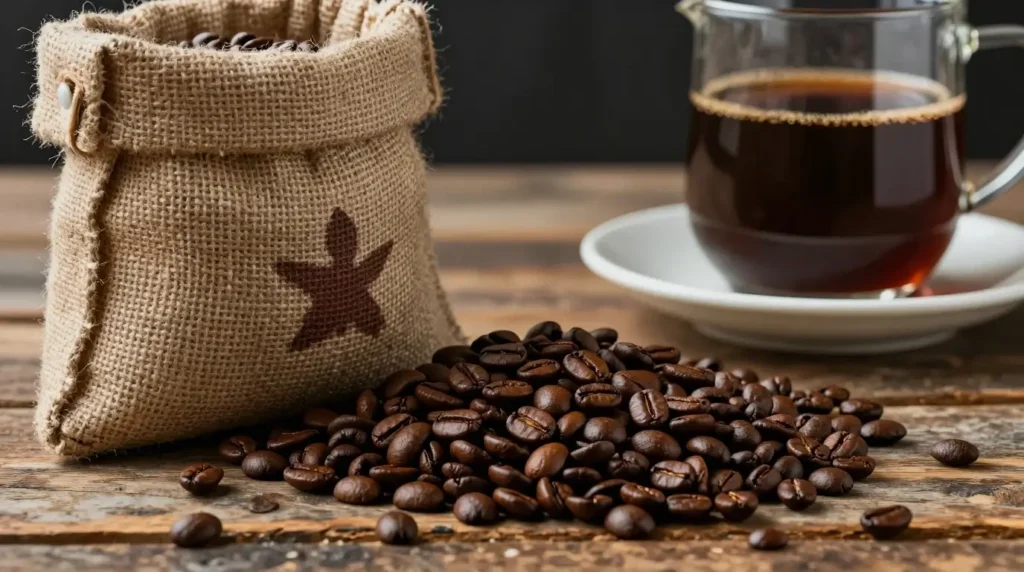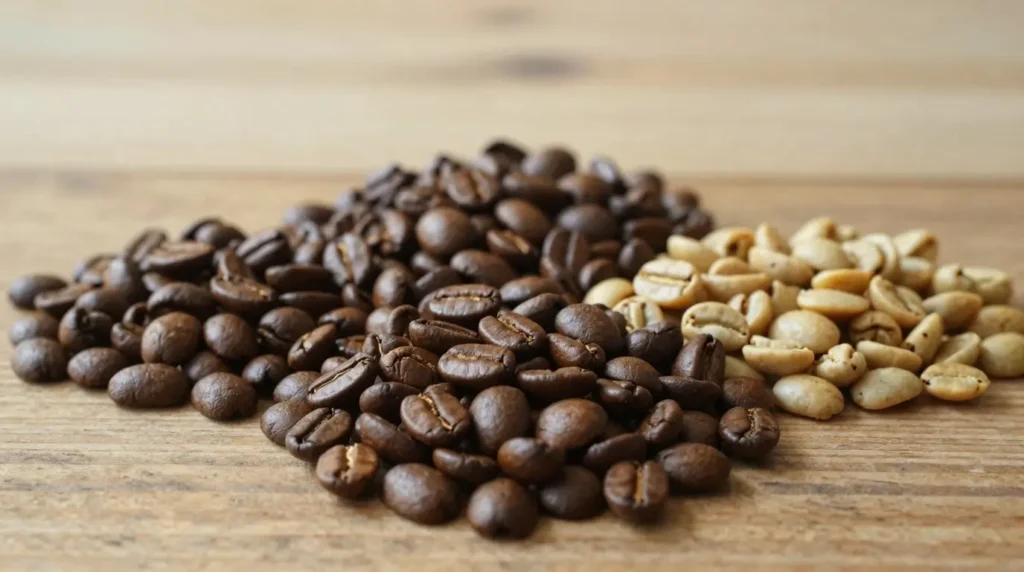
A side-by-side comparison of natural anaerobic coffee beans and chemically infused coffee, highlighting the difference between anaerobic coffee flavor vs artificial flavor.
Coffee Beans

Anaerobic vs. Infused Coffee: How to Spot the Real Flavor Difference

Coffee flavor reveals its true origin through three measurable scoring dimensions—acidity intensity, fruit-forward clarity, and mouthfeel smoothness—that separate fermentation-driven complexity from added compounds. Anaerobic fermentation builds layered, evolving profiles across all three dimensions, while artificial flavoring delivers single-note predictability. We use this rubric to give you a reliable, criteria-based method for identifying exactly what’s in your cup.

Anaerobic vs. Infused Coffee: How to Spot the Real Flavor Difference Read More »

A stylized 3D artistic rendering showing the brewing process of anaerobic coffee with sensory flavor profile icons.
Uncategorized

How to Brew Anaerobic Coffee: Cold-Bloom, Pulse-Pour, and Sensory Checkpoints for a Repeatable Cup

Anaerobic coffee demands a fundamentally different brewing approach because its sealed-fermentation process produces highly porous beans that release soluble acids and volatile compounds faster than any conventional roast. We control this accelerated extraction through a cold-bloom pre-infusion, a coarser grind size, low-temperature water, and a disciplined pulse-pour schedule that together preserve the process’s signature fruit aromas.

How to Brew Anaerobic Coffee: Cold-Bloom, Pulse-Pour, and Sensory Checkpoints for a Repeatable Cup Read More »

Hyper-realistic 3D magazine cover showing anaerobic coffee beans contrasted with traditional coffee beans, rendered with a hand-painted watercolor texture and bright studio lighting.
Coffee Beans

Anaerobic vs. Traditional Coffee Processing: What the Real Differences Mean for Your Cup

Coffee processing method determines every sensory outcome in your cup—acidity sharpness, body weight, and batch-to-batch stability—before brewing even begins. Anaerobic fermentation locks beans in oxygen-free tanks, concentrating lactic acids and syrupy body, while traditional aerobic methods produce cleaner, more predictable flavor profiles. We use five criteria—acidity, body, stability, extraction difficulty, and price premium—to show exactly where each method wins.

Anaerobic vs. Traditional Coffee Processing: What the Real Differences Mean for Your Cup Read More »

A professional infographic showing a coffee grind size chart for various brewing methods including espresso, pour-over, and French press.
Brewing

The Complete Coffee Grind Size Chart: Micron Ranges, Brewing Methods & Calibration for Every Brewer

A coffee grind size chart maps grind size categories — from extra-fine espresso particles at 100–300 microns to coarse French press grounds at 700–1,000 microns — directly to brewing methods through the surface-area principle. We use this micron-to-method relationship as a calibration baseline, but burr grinder uniformity and co-dominant brewing variables determine whether that baseline actually delivers repeatable extraction.

The Complete Coffee Grind Size Chart: Micron Ranges, Brewing Methods & Calibration for Every Brewer Read More »

Scroll to Top