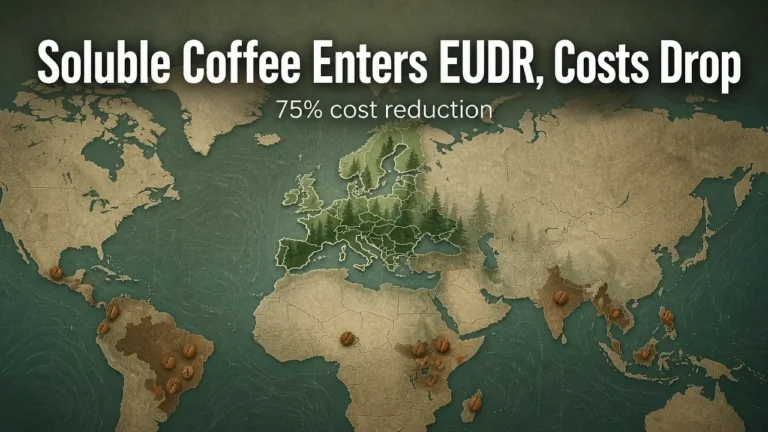

The European Commission has moved to expand the scope of the EU Deforestation Regulation (EUDR) to include soluble coffee while simultaneously cutting projected annual compliance costs for affected businesses by roughly 75% compared to the original regulation, according to a report published on 4 May 2026 in Brussels.
The Commission’s report and an accompanying draft Delegated Act propose adding soluble coffee — classified under customs code HS 2101 11 00 — to the list of products subject to EUDR due-diligence requirements. A Commission Staff Working Document accompanying the proposal estimates that soluble coffee is associated with a deforestation footprint of 1,865 hectares and emissions of 356,000 tonnes of CO₂ equivalent. The document values the environmental benefit of bringing soluble coffee into scope at €54.2 million, against a recurring compliance cost of €4.2 million.
The same package of measures removes leather and re-treaded tyres from the EUDR’s product scope and adds certain palm oil derivatives. New exemptions are introduced for product samples, waste, certain packing materials, and used and second-hand products. The Commission also confirmed plans to launch repositories of legislation from producing countries and certification schemes by the end of 2026, with the regulation’s full entry into application set for 30 December 2026.
Eileen Gordon-Laity, Secretary General of the European Coffee Federation, welcomed the soluble coffee addition. “Including soluble coffee in the scope would support fair and competitive conditions within the internal market and reinforce the Regulation’s environmental integrity,” she said. Gordon-Laity added that “aligning requirements across coffee categories is essential for both the effective implementation of the Regulation and for operators preparing for compliance ahead of the application date.”
The draft Delegated Act was open for public feedback until 1 June 2026, according to Comunicaffe International. The EUDR has been delayed twice since it was first introduced, and the 30 December 2026 application date represents the current confirmed deadline.
Industry readiness across the broader coffee sector has improved markedly in the lead-up to that deadline. FoodNavigator reported in April 2026, citing the International Coffee Organisation, that approximately 65% of coffee supply chains are now aligned with EUDR requirements — an increase of around 40 percentage points compared to the previous year — and that private-sector players have invested heavily in traceability systems, mapping, and data infrastructure.